
San Francisco County Jail #3
San Francisco County Jail #3
County Jail # 3
650-266-7500Arrested in San Francisco: finding someone in the Sheriff's jails
Police in the city, whether SFPD, BART or another agency, bring arrests to the Sheriff. The first stop is the San Francisco Intake and Release Center, 425 7th Street, San Francisco, CA 94103, behind the Hall of Justice. People who stay may live in County Jail #2 in the same building, or at County Jail #5, 1 Moreland Drive, San Bruno.
Put the name into the Sheriff's inmate search. It shows where someone is housed along with court information. Someone booked just now may not appear for some hours.
Need a person to tell you? Call 415-553-1430 on weekdays, or 415-553-1444 on nights and weekends. Ask which jail has your person. For getting out, read our San Francisco bail page, and for hearings see the San Francisco court page.
Read inmate search answers
 Read inmate search answers
1. Where are people held in San Francisco?
New arrests go through the Intake and Release Center. People who stay are housed in County Jail #2 in the same 7th Street building, or at County Jail #5 in San Bruno, 1 Moreland Drive, on county land south of the city. The old jail on the upper floors of the Hall of Justice at 850 Bryant Street closed in 2021.
↑ Back to the question list2. SF inmate locator
San Francisco County Inmate Search gives location and court information. Jail information answers 415-553-1430 during weekday office hours and 415-553-1444 at other times.
↑ Back to the question list3. Arraignment at the Hall of Justice
Jailed defendants appear within two court days at the Hall of Justice, 850 Bryant Street. The criminal clerk is in Room 101 (415-551-0651). Read San Francisco court steps.
Inmates go to the Hall of Justice courtrooms in person or join by video when the court sets that up, so a CourtCall slot is something each party reserves on their own. Someone who is a party in a related family, probate or civil matter can sign up on CourtCall with the judge's okay.
↑ Back to the question list4. Bail and pretrial release in SF
San Francisco relies heavily on pretrial release. Many people are released on own recognizance or with pretrial supervision after a judge's review, without paying money. Where bail is set, it can be posted with the Superior Court bond desk (415-551-0691) or the jail, or by a licensed agent. The SF case that led to the Humphrey ruling started here, so a defendant's finances are part of every bail decision. See the San Francisco bail guide.
↑ Back to the question list5. San Francisco Public Defender
The Public Defender, 555 Seventh Street (415-553-1671), defends San Franciscans without money for counsel and often meets clients before arraignment.
↑ Back to the question list6. Visiting SF jails
Visits are booked ahead and need photo ID; the San Bruno jail has its own schedule. See SF visiting and video visits.
↑ Back to the question list7. Mail and money in San Francisco
Use the person's name and booking number and the address of their housing facility. Topics: SF jail mail, account money, commissary, free jail phone calls, messages, tablets. San Francisco made jail phone calls free for people in custody in 2020.
↑ Back to the question list8. Juvenile hall
Juvenile Probation runs the Juvenile Justice Center, 375 Woodside Avenue (415-753-7800).
↑ Back to the question list9. San Francisco bail scams
A real deputy won't call you to demand a wire or gift card. To check, phone jail information at 415-553-1430 during business hours or 415-553-1444 after hours, and ask about the person's status.
↑ Back to the question list10. Who handles federal cases from San Francisco County?
It usually begins when the ATF, the Postal Inspection Service and the IRS make an arrest. Federal cases from this area belong to the Northern District of California, which meets in San Francisco: 450 Golden Gate Avenue, San Francisco, CA 94102. For filings and dates, phone the clerk at 415-522-2000. The judge gets a background report from pretrial services. The first hearing happens fast with a magistrate judge. Federal judges, unlike state judges, won't search for a bail amount. A bail hearing under federal bail law decides release or detention.
Until the case ends, the Marshals Service usually keeps the person in local jails by contract. Check the county inmate list first; there U.S. Marshals custody might appear. You can also call the federal Marshals Service for the Northern District of California in San Francisco at 415-436-7677 (450 Golden Gate Avenue, 20th Floor, San Francisco, CA 94102). A federal prison sentence means a move into the federal Bureau of Prisons (BOP) in time. The federal inmate locator lists their prison.
↑ Back to the question list11. ICE hold: what to expect
- Booking prints get compared through federal systems that ICE uses. ICE can then place a detainer.
- Paying bond does not clear this hold.
- Through a detainer, ICE requests that San Francisco jailers keep the person on ICE's behalf up to 48 hours after they would otherwise be released (8 CFR 287.7(d)). San Francisco's jails apply the California Values Act (SB 54) and the city's own sanctuary ordinance, which is stricter still: release follows the local case, and ICE notice or transfer is limited to a judicial warrant or a narrow set of serious convictions.
- Immigration officers can take custody at the San Francisco jail within that window. If ICE never collects them, this means they're released.
- ICE manages detainers here from the San Francisco field office: 630 Sansome Street, Room 590, San Francisco, CA 94111; call 415-365-8800.
- The detainee locator looks up people with the alien number (A-number) and home country. If you don't have the alien number (A-number), fill in DOB, native country, and the exact name.
- The last stop is ICE's call and can change.
12. Going to state prison from San Francisco? Here is the process
California's prison system, the CDCR, holds anyone sentenced to state time. Until then, they wait in the San Francisco jail until the CDCR has a bed ready. The trip ends at intake, where they are held processed. Workers there classify everyone by known gang ties, custody score, and health care needs. Their final step is a facility that fits their rating.
Try the CDCR inmate locator to see where they are. For visits and mail, open California state prisons.
↑ Back to the question list13. Does the San Francisco jail post mugshots online?
Check the San Francisco jail search for the person; San Francisco may not post mugshots there.
Section 13665 sets the state rule. It covers social media posts. Nonviolent arrests are the main target. Sheriffs and police can't share them there. Photos posted there expire after 14 days. Fugitives and threats are the exceptions. Jail websites are outside this law. Most sheriffs in California skip photos anyway.
The sheriff's office, 415-554-7225, handles media requests for booking photos that aren't online. ICE photos are released only via ICE's online FOIA request, if ICE agrees. Federal booking photos are kept private. Requests from families or reporters will not unlock it; the Marshals share one only for an inmate who escaped or fugitive, when posting it helps find them or caution nearby residents, or for urgent public safety.
↑ Back to the question list14. Which agency arrested them in San Francisco?
- San Francisco Police non-emergency: 415-553-0123
- San Francisco Sheriff's Office: 415-554-7225
BART Police, CHP and campus police also make arrests in the city.
↑ Back to the question list15. Does a warrant arrest in the Mission or Tenderloin go through 7th Street?
Yes. Every city arrest, warrant or otherwise, is processed at the Intake and Release Center behind the Hall of Justice, so families often come to the same block twice. Ask the Sheriff's Office about warrants at 415-554-7225; deputies check names over the phone, statewide records too. The court's online case query shows open criminal cases. Those held usually appear at 850 Bryant by the second weekday. If you have a warrant, hire counsel to arrange surrender, or phone the criminal clerk about a new date.
↑ Back to the question listSan Francisco contacts
- Roster: San Francisco County Inmate Search
- Intake and Release: 425 7th Street
- Jail information: 415-553-1430
- Court bond desk: 415-551-0691
- Public defender: 415-553-1671
Ask whether the person is in San Bruno before you travel.
San Francisco bail and bond: Sheriff jails, the court Bond Desk, and the Hall of Justice
Because the city and county are one, every adult arrest ends up in a Sheriff's jail. The booking point is the Intake and Release Centerat 425 7th Street, San Francisco, CA 94103. County Jail #2 shares that building, and County Jail #5 is out in San Bruno. This page explains where bail is paid, why a paid person can stay inside, and how judges decide.
Enter a full name in the Sheriff's inmate search and it points to the jail housing that person. Our San Francisco Jail Roster page also lists new arrests, warrants, charges and who defends people for free.
If the screen stays blank, call 415-553-1430 on weekdays from 8 a.m. to 5 p.m., or 415-553-1444 any other time. Ask which jail has your person and whether bail is set. After that, our San Francisco court page shows where the first hearing is.
1. How do I learn which county jail holds my brother?
Run his name through San Francisco County Inmate Search. A booking number makes the search faster. If the screen stays empty, phone the Sheriff's Intake and Release Center at 415-553-1430 on weekdays from 8 a.m. to 5 p.m., or 415-553-1444 nights, weekends, and holidays. Keep his exact legal name and birth date handy for the deputy. New bookings at 425 Seventh Street often post hours after the arrest; search again before dinner.
↑ Back to the question list2. Where are the county jails?
The Intake and Release Center, where people are booked, and County Jail #2 share 425 7th Street, South of Market. The Sheriff says County Jail #2 is the only San Francisco jail that houses women; its own line is 415-554-7225 on weekdays. The jail floors inside the Hall of Justice at 850 Bryant Street closed in 2020, so nobody is housed there now. Jail #5 is at 1 Moreland Drive in San Bruno, in San Mateo County. Most inmate questions begin with 415-553-1430.
↑ Back to the question list3. Where do I pay cash bail, and when?
Weekday cash bail goes to the Criminal Clerk's office, Room 101, Hall of Justice, 850 Bryant Street. Evenings, weekends, and holidays, take it to the property window at 425 7th Street. A law-firm guide, not the Sheriff, describes that window. Cash must cover the whole bail. Because windows move, confirm with the Bond Desk at 415-551-0691 before you leave home.
↑ Back to the question list4. Can I use a check, money order, or credit card?
Cashier's checks and money orders must be for the full amount and made out to the San Francisco Superior Court, with his name and booking number on them. Cards are taken through the court's online card system only for misdemeanor arrests, and you need his jail number and case number. No personal checks. The Bond Desk, 415-551-0691, settles any doubt.
↑ Back to the question list5. I paid. Why is he still inside?
Payment alone does not open the door. Take the bail receipt to the jail: the 425 7th Street building for anyone held there, and the jail information line can say where to go for anyone held in San Bruno. Staff also run a warrant check, so another case can keep him. Check San Francisco County Inmate Search to see whether he is still listed, then call 415-553-1430.
↑ Back to the question list6. What are some bail amounts in San Francisco?
The court's schedule that took effect July 1, 2025 listed: murder, no bail until a judge sets it; assault with a deadly weapon, $75,000; first-degree burglary, $75,000; second-degree burglary, $25,000; felony domestic violence, $50,000, or $100,000 with a prior; misdemeanor drunk driving, $5,000. A newer schedule started July 1, 2026, so check it for today's figures.
↑ Back to the question list7. What if the charge is not on the schedule?
The 2025 schedule sets $15,000 for an unscheduled felony, $3,000 for an unscheduled misdemeanor, and $100 for an unscheduled infraction. Attempts carry the same bail as the full crime. When one act produces several charges, bail follows the highest. Separate incidents add up, and each victim counts. A judge can still choose a different figure.
↑ Back to the question list8. Can a judge set bail he cannot afford?
Not as a way to keep him locked up. The court's own fact sheet explains that In re Humphrey (2021) requires judges to weigh ability to pay and to consider monitoring, check-ins, housing, or treatment first. Detention needs clear and convincing evidence that nothing less will protect the public. In April 2026 the Supreme Court's In re Kowalczyk decision (case S277910) held that a judge must consider free release terms first, and any cash amount has to be within the person’s reach. Penal Code 859b can also require release after 10 court days if the prosecution is not ready to show probable cause. A defense lawyer raises these points.
↑ Back to the question list9. When does the judge hear the case first?
Penal Code 825 gives the jail 48 hours from arrest to bring him to court, with Sundays and court holidays skipped. The arraignment is the first appearance: charges are explained, a free lawyer is appointed if he cannot afford one, and a plea is entered. Check the daily calendar on the monitor outside Room 101, or call the clerk at 415-551-0651.
↑ Back to the question list10. Which courthouse is it?
Mostly the Hall of Justice, 850 Bryant Street. The Civic Center Courthouse at 400 McAllister Street and the Community Justice Center at 575 Polk Street also take cases. The Hall of Justice criminal desk, 415-551-0651, can tell you the department. San Francisco has just the Superior Court for criminal matters.
↑ Back to the question list11. Can we offer a house instead of cash?
Possibly, but the court's public pages do not lay out its property bond steps. Phone the Bond Desk, 415-551-0691, before you gather deeds. Ask how much equity is required, whether property outside San Francisco counts, and how long approval takes. The Sheriff will not release anyone until the court approves it.
↑ Back to the question list12. How much will a San Francisco bondsman charge?
California insurance regulators report a usual fee of ten percent of the bail amount, and some San Francisco agents ask for less. That fee is how you buy the bond, so plan on losing it. Get the agreement, the collateral rules, and the penalty for a skipped court date on paper before signing. Check the agent's license first.
↑ Back to the question list13. His San Francisco listing shows “no bail.” Why?
Article I, section 12 of California’s constitution lets a San Francisco judge keep someone in with no bail if the charge could carry death. That power reaches violent crimes, sexual assaults, and felony threats of grave harm too, when the proof is strong and freeing him would put people at risk. Under the 2025 schedule, a murder charge carries no set amount until a judge decides one. A hold from another county or from parole also stops release.
↑ Back to the question list14. If we can’t afford an attorney, who defends him in San Francisco?
At the first hearing, the judge assigns the elected Public Defender, or a lawyer from the court’s conflict list if that office can’t take him. The Public Defender is at 555 Seventh Street and answers at 415-553-1671. Its Juvenile Division is 415-753-7600. The court also lists a pretrial diversion program, Project 20, at 415-626-4995.
↑ Back to the question list15. My niece is 16 and in custody. Where is she?
The Juvenile Probation Department runs the San Francisco Juvenile Justice Center, a secure residential facility for young people, at 375 Woodside Avenue. Probation answers at 415-753-7800. Youth cases are heard at that campus, open weekdays 8:00 a.m. to 5:00 p.m. Youth cases are kept confidential, and a teenager won’t appear in the adult jail search. Parents should phone that line first, then ask when her detention hearing is set.
↑ Back to the question list16. What happens if he misses a hearing?
Bail can be forfeited. Penal Code 1305 gives 180 days to return him to court, with five more days added for mailing notice on bonds over $400. The court also posts a monthly list of bail bonds filed in the Criminal Division. Call the clerk at 415-551-0651 and a lawyer immediately.
↑ Back to the question list17. San Francisco started the Humphrey case. What changed in 2026?
Humphrey began in San Francisco and led to the 2021 rule that judges must consider ability to pay. In April 2026 the state Supreme Court added, in Kowalczyk, that bail must generally be within reach. A judge at 850 Bryant seeking to keep a person locked up has to meet the no-bail test instead of choosing a huge amount.
↑ Back to the question list18. Where are San Francisco's criminal courts?
San Francisco hears adult criminal cases at the Hall of Justice on Bryant Street; other courts handle civil and youth cases:
- Hall of justice (criminal): 850 Bryant Street, San Francisco, CA 94103 · 415-551-0651
- Civic center courthouse: 400 McAllister Street, San Francisco, CA 94102 · 415-551-4000
- Polk Street annex: 575 Polk Street, San Francisco, CA 94102 · 415-551-4000
- Juvenile justice center: 375 Woodside Avenue, San Francisco, CA 94127 · 415-753-7800
19. What happens after a federal arrest in San Francisco?
The Northern District of California is headquartered on Golden Gate Avenue. County bail plays no role:
- A magistrate judge at San Francisco federal courthouse, 450 Golden Gate Avenue, San Francisco, CA 94102 hears the first appearance.
- Pretrial Services interviews him.
- Release or detention follows; a delay of three days (prosecutor) or five (defense) is possible.
- Detained people go to Marshals contract jails around the Bay.
Marshals: U.S. Marshals Service, 450 Golden Gate Avenue, 20th floor, San Francisco, 415-436-7677.
↑ Back to the question list20. Can ICE hold someone at the San Francisco jail after bail?
State law SB 54 and the city's own sanctuary rules both keep the Sheriff from holding people for ICE. Release timing can reach ICE only in narrow cases involving a serious or violent conviction. A TRUTH Act notice is required before ICE questions anyone.
San Francisco ICE field office, 630 Sansome Street, Room 590, San Francisco, CA 94111, 415-365-8800 is based in San Francisco. Detainees go to:
- Mesa Verde ICE Processing Center: 425 Golden State Avenue, Bakersfield, CA 93301
- Golden State Annex: 611 Frontage Road, McFarland, CA 93250
- California City detention site: 22844 Virginia Boulevard, California City, CA 93505
21. Which websites help after a San Francisco arrest?
- San Francisco County Inmate Search: name search; booking, bail and court date.
- VINELink (https://vinelink.vineapps.com/): California; facility.
- Federal Bureau of Prisons Inmate Locator (https://www.bop.gov/inmateloc/): register number or name; pretrial: 415-436-7677.
- CDCR Inmate Locator (https://inmatelocator.cdcr.ca.gov/): CDCR number or name.
- ICE Online Detainee Locator System (https://locator.ice.gov/odls/): A-number or name and country of birth; else 415-365-8800.
22. How do we confirm bail at the Hall of Justice?
Call the San Francisco criminal court at 415-551-0651. Ask whether a judge set bail or ordered release with terms.
↑ Back to the question listSan Francisco bond contacts
- County jails: San Francisco County jails: Intake and Release Center and Jail #2, 425 7th Street, San Francisco 94103; Jail #5, 1 Moreland Drive, San Bruno 94066
- Jail information: 415-553-1430 weekdays 8 a.m. to 5 p.m.; 415-553-1444 all other times
- Custody lookup: San Francisco County Inmate Search
- Bond Desk: Superior Court, 415-551-0691
- Criminal Clerk: Hall of Justice, Room 101, 850 Bryant Street; 415-551-0651
- Other courthouses: Civic Center Courthouse, 400 McAllister Street; Community Justice Center, 575 Polk Street
- Bail schedule: Superior Court fee and bail schedules
- Public Defender: 555 Seventh Street, San Francisco 94103; 415-553-1671
- Juvenile: Juvenile Justice Center (Juvenile Probation), 375 Woodside Avenue, San Francisco 94127; 415-753-7800
Bail windows, accepted payments, and schedules change, so confirm with the Bond Desk before you bring money. Judges may set any amount. Rules at the Bryant Street and County Jail 2 desks can change; this summary isn’t legal advice.
How to visit at San Francisco County Jail #3
County Jail #3 is in San Bruno. The Sheriff offers a free on-demand Flywheel ride from 598 Geneva Avenue, replacing the old shuttle. Call 855-359-2420 or use Flywheel; the gate deputy handles the voucher.
Book the in-person visit
- Use the Sheriff’s custody lookup to confirm the jail and get the person’s SF number (SFNO). Do not book under the other jail just because a convenient time appears.
- Register for a visitor account at ViaPath’s in-person reservation portal. The day before your visit, sign in between 9 a.m. and midnight Pacific time. Select the jail, choose an offered time and include every visitor when reserving. The portal allows no more than two adults.
- Arrive at the main gate, 1 Moreland Drive, San Bruno, CA 94066 at least 30 minutes early. Bring government-issued photo ID and keys. The Sheriff also allows money to be secured with your items in the visiting locker. Leave phones, cameras and bags outside. Do not bring weapons, illegal drugs or contraband anywhere on jail property, including in parked vehicles.
Published in-person hours
The Sheriff’s 2026 schedule lists Saturdays, Sundays and holidays, 7:30 a.m.–2 p.m. Pacific time, for all pods. The portal’s public banner lists only Sunday and holidays for this jail. Treat the offered reservation as final, and do not travel without confirmation. No regular weekday hours are confirmed. The Sheriff posts health screening and mask requirements; review them before leaving. Children generally need a parent or legal guardian; special parent-child contact and unaccompanied 16- or 17-year-old visits require separate approval.
Family video is scheduled separately
The Sheriff offers limited family video visits on a rotating schedule arranged internally with the person in custody. The ViaPath public in-person reservation is not the way to book it. Ask the person to check their housing unit’s process; join the confirmed video session five minutes early. Minors must be registered under a confirmed adult visitor and accompanied by that adult. Public fees and household booking slots are not listed. For help, call 415-553-1430.
Attorney and approved professional visits
Use the Sheriff’s legal video request page to submit the advance request; wait for a confirmation email. Urgent same-day requests are subject to staffing and available slots. For a limited in-person confidential visit through a partition, call the jail front desk at 650-266-7500 to check room availability, client consent and any current screening or credential requirements.


ConnectNetwork Video Visitation (powered by GTL and ViaPath Technologies) allows friends and family members to schedule and conduct live, face-to-face video visits with incarcerated loved ones from home. Using an internet-connected smartphone, tablet, or PC equipped with a webcam, visitors connect directly through housing-unit video stations or assigned tablets, eliminating the need to travel to the correctional facility.
Important: Advance Registration and Visitor Clearance Required
Detention centers do not permit unscheduled or unverified video sessions. Correctional facilities require prospective visitors to submit government-issued photo identification and receive administrative clearance before booking an appointment, an approval process that can take up to 48 hours depending on facility staffing. You should verify your visitor approval status with the facility prior to scheduling. If you do not register well in advance, you will miss your loved one's scheduled visiting window for the week.
Step-by-Step Instructions to Register and Schedule a Video Visit
- Visit web.connectnetwork.com or download the ConnectNetwork mobile application.
- Register your account and upload a clear photograph of your valid government ID for institutional review.
- Search for your facility by state and agency name, then link your loved one using their legal name or booking ID.
- Wait for email notification confirming that facility administration has approved your visitor status.
- Select Video Visits, view the facility's open calendar schedule, and select an available time slot.
- Pay any required session fees using a debit or credit card and save your appointment confirmation.
- Log into the portal 10 to 15 minutes before your scheduled start time with a working camera, microphone, and stable high-speed internet connection.
What the Inmate Needs to Do
The inmate receives an on-screen prompt on their pod kiosk terminal or handheld tablet alerting them to the upcoming visit. At the scheduled time, they log into the terminal with their assigned PIN, position themselves in front of the screen, and conduct the session. Visitors and inmates must follow all facility dress codes and behavior rules; sessions are monitored and will be disconnected immediately if rules are broken.
Official Providers: ConnectNetwork Portal | myViaPath
Customer Service Telephone: 1-877-650-4249
Support Hours: Monday – Friday, 7:00 AM – 11:00 PM CST; Saturday – Sunday, 8:00 AM – 7:00 PM CST
Supported Languages: English and Spanish
Other Services Provided by ConnectNetwork / ViaPath
In addition to Video Visitation, ConnectNetwork and ViaPath operate several financial and communication tools:
- Inmate Messaging: Send electronic messages and photos directly to an inmate's tablet or kiosk.
• Learn more on our website: Digital Messaging Guide | • Visit official vendor page: ConnectNetwork Messaging - Inmate Tablets: Discover educational programs, phone access, and entertainment offered on facility tablets.
• Learn more on our website: Tablet Programs Guide | • Visit official vendor page: ViaPath Tablet Programs - AdvancePay Phone Calling: Prepay for phone calling credits so your loved one can call your mobile device directly.
• Learn more on our website: AdvancePay Phone Guide | • Visit official vendor page: ConnectNetwork Phone Services - Online Bail Payments: Post court appearance bonds securely online to avoid in-person lobby visits.
• Learn more on our website: Bail & Bond Guide | • Visit official vendor page: TouchPay Bail Services
From Arrest to Verdict: San Francisco’s Criminal Courts
One court handles every adult criminal case in the city: the Superior Court of California, County of San Francisco. Nearly all of them are heard at the Hall of Justice, 850 Bryant Street, San Francisco, CA 94103, where the criminal clerk answers at 415-551-0651. Two other buildings, on McAllister and Polk Streets, take a few cases. Read on to see who goes where and how a case moves.
Has your person been moved or released? Use the Sheriff's inmate search, which gives location and court details. Our San Francisco Recent Arrests page also leads to warrants, charges, mugshots and free lawyers.
Fastest of all: ring the criminal clerk in Room 101 at 415-551-0651. Ask which department holds the case and the date it returns. To work on release money, read our San Francisco bail page.
1. Lesser SF charges (retail theft, first DUI, battery, trespass)
Because San Francisco is a combined city and county, one court handles every adult criminal case filed within its 47 square miles, from a shoplifting citation in Union Square to a homicide in the Bayview. That court is the Superior Court of California, County of San Francisco. When California unified its trial courts around 2000, the old municipal court disappeared, which is why no separate “city court” for crimes exists here. Nearly all criminal business takes place at the Hall of Justice, 850 Bryant Street, San Francisco, CA 94103, between Sixth and Seventh Streets in SoMa. The Criminal Clerk’s Office is in Room 101 and answers general questions, filings and records requests at (415) 551-0651. The court’s administrative headquarters at the Civic Center Courthouse can be reached at (415) 551-4000. A few criminal matters are heard elsewhere:
- Hall of Justice, 850 Bryant Street, San Francisco, CA 94103: arraignments, the master calendar (Department 22), preliminary hearings and most misdemeanor and felony trials. Criminal clerk: (415) 551-0651
- Civic Center Courthouse, 400 McAllister Street, San Francisco, CA 94102: some criminal calendars and trials. Main line: (415) 551-4000
- Community Justice Center, 575 Polk Street, San Francisco, CA 94102: a collaborative court serving the Tenderloin, Civic Center and nearby neighborhoods, which pairs cases with treatment, housing and social services
If you are unsure which department a case is in, the daily calendar is posted on the monitor outside Room 101, or you can call the clerk. Choose the San Francisco charge group below to see the usual steps.
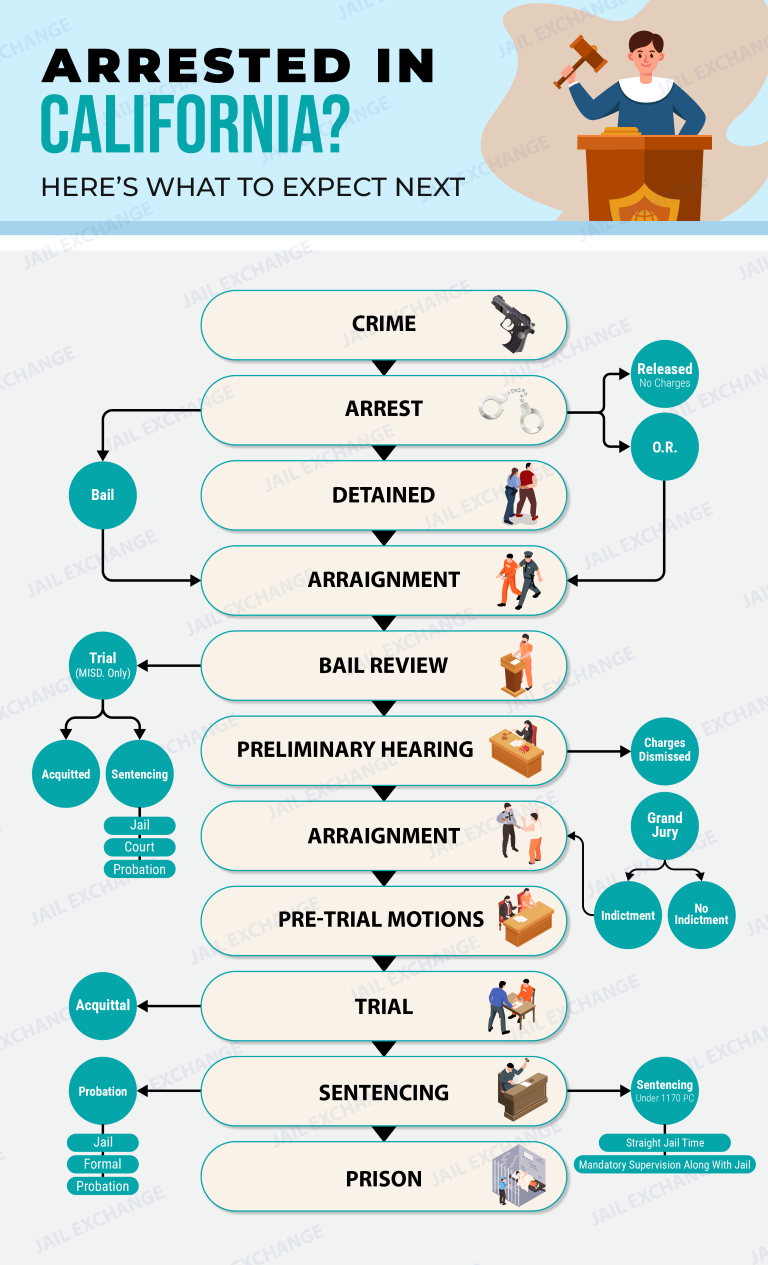
With one government running both city and county, the elected District Attorney files all San Francisco misdemeanors; there is no separate city attorney criminal unit. For lower-level offenses, SFPD commonly cites and releases, with the paperwork naming a date at 850 Bryant. When someone is instead booked into the Sheriff’s custody, state law gives the jail 48 hours, skipping Sundays and holidays, to bring the person before a judge.
That first appearance, the arraignment, is where the charges are formally read and a plea is entered, usually “not guilty” for now. The judge also decides on release terms. A defendant facing possible jail who can’t pay an attorney gets the San Francisco Public Defender, which is unusual in being the only elected public defender’s office in California. That lawyer is assigned by the first hearing, and the state stopped billing people for appointed defense years ago. On many small charges, the attorney can appear in court without the client present.
Pretrial conferences settle most SF misdemeanors through a plea, a downgrade, or dropped charges. Diversion is another path a judge may allow: misdemeanor diversion: if the person finishes counseling, classes or other conditions, the charge is dropped. DUI, domestic violence and offenses that require sex-offender registration are not eligible for diversion. Some Tenderloin and Civic Center cases are routed to the Community Justice Center on Polk Street, where a judge supervises treatment and services instead of a traditional prosecution track. A case that does not resolve is tried to a jury of 12, and a defendant has the right to start trial within 30 days of arraignment if in custody, or 45 days if released, although lawyers often waive that deadline to prepare.
The common ceiling for an SF misdemeanor is six months locked up and a $1,000 fine, with some offenses reaching a year. Sentences more often involve probation, fines, classes or community service. A ticket case often closes in one to several months.
↑ Back to the question list2. San Francisco felonies: break-ins, big thefts, drug dealing, injury DUIs
San Francisco felonies start with a complaint from prosecutors, and the defendant is brought to a courtroom at the Hall of Justice for arraignment within 48 hours of arrest. Release, bail and any protective orders are addressed at that hearing. Under the California Supreme Court’s 2021 ruling in In re Humphrey, a judge who sets bail must take into account whether the person is able to pay it, and release with conditions is often considered as an alternative to money bail. Humphrey started in San Francisco, and in 2026 the court added in Kowalczyk that bail set at 850 Bryant must also be within the defendant’s means.
Defendants who can’t pay get the elected Public Defender from day one. If a conflict blocks that office, for example a co-defendant it already speaks for, a San Francisco judge appoints a lawyer from a panel of private attorneys instead.
Next comes a preliminary hearing, usually inside 10 court days unless the defense agrees to push it, where a judge weighs if the proof is enough for trial. Prosecutors may bypass that step by presenting the case to the county grand jury for an indictment, though that route is uncommon. If the judge sends the case on, prosecutors file an “information” listing the charges, he answers them at a second arraignment, and the 60-day countdown to trial begins unless his lawyer gives it up. Giving up that deadline is common, and the large majority of these cases settle by plea deal, negotiated through the master calendar in Department 22 or the trial departments.
After a guilty verdict or plea, San Francisco Adult Probation prepares a report, and the judge generally imposes sentence within 20 court days of a verdict. Since 2011, many lower felony terms are spent in the county jail on Bryant Street or in San Bruno instead of a state prison. A “wobbler” crime may be filed as a felony or a misdemeanor, and a judge can sometimes lower it afterward. Expect a San Francisco felony to last many months, and sometimes longer than a year.
↑ Back to the question list3. San Francisco’s gravest cases: homicide, rape, robbery with a weapon
Nothing about the basic sequence changes for the gravest charges: arraignment, a preliminary hearing or indictment, and then trial. The differences are in custody, length and exposure. Under the state constitution, denial of bail is allowed in SF for felonies of violence or sexual assault when clear and convincing proof points to a real chance that freeing him would get someone badly hurt. That is why many of these defendants remain in Sheriff’s jail for the whole case.
Under the Three Strikes law, every one of these crimes counts as a strike. One past strike doubles the term, and two past strikes can bring 25 years to life. A violent felony conviction means serving 85% of the prison term at minimum.
- Murder: a conviction for second-degree murder carries 15 years to life, and one for first-degree murder carries 25 years to life. A “special circumstances” finding, like a murder tied to a robbery or rape, raises the punishment to death or life without any chance of release. Only the elected DA in SF can ask for a death sentence, and the governor’s 2019 order has stopped every execution statewide.
- Armed robbery: nine years is the most for the base SF robbery charge. Gun add-ons pile on 10 years, 20 years, or 25 years to life, for using a firearm, firing it, or wounding someone with it. Judges have had the power to drop those add-ons since 2018.
- Rape: as many as eight years, extra if aggravating facts are proven, and registration for life on the top sex-offender tier.
The Public Defender staffs these cases with its most seasoned trial attorneys, and whenever prosecutors seek the death penalty, two qualified defense lawyers must be appointed. Victims hold constitutional rights under Marsy’s Law, including notice of each SF court date, a voice at sentencing, and restitution, with support available through the District Attorney’s victim services unit. Lab work, investigators and expert testimony often keep SF cases open one to three years, while murder trials can take five or longer.
↑ Back to the question list4. San Francisco Superior Court locations
- Hall of justice (criminal): 850 Bryant Street, San Francisco, CA 94103 · 415-551-0651
- Civic center courthouse: 400 McAllister Street, San Francisco, CA 94102 · 415-551-4000
- Polk Street annex: 575 Polk Street, San Francisco, CA 94102 · 415-551-4000
- Juvenile justice center: 375 Woodside Avenue, San Francisco, CA 94127 · 415-753-7800
Here is what each building is used for:
- 850 Bryant Street holds nearly every adult criminal hearing in the city, from first arraignments to jury trials, and the county jail sits in the same block.
- The McAllister and Polk Street buildings near City Hall mainly hear civil, family and probate matters, so a criminal date there is rare.
- Youth cases go to the juvenile center on Woodside Avenue, beside juvenile hall.
- Check the court notice for the department number, since Bryant Street has many courtrooms on several floors.
The Superior Court here has judges who let a party attend some matters remotely through CourtCall, a private vendor that bills per appearance. Approval rests with the judge; after that, the person in the case registers on CourtCall and schedules, a fee waiver from the court pays for it, and many of its departments provide their own free video link.
↑ Back to the question list5. Federal cases in San Francisco
The city's federal arrests go straight to the Northern District of California a short walk from City Hall. A magistrate judge at San Francisco federal courthouse, 450 Golden Gate Avenue, San Francisco, CA 94102 opens the case, Pretrial Services reports, and the court decides detention. Marshals: U.S. Marshals Service, 450 Golden Gate Avenue, 20th floor, San Francisco, 415-436-7677.
↑ Back to the question list6. ICE detainers in San Francisco court
Bryant Street judges move forward regardless of a detainer. SB 54 and city law limit jail cooperation at release. The immigration court in San Francisco is a separate federal system. Defense counsel should explain immigration effects before a plea. ICE: San Francisco ICE field office, 630 Sansome Street, Room 590, San Francisco, CA 94111, 415-365-8800; detention sites:
- Mesa Verde ICE Processing Center: 425 Golden State Avenue, Bakersfield, CA 93301
- Golden State Annex: 611 Frontage Road, McFarland, CA 93250
- California City detention site: 22844 Virginia Boulevard, California City, CA 93505
7. San Francisco custody searches
- San Francisco County Inmate Search: Sheriff's jails.
- VINELink (https://vinelink.vineapps.com/): statewide.
- Federal Bureau of Prisons Inmate Locator (https://www.bop.gov/inmateloc/): federal; pretrial 415-436-7677.
- CDCR Inmate Locator (https://inmatelocator.cdcr.ca.gov/): prison.
- ICE Online Detainee Locator System (https://locator.ice.gov/odls/): A-number or name and birth country; 415-365-8800.
8. Calling to confirm a San Francisco hearing
Most criminal cases are heard at 850 Bryant Street. Call the clerk's office at 415-551-0651 with the case number and ask for the department and time. If he is still in custody, the Sheriff's intake line, 415-553-1430, can confirm the court list.
↑ Back to the question list9. Can I find out about a warrant before going to Bryant Street?
Yes. SFPD and Sheriff's deputies both serve warrants in the city. The Sheriff's Office at (415) 554-7225 can search a name across the city's file and California's, or your lawyer can run the check ahead of time. The Superior Court's case information page finds criminal cases by name or number. Your lawyer can arrange surrender at the Intake and Release Center, 425 7th Street, or petition the judge for a recall. The Hall of Justice criminal clerk at 850 Bryant Street handles questions about new dates.
↑ Back to the question listUse this as a broad San Francisco guide only; it isn’t legal advice. Anyone charged in the city can retain private counsel, or call the San Francisco Public Defender at (415) 553-1671.

icare (operated by Aramark Correctional Services) is a specialized gift package and commissary program that allows family members to order brand-name snack bundles, confectioneries, hygiene kits, and freshly prepared hot meals sent directly to an incarcerated loved one. Every package is packed to adhere strictly to facility security regulations.
Important: Order Cutoffs and Delivery Windows Vary by Jail
Detention centers do not manage care package deliveries under identical schedules. While some facilities allow weekly orders, others restrict deliveries to bi-weekly or monthly distribution windows, and spending limits vary from jail to jail. You should verify the facility's active cutoff schedule and order allowances by calling them directly. If an order is submitted after the weekly processing deadline, delivery will be held until the following cycle, leaving your loved one waiting an extra cycle for fresh meals or personal snacks.
Step-by-Step Instructions to Place an icare Package Order
- Obtain the inmate's legal first and last name, date of birth, and assigned booking or inmate ID number.
- Visit www.icaregifts.com on your computer or mobile device.
- Select Find a Loved One and choose the state and detention facility.
- Search for the inmate using their ID number or legal last name to unlock the facility-specific catalog.
- Browse available fresh food items, snack packs, candy selections, and hygiene kits, adding items up to the facility's spending cap.
- Proceed to checkout, enter your debit or credit card billing details, and submit your order.
- Save your digital receipt and confirmation tracking number for your records.
What the Inmate Needs to Do
The inmate does not need an internet account to receive care packages. Aramark prepares the shipment in tamper-evident security packaging and delivers it directly to the facility commissary department. Staff inspect the delivery and distribute it during scheduled housing unit delivery rounds, where the inmate signs the delivery manifest.
Official Provider: icare Gifts Official Website
Customer Service Telephone: 1-888-439-5020
Support Hours: Monday – Friday, 8:00 AM – 9:00 PM EST; Saturday – Sunday, 9:00 AM – 5:00 PM EST
Supported Languages: English and Spanish
Other Services Associated with Aramark Corrections
Depending on individual facility agreements, additional trust funding and commissary services may be available:
- Inmate Trust Fund Deposits: Transfer funds directly to an inmate's jail trust account for independent commissary spending.
• Learn more on our website: Inmate Trust Deposits Guide | • Visit official vendor page: icare Inmate Services
Buy Commissary for an Inmate in the San Francisco County Jail #3
San Francisco County Jail #3 Inmate Commissary - Sending Money or Purchasing Commissary for an Inmate
San Francisco County Jail #3 allows inmates to purchase commissary. This can be snacks, hygiene products, stamps, stationary, clothing and even electronics.
You can buy commissary for an inmate using an online service called icare gifts.

There is a monthly limit of $200-300 on how much inmates can spend on commissary items.
This amount is subject to change so call the facility at 650-266-7500 in order to confirm the amount that cannot be exceeded.
Inmates have access to both an in-house commissary store, and commissary packages that can be purchased and shipped to the inmate by friends and family.
Scroll down for information on the San Francisco County Jail #3's service they use for you being able to purchase commissary items online and have them shipped directly to the inmate.
You can also go to our Inmate Money page for information on how to send money to an inmate.
TouchPay Inmate Trust Money Deposits
Provider: TouchPay Direct • A ViaPath Technologies Company (GTL Financial)
TouchPay (operated by GTL Financial Services and part of ViaPath Technologies) provides payment processing solutions enabling family members to deposit funds directly into an incarcerated person's jail trust and commissary account. Deposited funds allow the inmate to purchase commissary food items, clothing, hygiene essentials, and medical sundries, or transfer balances to phone time.
Important: Facility Site IDs and Deposit Limits Vary
Once a person is booked and moved to a housing unit, facilities do not always allow cash drop-offs or phone payments directly to the jail window. Some might and you should confirm this by calling the facility and asking. In addition, each correctional agency requires a specific TouchPay Site ID number to route payments accurately. If you do not register online and fund your loved one's trust account immediately, they may be forced to wait days or weeks for standard paper processing, leaving them without essential soap, clean undergarments, basic medical sundries or snacks.
Step-by-Step Instructions to Register and Deposit Trust Funds
- Obtain the inmate's legal first and last name, date of birth, and assigned facility booking ID number, along with the jail's 3- to 5-digit TouchPay Site ID.
- Navigate to www.touchpayonline.com or dial automated phone payments at 1-866-232-1899.
- Select Trust Deposits and enter the facility Site ID or search by state and agency name.
- Confirm the inmate's profile matches the facility's active housing roster.
- Enter the deposit dollar amount, review convenience and transaction fees, and input your credit or debit card billing information.
- Submit payment and record your confirmation tracking number for your financial records.
What the Inmate Needs to Do
The inmate does not need an internet account to receive trust funds. Once authorized, funds post directly to their facility accounting balance in the jail's internal system. The inmate can review their updated balance at a dayroom kiosk terminal or on their trust receipt and place orders on their regular commissary distribution day.
Official Providers: TouchPay Official Website | ViaPath Technologies
Customer Service Telephone: 1-866-232-1899 (Automated & Live Support)
Support Hours: Automated Deposits 24/7/365; Live Support Monday – Friday, 8:00 AM – 7:00 PM CST
Supported Languages: English and Spanish
Other Services Provided by TouchPay (ViaPath Technologies)
In addition to Trust Money Deposits, TouchPay and ViaPath handle bail bonding and inmate telephone services:
- TouchPay Cash Bail & Bond Payments: Pay appearance bonds and release fees online 24/7 to expedite custody release.
• Learn more on our website: Cash Bail & Bonding Guide | • Visit official vendor page: TouchPay Bail Services - AdvancePay Phone Calling Accounts: Prepay for phone calling credits so your loved one can call your mobile phone directly.
• Learn more on our website: AdvancePay Calling Guide | • Visit official vendor page: ViaPath ConnectNetwork Calling
Deposit Money for an Inmate in the San Francisco County Jail #3
San Francisco County Jail #3 sits at 1 Moreland Drive in San Bruno. Families can put money on a person's account there in three ways.
- Mail a bank money order: U.S. bank money orders, cashier's checks and certified checks are taken, as long as they add up to no more than $100. Make it payable to the person's full name. Address it to: Last Name, First Name, SF number, San Francisco County Jail #3, 1 Moreland Drive, San Bruno, CA 94066.
- Use the San Bruno kiosk: A deposit kiosk opened at the San Bruno jail in March 2025, with another at 425 7th Street in San Francisco.
- Pay on the web: TouchPay takes card deposits.
Never put cash or a personal check in the mail; the jail won't accept them. Store purchases are capped at $100 a week. Call 650-266-7500 with questions.
San Francisco County Jail #3 is a San Francisco Sheriff's Office jail on Moreland Drive in San Bruno, south of the city. It has its own mailing address, separate from the jails downtown. Letters, legal papers, money orders and publications all go there by U.S. mail, with the person's last name, first name and SF number on the top line.
Mailing address for everything:
Inmate's Full Name & SF #
San Francisco County Jail #3
1 Moreland Drive
San Bruno, CA 94066
- SF number: This is the number the Sheriff uses for each person in custody. Look it up with the inmate search. Mail goes only to the named person.
- Reading material: Books, magazines and newspapers must be mailed by the publisher itself, no more than three per package. Each person may keep 10. Softcover books only.
- Pictures: 4 x 6 inches or smaller, and no more than 20 in an envelope. No Polaroids. Gang or illegal activity in a photo means it is kept and investigated.
- Money orders: U.S. bank money orders, cashier's checks or certified checks, $100 total at most. Write the person's full name as the payee with their SF number. Cash and personal checks are turned away.
- Your address: Put your full name and return address on the envelope, in the top left corner.
- Envelope size: Mail must be 8½ x 14 inches or smaller.
- Items that are refused: Postage stamps, stationery, cardboard, cloth, plastic, metal or wood, plus stickers, glitter, magnets, posters and jewelry. The person can buy paper and stamps from commissary.
- Dangerous content: Letters urging violence, and "how-to" magazines about weapons or escape, go to the Criminal Investigations Unit.
- Legal letters: Opened only while the person watches.
- Mail that breaks the rules: It may be sent back, or held and given to the person when they leave jail.
San Francisco County Jail #3 (formerly Jail #5) is at 1 Moreland Drive in San Bruno, in San Mateo County. It is still a San Francisco jail, so phone calls from it are free. San Francisco ended all jail phone charges on August 10, 2020, the first county in the country to do so.
It's a San Francisco Jail, With San Francisco's Free Calls
Even though the jail is in San Bruno, San Mateo County's phone rates don't apply. San Francisco pays for every call.
What Families Should Know
- Cost: none for local, long-distance or international calls.
- Incoming calls: not allowed without jail management approval.
- Busy times: phone time may be limited when demand is high.
- Programs: calls can't be made during program time.
Reaching Jail #3
The Sheriff's Office does not list a phone number on the Jail #3 page. Call the after-hours line at 415-553-1444 with the person's full name and date of birth.
Phone Company: ViaPath Technologies (formerly GTL)
Sheriff's Office: 415-553-1444
Address: 1 Moreland Drive, San Bruno, CA 94066
Other Free Services
- Calls: Free.
• More: Jail #3 Calls - Video Visits: Free in San Francisco jails.
• More: Video Visits - Money: Separate.
• More: Money Guide
Information for this service is currently unavailable.
ViaPath Technologies (formerly GTL / ConnectNetwork) deploys secure, correctional-grade handheld tablets to incarcerated individuals across state prison systems and county jails. Operating over private, secure internal networks, these tablets provide access to educational courses, legal research materials, job readiness resources, streaming music, podcasts, eBooks, and direct messaging with approved family contacts.
Important: Tablet Hardware Deployment and Rental Rules Vary
Detention centers do not manage tablet distribution identically. While some agencies issue individual personal tablets to every detainee at booking, others utilize shared pod docking stations or restrict tablet use to specific dayroom hours, which you should confirm with the facility directly. Although core educational and legal resources are generally provided free of charge, sending messages, listening to music, or making phone calls from the tablet requires an active balance funded by outside contacts.
Step-by-Step Instructions to Support and Fund Tablet Use
- Confirm that ViaPath or ConnectNetwork handheld tablets are deployed at your loved one's specific facility.
- Log into your account at web.connectnetwork.com or my.viapath.com.
- Ensure the inmate is linked to your contact list using their legal name and booking ID number.
- Deposit funds into their Inmate Account (for independent media, games, and music purchases) or your Messaging/Phone Account.
- Review all transaction charges, complete payment with a credit or debit card, and save your receipt.
- Notify your loved one that funds are available so they can download media or purchase subscriptions on their device.
What the Inmate Needs to Do
The inmate unlocks their assigned tablet by entering their unique facility PIN or using biometric verification. They can access free rehabilitative and legal content at no charge, or open communication and media applications to draft messages, place phone calls, or stream music using available balances. Devices are docked during quiet hours and shift changes for secure recharging and data synchronization.
Official Providers: ConnectNetwork Portal | myViaPath
Customer Service Telephone: 1-877-650-4249
Support Hours: Monday – Friday, 7:00 AM – 11:00 PM CST; Saturday – Sunday, 8:00 AM – 7:00 PM CST
Supported Languages: English and Spanish
Other Services Provided by ConnectNetwork / ViaPath
In addition to Tablet Programs, ConnectNetwork and ViaPath provide several other core communication and financial channels:
- Inmate Messaging: Exchange digital text messages and photographs directly with an inmate's tablet.
• Learn more on our website: Digital Messaging Guide | • Visit official vendor page: ConnectNetwork Messaging - Video Visitation: Conduct scheduled live video calls with your loved one from your home computer or smartphone.
• Learn more on our website: Video Visitation Guide | • Visit official vendor page: ConnectNetwork Video Visits - AdvancePay Phone Calling: Prepay for phone calling credits so your loved one can call your mobile device directly.
• Learn more on our website: AdvancePay Phone Guide | • Visit official vendor page: ConnectNetwork Phone Services - Trust Money Deposits: Send canteen funds directly into an incarcerated person's jail trust account.
• Learn more on our website: Trust Deposits Guide | • Visit official vendor page: ViaPath Trust Deposits
San Francisco County County Jails
San Francisco County Juvenile Facilities
Nearby counties
- County Jail # 3: 650-266-7500
- Adult Probation: 415-553-1706
- Adult Public Defender: 415-553-1671
- Bail: 415-553-1430
- County Jail Inmate Locator: 415-553-1430
- District Attorney: 415-553-1751
- Juvenile Court: 415-682-5100
- Juvenile Probation: 415-753-7800
- Juvenile Public Defender: 415-753-7601
- Prisoner Legal Services: 415-558-2472
- SF Criminal Court: 415-551-0651
- SF Jail Inmate Accounts: 415-575-4446
- SF Juvenile Hall: 415-753-7800
- Victims Help: 415-553-9044
The San Francisco County Jail #3 serves the following cities and towns of San Francisco County: San Francisco.