
Clinton County Jail
Clinton County Jail
Jail Phone Number
989-227-6580How do you find someone who is in jail in Clinton County?
Search for information about an inmate in the Clinton County Jail and view their jail mugshot:
- Review the Jail Roster, or
- Call the Clinton County Jail at 866-932-6506
- Look up the offender's criminal charges
- Find out their bond, and
- View their public mugshot in the roster.
If you cannot find the mugshot of the offender that has been arrested, it is because Clinton County or the state of Michigan has recently changed their policy regarding publicly posting them in the jail roster. However, you can write the jail at the following address and request a copy of an inmate's mugshot be mailed or sent by email to you. Make sure to include your email address in all correspondence.
Mail to:
Clinton County Jail
1347 E. Townsend Road
St. Johns, MI 48879
Attention: Media Relations - Inmate Mugshot Request
Mail, click on the link below, or call the facility at 989-227-6580 for the information you are looking for.
Clinton County Jail Inmate Search
How do I find out if someone was arrested in Clinton County?
There are five ways to find out if someone was arrested in Clinton County:
1. Look them up on the official jail inmate roster.
2. Look them up on vinelink.com, a national inmate tracking resource.
3. Call the jail at 866-932-6506. This is available 24 hours a day.
4. Write or visit the jail and request information.
You can reach them at:
Clinton County Jail
1347 E. Townsend Road
St. Johns, MI 48879
5. Do a search online using this person’s name, the town or city you think they were arrested in, and the crime you think they were arrested for. Sometimes the local newspaper, police department or sheriff’s office will have a daily police blotter published on their website.
What information is included in jail booking records and the jail roster?
Jail booking records, also known as the jail roster, typically include the following information:
• Full name of the inmate
• Inmate's physical characteristics (age, sex, height, weight, etc.)
• Inmate’s mugshot(s)
• Booking number, Inmate ID#, Jacket #, etc.
• Booking date and time
• Charges or offense details – the applicable statute
• Bond or bail amount, if applicable
• Court date, if set, plus the court name and location
• Previous arrests in this jurisdiction, conviction details, and sentence
- Note that not all this information will be included. Most booking records and jail inmate rosters contain only the basic information such as name, date of arrest and the criminal charge.
- The amount and quality of the information depends on the state’s laws and the jail’s policies.
How often are jail booking records and rosters updated?
Most jails update their records at least once per day. Some booking information is updated as often as every 15 minutes in the roster. From the time a person is first arrested until when they are booked in the jail, it can be as short as a couple of hours, up to 24 hours, or even longer if they were arrested during a major event such as a protest or riot in which hundreds of people were arrested at the same time.
How do I find an inmate in the Clinton County Jail?
There are seven ways to find an inmate in Clinton County or the Clinton County Jail:
1. Look them up on the official jail inmate roster.
2. Look them up on vinelink.com, a national inmate tracking resource.
3. Call the jail at 989-227-6580. This is available 24 hours a day.
4. Call local police departments in Clinton County. Sometimes the local jails will hold recent arrestees for up to 72 hours before transporting them the Clinton County Jail.
5. Check with the jails in neighboring counties and look up their rosters. It is always possible they were arrested there instead of Clinton County.
6. Write or visit the jail and request information.
Clinton County Jail
1347 E. Townsend Road
St. Johns, MI 48879
7. Do a search online using this person’s name, the town or city you think they were arrested in, and the crime you think they were arrested for. Sometimes the local newspaper, police department or sheriff’s office will have a daily police blotter published on their website as well.
How do I find an inmate in a Michigan state prison?
You can find an inmate in the Michigan Department of Corrections by searching for them on the State Prison Locator, Vinelink.com (a nationwide inmate locator resource), or by calling the Department of Corrections.
How do I find an inmate in federal prison?
- The United States Bureau of Prisons maintains an up-to-date inmate locator where you can look up any inmate that has been in federal prison from 1982 to the present day.
- If they are currently in custody, you can see what institution they are in.
- If they are in transport, meaning they are being shuttled from one prison to another, that information will not be available. If they are no longer in custody, it will list their discharge date.
- Other information provided is their BOP Registry Number (inmate ID#), their race, age and release date.
- If they are in custody, there are links to how to visit them, send them money, communicating with them and sending the prison a concern you may have about them.
How do I find a detainee in an ICE facility?
- The US Immigration and Custom’s Enforcement maintains an up-to-date online detainee locator of all foreign detainees aged 18 and older that are in the custody of ICE.
- When searching by name, a detainee's first and last names are required and must be an exact match. When inputting a hyphenated last name into the Online Detainee Locator System, include the hyphen for the locator to find the individual (e.g., Doe-Smith).
- You can also search by using an A-number (Alien Registration Number) if you have it at the same link. The A-Number must be exactly nine digits long. If the A-Number has fewer than nine digits, add zeros at the beginning.
- You are also required to select the detainee's correct Country of Birth from the drop-down menu provided on the page.
NOTE: If an alien is arrested for a state crime, you will still be able to locate them in the police jail or the county jail where they were arrested. If it was a misdemeanor crime, they would do their time in the Clinton County Jail or the county jail where they were arrested and convicted.
If they were convicted of a Michigan state felony and sent to state prison, and not deported, then you can locate them in the Michigan state prison system.
How do I find an inmate in juvenile detention?
In the United States, a juvenile is a person under the age of 18. If a juvenile is arrested for a crime, it is unlikely that their name will be publicly listed on an inmate search page or detention center roster, or will be released to the public. Only the juvenile’s parents or legal guardians will be given that information.
If the crime is a serious felony such as Capital Murder, some states will release their name to the public, either when they are first arrested or after they are convicted. However, in general, it is unlikely that an inmate who is a juvenile will have their name released in any public way.
How can I see if someone is in jail or prison in Clinton County or the state of Michigan?
For online searches, if you want to see if someone is in jail in Clinton County.
If you want a list of all the other county jail inmate searches in Michigan.
If you want a list of all the county jails in the United States.
If you want to look up an inmate in any of the Michigan state prisons. To look up the prisons in Michigan.
How do I get information on someone in jail in Clinton County?
If you want detailed information on a particular inmate in in jail in Clinton County, and you can’t find it online in the jail inmate roster, your only other option is to either call the jail at 989-227-6580, go to the jail in person and ask, or write them at:
Clinton County Jail
1347 E. Townsend Road
St. Johns, MI 48879
That said, most jails will limit the amount of information that they give to the public about an inmate in their roster because the offender is considered innocent until proven guilty, and thus is afforded a certain amount of privacy.
Once an offender is convicted, you are far more likely to find out information about them.
If you are good at using Google, you can dig into a person’s past and learn as much information about anyone as someone in the media can.
You can also search a website that has all the public records about people. One of the best online websites we found will cost you only $1.00.
Who can I call to find an inmate in Clinton County?
To find an inmate in custody or ask about their roster in Clinton County call 989-227-6580 24 hours a day.
Does the jail or prison have to keep the inmate in the county or state where they are charged or convicted?
No. Even though 99.9% of all pre-trial and convicted inmates are kept in the state where they were arrested and/or convicted, they can be kept in any US jail or prison that will have them. This is seen in circumstances where a jurisdiction is overcrowded, or an inmate is moved for their safety. That said, a person must stand trial where they were arrested unless the presiding judge or prosecuting attorney agrees to move the offender’s trial to a different jurisdiction if it is likely they will not get a fair trial.
What if I can’t find an inmate and I know they are in custody in Clinton County?
If you know an inmate is in custody in Clinton County, and you can’t find them, it can mean one of several things:
1. Either you or the jail has the spelling of the inmate’s name inputted incorrectly.
2. The jail has not yet updated their booking information or roster.
3. The inmate has already been released.
4. The inmate has either been arrested or is being housed in another jail.
5. The inmate is underage; therefore, it is illegal to post their information, or the inmate you are trying to find had their age incorrectly listed as someone under age 18.
I know the person was arrested and in jail, but my search in the roster comes back as “no record found.” What happened?
Same answer as that above. If you know an inmate is in custody in Clinton County, but your search comes back in the roster as “no record found.”, it can mean one of several things:
1. Either you or the jail has the spelling of the inmate’s name wrong.
2. The jail has not yet updated their booking information or roster.
3. The inmate has already been released.
4. The inmate has either been arrested or is being housed in another jail.
5. The inmate is underage; therefore it is illegal to post their information, or the inmate you are trying to find had their age incorrectly listed as someone under age 18.
I was released from jail in Clinton County, but my record still shows. When will it go away?
If your record of arrest and booking is still showing online, even though you were released, it is because some jails allow that information to remain public indefinitely. Unfortunately, even though the charges against you may have been dropped, many jails will not erase that information from their public records voluntarily.
In a situation like this your only option will be to get an attorney and request they petition the court to force the jail to remove this information. That said, if you were in fact found guilty of the crime you were arrested for, it is unlikely they will remove the information surrounding your arrest and conviction.
An inmate’s family member just died; how can I let them know right away?
The death of a family member is one of the few times, if not the only time, that a jail will take a message for an inmate. Because of the sensitivity of the tragic news, when a family member has died, the news will be transmitted by a member of the clergy, a counselor or someone who is very high ranking within the jail.
Jail management understands that a sudden death of a loved one could cause a violent emotional response that jeopardizes the safety of staff or other inmates.
An inmate’s family member just died; will they be allowed to attend the funeral?
The death of a family member is one of the few times, if not the only time, that a jail will allow an inmate, whether it pre-trial or post-conviction, to be allowed outside of the jail. Even if they are allowed outside the jail, they will have to have at least two armed escorts. An inmate attending a funeral is an extraordinary cost, use of staff and potential danger to the public. That is why it is rarely allowed.
This is not always the case though, and whether an inmate can attend a funeral depends on the inmate’s security classification, whether the jail has the staff to handle it, official jail policy, whether or not the inmate has an attorney that can push the right people, including the judge overseeing the inmate’s case, etc.
What determines whether an inmate is placed in low or high security facilities?
An inmate’s security classification depends on the following:
1. The inmate’s current crime.
2. The inmate previous crimes.
3. The inmate’s history for violence within the walls of the facility.
4. The inmate’s gang affiliation.
5. The jail's current distribution of inmates.
What information is available about an inmate?
The information that a jail or court releases publicly about an inmate depends on the laws in the state, the policy of the jail, and the sheriff’s or warden’s individual decision.
Jail booking records and rosters can include more or less, the following information:
• Full name of the inmate
• Inmate's physical characteristics (age, sex, height, weight, etc.)
• Inmate’s mugshot(s)
• Booking number, Inmate ID#, Jacket #, etc.
• Booking date and time
• Charges or offense details – the applicable statute
• Bond or bail amount, if applicable
• Court date, if set, plus the court name and location
• Previous arrests in this jurisdiction, conviction details, and sentence
What is vinelink.com?
Vinelink, which you will see referenced when discussing public information about offenders and inmates, is a national public roster that both allows the public to look up and see the person’s status, plus be able to track their movements, whether it involves being transferred from one facility to another or being released from custody.
The tracking feature is especially helpful for those who are victims of, or witnesses to, a crime and fear that the release of an offender may be dangerous to them or someone close to them.
Anyone can register with Vine to receive automated notifications via email, text or phone. It is available in 48 states and 2,900 jails and prisons.
Here is a short video explaining why it started and how it works.
How do I find old Clinton County jail and inmate records from years ago?
To find jail records that go back many years really depends on how far you want to go back, however you would need to send a written request to the county sheriff as follows:
Clinton County Sheriff
Att: Jail Records
1347 E. Townsend Road
St. Johns, MI 48879
Let them know the inmate’s name, any aliases, date of birth, the date range that the inmate may have been incarcerated, the crime they were charged with/convicted of, and any other helpful information you can think of.
How can I have my jail record sealed?
To have your jail records sealed, you will have to have the crime you were convicted of expunged. You should know up front that not all crimes are eligible for expungement.
1. Hire a lawyer that specializes in expungement.
2. If your crime is eligible, they will contact the District Attorney's office in the judicial district where you were charged or convicted.
3. They will file a petition with the court where you were charged or convicted.
4. The entire process may take 1-2 years.
Where can I get Prison records from the state of Michigan?
To get prison records from the state of Michigan, you will need to send a written request to the state prison system in Michigan.
Let them know the inmate’s name, any aliases, date of birth, the date range that the inmate may have been incarcerated, the crime they were charged with/convicted of, the name of the facility you believe they were incarcerated in, plus any other helpful information you can think of.
For inmate services and facility information such as:
- Directions
- Booking Process
- Visiting an Inmate
- Sending Money
- Mailing
- Emailing or Texting
- Receiving phone calls
- Bail Bond Information
- Court Information
Click the links above, or the button below.
Clinton County bail and bond: the Townsend Road jail and the St. Johns courthouse
Adults arrested in Clinton County are booked at the Sheriff's Office lockup, the Clinton County Jail, found at 1347 E. Townsend Road, St. Johns, MI 48879. This page shows how bail gets set, the bond types and how to pay.
Enter a last name in the Clinton County Inmate Search to see who is booked. Our Inmates in Custody page adds charges, active warrants and mugshots. The state rules are at Michigan bail law.
Ring the jail's inmate inquiry line, 989-403-5090, and ask if bail is set and where the money goes. Once that is handled, our court page explains the hearings ahead.
1. Is my husband at the Townsend Road jail or somewhere else?
Look him up on Clinton County Inmate Search. A fresh arrest can take a while to appear, so check again later in the day. If you cannot find the name, call the inmate inquiry line at 989-403-5090.
The jail also houses prisoners for federal, state and other county governments, so a person can be held here on someone else's case. Ask the line which agency the hold belongs to.
↑ Back to the question list2. Who runs the Clinton County Jail, and who is the sheriff?
The Sheriff leads the Sheriff's Office. The Sheriff's Office non-emergency line is 989-224-5200. The jail is at 1347 E. Townsend Road, St. Johns, MI 48879.
↑ Back to the question list3. What is the bail amount, and who decides it?
A judge or magistrate decides at arraignment, not the jail staff. The 65A District Court lists a judge and a magistrate. Check Clinton County Inmate Search for the figure on the booking. If it is blank, the person may not have seen the court yet.
The court office is at 989-224-5150. Ask whether bail has been set and when the hearing is.
↑ Back to the question list4. How long can the police keep someone before a hearing?
The rule that governs this is Michigan Court Rule 6.104. It says a person must be taken before a judicial officer without unnecessary delay, and every county must keep one available every day of the year. Courts also follow a 48-hour limit for a judge to review an arrest made without a warrant.
A person who cannot post bond must be taken to the district of the offense by the next regular business day.
↑ Back to the question list5. Where do I pay bail in St. Johns, and when?
For bond hours, the payment window and the payment types accepted, call the jail line at 989-403-5090 and ask four things: where to bring the money, what hours that window keeps, which payment types it takes, and what ID you need. Then call the 65A court at 989-224-5150 to ask the same about court hours.
Write down the case number and the amount before you go.
↑ Back to the question list6. What are my choices if the bail is too high for us?
Michigan courts start with release on a promise to appear. Money bail may be ordered only if the judge states on the record that appearance or safety cannot be assured another way (Court Rule 6.106). Judges may offer a 10 percent deposit or a surety bond for one quarter of the full amount.
A lawyer can ask the judge to lower the amount or add conditions, such as testing or a curfew, instead of money.
↑ Back to the question list7. What is a ten percent bond here?
If the judge allows it, you give the court 10 percent of the bail and the person signs for the rest. On a $5,000 bail that is $500. The money goes to the court clerk, not the jail.
Since May 1, 2026, the court may keep 10 percent of that deposit only when the offense falls under MCL 780.66 and the person is convicted. Otherwise the deposit comes back, less any fines, costs or assessments. The judge may say no to this option, and it is closed to people who were out on bail when charged or who have two felony convictions in the last five years.
↑ Back to the question list8. How do bail bondsmen work in Clinton County?
A bail agent posts a surety bond and charges a fee. I found no Michigan rule that sets the fee, so do not trust anyone who says the state fixes it. The state insurance agency does not license bondsmen as such. Agents hold an insurance producer license, and each court approves bondsmen on its own.
Ask the 65A court at 989-224-5150 which agents it accepts. Get every term in writing. Complaints about an agent can go to the Department of Insurance and Financial Services at 877-999-6442 or to the judge.
↑ Back to the question list9. Can someone use a house or land for the bond?
The court rule allows real property only with the court's consent, and the judge may ask for proof of its value. I could not confirm a Clinton County form, a required equity amount, or whether land outside the county counts. Ask the 65A court at 989-224-5150 before you gather deeds.
↑ Back to the question list10. What if he was arrested by a city or township officer?
St. Johns, DeWitt and Ovid each have police, and the county directory also lists DeWitt Township. Ask the arresting department whether a person is in its holding area, then check Clinton County Inmate Search for the county booking. Ovid's non-emergency police line is 989-834-5335. A short stay in a city cell is normal before transfer.
A misdemeanor arrest without a warrant can qualify for an interim bond, when no magistrate is on hand. It is paid to the arresting officer or the jail's deputy in charge and set between 20 percent of the lowest fine and the highest fine.
↑ Back to the question list11. Can a bond be refused in Clinton County?
Yes, in narrow cases. Michigan's Constitution, article 1, section 15, lets a court deny bail for murder and treason when the proof is evident. It also covers first-degree criminal sexual conduct, armed robbery and kidnapping for extortion, unless the court finds the person is unlikely to flee or hurt anyone. Repeat violent felons and violent felonies committed while on bail, probation or parole are in the list too.
A person held this way gets a custody hearing on request, and trial must start within 90 days unless the defense causes delay.
↑ Back to the question list12. My daughter is under 18. Where will she be held?
Under Michigan law, a person under 18 may not be kept with adult prisoners in a jail. Call the Probate Court Juvenile Division at 989-224-5195. The county directory also lists the Greenhaven Youth Home at 989-224-0809 under juvenile services. Ask staff whether she will be held there or at another facility.
↑ Back to the question list13. How do we get a free lawyer?
Ask the judge for one at the first hearing. You will fill in a money form. Clinton and Gratiot counties share an indigent defense office at 100 E. State St., Suite 1500, St. Johns, 989-668-3100. State standards call for a lawyer at the first appearance, and that lawyer can ask the judge to review bail.
↑ Back to the question list14. What if he misses court after bail is posted?
The court can issue a warrant, cancel release and order the bail forfeited. A notice goes out, and he has 28 days to surrender before judgment can be entered. On a bondsman's bond the court tells the agent within 7 days. A judgment may be set aside within a year if he is caught and the county's costs are repaid. Call his lawyer at once.
↑ Back to the question list15. When does the money come back?
Cash paid to the court is returned when the case ends and the court releases the bond. Fines, costs and assessments are taken out first on a bond the defendant signed. A bondsman's fee is not returned. Keep your receipt and ask the clerk at 989-224-5140 about refunds.
↑ Back to the question listClinton County bail contacts
- Jail: Clinton County Jail, 1347 E. Townsend Road, St. Johns, MI 48879; inmate inquiry 989-403-5090
- Custody lookup: Clinton County Inmate Search
- Sheriff's Office: 989-224-5200
- District court: 65A District Court, 100 E. State St., Suite 3400, St. Johns, MI 48879; 989-224-5150
- Circuit court and clerk: 100 E. State St., St. Johns; County Clerk, Suite 2600, 989-224-5140; circuit administrator 989-224-5132
- Prosecutor: 989-224-5260
- Public defense: Clinton/Gratiot County Indigent Defense, 100 E. State St., Suite 1500, 989-668-3100
- Juvenile: Probate Court Juvenile Division 989-224-5195; Greenhaven Youth Home 989-224-0809
- Agent complaints: Department of Insurance and Financial Services, 877-999-6442
Rules and phone lines change, and a judge can order anything that differs from what is written here. Check the details with the court or the jail on the day you pay. This page explains the process; it does not give legal advice.
How Do I pay Bail for Someone Arrested in Clinton County?

eXpress Account provides an electronic bail and bond processing service that allows family members to post court appearance bonds, cash bail, and facility fee contributions online using a credit or debit card. By submitting payments remotely, you eliminate the need to obtain cashier's checks or deliver physical cash directly to the detention facility booking window.
Important: Verify Bond Status Before Submitting Payment
Bail posting rules and release timelines are set by individual detention centers and municipal courts. Some facilities permit partial community bond payments, while others mandate full bail settlement before processing release paperwork. You must contact the jail booking desk to confirm that booking is complete, the bond amount is current, and no additional warrants or holds exist, as card processing charges cannot be refunded once an authorization is completed.
Step-by-Step Instructions to Post Bail Online
- Confirm the inmate's legal first and last name, date of birth, and assigned booking identification number with the facility.
- Navigate to expressaccount.com on your computer or mobile browser.
- Sign into your verified account or select the option to make a bond deposit.
- Select the state and facility where the individual is currently detained.
- Locate the defendant's record to ensure the electronic payment attaches to the active jail booking file.
- Enter the bond payment amount, review the calculated convenience fees, and input your card billing details.
- Authorize payment, print or save your digital confirmation receipt, and call the booking desk to notify staff that the bond has cleared.
What the Inmate Needs to Do
The booking officer verifies electronic receipt of the bond funds within the facility's administrative management system. Staff then print the official appearance bond and conditions of release. The inmate is called to the booking counter to review and sign their paperwork, after which staff complete property return and physical release.
Official Provider: eXpress Account Official Website
Customer Service Telephone: 1-866-422-6833
Support Hours: Monday – Friday, 8:00 AM – 4:00 PM EST
Supported Languages: English and Spanish
Other Services Provided by eXpress Account
In addition to Cash Bail & Bond Deposits, eXpress Account handles communication, trust banking, and care package services:
- Inmate Trust Money Deposits: Send canteen funds directly into an incarcerated person's jail trust account.
• Learn more on our website: Inmate Trust Deposits Guide | • Visit official vendor page: eXpress Account Trust Deposits - Commissary & Gift Package Ordering: Order pre-approved snack boxes, food packages, and clothing delivered directly to the jail.
• Learn more on our website: Commissary Ordering Guide | • Visit official vendor page: eXpress Account Store Packages - Digital Resident Messaging: Send electronic messages and letters directly to facility kiosks or for staff printing.
• Learn more on our website: Digital Messaging Guide | • Visit official vendor page: eXpress Account Messaging
Choose a Clinton County Jail video visit in Inmate Sales
Clinton County Jail is at 1347 East Townsend Road, St. Johns, MI 48879. The county directs visitors to Inmate Sales to reserve video visits.
- Create or sign in to your account and choose Clinton County Jail in Michigan.
- Select the onsite or remote video option. Review available times, fees and the visit location before you confirm. For a remote visit, use a camera, speaker and reliable internet connection. Use the Inmate Sales app or the browser instructed by the portal.
- Children may visit when accompanied by an adult. For account help call Inmate Sales at 866-340-7879.
For help confirming available times or planning an onsite visit, call the jail at 989-227-6580. Do not use the jail’s general hours as a visiting schedule.
Inmate Sales Video Visitation provides a secure online platform that enables families and loved ones to conduct scheduled face-to-face video visits with incarcerated individuals from home. Using an internet-connected smartphone, tablet, or personal computer equipped with a webcam, visitors connect directly through housing-unit video stations or tablets without traveling to the facility.
Important: Advance Registration and Visitor Clearance Required
Detention centers do not permit unscheduled or unverified video sessions. Correctional facilities require prospective visitors to submit government-issued photo identification and receive administrative clearance before booking an appointment, an approval process that can take up to 48 hours depending on facility staffing. You should verify your visitor approval status with the facility prior to scheduling. If you do not register well in advance, you will miss your loved one's scheduled visiting window for the week.
Step-by-Step Instructions to Register and Schedule a Video Visit
- Visit www.inmatesales.com or launch the Inmate Sales mobile app.
- Register your visitor profile and upload a clear photograph of your government-issued ID for background review.
- Wait for email notification confirming facility visitor approval.
- Select Schedule Video Visit, choose the detention facility, and select the inmate.
- Browse the available schedule calendar, select an open time slot, and pay the visitation fee using a credit or debit card.
- Log into the website or mobile app 10 minutes prior to the start time on a device with a functioning camera, microphone, and stable high-speed internet connection.
What the Inmate Needs to Do
The inmate receives a visitation notification on their housing unit video kiosk or tablet. At the appointed time, they log in with their PIN and sit before the terminal. Inmates and visitors must strictly observe jail dress and conduct rules; sessions are monitored by staff and will terminate immediately upon any violation.
Official Provider: Inmate Sales Official Website
Customer Service Telephone: 1-877-998-5678 or 1-702-829-3001
Support Hours: Monday – Friday, 8:00 AM – 11:00 PM EST; Saturday, 9:00 AM – 5:00 PM EST
Supported Languages: English and Spanish
Other Services Provided by Inmate Sales (CPC)
In addition to Remote Video Visitation, Inmate Sales provides calling, messaging, and commissary options:
- Prepaid Phone Calling Accounts: Prepay for phone calling credits so your loved one can call your telephone directly.
• Learn more on our website: Prepaid Calling Accounts Guide | • Visit official vendor page: Inmate Sales Calling - Two-Way Texting & Messaging: Send digital text messages and photos directly to an inmate's device.
• Learn more on our website: Digital Messaging Guide | • Visit official vendor page: Inmate Sales Messaging - Inmate Tablets & Digital Media: Discover educational programs, phone access, and entertainment offered on facility tablets.
• Learn more on our website: Tablet Programs Guide | • Visit official vendor page: Inmate Sales Tablets - Commissary & Care Packages: Order pre-approved snack boxes, food packages, and clothing directly to the jail.
• Learn more on our website: Commissary Orders Guide | • Visit official vendor page: Inmate Sales Commissary
Clinton County Criminal Cases: Courthouse, Charges and Court Dates in St. Johns
Clinton County hearings begin at the 65A District Court, 100 East State Street, St. Johns, MI 48879, 989-224-5150. Felony cases move up to the Circuit Court at that address. Arrested people are held at the Clinton County Jail.
Look up who is in custody with the Clinton County Inmate Search. Our Jail Roster shows recent arrests and warrants, too.
The County Clerk, 989-224-5140, can tell you about Circuit Court dates. If your person should come home sooner, our bond page has the steps.
1. What local courts serve people charged in Clinton County?
A person accused of a crime still has rights, including the right to challenge the alleged offense in court. In Clinton County, Michigan , lower-level criminal charges and the opening stages of felony cases are generally handled in District Court . Most felony trials and felony sentencing belong in Circuit Court . Juvenile delinquency cases usually go through the Family Division of Circuit Court. The Clinton County Prosecuting Attorney represents the state. St. Johns is the county seat.
2. Someone you love was arrested in Clinton County. What do you do first?
Write down the person’s full name and birth date, the arresting agency, the booking location, the court matter number if available, and the next hearing date. Ask the jail whether the person is still in custody and whether a bond or other release order has been entered. The jail handles custody; the court sets bond and court dates. The District Court ordinarily handles a misdemeanor case and the first felony hearings. The Circuit Court normally handles the felony after the preliminary stage. A relative may be able to attend public hearings, but the judge and appointed lawyer—not a jail officer—determine how the legal case moves forward.
- 65A District Court — 100 E. State St., St. Johns, MI 48879. 989-224-5152.
- District Court: Hears most misdemeanors and holds the first hearings in felony cases, including arraignment and preliminary examination.
- Circuit Court: Handles felony trials, pleas, sentencing, and appeals assigned by Michigan law.
- Family Division of Circuit Court: Handles juvenile delinquency proceedings and related matters.
- Clinton County Prosecuting Attorney: Represents the state in local criminal prosecutions.
- Appointed defense lawyer: People who cannot afford counsel in qualifying criminal cases can request an appointed attorney.
- Local jail and custody: County sheriffs normally manage local jail custody; a court may order release with conditions or continued detention.
Where does a case start? Someone arrested in Clinton County may first be booked by police and brought before a judge or magistrate. The charge determines which court hears the case, and the written notice controls where the defendant must appear. Michigan District Courts decide most misdemeanors and handle the first steps of felonies. Circuit Court generally takes over a felony after a waiver or a finding of probable cause at the preliminary examination.
What happens to someone waiting in jail? The Clinton County sheriff or another authorized jail may hold the person charged while a court considers release. Custody and release decisions are recorded as part of the criminal matter. A courthouse and a detention center are not necessarily on the same property.
This guide explains the usual criminal court process in Clinton County in plain language. The exact charge, criminal history, and judge’s findings affect the outcome. It is general information, not personal legal advice.
↑ Back to the question list2. What happens with a misdemeanor charge in Clinton County?
In Clinton County, a misdemeanor may start with a ticket or a notice to appear, while a more serious situation can lead to arrest and booking. Examples include certain assaults without serious injury, shoplifting and some impaired-driving charges. The criminal accusation written on the paperwork matters because Michigan has different penalties for different misdemeanors.
Getting to the first hearing and discussing release
At arraignment, the judge tells the person charged what offense is charged, explains important rights and addresses a plea and release conditions. Some people can leave on a personal promise to return; others may have money bond, supervision, travel limits or no-contact orders. A judge can also deny release where the law permits. Bail is not a punishment or proof of guilt.
After the first court date
The Clinton County District Court may schedule a pretrial hearing. Lawyers review police reports, videos and other evidence. The prosecuting attorney may offer an agreement, dismiss a charge or proceed to trial. The person charged can contest the evidence rather than accept a plea. Jury-trial rules depend on the offense and the legally available punishment.
How a person can obtain defense counsel
If the defendant faces a charge that qualifies for appointed counsel and does not have enough money to hire an attorney, the judge is permitted to determine eligibility for a public defender or assigned lawyer. Request this help promptly; do not assume a defender is automatically assigned after booking.
Possible misdemeanor results
For anyone trying to follow the process: Michigan misdemeanors have different maximums. Common statutory limits include 90 or 93 days, one year, and in certain cases two years, with fines fixed by the particular statute. Some offenses also require driver-license action, restitution, classes or probation. The exact charge and prior record matter more than the county name.
↑ Back to the question list3. How does a serious criminal case move through Clinton County courts?
A felony accusation in Clinton County ordinarily starts with a District Court arraignment, even when the eventual trial would be in Circuit Court. Prosecutors must establish the legal basis for moving the case forward. A felony carries the possibility of a state-prison sentence, although not every conviction results in prison time.
Probable cause conference and preliminary examination
Michigan generally sets a probable cause conference 7 to 14 days after felony arraignment and schedules the preliminary examination roughly 5 to 7 days after that conference, unless a legal waiver, adjournment or exception changes the schedule. At the preliminary examination the state's attorneys must show probable cause that a crime occurred and that this defendant committed it. That decision is not a finding of guilt.
How a serious case reaches Circuit Court
When the alleged offense is bound over, Clinton County Circuit Court handles the felony case. The accused person may be arraigned again, and the attorneys involved exchange evidence, negotiate, file motions or set a trial. The prosecutor must prove guilt beyond a reasonable doubt at trial. Defendants who cannot afford legal counsel should ask the court about appointed representation.
What a felony sentence can involve
Put simply: Michigan sentencing rules look at the offense statute, a record of earlier convictions, the sentencing guidelines when applicable, and any mandatory minimum. A nonviolent first offender might be eligible for probation or another lawful alternative, but some violent or repeat offenses require custody. Do not use a single felony-class chart to predict all Michigan sentences.
↑ Back to the question list4. How are the most serious prosecutions handled in Clinton County?
Murder, armed robbery, criminal sexual conduct and assaults causing serious harm are examples of grave charges that could be prosecuted in Clinton County. Seriousness by itself does not turn a Michigan crime into a federal case. Most such charges remain in the state Circuit Court unless federal law independently applies.
Detention and defense
A judge considers Michigan’s release rules, risk of flight, safety and legally relevant facts. A no-contact order or other condition may be imposed. Some defendants remain in jail while lawyers examine records, DNA or other scientific evidence. These charges need careful legal advice and frequently involve complicated court motions.
Trial and possible prison terms
First-degree murder carries mandatory life without parole for adults under Michigan law, subject to legally applicable exceptions and youth-sentencing rules. Second-degree murder can carry a sentence up to life imprisonment. Armed robbery and several serious criminal sexual conduct crimes can also carry very long terms. Other violent offenses have their own penalty sections. Michigan does not have the death penalty.
Victim and family support
Here is the practical point for a family: The Clinton County Prosecuting Attorney may have a victim-witness unit that explains hearing notices and available services. The defense attorney protects the legal rights of the person charged. The amount of time a case takes depends on witnesses, evidence, motions and the court calendar.
↑ Back to the question list5. How does juvenile court work in Clinton County?
A youth accused of breaking a criminal law in Clinton County in most situations appears in the Family Division of Circuit Court instead of an adult District Court. Michigan juvenile proceedings emphasize the child’s age, the offense, safety, and whether services can address the problem.
Intake and the first decision
After police contact, juvenile court intake may review a complaint and decide whether it needs a formal petition. Some matters can be diverted or handled through services without a full court trial. If a youth is held, the law provides for prompt judicial review, and parents or guardians should ask where the child is housed.
Hearings and possible outcomes
If a formal petition is filed, the court explains the allegations and the child’s rights. An adjudication hearing decides whether the state's lawyer proved the allegation under the applicable legal standard. Outcomes may include supervision, probation, counseling, treatment, restitution, or placement through the youth-services system where authorized.
When a juvenile might face adult-style prosecution
The important thing to understand is: Special laws permit designation or waiver for certain serious offenses and ages; an adult criminal matter is not automatic simply because someone is charged with a felony. Juvenile and youthful-offender rules are complicated, so ask for an attorney experienced in youth cases. Many juvenile records are not open to the public.
↑ Back to the question list6. What jail terms, prison terms, and fines does the law allow in Clinton County?
Someone arrested in Clinton County does not receive a sentence just because the police wrote a charge on a report. The prosecutor must prove the case or the person charged must enter a valid plea. If there is a conviction, the judge uses the exact charge and Michigan statute. The amounts below are legal limits for the listed offenses, not a promise that the judge will order those amounts. Fines can be accompanied by court costs, assessments and restitution to a victim.
Specific Michigan charges and their statutory punishments
- Simple assault or assault and battery (MCL 750.81(1)): Up to 93 days in jail and/or a fine up to $500 A basic assault charge without a different applicable enhancement.
- First domestic assault (MCL 750.81(2)): Up to 93 days in jail and/or $500 Prior offenses or added facts can raise penalties.
- Second domestic assault (MCL 750.81(4)): Up to 1 year in jail and/or $1,000 Prior qualifying conviction is required.
- First ordinary drunk-driving offense (OWI) (MCL 257.625(9)(a)): Up to 93 days in jail; $100–$500 fine; up to 360 hours community service Driver’s-license consequences and other costs may also apply.
- First high-BAC OWI, BAC at least .17 (MCL 257.625(1)(c), (9)(a)): Up to 180 days in jail; $200–$700 fine May include ignition-interlock and license restrictions.
- OWI with one prior conviction within 7 years (MCL 257.625(9)(b)): $200–$1,000 fine plus a lawful jail or community-service penalty Specific mandatory minimums and alternative sanctions apply.
- Home invasion, third degree (MCL 750.110a(4), (7)): Up to 5 years in prison and/or $2,000 A felony; the precise grade depends on conduct.
- Home invasion, second degree (MCL 750.110a(3), (6)): Up to 15 years in prison and/or $3,000 A felony; may involve entering a dwelling to commit certain crimes.
- Home invasion, first degree (MCL 750.110a(2), (5)): Up to 20 years in prison and/or $5,000 Aggravating factors include a dangerous weapon or someone lawfully present.
- Felony with no specific punishment stated (MCL 750.503): Up to 4 years in prison and/or $5,000 Default rule only: does not replace a statute that sets its own penalty.
- Misdemeanor with no specific punishment stated (MCL 750.504): Up to 90 days in jail and/or $500 Default rule only: many offenses set different limits.
- First-degree murder (adult conviction) (MCL 750.316): Life imprisonment without possibility of parole, subject to applicable constitutional/youth exceptions Michigan does not have the death penalty.
Why a felony's sentencing-guidelines range may be different
Michigan does not have one statewide table saying all Class A felonies get one sentence and all Class B felonies get another. For eligible felonies, the judge calculates an offense-variable score based on how the crime happened and a prior-record-variable score based on the person's record. Those scores, the crime's offense category and its sentencing classification produce a recommended minimum prison-term range. That recommended range is different from the statutory maximum, which is the most prison time allowed for that crime. Courts can depart from a recommendation when lawful and must explain a reasonable departure. Mandatory minimums can override ordinary guideline calculations.
For example, a five-year maximum for third-degree home invasion does not mean that everyone convicted must serve five years. A particular defendant may receive a lower prison minimum, probation or another lawful sentence depending on the sentencing law and case facts. Michigan prison sentences frequently state both a minimum and a maximum; parole eligibility and release do not automatically happen on the minimum date.
What about probation, restitution and jail?
For anyone trying to follow the process: A judge may order reporting to a probation officer, drug or alcohol testing, classes, treatment, community service, and repayment of a victim's proven losses. Violating probation can lead to another court hearing and a new penalty. Some people serve a local jail term instead of being sent to state prison; others qualify for an alternative sentence. A defendant's lawyer can request the sentencing-information report and explain the actual scored range before sentencing.
↑ Back to the question list7. When is a crime prosecuted in federal rather than state court in Clinton County?
Clinton County is part of the U.S. District Court for the Western District of Michigan, Southern Division. This court handles violations of federal criminal law; it is separate from Michigan District Court, despite the similar names. The western or central Lower Peninsula location of the county determines its federal judicial assignment.
Federal courthouse and contact
- Federal court: U.S. District Court, Western District of Michigan, Southern Division
- Courthouse: United States District Court — Western District of Michigan, Grand Rapids courthouse. 110 Michigan Street NW, Grand Rapids, MI 49503.
- Clerk’s office telephone: 616-456-2381.
What makes a crime federal?
Examples may involve trafficking drugs in violation of federal law, bank robbery involving a federally insured institution, certain firearm violations, federal tax crimes, fraud that uses interstate communications, immigration crimes, and offenses on federal property. Crossing a state line may be relevant to some laws, but is not required for every federal charge. A serious local assault or theft is not federal simply because it is serious.
Steps in a federal criminal case
A person may be arrested on a federal complaint or indictment and then appears before a U.S. magistrate judge. The judge reviews rights, counsel and detention or release. Serious federal charges ordinarily involve grand jury indictment unless a lawful exception applies. Discovery and motions follow; a plea or jury trial determines the outcome. A federal judge imposes sentence under federal statutes and sentencing rules, with any mandatory minimums applying where required.
Federal custody and sentences
Put simply: The U.S. Marshals Service handles federal pretrial custody and transportation, often through contracted local facilities. People receiving federal prison sentences are generally placed by the Federal Bureau of Prisons. Someone arrested within a Michigan county may therefore be housed far from the county jail and may need to be found through federal channels.
↑ Back to the question list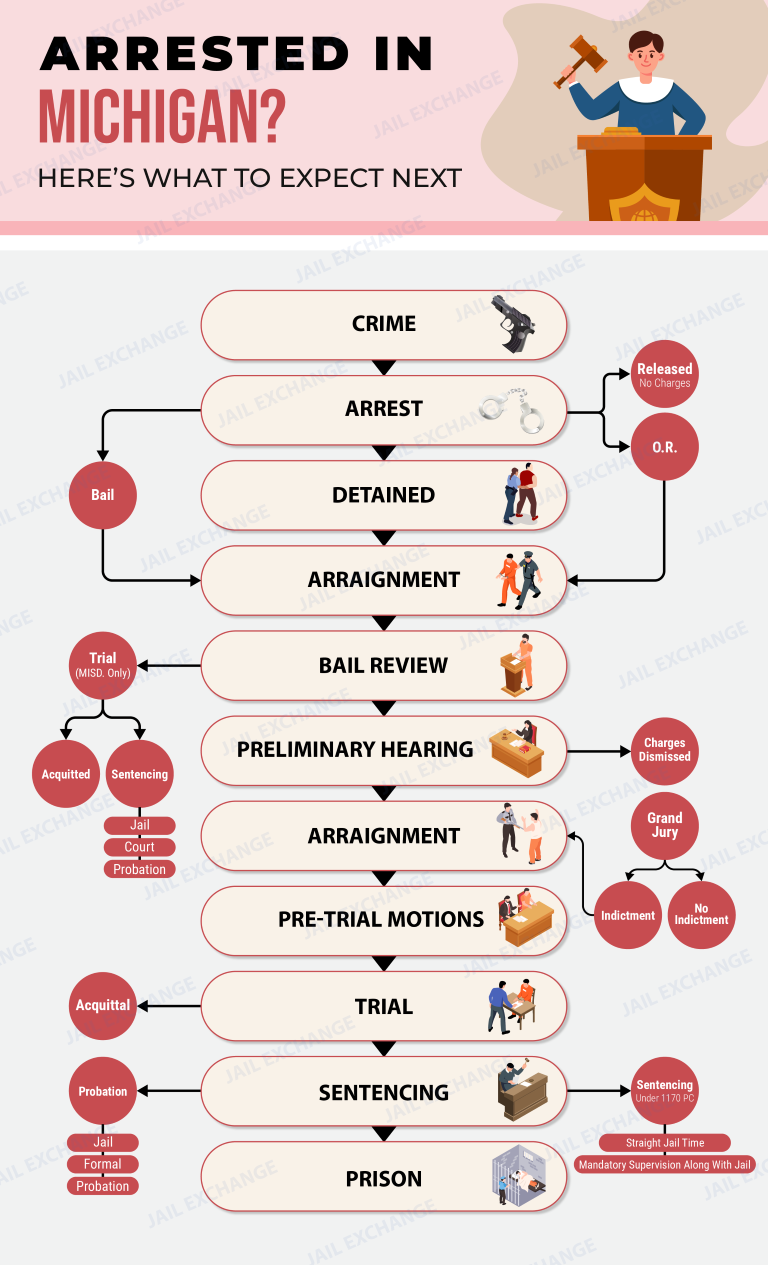
Express Account (TIGGS) Commissary Ordering
Provider: Express Account / The Inmate Goods & Gifts Solution (TIGGS)
Express Account Commissary Ordering enables family members to purchase pre-approved snack boxes, meat and cheese selections, hygiene bundles, and seasonal gift care packages sent directly to an incarcerated loved one. Each package is packed to meet institutional security guidelines, ensuring orders are approved upon arrival at the facility.
Important: Package Deadlines and Delivery Windows Vary
Detention centers do not all follow identical package distribution schedules. Some facilities allow weekly orders while others restrict shipments to bi-weekly or monthly windows, and spending limits differ widely across institutions. You should confirm the facility's active cutoff schedule and order allowances by calling them directly. If an order is placed after the weekly processing deadline, it will be held until the following distribution cycle, leaving your loved one waiting an extra cycle for fresh supplies.
Step-by-Step Instructions to Place a Package Order
- Obtain the inmate's legal first and last name, date of birth, and assigned booking identification number.
- Go to www.expressaccount.com.
- Select Send a Gift or Order Packages.
- Choose the state and facility where the inmate is currently housed.
- Search for the inmate to unlock the facility's authorized product catalog.
- Select pre-approved snacks, beverages, hygiene kits, and clothing items up to the jail's allowed spending limit.
- Enter your billing address and complete checkout with a credit or debit card.
- Save your confirmation receipt and package tracking number for your records.
What the Inmate Needs to Do
The inmate does not need an active online account to receive care packages. TIGGS packages the order in tamper-evident security boxes and delivers it directly to the facility commissary department. Jail officers inspect the shipment and deliver the items during regular housing unit commissary delivery, where the inmate signs for receipt.
Official Provider: Express Account Official Website
Customer Service Telephone: 1-866-422-6833
Support Hours: Monday – Friday, 8:00 AM – 5:00 PM CST
Supported Languages: English and Spanish
Other Services Provided by Express Account (TIGGS)
In addition to Commissary Package Ordering, Express Account handles inmate trust and canteen money transfers:
- Inmate Trust Money Deposits: Deposit funds directly into an inmate's personal account for independent canteen shopping.
• Learn more on our website: Inmate Trust Deposits Guide | • Visit official vendor page: Express Account Trust Deposits
Buy Commissary for an Inmate in the Clinton County Jail
Clinton County Jail Inmate Commissary - Sending Money or Purchasing Commissary for an Inmate
Clinton County Jail allows inmates to purchase commissary. This can be snacks, hygiene products, stamps, stationary, clothing and even electronics.
You can buy commissary for an inmate using an online service called Express Account.

There is a monthly limit of $200-300 on how much inmates can spend on commissary items.
This amount is subject to change so call the facility at 989-227-6580 in order to confirm the amount that cannot be exceeded.
Inmates have access to both an in-house commissary store, and commissary packages that can be purchased and shipped to the inmate by friends and family.
Scroll down for information on the Clinton County Jail's service they use for you being able to purchase commissary items online and have them shipped directly to the inmate.
You can also go to our Inmate Money page for information on how to send money to an inmate.
Express Account (TIGGS) Inmate Trust Deposits
Provider: Express Account / The Inmate Goods & Gifts Solution (TIGGS)Express Account (operated by TIGGS) provides a secure online payment portal allowing family and friends to deposit funds directly into an incarcerated person's jail trust and canteen account using a debit or credit card. Deposited money gives inmates the financial balance required to independently buy food items, hygiene supplies, writing materials, and over-the-counter medication from the facility store.
Important: Facility Banking Rules Differ Across Jails
Once a person is booked and moved to a cell, facilities do not always allow cash drop-offs or phone payments directly to the jail window. Some might and you should confirm this by calling the facility and asking. But if you do not register online and fund your loved one's trust account immediately, they may be forced to wait days or weeks for standard paper processing, leaving them without essential soap, clean undergarments, basic medical sundries or snacks.
Step-by-Step Instructions to Register and Deposit Funds
- Confirm the inmate's legal first and last name, date of birth, and assigned facility booking ID number.
- Navigate to www.expressaccount.com on your computer or mobile browser.
- Click on Send Money or Make a Deposit.
- Select the state and the detention center where your loved one is currently detained.
- Search for the inmate to confirm their active housing record and verify their identity matches the facility roster.
- Choose your deposit amount, review the card processing and convenience fees, and enter your debit or credit card billing information.
- Authorize payment and save the digital receipt and transaction authorization number for your financial records.
What the Inmate Needs to Do
The inmate does not need an internet connection to receive trust funds. Once the electronic payment clears, the funds post directly to their ledger balance in the jail's internal commissary management system. The inmate can verify their balance at a housing pod kiosk or on their weekly trust statement to place orders during the next scheduled commissary cycle.
Official Provider: Express Account Official Website
Customer Service Telephone: 1-866-422-6833
Support Hours: Monday – Friday, 8:00 AM – 5:00 PM CST
Supported Languages: English and Spanish
Other Services Provided by Express Account (TIGGS)
In addition to Inmate Trust Deposits, Express Account provides direct care package delivery services at participating facilities:
- Commissary & Gift Package Ordering: Order pre-approved snack boxes, food packages, and personal care essentials delivered directly to the jail.
• Learn more on our website: Commissary Ordering Guide | • Visit official vendor page: Express Account Package Orders
Deposit Money for an Inmate in the Clinton County Jail
Deposits for someone at the Clinton County Jail, 1347 E. Townsend Road in St. Johns, go straight to the facility trust account.
- Online: Pay at Express Account. A convenience fee is added.
- By phone: Call 866-422-6833 to reach a live agent.
- Lobby kiosk: Use the kiosk in the jail lobby. A service fee is added to every money transaction.
- Money order by mail: This is the only kind of money the jail takes by mail. Make it out to the person's full name, write their inmate ID on it, and mail it by itself to Clinton County Jail, 1347 E. Townsend Road, St. Johns, MI 48879. Any letter sent with it is destroyed.
Never mail cash or checks. A money order sent the wrong way is returned to you.
Personal letters for the Clinton County Jail in St. Johns are not mailed to the jail building. They go to a mail-scanning service that sends a digital copy to the jail, because mail soaked in drugs like meth or heroin and then dried has been used to smuggle drugs into jails. Legal mail and money orders are the only items that go straight to the jail on East Townsend Road.
Personal letters and photos (scanned):
Inmate's Full Name & Inmate ID#
Clinton County Jail, MI
PO Box 76550
Highland Heights, KY 41076
Legal mail, money orders and publications:
Inmate's Full Name & Inmate ID#
Clinton County Jail
1347 E. Townsend Road
St. Johns, MI 48879
- On the envelope: Write the inmate's name followed by their inmate ID, and always include your return address.
- Paper size: Pages run through a sheet-fed scanner, so nothing may be bigger than a regular 8½ by 11 inch sheet or thicker than light card stock.
- Photos: Pictures are the only thing allowed inside a letter. Send up to 10 per envelope, on real photo paper. Pictures printed from the internet, colored paper and revealing photos get destroyed.
- Don't include: Stamps, blank envelopes or writing paper. Cash and checks are never accepted.
- Money orders: These are the only form of money taken by mail. Mail each one by itself to the St. Johns address, because a letter sent along with a money order is destroyed. Make it out to the inmate's full name and write their inmate ID on it. If you are unsure, call 989-227-6580 to confirm. Another way is to make a deposit online.
- Books and magazines: They must be new, paperback, and shipped by the publisher to the St. Johns address.
- Sent back to you: Legal mail or money orders mailed to the wrong address, certified mail that needs the inmate's signature, and mail with postage due.
For faster contact, try the jail's electronic messages.
Inmate Sales (Combined Public Communications - CPC) provides telecommunications services that allow incarcerated individuals to place outbound voice calls from dayroom telephones or handheld tablets to family and friends. Because correctional facilities do not permit incoming calls, funding an Inmate Sales prepaid account links calling credits directly to your phone number so calls connect without carrier restrictions.
Important: Mobile Phones Automatically Block Inmate Collect Calls
Cellular phone carriers automatically reject standard collect calls originating from jail phone systems. While some residential landlines might permit direct monthly billing, mobile devices and internet-based telephone lines require an active prepaid calling balance, which you can verify by checking with your provider. If you do not register online and fund an Inmate Sales account right away, your loved one will receive an automated disconnect announcement when attempting to call your number.
Step-by-Step Instructions to Register and Fund a Phone Account
- Visit www.inmatesales.com or call customer care at 1-877-998-5678.
- Click New User and register using the primary 10-digit telephone number where you want to receive calls.
- Select the state and facility where the inmate is currently detained.
- Link the inmate to your profile using their full legal name and booking ID number.
- Select Prepaid Collect Phone or Direct Inmate PIN Debit.
- Select your deposit dollar amount and enter your debit or credit card billing details.
- Submit payment, record your confirmation number, and confirm that your mobile phone allows calls from automated or unknown correctional numbers.
What the Inmate Needs to Do
The inmate dials your 10-digit telephone number from any dayroom telephone or tablet and keys in their assigned PIN. The automated system verifies that your phone number has an active prepaid balance and connects the call once you accept the automated prompt. All personal telephone conversations are recorded and monitored by facility staff.
Official Provider: Inmate Sales Official Website
Customer Service Telephone: 1-877-998-5678 or 1-702-829-3001
Support Hours: Monday – Friday, 8:00 AM – 11:00 PM EST; Saturday, 9:00 AM – 5:00 PM EST
Supported Languages: English and Spanish
Other Services Provided by Inmate Sales (CPC)
In addition to Phone Calling Accounts, Inmate Sales provides several other communication and visitation channels:
- Inmate Tablets & Digital Media: Discover educational programs, phone access, and entertainment offered on facility tablets.
• Learn more on our website: Tablet Programs Guide | • Visit official vendor page: Inmate Sales Tablets - Two-Way Texting & Messaging: Send digital text messages and photos directly to an inmate's device.
• Learn more on our website: Digital Messaging Guide | • Visit official vendor page: Inmate Sales Messaging - Remote Video Visitation: Schedule and join live video visits from home using your computer or smartphone.
• Learn more on our website: Video Visitation Guide | • Visit official vendor page: Inmate Sales Video Visits - Commissary & Care Packages: Order pre-approved snack boxes, food packages, and clothing directly to the jail.
• Learn more on our website: Commissary Orders Guide | • Visit official vendor page: Inmate Sales Commissary
Inmate Sales Two-Way Texting allows friends and family members to exchange electronic text messages and digital photo attachments directly with an incarcerated loved one. Messages are delivered electronically to housing unit kiosks and handheld tablets within hours, avoiding the lengthy transit times associated with physical postal mail.
Important: Electronic Messaging Screening Rules Differ
Inmates cannot receive incoming phone calls, and traditional postal mail rules differ across correctional agencies. While some facilities still allow regular handwritten letters, many jails have transitioned to digital-only mail scanning or restrict postal delivery, which you can verify by checking facility rules. If you do not register online and purchase messaging credits immediately, your loved one may face lengthy periods without direct written contact from family.
Step-by-Step Instructions to Register and Send Text Messages
- Go to www.inmatesales.com or launch the Inmate Sales mobile app.
- Register your account using your 10-digit telephone number and email address.
- Select Text Messaging / Chirp from your service options.
- Select your state and detention center, then search for the inmate using their full legal name or booking ID.
- Purchase a messaging credit bundle using a debit or credit card.
- Type your message in the composition window and attach approved JPEG photos if permitted by the facility.
- Submit your message to the facility's screening queue.
What the Inmate Needs to Do
All electronic correspondence is screened by facility staff before delivery. Once approved, messages appear in the inmate's inbox on their housing unit terminal or tablet. The inmate opens the message, reads your note, and types an electronic reply using their available credits.
Official Provider: Inmate Sales Official Website
Customer Service Telephone: 1-877-998-5678 or 1-702-829-3001
Support Hours: Monday – Friday, 8:00 AM – 11:00 PM EST; Saturday, 9:00 AM – 5:00 PM EST
Supported Languages: English and Spanish
Other Services Provided by Inmate Sales (CPC)
In addition to Two-Way Texting, Inmate Sales provides several communication, commissary, and visitation options:
- Remote Video Visitation: Schedule and join live video visits from home using your computer or smartphone.
• Learn more on our website: Video Visitation Guide | • Visit official vendor page: Inmate Sales Video Visits - Prepaid Phone Calling Accounts: Prepay for phone calling credits so your loved one can call your telephone directly.
• Learn more on our website: Prepaid Calling Accounts Guide | • Visit official vendor page: Inmate Sales Calling - Inmate Tablets & Digital Media: Discover educational programs, phone access, and entertainment offered on facility tablets.
• Learn more on our website: Tablet Programs Guide | • Visit official vendor page: Inmate Sales Tablets - Commissary & Care Packages: Order pre-approved snack boxes, food packages, and clothing directly to the jail.
• Learn more on our website: Commissary Orders Guide | • Visit official vendor page: Inmate Sales Commissary
Inmate Sales (CPC) provides corrections-grade handheld wireless tablets to incarcerated individuals in county detention centers. Operating on a secure internal network, these devices allow inmates to conduct remote video visits, make voice telephone calls, send and receive text messages, stream approved music, read digital books, and access self-help legal resources directly from their living areas.
Important: Tablet Hardware Deployment and Rental Rules Vary
Detention centers do not manage tablet distribution identically. While some agencies issue individual personal tablets to every detainee at booking, others utilize shared pod docking stations or restrict tablet use to specific dayroom hours, which you should confirm with the facility directly. Although core educational and legal resources are generally provided free of charge, sending messages, listening to music, or making phone calls from the tablet requires an active balance funded by outside contacts.
Step-by-Step Instructions to Support and Fund Tablet Use
- Verify that Inmate Sales / CPC tablets are deployed at your loved one's specific detention facility.
- Navigate to www.inmatesales.com or launch the Inmate Sales mobile app.
- Sign into your verified user profile and link the inmate's legal name and booking ID number.
- Select Tablet / Chirp Funds or Inmate PIN Debit to add funds to their available balance.
- Specify your deposit amount, review convenience fees, and enter your credit or debit card billing details.
- Submit payment, save your confirmation receipt, and notify your loved one that their device balance is available.
What the Inmate Needs to Do
The inmate unlocks their assigned tablet using their PIN or biometric scan. Their available balance appears on the screen, allowing them to download songs, read digital books, write messages, and communicate with approved family members. Devices are docked during quiet hours and shift changes for secure recharging and data synchronization.
Official Provider: Inmate Sales Official Website
Customer Service Telephone: 1-877-998-5678 or 1-702-829-3001
Support Hours: Monday – Friday, 8:00 AM – 11:00 PM EST; Saturday, 9:00 AM – 5:00 PM EST
Supported Languages: English and Spanish
Other Services Provided by Inmate Sales (CPC)
In addition to Tablet Services, Inmate Sales provides several core communication channels:
- Two-Way Texting & Messaging: Send digital text messages and photos directly to an inmate's device.
• Learn more on our website: Digital Messaging Guide | • Visit official vendor page: Inmate Sales Messaging - Remote Video Visitation: Schedule and join live video visits from home using your computer or smartphone.
• Learn more on our website: Video Visitation Guide | • Visit official vendor page: Inmate Sales Video Visits - Prepaid Phone Calling Accounts: Prepay for phone calling credits so your loved one can call your telephone directly.
• Learn more on our website: Prepaid Calling Accounts Guide | • Visit official vendor page: Inmate Sales Calling - Commissary & Care Packages: Order pre-approved snack boxes, food packages, and clothing directly to the jail.
• Learn more on our website: Commissary Orders Guide | • Visit official vendor page: Inmate Sales Commissary
Clinton County Juvenile Facilities
Nearby counties
- Jail (Main): 989-227-6580
- In Custody Inmate Information: 866-932-6506
- Sheriff: 989-224-5200
The Clinton County Jail serves the following cities and towns of Clinton County: Bath, Dewitt, Eagle, Elsie, Fowler, Laingsburg, Maple Rapids, Ovid, Pewamo, Saint Johns and Westphalia.