
Eaton County Jail
Eaton County Jail
Jail Phone Number
517-543-3512Eaton County Inmate Search: Find a Person Held in Charlotte
Arrests in this county end at the Eaton County Jail, 1025 Independence Boulevard, Charlotte, MI 48813. Deputies and city officers both drop people off there. This page helps you locate the person, then walks through bond, lawyers, visits, money, mail and court.
Try the jail search with the person's name to check whether they are in custody. A person just brought in may not be listed yet, so check again in a few hours. For mugshots, charges and release news, phone the jail when the page shows nothing.
The jail's main number is 517-543-3512. Know the full name and the birth date before you dial. Then find out the offense listed, any bond amount and the next hearing. Next, read our bail page and court page.
Read inmate search answers
 Read inmate search answers
1. Steps for searching the Eaton County Jail list
Here is the quickest way:
- Open the jail search on any device.
- Type the surname. A long list means you should add a first name.
- Still blank? Test a nickname, the middle name or another spelling.
- Copy any number shown next to the name. The jail calls it the inmate ID. Keep it for mail, deposits and phone accounts.
The search shows if someone is in the jail. For the charge, the bond and release plans, call 517-543-3512.
↑ Back to the question list2. A name is not coming up, what now?
An empty result often has a plain reason:
- Still being booked. Fingerprinting and forms can take a while.
- Police still have them. A city or township officer may keep the person at the station before the drive to the jail.
- They went home. Some people post a small interim bond with a jail deputy, or are freed after the first court hearing.
- Another county has them. The jail rents beds to other counties, and officers from elsewhere may arrest a person from here.
- The spelling differs. Run the search again with other forms of the name.
Ask the arresting agency for its report number and where it took the person. Then phone 517-543-3512 and have the jail desk check the name.
↑ Back to the question list3. Where might the person be held besides Charlotte?
Most adults picked up here stay in one building:
- Eaton County Jail, 1025 Independence Boulevard, Charlotte, MI 48813, 517-543-3512. It can hold 374 people. Its residents include people waiting for trial, people serving jail terms for misdemeanors or felonies, and people waiting for a ride to state prison. A judge may allow some people with non-violent cases to go to work while serving time. The Bond Lobby is a separate front entrance, marked with a large 3, where bond receipts are handed in. No one is housed there.
If the arrest took place across a county line, check that county's jail. People arrested in the Lansing area may be in the Ingham County jail, and its JE page shows the address and phone. To the north, the Clinton County Jail sits at 1347 E. Townsend Road, Saint Johns, MI 48879, phone 989-227-6580.
Anyone under 18 is kept away from adults. See the youth answer further down.
↑ Back to the question list4. Mugshots from the Eaton County jail search
The county's own pages do not say whether the search carries mugshots, so phone 517-543-3512 and put the question to the jail.
A state Attorney General opinion calls the photos police take of suspects public records. Release can be denied, though, if it would badly and needlessly intrude on someone's privacy. To ask, send a written request to the department that arrested the person, citing the state's FOIA law, MCL 15.231 onward.
- A photo held by ICE must be asked for at ice.gov/foia/requestICErecords.
- Federal booking photos generally are not released, but the U.S. Marshals Service may release one when, for example, it is hunting a fugitive.
5. Getting word when they leave or change jails
Sign up for MI-VINE. This free service reports when someone is let out, moved or gets away. It covers many Michigan jails and the state prisons, along with certain court dates.
- Register on vinelink.com or phone 800-770-7657.
- Keep the person's name and inmate ID handy.
- Ask the jail desk if this person is tracked yet, since new bookings may lag.
Checking the jail search each morning helps too.
↑ Back to the question list6. Bail and release after an Eaton County arrest
Soon after an arrest, the person appears before a judge or magistrate, sometimes through a screen set up in the jail. This first hearing, the arraignment, happens in the 56A District Court, 1045 Independence Boulevard, Charlotte, MI 48813, 517-543-7520.
- Interim bond. For certain minor offenses, when no magistrate can be reached, the deputy running the jail may accept a small bond. After a domestic violence arrest, no interim bond is allowed and a judge or magistrate decides first.
- Release with no cash. The court rules lean toward release after the person signs a pledge to appear, or signs an unsecured bond with no cash due at first. Cash bail needs a judge's finding that no lesser step will make the person return or protect others.
- One-tenth deposit. A court can allow a payment of ten percent of the bail to the clerk. Since May 1, 2026, the court holds that deposit back only when the person is found guilty of an MCL 780.66 offense. If the case ends without a conviction, you get it all back, less anything owed in fines or costs.
- Bond agents. Agents must hold a state insurance producer license and get each court's okay. Report problems to the state insurance office, 877-999-6442.
Pay court money at the courthouse in business hours. Then carry the receipt to the Bond Lobby at door 3, press the intercom and wait for an officer. Read our bail page for more, or the Michigan bail laws page for the state rules.
↑ Back to the question list7. Learning the charges against them
The jail desk knows what the person was booked for. Phone 517-543-3512 and ask. The prosecutor may later change the charge.
Once a case exists, find it by name in MiCOURT Case Search. When it does not appear, ask the court clerk. The District Court's criminal page is on eatoncounty.org. The Prosecuting Attorney, Room 210, 1045 Independence Boulevard, Charlotte, MI 48813, 517-543-4801, files the formal charges.
↑ Back to the question list8. Free lawyers for people in the Eaton County Jail
Early in the case the court must ask if the person wants counsel. If a lawyer costs too much, the court weighs eligibility. Having bond money does not end that right.
- Public Defender's Office, 1033 Healthcare Drive, Suite 1, Charlotte, MI 48813, 517-543-4449. Its attorneys handle misdemeanor and felony cases in both District and Circuit Court.
- Michigan Indigent Defense Commission, 517-657-3066, for questions about statewide standards.
A private attorney is also an option.
↑ Back to the question list9. Eaton County Jail video visits and the rules
Every visit happens by video. Reserve a time through SmartInmate at smartinmate.com or on the kiosk in the front lobby. The booking must be made a full day ahead.
- At the jail. A visit runs 30 minutes, once per week. The April 2026 family guide lists Monday to Thursday, with morning and afternoon slots, and no visits on county holidays. SmartInmate shows what is open.
- From home. Video calls from your own phone or computer can be booked most days, from early morning to late evening, for a fee. You will upload a photo of a driver's license or other state photo ID, plus a selfie.
- A list of approved visitors is no longer required.
Questions go to 517-543-3512, where you can ask for the receptionist. Find extra tips in our visiting guide.
↑ Back to the question list10. Depositing money for someone in the Charlotte jail
There are four ways to add funds:
- Visit eXpressAccount.com.
- Dial the automated line, 866-422-6833, day or night.
- Use the lobby kiosk at the Sheriff's Office, 1025 Independence Boulevard, Charlotte, MI 48813. It accepts cash and credit cards around the clock.
- Send a money order payable to the inmate. Personal checks, business checks, loose change and foreign money get sent back. Ask the jail how to mark the envelope before you mail it.
Canteen Services runs the jail store. With a zero balance, the person still gets required hygiene and phone items, billed later after release. Details are in our money page and commissary page.
↑ Back to the question list11. Phones, texts and tablets inside
Phones hang in the living areas. The person buys minutes at the commissary and moves them to a phone account. Smart Communications runs it at smartinmate.com, with tech support at 727-349-1561.
Ask the desk at 517-543-3512 if tablets or texts are available. Personal messages for inmates are turned down unless the news is urgent and checkable, like a family death. The jail phone guide and inmate email page explain typical options.
↑ Back to the question list12. Addressing a letter to the jail
On the envelope, put: the person's name - inmate ID, C/O Mail Processing Center, P.O. Box 9186, Seminole, FL 33775-9186. Letters go to a mail center in Florida first and reach the jail from there.
- Anything that is not a newspaper subscription is sent back, so ask the jail before you mail a letter.
- Books sent by a publisher through the post office or UPS are no longer taken.
- Leave cash out of the envelope.
If a letter comes back, call 517-543-3512 and ask for the Corrections Clerk. Our mail guide adds more tips.
↑ Back to the question list13. Clothes, belongings and pickup
What the person wore in stays with the jail until release. Street clothes are turned away, except one change for a jury trial. Items that are allowed can be dropped at the Lobby Reception Desk, Monday to Thursday, 8:00 a.m. to 4:15 p.m., with county holidays off.
After a release, the person fills out a form at the booking office first. Then you go to the Bond Lobby, door 3, 1025 Independence Boulevard, Charlotte, MI 48813. The jail's FAQ gives weekday hours of 8:00 a.m. to 5:00 p.m. Call 517-543-3512 before the trip.
↑ Back to the question list14. Health care inside the jail
Phone 517-543-3512 and ask for the Jail Medical Clinic. Name every medicine, the dose and who prescribed it. The person can also ask for a medical visit from inside the jail.
- A visit the inmate asks for costs $25.00 with a doctor or dentist, and $7.50 with a nurse. Handling a prescription costs $3.00.
- Exams that the jail orders are free.
- Staff will want a copy of the insurance card.
Dial 911 for a crisis.
↑ Back to the question list15. Could a warrant be out in Eaton County?
The Sheriff's Office serves county warrants from 1025 Independence Boulevard, Charlotte, MI 48813. Phone 517-543-3512 and ask whether a warrant exists. City police can speak for their own towns, and the final answer here names each department. Filed cases appear in MiCOURT, and a court clerk can also look. A lawyer should help you clear a warrant. After that, call the court behind it and arrange to turn yourself in. The 56A District Court sits at 1045 Independence Boulevard, Charlotte, MI 48813, 517-543-7520, and can say which court holds the paper.
↑ Back to the question list16. Finding the next Eaton County hearing
Every court keeps its own calendar. Ask the jail desk, or ring the court holding the case. All three sit at 1045 Independence Boulevard, Charlotte, MI 48813:
- 56A District Court, 517-543-7520: misdemeanors, arraignments and first felony hearings.
- 56th Circuit Court, Room 227, 517-543-4335: felony cases after bindover.
- Trial Courts main line, 517-543-7500: start here if you cannot tell which court is involved.
In a felony case, two early dates follow arraignment. First is a probable cause conference within 7 to 14 days. Then comes the preliminary examination, 5 to 7 days after the conference. Our court guide shows each stage.
↑ Back to the question list17. A federal charge instead of a state one
This area belongs to the federal Western District of Michigan, Southern Division. Hearings are held in Grand Rapids and Lansing, so ask the clerk where yours will be.
- Grand Rapids: Federal Building, 110 Michigan Street NW, Grand Rapids, MI 49503, 616-456-2381.
- Lansing: Federal Building, 315 W. Allegan Street, Lansing, MI 48933, 517-377-1559.
- U.S. Marshals, Suite 744, 110 Michigan Street NW, Grand Rapids, MI 49503, 616-456-2438. Ask them where the person is being held.
A federal judge handles custody before trial at a detention hearing (18 U.S.C. 3142). After a sentence, use the Federal Bureau of Prisons inmate locator.
↑ Back to the question list18. If ICE puts a hold on the person
- The jail gets a detainer. That is an ICE request on Form I-247A.
- Under 8 CFR 287.7(d), the jail may hold the person up to 48 hours after they would otherwise be released.
- After that, ICE chooses whether to take them into custody.
- You can search the ICE Online Detainee Locator using the full name and the birth country.
For Michigan and Ohio, immigration enforcement runs through the ERO Detroit Field Office, found at 985 Michigan Avenue, Suite 207, Detroit, MI 48226, 313-771-6601.
↑ Back to the question list19. Looking up a person sent to state prison
County deputies drive a sentenced person to intake. The Reception and Guidance Center in Jackson receives men, and a reception center in Ypsilanti receives women. The intake stage lasts roughly a month to six weeks. Visits are paused then, but family may send letters and add money.
- Look up a name or number in the state's Offender Tracking Information System (OTIS).
- Rules on visits and letters at each prison are covered in our Michigan state prisons guide.
20. An arrest of someone younger than 18
A person under 18 is a juvenile here, and youth are not to share space with adults. These cases are heard by the Family Division, a part of Circuit Court. For some felonies, a judge may transfer a youth who is at least 14 to the adult system (MCL 712A.4).
- Eaton County Youth Facility, Detention Unit, 822 Courthouse Drive, Charlotte, MI 48813, 517-543-3244. Ask for Detention. It holds up to 8 boys and girls.
- Juvenile Court, 822 Courthouse Drive, Charlotte, MI 48813, 517-543-6003, for hearings and probation.
Youth files are private, so these offices will tell you who to contact.
↑ Back to the question list21. Police departments across the county
These agencies make arrests here. For a city or village number, call the Sheriff's line or open the department's page.
- Eaton County Sheriff's Office, 1025 Independence Boulevard, Charlotte, MI 48813, 517-543-3512. Deputies cover the whole county and work by contract for Delta Township, Oneida Township and the Village of Vermontville. Delta patrol: 517-323-8480. Lansing-area line: 517-372-8217. Tips: 517-543-5433.
- Charlotte Police Department
- Eaton Rapids Police Department
- Potterville Police
- Central Dispatch, 911 Courthouse Drive, Charlotte, MI 48813, 517-543-4913
- Michigan State Police Lansing Post, 7119 N. Canal Road, Lansing, MI 48913, 517-322-1907
Eaton County bail and bond: from the Sheriff's Office in Charlotte to the courthouse on the same street
Eaton County sends adults to the Eaton County Jail, 1025 Independence Boulevard, Charlotte, MI 48813, which the Sheriff's Office runs. You will find out below how bond works and how it gets paid.
The quickest check is the Eaton County Inmate Search, where you type the last name. For active warrants, charges and who is behind bars, use our Jail Roster.
Not sure where to begin? Call 517-543-3512 and ask for the jail desk, then ask how to post a bond. Our court page comes next, once you know the hearing plan.
1. My son was arrested near Eaton Rapids or Grand Ledge. Where is he now?
City and township officers arrest people in several places across Eaton County, and some arrests are made by another agency's officers. Ask the arresting department for its report number and where it took him. Then search Eaton County Inmate Search. A new booking can take a few hours to appear, so call the Sheriff's Office at 517-543-3512.
↑ Back to the question list2. What is at 1025 Independence Boulevard?
That address is listed for both the Sheriff's Office and the county jail, in Charlotte, MI 48813. The Eaton County Courthouse is nearby at 1045 Independence Boulevard. Because the same number, 517-543-3512, is listed for both the Sheriff's Office and the jail, ask for the jail desk when you call.
↑ Back to the question list3. How do I find out what the court set?
Check Eaton County Inmate Search for the bail on his booking. Bail is chosen by a judge or magistrate at arraignment, so a new arrest may show no figure yet. The Probate Court at the courthouse answers at 517-543-4185, but the district court that hears criminal cases has its own line. I could not read it, so call the Sheriff's Office to learn which courtroom he will appear in.
↑ Back to the question list4. Where do I pay, and what hours does the window keep?
I could not read a posting guide for Eaton County, so I will not name hours or payment types. Phone 517-543-3512 and ask where bond is accepted, if that spot is open at night and on weekends, and which payment types it takes. A cash bond in a defendant's name is also applied to fines and costs first, so ask what the receipt will list.
↑ Back to the question list5. Can a judge send him home with no money?
Yes. Michigan Court Rule 6.106 starts with release on a written promise to appear or an unsecured bond. A judge must give reasons on the record before ordering custody or money bail. Ask for that hearing through his lawyer, because the judge also weighs his record, past court appearances, mental health and community ties.
↑ Back to the question list6. How does the 10 percent option work in Eaton County?
When a judge allows it, you deposit a tenth of the bail with the court, and he signs a bond for the rest. For a $2,000 bail, that is $200. The deposit can be applied to fines, costs and restitution after a conviction.
As of May 1, 2026, the court may keep 10 percent only if the case falls under MCL 780.66 and the person is convicted. Without a conviction the whole deposit returns.
↑ Back to the question list7. What if the judge wants a bondsman?
A court may accept a surety bond for one quarter of the full bail, written by an agent the court approves. For $8,000 bail, one quarter is $2,000, though the bondsman's own fee is separate and I found no state rule capping it. DIFS does not license bondsmen as such; agents hold insurance producer licenses. Read all terms before you sign, and report problems at 877-999-6442.
↑ Back to the question list8. Can somebody with two felony convictions get a 10 percent bond?
Not under the state's rules. A person who was out on bail when charged, or who has two felony convictions in the last five years, must post cash or use a non-applicant surety, according to the state court administrators' guidance on MCL 765.6a. Ask the lawyer how this applies, because the judge makes the call.
↑ Back to the question list9. Can I offer my home in Charlotte as the bond?
Only with the court's consent, and the judge may require proof of the home's value. I could not confirm whether property outside Eaton County is accepted. Call the Sheriff's Office at 517-543-3512 to ask who handles property bonds before you order a title search.
↑ Back to the question list10. Can I be kept without any bail?
In a few cases. Michigan's Constitution lets the court deny bail for murder and treason when proof is evident. It can also do so for first-degree criminal sexual conduct, armed robbery and kidnapping for extortion unless the person is shown to be no risk of flight or harm. A person with two earlier violent felony convictions in 15 years can be held too. Trial must start within 90 days or the court must hold a bail hearing.
↑ Back to the question list11. What if my niece is 16?
Michigan bars holding anyone under 18 in an adult jail unless sight and sound separated. The family division of the court handles youth cases. Call the Probate Court at 517-543-4185 and ask which juvenile detention center Eaton County uses and who to contact.
↑ Back to the question list12. Who pays for a lawyer if we cannot?
Tell the judge at the first appearance. You will fill out a form about income. I did not find an Eaton County defender phone, so ask the Probate Court clerk at 517-543-4185 to route you, or contact the Michigan Indigent Defense Commission at 517-657-3066.
↑ Back to the question list13. What if I am sent a message asking for payment by gift card?
No court takes that. Do not pay. Call 517-543-3512 and report it.
↑ Back to the question list14. What do I do if he skips a court date?
The court can revoke release, order a warrant and declare bail forfeited. The notice goes by mail, and he has 28 days to turn himself in. A bondsman is told within 7 days. If he is arrested within a year and the county's costs are paid, a judge can set the judgment aside.
↑ Back to the question listEaton County bail contacts
- Jail and Sheriff: Eaton County Jail and Sheriff's Office, listed at 1025 Independence Boulevard, Charlotte, MI 48813; 517-543-3512
- Custody lookup: Eaton County Inmate Search
- Courthouse: Eaton County Courthouse, 1045 Independence Boulevard, Charlotte, MI 48813
- Probate Court: 517-543-4185
- State indigent defense: Michigan Indigent Defense Commission, 517-657-3066
- Agent complaints: Department of Insurance and Financial Services, 877-999-6442
Phone numbers, hours and local procedures can be changed by the county, and judges set their own conditions. Reconfirm anything that involves money with the Sheriff's Office or the court first.
Book Eaton County Jail video visits at least 24 hours ahead
Family and friends visit by video. The jail does not require people in custody to keep a visitor list. Reserve at least 24 hours ahead through SmartInmate or use the public scheduling kiosk in the front lobby, which is accessible all day. The kiosk’s scheduling availability is not the same as onsite visiting hours.
Onsite video (Eastern time)
The April 2026 Sheriff’s guide lists Monday through Thursday, 9–10 a.m. and 1–3 p.m., excluding county holidays. One 30-minute onsite visit per week is allowed. The jail is at 1025 Independence Boulevard, Charlotte, MI 48813. Some older county instructions list Friday and a later morning finish; use the current times in the scheduler.
Remote video (Eastern time)
Every day, 8 a.m.–10:45 p.m. Upload a state-issued photo ID and a photo of yourself in SmartInmate. Wait for approval by email before scheduling your first 15- or 30-minute visit. Check the fee before confirming.
Call the visitation receptionist at 517-543-3512, extension 6955, Monday–Thursday, 8 a.m.–4 p.m. Eastern time. For technical help, call Smart Communications at 727-349-1561.

SmartJailMail Video Visitation provides a secure online platform that enables families and friends to conduct live, face-to-face video visits with incarcerated loved ones from home. Using an internet-connected smartphone, tablet, or personal computer equipped with a webcam, visitors can connect directly without traveling to the facility.
Important: Advance Registration and Visitor Clearance Required
Detention centers do not permit unscheduled or unverified video sessions. Correctional facilities require prospective visitors to submit government-issued photo identification and receive administrative clearance before booking an appointment, an approval process that can take up to 48 hours depending on facility staffing. You should verify your visitor approval status with the facility prior to scheduling. If you do not register well in advance, you will miss your loved one's scheduled visiting window for the week.
Step-by-Step Instructions to Register and Schedule a Video Visit
- Visit www.smartjailmail.com and sign into your account.
- Register your visitor profile and upload a clear photograph of your government-issued ID (driver's license or passport) for facility background review.
- Wait for email notification confirming facility visitor approval.
- Select Video Visitation, choose the detention facility, and select the inmate.
- Browse the available schedule calendar, select an open time slot, and pay the visitation fee using a credit or debit card.
- Log into the website 10 minutes prior to the start time on a device with a functioning camera, microphone, and reliable high-speed internet connection.
What the Inmate Needs to Do
The inmate receives a visitation notification on their housing unit video kiosk or tablet. At the appointed time, they log in with their PIN and sit before the terminal. Inmates and visitors must strictly observe jail dress and conduct rules; sessions are monitored by staff and will terminate immediately upon any violation.
Official Provider: SmartJailMail Official Website
Customer Service Telephone: 1-888-253-5178
Support Hours: Monday – Friday, 7:00 AM – 7:00 PM EST
Supported Languages: English and Spanish
Other Services Provided by Smart Communications
In addition to Remote Video Visitation, Smart Communications provides electronic messaging and phone calling services:
- SmartJailMail Two-Way Messaging: Send electronic messages and photos directly to an inmate's housing unit kiosk.
• Learn more on our website: Two-Way Messaging Guide | • Visit official vendor page: SmartJailMail Messaging - Smart Inmate Phone Services: Prepay for phone calling credits so your loved one can call your telephone directly.
• Learn more on our website: Inmate Phone Time Guide | • Visit official vendor page: Smart Inmate Calling
Eaton County Criminal Court Help: Misdemeanors, Felonies and Youth Cases
The 56A District Court, at 1045 Independence Blvd., Charlotte, MI 48813, usually sees a case first. Serious felonies move up to the Circuit Court later. People waiting on a hearing are held at the Eaton County Jail, 1025 Independence Boulevard, Charlotte, MI 48813.
Look for a name in the Eaton County Inmate Search before you head to the courthouse. You can also scan recent arrests, charges and mugshots in the Eaton County Jail Roster.
Dial 517-543-7500 to reach the courthouse and ask about your person's next date. If you want them home sooner, read our bond page.
1. Where does a family go for court information in Eaton County?
The first court appearance is usually about the alleged offense, the defendant’s rights, and whether the person can be released. In Eaton County, Michigan , lower-level criminal charges and the opening stages of felony cases are generally handled in District Court . Most felony trials and felony sentencing belong in Circuit Court . Juvenile delinquency cases usually go through the Family Division of Circuit Court. The Eaton County Prosecuting Attorney represents the state. Charlotte is the county seat.
2. Someone you love was arrested in Eaton County. What do you do first?
Write down the person’s full name and birth date, the arresting agency, the booking location, the court matter number if available, and the next hearing date. Ask the jail whether the person is still in custody and whether a bond or other release order has been entered. The jail handles custody; the court sets bond and court dates. The District Court ordinarily handles a misdemeanor case and the first felony hearings. The Circuit Court ordinarily handles the felony after the preliminary stage. A family member may be able to attend public hearings, but the judge and appointed lawyer—not a jail officer—determine how the legal case moves forward.
- 56A District Court — 1045 Independence Blvd., Charlotte, MI 48813. 517-543-7520.
- District Court: Hears most misdemeanors and holds the first hearings in felony cases, including arraignment and preliminary examination.
- Circuit Court: Handles felony trials, pleas, sentencing, and appeals assigned by Michigan law.
- Family Division of Circuit Court: Handles juvenile delinquency proceedings and related matters.
- Eaton County Prosecuting Attorney: Represents the state in local criminal prosecutions.
- Appointed defense lawyer: People who cannot afford counsel in qualifying criminal cases can request an appointed attorney.
- Local jail and custody: County sheriffs normally manage local jail custody; a court may order release with conditions or continued detention.
Where does a case start? Someone arrested in Eaton County may first be booked by police and brought before a judge or magistrate. The charge determines which court hears the case, and the written notice controls where the defendant must appear. Michigan District Courts decide most misdemeanors and handle the first steps of felonies. Circuit Court generally takes over a felony after a waiver or a finding of probable cause at the preliminary examination.
What happens to someone waiting in jail? The Eaton County sheriff or another authorized jail may hold the person charged while a court considers release. Custody and release decisions are recorded as part of the criminal case. A courthouse and a detention center are not necessarily on the same property.
This guide explains the usual criminal court process in Eaton County in plain language. The exact charge, criminal history, and judge’s findings affect the outcome. It is general information, not personal legal advice.
↑ Back to the question list2. What are the steps in a minor criminal case in Eaton County?
In Eaton County, a misdemeanor may start with a ticket or a notice to appear, while a more serious situation can lead to arrest and booking. Examples include certain assaults without serious injury, shoplifting and some impaired-driving charges. The criminal accusation written on the paperwork matters because Michigan has different penalties for different misdemeanors.
Arraignment: what the judge decides about bail
At arraignment, the judge tells the person charged what offense is charged, explains important rights and addresses a plea and release conditions. Some people can leave on a personal promise to return; others may have money bond, supervision, travel limits or no-contact orders. A judge can also deny release where the law permits. Bail is not a punishment or proof of guilt.
The next steps once charges are read
The Eaton County District Court may schedule a pretrial hearing. Lawyers review police reports, videos and other evidence. The prosecuting attorney may offer an agreement, dismiss a charge or proceed to trial. The person charged can contest the evidence rather than accept a plea. Jury-trial rules depend on the offense and the legally available punishment.
When the court pays for an attorney
It helps to know: If the person charged faces a charge that qualifies for appointed counsel and does not have enough money to hire an attorney, the court can determine eligibility for a public defender or assigned lawyer. Request this help promptly; do not assume a defender is automatically assigned after booking.
Possible misdemeanor results
Michigan misdemeanors have different maximums. Common statutory limits include 90 or 93 days, one year, and in certain cases two years, with fines fixed by the particular statute. Some offenses also require driver-license action, restitution, classes or probation. The exact charge and prior record matter more than the county name.
↑ Back to the question list3. What happens after a felony arrest in Eaton County?
A felony accusation in Eaton County normally starts with a District Court arraignment, even when the eventual trial would be in Circuit Court. Prosecutors must establish the legal basis for moving the court matter forward. A felony carries the possibility of a state-prison sentence, although not every conviction results in prison time.
Probable cause conference and preliminary examination
Michigan usually sets a probable cause conference 7 to 14 days after felony arraignment and schedules the preliminary examination roughly 5 to 7 days after that conference, unless a legal waiver, adjournment or exception changes the schedule. At the preliminary examination the state's attorneys must show probable cause that a crime occurred and that this defendant committed it. That decision does not establish guilt.
The handoff from District Court to Circuit Court
For relatives following the case, the key distinction is this: When the charge is bound over, Eaton County Circuit Court handles the felony case. The person facing charges may be arraigned again, and the parties exchange evidence, negotiate, file motions or set a trial. The prosecuting attorney must prove guilt beyond a reasonable doubt at trial. Defendants who cannot afford legal counsel should ask the court about appointed representation.
What a felony sentence can involve
Michigan sentencing rules look at the offense statute, a record of earlier convictions, the sentencing guidelines when applicable, and any mandatory minimum. A nonviolent first offender might be eligible for probation or another lawful alternative, but some violent or repeat offenses require custody. Do not use a single felony-class chart to predict all Michigan sentences.
↑ Back to the question list4. What if someone faces murder, robbery, or another violent crime in Eaton County?
Murder, armed robbery, criminal sexual conduct and assaults causing serious harm are examples of grave charges that could be prosecuted in Eaton County. Seriousness by itself does not turn a Michigan crime into a federal case. Most such charges remain in the state Circuit Court unless federal law independently applies.
Detention and defense
A judge considers Michigan’s release rules, risk of flight, safety and legally relevant facts. A no-contact order or other condition may be imposed. Some defendants remain in jail while lawyers examine records, DNA or other scientific evidence. These charges need careful legal advice and frequently involve complicated court motions.
Trial and possible prison terms
For a person new to the court system: First-degree murder carries mandatory life without parole for adults under Michigan law, subject to legally applicable exceptions and youth-sentencing rules. Second-degree murder can carry a sentence up to life imprisonment. Armed robbery and several serious criminal sexual conduct crimes can also carry very long terms. Other violent offenses have their own penalty sections. Michigan does not have the death penalty.
Victim and family support
The Eaton County Prosecuting Attorney may have a victim-witness unit that explains hearing notices and available services. The defense attorney protects the legal rights of the person charged. The amount of time a case takes depends on witnesses, evidence, motions and the court calendar.
↑ Back to the question list5. What happens when a person under 18 is arrested in Eaton County?
A youth accused of breaking a criminal law in Eaton County in most situations appears in the Family Division of Circuit Court instead of an adult District Court. Michigan juvenile proceedings emphasize the child’s age, the offense, safety, and whether services can address the problem.
Intake and the first decision
After police contact, juvenile court intake may review a complaint and decide whether it needs a formal petition. Some matters can be diverted or handled through services without a full court trial. If a youth is held, the law provides for prompt judicial review, and parents or guardians should ask where the child is housed.
Hearings and possible outcomes
In practice, it works this way: If a formal petition is filed, the court explains the allegations and the child’s rights. An adjudication hearing decides whether the state's lawyer proved the allegation under the applicable legal standard. Outcomes may include supervision, probation, counseling, treatment, restitution, or placement through the youth-services system where authorized.
When a juvenile might face adult-style prosecution
Special laws permit designation or waiver for certain serious offenses and ages; an adult criminal matter is not automatic simply because someone is charged with a felony. Juvenile and youthful-offender rules are complicated, so ask for an attorney experienced in youth cases. Many juvenile records are not open to the public.
↑ Back to the question list6. How does sentencing work for charges brought in Eaton County?
Someone arrested in Eaton County does not receive a sentence just because the police wrote a charge on a report. The prosecuting attorney must prove the case or the person charged must enter a valid plea. If there is a conviction, the judge uses the exact charge and Michigan statute. The amounts below are legal limits for the listed offenses, not a promise that the judge will order those amounts. Fines can be accompanied by court costs, assessments and restitution to a victim.
Specific Michigan charges and their statutory punishments
- Simple assault or assault and battery (MCL 750.81(1)): Up to 93 days in jail and/or a fine up to $500 A basic assault charge without a different applicable enhancement.
- First domestic assault (MCL 750.81(2)): Up to 93 days in jail and/or $500 Prior offenses or added facts can raise penalties.
- Second domestic assault (MCL 750.81(4)): Up to 1 year in jail and/or $1,000 Prior qualifying conviction is required.
- First ordinary drunk-driving offense (OWI) (MCL 257.625(9)(a)): Up to 93 days in jail; $100–$500 fine; up to 360 hours community service Driver’s-license consequences and other costs may also apply.
- First high-BAC OWI, BAC at least .17 (MCL 257.625(1)(c), (9)(a)): Up to 180 days in jail; $200–$700 fine May include ignition-interlock and license restrictions.
- OWI with one prior conviction within 7 years (MCL 257.625(9)(b)): $200–$1,000 fine plus a lawful jail or community-service penalty Specific mandatory minimums and alternative sanctions apply.
- Home invasion, third degree (MCL 750.110a(4), (7)): Up to 5 years in prison and/or $2,000 A felony; the precise grade depends on conduct.
- Home invasion, second degree (MCL 750.110a(3), (6)): Up to 15 years in prison and/or $3,000 A felony; may involve entering a dwelling to commit certain crimes.
- Home invasion, first degree (MCL 750.110a(2), (5)): Up to 20 years in prison and/or $5,000 Aggravating factors include a dangerous weapon or someone lawfully present.
- Felony with no specific punishment stated (MCL 750.503): Up to 4 years in prison and/or $5,000 Default rule only: does not replace a statute that sets its own penalty.
- Misdemeanor with no specific punishment stated (MCL 750.504): Up to 90 days in jail and/or $500 Default rule only: many offenses set different limits.
- First-degree murder (adult conviction) (MCL 750.316): Life imprisonment without possibility of parole, subject to applicable constitutional/youth exceptions Michigan does not have the death penalty.
Why a felony's sentencing-guidelines range may be different
Michigan does not have one statewide table saying all Class A felonies get one sentence and all Class B felonies get another. For eligible felonies, the judge calculates an offense-variable score based on how the crime happened and a prior-record-variable score based on the person's record. Those scores, the crime's offense category and its sentencing classification produce a recommended minimum prison-term range. That recommended range is different from the statutory maximum, which is the most prison time allowed for that crime. Courts can depart from a recommendation when lawful and must explain a reasonable departure. Mandatory minimums can override ordinary guideline calculations.
For example, a five-year maximum for third-degree home invasion does not mean that everyone convicted must serve five years. A particular defendant may receive a lower prison minimum, probation or another lawful sentence depending on the sentencing law and case facts. Michigan prison sentences frequently state both a minimum and a maximum; parole eligibility and release do not automatically happen on the minimum date.
What about probation, restitution and jail?
A judge may order reporting to a probation officer, drug or alcohol testing, classes, treatment, community service, and repayment of a victim's proven losses. Violating probation can lead to another court hearing and a new penalty. Some people serve a local jail term instead of being sent to state prison; others qualify for an alternative sentence. A defendant's lawyer can request the sentencing-information report and explain the actual scored range before sentencing.
↑ Back to the question list7. Where do federal criminal cases connected with Eaton County go?
Eaton County is part of the U.S. District Court for the Western District of Michigan, Southern Division. This court handles violations of federal criminal law; it is separate from Michigan District Court, despite the similar names. The western or central Lower Peninsula location of the county determines its federal judicial assignment.
Federal courthouse and contact
- Federal court: U.S. District Court, Western District of Michigan, Southern Division
- Courthouse: United States District Court — Western District of Michigan, Grand Rapids courthouse. 110 Michigan Street NW, Grand Rapids, MI 49503.
- Clerk’s office telephone: 616-456-2381.
What makes a crime federal?
Examples may involve trafficking drugs in violation of federal law, bank robbery involving a federally insured institution, certain firearm violations, federal tax crimes, fraud that uses interstate communications, immigration crimes, and offenses on federal property. Crossing a state line may be relevant to some laws, but is not required for every federal charge. A serious local assault or theft is not federal simply because it is serious.
Steps in a federal criminal case
For relatives following the case, the key distinction is this: A person may be arrested on a federal complaint or indictment and then appears before a U.S. magistrate judge. The judge reviews rights, counsel and detention or release. Serious federal charges ordinarily involve grand jury indictment unless a lawful exception applies. Discovery and motions follow; a plea or jury trial determines the outcome. A federal judge imposes sentence under federal statutes and sentencing rules, with any mandatory minimums applying where required.
Federal custody and sentences
The U.S. Marshals Service handles federal pretrial custody and transportation, often through contracted local facilities. People receiving federal prison sentences are generally placed by the Federal Bureau of Prisons. Someone arrested within a Michigan county may therefore be housed far from the county jail and may need to be found through federal channels.
↑ Back to the question list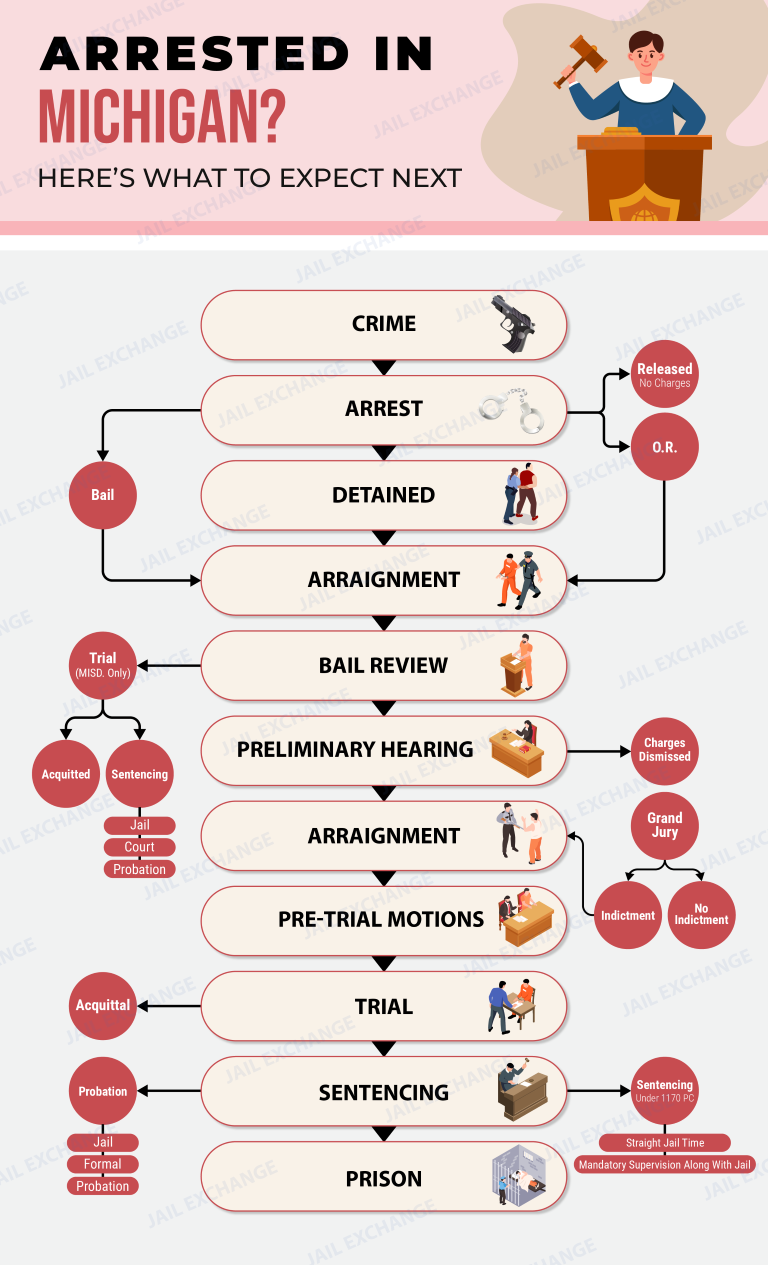
Information for this service is currently unavailable.
Express Account (TIGGS) Inmate Trust Deposits
Provider: Express Account / The Inmate Goods & Gifts Solution (TIGGS)
Express Account (operated by TIGGS) provides a secure online payment portal allowing family and friends to deposit funds directly into an incarcerated person's jail trust and canteen account using a debit or credit card. Deposited money gives inmates the financial balance required to independently buy food items, hygiene supplies, writing materials, and over-the-counter medication from the facility store.
Important: Facility Banking Rules Differ Across Jails
Once a person is booked and moved to a cell, facilities do not always allow cash drop-offs or phone payments directly to the jail window. Some might and you should confirm this by calling the facility and asking. But if you do not register online and fund your loved one's trust account immediately, they may be forced to wait days or weeks for standard paper processing, leaving them without essential soap, clean undergarments, basic medical sundries or snacks.
Step-by-Step Instructions to Register and Deposit Funds
- Confirm the inmate's legal first and last name, date of birth, and assigned facility booking ID number.
- Navigate to www.expressaccount.com on your computer or mobile browser.
- Click on Send Money or Make a Deposit.
- Select the state and the detention center where your loved one is currently detained.
- Search for the inmate to confirm their active housing record and verify their identity matches the facility roster.
- Choose your deposit amount, review the card processing and convenience fees, and enter your debit or credit card billing information.
- Authorize payment and save the digital receipt and transaction authorization number for your financial records.
What the Inmate Needs to Do
The inmate does not need an internet connection to receive trust funds. Once the electronic payment clears, the funds post directly to their ledger balance in the jail's internal commissary management system. The inmate can verify their balance at a housing pod kiosk or on their weekly trust statement to place orders during the next scheduled commissary cycle.
Official Provider: Express Account Official Website
Customer Service Telephone: 1-866-422-6833
Support Hours: Monday – Friday, 8:00 AM – 5:00 PM CST
Supported Languages: English and Spanish
Other Services Provided by Express Account (TIGGS)
In addition to Inmate Trust Deposits, Express Account provides direct care package delivery services at participating facilities:
- Commissary & Gift Package Ordering: Order pre-approved snack boxes, food packages, and personal care essentials delivered directly to the jail.
• Learn more on our website: Commissary Ordering Guide | • Visit official vendor page: Express Account Package Orders
Deposit Money for an Inmate in the Eaton County Jail
Families have four ways to add money to an inmate trust account at the Eaton County Jail in Charlotte.
- Online: Go to eXpress Account and pay by debit or credit card.
- By phone: eXpress Account's automated line, 1-866-422-6833, takes card payments 24 hours a day.
- Lobby kiosk: The kiosk in the Sheriff's Office lobby takes cash or a credit card, day or night.
- By mail: Make a money order out to the inmate and mail it to Eaton County Sheriff's Office - MO, 1025 Independence Boulevard, Charlotte, MI 48813.
Trust accounts will not take personal or business checks, coins or foreign money. Canteen Services runs the jail store. A person with no money still gets the hygiene and communication supplies the law requires, and that cost is billed to them after release.
Personal mail for the Eaton County Jail in Charlotte goes to an outside mail-processing service, not to the jail. Paper letters that arrive at the jail building are sent back, except newspaper subscriptions. Money orders, legal mail and newspapers are the items that still go to the jail on Independence Boulevard.
Personal mail (to the processing service):
Inmate's Full Name & Inmate ID#
Eaton County Jail, MI
C/O Mail Processing Center
P.O. Box 9186
Seminole, FL 33775-9186
Legal mail, newspapers and money orders (to the jail):
Inmate's Full Name & Inmate ID#
Eaton County Jail
1025 Independence Blvd.
Charlotte, MI 48813-1000
- Name and number: Start the address with the inmate's name, a dash, and their inmate ID.
- Books: The jail no longer accepts books or other reading material from publishers, whether by mail or parcel service. Inmates read books on jail tablets and can use the jail library.
- Newspapers: A newspaper subscription can be mailed to the jail address by the publisher.
- Money orders: Make the money order payable to the inmate. Put it in a plain white envelope and write "MO" with the jail's name on the first line, then the inmate's name, then the jail's street address. Personal or business checks, coins and foreign money are refused. For a faster deposit, put money on the inmate's trust account online.
- Drop-offs: Personal notes and personal items are not taken for inmates unless there is a real emergency, such as a death in the family. Street clothes are only accepted as one change of clothing for a jury trial.
- Your address: Print your full name and return address in the top left corner of every envelope.
- Ink: Use blue or black ink, with no markers, crayon, glitter or perfume.
- Returned mail: If a letter comes back, call 517-543-3512 and ask for the Corrections Clerk at extension 5051.
For quick notes, use the jail's electronic messages.

Smart Inmate (operated by Smart Communications) provides secure telecommunications services for county detention centers and local correctional facilities. Establishing an AdvancePay prepaid telephone account links calling minutes directly to your mobile phone or landline number, ensuring outbound calls placed by an incarcerated loved one connect without carrier billing interruptions.
Important: Cellular Networks Block Unfunded Inmate Calls
Inmate phone networks do not permit incoming telephone calls, and cellular carriers do not support collect billing from detention centers. While select traditional landlines may support direct monthly carrier billing, wireless smartphones and VoIP lines require an active prepaid calling balance, which you can verify by checking with your telephone service provider. If you do not register online and fund your phone account right away, your loved one will receive an automated disconnect announcement when dialing your number.
Step-by-Step Instructions to Register and Fund a Phone Account
- Visit www.smartinmate.com or call customer care at 1-888-253-5178.
- Click Sign Up and register using your primary 10-digit telephone number and email address.
- Select the state and facility where the inmate is currently housed.
- Locate the inmate using their full legal name or facility booking ID number.
- Choose your deposit amount ($25, $50, or custom amount) and enter your credit or debit card billing information.
- Authorize payment, save your confirmation number, and confirm that your mobile phone does not filter automated correctional phone lines as spam.
What the Inmate Needs to Do
The inmate dials your 10-digit telephone number from any dayroom telephone and keys in their assigned PIN. The automated system verifies that your phone number has an active prepaid balance and connects the call once you press the prompted number to accept. All personal telephone calls are recorded and monitored by facility investigators.
Official Provider: Smart Inmate Official Website
Customer Service Telephone: 1-888-253-5178
Support Hours: Monday – Friday, 7:00 AM – 7:00 PM EST
Supported Languages: English and Spanish
Other Services Provided by Smart Communications
In addition to Phone Calling, Smart Communications provides digital messaging and visitation options via its companion portals:
- SmartJailMail Two-Way Messaging: Send electronic messages and photos directly to an inmate's housing unit kiosk.
• Learn more on our website: Digital Messaging Guide | • Visit official vendor page: SmartJailMail Messaging - SmartJailMail Remote Video Visits: Schedule and join live video visits from home using your computer or smartphone.
• Learn more on our website: Video Visitation Guide | • Visit official vendor page: SmartJailMail Video Visits
Smart Communications provides the SmartJailMail digital communications system, enabling two-way electronic messaging, photo sharing, and digital mail delivery for county jails and correctional facilities across the United States. Messages and approved digital photos clear electronic screening in hours, eliminating postal delays.
Important: Postal Mail Transition and Digital Message Credits Vary
Inmates cannot receive incoming phone calls, and traditional postal mail rules differ across correctional agencies. While some facilities still allow regular handwritten letters, many facilities utilizing Smart Communications have completely eliminated physical mail delivery, redirecting postal letters to a central scanning hub or mandating direct digital messaging, which you can verify by checking facility rules. If you do not register online and purchase message credits immediately, your loved one may face lengthy communication delays while waiting for updates from home.
Step-by-Step Instructions to Register and Send Messages
- Visit www.smartjailmail.com and click Sign Up to create a free user profile.
- Verify your email address and primary telephone number.
- Search for the inmate by selecting the state, detention facility, and entering their legal name or booking ID.
- Send an electronic contact connection request to link your account to the inmate's profile.
- Purchase a messaging credit bundle using a debit or credit card.
- Compose your message in the text editor and attach approved JPEG photos if permitted by facility guidelines.
- Submit your message to the facility's screening queue.
What the Inmate Needs to Do
All electronic correspondence is screened by facility staff before delivery. Once approved, messages appear in the inmate's inbox on their housing unit Smart Communications kiosk or tablet. The inmate opens the message, views attached photos, and types an electronic reply using their available credits.
Official Provider: SmartJailMail Official Website
Customer Service Telephone: 1-888-253-5178
Support Hours: Monday – Friday, 7:00 AM – 7:00 PM EST
Supported Languages: English and Spanish
Other Services Provided by Smart Communications
In addition to Two-Way Messaging, Smart Communications operates video visitation and phone services at participating facilities:
- Remote Video Visitation: Schedule and join live face-to-face video visits from your computer or smartphone.
• Learn more on our website: Video Visitation Guide | • Visit official vendor page: SmartJailMail Video Visits - Smart Inmate Phone Services: Prepay for phone calling credits so your loved one can call your mobile phone directly.
• Learn more on our website: Inmate Phone Time Guide | • Visit official vendor page: Smart Inmate Calling
Smart Communications Inmate Tablets & Digital Services
Provider: Smart Communications (SmartJailMail / SmartPad)Smart Communications deploys secure, corrections-grade handheld tablets (SmartPad) to incarcerated individuals in county detention facilities. Operating on a secure internal wireless network, these devices allow inmates to conduct remote video visits, make voice telephone calls, send and receive electronic messages, stream approved music, read digital books, and access self-help resources directly from their housing pods.
Important: Tablet Hardware Deployment and Rental Rules Vary
Detention centers do not manage tablet distribution identically. While some agencies issue individual personal tablets to every detainee at booking, others utilize shared pod docking stations or restrict tablet use to specific dayroom hours, which you should confirm with the facility directly. Although core educational and legal resources are generally provided free of charge, sending messages, listening to music, or making phone calls from the tablet requires an active balance funded by outside contacts.
Step-by-Step Instructions to Support and Fund SmartPad Tablets
- Verify that Smart Communications handheld tablets are active at your loved one's specific detention facility.
- Navigate to www.smartjailmail.com on your computer or mobile device.
- Sign into your verified user profile and link the inmate's legal name and booking ID number.
- Select Messaging Credits or Inmate Media Funds to add funds to their available balance.
- Specify your deposit dollar amount, review convenience fees, and enter your credit or debit card billing details.
- Submit payment, save your confirmation receipt, and notify your loved one that their device balance is available.
What the Inmate Needs to Do
The inmate unlocks their assigned tablet using their PIN or biometric scan. Their available balance appears on the screen, allowing them to download songs, read digital books, write messages, and communicate with approved family members. Devices are returned to charging racks during facility count times and for overnight storage.
Official Provider: SmartJailMail Official Website
Customer Service Telephone: 1-888-253-5178
Support Hours: Monday – Friday, 7:00 AM – 7:00 PM EST
Supported Languages: English and Spanish
Other Services Provided by Smart Communications
In addition to Tablet Services, Smart Communications provides several other communication, financial, and visitation options:
- SmartJailMail Two-Way Messaging: Send electronic messages and photos directly to an inmate's housing unit kiosk.
• Learn more on our website: Two-Way Messaging Guide | • Visit official vendor page: SmartJailMail Messaging - Remote Video Visitation: Schedule and join live face-to-face video visits from your computer or smartphone.
• Learn more on our website: Video Visitation Guide | • Visit official vendor page: SmartJailMail Video Visits - Smart Inmate Phone Services: Prepay for phone calling credits so your loved one can call your telephone directly.
• Learn more on our website: Inmate Phone Time Guide | • Visit official vendor page: Smart Inmate Calling - Inmate Trust & Commissary Deposits: Send money directly into an inmate's jail trust account for independent commissary spending.
• Learn more on our website: Trust Deposits Guide | • Visit official vendor page: Smart Communications Deposits
Eaton County Juvenile Facilities
Nearby counties
- Jail (Main): 517-543-3512
- Administration: 517-543-5041
- Delta Phone Sheriff Office: 517-323-8480
- Lansing Phone Sheriff Office: 517-372-8217
- Sheriff: 517-543-3512
The Eaton County Jail serves the following cities and towns of Eaton County: Bellevue, Brookfield, Charlotte, Delta, Dimondale, Eaton Rapids, Grand Ledge, Hamlin, Lansing, Mulliken, Olivet, Potterville, Roxand, Sunfield, Vermontville and Windsor.