
Jackson County Chanter Road Jail
Jackson County Chanter Road Jail
Chanter Road Jail
517-768-1609Jackson County Inmate Search: Where They Are and What to Do Next
Sheriff's deputies in Jackson take arrested adults to one of two county jails: the Wesley Street Jail, 212 W. Wesley Street, Jackson, MI 49201, or the Chanter Road Jail, 1995 Chanter Road, Jackson, MI 49201. Below you will find answers on mugshots, bail, lawyers, visits, money and mail.
Type the person's name into the jail lookup. A hit means they are in custody. Very recent bookings may lag behind, so phone the jail to learn the charge and the bond.
Right now, call the Wesley Street Jail desk at 517-768-7900. Say the full name and birth date. Ask which building holds them. Next, skim our bail guide and court guide.
Read inmate search answers
 Read inmate search answers
1. Using the Jackson County jail search step by step
The county does not say whether one lookup covers both buildings. Here is the process:
- Go to the online jail lookup.
- Put in the family name. Use a first name too only when you get a long list.
- Nothing? Try other spellings, a middle name or an older surname.
- If a row appears, match the birth date to be certain of the person.
- Phone the jail for anything the screen leaves out.
The county also lists a general jail line for both buildings, 517-768-4833.
↑ Back to the question list2. The name is missing from the results. What now?
A blank result can have an ordinary cause:
- Booking is not done. Staff need time to enter a new arrest.
- A town police cell. The local officers may hold the person briefly first.
- Back on the street. A small bond posted at the jail, or release ordered at the first hearing, may have freed them.
- Another county. They may sit in a jail elsewhere.
- A minor. Adult jails do not take people under 18.
Phone 517-768-7900 and ask for Booking. Central Dispatch, 517-787-7913, may be able to point you to the arresting department.
↑ Back to the question list3. Which of the two jail buildings might hold them?
The Sheriff runs both jails. Nothing on the county's pages points to a work release site, an annex or a town lockup.
- Wesley Street Jail, 212 W. Wesley Street, Jackson, MI 49201, 517-768-7900. The Sheriff's Department works out of this same building.
- Chanter Road Jail, 1995 Chanter Road, Jackson, MI 49201, 517-768-1609. Among others, it houses trustees, who are inmates trusted with extra duties.
Pages from the county do not tell us which building has men, women, people awaiting trial or people serving time. Ask the desk before you travel. A person already sentenced to state prison is not here. See the prison answer below.
↑ Back to the question list4. Will I see mugshots in the Jackson County search?
The county does not say its lookup displays mugshots. Staff do use digital photos at booking. Michigan's Attorney General has written that pictures police take of suspects are public records. Still, an agency can refuse if handing one over would badly and needlessly invade privacy. Ask in writing under Michigan's public records law, the Freedom of Information Act (MCL 15.231 et seq.).
Send your request to the arresting agency. For a Sheriff's arrest, phone 517-768-7900 and ask how to file one.
- For ICE photos, use the ICE records page.
- Booking photos from federal arrests are generally not handed out. Only the U.S. Marshals Service may release one, if it is trying to catch a fugitive.
5. Is there a free way to be told when they walk out or transfer?
Yes. Michigan's VINE service reports releases, transfers and escapes from county jails and state prisons, plus court events.
- Dial 800-770-7657 at any hour.
- Or use the VINELink site.
- Enter the full name, then pick phone, text or email.
Treat a VINE message as a bonus. For news on the same day, ask the desk at 517-768-7900.
↑ Back to the question list6. Bail and release after a Jackson County arrest: how it works
Without needless delay, the person is brought before a judge or magistrate, who may join by video from the jail. The 12th District Court, 312 S. Jackson Street, Jackson, MI 49201, handles this. Its magistrate line is 517-768-6859.
- Interim bond. For certain minor charges, a deputy in charge at the jail can take a modest bond when no magistrate is free. If the arrest involves domestic violence, the person stays put until a judge or magistrate names a bond.
- The first hearing. The usual result is release on a signed promise or a bond with no cash up front, sometimes with rules such as no contact with the person who was hurt. Money bail comes only when the judge states that nothing milder will work.
- Paying money bail. A family may give the court clerk 10 percent of the amount. Another route is a licensed bond agent that the court approves.
- Getting the 10 percent back. A court rule changed on May 1, 2026. Now the court may keep it only after a guilty finding on a covered crime. Otherwise the deposit is refunded, less any fines or costs.
Our bail guide has more steps. For the state's rules, see Michigan bail laws. A skipped court date can cost the bond.
↑ Back to the question list7. How do I get the exact charge?
Ask the jail desk at 517-768-7900 what the person was booked for. The prosecutor may later change it.
Once a case is open, search it on MiCOURT. If it does not appear, phone the 12th District Court's criminal side at 517-788-4260. The Prosecuting Attorney answers at 517-788-4283.
↑ Back to the question list8. Can the court give them a free attorney?
At the first hearing the court has to bring up a lawyer. The judge then decides if the person gets a free one. Having bond money does not shut the door on that help.
- The county directory shows a Public Defender office at 517-768-6842.
- The Michigan Indigent Defense Commission takes general questions at 517-657-3066.
Families may also pay a private attorney. Keep case details for that attorney, since jail calls are taped.
↑ Back to the question list9. Visiting hours at the two Jackson County jails
The buildings keep separate days. Each is open for visits from 7:15 a.m. to 2:30 p.m.
- Chanter Road: Thursday for last names A to K, Friday for L to Z. Staff break for lunch from 11:30 a.m. to 1:00 p.m.
- Wesley Street: Saturday for A to K, Sunday for L to Z. Lunch break runs 11:00 a.m. to noon. Spots are first come, first served.
Other rules:
- A person may have visitors once held for 7 days.
- Three visitors a day at most, and three in the room at once. Come as a group.
- Carry state ID. Visits run about 15 minutes, and talk is recorded.
- Leave food, drinks, bags, purses and phones outside.
- Children need to stand at least 48 inches tall. Anyone under 17 must have a parent along.
Phone 517-768-7900 to ask if the A to K split uses the inmate's name. See our visiting guide too.
↑ Back to the question list10. Putting funds on their jail account
You can add funds at any hour in two ways.
- Use a kiosk in the lobby of either jail.
- Go to Express Account online, which the county names for families. Choose Michigan, then Jackson County.
Have the full name and inmate ID ready. Do not send cash by mail. Our money guide has the basics and our commissary guide shows what it can buy. For trouble, call 517-768-7900.
↑ Back to the question list11. Phone calls, texts and video from the jails
Inmates dial out only, between 7 a.m. and 11 p.m. Each call is billed to the receiver or paid from a prepaid SMART account. Nobody inside can take an incoming call or message.
SmartJailMail.com lets you send electronic notes and pictures, which staff monitor. Its help line is 888-843-1972. The county's visiting rules never mention video from home, so ask the desk.
Details are in our phone guide for jails and our guide to emailing inmates. Calls are taped, so skip talk about the charge.
↑ Back to the question list12. What goes on the envelope?
Mail sent to a jail's street address is returned. Use this block:
Inmate Name and Inmate ID number
C/O Mail Processing Center
PO Box 9167
Seminole, Florida 33775-9167
Letters and postcards are accepted. Staff scan every piece, and the inmate views the scan on a kiosk or tablet. For rules on pictures or books, call 517-768-7900. Our mail guide adds more.
↑ Back to the question list13. What becomes of their belongings?
Nothing on the county's pages explains how belongings are stored or returned to family. Phone 517-768-7900 first. Ask who may collect, what ID to show, and which building holds the bag.
↑ Back to the question list14. Getting medical help for someone locked up here
Phone the desk at 517-768-7900. Share the name, the problem, and any medicine with its dose and prescriber, if you know them.
The person can tell jail staff about the problem. If a problem stays open, the county says to go to the Corrections Deputy, then the duty Sergeant. For a true emergency, dial 911.
↑ Back to the question list15. Could a warrant be out under their name?
Call 517-768-7900 and ask whether one exists for the person's name. You can also open the 12th District Court active warrant list. For case records, try MiCOURT, and ask the court clerk when a case does not show. To clear a warrant, speak with an attorney before you go anywhere, since turning yourself in is a big step. After that, get in touch with the issuing court. The District Court sits at 312 S. Jackson Street, Jackson, MI 49201, 517-788-4260.
↑ Back to the question list16. Who knows when the next hearing is?
The court holding the case has the answer:
- 12th District Court, 312 S. Jackson Street, Jackson, MI 49201, 517-788-4260. It takes lesser crimes and the opening steps of felonies. Traffic matters go to 517-788-4250.
- Circuit Court, Jackson County Courthouse, 312 S. Jackson Street, Jackson, MI 49201, administration 517-788-4450. Felonies move here after the early hearings.
The District Court is open weekdays from 8 a.m. to 4:30 p.m. and closes for lunch from 11:30 a.m. to noon. Ask the Circuit Court for its hours. A felony case often has a conference one to two weeks after arraignment, then an exam follows roughly a week later. Our court guide explains every stage.
↑ Back to the question list17. A federal arrest: who has them and where do they go?
This area falls in the Eastern District of Michigan, Southern Division. Court is in Detroit at the Theodore Levin U.S. Courthouse, 231 W. Lafayette Blvd., Detroit, MI 48226. The clerk answers at 313-234-5000.
- A federal judge sits at the detention hearing, which settles pretrial custody (18 U.S.C. 3142).
- The U.S. Marshals Service works from Room 300 of that courthouse, 313-202-0135. Ask them where the person sleeps.
- Follow the case on PACER, the federal docket site.
- After a sentence, search the Federal Bureau of Prisons locator.
18. Immigration agents want to take the person: what happens?
The usual order of events is:
- ICE gives the jail a hold request called Form I-247A.
- Under 8 CFR 287.7(d), the jail can keep the person up to 48 hours after they would otherwise be released.
- ICE picks them up. Use the ICE Online Detainee Locator with a name and country of birth.
- No match? Call the ICE field office, 985 Michigan Avenue, Suite 207, Detroit, MI 48226, 313-771-6601. It serves Michigan and Ohio.
19. Looking up someone sentenced to a state prison
Following a sentence to prison, the first stop is a state intake center, and deputies make the drive. The Reception and Guidance Center in the city of Jackson receives men. Women are received at the center in Ypsilanti. Intake takes about a month to six weeks. Visitors are turned away during it, yet letters and deposits still reach the person.
- Check the OTIS offender search from the Department of Corrections.
- See our Michigan prisons guide for each facility's rules.
State prisoners never appear in the county jail lookup.
↑ Back to the question list20. A teenager was picked up: what happens in Jackson County?
A 17-year-old is a juvenile in Michigan, as of 2021. The case is handled in the circuit court's Family Division, and the law keeps the youth out of sight and sound of adults. To learn where a teen is held, phone the Probate Court and Family Division at 517-788-4290.
The county also runs a Youth Center, 517-788-4460. Ask whether the teen is there. A judge may send someone aged 14 or older to adult court, and a few grave charges begin there.
↑ Back to the question list21. Jackson County police and who patrols where
Which agency made the stop often shapes where the person is first held. Central Dispatch can say who covers a given street.
- Jackson County Central Dispatch (non-emergency), 517-787-7913
- Jackson County Sheriff's Office, 212 W. Wesley Street, Jackson, MI 49201, 517-768-7900.
- Michigan State Police, Jackson Post, 3401 Cooper Street, Jackson, MI 49201, 517-780-4580
Each city, village and township department has its own non-emergency number. Ask Central Dispatch which one applies.
↑ Back to the question listJackson County bail and bond: the county jail, the courthouse, and the prisons that confuse everyone
After an arrest in Jackson County, a person is held by the Sheriff's Office at the Wesley Street jail, 212 West Wesley Street, Jackson, MI 49201. A second Sheriff's building sits on Chanter Road, so ask which one holds your person. Below, you will see where bond is paid and how it works.
Enter a last name in the county's jail lookup for custody and bond. Our Inmate Search page shows recent arrests, warrants and public defenders.
Phone the Sheriff's Office at 517-768-7921 and ask where cash is taken and which building to visit. After that, our court page covers hearings.
1. My relative is "in Jackson," but is that the county jail or a prison?
Jackson is home to several state prisons, including Cooper Street Correctional Facility, G. Robert Cotton Correctional Facility, Parnall Correctional Facility and the Egeler Reception and Guidance Center Annex. Those are run by the state for people already sentenced, and they are not on the county jail search.
Someone just arrested is held by the county. Search Jackson County Inmate Search first. If the name is not there and the person was sentenced to prison, the state corrections department is the place to ask. If you are unsure, call the sheriff at 517-768-7921.
↑ Back to the question list2. Where is the Jackson County jail, and is it one building?
Public listings put the sheriff's office and jail at 212 West Wesley Street, Jackson, MI 49201. Some listings also show a second sheriff's building on Chanter Road. I could not confirm from a county page which building holds people, so ask the desk at 517-768-7921 before you drive anywhere.
A 2022 news story described the jail building as more than 70 years old. Voters turned down a millage that year that would have paid for an addition, so the county kept running with its old facilities then.
↑ Back to the question list3. How do I find the bail amount and the next court date?
Start with Jackson County Inmate Search for the booking and any amount. The 12th District Court, at the courthouse on South Jackson Street, handles misdemeanors and the first step of felonies. Its number is 517-788-4260. The 4th Circuit Court handles felonies after that and is at 517-788-4268.
↑ Back to the question list4. Where do I take money to post a bond in Jackson?
I could not read a posted window, hours or payment list for Jackson. Do not guess. Call the sheriff at 517-768-7921 and ask where cash is taken, which payment types are accepted, and whether the district court must be open.
Ask whose name goes on the receipt. Cash posted by a defendant can be applied to fines, costs and assessments before any refund.
↑ Back to the question list5. Does the judge have to follow a chart of bail amounts?
Not in the way many people expect. Michigan has no statewide bail chart. The chief judge of each court often sets a local bail policy, and magistrates are expected to follow it. A felony warrant may carry limits on release before the first hearing.
I did not read a Jackson County chart with dollar figures, so I will not guess at amounts. The 12th District Court at 517-788-4260 can tell you what applies to a specific charge.
↑ Back to the question list6. Why did the judge order cash only?
Under MCL 765.6a, a person charged while already out on bail, or with two felony convictions within five years, may need a cash bond or a surety who is not a bonding company. In those cases a ten percent bond is not allowed.
The judge has to state reasons for any money bail. Ask the lawyer, or call 517-788-4260, which rule the judge relied on.
↑ Back to the question list7. Can the bail be lowered?
Yes, by a motion. Court Rule 6.106 lets either side ask a court to review release, and there is no filing fee. Before the formal felony arraignment in circuit court, a judge changes bail only for a substantial reason. After that, the court can decide fresh. The person asking carries the first burden.
A lawyer is best placed to file it. At the first hearing, ask for a lawyer if the family cannot pay for one.
↑ Back to the question list8. What does a Michigan bond agent really do?
A bond agent must hold an insurance producer license, and each court approves agents on its own terms. The state does not set a premium that I could find, so compare more than one and get the terms in writing before you sign.
The agent promises the court that the person will appear. The agent is not responsible for other conditions of release.
↑ Back to the question list9. Can my house be used as security?
The rule says real property may secure a bond with the court's consent and proof of value. I did not read Jackson-specific steps. Call the 4th Circuit at 517-788-4268 or the district court at 517-788-4260 before you collect deeds and tax papers.
↑ Back to the question list10. How soon is the first court hearing?
The law requires an arraignment without unnecessary delay, and the constitutional limit for holding someone arrested without a warrant before a judge reviews the case is generally 48 hours. A judge or magistrate must be on call every day for felony bail.
↑ Back to the question list11. When can bail be denied?
Only under the state constitution's short list: murder and treason, certain first-degree sexual, armed robbery and kidnapping charges, and certain repeat or on-release violent felonies. If a court denies bail, trial must start within 90 days unless the defense asks for delay.
↑ Back to the question list12. Who is the lawyer if we cannot pay?
Jackson County has its own indigent defense system under the state commission. I did not find a defender phone, so call the 4th Circuit Court at 517-788-4268. The judge will ask at the first appearance whether you need a lawyer.
↑ Back to the question list13. Where are juveniles held in Jackson County?
I did not read which youth detention center the county uses. A person under 18 may not be held with adults. Call the 4th Circuit Court at 517-788-4268 and ask for the Family Division.
↑ Back to the question list14. What if the court date is missed?
The judge may issue a warrant, revoke release and declare the bond forfeited. A mailed notice starts a 28-day window to surrender before a judgment. If a bond agent wrote the bond, the court must tell the agent within seven days. Act at once and call 517-788-4260.
↑ Back to the question listJackson County bail contacts
- Jail: Jackson County Sheriff's Office and jail, 212 West Wesley Street, Jackson, MI 49201; 517-768-7921; Jackson County jail and bond pages
- Custody lookup: Jackson County Inmate Search
- Courthouse: Jackson County Courthouse, 312 S. Jackson St., Jackson, MI 49201
- District court: 12th District Court, 517-788-4260
- Circuit court: 4th Circuit Court, 517-788-4268
- Public defense: Ask the circuit court at 517-788-4268
- Juvenile: Ask the Family Division through 517-788-4268
Jail addresses, phone lines and court procedures change, and a judge can order different terms in any case. Verify with the sheriff or the court before paying anyone. This is a plain-language guide, not a lawyer's opinion.
How Do I pay Bail for Someone Arrested in Jackson County?

eXpress Account provides an electronic bail and bond processing service that allows family members to post court appearance bonds, cash bail, and facility fee contributions online using a credit or debit card. By submitting payments remotely, you eliminate the need to obtain cashier's checks or deliver physical cash directly to the detention facility booking window.
Important: Verify Bond Status Before Submitting Payment
Bail posting rules and release timelines are set by individual detention centers and municipal courts. Some facilities permit partial community bond payments, while others mandate full bail settlement before processing release paperwork. You must contact the jail booking desk to confirm that booking is complete, the bond amount is current, and no additional warrants or holds exist, as card processing charges cannot be refunded once an authorization is completed.
Step-by-Step Instructions to Post Bail Online
- Confirm the inmate's legal first and last name, date of birth, and assigned booking identification number with the facility.
- Navigate to expressaccount.com on your computer or mobile browser.
- Sign into your verified account or select the option to make a bond deposit.
- Select the state and facility where the individual is currently detained.
- Locate the defendant's record to ensure the electronic payment attaches to the active jail booking file.
- Enter the bond payment amount, review the calculated convenience fees, and input your card billing details.
- Authorize payment, print or save your digital confirmation receipt, and call the booking desk to notify staff that the bond has cleared.
What the Inmate Needs to Do
The booking officer verifies electronic receipt of the bond funds within the facility's administrative management system. Staff then print the official appearance bond and conditions of release. The inmate is called to the booking counter to review and sign their paperwork, after which staff complete property return and physical release.
Official Provider: eXpress Account Official Website
Customer Service Telephone: 1-866-422-6833
Support Hours: Monday – Friday, 8:00 AM – 4:00 PM EST
Supported Languages: English and Spanish
Other Services Provided by eXpress Account
In addition to Cash Bail & Bond Deposits, eXpress Account handles communication, trust banking, and care package services:
- Inmate Trust Money Deposits: Send canteen funds directly into an incarcerated person's jail trust account.
• Learn more on our website: Inmate Trust Deposits Guide | • Visit official vendor page: eXpress Account Trust Deposits - Commissary & Gift Package Ordering: Order pre-approved snack boxes, food packages, and clothing delivered directly to the jail.
• Learn more on our website: Commissary Ordering Guide | • Visit official vendor page: eXpress Account Store Packages - Digital Resident Messaging: Send electronic messages and letters directly to facility kiosks or for staff printing.
• Learn more on our website: Digital Messaging Guide | • Visit official vendor page: eXpress Account Messaging
Visiting the Jackson County Chanter Road Jail
Before you leave, confirm your family member is at the Chanter Road Jail, 1995 Chanter Road, Jackson, MI 49201. Call 517-768-1609 for that building or 517-768-4833 for county jail information.
Home video and the free jail visit
Register through SmartJailMail with government-issued photo ID. Once approved, choose Schedule a Visit and select the available appointment for your family member. Sign in 15 minutes before a home visit. The county allows one free 20-minute visit at the jail per inmate each week; reserve it 24 hours ahead and select on site when booking online.
Published visiting windows (Eastern)
- Smart video: 7–11:45 a.m., 1–3:45 p.m. and 5:30–10:45 p.m.
- Face-to-face: 7–10 a.m., 3–4 p.m. and 7–9 p.m. Ask the jail which appointments apply to the person you are visiting.
The same county instructions also show a general 7:30 a.m.–10:20 p.m. range and note security closures. The Sheriff’s FAQ separately lists surname appointments from 1–2:30 p.m. Wednesday (A–F), Thursday (G–M) and Friday (N–Z), with a Saturday 1–2:30 p.m. slot for Chanter Road trustees. Use the confirmed times shown in Smart for video and call the jail before traveling for a face-to-face visit.
Leave bags, food, drinks and recording devices outside. The Sheriff’s FAQ says children under 17 or under 48 inches tall must be accompanied by an adult with identification; confirm the rule for your appointment.

SmartJailMail Video Visitation provides a secure online platform that enables families and friends to conduct live, face-to-face video visits with incarcerated loved ones from home. Using an internet-connected smartphone, tablet, or personal computer equipped with a webcam, visitors can connect directly without traveling to the facility.
Important: Advance Registration and Visitor Clearance Required
Detention centers do not permit unscheduled or unverified video sessions. Correctional facilities require prospective visitors to submit government-issued photo identification and receive administrative clearance before booking an appointment, an approval process that can take up to 48 hours depending on facility staffing. You should verify your visitor approval status with the facility prior to scheduling. If you do not register well in advance, you will miss your loved one's scheduled visiting window for the week.
Step-by-Step Instructions to Register and Schedule a Video Visit
- Visit www.smartjailmail.com and sign into your account.
- Register your visitor profile and upload a clear photograph of your government-issued ID (driver's license or passport) for facility background review.
- Wait for email notification confirming facility visitor approval.
- Select Video Visitation, choose the detention facility, and select the inmate.
- Browse the available schedule calendar, select an open time slot, and pay the visitation fee using a credit or debit card.
- Log into the website 10 minutes prior to the start time on a device with a functioning camera, microphone, and reliable high-speed internet connection.
What the Inmate Needs to Do
The inmate receives a visitation notification on their housing unit video kiosk or tablet. At the appointed time, they log in with their PIN and sit before the terminal. Inmates and visitors must strictly observe jail dress and conduct rules; sessions are monitored by staff and will terminate immediately upon any violation.
Official Provider: SmartJailMail Official Website
Customer Service Telephone: 1-888-253-5178
Support Hours: Monday – Friday, 7:00 AM – 7:00 PM EST
Supported Languages: English and Spanish
Other Services Provided by Smart Communications
In addition to Remote Video Visitation, Smart Communications provides electronic messaging and phone calling services:
- SmartJailMail Two-Way Messaging: Send electronic messages and photos directly to an inmate's housing unit kiosk.
• Learn more on our website: Two-Way Messaging Guide | • Visit official vendor page: SmartJailMail Messaging - Smart Inmate Phone Services: Prepay for phone calling credits so your loved one can call your telephone directly.
• Learn more on our website: Inmate Phone Time Guide | • Visit official vendor page: Smart Inmate Calling
Jackson County Criminal Courts in Jackson: Hearings, Lawyers and Next Steps
Court cases for people arrested in Jackson County begin at the Jackson County Courthouse, 312 S. Jackson St., Jackson, MI 49201. The 12th District Court, 517-788-4260, handles the first hearing. Felonies go on to the 4th Circuit Court, and adults wait at the Wesley Street jail.
See whether someone is held by using the jail's name search. Our Jail Roster page adds charges, mugshots and active warrants.
Call the 4th Circuit Court at 517-788-4268 and ask where the case stands. To learn how people get out, see our bail page.
1. Where does a family go for court information in Jackson County?
After an arrest, knowing the difference between District Court and Circuit Court can make the next steps less confusing. In Jackson County, Michigan , lower-level criminal charges and the opening stages of felony cases are generally handled in District Court . Most felony trials and felony sentencing belong in Circuit Court . Juvenile delinquency cases generally go through the Family Division of Circuit Court. The Jackson County Prosecuting Attorney represents the state. Jackson is the county seat.
2. Someone you love was arrested in Jackson County. What do you do first?
Write down the person’s full name and birth date, the arresting agency, the booking location, the court matter number if available, and the next hearing date. Ask the jail whether the person is still in custody and whether a bond or other release order has been entered. The jail handles custody; the court sets bond and court dates. The District Court ordinarily handles a misdemeanor case and the first felony hearings. The Circuit Court ordinarily handles the felony after the preliminary stage. A relative may be able to attend public hearings, but the judge and appointed lawyer—not a jail officer—determine how the legal case moves forward.
- 12th District Court — 312 S. Jackson St., Jackson, MI 49201. 517-788-4260.
- District Court: Hears most misdemeanors and holds the first hearings in felony cases, including arraignment and preliminary examination.
- Circuit Court: Handles felony trials, pleas, sentencing, and appeals assigned by Michigan law.
- Family Division of Circuit Court: Handles juvenile delinquency proceedings and related matters.
- Jackson County Prosecuting Attorney: Represents the state in local criminal prosecutions.
- Appointed defense lawyer: People who cannot afford counsel in qualifying criminal cases can request an appointed attorney.
- Local jail and custody: County sheriffs normally manage local jail custody; a court may order release with conditions or continued detention.
Where does a case start? Someone arrested in Jackson County may first be booked by police and brought before a judge or magistrate. The charge determines which court hears the case, and the written notice controls where the defendant must appear. Michigan District Courts decide most misdemeanors and handle the first steps of felonies. Circuit Court generally takes over a felony after a waiver or a finding of probable cause at the preliminary examination.
What happens to someone waiting in jail? The Jackson County sheriff or another authorized jail may hold the person charged while a court considers release. Custody and release decisions are recorded as part of the criminal case. A courthouse and a detention center are not necessarily on the same property.
This guide explains the usual criminal court process in Jackson County in plain language. The exact charge, criminal history, and judge’s findings affect the outcome. It is general information, not personal legal advice.
↑ Back to the question list2. What are the steps in a minor criminal case in Jackson County?
In Jackson County, a misdemeanor may start with a ticket or a notice to appear, while a more serious situation can lead to arrest and booking. Examples include certain assaults without serious injury, shoplifting and some impaired-driving charges. The criminal accusation written on the paperwork matters because Michigan has different penalties for different misdemeanors.
Arraignment: what the judge decides about bail
At arraignment, the judge tells the person charged what offense is charged, explains important rights and addresses a plea and release conditions. Some people can leave on a personal promise to return; others may have money bond, supervision, travel limits or no-contact orders. A judge can also deny release where the law permits. Bail is not a punishment or proof of guilt.
The next steps once charges are read
The Jackson County District Court may schedule a pretrial hearing. Lawyers review police reports, videos and other evidence. The prosecuting attorney may offer an agreement, dismiss a charge or proceed to trial. The person charged can contest the evidence rather than accept a plea. Jury-trial rules depend on the offense and the legally available punishment.
When the court pays for an attorney
For relatives following the case, the key distinction is this: If the defendant faces a charge that qualifies for appointed counsel and does not have enough money to hire an attorney, the judge is permitted to determine eligibility for a public defender or assigned lawyer. Request this help promptly; do not assume a defender is automatically assigned after booking.
Possible misdemeanor results
Michigan misdemeanors have different maximums. Common statutory limits include 90 or 93 days, one year, and in certain cases two years, with fines fixed by the particular statute. Some offenses also require driver-license action, restitution, classes or probation. The exact charge and prior record matter more than the county name.
↑ Back to the question list3. What happens after a felony arrest in Jackson County?
A felony accusation in Jackson County normally starts with a District Court arraignment, even when the eventual trial would be in Circuit Court. Prosecutors must establish the legal basis for moving the court matter forward. A felony carries the possibility of a state-prison sentence, although not every conviction results in prison time.
Probable cause conference and preliminary examination
Michigan usually sets a probable cause conference 7 to 14 days after felony arraignment and schedules the preliminary examination roughly 5 to 7 days after that conference, unless a legal waiver, adjournment or exception changes the schedule. At the preliminary examination the state's attorneys must show probable cause that a crime occurred and that this defendant committed it. That decision is not a finding of guilt.
The handoff from District Court to Circuit Court
For a person new to the court system: When the charge is bound over, Jackson County Circuit Court handles the felony case. The defendant may be arraigned again, and the parties exchange evidence, negotiate, file motions or set a trial. The prosecuting attorney must prove guilt beyond a reasonable doubt at trial. Defendants who cannot afford legal counsel should ask the court about appointed representation.
What a felony sentence can involve
Michigan sentencing rules look at the offense statute, a record of earlier convictions, the sentencing guidelines when applicable, and any mandatory minimum. A nonviolent first offender might be eligible for probation or another lawful alternative, but some violent or repeat offenses require custody. Do not use a single felony-class chart to predict all Michigan sentences.
↑ Back to the question list4. What if someone faces murder, robbery, or another violent crime in Jackson County?
Murder, armed robbery, criminal sexual conduct and assaults causing serious harm are examples of grave charges that could be prosecuted in Jackson County. Seriousness by itself does not turn a Michigan crime into a federal case. Most such charges remain in the state Circuit Court unless federal law independently applies.
Detention and defense
A judge considers Michigan’s release rules, risk of flight, safety and legally relevant facts. A no-contact order or other condition may be imposed. Some defendants remain in jail while lawyers examine records, DNA or other scientific evidence. These charges need careful legal advice and frequently involve complicated court motions.
Trial and possible prison terms
In practice, it works this way: First-degree murder carries mandatory life without parole for adults under Michigan law, subject to legally applicable exceptions and youth-sentencing rules. Second-degree murder can carry a sentence up to life imprisonment. Armed robbery and several serious criminal sexual conduct crimes can also carry very long terms. Other violent offenses have their own penalty sections. Michigan does not have the death penalty.
Victim and family support
The Jackson County Prosecuting Attorney may have a victim-witness unit that explains hearing notices and available services. The defense attorney protects the legal rights of the person charged. The amount of time a case takes depends on witnesses, evidence, motions and the court calendar.
↑ Back to the question list5. What happens when a person under 18 is arrested in Jackson County?
A youth accused of breaking a criminal law in Jackson County in most situations appears in the Family Division of Circuit Court instead of an adult District Court. Michigan juvenile proceedings emphasize the child’s age, the offense, safety, and whether services can address the problem.
Intake and the first decision
After police contact, juvenile court intake may review a complaint and decide whether it needs a formal petition. Some matters can be diverted or handled through services without a full court trial. If a youth is held, the law provides for prompt judicial review, and parents or guardians should ask where the child is housed.
Hearings and possible outcomes
It helps to know: If a formal petition is filed, the court explains the allegations and the child’s rights. An adjudication hearing decides whether the state's lawyer proved the allegation under the applicable legal standard. Outcomes may include supervision, probation, counseling, treatment, restitution, or placement through the youth-services system where authorized.
When a juvenile might face adult-style prosecution
Special laws permit designation or waiver for certain serious offenses and ages; an adult criminal matter is not automatic simply because someone is charged with a felony. Juvenile and youthful-offender rules are complicated, so ask for an attorney experienced in youth cases. Many juvenile records are not open to the public.
↑ Back to the question list6. How does sentencing work for charges brought in Jackson County?
Someone arrested in Jackson County does not receive a sentence just because the police wrote a charge on a report. The prosecutor must prove the case or the person charged must enter a valid plea. If there is a conviction, the judge uses the exact charge and Michigan statute. The amounts below are legal limits for the listed offenses, not a promise that the judge will order those amounts. Fines can be accompanied by court costs, assessments and restitution to a victim.
Specific Michigan charges and their statutory punishments
- Simple assault or assault and battery (MCL 750.81(1)): Up to 93 days in jail and/or a fine up to $500 A basic assault charge without a different applicable enhancement.
- First domestic assault (MCL 750.81(2)): Up to 93 days in jail and/or $500 Prior offenses or added facts can raise penalties.
- Second domestic assault (MCL 750.81(4)): Up to 1 year in jail and/or $1,000 Prior qualifying conviction is required.
- First ordinary drunk-driving offense (OWI) (MCL 257.625(9)(a)): Up to 93 days in jail; $100–$500 fine; up to 360 hours community service Driver’s-license consequences and other costs may also apply.
- First high-BAC OWI, BAC at least .17 (MCL 257.625(1)(c), (9)(a)): Up to 180 days in jail; $200–$700 fine May include ignition-interlock and license restrictions.
- OWI with one prior conviction within 7 years (MCL 257.625(9)(b)): $200–$1,000 fine plus a lawful jail or community-service penalty Specific mandatory minimums and alternative sanctions apply.
- Home invasion, third degree (MCL 750.110a(4), (7)): Up to 5 years in prison and/or $2,000 A felony; the precise grade depends on conduct.
- Home invasion, second degree (MCL 750.110a(3), (6)): Up to 15 years in prison and/or $3,000 A felony; may involve entering a dwelling to commit certain crimes.
- Home invasion, first degree (MCL 750.110a(2), (5)): Up to 20 years in prison and/or $5,000 Aggravating factors include a dangerous weapon or someone lawfully present.
- Felony with no specific punishment stated (MCL 750.503): Up to 4 years in prison and/or $5,000 Default rule only: does not replace a statute that sets its own penalty.
- Misdemeanor with no specific punishment stated (MCL 750.504): Up to 90 days in jail and/or $500 Default rule only: many offenses set different limits.
- First-degree murder (adult conviction) (MCL 750.316): Life imprisonment without possibility of parole, subject to applicable constitutional/youth exceptions Michigan does not have the death penalty.
Why a felony's sentencing-guidelines range may be different
Michigan does not have one statewide table saying all Class A felonies get one sentence and all Class B felonies get another. For eligible felonies, the judge calculates an offense-variable score based on how the crime happened and a prior-record-variable score based on the person's record. Those scores, the crime's offense category and its sentencing classification produce a recommended minimum prison-term range. That recommended range is different from the statutory maximum, which is the most prison time allowed for that crime. Courts can depart from a recommendation when lawful and must explain a reasonable departure. Mandatory minimums can override ordinary guideline calculations.
For example, a five-year maximum for third-degree home invasion does not mean that everyone convicted must serve five years. A particular defendant may receive a lower prison minimum, probation or another lawful sentence depending on the sentencing law and case facts. Michigan prison sentences frequently state both a minimum and a maximum; parole eligibility and release do not automatically happen on the minimum date.
What about probation, restitution and jail?
A judge may order reporting to a probation officer, drug or alcohol testing, classes, treatment, community service, and repayment of a victim's proven losses. Violating probation can lead to another court hearing and a new penalty. Some people serve a local jail term instead of being sent to state prison; others qualify for an alternative sentence. A defendant's lawyer can request the sentencing-information report and explain the actual scored range before sentencing.
↑ Back to the question list7. Where do federal criminal cases connected with Jackson County go?
Jackson County is part of the U.S. District Court for the Eastern District of Michigan, Southern Division. This court handles violations of federal criminal law; it is separate from Michigan District Court, despite the similar names. The southeastern Lower Peninsula location of the county determines its federal judicial assignment.
Federal courthouse and contact
- Federal court: U.S. District Court, Eastern District of Michigan, Southern Division
- Courthouse: United States District Court — Eastern District of Michigan, Detroit courthouse. 231 W. Lafayette Boulevard, Detroit, MI 48226.
- Clerk’s office telephone: 313-234-5000.
What makes a crime federal?
Examples may involve trafficking drugs in violation of federal law, bank robbery involving a federally insured institution, certain firearm violations, federal tax crimes, fraud that uses interstate communications, immigration crimes, and offenses on federal property. Crossing a state line may be relevant to some laws, but is not required for every federal charge. A serious local assault or theft is not federal simply because it is serious.
Steps in a federal criminal case
For a person new to the court system: A person may be arrested on a federal complaint or indictment and then appears before a U.S. magistrate judge. The judge reviews rights, counsel and detention or release. Serious federal charges ordinarily involve grand jury indictment unless a lawful exception applies. Discovery and motions follow; a plea or jury trial determines the outcome. A federal judge imposes sentence under federal statutes and sentencing rules, with any mandatory minimums applying where required.
Federal custody and sentences
The U.S. Marshals Service handles federal pretrial custody and transportation, frequently through contracted local facilities. People receiving federal prison sentences are in most situations placed by the Federal Bureau of Prisons. Someone arrested within a Michigan county may therefore be housed far from the county jail and may need to be found through federal channels.
↑ Back to the question list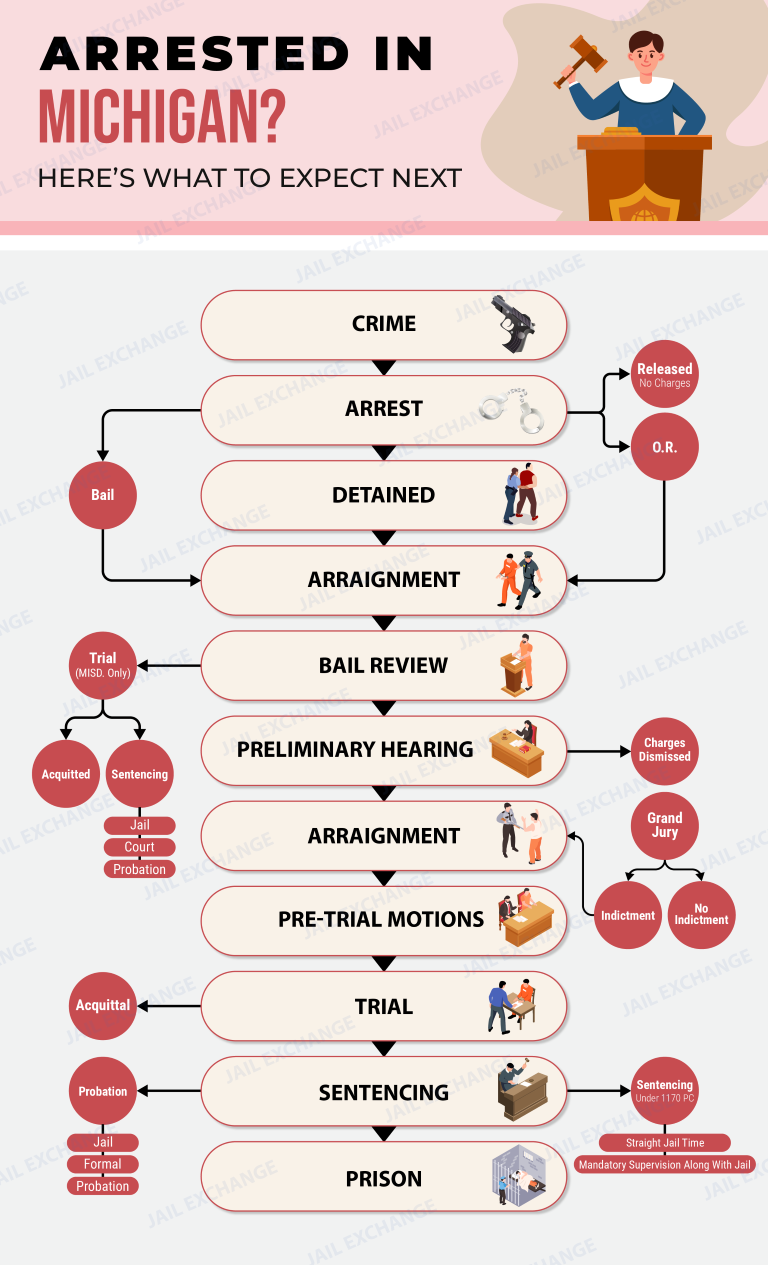
Express Account (TIGGS) Commissary Ordering
Provider: Express Account / The Inmate Goods & Gifts Solution (TIGGS)
Express Account Commissary Ordering enables family members to purchase pre-approved snack boxes, meat and cheese selections, hygiene bundles, and seasonal gift care packages sent directly to an incarcerated loved one. Each package is packed to meet institutional security guidelines, ensuring orders are approved upon arrival at the facility.
Important: Package Deadlines and Delivery Windows Vary
Detention centers do not all follow identical package distribution schedules. Some facilities allow weekly orders while others restrict shipments to bi-weekly or monthly windows, and spending limits differ widely across institutions. You should confirm the facility's active cutoff schedule and order allowances by calling them directly. If an order is placed after the weekly processing deadline, it will be held until the following distribution cycle, leaving your loved one waiting an extra cycle for fresh supplies.
Step-by-Step Instructions to Place a Package Order
- Obtain the inmate's legal first and last name, date of birth, and assigned booking identification number.
- Go to www.expressaccount.com.
- Select Send a Gift or Order Packages.
- Choose the state and facility where the inmate is currently housed.
- Search for the inmate to unlock the facility's authorized product catalog.
- Select pre-approved snacks, beverages, hygiene kits, and clothing items up to the jail's allowed spending limit.
- Enter your billing address and complete checkout with a credit or debit card.
- Save your confirmation receipt and package tracking number for your records.
What the Inmate Needs to Do
The inmate does not need an active online account to receive care packages. TIGGS packages the order in tamper-evident security boxes and delivers it directly to the facility commissary department. Jail officers inspect the shipment and deliver the items during regular housing unit commissary delivery, where the inmate signs for receipt.
Official Provider: Express Account Official Website
Customer Service Telephone: 1-866-422-6833
Support Hours: Monday – Friday, 8:00 AM – 5:00 PM CST
Supported Languages: English and Spanish
Other Services Provided by Express Account (TIGGS)
In addition to Commissary Package Ordering, Express Account handles inmate trust and canteen money transfers:
- Inmate Trust Money Deposits: Deposit funds directly into an inmate's personal account for independent canteen shopping.
• Learn more on our website: Inmate Trust Deposits Guide | • Visit official vendor page: Express Account Trust Deposits
Buy Commissary for an Inmate in the Jackson County Chanter Road Jail
Jackson County Chanter Road Jail Inmate Commissary - Sending Money or Purchasing Commissary for an Inmate
Jackson County Chanter Road Jail allows inmates to purchase commissary. This can be snacks, hygiene products, stamps, stationary, clothing and even electronics.
You can buy commissary for an inmate using an online service called Express Account.

There is a monthly limit of $200-300 on how much inmates can spend on commissary items.
This amount is subject to change so call the facility at 517-768-1609 in order to confirm the amount that cannot be exceeded.
Inmates have access to both an in-house commissary store, and commissary packages that can be purchased and shipped to the inmate by friends and family.
Scroll down for information on the Jackson County Chanter Road Jail's service they use for you being able to purchase commissary items online and have them shipped directly to the inmate.
You can also go to our Inmate Money page for information on how to send money to an inmate.
Express Account (TIGGS) Inmate Trust Deposits
Provider: Express Account / The Inmate Goods & Gifts Solution (TIGGS)Express Account (operated by TIGGS) provides a secure online payment portal allowing family and friends to deposit funds directly into an incarcerated person's jail trust and canteen account using a debit or credit card. Deposited money gives inmates the financial balance required to independently buy food items, hygiene supplies, writing materials, and over-the-counter medication from the facility store.
Important: Facility Banking Rules Differ Across Jails
Once a person is booked and moved to a cell, facilities do not always allow cash drop-offs or phone payments directly to the jail window. Some might and you should confirm this by calling the facility and asking. But if you do not register online and fund your loved one's trust account immediately, they may be forced to wait days or weeks for standard paper processing, leaving them without essential soap, clean undergarments, basic medical sundries or snacks.
Step-by-Step Instructions to Register and Deposit Funds
- Confirm the inmate's legal first and last name, date of birth, and assigned facility booking ID number.
- Navigate to www.expressaccount.com on your computer or mobile browser.
- Click on Send Money or Make a Deposit.
- Select the state and the detention center where your loved one is currently detained.
- Search for the inmate to confirm their active housing record and verify their identity matches the facility roster.
- Choose your deposit amount, review the card processing and convenience fees, and enter your debit or credit card billing information.
- Authorize payment and save the digital receipt and transaction authorization number for your financial records.
What the Inmate Needs to Do
The inmate does not need an internet connection to receive trust funds. Once the electronic payment clears, the funds post directly to their ledger balance in the jail's internal commissary management system. The inmate can verify their balance at a housing pod kiosk or on their weekly trust statement to place orders during the next scheduled commissary cycle.
Official Provider: Express Account Official Website
Customer Service Telephone: 1-866-422-6833
Support Hours: Monday – Friday, 8:00 AM – 5:00 PM CST
Supported Languages: English and Spanish
Other Services Provided by Express Account (TIGGS)
In addition to Inmate Trust Deposits, Express Account provides direct care package delivery services at participating facilities:
- Commissary & Gift Package Ordering: Order pre-approved snack boxes, food packages, and personal care essentials delivered directly to the jail.
• Learn more on our website: Commissary Ordering Guide | • Visit official vendor page: Express Account Package Orders
Deposit Money for an Inmate in the Jackson County Chanter Road Jail
At the Jackson County Chanter Road Jail, money can go on an inmate account at any hour of the day.
- Lobby kiosks: Deposits can be made 24 hours a day at the kiosks in the lobby of both Jackson County jails: Chanter Road at 1995 Chanter Road and Wesley Street at 212 W. Wesley Street, both in Jackson.
- Online: Use eXpress Account and select Michigan and Jackson County so the money lands at the right jail.
- By phone: eXpress Account takes card deposits at 866-422-6833.
- By mail: Money is not taken by mail. Use the kiosks, the website or the phone line.
Do not send cash by mail.
The Jackson County Chanter Road Jail is one of the two Jackson County Sheriff's jails in Jackson. Letters and postcards from family and friends do not go to Chanter Road. They go to a mail-scanning service, and the inmate reads the scanned pages on a kiosk or tablet. Scanning keeps out paper soaked in drugs, and personal mail sent to either jail's street address is returned to the sender.
Personal letters and postcards (scanned):
Inmate's Full Name & Inmate ID
Jackson County Jail-MI
c/o Mail Processing Center
P.O. Box 9167
Seminole, Florida 33775-9167
Legal mail, books and publications:
Inmate's Full Name & Inmate ID
Jackson County Jail
1995 Chanter Road
Jackson, MI 49201
- Addressing: Write the inmate's name and inmate ID on the first line. Check the inmate search or call 517-768-1609 for the ID.
- Letters or postcards: Either one is accepted at the scanning address.
- Your return address: The sender's name and address belong in the top left corner of every envelope or card.
- Writing: Use blue or black ink, and keep markers, crayons, glitter, confetti and drawings off the page.
- Publications: Order new books, newspapers and magazines from the publisher and have them shipped to the Chanter Road address. Excessively violent, pornographic or obscene books are not delivered.
- Photos: Pictures can be sent with electronic messages, which staff monitor.
- Packages: Packages are limited to orders placed through the jail's commissary.
- Money: Deposits to an inmate's account are made online, not by mail.

Smart Inmate (operated by Smart Communications) provides secure telecommunications services for county detention centers and local correctional facilities. Establishing an AdvancePay prepaid telephone account links calling minutes directly to your mobile phone or landline number, ensuring outbound calls placed by an incarcerated loved one connect without carrier billing interruptions.
Important: Cellular Networks Block Unfunded Inmate Calls
Inmate phone networks do not permit incoming telephone calls, and cellular carriers do not support collect billing from detention centers. While select traditional landlines may support direct monthly carrier billing, wireless smartphones and VoIP lines require an active prepaid calling balance, which you can verify by checking with your telephone service provider. If you do not register online and fund your phone account right away, your loved one will receive an automated disconnect announcement when dialing your number.
Step-by-Step Instructions to Register and Fund a Phone Account
- Visit www.smartinmate.com or call customer care at 1-888-253-5178.
- Click Sign Up and register using your primary 10-digit telephone number and email address.
- Select the state and facility where the inmate is currently housed.
- Locate the inmate using their full legal name or facility booking ID number.
- Choose your deposit amount ($25, $50, or custom amount) and enter your credit or debit card billing information.
- Authorize payment, save your confirmation number, and confirm that your mobile phone does not filter automated correctional phone lines as spam.
What the Inmate Needs to Do
The inmate dials your 10-digit telephone number from any dayroom telephone and keys in their assigned PIN. The automated system verifies that your phone number has an active prepaid balance and connects the call once you press the prompted number to accept. All personal telephone calls are recorded and monitored by facility investigators.
Official Provider: Smart Inmate Official Website
Customer Service Telephone: 1-888-253-5178
Support Hours: Monday – Friday, 7:00 AM – 7:00 PM EST
Supported Languages: English and Spanish
Other Services Provided by Smart Communications
In addition to Phone Calling, Smart Communications provides digital messaging and visitation options via its companion portals:
- SmartJailMail Two-Way Messaging: Send electronic messages and photos directly to an inmate's housing unit kiosk.
• Learn more on our website: Digital Messaging Guide | • Visit official vendor page: SmartJailMail Messaging - SmartJailMail Remote Video Visits: Schedule and join live video visits from home using your computer or smartphone.
• Learn more on our website: Video Visitation Guide | • Visit official vendor page: SmartJailMail Video Visits
Smart Communications provides the SmartJailMail digital communications system, enabling two-way electronic messaging, photo sharing, and digital mail delivery for county jails and correctional facilities across the United States. Messages and approved digital photos clear electronic screening in hours, eliminating postal delays.
Important: Postal Mail Transition and Digital Message Credits Vary
Inmates cannot receive incoming phone calls, and traditional postal mail rules differ across correctional agencies. While some facilities still allow regular handwritten letters, many facilities utilizing Smart Communications have completely eliminated physical mail delivery, redirecting postal letters to a central scanning hub or mandating direct digital messaging, which you can verify by checking facility rules. If you do not register online and purchase message credits immediately, your loved one may face lengthy communication delays while waiting for updates from home.
Step-by-Step Instructions to Register and Send Messages
- Visit www.smartjailmail.com and click Sign Up to create a free user profile.
- Verify your email address and primary telephone number.
- Search for the inmate by selecting the state, detention facility, and entering their legal name or booking ID.
- Send an electronic contact connection request to link your account to the inmate's profile.
- Purchase a messaging credit bundle using a debit or credit card.
- Compose your message in the text editor and attach approved JPEG photos if permitted by facility guidelines.
- Submit your message to the facility's screening queue.
What the Inmate Needs to Do
All electronic correspondence is screened by facility staff before delivery. Once approved, messages appear in the inmate's inbox on their housing unit Smart Communications kiosk or tablet. The inmate opens the message, views attached photos, and types an electronic reply using their available credits.
Official Provider: SmartJailMail Official Website
Customer Service Telephone: 1-888-253-5178
Support Hours: Monday – Friday, 7:00 AM – 7:00 PM EST
Supported Languages: English and Spanish
Other Services Provided by Smart Communications
In addition to Two-Way Messaging, Smart Communications operates video visitation and phone services at participating facilities:
- Remote Video Visitation: Schedule and join live face-to-face video visits from your computer or smartphone.
• Learn more on our website: Video Visitation Guide | • Visit official vendor page: SmartJailMail Video Visits - Smart Inmate Phone Services: Prepay for phone calling credits so your loved one can call your mobile phone directly.
• Learn more on our website: Inmate Phone Time Guide | • Visit official vendor page: Smart Inmate Calling
Smart Communications Inmate Tablets & Digital Services
Provider: Smart Communications (SmartJailMail / SmartPad)Smart Communications deploys secure, corrections-grade handheld tablets (SmartPad) to incarcerated individuals in county detention facilities. Operating on a secure internal wireless network, these devices allow inmates to conduct remote video visits, make voice telephone calls, send and receive electronic messages, stream approved music, read digital books, and access self-help resources directly from their housing pods.
Important: Tablet Hardware Deployment and Rental Rules Vary
Detention centers do not manage tablet distribution identically. While some agencies issue individual personal tablets to every detainee at booking, others utilize shared pod docking stations or restrict tablet use to specific dayroom hours, which you should confirm with the facility directly. Although core educational and legal resources are generally provided free of charge, sending messages, listening to music, or making phone calls from the tablet requires an active balance funded by outside contacts.
Step-by-Step Instructions to Support and Fund SmartPad Tablets
- Verify that Smart Communications handheld tablets are active at your loved one's specific detention facility.
- Navigate to www.smartjailmail.com on your computer or mobile device.
- Sign into your verified user profile and link the inmate's legal name and booking ID number.
- Select Messaging Credits or Inmate Media Funds to add funds to their available balance.
- Specify your deposit dollar amount, review convenience fees, and enter your credit or debit card billing details.
- Submit payment, save your confirmation receipt, and notify your loved one that their device balance is available.
What the Inmate Needs to Do
The inmate unlocks their assigned tablet using their PIN or biometric scan. Their available balance appears on the screen, allowing them to download songs, read digital books, write messages, and communicate with approved family members. Devices are returned to charging racks during facility count times and for overnight storage.
Official Provider: SmartJailMail Official Website
Customer Service Telephone: 1-888-253-5178
Support Hours: Monday – Friday, 7:00 AM – 7:00 PM EST
Supported Languages: English and Spanish
Other Services Provided by Smart Communications
In addition to Tablet Services, Smart Communications provides several other communication, financial, and visitation options:
- SmartJailMail Two-Way Messaging: Send electronic messages and photos directly to an inmate's housing unit kiosk.
• Learn more on our website: Two-Way Messaging Guide | • Visit official vendor page: SmartJailMail Messaging - Remote Video Visitation: Schedule and join live face-to-face video visits from your computer or smartphone.
• Learn more on our website: Video Visitation Guide | • Visit official vendor page: SmartJailMail Video Visits - Smart Inmate Phone Services: Prepay for phone calling credits so your loved one can call your telephone directly.
• Learn more on our website: Inmate Phone Time Guide | • Visit official vendor page: Smart Inmate Calling - Inmate Trust & Commissary Deposits: Send money directly into an inmate's jail trust account for independent commissary spending.
• Learn more on our website: Trust Deposits Guide | • Visit official vendor page: Smart Communications Deposits
Jackson County County Jails
Jackson County Juvenile Facilities
- Chanter Road Jail: 517-768-1609
- Adult Probation: 517-788-4280
- Jackson Police: 517-788-4100
- Prosecutor: 517-788-4283
- Public Defender: 517-768-6842
- Sheriff: 517-768-7900
- Wesley Street Jail: 517-768-7900
The Jackson County Chanter Road Jail serves the following cities and towns of Jackson County: Brooklyn, Cement City, Concord, Grass Lake, Hanover, Jackson, Leoni, Liberty, Munith, Napoleon, Parma, Pulaski, Rives, Sandstone, Spring Arbor, Springport, Summit, Tompkins, Waterloo and Henrietta.