
Johnson County Detention Center
Johnson County Detention Center
Jail Phone Number
660-747-2265Johnson County Inmate Search: Finding and Contacting a Family Member
To find someone arrested in Johnson County, open the Sheriff’s official inmate roster. Choose Current Inmates for the active list or 48 Hour Release for recent departures. Compare the identifying details carefully, and call 660-747-6469 if a recent booking is missing or the current location is unclear.
The Johnson County Detention Center is at 278 Southwest 871st Road, Centerview, MO 64019, separate from the courthouse in Warrensburg. The Sheriff lists its phone contact as available 24 hours a day. Have the person’s full legal name, birth date and approximate arrest time ready, and ask for the booking number and actual holding facility before arranging a visit, mail or a deposit.
The questions below explain mugshots, warrants, calls, visits, mail and urgent family concerns. Our Bail guide covers bond and release questions, while the Court guide helps with Johnson County records, clerk contacts and hearing locations.
Read inmate search answers
 Read inmate search answers
1. How do I find someone arrested in Johnson County?
The county roster selection page links two views: Current Inmates and 48 Hour Release. Select current housing or recent departures according to the question you need to answer. Compare the identifying details before deciding an entry is the person you mean. If the record is unclear or the location matters to a planned trip, call 660-747-6469, 278 Southwest 871st Road, Centerview, MO 64019. A filed court case can continue after someone leaves detention.
2. What if I cannot find a recent booking?
Find out which department made the arrest and where it took the person. Ask the receiving staff whether intake has finished and whether custody has moved again. Provide the legal name and arrest date, with other identifying details privately as needed. A university, city or military connection does not confirm the final holding institution. Retain the agency's incident reference and the receiving contact. Check recent departures separately when the inquiry concerns release rather than current detention.
3. Which contact should I use for jail business?
The county directory locates the Sheriff and detention center at 278 Southwest 871st Road, Centerview, MO 64019, 660-747-6469. The Justice Center for circuit-court matters is on West Market Street in Warrensburg. Confirm the counter and appointment needed before traveling. The Johnson County Detention Center overview connects family-service guides. If the person is with another receiving authority, use that institution's actual visiting, deposit and pickup procedures.
4. How can I request a booking photograph?
Identify the arrest date and agency when requesting a particular record. The Sheriff at 278 Southwest 871st Road, Centerview, MO 64019, 660-747-6469, can route a county booking inquiry. A city or university investigation can have a separate custodian after detention at the county facility. State the event reference and material requested so staff can identify the correct procedure. A photograph is not a conviction record and cannot confirm the final court judgment or current holding location.
5. How can I receive custody alerts?
Locate an available matching record through MOVANS and follow the directions for the participating agency's current registration process. Missouri began its replacement local-jail alert platform in May 2026; earlier local subscribers should register under the new instructions. Assistance is 573-526-1929. Update your registration when your contact details change. A movement alert provides custody information; the court's hearing instructions continue separately. After a reported transfer, confirm the receiving institution before making family-service arrangements.
6. What should I confirm before paying bond?
Obtain the judge's actual order, amount, case reference and allowed release type. Ask staff where the payment belongs and what documents the payer needs. The Bail guide explains the available arrangements. Before paying, confirm every additional case or agency hold that could affect discharge. Keep the receipt and written conditions. Confirm the approved collection point and timing with detention personnel; a spending-account deposit or phone transaction does not satisfy the court's separate release order.
7. Where can I read the charges filed in court?
Locate the person’s court file through Case.net, checking its identifying details. The Circuit Clerk is at 101 West Market Street, Warrensburg, MO 64093, 660-422-7413. Keep separate references when multiple matters appear. A prosecutor may change the original accusation, and the eventual judgment is different from an initial booking label. Follow the later entries and ask the lawyer what a specific amendment, dismissal or condition means for the case.
8. Which public defender office serves Johnson County?
Missouri Public Defender District 17 serves Johnson County from 502 Westchester Avenue, Harrisonville, MO 64701, 816-380-3160. Review the application requirements and provide the financial details and case documents requested. Include the next hearing information. Eligibility is reviewed for covered state criminal proceedings. Confirm the actual proceeding before applying: ordinary state defender services exclude city ordinance, civil and family cases, which may require a different representation route.
9. How should I arrange a family visit?
The facility's family-service guide identifies HomeWAV for video contact. Consult the visiting instructions and check approval and appointment requirements before buying service or making a trip. Match the selected person and institution to current housing. Ask what identification is required and whether the visit is remote or in the lobby. If the person moves, check the arrangement again with the receiving facility. Private attorney access should use the designated legal-visit procedure.
10. What should I check before sending account money?
The facility guide links trust-account funding to Access Corrections, which offers telephone assistance at 866-345-1884. Consult the deposit instructions and verify the purpose and recipient before completing a transaction. Save the receipt, amount and account identifier for support. If housing changes, ask what happens to earlier orders or balances before using a different institution's payment system. Purchasing funds, phone credit and a court bond serve different purposes.
11. How do I arrange calls or ask about messaging?
The facility guide links HomeWAV for calls and contact accounts, with customer assistance at 844-394-6639. Consult the phone guide or messaging guide for that channel. Save the service identifier for technical questions. Arrange confidential discussions through counsel’s legal-contact procedure. Report urgent health or safety concerns directly to detention staff instead of awaiting an ordinary message.
12. What should I check before sending personal mail?
The facility guide gives the detainee's full name and ID, Johnson County Detention Center, 278 Southwest 871st Road, Centerview, MO 64019. Consult the correspondence instructions and confirm the approved item and any separate legal-mail procedure before posting it. Include your return details and check that housing remains current. A mailing address does not authorize every package, subscription or deposit. Original court documents and other difficult-to-replace materials need particular care if an transfer to another facility is expected.
13. How can I collect belongings after booking?
Describe the item and ask how the detainee authorizes a recipient. Confirm the identification, receiving counter and appointment before setting out for 278 Southwest 871st Road, Centerview, MO 64019. The Sheriff's listed contact is 660-747-6469. When property is retained as evidence, ask the investigating agency how release is authorized. Stored personal belongings and materials retained for a court case can require different approvals. Permission to collect property also does not confirm permission to deliver clothing or packages to the facility.
14. How do I report an urgent concern or medication need?
Use the Sheriff's 24-hour contact, 660-747-6469, and clearly explain the concern's urgency. Give the detainee’s identifying details and request contact with the responding team. Explain the relevant prescription, medical provider or event through the channel staff specify, and note when contact was made and what follow-up was requested. Do not wait for a future family appointment or account transaction to report a pressing issue. If another institution now holds custody, contact the receiving staff directly.
15. How can I check a Johnson County warrant?
Find the court responsible for the order and obtain its reference. Contact the Circuit Clerk at 101 West Market Street, Warrensburg, MO 64093, 660-422-7413, about the filed order. Get legal advice on the court action and appearance requirements appropriate to it. If surrender is required, confirm arrangements with the Sheriff at 660-747-6469. An absent name on the custody list does not show that a warrant ended. Obtain the court’s written outcome; an old search listing or private demand for payment is not proof of recall.
16. Where can I confirm the next court appearance?
Save the individual hearing notice with its matching Case.net file and case number. Contact clerk staff at 660-422-7413, 101 West Market Street, Warrensburg, MO 64093, for a time-sensitive scheduling inquiry. Check which division will hear the matter, the location and how attendance works. The Court guide provides procedural context. A transfer or departure from detention does not itself remove the appearance requirement; ask counsel before treating a custody change as cancellation.
17. Where do I look after a federal arrest?
Johnson County belongs to the Western Division of Missouri's Western District. The Charles Evans Whittaker U.S. Courthouse is at 400 East 9th Street, Kansas City, MO 64106, 816-512-5000. Federal placement questions can be routed through the U.S. Marshals at that address, Suite 3740, 816-512-2000. State and federal orders can have distinct release requirements. Consult the federal prison lookup for a BOP record. Direct pretrial placement questions to the responsible federal agency.
18. How can I find someone transferred to ICE?
Find which agency now holds the person and enter the identification requested in the ICE locator. An immigration detainer asks that the person remain in detention up to 48 hours after they would otherwise be released. Legal counsel should assess how the request affects the criminal release terms. ICE's Kansas City office is at 11125 North Ambassador Drive, Suite 100, Kansas City, MO 64153, 816-880-5000. Follow ICE's document-request directions.
19. How do I find someone in a Missouri state prison?
Search the Missouri DOC offender system by name or assigned corrections identifier. Check the reported status and institution together, because the database also covers probation and parole records. Retain the DOC number with the sentencing reference for later questions. After locating the prison, consult the Missouri institution directory. Check how the receiving location handles deposits and correspondence before switching services, sending items or arranging travel using earlier county-jail information.
20. How can a parent locate a detained child?
The 17th Circuit Juvenile Office lists its Johnson County office at 101 West Market Street, Suite 101, Warrensburg, MO 64093, 660-422-7418. The office can route a parent to the circuit’s regional detention services in Harrisonville when necessary. Ask the assigned officer about the child's actual placement and next hearing rather than assuming the office address is housing. Obtain directions for parent contact, representation and visits through the authorized youth-case process.
21. Which local police department should I contact?
- Johnson County Sheriff: 278 Southwest 871st Road, Centerview, MO 64019; 660-747-6469.
- Warrensburg Police: 102B South Holden Street, Warrensburg, MO 64093; 660-747-9133.
- Knob Noster Police: 218 North State Street, Knob Noster, MO 65336; 660-563-2233.
- Holden Police: 110 West Third Street, Holden, MO 64040; 816-850-4154.
- Leeton Police: 108 West Summerfield, Leeton, MO 64761; 660-653-4520.
- University of Central Missouri Public Safety: 306 Broad Street, Warrensburg, MO 64093; 660-543-4123.
Direct the report request to the investigating department and give the relevant incident reference. Keep county booking and court identifiers separately. For emergency assistance, call 911.
Johnson County Bail and Bond: Helping a Relative Get Released
To help someone get released on a Johnson County case, confirm the bond order, permitted payment type and other holds before paying. Call the Sheriff at 660-747-6469 to ask where the person is held and which office receives the particular bond. The questions below explain payment, surety contracts and requests for conditions the defendant can meet.
The Circuit Clerk is at 101 West Market Street, Warrensburg, MO 64093, 660-422-7413. A judge decides release conditions; jail staff carry out the order. Keep the current court order, case number and booking identifier together before arranging payment.
The Sheriff's contact address is 278 Southwest 871st Road, Centerview, MO 64019. Confirm the actual detention and payment location before traveling, especially if another county is involved. Our Inmate Search guide helps locate someone, the Court guide explains hearings, and the Missouri Bail guide covers statewide release rules.
1. Where do I start if I need to post bond?
Call the Sheriff at 660-747-6469 and ask for current custody, actual housing, the release order, permitted bond type and any other holds. The Sheriff's published contact address is 278 Southwest 871st Road, Centerview, MO 64019. Ask which office receives payment for the particular case before traveling or sending money.
2. Which office can explain the court's order?
The Circuit Clerk is at 101 West Market Street, Warrensburg, MO 64093, 660-422-7413. Ask which order is current, what it allows and which office receives the payment. Staff explain procedure, while counsel advises the defendant about legal choices.
3. How do I confirm the person is still in custody?
Call 660-747-6469 and provide the full legal name, date of birth and arrest details if known. Ask for the booking identifier and actual detention facility. A court file or old photograph does not establish present custody. The Inmate Search guide explains further checks and family contact.
4. What should I ask before spending money?
Ask which case the payment covers, the exact amount and permitted type, the current payment location and method, and whether another hold would prevent release. Keep the booking and case numbers separate. Money for commissary or video contact is not a bond payment.
5. Why might a person have no bond amount yet?
The person may be in booking, awaiting a charging decision or waiting for the judge's order. Missouri § 544.170 generally requires discharge within 24 hours after warrantless arrest unless a charge and warrant provide continued custody as stated there. Another lawful basis for detention may apply. Ask counsel about the facts rather than assuming automatic release.
6. Which court decides release on a state charge?
Johnson County shares Missouri’s 17th Judicial Circuit with Cass County. The judge handling the case decides release terms; jail staff carry out the order. A cashier cannot reduce the amount. Check the county and case number before choosing a receiving court or jail office.
7. Does every case require cash bail?
No. Missouri Rule 33.01 calls for an individual assessment of appearance and safety, considering nonmonetary conditions before financial ones when appropriate and taking ability to pay into account. Detention is possible when legal requirements are met. The Missouri Bail guide explains the statewide rules.
8. What does release on recognizance mean?
The defendant promises in writing to appear and obey the order, potentially without an upfront deposit. There may still be restrictions on contact, travel, alcohol, weapons or reporting. Read the actual conditions before making family or work plans. Recognizance does not dismiss the charge.
9. What kinds of bond might be permitted?
The order may allow full cash, an authorized percentage deposit, a licensed surety or approved property security, or release on a promise with conditions. Ask which alternatives are written into the order. A court-authorized 10% deposit is different from a commercial premium, and neither is available automatically.
10. When can an unaffordable condition be reviewed?
Counsel can ask about release review and modification under Rules 33.05 and 33.06. Explain what cannot be met and provide financial, housing and appearance information. Ask about the scheduled hearing rather than assuming a weekend arrest has a fixed outcome. The present order remains in force unless changed.
11. What should I check before hiring a bail agent?
Check the Missouri license and get a written contract showing the premium, collateral, payment terms and co-signer obligations. Ask what happens if the person misses court or the surety surrenders them. A service fee generally is not refundable court cash. Do not sign based only on a quoted percentage.
12. Can a home or land be used for bond?
The court must authorize and approve property security. Ask which ownership, lien and valuation documents are needed. Understand the risk of forfeiture before pledging a home or farm. A relative's willingness to help does not require the judge to accept the proposed property.
13. What should I bring to post an approved bond?
Bring identification, the defendant's full name and the booking or case number. First confirm the receiving office, street address, available hours and accepted payment. Get a receipt naming the payer and case. Ask how payment confirmation and the release order reach the jail.
14. Can I use a card or pay bond online?
Ask jail or court staff about that specific order and provider. A website accepting commissary money, phone credit or fines is not automatically a bond service. Confirm the payee and fee before entering card details. Do not buy a money order until the receiving office confirms the method.
15. Who can post money for a family member?
An adult payer should be at least 18 and bring government-issued identification. Ask about additional requirements for this bond. Check the depositor name on the receipt and ask how an eventual refund is issued. Private arrangements among relatives do not automatically alter the court record.
16. How long will release take after payment?
The receiving office must process payment and release authority, and jail staff must address other lawful holds. Ask what remains before arranging pickup. There is no release-time guarantee for every case. A receipt does not prove that discharge is finished; confirm the pickup location with staff.
17. How can relatives living elsewhere help?
Start with the actual detention facility, case number and current release order. Ask the receiving office what a payer living elsewhere must do before sending funds. Family can help contact counsel and organize records without promising a release time or signing an agent's contract before reading it.
18. What if a traveler is arrested in Johnson County?
Ask which agency made the arrest, which facility received the person and which county filed the charge. Tell counsel about out-of-town housing, work and transportation needs. A lawyer can request workable conditions. Returning home does not excuse a required hearing or travel restriction.
19. What should I ask after an arrest away from home?
Get the exact location, arresting agency, receiving facility and case number. The name of a nearby town or recreation area is not enough to identify the court. Confirm which order and payment office apply before sending money, and explain travel needs to counsel.
20. Can another county prevent release?
A separate valid warrant or hold may remain after the local bond is satisfied. Ask which county and case need action and whether a transfer is expected. One receipt covers the stated order, not every other matter. Have the lawyer review the remaining basis for custody.
21. What if an out-of-state warrant is found?
It can create a separate hold and extradition proceeding. Ask which state and agency requested custody and notify counsel. The defendant should understand the consequences before signing a waiver. Paying a local bond does not resolve the other state's court order.
22. How do probation, parole or immigration matters affect release?
Ask staff to identify every separate basis for custody. Another supervising agency or court may need to act. An ICE detainer requests a hold of up to 48 hours after they would otherwise be released. Counsel should review the actual request and orders; the criminal bond does not decide an immigration case.
23. Where do Warrensburg ordinance cases go?
Read the court named on a Warrensburg, Knob Noster or other city citation before paying. The Johnson County Circuit Clerk is at the Justice Center, 101 West Market Street, Warrensburg, MO 64093, 660-422-7413. Ask which court has the file, where the hearing will take place and whether a requested payment is bond or a fine involving a plea. A city ordinance case may use a different clerk or calendar. Ask the court to identify the order and whether a proposed payment is bond or a fine involving a plea.
24. What paperwork should the family keep?
Save the full release order, receipt and next court notice. Check dates, restrictions, case number and payer details. Make copies available to the defendant and lawyer. Update contact information as required. A reminder from a relative helps, but the defendant remains responsible for compliance.
25. What if the release order is unclear or difficult to follow?
Ask counsel before acting on a guess. Work, childcare, housing or treatment needs may support a request for change, but the judge must approve it. A protected person's invitation does not cancel a no-contact order. Violations can lead to a warrant, stricter conditions or detention.
26. Can an agent return the defendant to custody?
A surety may have surrender rights and duties under Missouri law and the contract. Ask counsel and the agent which procedure applies and whether a new order is needed. Review additional charges in writing. Surrender does not end the criminal prosecution or cancel its hearings.
27. What information helps a request for different conditions?
Give counsel a realistic account of income, necessary expenses, housing, work, treatment and transportation to court. Explain the particular condition that cannot be met and propose an alternative. The court decides the request; submitting it alone does not lower the amount or excuse the existing terms.
28. How do I check the most recent bond entry?
Find the correct Johnson County file on Missouri Case.net. Other counties share the 17th Circuit, so match the county and case number. Read later entries that may replace an older amount. Ask the clerk or lawyer to explain any uncertainty before paying based on a docket screenshot.
29. How can I check whether cash bond is refundable?
Call the Circuit Clerk at 660-422-7413 with the receipt and case number. Ask whether the court released the deposit, who is recorded to receive it and whether lawful deductions apply. Keep the mailing address current. Do not assume full repayment or a fixed date before processing is complete.
31. Does dismissal mean the person leaves immediately?
Ask the lawyer what the dismissal changes and whether any other cases remain. The jail needs appropriate release authority and may still have a separate lawful hold. Check bond discharge and refund paperwork separately. One closed case does not establish that every warrant or order has ended.
32. What should someone do after missing a hearing?
Contact the lawyer promptly and explain the reason. The court may issue a warrant and begin forfeiture. Ask which filing or appearance is needed; a relative's call does not automatically excuse the absence. A commercial contract may also expose a co-signer to costs.
33. Do children use adult bond procedures?
Juvenile matters generally have different detention and release rules. Ask the Circuit Clerk at 660-422-7413 for the juvenile office. A parent needs the child's actual placement, assigned officer, lawyer and next hearing. Do not assume a child is in the adult jail or send adult bond funds without directions.
34. Who helps someone who cannot afford a lawyer?
The Harrisonville public defender office serving Johnson County is at 502 Westchester Avenue, Harrisonville, MO 64701, 816-380-3160. Use the application for services and ask how the defendant can apply from jail. The program reviews finances and qualifying state charges; ordinary municipal, traffic, civil and family matters are excluded.
35. Who decides release on a federal charge?
Johnson County is in the Western Division of the U.S. District Court for the Western District of Missouri. The Charles Evans Whittaker U.S. Courthouse is at 400 East 9th Street, Kansas City, MO 64106, 816-512-5000. Follow the actual federal notice for the courtroom and attendance instructions. A state bond and county court date do not control a separate federal proceeding. Follow federal counsel's directions; paying a state bond does not satisfy a separate federal order.
36. Can the defendant travel to work after release?
Read the actual travel and reporting terms before crossing a restricted boundary or leaving Missouri. Counsel can request approval or a modification if work requires travel. Explain the schedule and route and obtain required permission. Employment alone does not change a release condition.
37. What if the case involves an order of protection?
Read both the protective order and criminal release conditions with counsel. They may restrict direct contact, messages, third-party contact or access to a shared home. Arrange housing and any permitted property pickup without violating the order. A private agreement between the people involved does not change the court's terms.
38. What should a family do after a holiday arrest?
Call 660-747-6469 to ask whether an existing warrant or order already sets release conditions and where an authorized payment is accepted. If terms have not been entered, ask counsel about the initial appearance and review. Do not rely on an assumed holiday delay or a promise that staff can set a bond themselves.
39. What is the final check before traveling to Warrensburg?
Confirm custody, the current amount and permitted bond type, other holds, the payment counter and accepted method at 660-747-6469. Bring identification and the booking number. For court records call 660-422-7413. Our Court guide explains the next hearing after release.
HomeWAV Visits at Johnson County Detention Center
Johnson County Detention Center is at 278 Southwest 871st Road, Centerview, MO 64019. The sheriff uses HomeWAV for family video visits. Call the sheriff at 660-747-6469 and ask for detention to confirm the person is in Centerview and whether a lobby visit is available.
- Set up your account: Sign up on the HomeWAV website or app. Use a clear, unfiltered photo of yourself and a readable photo of your government-issued ID. The jail must approve your account. The sheriff says review usually takes about 24 hours and typically no more than two days.
- From home: Sign in and stay available. The person in custody can see that you are online and may start the call. If your account needs funds, check the amount shown by HomeWAV before paying. No fixed home visiting timetable is given on the current sheriff’s instructions.
- At the jail: Check with detention staff for the current lobby times, whether you need a reservation, and where to check in. Do not use the home-call process as a lobby appointment.

HomeWav provides secure, pay-per-minute remote video visitation that allows friends and family members to connect with an incarcerated loved one from home. Using a computer with a webcam or the HomeWav mobile app, visitors can hold live, face-to-face video sessions without traveling to the detention center or sitting in jail waiting areas.
Important: Advance Account Approval and Visiting Hours Differ
Detention centers do not permit instant or unvetted video calls. All prospective visitors must register an account, upload government-issued photo identification, and await facility review before any session can take place, an approval process that can take up to 48 hours depending on the jail. Some facilities allow on-demand video calls when the inmate is logged into the kiosk, while others require scheduling appointments in advance, which you should confirm by calling the facility directly. If you delay setting up your account, you risk missing your loved one's designated visiting window.
Step-by-Step Instructions to Register and Set Up Video Visitation
- Visit www.homewav.com or download the HomeWav mobile app for iOS or Android.
- Click Sign Up and create your user account using your primary email address and phone number.
- Upload a clear photo of your valid government ID (driver's license or passport) and take a live selfie for identity verification.
- Search for the facility and select your incarcerated loved one by legal name or booking ID.
- Wait for email notification confirming that facility administration has approved your visitor profile.
- Add funds to your HomeWav account balance using a major credit or debit card to cover pay-per-minute video call fees.
- Depending on the jail's system, schedule an upcoming visit time or remain logged into the app to receive video calls initiated directly by the inmate.
What the Inmate Needs to Do
The inmate logs onto the HomeWav kiosk or wall terminal in their housing unit using their assigned PIN. If you have an active balance and approved status, your name appears in their directory. The inmate selects your name to initiate the video call or joins the appointment at the pre-scheduled time. Inmates and visitors must strictly observe jail conduct and dress codes, as sessions are monitored by staff and will disconnect immediately upon any infraction.
Official Provider: HomeWav Official Website
Customer Service Telephone: 1-844-394-6639
Support Hours: Monday – Friday, 8:00 AM – 5:00 PM CST
Supported Languages: English and Spanish
Other Services Provided by HomeWav
In addition to Remote Video Visitation, HomeWav offers several other communication services at participating correctional facilities:
- Voice Calling Accounts: Fund calling minutes so your loved one can call your telephone directly from the HomeWav unit.
• Learn more on our website: Voice Calling Accounts Guide | • Visit official vendor page: HomeWav Voice Calls - Inmate Text Messaging: Exchange quick electronic text messages and digital photos through the HomeWav app.
• Learn more on our website: Inmate Text Messaging Guide | • Visit official vendor page: HomeWav Text Messaging
Johnson County Court Guide: Case Searches, Locations and Family Help
For Johnson County criminal court information, call the Circuit Clerk at 660-422-7413. The courthouse office is at 101 West Market Street, Warrensburg, MO 64093. Search Missouri Case.net for public case records and hearing entries. Match the county, case number and division before deciding where to appear.
The Circuit Clerk handles court records at the Justice Center on West Market Street in Warrensburg. Search Case.net for public case entries and check the named court and division before paying or traveling. Detention is separately located near Centerview, so confirm the actual hearing location rather than using the jail address. Johnson County shares Missouri’s 17th Judicial Circuit with Cass County. The court named on the notice determines where the defendant must attend.
For custody and the actual detention facility, call the Sheriff at 660-747-6469. The Sheriff's contact address is 278 Southwest 871st Road, Centerview, MO 64019; a jail address is not a substitute for a hearing location. Our Inmate Search guide helps locate someone, and our Bail guide explains release.
1. Which court handles a Johnson County criminal case?
Johnson County shares Missouri’s 17th Judicial Circuit with Cass County. The Circuit Clerk is at 101 West Market Street, Warrensburg, MO 64093, 660-422-7413. Circuit and associate circuit proceedings are parts of Missouri's trial-court system. Read the notice for the assigned division, judge and courtroom.
Associate circuit judges handle many misdemeanors and early felony matters. An ordinance case can belong to a municipal division. The prosecutor represents the government; a defendant needs separate defense counsel. Clerk staff help explain records and procedures but cannot advise a defendant how to plead.
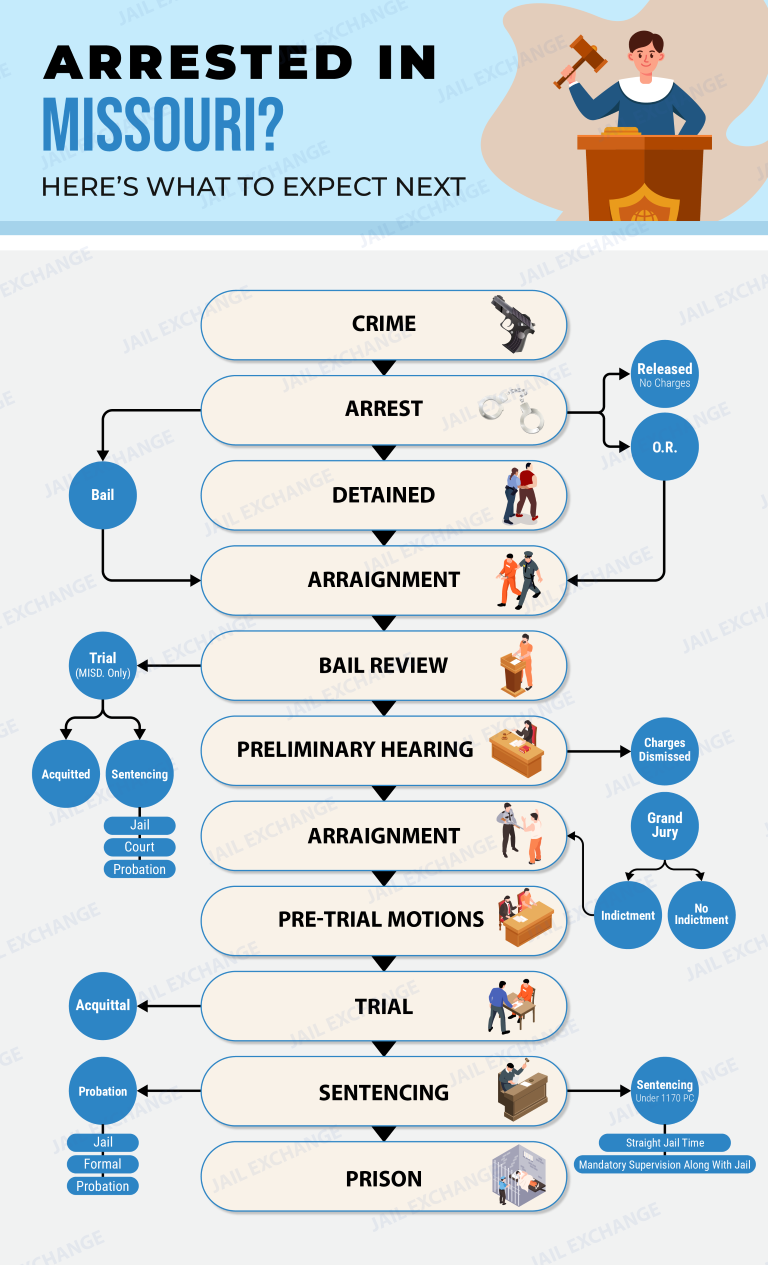
2. What should a family expect after an arrest in Johnson County?
The arresting agency may take a person to the local jail for processing, including identification, inventory of property, and a health review.
Release may be on a promise to appear, with supervision, or under a secured bond ordered by a judge.
The first court hearing deals with the accusation, the person’s rights, and whether release is allowed while the case is pending. A judge can set restrictions on contact, travel, weapons, or reporting. Failing to return to court may result in a warrant and new consequences.
For a worried family, the useful facts are the person’s complete name, date of birth, booking agency, whether a bond was ordered, and the next hearing date. A jail phone operator cannot give legal advice and a bond amount should not be mistaken for a criminal fine.
3. How are misdemeanors handled in Johnson County?
For a minor state charge, an arrest is possible, but the case may start with paperwork and a court appearance instead.
At an arraignment or initial court date, the accused learns the charge and can enter an authorized plea. The prosecutor and defense may exchange information or discuss an agreement. If there is no agreement, the court schedules a contested hearing or trial.
Missouri law, § 558.011, permits at most one year for a Class A misdemeanor, six months for Class B, and 15 days for Class C. Under § 558.002, ordinary maximum fines are $2,000, $1,000, and $750 respectively, unless a more specific rule controls.
A judge can consider probation or a suspended sentence when allowed. A traffic ticket or city ordinance charge may follow its own fine schedule; it should not automatically be treated as a Class A misdemeanor.
4. What happens when the charge is a felony in Johnson County?
The prosecutor may seek an indictment from a grand jury. A case may also proceed through an information after the legally required steps.
A felony allegation can first appear before an associate circuit judge to address counsel, bond, and probable cause.
A judge deciding probable cause is not deciding whether the defendant is guilty. If charges go forward, both sides have opportunities for motions, disclosure of evidence, and plea discussions. A criminal conviction at trial requires proof beyond a reasonable doubt.
Counsel matters early: statements, searches, identification issues, and detention orders can shape the defense. A plea may avoid trial but can also create a lasting record or prison sentence, so the person should understand the terms before agreeing.
5. How does the court handle a serious violent felony in Johnson County?
A major violent prosecution may need forensic testing, expert witnesses, and several pretrial hearings.
Serious violent accusations usually bring closer attention to release conditions and victim safety.
Missouri defines “dangerous felonies” by statute. Certain convictions carry an 85% minimum service requirement before parole eligibility. That is not a rule for every charge involving violence; it depends on the precise conviction and statute.
In homicide and other extremely serious cases, the lawyer may address expert evidence, mental-state disputes, and sentencing issues long before trial. Families should not assume that a high bond means guilt or that a dismissed charge guarantees immediate release when other warrants exist.
6. What happens if someone under 18 is accused in Johnson County?
A child may be released to family with rules to follow, supervised at home, or held in an authorized youth facility when legally justified.
A youth accused of wrongdoing generally goes through the circuit court’s juvenile division, not the adult criminal calendar.
The juvenile division considers the child’s age, the allegation, family situation, and safety needs. A formal petition, if filed, is different from an adult criminal information or indictment. Some youth matters may be diverted from full court processing.
Parents or guardians should ask who is assigned to the child, where the youth is being held if detained, and when the next hearing will occur. Transfer to adult criminal court is possible only under specific legal procedures; it is not automatic for every serious accusation.
7. What are the jail terms, prison sentences and fines in Johnson County?
A defendant may face a fine, probation, a suspended sentence, jail or prison depending on what is proven and the law that applies.
- Class A felony: 10–30 years or life.
- Class B felony: 5–15 years.
- Class C felony: 3–10 years.
- Class D felony: up to 7 years.
- Class E felony: up to 4 years.
- Class A misdemeanor: up to one year; normally up to $2,000 fine.
- Class B misdemeanor: up to six months; normally up to $1,000 fine.
- Class C misdemeanor: up to 15 days; normally up to $750 fine.
- Class D misdemeanor: no ordinary jail term; normally up to $500 fine.
Missouri Revised Statutes §§ 558.011 and 558.002 set these general ranges and fines. Standard felony fines can reach $10,000 for Classes C, D, or E. Some individual crimes have different rules, special minimums, or sentencing enhancements. A prior felony can also affect the authorized punishment.
For Class D or E felonies, Missouri law can permit a special county-jail term of up to one year instead of a longer state prison term. Probation, treatment court, and suspended sentences are possible in eligible cases; none is promised simply because a person has no record.
Parole eligibility is not the same as an automatic release date. The date can change with the charge, sentencing law, and Department of Corrections decisions. These figures state the general law in force in October 2026, not legislation scheduled to take effect in 2028.
What changes under Missouri sentencing law on January 1, 2028?
For families in Johnson County, the difference between current law and the scheduled 2028 law matters. Missouri Revised Statutes § 558.011 has a new version scheduled to take effect January 1, 2028. The percentages below describe when someone may first qualify for parole consideration, not a promised release date. They do not replace special rules that demand a longer time in prison.
- Class A felony: 10 to 30 years or life; generally 70% of the sentence before parole eligibility.
- Class B felony: 5 to 15 years; generally 50% before parole eligibility.
- Class C felony: 3 to 10 years; generally 30% for a first conviction, 35% for a second and 50% for a third or later conviction. Certain offenses requiring sex-offender registration carry 40%.
- Class D felony: up to 7 years; generally 20% for a first conviction, 25% for a second and 50% for a third or later conviction. Certain registrable offenses carry 25%.
- Class E felony: up to 4 years; generally 15% for a first conviction, 20% for a second and 50% for a third or later conviction. Certain registrable offenses carry 25%.
- Dangerous felonies: the law requires 85% of the sentence before parole eligibility.
For Class A and B felonies and certain crimes requiring sex-offender registration committed on or after January 1, 2028, the law also removes eligibility for conditional release. Parole and conditional release are not the same. Whether the new law applies to a particular person depends on the offense date, the final charges, earlier convictions and other sentencing laws. Until the effective date, the existing statute remains controlling. Source: Missouri Revised Statutes § 558.011.
8. Which federal court handles charges from Johnson County?
Johnson County is in the Western Division of the U.S. District Court for the Western District of Missouri. The Charles Evans Whittaker U.S. Courthouse is at 400 East 9th Street, Kansas City, MO 64106, 816-512-5000. Follow the actual federal notice for the courtroom and attendance instructions. A state bond and county court date do not control a separate federal proceeding.
Federal charges require a basis in federal law, such as qualifying firearms, bank robbery, fraud or interstate drug offenses. A state accusation does not become federal simply because someone crosses a county line. Federal authorities decide federal release. Pretrial detainees can be held in contract jails and may not immediately appear in the BOP locator.
9. How do I find the case number and next hearing?
Search Missouri Case.net by name or case number and match Johnson County and the person. Read recent docket entries and hearing information. Match the person and case number rather than relying on a similar name.
Call 660-422-7413 if the notice and online entry are unclear. A new or restricted matter may not be publicly visible. Counsel explains the legal effect of a court entry.
10. Where do I ask about a Warrensburg municipal ticket?
Read the court named on a Warrensburg, Knob Noster or other city citation before paying. The Johnson County Circuit Clerk is at the Justice Center, 101 West Market Street, Warrensburg, MO 64093, 660-422-7413. Ask which court has the file, where the hearing will take place and whether a requested payment is bond or a fine involving a plea. A city ordinance case may use a different clerk or calendar.
A city officer can issue a state charge or an ordinance allegation. The department alone does not establish the case type. Keep the ticket and read the named court, response instructions and next date before paying or traveling. A fine involving a plea is different from posting bond.
11. How can someone apply for a public defender?
The Harrisonville public defender office serving Johnson County is at 502 Westchester Avenue, Harrisonville, MO 64701, 816-380-3160. Use the application for services and ask how the defendant can apply from jail. The program reviews finances and qualifying state charges; ordinary municipal, traffic, civil and family matters are excluded.
Family can help gather financial and case information, but an application does not automatically appoint a lawyer or postpone a hearing. Give staff the next court date. Ask the appropriate court about representation for a proceeding outside the state program.
12. Does detention in another county move the Johnson County case?
A detention location and a filing court are different things. Ask the Sheriff for the actual jail and counsel or the clerk for the active court file. Housing elsewhere does not by itself establish that the case moved; a change of venue is a separate court matter.
Use 660-747-6469 for custody questions and 660-422-7413 for a Johnson County criminal file. Keep the receiving jail's booking identifier and court case number separately. Do not choose a hearing location from a jail address alone.
13. How can I check a warrant or missed hearing?
Search the correct Johnson County file on Missouri Case.net and call the criminal clerk at 660-422-7413. The courthouse office is at 101 West Market Street, Warrensburg, MO 64093. Ask staff to clarify an entry you do not understand. A missing public result does not prove that no warrant exists. Ask the Sheriff at 660-747-6469 about its current inquiry and surrender procedure, and discuss the proper court response with counsel. Keep any order resolving the warrant. Do not assume a private payment to an unknown caller cancels it or that paying one bond resolves every separate order.
14. How can relatives help prepare for a hearing?
Keep the current notice, case number, lawyer's contact and release conditions together. Confirm the courthouse entrance, courtroom and security rules and arrange a reliable ride. Tell counsel promptly about a medical, work or transportation problem affecting attendance.
Our Bail guide explains release conditions and requests for change. A relative's call does not excuse a hearing. Respect contact restrictions while helping; a protected person's invitation does not cancel a court order.

Access Securepak is an authorized correctional commissary care-package program that allows families to purchase customized food, snack, hygiene, apparel, and electronics packages sent directly to an incarcerated loved one. Every package is custom-packed to meet the strict security regulations of the specific jail or state prison.
Important: Delivery Schedules and Package Quotas
Jail package guidelines are not uniform across detention centers. Some facilities permit orders year-round, while others restrict deliveries to quarterly cycles or strict weekly deadlines that you should confirm with the facility directly. If you delay setting up your account, you risk missing the upcoming delivery cutoff, leaving your loved one waiting an extra cycle for fresh food, warm thermals, or personal toiletries.
Step-by-Step Instructions to Register and Access Service
- Visit the official Access Securepak online store at www.accesscatalog.com.
- Select the state and the specific jail or correctional institution from the dropdown menu.
- Enter the inmate's legal last name and inmate ID to verify their active housing and package eligibility.
- Browse the catalog of approved meats, cheeses, ramen soups, cookies, toiletries, and clothing.
- Add items to your cart up to the facility's maximum weight or dollar limit (usually $50 to $125 per order).
- Check out using your debit or credit card and save the order confirmation tracking number.
What the Inmate Needs to Do
The inmate does not need to order anything themselves. Securepak ships the sealed package directly to the correctional facility's commissary warehouse. Jail staff inspect the box and deliver it to the inmate during regular pod commissary distribution, where the inmate signs for the package.
Official Provider: Access Corrections / Keefe Group Official Website
Customer Service Telephone: 1-800-546-6283
Support Hours: Monday – Friday, 8:30 AM – 11:30 PM EST; Saturday, 11:00 AM – 5:00 PM EST
Supported Languages: English and Spanish
Other Services Provided by Access Corrections / Keefe Group
In addition to Access Securepak (Commissary & Gift Packages), Access Corrections / Keefe Group provides several other communication, financial, and visitation services at participating correctional facilities:
- Inmate Trust Money Deposits: Send cash directly to their personal account so they can buy items independently.
• Learn more on our website: Inmate Trust Money Deposits Guide | • Visit official vendor page: Access Corrections / Keefe Group Inmate Trust Money Deposits - Digital Messaging & Photos: Send fast electronic letters and digital pictures to their tablet.
• Learn more on our website: Digital Messaging & Photos Guide | • Visit official vendor page: Access Corrections / Keefe Group Digital Messaging & Photos
Buy Commissary for an Inmate in the Johnson County Detention Center
Johnson County Detention Center Inmate Commissary - Sending Money or Purchasing Commissary for an Inmate
Johnson County Detention Center allows inmates to purchase commissary. Ask the jail what its commissary sells; snacks and hygiene items are common.
You can buy commissary for an inmate using an online service called Access Securepak.

Call the facility at 660-747-2265 to ask whether there is a limit on how much an inmate can spend on commissary.
Access Securepak's site shows whether friends and family can order commissary for an inmate at this jail.
Scroll down for information on the Johnson County Detention Center's service they use for you being able to purchase commissary items online and have them shipped directly to the inmate.
You can also go to our Inmate Money page for information on how to send money to an inmate.
Access Secure Deposits (Smart Deposit) allows families and friends to securely transfer money directly into an incarcerated person's jail trust account using a debit or credit card. Deposited funds become immediately available for your loved one to purchase essential hygiene goods, over-the-counter medication, food items, and writing materials from the facility commissary.
Important: Inmate Banking Policies Vary by Facility
Once a person is booked and moved to a cell, facilities do not always allow cash drop-offs or phone payments directly to the jail. Some might and you should confirm this by calling the facility and asking. But if you do not register online and fund your loved one's trust account immediately, they may be forced to wait days or weeks for standard paper processing, leaving them without essential soap, clean undergarments, basic medical sundries or snacks.
Step-by-Step Instructions to Register and Access Service
- Obtain the inmate's legal first and last name, date of birth, and official six- to ten-digit Booking or Inmate ID number.
- Visit the official Access Corrections portal at www.accesscorrections.com or download the Access Corrections mobile app.
- Select the state and the exact detention facility or county jail where the inmate is currently housed.
- Add the inmate as a contact and confirm their identity from the facility roster.
- Enter your debit or credit card billing information, choose your deposit amount, review the facility processing fee, and submit your payment.
- Save and print your transaction confirmation number for verification.
What the Inmate Needs to Do
The inmate does not need internet access to receive your deposit. Once approved, the funds post directly to their facility account balance. The inmate can verify their balance at the dayroom kiosk or on their trust statement and start ordering items on the next designated commissary day.
Official Provider: Access Corrections / Keefe Group Official Website
Customer Service Telephone: 1-866-345-1884
Support Hours: 24/7/365
Supported Languages: English and Spanish
Other Services Provided by Access Corrections / Keefe Group
In addition to Access Secure Deposits (Trust Money), Access Corrections / Keefe Group provides several other communication, financial, and visitation services at participating correctional facilities:
- Digital Messaging & Photos: Send digital letters and pictures straight to the inmate's kiosk or tablet.
• Learn more on our website: Digital Messaging & Photos Guide | • Visit official vendor page: Access Corrections / Keefe Group Digital Messaging & Photos - Commissary Care Packages: Order pre-approved food boxes, thermal clothes, and snack bundles directly to the jail.
• Learn more on our website: Commissary Care Packages Guide | • Visit official vendor page: Access Corrections / Keefe Group Commissary Care Packages
Deposit Money for an Inmate in the Johnson County Detention Center
Because the Johnson County Detention Center in Centerview allows only postcards in the mail, an envelope of money isn't an option. Use one of these instead.
- Create a login at Access Corrections, then pay with a debit or credit card. The deposit lands in the person's trust account.
- Or ring Access Corrections on 866-345-1884 and use a card over the phone.
Whether Centerview has a kiosk, or staff accept money face to face, is something the detention center doesn't share publicly. Find out at 660-747-2265. Cash and personal checks never belong in the mail.
The Johnson County Detention Center sits on SW 871 Road in Centerview and is run by the Johnson County Sheriff's Office. Since 2018 it has been a postcard-only jail, so a letter in an envelope will not reach the person inside. Legal and government mail is the one kind that comes in without asking first.
Postcards and legal mail:
Inmate's Full Name & Inmate ID#
Johnson County Detention Center
278 SW 871 Road
Centerview, MO 64019
- Card size: A postcard can be up to 4.25 by 6 inches, and no bigger.
- What to write on it: Your name and return address, the inmate's name and, if you know it, their cell assignment, along with the detention center's address.
- Postage: Metered postcards work best. Staff peel off regular stamps, and that often tears part of the card.
- Altered cards: Stickers, address labels, watermarks, stains or lipstick get the postcard sent back or put away with the inmate's property.
- Everything else: Mail that is not a postcard or legal mail is returned to you or stored with the inmate's belongings until release.
- Pictures: Photos need an exception approved ahead of time by the Detention Division Director. The inmate files a request that lists your full name and address, and only one picture request can be open at a time.
- Family hardship: If an immediate family member has been held more than 30 days and an emergency calls for more than a postcard, the inmate can ask for an exception. Hard-copy proof of the family tie is required.
- Jail to jail: Inmates may not write to people held at other institutions, except family members the Detention Division Commander approves.
- Turned-away mail: When staff reject something, the sender is told in writing.
Look the person up on the jail roster before you mail, and send money online rather than by post.
HomeWav Voice Calling allows incarcerated individuals to place outbound voice calls from housing-unit terminals directly to approved outside phone numbers. Because correctional facilities do not permit incoming phone calls, opening and funding a HomeWav voice account provides the prepaid balance required to connect calls without relying on traditional collect billing.
Important: Mobile Phones Require an Active Balance to Receive Calls
Mobile cellular carriers automatically block collect calls originating from jail phone systems. While select traditional residential landlines might allow direct operator billing, cellular and internet-based phone numbers require an active HomeWav prepaid account, which you can verify by checking with your provider. If you do not register online and fund your phone balance immediately, your loved one will hear an automated operator recording stating that your phone number cannot accept calls.
Step-by-Step Instructions to Set Up and Fund Voice Calling
- Go to www.homewav.com or open the HomeWav mobile app.
- Register your account using the primary 10-digit cellphone number where you want your loved one to call.
- Select the detention center where the inmate is currently located.
- Search for and add the inmate to your approved contact list by full legal name or booking ID.
- Deposit funds into your account balance using a Visa, MasterCard, or Discover card.
- Ensure your mobile device has third-party spam call blockers disabled so automated jail connection alerts ring through properly.
What the Inmate Needs to Do
The inmate logs onto the housing unit HomeWav terminal using their PIN, selects your contact name or dials your 10-digit number, and initiates the call. HomeWav's automated operator verifies that your account has available funds and connects the call. All personal telephone calls are recorded and subject to facility monitoring.
Official Provider: HomeWav Official Website
Customer Service Telephone: 1-844-394-6639
Support Hours: Monday – Friday, 8:00 AM – 5:00 PM CST
Supported Languages: English and Spanish
Other Services Provided by HomeWav
In addition to Voice Calling, HomeWav offers video visitation and messaging at participating facilities:
- Remote Video Visitation: Hold live, face-to-face video visits from home using a smartphone or computer webcam.
• Learn more on our website: Video Visitation Guide | • Visit official vendor page: HomeWav Video Visits - Inmate Text Messaging: Send two-way digital text messages and photos through the mobile app.
• Learn more on our website: Inmate Text Messaging Guide | • Visit official vendor page: HomeWav Text Messaging
HomeWav Inmate Text Messaging provides a fast, two-way digital communication platform that allows families to exchange text messages and photo attachments with an incarcerated loved one. Messages are delivered directly to the inmate's terminal or tablet screen within hours, bypassing long postal mail processing times.
Important: Digital Mail Screening Rules Vary by Facility
Inmates cannot receive incoming phone calls, and traditional postal mail rules differ across jurisdictions. While some detention centers still allow regular handwritten letters, many facilities now restrict physical paper mail or mandate electronic messaging, which you can verify by checking facility rules. If you do not register online and set up message credits immediately, your loved one may face lengthy periods without direct written contact from family.
Step-by-Step Instructions to Register and Send Text Messages
- Download the HomeWav mobile app on your smartphone or go to www.homewav.com.
- Register your account, complete identity verification, and link your incarcerated contact.
- Navigate to the Text Messaging section of the app.
- Purchase messaging credits using a credit or debit card.
- Type your message and attach approved JPEG photos if permitted by facility guidelines.
- Send your message to the facility's automated and manual screening queue.
What the Inmate Needs to Do
All electronic correspondence is screened by correctional staff before delivery. Once approved, messages appear in the inmate's inbox on their housing unit HomeWav kiosk or tablet. The inmate opens the message, reads your note, and types an electronic reply using available account credits.
Official Provider: HomeWav Official Website
Customer Service Telephone: 1-844-394-6639
Support Hours: Monday – Friday, 8:00 AM – 5:00 PM CST
Supported Languages: English and Spanish
Other Services Provided by HomeWav
In addition to Inmate Text Messaging, HomeWav offers video visitation and voice calling services:
- Remote Video Visitation: Schedule and join live video visits from home using your phone or computer.
• Learn more on our website: Video Visitation Guide | • Visit official vendor page: HomeWav Video Visits - Voice Calling Accounts: Prepay for voice calling minutes so your loved one can call your telephone directly.
• Learn more on our website: Voice Calling Accounts Guide | • Visit official vendor page: HomeWav Voice Calls
HomeWAV provides secure handheld wireless tablets designed specifically for county jails and regional detention facilities. Through HomeWAV's closed facility network, these mobile tablets grant incarcerated individuals direct access to on-demand video calls, voice calling, two-way text messaging, digital educational programs, and institutional grievances directly from their living areas.
Important: Tablet Access Hours and Account Balances Vary
Detention centers do not manage tablet distribution identically. While some agencies issue individual personal tablets to every detainee at booking, others utilize shared pod docking stations or restrict tablet use to specific dayroom hours, which you should confirm with the facility directly. Although core educational and legal resources are generally provided free of charge, sending messages, initiating video calls, or making phone calls from the tablet requires an active prepaid HomeWAV balance funded by outside contacts.
Step-by-Step Instructions to Support HomeWAV Tablet Use
- Visit www.homewav.com or download the HomeWAV mobile app.
- Register your account and complete identity verification by uploading your government-issued ID.
- Search for your facility by state and add your incarcerated loved one by legal name or booking ID.
- Select Add Funds and deposit money into your HomeWAV account balance.
- Review transaction fees, complete payment using a credit or debit card, and record your confirmation receipt.
- Inform your loved one that calling, messaging, and video minutes are funded on their device.
What the Inmate Needs to Do
The inmate unlocks their assigned HomeWAV tablet using their individual PIN. When funds are present in your account, they can select your name from their approved contacts to initiate an on-demand video session, place a voice call, or draft a text message. Devices must be placed on docking charging carts during institutional count times and night lockup.
Official Provider: HomeWAV Official Website
Customer Service Telephone: 1-844-394-6639
Support Hours: Monday – Friday, 8:00 AM – 5:00 PM CST
Supported Languages: English and Spanish
Other Services Provided by HomeWAV
In addition to Tablet Services, HomeWAV provides several direct communication solutions:
- Remote Video Visits: Meet face-to-face over secure live video from home on your schedule.
• Learn more on our website: Video Visitation Guide | • Visit official vendor page: HomeWAV Video Visits - Prepaid Phone Calling: Prepay for voice calling minutes so your loved one can call your telephone directly.
• Learn more on our website: Phone Calling Guide | • Visit official vendor page: HomeWAV Voice Services - Digital Inmate Messaging: Send electronic messages and photos directly to an inmate's device.
• Learn more on our website: Digital Messaging Guide | • Visit official vendor page: HomeWAV Messaging
Johnson County Juvenile Facilities
Nearby counties
- Jail (Main): 660-747-2265
The Johnson County Detention Center serves the following cities and towns of Johnson County: Centerview, Holden, Kingsville, Knob Noster, Leeton and Warrensburg.