
Park County Detention Center
Park County Detention Center
Jail Phone Number
406-222-4178Park County Inmate Search and Jail Roster
Whether the arrest was made by a deputy near Wilsall, a city officer in Livingston or a trooper on I-90, adults end up at the Park County Detention Center. The jail is in the City/County Complex, 414 E. Callender St., Livingston, MT 59047, and visitors use the Law Enforcement entrance at the back. This page covers finding someone, the charges, visits, money and calls.
The Sheriff's Inmate Roster shows who is inside. Each line gives the name, the charges, the bond, the court, the agency holding the person and the arrest date. The list is rebuilt every night, so a same-day arrest or release may not show until the next morning.
For anything newer, phone the jail at 406-222-4178. Staff answer inmate questions around the clock, so ask what charges were filed, what the bond is and which court is next. Our bail page explains release money and bondsmen, and our court page tracks the case from start to sentence.
Read inmate search answers
 Read inmate search answers
1. How do I use the Park County Inmate Roster?
The list is short. On one late-October day it held 22 names. Try these steps:
- Open the Inmate Roster.
- Names are listed last name first. Press Ctrl+F (Find on a phone) and enter the surname you need.
- The middle column holds the charges, the bond and the court.
- Read the last column for the holding agency and the arrest date.
- Write down the exact spelling and the arrest date. Both help when you call staff.
Every entry carries a reminder that the people listed are innocent until proven guilty.
↑ Back to the question list2. Their name isn't showing. What could explain it?
Several things can explain a missing name:
- Timing. The list updates once a night, so an arrest from this afternoon may not appear yet.
- Release. The person may have posted bond or been let go by a judge.
- A move. Officers drive inmates to other county jails and to mental health facilities around Montana. The jail won't discuss transports to other counties or states.
- Spelling. Search again under a nickname, a middle name or a name used before marriage.
- Age. Someone under 18 is handled through Youth Court Services, not the adult list.
When in doubt, call the Detention Center at 406-222-4178 and give the person's legal name and birthday. If no one picks up, leave a message, since officers may be with inmates.
↑ Back to the question list3. What do the letters and notes on the roster mean?
The last column shows who is holding the person:
- SO means the Sheriff's Office.
- PD means the city police department.
- MHP means the Montana Highway Patrol.
- DOC means the Montana Department of Corrections.
In the charge column, the court with the case appears in parentheses, such as Justice Court, City Court or District Court. A few entries name a court from another county or state, which usually means a hold for that court. Notes like GPS, SCRAM (an alcohol monitor) or drug patch are release conditions. "No Bond" means there is no bail amount to pay on that charge right now, so ask the jail what it means for your loved one.
↑ Back to the question list4. Could they be held at a jail outside the county?
Adults arrested here normally stay in the jail on Callender Street. If the arrest happened close to a neighboring county, also check these jails:
- Gallatin County Detention Center, 605 S. 16th Ave, Bozeman, MT 59715, 406-582-2130. Some Yellowstone prisoners are held here under contract.
- Sweet Grass County Sheriff's Office, 200 West First Avenue, Big Timber, MT 59011, 406-932-5143. It keeps people only for short holds.
- Yellowstone County Detention Facility in Billings, booking line 406-256-6881, open 24 hours. Stillwater and Carbon counties send their prisoners there.
Jail staff won't talk about transports to other counties or states. If a name drops off the local roster, call these jails directly.
↑ Back to the question list5. Is a Park County booking photo open to the public?
The roster is a text list, so the photo has to be requested. Under MCA 44-5-103, Montana counts a booking photo as public. Bail records and daily jail lists fall in that same open group.
- Ask the Sheriff's Office business line, 406-222-4172, how to request a booking photo.
- The county uses a public information request form for records from its offices.
- For a person held by ICE, photos come only through the ICE records request page.
- The U.S. Marshals Service sometimes publishes a federal mugshot to help catch a fugitive, but most federal booking photos stay private.
6. Who tells the family about a release or transfer?
For a stay in the county jail, your best tools are the nightly roster update and a phone call to staff at 406-222-4178.
- VINE is a free state alert line that sends calls, texts or emails. It is meant for adult felons the state supervises, not everyone in the county jail. Sign up on VINELink or call 800-456-3076. You must register yourself.
- Some crime victims are alerted by law. In stalking cases, protection order cases and cases of assaulting or strangling a partner, the jail must tell the alleged victim once the accused is out on bail (MCA 46-9-108).
7. Where can I read the charges in full?
The roster splits each person's charges into felonies and misdemeanors. To look up the law behind a charge, search the free Montana Code Annotated. For example, theft is MCA 45-6-301.
The full complaint becomes part of the court file after filing. For felonies, open the District Court portal. Justice Court and City Court files are on the limited jurisdiction portal. The County Attorney's Office decides the final charges. Reach it at 414 E. Callender St., Livingston, MT 59047, 406-222-4150.
↑ Back to the question list8. How is bond posted for someone in this jail?
The roster shows the bond amount for each charge, or the words "No Bond." The Detention Center accepts exact cash, a certified check or a bondsman. Justice Court bonds can be cash, money orders, cashier's checks or a bondsman's bond. Personal checks won't work.
- City Court bonds go through city dispatch, 406-222-2050.
- Cash bonds over $10,000 are posted with the court during business hours.
- Nights and weekends, jail staff can still process Justice Court bonds, District Court bonds and bonds set by out-of-county courts.
Call 406-222-4178 before you go. Our bail page explains amounts, bondsmen and refunds.
↑ Back to the question list9. How does an inmate get a free lawyer?
No inmate has to face court alone. The judge goes over appointed counsel at the person's first court date, including how to get a lawyer at no cost. Montana's Office of State Public Defender represents people in youth cases, felony cases and misdemeanor cases that could mean time in jail.
- Justice Court sends a referral, and the person then applies to the Bozeman public defender office, 77 Discovery Drive, Bozeman, MT 59718, 406-582-2450.
- Family members can help fill out the online application. Gather the latest pay stubs and bank statements before starting.
- A judge decides who qualifies, and a fee may be charged later.
A private lawyer is another option. Ask the jail at 406-222-4178 how attorney visits are arranged.
↑ Back to the question list10. When are video visits at the Park County Detention Center?
Every visit is by video at the jail. There is no face-to-face contact. The schedule is fixed, with no exceptions:
- Thursdays, 6:00 to 10:00 p.m.
- Sundays, 1:00 to 5:00 p.m.
Each inmate may have two visits a day, up to 15 minutes each, and no more than 3 visitors may sit in the room at once. Visits go first come, first served, with no reservations. Check-in opens 10 minutes before visiting begins, and not earlier.
- Visits start only after the inmate's first court appearance. They are paused while an inmate is on disciplinary status.
- Give your name, address and date of birth, and show a photo ID.
- Anyone under 18 needs a parent or legal guardian along.
- Leave phones, purses, bags and containers in your car. A phone seen during a visit ends it.
- Dress appropriately, arrive sober and keep language clean. Officers may watch.
More visiting advice is on our visitation page.
↑ Back to the question list11. What are the ways to add money to their jail account?
There are two ways to add funds:
- Hallway kiosk. A deposit kiosk sits in the Law Enforcement hallway of the City/County Complex.
- Online. Use the deposit link on the Sheriff's Detention Center page. Pick the facility, then search for the inmate. For help with the site, call 800-284-1990.
Have the inmate's full name spelled as it is on the roster. Any money left at release comes back to the person as a check or a debit card. Our money page and commissary page explain what deposits can pay for. Never mail cash.
↑ Back to the question list12. Can I call someone in the jail, or leave a message?
Inmates can make outgoing calls, but they can't take incoming ones. Jail staff also can't pass along messages, so the call has to come from your loved one.
To learn how calls are billed, or whether messaging or tablets are offered, call 406-222-4178. Treat every call as if someone is listening, and keep case details for the lawyer. Read more on our jail phone page, and see our email and messaging page for electronic options.
↑ Back to the question list13. What can I mail to the Park County jail?
Address letters with the inmate's full name only, in this format: (Inmate Full Name), C/O Park County Detention Center, 414 E. Callender, Livingston, MT 59047. The jail is strict about what gets through:
- Letters, cards and photographs are allowed.
- Refused items include Polaroids, newspaper clippings, drawings, stickers and glitter.
- Musical cards, blank paper, blank cards and extra envelopes are refused too.
- Anything written in crayon or marker is turned away.
- The envelope must show your first and last name and a return address, or it goes back.
- Packages are not accepted, and letters can't be dropped off in person. They must come by mail.
Staff search every item. See our mail page for more.
↑ Back to the question list14. Can I drop off medicine, glasses or clothing?
Only a few things are accepted for inmates:
- Medication in its prescription bottle, with a valid prescription attached
- Medical equipment
- Eyeglasses and contact lenses
Nothing else is taken, so leave clothes, books and snacks at home. Before you bring medication, call 406-222-4178 to let staff know it is coming.
↑ Back to the question list15. How do I collect their belongings after release?
Items a person had at booking are stored until release. Leftover account money goes back to them then too. To pick up things for someone still inside, phone the jail first at 406-222-4178.
Ask if a signed note from the inmate is needed and when you can come by. Bring photo ID, and use the rear Law Enforcement door at 414 E. Callender St., Livingston, MT 59047.
↑ Back to the question list16. Who looks after an inmate's health?
Detention Officers take inmates to medical and dental appointments and, when needed, to mental health facilities anywhere in the state. City police say people who are hurt or sick when arrested are treated by Livingston Fire and Ambulance.
If your loved one needs medicine, call the jail at 406-222-4178. Tell staff what the medicine is, how much is taken and who prescribed it. Medicine may be dropped off only in a prescription bottle with a valid prescription. In an emergency, call 911, and mention any risk of self-harm or a mental health crisis right away.
↑ Back to the question list17. Does someone have a warrant in Park County?
Out in the county, deputies carry out warrants. Inside city limits, city officers do. To ask, call the Sheriff's Office at 406-222-4172 or the 911 center's main line, 406-222-2050, which dispatches for both. Filed cases can be found on the state's free court sites for felonies and for misdemeanors. Anyone the state is seeking after an escape, or after skipping out on supervision, is flagged on the Montana offender search. Speak with a lawyer before turning yourself in. Surrender takes place at the jail's rear entrance, 414 E. Callender St., Livingston, MT 59047. The court behind the warrant may also set a new date.
↑ Back to the question list18. When is their next hearing, and who would know?
Start with the court named in parentheses on the roster, then call that office:
- Justice Court, 414 East Callender St., Livingston, MT 59047, 406-222-4170. Open court is Tuesday and Thursday at 9:00 a.m., and in-custody cases are seen by video.
- Clerk of District Court, 414 E. Callender Street, Room 106, Livingston, MT 59047, 406-222-4125.
- City Court, 406-823-6013. Ask staff where to go, since city pages show two addresses.
The free state court portals list upcoming hearings as well. For what happens at each hearing, read our court page.
↑ Back to the question list19. What if a federal agent or a park ranger made the arrest?
Then the case is federal. For most of the county, that means federal court in Billings: James F. Battin Federal Courthouse, 2601 2nd Avenue North, Suite 1200, Billings, MT 59101, 406-247-7000.
- Arrests inside Yellowstone go to the federal District of Wyoming, which covers the Montana part of the park too. Its judge for those cases works from Mammoth's Yellowstone Justice Center, 105 Albright Avenue, 2nd Floor, Mammoth, WY 82190, 307-227-7020.
- Where a federal defendant waits for trial is up to the U.S. Marshals Service. Call the Billings office, 406-200-6004, to find out.
- PACER holds the case records, and the Federal Bureau of Prisons inmate locator lists people after sentencing.
20. Could immigration officers take custody?
Yes, if ICE has placed a detainer. This is the usual sequence:
- ICE sends a detainer request on Form I-247A.
- That allows a hold of up to 48 hours after they would otherwise be released. State law makes officers honor it, though not for someone with credible papers proving citizenship or lawful status (MCA 27-16-801).
- The person is then handed over to ICE. Montana falls under its Salt Lake City Field Office, 2975 Decker Lake Drive, Suite 100, West Valley City, UT 84119, 801-736-1200.
- Search the ICE Online Detainee Locator. You will need an A-number, or the person's exact name and birth country. ICE says to phone the field office when the search comes back empty.
21. Moved to state prison? Here is how to track them
A person headed for state custody often stays in the Callender Street jail for a while first. The Department of Corrections must assess them before choosing a placement. The roster marks those inmates as DOC holds.
- Look up the current facility on the Montana offender search. A state ID number works, or just a name.
- Each prison's visiting and mail rules: see our Montana state prisons guide.
- The probation office in the City/County Complex answers at 406-222-4165.
22. Where do arrested youths go?
The adult jail is mostly off limits to anyone under 18. A rural county may hold a youth there briefly before a hearing. The limit is 24 hours, on a clock that freezes over weekends and holidays. The youth must have no contact of any kind with adult prisoners (MCA 41-5-349). A detained youth must see a judge within 24 hours on the same count (MCA 41-5-332).
Youth cases are kept off the public portals. To learn where a child is held and when court is, call Youth Court Services at 406-222-4162, weekdays 8:00 a.m. to 5:00 p.m.
↑ Back to the question list23. Who arrests people in Park County, and how do I reach them?
Roughly 18,214 people call the county home (Census Bureau, July 1, 2025 estimate). The roster's agency column points to one of these:
- Sheriff's Office, City/County Complex, 414 E. Callender St., Livingston, MT 59047, business line 406-222-4172. Its 18 full-time officers patrol about 2,802 square miles, from Wilsall south to Cooke City. The town of Clyde Park contracts with the Sheriff for its police work.
- Livingston Police Department, 414 E. Callender Street, Livingston, MT 59047, through the shared 911 dispatch center, 406-222-2050.
- Montana Highway Patrol, 18 Trooper Drive, Boulder, MT 59632, 24-hour dispatch 855-647-3777.
- State game wardens with Montana's fish and wildlife agency also bring people to this jail.
- Montana Department of Corrections, which has some of its own inmates at the jail, 5 S Last Chance Gulch Street, Helena, MT 59620, 406-444-3930.
- Yellowstone rangers enforce federal law in the park. Those cases go to federal court in Wyoming.
Getting Someone Out on Bail in Park County, Montana
An arrest in Livingston, Wilsall, Cooke City or out on a ranch road all leads to the same place. Adults are booked into the Park County Detention Center, part of the City/County Complex at 414 E. Callender St., Livingston, MT 59047. This page explains who decides bail, typical amounts, payment spots and how bondsmen fit in.
Start by finding your loved one on the Sheriff's Inmate Roster, which lists the bond next to each name. Our Recent Arrests and Inmate Search page sticks to the arrest and the time locked up. Go there to see who is still behind bars, look for open warrants and read the charges. It also covers booking photos, a free lawyer and items left at the jail.
Someone at the jail answers 406-222-4178 at any hour. Ask what the bail is, where it can be posted and when court is. Families and visitors walk around back to the Law Enforcement door. Every stage of the case has its own section on our criminal court page.
1. Who picks the bail amount after a Park County arrest?
A judge, not the jail. Under MCA 46-7-101, police must bring the person in front of the nearest judge they can reach, with no needless delay. Montana then wants the release question answered at that very first hearing (MCA 46-9-109).
Here, that hearing is usually in Justice Court, 414 East Callender St., Livingston, MT 59047, 406-222-4170. Anyone in custody appears on a video screen from the jail after the day's scheduled cases wrap up. Open court is held Tuesday and Thursday at 9:00 a.m.
Tickets and arrests by city officers inside town go to City Court, 406-823-6013. If a felony later moves on to District Court, the bail set earlier stays in force unless that judge changes it (MCA 46-9-201).
↑ Back to the question list2. Do we have to come up with cash?
Cash is one of several paths. Montana asks judges to go easy where they safely can, choosing the least burdensome terms that keep the case on track (MCA 46-9-108). Expect one of these:
- Own recognizance. Free release on the person's written word to come back (MCA 46-9-111).
- Rules to follow. Stay sober, give up guns, keep a curfew or keep away from the alleged victim. Some names on the local roster show GPS, an alcohol monitor or a drug patch as a condition.
- Full cash. Every dollar is paid in and held by the court.
- A bondsman. You pay a licensed agent, and the agent vouches for the full bail.
- Land. Montana real estate can serve as security when the owner's clear equity covers the bail (MCA 46-9-401).
- A license. On some traffic charges, a driver's license may be held instead of money.
3. Roughly what does bail cost here?
It depends on the charge and the judge. Many judges glance at the Montana Supreme Court's Recommended Bond Schedule as a guide, yet each one is free to pick a different number. Its figures already include surcharges. A sample from the 2026 schedule:
- Misdemeanor simple assault with an injury: $585 (must appear in court)
- Furnishing alcohol to someone not yet 21: $535 (must appear)
- Running a boat while impaired: $335
- Truancy: $135
- Felonies: left blank on the schedule, for the judge to decide
To get a feel for local numbers, the roster on one day in late October showed bonds as low as $100 and as high as $250,000, plus three people held with no bond at all. Ask the jail at 406-222-4178 for the exact figure in your case.
↑ Back to the question list4. Can a person bond out before their first court date?
Often, yes, but not for every charge. City police work under written arrest rules that spell it out:
- Misdemeanor arrests usually come with the right to post bond before the first hearing.
- A DUI arrest means bond must be posted before any early release.
- A felony arrest means waiting in jail until Justice Court sets bond.
- An arrest for assaulting a partner or relative means staying put until a judge has seen the person.
By state law the same wait applies to stalking, partner strangulation and violations of protection or no-contact orders (MCA 46-9-302). Officers are not allowed to bring cash to a suspect or post bond on their behalf.
↑ Back to the question list5. What should I bring to post bond at the jail in Livingston?
Bring the right kind of money and your ID. At the Detention Center, a bond can be paid with cash in exact change, with a certified check, or through a bail bond company. Whenever a jailer takes bail for a judge, you are owed a signed receipt (MCA 46-9-302).
- Phone 406-222-4178. If nobody answers, staff may be busy with inmates, so leave a message.
- Give the jailer the full legal name and birthday. Ask the bond amount and the court behind it.
- Confirm the jail can take that bond today, or learn which court window you need.
- Park near the City/County Complex and head to the Law Enforcement entrance at the rear.
- Hand over exact cash or a certified check, then hold on to the receipt.
6. What does each Park County court accept for a bond?
The rules shift from court to court, so match the payment to the court on the roster:
- Justice Court: a cashier's check, a money order, cash or a bondsman, but never a personal check. The office, 406-222-4170, keeps weekday hours from 8:00 a.m. to 5:00 p.m.
- City Court: its bonds are handled by city dispatch at 406-222-2050.
- District Court: for felony bonds, start with the Clerk of District Court, 406-222-4125.
- Big cash bonds: any cash bond above $10,000 must wait for court office hours.
On any regular workday, schedule bail can also be paid at the court itself. Each court posts its bail list in its office.
↑ Back to the question list7. Can bond be posted late at night or on a weekend?
Yes, for many cases. Once the courts close, jail staff process bonds for Justice Court, District Court and courts in other counties. That helps if a person was picked up here on a case from somewhere else.
City Court bonds are the exception, since they still run through city dispatch. A cash bond over $10,000 also waits for a court to open. Before driving over, call the Detention Center at 406-222-4178 and make sure tonight's bond is one the jail can take.
↑ Back to the question list8. Is there a way to pay bail with a card or online?
Plan to pay in person. The official rules for bail here name cash, certified checks, money orders, cashier's checks and bondsmen.
Justice Court and City Court both use CitePay, a card payment site, so people can pay many traffic tickets from home for a small fee. It is meant for citation numbers. It is not a way to free someone from jail. Tickets for DUI, or for any charge that could bring jail time, can't be paid there either.
A warning: scammers sometimes call families and demand bail through gift cards, payment apps or crypto. Hang up and call the jail directly at 406-222-4178.
↑ Back to the question list9. Is a bail bondsman worth calling?
Montana's code uses a mouthful for bondsmen: "surety bail bond insurance producer." They are licensed through the state's Commissioner of Securities and Insurance (MCA 33-17-1601). According to the jail, local bondsmen advertise in the phone book and online, and some leave business cards in the Law Enforcement hallway.
- The fee you pay is what the agent earns. Don't expect it back.
- Collateral, such as a pickup's title, may be required. Ask for a written promise about when you get it back.
- Skip a court date, and the agent may track down and arrest your loved one, usually after a call to local police (MCA 46-6-508).
- The bond backs court dates and nothing else, so it can't cover fines or restitution (MCA 46-9-503).
- Before signing, check the agent's license with the NAIC lookup tool.
10. Bail is paid. What else could be keeping them inside?
A bond only reaches the case it belongs to. Something else may be holding the person:
- Someone else's warrant. On one recent roster, people were held for courts in Pennsylvania, Colorado and Bozeman. Since a 2025 change, a local judge has no power to bail out someone wanted on an outside warrant (MCA 46-9-201).
- Extradition. After being returned from another state, the person must face the judge who signed that warrant first (MCA 46-9-105).
- State corrections. The roster marks some people as held for the Department of Corrections. A probation or parole problem can keep someone locked up by itself.
- Two separate cases. A city charge and a county charge each carry their own bond.
- Federal or ICE holds. Those are explained later on this page.
Ask jail staff at 406-222-4178 to list every hold before you spend a dollar.
↑ Back to the question list11. Could the judge say no to bail?
Rarely. The Montana Constitution promises bail to everyone, apart from a crime that could carry the death penalty when "the proof is evident or the presumption great" (Mont. Const. art. II, sec. 21). Excessive bail is banned outright (Mont. Const. art. II, sec. 22).
Still, someone can be kept in jail before trial when a judge finds probable cause that no workable conditions would get them back to court (MCA 46-9-106). The crime itself, earlier convictions, any record of fleeing, the risk the person poses and their ties to the Livingston area all count (MCA 46-9-109).
Arguments for higher bail come from the County Attorney's Office, 414 E. Callender St., Livingston, MT 59047, 406-222-4150.
↑ Back to the question list12. Can the bond be cut down in a Park County case?
It can. Either lawyer may ask for bail to go up, go down or change form (MCA 46-9-311). The other side gets notice so it can respond.
- The defense lawyer asks in writing, filed with whichever court has the case.
- Pull together proof of work, proof of a home here, a list of relatives in the area and a true picture of what the family can pay. Bail may not be oppressive, and state law ties it to a person's means (MCA 46-9-301).
- Offer something that answers the judge's concern, such as GPS tracking or an alcohol monitor.
Justice Court sets its own motion days, so ask the clerks at 406-222-4170. Felony requests go through the District Court clerk, 406-222-4125.
↑ Back to the question list13. Who pays for a defense lawyer in Park County?
The state does, when the person qualifies. The right to appointed counsel is one of the things the judge covers at the first hearing (MCA 46-7-102). The Office of State Public Defender takes felonies, youth cases and jailable misdemeanors.
Low income is the first test, meaning a household at or below 133% of the poverty guideline. Earning more doesn't end the matter if the cost of a lawyer would mean real hardship. Nobody can be refused simply for having work or for having posted bail (MCA 47-1-111). A judge has the final say.
- Justice Court makes the referral. The application then goes to the Bozeman office, 77 Discovery Drive, Bozeman, MT 59718, 406-582-2450.
- People can also apply on the public defender's website.
- A fee may be charged later, so ask about it.
14. Where do I go for court in Park County?
Almost everything is under one roof at the City/County Complex. Ask at the front for the right room.
- Sixth Judicial District Court hears felonies. The Clerk of District Court is upstairs at 414 E. Callender Street, Room 106, Livingston, MT 59047, 406-222-4125, weekdays 8:00 a.m. to 5:00 p.m. One district judge serves this county and Sweet Grass County.
- Justice Court takes county misdemeanors and the first hearing in felonies, 414 East Callender St., Livingston, MT 59047, 406-222-4170.
- City Court covers offenses in the city, 406-823-6013. City web pages list two different street addresses for it, so phone before you head over.
- Federal court for most cases from here: James F. Battin Federal Courthouse, 2601 2nd Avenue North, Suite 1200, Billings, MT 59101, 406-247-7000.
15. Will we ever see the bail money again?
Usually, if every hearing is kept. Once the case is over, Montana courts give cash bail back (MCA 46-9-502). Under state court rules, the refund goes only to whoever made the deposit, so the receipt and your ID matter.
Skipping court changes that. The judge may order the bail forfeited. If notice of that order is not mailed out within 10 working days, the bond becomes void (MCA 46-9-503).
- The family or surety gets 90 days to produce the person or show a good reason for missing court. After that, the judge may wipe out the forfeiture.
- Forfeited misdemeanor money stays local, with the city or county that received it. In a felony, the state keeps it (MCA 46-9-511).
- Forfeited bail can also be paid out to a crime victim (MCA 46-9-512).
Call whichever court has the deposit to ask about getting it back, for example Justice Court at 406-222-4170.
↑ Back to the question list16. Who hands back wallets, keys and leftover jail money?
At release, any money left in the inmate's account is paid out on a debit card or by check. To ask about clothes, keys or a wallet still in storage, call the Detention Center at 406-222-4178 and ask when items can be collected.
Have your photo ID along. Collecting for a friend? Staff may want a signed OK from that friend. Our inmate account page walks through deposits and balances.
↑ Back to the question list17. What if it is a federal case, or the arrest was in Yellowstone?
Federal charges from this county are normally filed in the Billings Division of the U.S. District Court for the District of Montana. Its clerk's counter: James F. Battin Federal Courthouse, 2601 2nd Avenue North, Suite 1200, Billings, MT 59101, 406-247-7000.
Yellowstone works another way. The Montana side of the park falls under the federal District of Wyoming, which meets inside the park's Yellowstone Justice Center, 105 Albright Avenue, 2nd Floor, Mammoth, WY 82190, 307-227-7020.
- Whether the person goes home before trial gets settled at the first federal hearing (18 U.S.C. 3142).
- Federal prisoners stay in U.S. Marshals Service custody. Ask its Billings office where someone is held, 406-200-6004.
- Some Yellowstone prisoners are held under contract at the Gallatin County jail in Bozeman.
- PACER has the case papers for a per-page fee.
18. Does a paid bond stop an ICE detainer?
No. Immigration holds are separate from state bail. Here is how they usually unfold:
- First, ICE, the federal immigration agency, puts its request on Form I-247A and sends it to the jail.
- With it, the jail can keep the person up to 48 hours after they would otherwise be released (8 CFR 287.7(d)).
- Montana requires officers to honor it and explain the hold to the person. Strong papers showing citizenship or lawful immigration status end the duty to hold (MCA 27-16-801).
- ICE agents then take the person under their Salt Lake City Field Office, 2975 Decker Lake Drive, Suite 100, West Valley City, UT 84119, 801-736-1200.
- Search the ICE Online Detainee Locator. It needs the country of birth along with the name.
19. After a prison sentence, where does the person go first?
Most often, they stay right here in the county jail for a while. Felony terms over a year are run by the Montana Department of Corrections. After sentencing, people tend to sit in the county jail until the state finishes an assessment. Then the state decides between prison, prerelease and a treatment setting.
- Track their location with the Montana offender search.
- Our Montana prisons directory explains visits and mail at every state lockup.
- Adult probation for this area works out of the City/County Complex, 406-222-4165.
20. My teenager was arrested in Park County. What now?
Under 18 means Youth Court in almost every case. That court is run by the district judge (MCA 41-5-203). Booking alone can't keep a youth overnight in an adult jail. In rural counties, a youth awaiting a hearing may be held there up to 24 hours, weekends and holidays not counted, only when completely separated from adult inmates (MCA 41-5-349).
- If your child is held, a judge has 24 hours to review whether the arrest had probable cause. Weekends and holidays stretch that clock (MCA 41-5-332).
- Youths can get bail, and the judge has to weigh what the parents are able to pay (MCA 41-5-323).
- Youth Court Services, 406-222-4162, can tell you where your child is. The office is open weekdays 8:00 a.m. to 5:00 p.m.
Walk-in video visits at Park County Detention Center
Park County offers non-contact video visits at the jail. Go to the City/County Complex at 414 E. Callender St., Livingston, MT 59047. Use the rear Law Enforcement entrance and pick up the hallway phone labeled JAIL. Call detention at 406-222-4178 with questions, not to reserve a place.
- Thursday: 6–10 p.m. Mountain time; check-in opens at 5:50 p.m.
- Sunday: 1–5 p.m. Mountain time; check-in opens at 12:50 p.m.
Visits are first come, first served. The jail does not take reservations or make exceptions to those hours. Each person in custody can have two visits per visiting day, up to 15 minutes each. They are not eligible before their initial court appearance or while on disciplinary status.
Register with staff and bring photo ID for each visitor. No more than three visitors can be in the room at once. Minors must come with a parent or legal guardian. Keep phones, purses and packages out of the visiting room.
Video away from the jail
Park County appears in Inmate Canteen with a video-call option, but the county’s published hours and walk-in procedure are for the jail. Confirm any at-home option with detention before buying credits.

Inmate Canteen Video Visitation allows family members and approved contacts to hold scheduled, face-to-face video visits with incarcerated loved ones from home. Using a computer with a webcam or a mobile device, visitors can connect directly through housing-unit video kiosks without traveling to the correctional facility.
Important: Advance Visitor Clearance Required
Detention centers do not permit unscheduled or unverified video sessions. Correctional facilities require prospective visitors to submit government-issued photo identification and receive administrative clearance before booking an appointment, an approval process that can take up to 48 hours depending on facility staffing. You should verify your visitor approval status with the facility prior to scheduling. If you do not register well in advance, you will miss your loved one's scheduled visiting window for the week.
Step-by-Step Instructions to Register and Schedule a Video Visit
- Visit www.inmatecanteen.com and sign into your account.
- Register your visitor profile and upload a clear photograph of your government-issued ID (driver's license or passport) for facility background review.
- Wait for email notification confirming facility visitor approval.
- Select Video Visitation, choose the detention facility, and select the inmate.
- Browse the available schedule calendar, select an open time slot, and pay the visitation fee using a credit or debit card.
- Log into the website or app 10 minutes prior to the start time on a device with a functioning camera, microphone, and reliable high-speed internet connection.
What the Inmate Needs to Do
The inmate receives a visitation notification on their housing unit video kiosk. At the appointed time, they log in with their PIN and sit before the terminal. Inmates and visitors must strictly observe jail dress and conduct rules; sessions are monitored by staff and will terminate immediately upon any violation.
Official Provider: Inmate Canteen Official Website
Customer Service Telephone: 1-715-690-2965
Support Hours: Monday – Friday, 8:00 AM – 5:00 PM CST
Supported Languages: English and Spanish
Other Services Provided by Inmate Canteen (TurnKey Corrections)
In addition to Remote Video Visitation, Inmate Canteen provides several other communication, financial, and commissary services at participating correctional facilities:
- Commissary & Snack Packs: Order pre-approved snack boxes, food packages, and clothing directly to the jail.
• Learn more on our website: Commissary Orders Guide | • Visit official vendor page: Inmate Canteen Commissary - Digital Messaging & Chirp Texts: Send electronic messages and photos directly to housing pod kiosks and handheld devices.
• Learn more on our website: Digital Messaging Guide | • Visit official vendor page: Inmate Canteen Messaging - Trust & Phone Deposits: Deposit money directly into an inmate's jail trust account or phone calling balance.
• Learn more on our website: Trust & Phone Deposits Guide | • Visit official vendor page: Inmate Canteen Deposits
Park County Criminal Courts and Case Steps
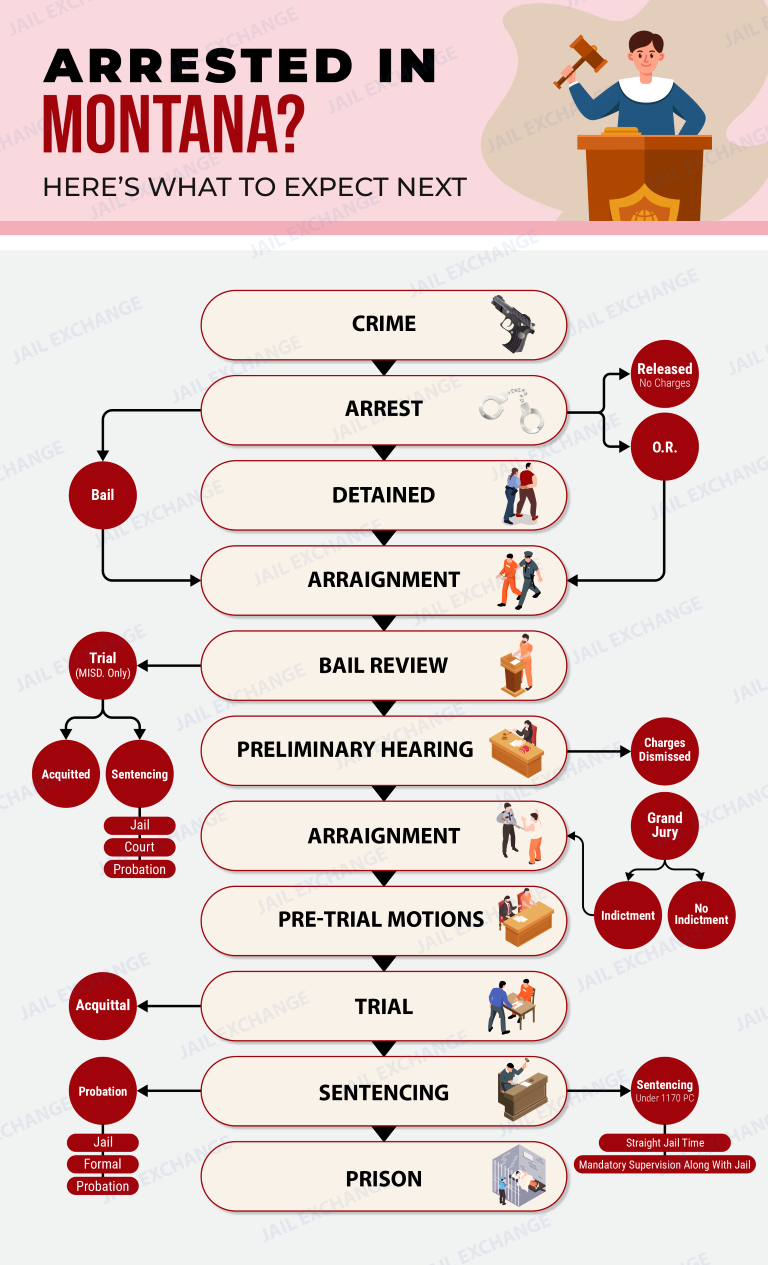
While a case is pending, adults stay at the Park County Detention Center, inside the City/County Complex, 414 E. Callender St., Livingston, MT 59047. Nearly every criminal case is heard under that same roof. Below we cover the Sixth Judicial District Court, Justice Court and City Court, and the path from first hearing to sentence.
The Sheriff's Inmate Roster, refreshed each night, shows who is there and which court has each charge. Our Jail Roster and Inmate Lists page covers the arrest and life in custody. It shows how to confirm a loved one is locked up and learn about active warrants. It also explains charges, mugshots, the public defender and getting property back.
For anything newer than last night, call the jail at 406-222-4178. Learn which judge holds the case and the next day the person must appear. Our bail page spells out how to pay for a release.
1. Misdemeanor or felony: which court is in charge?
The charge decides the court. Locally, it breaks down like this:
- Justice Court takes misdemeanor tickets from deputies, the Highway Patrol, state game wardens and truck-weight officers, plus criminal complaints from the County Attorney. It hears a felony only at its first appearance.
- City Court takes misdemeanors and city ordinance cases from inside city limits (MCA 3-11-103).
- District Court takes all felonies, meaning crimes punishable by over a year behind prison walls (MCA 45-2-101).
- Youth Court is the district judge's court for people under 18.
Justice Court keeps a formal record of what is said in court. It also handles civil suits up to $15,000 and orders of protection.
↑ Back to the question list2. Which rooms in the complex hold the Park County courts?
All three local courts share the complex at 414 E. Callender. Allow time to find the right office.
- Clerk of District Court, 414 E. Callender Street, Room 106, Livingston, MT 59047, 406-222-4125. The office is upstairs and keeps weekday hours, 8:00 a.m. to 5:00 p.m., closed on major holidays. The district judge's office answers at 406-222-4130.
- Justice Court, 414 East Callender St., Livingston, MT 59047, 406-222-4170, open weekdays 8:00 a.m. to 5:00 p.m.
- City Court, 406-823-6013. Its office is open weekdays 8:00 a.m. to 4:00 p.m.
The district court here also serves Sweet Grass County. Its court sits in Big Timber at 200 West 1st Ave., Big Timber, MT 59011, 406-932-5154.
↑ Back to the question list3. Do the two towns have courts of their own?
The city has one. City Court handles misdemeanors and ordinance cases that city police write inside Livingston. The state court directory lists it in the City/County Complex, while one city web page gives City Hall, 220 E. Park St., Livingston, MT 59047, as its address. Call the court at 406-823-6014 before you go so you end up in the right building.
City Court is a court of record. Fines and many tickets can be paid online through CitePay, a payment service linked from the city's court page.
The small town of Clyde Park pays the Sheriff's Office to handle its police work. Tickets there are written by deputies, so they head to Justice Court along with cases from Wilsall, Cooke City and the rest of the rural county.
↑ Back to the question list4. What happens the first time they see a judge?
Police must bring the person to the closest available judge with no needless delay (MCA 46-7-101). Here that is usually Justice Court, by video link from the jail. Montana requires the judge to explain these points (MCA 46-7-102):
- the exact charges
- that a lawyer may be appointed if the person can't afford one
- how pretrial release could happen
- that silence is allowed, and words spoken can become trial evidence
- that firearm rights can be lost with a conviction
- on a felony complaint, the right to have a judge rule on probable cause
The judge rules on bail before the hearing ends (MCA 46-9-109).
↑ Back to the question list5. How does a misdemeanor move through Park County Justice Court?
Open court meets Tuesdays and Thursdays at 9:00 a.m. sharp, and check-in starts at 8:30. Prisoners join by video once the day's calendar is done. A typical case runs like this:
- Arraignment. A plea is entered: guilty, not guilty or no contest.
- Omnibus hearing. After a not-guilty plea, the court sets this hearing about six weeks out, on certain Monday afternoons.
- Motions. Law-and-motion hearings by Zoom run on certain Wednesday afternoons. People who live outside Montana may ask the court to let them appear by Zoom.
- Trial. Six jurors hear a misdemeanor trial unless the sides settle on fewer (MCA 46-17-201).
If a ticket's "appear by" date passes with no word from the driver, the court may issue a warrant and have the license suspended. Reinstating it costs $103, payable to the Records and Driver Control Bureau, a state office, 406-444-3933.
↑ Back to the question list6. How much jail or fine can a misdemeanor bring?
After a not-guilty plea, the trial has to begin within 6 months or the charge is thrown out. Good cause, or a delay the defense requested, can stretch that limit (MCA 46-13-401). Typical penalties:
- DUI, first offense: $600 to $1,000 plus 24 hours to 6 months behind bars (MCA 61-8-1007)
- Theft of $1,500 or less, first or second time: a $1,500 fine, 6 months in jail, or both at most (MCA 45-6-301)
- Partner or family member assault, first offense: $100 to $1,000, with jail of at least 24 hours but no more than a year (MCA 45-5-206)
- Misdemeanors with no penalty of their own: as much as 6 months and $500 (MCA 46-18-212)
After a first DUI, Justice Court must approve any probationary license, and the driver waits 30 days. A judge may instead defer a misdemeanor sentence, generally for up to a year. Follow every condition, and the charge can be dismissed (MCA 46-18-204).
↑ Back to the question list7. How does a felony travel from arrest to sentencing?
Felonies begin in Justice Court and finish in District Court. The usual order:
- First appearance in Justice Court. Bond is set, often by video from the jail.
- Charging. The County Attorney files a sworn request asking the district judge to allow the felony charge. That charge paper is called an information (MCA 46-11-201). Justice Court may instead hold a preliminary hearing on probable cause (MCA 46-10-105).
- Arraignment in District Court. With the written charge in hand, the defendant answers it (MCA 46-12-201).
- Omnibus hearing and plea talks. The lawyers trade evidence and may reach a deal.
- Trial. Twelve jurors hear the case, and all of them must agree (MCA 46-16-110). A judge alone can decide it if both sides sign off.
- Sentencing follows a guilty plea or verdict.
Most felonies carry up to 10 years and a $50,000 fine when no other penalty is set (MCA 46-18-213). Stealing more than $1,500 can also bring 10 years. A drug possession conviction can mean up to 5 years, and first-timers are presumed to deserve a deferred sentence (MCA 45-9-102).
↑ Back to the question list8. Are violent and family violence cases handled differently?
Yes. These charges bring extra rules:
- Waiting for a judge. Stalking, protection order violations, and assaulting or choking a partner or relative all require a judge's review before any release (MCA 46-9-302).
- Tougher repeats. A third partner or family assault is punished as a felony, with up to 5 years (MCA 45-5-206).
- GPS by default. For felony stalking or felony partner assault, judges are expected to order electronic monitoring when it can be had (MCA 46-9-108).
- Victim notice. The Detention Center has to tell the alleged victim when the accused bails out.
- Detention. A judge may refuse release when no conditions would protect others or assure a return to court (MCA 46-9-106).
9. Which lawyers handle the two sides of a Park County case?
On the government's side is the County Attorney's Office. It charges all felonies plus the misdemeanors that land in Justice Court. You will find it at the City/County Complex, 414 E. Callender St., Livingston, MT 59047, 406-222-4150. The office is open weekdays from 8:00 a.m. to noon and 1:00 to 5:00 p.m. Its web pages explain deferred prosecution agreements, how defense lawyers receive evidence, and what people without a lawyer should know.
For the defense, people short on money turn to the Office of State Public Defender. Justice Court sends a referral first, and the paperwork then heads to the public defender in Bozeman, 77 Discovery Drive, Bozeman, MT 59718, 406-582-2450. Or apply on the public defender's website. Approval rests with a judge, and some clients are billed a fee later (MCA 47-1-111).
↑ Back to the question list10. Where can I see a case file or a hearing date?
Anyone can search Montana court files at no cost on two state websites, using a name or a case number:
- Felonies: the District Court public portal
- Justice Court and City Court cases: the limited jurisdiction public portal
The District Court clerk has posted plain how-to sheets for the case search and for the court calendar. Youth matters and sealed records stay hidden from public search. Nothing showing? Phone the court: Justice Court at 406-222-4170, the District Court clerk at 406-222-4125, or City Court at 406-823-6013. Keep the full name and birth date handy.
↑ Back to the question list11. Is there a warrant, and how can it be cleared?
Deputies serve warrants across the county, and city police serve them in town. Deputies or dispatchers can confirm a warrant: try the Sheriff's Office business line at 406-222-4172 or the shared dispatch center at 406-222-2050. Open cases can be searched free on the state's two court portals, one for District Court and one for limited jurisdiction courts. On the Montana offender search, a status of escape or absconder means the state wants that person. Justice Court warns that a missed "appear by" date can lead to a warrant. Before acting, talk with a defense lawyer. Surrender is done at the Detention Center's rear entrance, 414 E. Callender St., Livingston, MT 59047, or the court that issued the warrant may agree to a new date.
↑ Back to the question list12. Where do federal cases from Park County go?
Most go to the Billings Division of the U.S. District Court for the District of Montana. Clerk's office: James F. Battin Federal Courthouse, 2601 2nd Avenue North, Suite 1200, Billings, MT 59101, 406-247-7000, open weekdays 8:00 a.m. to 5:00 p.m.
- A federal magistrate or judge holds a detention hearing at the first court date (18 U.S.C. 3142).
- Before that hearing, a pretrial officer writes a report. U.S. Probation and Pretrial Services works in Suite 1300 of the same courthouse, 406-657-6287.
- The U.S. Marshals Service holds and moves federal prisoners, 406-200-6004.
Crimes inside Yellowstone follow a different map. The federal District of Wyoming covers the whole park, including the slice that lies in Montana. Park cases are heard by a federal judge based in Mammoth, Yellowstone Justice Center, 105 Albright Avenue, 2nd Floor, Mammoth, WY 82190, 307-227-7020. Federal dockets for both districts are on PACER.
↑ Back to the question list13. Can an ICE detainer derail the state case?
The state case keeps moving. What changes is the release day. Using Form I-247A, ICE can request that the person be kept up to 48 hours after they would otherwise be released, giving agents time to arrive (8 CFR 287.7(d)).
- Under Montana law, an officer holding a detainer must arrest on it and tell the person (MCA 27-16-801).
- Believable proof of citizenship or lawful status means the person can't be kept on that basis.
- Since 2025, a lawful traffic or street stop can include questions about immigration status (MCA 46-5-401).
- Once ICE has custody, the case is under its Salt Lake City Field Office, 2975 Decker Lake Drive, Suite 100, West Valley City, UT 84119, 801-736-1200.
- Search for the person on the ICE Online Detainee Locator.
14. Where would a long felony term be spent?
Felony time over a year is managed by the Montana Department of Corrections. Until a state assessment is done, the person usually waits in the jail on Callender Street. After that, the state chooses a setting, from prerelease to treatment to prison.
- The state offender search tells you where the person is housed.
- For each prison's rules, see our Montana state prisons guide.
- Local adult probation officers work in the City/County Complex, 406-222-4165.
- Parole hearings and decisions: Board of Pardons and Parole, 1002 Hollenbeck Road, Deer Lodge, MT 59722, 406-846-1404.
15. What should parents know about Youth Court in Park County?
A charge against a person under 18 is a Youth Court matter, handled by the district judge (MCA 41-5-203). The public portals never show those files. Justice Court requires a youth to appear in person on any ticket it handles.
- Locked-up youths get a judge's probable cause review within 24 hours on the clock, which pauses for weekends and legal holidays (MCA 41-5-332).
- For a handful of grave charges, the County Attorney can push for adult court once the youth has turned 12 (MCA 41-5-206).
- State prison is off limits to anyone younger than 16.
Youth Court Services for the Sixth Judicial District is in the complex too, 414 E. Callender Street, Livingston, MT 59047, 406-222-4162, weekdays 8:00 a.m. to 5:00 p.m.
↑ Back to the question list16. Where do crime victims find help?
Victims get a guide through the process from the Victim/Witness Coordinator, a staff member in the County Attorney's Office. Call 406-222-4150.
- Before agreeing to a plea deal, dropping charges or backing a release, the prosecutor must check in with the victim. The rule covers every felony and any misdemeanor that involved injury or a threat (MCA 46-24-104).
- ASPEN offers shelter and advocacy after domestic or sexual violence at 411 E Callender St, Livingston, MT 59047, 406-222-5902. Its 24-hour crisis line is 406-222-8154.
- For state felony offenders, VINE sends custody and release alerts. Register at VINELink or call 800-456-3076.
- State victim compensation pays as much as $25,000 toward costs from a crime. Call 800-498-6455.
Inmate Canteen (operated by TurnKey Corrections) allows friends and family members to purchase pre-approved commissary packages, including brand-name snacks, confectionery goods, personal hygiene products, stationery, and apparel kits sent directly to an incarcerated loved one. Every package is packed to adhere strictly to facility security regulations, ensuring items pass institutional intake without being rejected at the loading dock.
Important: Package Deadlines and Delivery Windows Vary
Detention centers do not manage care package deliveries under identical schedules. While some facilities allow weekly orders, others restrict deliveries to bi-weekly or monthly distribution windows, and spending limits vary from jail to jail. You should verify the facility's active cutoff schedule and order allowances by calling them directly. If an order is submitted after the weekly processing deadline, delivery will be held until the following cycle, leaving your loved one waiting an extra cycle for fresh snacks, thermal wear, or personal care supplies.
Step-by-Step Instructions to Place a Commissary Package Order
- Confirm the inmate's legal first and last name, date of birth, and assigned booking or inmate ID number.
- Navigate to www.inmatecanteen.com and sign in or create a user profile.
- Select Commissary / Store and choose your state and detention center.
- Search for the inmate to unlock the facility's approved product catalog.
- Select allowable snack foods, candies, personal care goods, and clothing items up to the facility's allowed spending limit.
- Proceed to checkout, enter your debit or credit card billing details, and submit payment.
- Save your digital receipt and confirmation tracking number for your records.
What the Inmate Needs to Do
The inmate does not need an internet account to receive care packages. TurnKey Corrections prepares the order in secure, tamper-evident packaging and delivers it directly to the jail commissary department. Facility staff inspect the shipment and deliver the items during regular housing unit commissary rounds, where the inmate signs for receipt.
Official Provider: Inmate Canteen Official Website
Customer Service Telephone: 1-715-690-2965
Support Hours: Monday – Friday, 8:00 AM – 5:00 PM CST
Supported Languages: English and Spanish
Other Services Provided by Inmate Canteen (TurnKey Corrections)
In addition to Commissary Care Packages, Inmate Canteen provides several other communication, financial, and visitation services:
- Tablets & Chirp Units: Learn how secure handheld devices allow inmates to communicate, read, and message.
• Learn more on our website: Tablet Programs Guide | • Visit official vendor page: Inmate Canteen Devices - Remote Video Visitation: Schedule and join live face-to-face video visits from your computer or smartphone.
• Learn more on our website: Video Visitation Guide | • Visit official vendor page: Inmate Canteen Video Visits - Digital Messaging: Send electronic messages and photos directly to housing pod kiosks and handheld devices.
• Learn more on our website: Digital Messaging Guide | • Visit official vendor page: Inmate Canteen Messaging - Trust & Phone Deposits: Deposit money directly into an inmate's jail trust account or phone calling balance.
• Learn more on our website: Trust & Phone Deposits Guide | • Visit official vendor page: Inmate Canteen Deposits
Buy Commissary for an Inmate in the Park County Detention Center
Park County Detention Center Inmate Commissary - Sending Money or Purchasing Commissary for an Inmate
Park County Detention Center allows inmates to purchase commissary. This can be snacks, hygiene products, stamps, stationary, clothing and even electronics.
You can buy commissary for an inmate using an online service called Inmate Canteen.
Inmate Canteen Customer Service can be reached at 715-690-2965, or by email at support@inmatecanteen.com.

There is a monthly limit of $200-300 on how much inmates can spend on commissary items.
This amount is subject to change so call the facility at 406-222-4178 in order to confirm the amount that cannot be exceeded.
Inmates have access to both an in-house commissary store, and commissary packages that can be purchased and shipped to the inmate by friends and family.
Scroll down for information on the Park County Detention Center's service they use for you being able to purchase commissary items online and have them shipped directly to the inmate.
You can also go to our Inmate Money page for information on how to send money to an inmate.
Inmate Canteen Trust & Phone Deposits allow friends and family members to transfer money directly into an incarcerated person's jail trust account or telephone calling balance using a credit or debit card. Deposited funds give your loved one the financial balance needed to buy personal care goods, over-the-counter medication, snacks, and phone talk time from the facility canteen.
Important: Facility Banking Policies Vary Across Jails
Once a person is booked and moved to a cell, facilities do not always allow cash drop-offs or phone payments directly to the jail window. Some might and you should confirm this by calling the facility and asking. But if you do not register online and fund your loved one's trust account immediately, they may be forced to wait days or weeks for standard paper processing, leaving them without essential soap, clean undergarments, basic medical sundries or snacks.
Step-by-Step Instructions to Register and Deposit Funds
- Confirm the inmate's legal first and last name, date of birth, and assigned booking or inmate ID number.
- Navigate to www.inmatecanteen.com on your computer or mobile device.
- Click on Deposit Funds and select whether to fund the Trust Account (for commissary) or Phone Account (for talk time).
- Select the state and facility where the inmate is currently housed.
- Search for the inmate to confirm their active housing record matches the facility roster.
- Enter your deposit dollar amount, review convenience fees, and enter your debit or credit card billing details.
- Submit payment and save the digital confirmation receipt for your financial records.
What the Inmate Needs to Do
The inmate does not need an internet connection to receive trust funds. Once payment clears, the balance posts directly to their accounting profile in the jail's internal system. The inmate can review their updated balance at the pod kiosk terminal and place their regular weekly commissary order or make outbound phone calls.
Official Provider: Inmate Canteen Official Website
Customer Service Telephone: 1-715-690-2965
Support Hours: Monday – Friday, 8:00 AM – 5:00 PM CST
Supported Languages: English and Spanish
Other Services Provided by Inmate Canteen (TurnKey Corrections)
In addition to Trust & Phone Deposits, Inmate Canteen provides several other communication, financial, and commissary services at participating correctional facilities:
- Commissary & Snack Packs: Order pre-approved snack boxes, food packages, and clothing directly to the jail.
• Learn more on our website: Commissary Orders Guide | • Visit official vendor page: Inmate Canteen Commissary - Remote Video Visitation: Schedule and join live face-to-face video visits from your computer or smartphone.
• Learn more on our website: Video Visitation Guide | • Visit official vendor page: Inmate Canteen Video Visits - Digital Messaging & Chirp Texts: Send electronic messages and photos directly to housing pod kiosks and handheld devices.
• Learn more on our website: Digital Messaging Guide | • Visit official vendor page: Inmate Canteen Messaging
Deposit Money for an Inmate in the Park County Detention Center
The Park County Sheriff lists two ways to add money to an account at the Park County Detention Center in Livingston.
- Kiosk: Use the kiosk in the Law Enforcement hallway at the City/County Complex, 414 E. Callender St. Go in through the Law Enforcement entrance at the back of the building.
- Online: Go to Inmate Canteen, pick the facility and look up the person. For help with the site or a payment, call 1-800-284-1990.
- Mail: Mail to the jail is limited to letters, cards and photos, so send money with one of the two ways above.
When someone is released, the balance left in their account is given to them on a debit card or as a check. For anything else, the detention center's 24-hour line is 406-222-4178.
Mail for the Park County Detention Center in Livingston goes to the City/County Complex on East Callender Street, addressed in care of the detention center. The jail takes only letters, cards and photographs by mail, and officers search everything before it goes inside. You don't need a booking number; the person's full name is enough.
Where to send letters, cards and legal mail:
Inmate's Full Name & Inmate ID #
C/O Park County Detention Center
414 E. Callender
Livingston, MT 59047
- Your name on it: The envelope must show your first and last name and your return address. Mail without them is refused.
- Photographs: Ordinary printed photos are welcome, but the detention center turns away Polaroid shots.
- Things that get mail refused: Newspaper clippings, drawings, stickers, glitter, musical cards, blank paper or blank cards, extra envelopes, and anything written in crayon or marker.
- Ink: A blue or black pen is the safe choice for letters to the Livingston jail.
- No packages: Packages are not allowed, and books and magazines are not on the list of what the jail accepts.
- By mail only: Letters cannot be dropped off at the jail. Staff also cannot pass along messages for you.
- Items you can bring: Only medicine in a pharmacy bottle with a valid prescription, medical equipment, glasses or contact lenses.
- Putting money on an account: Use the kiosk in the Law Enforcement hallway or send money online.
- Phones: Inmates can make calls out but cannot take incoming calls. Staff answer questions about the jail around the clock at 406-222-4178.
To see who is in custody now, check the Park County inmate roster.

Securus AdvanceConnect is a prepaid calling account that links directly to your mobile phone or landline number, allowing you to receive outbound calls from an incarcerated individual. Because correctional phone systems never allow incoming calls, funding an AdvanceConnect balance ensures calls are accepted immediately without being blocked by cell carriers.
Important: Mobile Networks Block Inmate Calls Without Prepaid Funds
Correctional facilities do not allow collect billing to cell phones, and mobile carriers automatically block incoming collect calls from detention centers. While some residential landlines may allow direct billing, mobile phones and VoIP services require an active prepaid AdvanceConnect balance, which you can verify with your phone provider. If you do not register online and fund your account right away, your loved one will hear an automated error message stating that your number cannot accept calls.
Step-by-Step Instructions to Register and Fund AdvanceConnect
- Go to securustech.online or open the Securus mobile app.
- Select Sign Up and create your account using your 10-digit telephone number and email address.
- Search for your facility by state and agency name, then add the inmate using their full legal name or booking ID.
- Select AdvanceConnect under calling accounts.
- Choose your deposit amount, review convenience and transaction fees, and enter your credit or debit card billing details.
- Authorize payment and confirm that your mobile phone allows calls from automated or unknown correctional numbers.
What the Inmate Needs to Do
The inmate picks up any dayroom phone or logs onto their handheld tablet, dials your 10-digit number, and enters their assigned PIN. The automated system verifies that your AdvanceConnect account has an active balance and connects the call. All calls are subject to recording and monitoring by facility staff.
Official Provider: Securus Technologies Official Website
Customer Service Telephone: 1-800-844-6591
Support Hours: 24 hours a day, 7 days a week, 365 days a year
Supported Languages: English and Spanish
Other Services Provided by Securus Technologies
In addition to AdvanceConnect Prepaid Calling, Securus Technologies and its subsidiary JPay provide several other communication, financial, and visitation services:
- Direct Bill Phone Calling: Establish a monthly billed calling account for verified landline numbers.
• Learn more on our website: Direct Bill Phone Calling Guide | • Visit official vendor page: Securus Direct Bill - Securus Video Connect: Schedule and join live video visits from home using your computer or smartphone.
• Learn more on our website: Video Visitation Guide | • Visit official vendor page: Securus Video Connect - JPay Money Deposits (Trust & Canteen): Send money directly into an inmate's jail trust account for commissary store purchases.
• Learn more on our website: Money Deposits Guide | • Visit official vendor page: JPay Money Transfers - JPay Email Messaging & Photos: Send electronic messages, photo attachments, and VideoGrams directly to their tablet or kiosk.
• Learn more on our website: Email Messaging Guide | • Visit official vendor page: JPay Email Services
Securus Direct Bill is an invoiced telephone calling service designed for approved residential landlines, law offices, and commercial businesses. Instead of prepaying funds in advance, calls received from an incarcerated individual are billed directly to your account on a monthly itemized billing invoice.
Important: Direct Bill Requires Credit Approval and Qualifying Lines
Direct Bill is not available for mobile cell phones, internet VoIP numbers, or customers with poor or unestablished telephone credit history. Correctional facilities enforce strict telecommunications billing rules, which you can verify by calling Securus customer care. If your line does not meet credit approval standards, you must open an AdvanceConnect prepaid account instead to receive incoming calls from your loved one.
Step-by-Step Instructions to Set Up a Direct Bill Account
- Contact Securus customer service at 1-800-844-6591 or submit an application via securustech.net.
- Provide your billing name, service address, and qualifying residential or business landline telephone number.
- Submit to a standard credit evaluation performed by Securus to determine billing eligibility.
- Establish your authorized monthly credit limit upon approval.
- When your phone rings with a call from the detention center, follow the recorded operator instructions and press the requested key to accept charges.
- Pay your monthly billing invoice online, by phone, or through the mail.
What the Inmate Needs to Do
The inmate dials your phone number from any dayroom telephone and keys in their assigned PIN. The automated system verifies that your account is in good standing and has not exceeded its monthly spending ceiling before connecting the call. All non-privileged conversations are recorded and monitored.
Official Provider: Securus Technologies Official Website
Customer Service Telephone: 1-800-844-6591
Support Hours: 24 hours a day, 7 days a week, 365 days a year
Supported Languages: English and Spanish
Other Services Provided by Securus Technologies
In addition to Direct Bill Calling, Securus and its subsidiary JPay offer several other communication, financial, and visitation services:
- AdvanceConnect Prepaid Calling: Fund a prepaid calling account tied to your mobile phone number.
• Learn more on our website: AdvanceConnect Calling Guide | • Visit official vendor page: Securus AdvanceConnect - Securus Video Connect: Schedule and join live video visits from home using your computer or smartphone.
• Learn more on our website: Video Visitation Guide | • Visit official vendor page: Securus Video Connect - JPay Money Deposits (Trust & Canteen): Send money directly into an inmate's jail trust account for commissary store purchases.
• Learn more on our website: Money Deposits Guide | • Visit official vendor page: JPay Money Transfers - JPay Email Messaging & Photos: Send electronic letters, photos, and VideoGrams directly to their tablet or kiosk.
• Learn more on our website: Email Messaging Guide | • Visit official vendor page: JPay Email Services
Inmate Canteen Digital Messaging allows friends and family members to send electronic text messages and digital photos directly to an incarcerated loved one. Messages are delivered electronically to housing unit kiosks and Chirp handheld devices within hours, avoiding the lengthy delivery times associated with postal mail.
Important: Electronic Mail Guidelines Vary by Facility
Correctional facilities enforce strict rules regarding incoming correspondence. While some jails continue to accept paper letters, many facilities restrict physical postal mail or mandate digital message screening, which you can verify by checking facility rules. If you do not register online and set up message credits immediately, your loved one may face lengthy periods without direct written contact from family.
Step-by-Step Instructions to Register and Send Messages
- Go to www.inmatecanteen.com and sign in or create a user profile.
- Select Email / Messaging and choose your state and detention facility.
- Search for the inmate using their legal first and last name or booking ID number.
- Purchase messaging credits using a credit or debit card.
- Type your message in the text box and attach approved digital images if permitted by the facility.
- Submit your message to the facility's screening queue.
What the Inmate Needs to Do
All electronic correspondence is screened by facility staff before delivery. Once approved, messages appear in the inmate's inbox on their housing unit kiosk or assigned handheld Chirp device. The inmate opens the message, reads your note, and types an electronic reply using their available account credits.
Official Provider: Inmate Canteen Official Website
Customer Service Telephone: 1-715-690-2965
Support Hours: Monday – Friday, 8:00 AM – 5:00 PM CST
Supported Languages: English and Spanish
Other Services Provided by Inmate Canteen (TurnKey Corrections)
In addition to Digital Messaging, Inmate Canteen provides several other communication, financial, and commissary services at participating correctional facilities:
- Commissary & Snack Packs: Order pre-approved snack boxes, food packages, and clothing directly to the jail.
• Learn more on our website: Commissary Orders Guide | • Visit official vendor page: Inmate Canteen Commissary - Remote Video Visitation: Schedule and join live face-to-face video visits from your computer or smartphone.
• Learn more on our website: Video Visitation Guide | • Visit official vendor page: Inmate Canteen Video Visits - Trust & Phone Deposits: Deposit money directly into an inmate's jail trust account or phone calling balance.
• Learn more on our website: Trust & Phone Deposits Guide | • Visit official vendor page: Inmate Canteen Deposits
Inmate Canteen (TurnKey Corrections) provides specialized handheld tablets and Chirp communication units to incarcerated individuals in county detention centers. Running over a secure internal wireless network, these devices allow inmates to send and receive text messages, submit facility requests, review commissary balance accounts, and read digital materials directly from their living areas.
Important: Tablet Hardware Deployment and Rental Rules Vary
Detention centers do not manage tablet distribution identically. While some agencies issue individual personal tablets to every detainee at booking, others utilize shared pod docking stations or restrict tablet use to specific dayroom hours, which you should confirm with the facility directly. Although core educational and legal resources are generally provided free of charge, sending messages, initiating video calls, or making phone calls from the tablet requires an active balance funded by outside contacts.
Step-by-Step Instructions to Support and Fund Tablet Use
- Confirm that TurnKey Corrections / Inmate Canteen tablets or Chirp devices are active at the facility.
- Navigate to www.inmatecanteen.com and sign into your user profile.
- Link the inmate to your account by state, detention facility, and their legal name or booking ID.
- Select Messaging / Chirp Funds or Trust Deposits to add funds to their available balance.
- Specify your deposit amount, review convenience fees, and enter your credit or debit card billing details.
- Submit payment, save your confirmation receipt, and notify your loved one that their device balance is available.
What the Inmate Needs to Do
The inmate logs into their assigned tablet or Chirp device using their personal PIN. They can review their available messaging balance, read incoming family correspondence, and type replies directly on the device. Tablets are returned to docking stations during facility count times and for overnight charging.
Official Provider: Inmate Canteen Official Website
Customer Service Telephone: 1-715-690-2965
Support Hours: Monday – Friday, 8:00 AM – 5:00 PM CST
Supported Languages: English and Spanish
Other Services Provided by Inmate Canteen (TurnKey Corrections)
In addition to Tablet Services, Inmate Canteen provides several other communication, financial, and commissary services:
- Commissary & Care Packages: Order pre-approved snack boxes, food packages, and clothing directly to the jail.
• Learn more on our website: Commissary Orders Guide | • Visit official vendor page: Inmate Canteen Commissary - Remote Video Visitation: Schedule and join live face-to-face video visits from your computer or smartphone.
• Learn more on our website: Video Visitation Guide | • Visit official vendor page: Inmate Canteen Video Visits - Digital Messaging: Send electronic text messages and digital photos directly to housing pod kiosks and handheld devices.
• Learn more on our website: Digital Messaging Guide | • Visit official vendor page: Inmate Canteen Messaging - Trust & Phone Deposits: Deposit money directly into an inmate's jail trust account or phone calling balance.
• Learn more on our website: Trust & Phone Deposits Guide | • Visit official vendor page: Inmate Canteen Deposits
Park County Juvenile Facilities
- Jail (Main): 406-222-4178
- Sheriff: 406-222-2050
The Park County Detention Center serves the following cities and towns of Park County: Clyde Park, Emigrant, Gardiner, Livingston, Pray and Wilsall.