
Albany County Correctional Facility
Albany County Correctional Facility
Physical Address
840 Old Albany Shaker RoadAlbany, NY 12211
Jail Phone Number
518-869-2600Inmate Search in Albany County: Tracking Down a Loved One at the Colonie Jail
Adults arrested across the county are held at the Albany County Correctional Facility, 840 Old Albany Shaker Road, Albany, NY 12211. The jail stands in the Town of Colonie.
Begin with the Sheriff's inmate lookup, then confirm custody on VINELink, the statewide system that tracks people in New York's county jails. Type the person's first and last name the way it appears on an ID, and a match shows whether they are in custody and where. Court records and hearing dates sit with the court handling the case, and our criminal court guide lists each one.
Someone booked in the last few hours, or released or moved today, may not show the change yet. For the latest status, call the jail's main number, 518-869-2600. Getting someone home is explained on our bail page.
Read inmate search answers
 Read inmate search answers
1. Which steps find an inmate in the Albany County jail?
Six quick steps will tell you a lot:
- Open the Sheriff's inmate lookup.
- Next, go to VINELink and pick New York if asked.
- Type the last name and first name. No luck? Try other spellings, a nickname or both last names.
- Look at the facility and status on any match. "In custody" means the person is still held.
- Jot down any ID number shown, since jail staff may ask for it.
- Call the jail at 518-869-2600 to confirm, and ask about bail and the court date.
No computer? VINE also takes custody questions by phone at 888-846-3469.
↑ Back to the question list2. What if their name won't come up?
Don't panic. A missing name often has a simple reason:
- Still being booked. Booking takes time, and new entries may lag behind.
- Sent home with a ticket. On most low-level charges, police give an appearance ticket and release the person from the station (CPL 150.20).
- Already released. Many people go home right after the arraignment.
- At court or with police. The person may still be with the arresting officers or waiting to see a judge.
- A different spelling. Try a hyphenated name, a middle name or a maiden name.
- Held elsewhere. A federal, state prison or out-of-county case means a different lookup.
Call the jail at 518-869-2600. If the arrest was in the capital city, you can also reach the Albany Police Department, 165 Henry Johnson Boulevard, Albany, NY 12210, at 518-438-4000. For a Sheriff's arrest, the non-emergency Communication Center is 518-765-2351.
↑ Back to the question list3. Could a nearby county jail be holding them?
Yes, if the arrest or warrant came from a neighboring county. Each of these jails is run by its own sheriff:
- Rensselaer County Jail: 4000 Main Street, Troy, NY 12180, 518-266-1900
- Schenectady County Jail: 320 Veeder Avenue, Schenectady, NY 12307, 518-388-4300
- Saratoga County Jail: 6010 County Farm Road, Ballston Spa, NY 12020, 518-885-2480
- Schoharie County Jail: 157 Steadman Way, Howes Cave, NY 12092, 518-295-2264
- Greene County Jail: 45 Haverly Memorial Drive, Coxsackie, NY 12051, 518-943-3300
- Columbia County Jail: 85 Industrial Tract, Hudson, NY 12534, 518-828-3324
Teens aged 16 and 17 are never sent to an adult jail. Their placement is the Capital District Juvenile Secure Detention Facility, a regional center for four counties.
↑ Back to the question list4. Can I see an Albany County mugshot?
The county lookup and VINE are built to show custody, meaning whether a person is held and where. Questions about a booking photo go to the Sheriff's Office at 518-487-5440.
New York law keeps booking photos private. One may be shared only for a specific police purpose (Public Officers Law § 89(2)(b)(viii)). Reporters can make their request through the Sheriff's Office too.
- Photos from ICE: file a request with the agency's records request page.
- Federal photos: normally withheld. Only the U.S. Marshals Service might put one out, for instance while searching for a fugitive.
5. How do release and transfer alerts work?
VINE can warn you when custody changes. The county's corrections page points families to it.
- Find the person on VINELink.
- Choose to register for alerts by phone call, text or email.
- Pick a PIN for phone alerts.
A release or transfer sets off an automatic phone call. The calls repeat for up to two days, stopping once you key in your PIN. Your sign-up stays private from the person held. To register by phone, dial 888-846-3469. For someone in state prison, DOCCS also runs its own victim notification program.
↑ Back to the question list6. Will they need bail to come home?
Since New York's bail reform began on January 1, 2020, release without money has been the rule for most charges. A judge at the arraignment, usually held within about a day, picks one of four outcomes:
- release on the person's written promise to return;
- release with conditions, such as check-ins with the county's pretrial supervision program;
- bail, allowed only for "qualifying offenses" listed in the law (CPL 510.10(4));
- remand, meaning no release, allowed only for some qualifying felonies.
If bail is set, it can be paid at the jail, the court or the county treasurer (CPL 520.15). Call the jail at 518-869-2600 for the amount and any other holds. Our bail guide covers payment forms, bond agents and refunds.
↑ Back to the question list7. Where can I learn the charges filed?
Charges are read aloud at the arraignment, so the defense lawyer will know them that day. You can also learn them these ways:
- Ask the jail at 518-869-2600. Give the full name and birth date.
- Call the court clerk with the docket number from the release or bail papers.
- Search WebCrims, which covers some courts and shows only open cases that still have a court date ahead.
- For felonies after indictment, phone the County Court clerk at 6 Lodge Street, Room 113, Albany, NY 12207, 518-285-8777.
Felonies are the serious crimes, graded A down to E, and they can bring state prison time. Misdemeanors are lesser crimes, punished by local jail time that tops out at 364 days. A violation is not a crime at all.
↑ Back to the question list8. How does a jailed person get a lawyer?
Anyone too poor to hire a lawyer gets one from the court for free. That lawyer should be at the arraignment (Executive Law § 832(4)). Being locked up counts toward qualifying.
- Most cases go to the Public Defender's Office, 112 State Street, 2nd Floor, Albany, NY 12207, 518-447-7150.
- If that office has a conflict, the Alternate Public Defender or a lawyer from the county's Assigned Counsel Program takes over.
- Federal charges get a lawyer from the Federal Public Defender, 54 State Street, Suite 310, Albany, NY 12207, 518-436-1850.
Family members can call the defender's office with the person's name and court date.
↑ Back to the question list9. What visiting rights apply in the Albany County jail?
A minimum of two hours of visiting time each week is guaranteed to each person in a New York county jail. Each visit lasts at least 30 minutes, and the jail must publish a schedule that allows at least two visits weekly (9 NYCRR 7008.3).
- A person may ask for a non-contact visit within 24 hours of arriving (9 NYCRR 7008.4).
- Visitors need proof of identity, and the person inside must agree to the visit.
- Visitors under 18 may need a parent or guardian, or written permission.
- Staff may search visitors and anything they bring.
Ask the jail at 518-869-2600 for current visit days, sign-up steps and any video visit choices. Our visitation page walks through booking and what to expect.
↑ Back to the question list10. Can family put money on a jail account?
Account funds let the person buy items from the jail store and pay for some services. To learn the deposit choices that work right now, including any lobby, online or mail options, call the jail at 518-869-2600 before you send anything.
- Put the person's full name, plus any ID number, on every deposit.
- Keep every receipt and confirmation number.
- Never mail cash.
Our guide to inmate deposits compares common ways to send money, while our commissary page covers what the store sells.
↑ Back to the question list11. What are the rules for calls, texts and email?
New York lets every person make phone calls when they are admitted to a jail, and staff must tell them about that right (9 NYCRR 7002.8). At admission each person also gets written rules that cover phone use (9 NYCRR 7002.9). Rates and providers are set by each county.
- Ask the jail at 518-869-2600 which phone, message and tablet services it uses.
- Ask how to set up an account so calls can reach your number.
- Ask what the calls cost and whether they are recorded.
Our jail phone page and inmate email page explain the setup steps.
↑ Back to the question list12. What should a letter to the Colonie jail include?
People in New York jails may write to anyone, with no limit on how much mail comes or goes (9 NYCRR 7004.1). Before you write, call the jail at 518-869-2600. Ask for the mailing address for personal letters and the number to put after the person's name.
- Staff may open personal mail to check for contraband. Reading it takes a written order with reasons (9 NYCRR 7004.3).
- Mail from an attorney or a court is unsealed only while the person watches (9 NYCRR 7004.4).
- People with no money get paper and postage for at least two one-ounce letters a week (9 NYCRR 7004.2).
- Sign each letter and put where you live in the corner of the envelope.
Our inmate mail page explains photos, books and other rules.
↑ Back to the question list13. Where does Albany County keep their property?
Belongings collected during booking, like wallets, phones, keys and street clothes, stay in the jail's care. To pick something up before release, call the jail at 518-869-2600 first.
- Ask if a signed form from the person, naming you, is needed for pickup.
- Ask the pickup days and hours.
- Bring a government photo ID that matches the name on the form.
Leftover account money is handled separately. Ask how it is paid back at release, and see our account money guide.
↑ Back to the question list14. Who handles a medical problem behind bars?
Officers who hold someone in custody must attend to their medical and mental health needs (Civil Rights Law § 28). For a true emergency, dial 911.
- Call the jail at 518-869-2600. Share the health problem and any medicines the person takes.
- Have the doctor or pharmacy send records if staff ask for them.
- Tell the defense lawyer, who can raise urgent needs with the judge.
New York's HALT law also limits solitary confinement in county jails. Except in narrow cases, solitary is off limits for anyone age 21 and under or 55 and up, for pregnant people, and for people with disabilities. Concerns about conditions can be sent to the New York State Commission of Correction, 80 S. Swan Street, Albany, NY 12210, 518-485-2346.
↑ Back to the question list15. Is there an Albany County warrant for them?
Sheriff's deputies, 518-487-5440, and city, town and village police carry out warrants here. The state's list of wanted people is on the New York State Police Wanted and Missing page. A phone call to the clerk where the case is filed, or to the Sheriff's Office, will answer whether one is open. Bench warrants for missed dates come from the judge on that case. To clear one, the person and a lawyer should appear at that court, or call the clerk for a new date. For felonies, that is County Court, 6 Lodge Street, Room 113, Albany, NY 12207, 518-285-8777.
↑ Back to the question list16. Where can the next court date be found?
Look first at the appearance ticket, release order or bail receipt, since each one lists the next date. If you don't have those papers, try these:
- WebCrims shows upcoming dates for open cases in the courts it covers. Closed cases and cases with no future date are left off.
- Call the court that has the case. Cohoes City Court is at 97 Mohawk Street, Cohoes, NY 12047, 518-453-5501. Watervliet City Court is at 2 Fifteenth Street, Watervliet, NY 12189, 518-453-5550.
- Ask the defense lawyer, who gets every date.
Every courthouse, with its address and phone, appears in our court guide.
↑ Back to the question list17. Is a federal prisoner kept in Colonie or elsewhere?
A federal arrest here goes to the Northern District of New York, which hears cases at the James T. Foley Courthouse, 445 Broadway, Albany, NY 12207, 518-257-1789. A federal judge rules on pretrial release at the first court date (18 U.S.C. 3142).
- The U.S. Marshals Service holds custody while the case is pending. Call its office at 445 Broadway, 2nd Floor, Albany, NY 12207, 518-472-5401, to learn where the person is housed.
- Federal prisoners also stay at the county jail in Colonie, so check there as well.
- Case papers are on PACER.
- Once sentenced, federal prisoners are placed by the Bureau of Prisons. Check the Federal Bureau of Prisons inmate locator.
18. How do I find someone ICE is holding?
Here is how an ICE case usually unfolds, and where to look:
- The jail receives Form I-247A, known as an immigration detainer, from ICE.
- Under federal rules, the request covers up to 48 hours after they would otherwise be released (8 CFR 287.7(d)).
- If ICE takes custody, this area is served by the Buffalo Field Office, 130 Delaware Avenue, Buffalo, NY 14202, 716-843-7600. ICE holds some upstate detainees at its Buffalo (Batavia) Service Processing Center, 4250 Federal Drive, Batavia, NY 14020, 585-344-6500, which gives detainee information from 8 a.m. to 4 p.m.
- Search the ICE Online Detainee Locator.
New York sets tighter limits than federal rules. A 2018 ruling in Wells v DeMarco said New York officers have no state power to make civil immigration arrests. The Attorney General tells local agencies to honor detainers only with a judge's warrant. Executive Law § 170-k voided all 287(g) agreements on August 25, 2026. Civil Rights Law § 28 bars civil immigration arrests tied to court visits unless a judge authorized them.
↑ Back to the question list19. Which lookup tracks a person moved to state prison?
When a felony term runs longer than one year, the Department of Corrections and Community Supervision (DOCCS) takes custody from the county. A reception center sorts each new arrival, then DOCCS sends them to a fitting prison.
- Open the Incarcerated Lookup.
- Enter the DIN, or the exact last name with the year of birth.
- Copy down the prison's name and the DIN; both go on letters and visit forms.
The lookup goes offline nightly around 11:45 p.m. Without internet, call DOCCS at 518-457-5000 during business hours. People on parole can be found with the Parolee Lookup. See our New York prisons directory for each facility.
↑ Back to the question list20. Where are arrested teenagers taken?
Under Raise the Age, teens of 16 and 17 can't be held in jails for adults. Police must notify a parent right away and say where questioning will happen (Family Court Act § 305.2). A detained youth stays at the Capital District Juvenile Secure Detention Facility.
- Felony cases start in the Youth Part, and many move to Family Court.
- Misdemeanor cases go to probation intake.
- If a child is detained and no Family Court petition has been filed yet, a judge must see the child within 72 hours, or sooner if court opens before then (Family Court Act § 307.3).
For a youth's location, call the Probation Department, 60 South Pearl Street, 4th Floor, Albany, NY 12207, 518-487-5200. Family Court is at 30 Clinton Avenue, Albany, NY 12207, 518-285-8600.
↑ Back to the question list21. Which police force in Albany County handled the arrest?
The arresting agency can say where the person was taken. Use these non-emergency numbers, and dial 911 in an emergency.
Sheriff's Office
- Office of the Sheriff: 518-487-5440
- Communication Center, non-emergency: 518-765-2351
- Patrol Station: 518-655-7800
- Airport Station: 518-242-4400
Cities
- Albany Police Department: 165 Henry Johnson Boulevard, Albany, NY 12210, 518-438-4000
- Cohoes Police Department: 97 Mohawk Street, Cohoes, NY 12047, 518-237-5333
- Watervliet Police Department: 2 Fifteenth Street, Watervliet, NY 12189, 518-270-3833
Towns and villages with their own police
- Colonie Police Department: 312 Wolf Road, Latham, NY 12211, community services line 518-782-2662
- Bethlehem Police Department: 447 Delaware Avenue, Delmar, NY 12054, 518-439-9973
- Coeymans Police Department: 18 Russell Avenue, Ravena, NY 12143, 518-756-2059
- Menands Police Department: 250 Broadway, Menands, NY 12204, 518-463-1681
- Green Island Police Department: non-emergency line 518-655-7854, which does not reach a staffed front desk
- Guilderland Police Department and Altamont village police: call the Sheriff's Communication Center for help reaching them
Areas covered by the Sheriff or State Police
- Berne, Knox, New Scotland, Rensselaerville and Westerlo have no town police force. Calls there are answered by the Sheriff's patrol or the State Police.
- For the villages of Ravena, Voorheesville and Colonie, ask the Sheriff's Communication Center which agency patrols.
- State Police Troop G, Zone 1 stations at Guilderland (Willow Street, PO Box 1309, Guilderland, NY 12084), New Scotland (2019 Indian Fields Road, Feura Bush, NY 12067) and Westerlo (Town Building, County Route 401, Westerlo, NY 12193): 518-477-9333
- State Police Capital station: Concourse, Empire State Plaza, Albany, NY 12242, 518-474-5330
- Troop G headquarters: 760 Troy Schenectady Road, Latham, NY 12110, 518-783-3211
Campus police
- University at Albany Police Department: Alumni Drive, 1400 Washington Avenue, Albany, NY 12222, open around the clock, 518-442-3131
Albany County Bail, Bonds and Release
On January 1, 2020, New York switched on its bail reform law, then amended it in 2020, 2022 and 2023. Most misdemeanor and nonviolent felony arrests now end with release, without paying a cent. This page explains the serious charges that can still bring money bail, or jail with no bail at all. Adults picked up by any police agency here are taken to the Albany County Correctional Facility, 840 Old Albany Shaker Road, Albany, NY 12211.
To check whether someone is being held, start with the Sheriff's inmate lookup. Our Inmate Lists page centers on custody after an arrest. It helps you learn who sits in the jail today, spot new bookings, find open warrants, learn the charges, pull up mugshots, get in touch with a public defender, and plan a property pickup. Separate pages explain visits and deposits.
The Sheriff's Office operates the jail in the Town of Colonie. Your first move is a call to its main line, 518-869-2600. Ask whether your person is there and whether bail was set. Court dates and steps live on our criminal court guide.
1. Which judge decides release after an Albany County arrest?
A judge decides, never the jail staff. The state court system says the wait from arrest to the first hearing is usually about 24 hours. That hearing is called an arraignment. The judge reads the charge, makes sure a lawyer is there, and decides whether the person goes home.
The court depends on where the arrest happened:
- Inside the capital city: Albany City Court, Criminal Part, 1 Morton Avenue, Albany, NY 12202.
- Cohoes: Cohoes City Court, 97 Mohawk Street, Cohoes, NY 12047, 518-453-5501.
- Watervliet: Watervliet City Court, 2 Fifteenth Street, Watervliet, NY 12189, 518-453-5550.
- Colonie and Menands: Colonie Town Court, 312 Wolf Road, Latham, NY 12110, 518-782-2633.
- Other towns and villages: the local justice court for that town.
Plenty of people skip jail entirely. On most low-level charges, officers are required to write an appearance ticket, often called a desk appearance ticket. The person then goes home with a court date (CPL 150.20). Family violence cases, open warrants and a missed court date in the past two years are some of the exceptions.
↑ Back to the question list2. What release choices can a New York judge make?
New York calls the judge's decision a securing order (CPL 500.10). It comes in four kinds:
- Own recognizance. After signing a written promise to come back, the person is free to leave. Nobody pays anything.
- Release with conditions. The person goes home under rules, like checking in with a program, a curfew or staying away from someone. They can't be billed for these rules (CPL 500.10(3-a)). Judges here can use the county's Pretrial Release Under Supervision program, which the Probation Department runs from 60 South Pearl Street, 4th Floor, Albany, NY 12207, 518-487-5200.
- Bail. Cash or a bond, handed back once the case is over if no court date was missed. The law reserves it for "qualifying offenses."
- Remand. No release at all, and no amount that can be paid. This is limited to some qualifying felonies (CPL 510.10(4)).
When bail is part of the order, it must offer at least three forms of payment. One of them has to be a bond that is unsecured or only partly secured (CPL 520.10). With an unsecured bond, someone signs and owes money only if the person fails to show. With a partly secured bond, the deposit is capped at 10 percent of the bail (CPL 500.10(18)).
Ankle monitors have limits too. Before ordering a monitor, the judge must hold a hearing. Each order lasts 60 days at most until a fresh review (CPL 510.40(4)).
↑ Back to the question list3. What does bail usually cost in Albany County?
New York has no bail chart with set prices. The judge picks a number for each case after weighing the charge, past record, any history of skipping court, and what the person can pay without real hardship (CPL 510.10(1)). For most misdemeanors and nonviolent felonies, the answer is no bail at all.
State figures from the Division of Criminal Justice Services show how often bail was set at arraignment in 2024 outside New York City:
- City courts: bail in 20 percent of cases, own recognizance in 57 percent, conditions in 16 percent, remand in 7 percent.
- Town and village courts: bail in 13 percent, own recognizance in 75 percent, conditions in 5 percent, remand in 7 percent.
If bail is set and a bond agent is used, state law caps the agent's fee (Insurance Law § 6804). The most an agent may charge:
- $1,000 bond: $100
- $3,000 bond: $300
- $5,000 bond: $460
- $10,000 bond: $860
- $25,000 bond: $1,760
To hear the exact figure for one person, phone the court that held the hearing, or ask the jail at 518-869-2600.
↑ Back to the question list4. What steps get bail paid at the Colonie jail?
State law lets cash bail be handed to the sheriff who is holding the person (CPL 520.15). The jail sits at 840 Old Albany Shaker Road, Albany, NY 12211. Work through these steps:
- Phone the jail at 518-869-2600 before you drive over.
- Spell the person's name and share their birth date. Ask for the bail amount, the court and the docket number.
- Ask what hours bail is taken and which payments the jail accepts today.
- Ask whether any other hold, such as a warrant from another court, will keep them inside.
- Bring a photo ID and the exact payment. You will fill out and sign a form.
- Keep the receipt somewhere safe. It is your proof for the refund later.
When proof of the deposit reaches staff, state law requires release at once. For other Sheriff's Office questions, call 518-487-5440. The Civil Division line, 518-487-5400, handles papers in lawsuits and can't help with an inmate.
↑ Back to the question list5. Can bail be paid at a city, town or county court?
Yes. Besides the sheriff, cash bail may go to the judge's own court or to the county treasurer (CPL 520.15). Call ahead each time and ask the hours, the payment types and whether the jail will release the person as soon as you pay.
- County Court (felonies after indictment): Judicial Center, 6 Lodge Street, Room 113, Albany, NY 12207, 518-285-8777. Open weekdays 9:00 a.m. to 4:00 p.m., closed on state holidays.
- Cohoes City Court: 97 Mohawk Street, Cohoes, NY 12047, 518-453-5501. Open 8:00 a.m. to 4:00 p.m.; the payment window shuts at 3:45 p.m.
- Watervliet City Court: 2 Fifteenth Street, Watervliet, NY 12189, 518-453-5550.
- Colonie Town Court: Public Safety Building, 312 Wolf Road, Latham, NY 12110, 518-782-2633. It took over Menands cases when that village court closed on July 7, 2025.
- Bethlehem Town Court: Town Hall, 447 Delaware Avenue, Delmar, NY 12054, 518-439-9717. The office is open weekdays 8:30 a.m. to 4:00 p.m. and closes early on Tuesdays for court.
- Coeymans Town Court: Town Building, 18 Russell Avenue, Ravena, NY 12143, 518-756-8480.
- The capital's city court, Criminal Part: 1 Morton Avenue, Albany, NY 12202.
If the case sits in a different town court, ask the jail at 518-869-2600 which court has it.
↑ Back to the question list6. Which kinds of payment are taken for bail?
New York counts three things as bail: cash, a bond, or a charge on a credit card or similar device (CPL 500.10(9)). The judge's order names which forms count in that case, so read it closely or ask the clerk.
- Cash: bring the exact amount and get a signed receipt.
- Credit card: a legal form of bail when the order lists it. Ask about any card fee first.
- Insurance company bond: a licensed agent files it for you.
- Unsecured or partly secured bond: signed papers, plus a deposit of no more than a tenth of the bail for the partly secured kind.
Any adult can post cash bail for the person, not just relatives (CPL 500.10(10)). The money still belongs to whoever paid it unless it is forfeited (CPL 520.15). Never mail cash. To learn which forms the jail takes on a given day, call 518-869-2600.
↑ Back to the question list7. What may a New York bail bondsman charge?
A bail bond agent covers the full bail for a fee called a premium. Nobody may sell bail bonds here without a license from DFS, the state Department of Financial Services.
- The fee can't go past 10 percent of the first $3,000, 8 percent of the next $7,000, and 6 percent of anything above $10,000 (Insurance Law § 6804).
- The agent usually keeps the premium. But if the person is never released, or is freed without money bail, the whole premium can be refunded within 14 days.
- No other fees are allowed, apart from a few listed costs such as tracking down someone who skipped court.
- Collateral, meaning property the agent holds as a backup, should be reasonable, like 10 percent of the bond. Once the agent receives the papers that close out the bond, the collateral is due back in 45 days, unless the bail was forfeited.
- You are owed a detailed, signed receipt each time you pay or get collateral back.
Check any agent with the DFS bail agent search before you sign. File problems on the DFS complaint page. A charitable bail group, which is a nonprofit that can pay bail in cash, must give its DFS certificate number if you ask in writing.
↑ Back to the question list8. Could a hold block release after bail is paid?
A bail payment settles one case only. A separate hold can still block release, so have the jail at 518-869-2600 list every hold first. These are the usual ones:
- Another open case or warrant. A different court may hold its own charge and set its own bail.
- County probation. A new arrest can bring a violation case. The Probation Department is at 60 South Pearl Street, 4th Floor, Albany, NY 12207, 518-487-5200.
- State parole. Parole belongs to the Department of Corrections and Community Supervision, Harriman State Campus, Building #4, 1220 Washington Avenue, Albany, NY 12226, 518-457-5000.
- A federal hold. The county jail also keeps people for federal courts, and state bail does not touch those cases.
- An immigration detainer. Federal immigration agents sometimes ask for the person to stay put, though New York sharply limits when a local jail can agree.
9. When is remand, meaning no bail, allowed?
A judge may order remand only for a qualifying felony (CPL 510.10(4)). With remand, there is no amount to pay; the person stays in jail. The list includes violent felonies, most class A felonies, some sex crimes, any crime said to have caused a death, a felony committed while on probation or parole, and some new charges filed while the person was already out on a similar case.
Local courts face one more limit. Judges in the city, town and village courts can't free a person accused of a class A felony, or one who already has two felony convictions (CPL 530.20(2)). A superior court judge has to decide those.
The judge must give the reasons out loud or in writing (CPL 510.10(1)). A 2023 budget law widened judges' power to use bail when the charge is serious. The office that argues for bail or remand is the District Attorney's Office, 6 Lodge Street, Albany, NY 12207, 518-487-5460.
↑ Back to the question list10. How can a lawyer get bail reduced?
The defense may go to a superior court judge in the county when a local court's bail seems too high, release was refused, or the rules feel too harsh (CPL 530.30). That judge can lower the bail, ease the rules or let the person go. For a felony, the District Attorney gets to speak first. Only one request of this kind is allowed, so it should be strong.
Help the lawyer build it:
- Collect pay stubs, a lease or mail showing an address, and names of relatives nearby.
- List what the family could really pay. Judges must weigh whether bail can be paid without undue hardship (CPL 510.10(1)).
- Offer a plan that answers the judge's worry, such as supervision by the pretrial program.
Time limits help too. If the prosecutor is not ready for trial within 90 days on a felony, a jailed person must be released, with shorter limits for misdemeanors (CPL 30.30(2)). For felony matters, the County Court clerk is at 6 Lodge Street, Room 113, Albany, NY 12207, 518-285-8777.
↑ Back to the question list11. Is a free defense lawyer available in Albany County?
Yes, when the person can't pay. New York's plan is for an appointed lawyer to stand beside them at the very first hearing (Executive Law § 832(4)). In this county, that is usually the Public Defender:
- Public Defender's Office: 112 State Street, 2nd Floor, Albany, NY 12207, 518-447-7150.
- Alternate Public Defender: steps in when the Public Defender has a conflict, for example when it already represents someone else in the same case. The Public Defender's line can point you there.
- Assigned Counsel Program: a county program that assigns private lawyers when neither office can take the case. The judge makes that assignment.
State guidelines presume a person qualifies when household income falls below 250 percent of the federal poverty level. Being in jail counts as a reason too. Only the person's own income counts, not a husband's or wife's. The judge decides in the end, and the court can appoint counsel on a temporary basis in the meantime.
↑ Back to the question list12. Which courthouses hear Albany County cases?
Main courthouses for criminal and youth cases:
- County Court (felony trials): Judicial Center, 6 Lodge Street, Room 113, Albany, NY 12207, 518-285-8777. Weekdays 9:00 a.m. to 4:00 p.m.
- Supreme Court (mostly civil cases outside New York City): 16 Eagle Street, Room 102, Albany, NY 12207, 518-285-8989. Weekdays 9:00 a.m. to 5:00 p.m.
- Family Court (children and families): 30 Clinton Avenue, Albany, NY 12207, 518-285-8600. Open 9:00 a.m. to 5:00 p.m.
- Albany City Court, Criminal Part: 1 Morton Avenue, Albany, NY 12202.
- Cohoes City Court: 97 Mohawk Street, Cohoes, NY 12047, 518-453-5501.
- Watervliet City Court: 2 Fifteenth Street, Watervliet, NY 12189, 518-453-5550.
- Colonie Town Court: 312 Wolf Road, Latham, NY 12110, 518-782-2633.
- Bethlehem Town Court: 447 Delaware Avenue, Delmar, NY 12054, 518-439-9717.
- Coeymans Town Court: 18 Russell Avenue, Ravena, NY 12143, 518-756-8480.
- Guilderland Town Court: mail to PO Box 339, Guilderland, NY 12084, 518-356-1980.
- Green Island Town Court: court clerk 518-273-0661.
- Federal court: James T. Foley Courthouse, 445 Broadway, Albany, NY 12207, 518-257-1789.
Berne, Knox, New Scotland, Rensselaerville and Westerlo each have a town court, and Altamont has a village court. Get their addresses and hours from the state's Find a Court tool.
↑ Back to the question list13. When is cash bail returned or kept?
Cash bail is paid back when the case ends, or sooner if the judge cancels the bail. The court signs a refund order, but the check itself comes from the office holding the money, not the courtroom.
- A dismissal or a not-guilty verdict brings back every dollar.
- With any other outcome, 3 percent stays with the county as a fee (General Municipal Law § 99-m).
- The refund goes to the person whose name is on the receipt, so keep it with your photo ID.
If the person misses court with no good reason, the bail is forfeited, which means the county can keep it (CPL 540.10). A judge may erase that loss if the person returns and explains the absence before the case's final adjournment. For cash, the county treasurer must mail notice to the person who paid. From the date of the forfeiture, there is one year to ask a superior court to return part or all of the money (CPL 540.30).
Ask the court that set bail how to collect. For felony cases, call the County Court clerk at 518-285-8777.
↑ Back to the question list14. How are belongings and account money picked up?
Ask about the person's things and leftover account money before they walk out. The jail is at 840 Old Albany Shaker Road, Albany, NY 12211, and staff answer at 518-869-2600. Ask three things:
- how leftover money on their jail account is paid back,
- when and where clothes, phones, wallets and keys can be picked up,
- if collecting for someone else takes a written OK from them.
Bring a photo ID when you go. Our inmate account guide and commissary page explain how deposits and store orders usually work.
↑ Back to the question list15. Which judge rules on release for a federal charge?
Charges brought by the U.S. government go before the U.S. District Court for the Northern District of New York, Albany Division. It sits in the James T. Foley Courthouse, 445 Broadway, Albany, NY 12207, 518-257-1789, and the clerk's office keeps hours of 8:30 a.m. to 4:00 p.m.
- A federal judge decides release at the first appearance. The detention hearing is held right then. Either side can seek a few extra days, and the person stays locked up meanwhile (18 U.S.C. 3142(f)).
- The judge may release on a promise, an unsecured bond or conditions, or order the person held (18 U.S.C. 3142(a)).
- The U.S. Marshals Service keeps people in custody before trial. Its office is in the same courthouse, 445 Broadway, 2nd Floor, Albany, NY 12207, 518-472-5401. The county jail holds federal prisoners too, so ask the Marshals where the person is.
- Federal Pretrial Services, 445 Broadway, Room 347, Albany, NY 12207, 518-257-1700, watches people released before trial.
- The Federal Public Defender is at 54 State Street, Suite 310, Albany, NY 12207, 518-436-1850.
After a prison sentence, use the Federal Bureau of Prisons inmate locator. Case papers are on PACER, which costs 10 cents a page.
↑ Back to the question list16. Does ICE still get the person after bail is paid?
It won't. An immigration hold is separate from state bail, and paying one leaves the other in place. Here is the federal process, and then what New York changes:
- Immigration and Customs Enforcement (ICE) lodges a request, Form I-247A, with the jail. It is known as a detainer.
- It requests that the jail hold the person up to 48 hours after they would otherwise be released (8 CFR 287.7(d)).
- ICE officers come to take the person. This part of the state falls outside the New York City office's area, so the Buffalo Field Office, 130 Delaware Avenue, Buffalo, NY 14202, 716-843-7600, handles it. One place ICE holds people upstate is the Buffalo (Batavia) Service Processing Center, 4250 Federal Drive, Batavia, NY 14020, 585-344-6500.
- Look the person up on the ICE Online Detainee Locator.
New York law limits step 2. In the 2018 Wells v DeMarco case, the Appellate Division ruled that local police and jail officers lack state authority to make arrests over civil immigration matters. It also found that keeping a person on an ICE detainer alone was unlawful. Guidance from the state Attorney General says a detainer should be honored only if it arrives with a judicial warrant.
Two more state laws matter. Executive Law § 170-k, passed in 2026, ended every 287(g) deal as of August 25, 2026. Those deals had let local officers do ICE work. Civil Rights Law § 28 protects people on their way into, inside, or out of a courthouse. A civil immigration arrest there needs a judge's warrant or court order.
↑ Back to the question list17. How does a long sentence move to state prison?
Jail time for a misdemeanor tops out at 364 days. Longer felony terms are served with the state Department of Corrections and Community Supervision (DOCCS). After the judge hands down the sentence, they wait in the county lockup until local officials mark them "state ready." From that point, the state prison system gets a ten-business-day window to accept the transfer.
At the reception center, workers check papers, take prints, issue an ID number called a DIN, and look at health and mental health needs. Then they decide which prison fits.
- Search the DOCCS Incarcerated Lookup by DIN, or by last name and birth year.
- Without internet, call DOCCS on weekdays at 518-457-5000.
- Read about each facility in our directory of New York prisons.
18. What happens when police arrest a teen from Albany County?
Under New York's Raise the Age law, teens who are 16 or 17 can't be held in a jail that houses adults. It covered 16-year-olds from October 1, 2018, and 17-year-olds from October 1, 2019.
- Police holding a child must get word to a parent immediately (Family Court Act § 305.2).
- A teen charged with a felony starts in the Youth Part, a court part just for these cases. A nonviolent felony moves to Family Court unless the District Attorney, within 30 days of the arraignment, proves "extraordinary circumstances" (CPL 722.23).
- A misdemeanor arrest of a teen is sent to probation intake rather than to adult court.
- Youths who are held go to the Capital District Juvenile Secure Detention Facility, which serves this county along with Rensselaer, Saratoga and Schenectady.
- Family Court is at 30 Clinton Avenue, Albany, NY 12207, 518-285-8600.
For the youth's location and hearing date, call the Probation Department, which handles youth intake, at 60 South Pearl Street, 4th Floor, Albany, NY 12207, 518-487-5200.
↑ Back to the question listAlbany County Correctional Facility ON-SITE (at the jail) VIDEO VISITATION SCHEDULE
840 Old Albany Shaker Road
Albany, NY 12211
518-869-2600
Schedule Video Visits online with Securus

- On-site Visits are free.
- Visits are 60 minutes.
- Visitation schedule subject to change.
- Inmates are allowed two onsite visits per week.
- A maximum of 2 guests are allowed per an on-site video session.
- All visits must be made at least 24 hours in advance.
- You must provide a valid government issued photo ID.
ON SITE VISITATION SCHEDULE
| DAY | TIME |
| SUNDAY | 7:30-8:30am 8:45-9:45am 10:00-11:00am 12:30-1:30pm |
| MONDAY | 3:30-4:30pm 6:00-7:00pm 7:15-8:15pm 8:30pm-9:30pm |
| TUESDAY | No Video Sessions |
| WEDNESDAY | 3:30-4:30pm 6:00-7:00pm 7:15-8:15pm 8:30pm-9:30pm |
| THURSDAY | 3:30-4:30pm 6:00-7:00pm 7:15-8:15pm 8:30pm-9:30pm |
| FRIDAY | No Video Sessions |
| SATURDAY | No Video Sessions |
Albany County Correctional Facility REMOTE (at home) VIDEO VISITATION SCHEDULE
Schedule Video Visits online with Securus
- All visits must be scheduled at least 24 hours in advance.
- Visits are $5.95 for 30 minutes.
- Visitation Schedule subject to change.
REMOTE VISITATION SCHEDULE
| DAY | TIME |
| SUNDAY | 7:30 AM - 10:45 AM 12:15 PM - 2:15 PM 3:15 PM - 4:45 PM 6:15 PM - 9:45 PM |
| MONDAY | 7:30 AM - 10:45 AM 12:15 PM - 2:15 PM 3:15 PM - 4:45 PM 6:15 PM - 9:45 PM |
| TUESDAY | 7:30 AM - 10:45 AM 12:15 PM - 2:15 PM 3:15 PM - 4:45 PM 6:15 PM - 9:45 PM |
| WEDNESDAY | 7:30 AM - 10:45 AM 12:15 PM - 2:15 PM 3:15 PM - 4:45 PM 6:15 PM - 9:45 PM |
| THURSDAY | 7:30 AM - 10:45 AM 12:15 PM - 2:15 PM 3:15 PM - 4:45 PM 6:15 PM - 9:45 PM |
| FRIDAY | 7:30 AM - 10:45 AM 12:15 PM - 2:15 PM 3:15 PM - 4:45 PM 6:15 PM - 9:45 PM |
| SATURDAY | 7:30 AM - 10:45 AM 12:15 PM - 2:15 PM 3:15 PM - 4:45 PM 6:15 PM - 9:45 PM |
Attorneys have access to their clients during certain hours.
- Inmates cannot be seen during mealtimes, lockdowns and emergency situations.
- Attorneys may call 518-869-2600 for appointments.

Securus Video Connect allows families to conduct scheduled face-to-face video visits with incarcerated loved ones from home. Using a computer with a webcam or the Securus mobile app, visitors can join live video sessions without traveling to the facility or waiting in jail visitor lobbies.
Important: Advance Registration and Visitor Clearance Required
Detention centers do not permit unscheduled or unverified video sessions. Correctional facilities require prospective visitors to submit government-issued photo identification and receive administrative clearance before booking an appointment, an approval process that can take up to 48 hours depending on facility staffing. You should verify your visitor approval status with the facility prior to scheduling. If you do not register well in advance, you will miss your loved one's scheduled visiting window for the week.
Step-by-Step Instructions to Register and Schedule a Video Visit
- Visit securustech.online or open the Securus mobile app.
- Register your account and upload a clear photograph of your government-issued ID (driver's license or passport) for facility background review.
- Wait for email confirmation indicating that facility administration has granted visitor approval.
- Select Schedule a Visit, choose your detention facility, and select the inmate.
- Browse the available schedule calendar, select an open 20- or 30-minute time slot, and pay the fee using a credit or debit card.
- Log into the website or app 10 minutes prior to the start time on a device with a functioning camera, microphone, and reliable high-speed internet connection.
What the Inmate Needs to Do
The inmate receives an alert on their housing unit video kiosk or personal tablet. At the scheduled time, they log in with their PIN and sit in front of the terminal. Inmates and visitors must strictly observe jail dress and conduct rules; sessions are monitored by staff and will terminate immediately upon any violation.
Official Provider: Securus Technologies Official Website
Customer Service Telephone: 1-800-844-6591
Support Hours: 24 hours a day, 7 days a week, 365 days a year
Supported Languages: English and Spanish
Other Services Provided by Securus Technologies
In addition to Securus Video Connect, Securus and its subsidiary JPay offer several other communication, financial, and visitation services:
- AdvanceConnect Prepaid Calling: Prepay for phone calling credits so your loved one can call your mobile phone directly.
• Learn more on our website: AdvanceConnect Calling Guide | • Visit official vendor page: Securus AdvanceConnect - Direct Bill Phone Calling: Establish an invoiced monthly billing account for qualified residential landlines.
• Learn more on our website: Direct Bill Phone Calling Guide | • Visit official vendor page: Securus Direct Bill - JPay Money Deposits (Trust & Canteen): Send money directly into an inmate's jail trust account for commissary store purchases.
• Learn more on our website: Money Deposits Guide | • Visit official vendor page: JPay Money Transfers - JPay Email Messaging & Photos: Send electronic letters, photos, and VideoGrams directly to their tablet or kiosk.
• Learn more on our website: Email Messaging Guide | • Visit official vendor page: JPay Email Services
Albany County Criminal Court Guide
In Albany County, criminal cases almost always begin in a city court or a town or village justice court, while indicted felonies finish in County Court. That court works out of the Judicial Center at 6 Lodge Street, Room 113, Albany, NY 12207. Its clerk picks up at 518-285-8777 on weekdays between 9:00 a.m. and 4:00 p.m. The county belongs to the state's Third Judicial District.
The Sheriff's inmate lookup is the first stop for confirming who is in the jail. Our Jail Roster page covers custody itself. Use it for locating someone who is held, recent arrests, charges, mugshots, outstanding warrants, property pickup and appointed lawyers.
Anyone arrested and held waits at the county Correctional Facility, 840 Old Albany Shaker Road, Albany, NY 12211. If the lookup leaves you unsure, phone the jail at 518-869-2600. Our bail and release page tells how a person can get out before trial.
1. Do felonies and misdemeanors start in different courts?
No. They start in the same local courts, but only felonies move up. New York sorts offenses into three levels:
- Felony. The most serious kind of crime, with state prison possible. Classes run from A, the worst, down to E.
- Misdemeanor. A smaller crime. The local jail term caps at 364 days for class A and three months for class B (Penal Law § 70.15).
- Violation. An offense that is not a crime at all, with up to 15 days in jail.
City, town and village courts are known as local criminal courts. They try misdemeanors and violations from start to finish. In felony cases, they only hold the arraignment and a preliminary hearing. After a grand jury votes an indictment, the felony goes to County Court. Outside New York City, Supreme Court mostly hears civil disputes, so criminal trials stay in County Court. Cases with young people go to Family Court or the Youth Part.
↑ Back to the question list2. Where do Albany County's higher courts sit?
These courts take cases from every corner of the county:
- County Court (indicted felonies): Judicial Center, 6 Lodge Street, Room 113, Albany, NY 12207, 518-285-8777. Weekdays 9:00 a.m. to 4:00 p.m., closed on state holidays.
- Drug Court (court-supervised treatment): Judicial Center, 6 Lodge Street, Albany, NY 12207, 518-285-6138.
- Supreme Court (civil cases): 16 Eagle Street, Room 102, Albany, NY 12207, 518-285-8989. Weekdays 9:00 a.m. to 5:00 p.m.
- Family Court (youth, family offense and child cases): 30 Clinton Avenue, Albany, NY 12207, 518-285-8600. Open 9:00 a.m. to 5:00 p.m.
- Family Treatment Court: inside Family Court at 30 Clinton Avenue, Albany, NY 12207, 518-285-8630.
- Regional Treatment Court: part of the capital's city court at 1 Morton Avenue, Albany, NY 12202, 518-453-5525. The same court runs an Alternative Treatment Court for people with a serious mental illness.
- Federal court: James T. Foley Courthouse, 445 Broadway, Albany, NY 12207, 518-257-1789.
3. Which city, town and village courts are here?
Arrests are first heard close to home, in courts like these:
- Albany City Court, Criminal Part: 1 Morton Avenue, Albany, NY 12202.
- Cohoes City Court: 97 Mohawk Street, Cohoes, NY 12047, 518-453-5501. Open 8:00 a.m. to 4:00 p.m., with payments taken until 3:45 p.m.
- Watervliet City Court: 2 Fifteenth Street, Watervliet, NY 12189, 518-453-5550.
- Colonie Town Court: Public Safety Building, 312 Wolf Road, Latham, NY 12110, 518-782-2633. Alternative number: 518-783-2714. Its window is open weekdays 8:30 a.m. to 12:30 p.m. and 1:30 to 3:00 p.m.
- Bethlehem Town Court: Town Hall, 447 Delaware Avenue, Delmar, NY 12054, 518-439-9717. Criminal court meets the first and third Tuesday at 4:00 p.m.
- Coeymans Town Court: Town Building, 18 Russell Avenue, Ravena, NY 12143, 518-756-8480.
- Guilderland Town Court: Town Hall, PO Box 339, Guilderland, NY 12084, 518-356-1980.
- Green Island Town Court: town and court clerk, 518-273-0661.
Menands Village Court shut its doors on July 7, 2025. All of its cases moved to Colonie Town Court.
The remaining local courts are the Berne, Knox, New Scotland, Rensselaerville and Westerlo town courts and the Altamont Village Court. Pull up their addresses and hours in the state's Find a Court search, or ask the County Court clerk at 518-285-8777 to steer you.
↑ Back to the question list4. What happens at the arraignment?
The arraignment is the accused person's first court appearance. Most happen within roughly a day of the arrest, the court system says. The hearing is held by the local court covering the city, town or village of the arrest. After a night or weekend arrest, ask the arresting police or the jail at 518-869-2600 where and when it will be.
During the hearing:
- the charges are read out loud;
- a defense lawyer stands with the person, free of charge when money is tight;
- the judge chooses release, conditions, bail or, for some felonies, remand;
- in family cases, a temporary order of protection may be issued (CPL 530.12);
- a misdemeanor might end with a plea, while a felony gets a date for its next step.
Someone held on a felony complaint gets a firm deadline. Within 120 hours, or 144 when the clock runs over a weekend or holiday, a preliminary hearing must start or a grand jury must act. If neither happens, the person must be let out on their own promise, with a few exceptions (CPL 180.80).
↑ Back to the question list5. How do misdemeanors like petty theft move through court?
Misdemeanors usually stay in the local court that arraigned them. The District Attorney's Office prosecutes them. After the arraignment, the usual path looks like this:
- The prosecutor turns over its evidence, called discovery, within 20 calendar days when the accused is in custody and 35 when free (CPL 245.10).
- Trial readiness is due in 90 days for class A and 60 days for class B (CPL 30.30).
- The case ends in a dismissal, a plea bargain or a trial.
Sentences the judge can give:
- Class A: jail of no more than 364 days, plus a fine reaching $1,000
- Class B: three months of jail at the most, plus a fine reaching $500
- Violation: 15 days of jail at the most, plus a fine reaching $250
- Probation instead of jail: two or three years for class A, one year for class B (Penal Law § 65.00)
- Conditional discharge: no jail and no probation officer, but one year of court rules (Penal Law § 65.05)
A case that ends in the person's favor is sealed (CPL 160.50). The Clean Slate Act also seals most misdemeanor convictions on its own three years after release or sentencing.
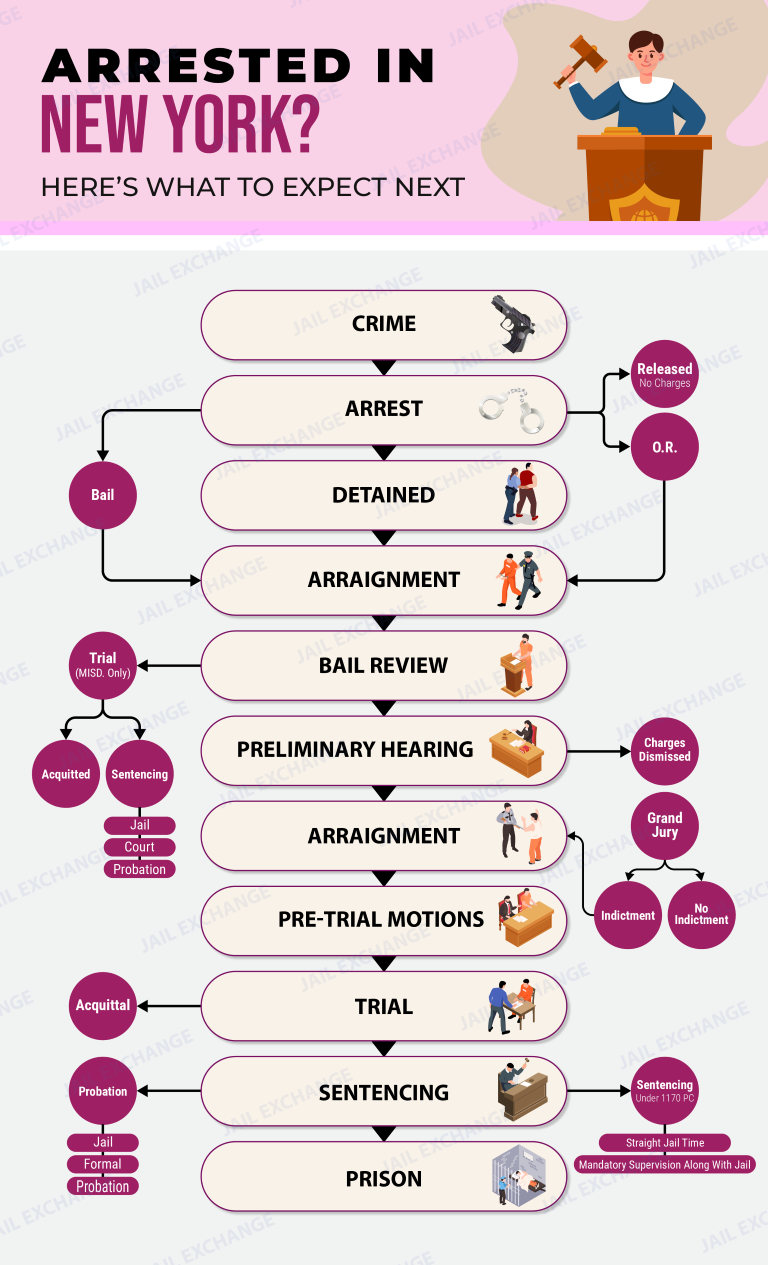
↑ Back to the question list6. What are the steps in an Albany County felony case?
Felonies travel a longer road than misdemeanors:
- Local arraignment. A city, town or village judge hears the felony complaint and rules on release.
- Preliminary hearing. The local judge checks whether there is enough evidence to hold the case, unless it goes straight to a grand jury.
- Grand jury. A panel of local residents meets in secret, listens to the prosecutor, and votes on an indictment, the formal charge. The accused may ask in writing to testify (CPL 190.50(5)).
- County Court arraignment. The person answers the indictment before a County Court judge.
- Discovery and motions. Evidence changes hands, and lawyers file written requests on legal points.
- Plea or trial. The prosecution has six months to announce it is ready for trial (CPL 30.30).
- Sentencing. If there is a conviction, the County Court judge sets the punishment.
Class A can bring life in prison. Class B tops out at 25 years, C at 15, D at 7 and E at 4 (Penal Law § 70.00). Felony fines reach $5,000 or twice the defendant's gain, whichever is higher (Penal Law § 80.00). Some people whose felony grew out of addiction can be sent to treatment instead through judicial diversion (CPL Article 216), handled here by the Drug Court.
↑ Back to the question list7. Why do violent felonies carry harsher terms?
The law lists certain crimes as violent felonies (Penal Law § 70.02). They bring fixed prison terms, followed by post-release supervision, which works much like parole. The ranges by class:
- Class B (first-degree robbery or burglary, for example): from 5 years up to 25
- Class C (second-degree robbery or weapon possession, for example): from 3.5 years up to 15
- Class D (second-degree assault, for one): from 2 years up to 7
- Class E: from 1.5 years up to 4
Each violent felony counts as a qualifying offense, which opens the door to bail or remand (CPL 510.10(4)). On a class A felony, release can come only from a superior court. After a felony conviction in a family case, a final order of protection can last up to eight years past sentencing or past the end of the prison term, whichever is later (CPL 530.12(5)). Violent felonies also can't be sealed later by application (CPL 160.59).
↑ Back to the question list8. Which offices prosecute and defend Albany County cases?
Prosecution is the job of the elected District Attorney, in county and local courts alike:
- District Attorney's Office: Judicial Center, 6 Lodge Street, Albany, NY 12207, 518-487-5460.
People who can't pay for a lawyer are defended by county offices:
- Public Defender's Office: 112 State Street, 2nd Floor, Albany, NY 12207, 518-447-7150. It covers most criminal cases, plus family and youth matters.
- Alternate Public Defender: handles criminal, family and appeal cases when a conflict keeps the Public Defender out.
- Assigned Counsel Program: places private lawyers on cases neither office can take.
A lawyer should be at the arraignment. The court can name one before it decides if the person qualifies (Executive Law § 832(4)). Being in jail points toward qualifying. So does low pay, under 250 percent of the federal poverty line.
↑ Back to the question list9. Where do I find a case status or hearing date?
Start with the paperwork. An appearance ticket, release form or bail receipt names the court and the next date.
- WebCrims is the state's search for criminal cases. Outside New York City it covers only certain courts. It shows pending cases with an upcoming date only, so closed, sealed and youthful offender files are left out. Enter the first two letters, or more, of both names and pick the county.
- County Court felony cases: the clerk at 6 Lodge Street, Room 113, Albany, NY 12207, 518-285-8777.
- Cohoes City Court: 97 Mohawk Street, Cohoes, NY 12047, 518-453-5501.
- Watervliet City Court: 2 Fifteenth Street, Watervliet, NY 12189, 518-453-5550.
- Bethlehem Town Court dates: the clerk at Town Hall, 447 Delaware Avenue, Delmar, NY 12054, 518-439-4955, option 2.
- Colonie Town Court: 312 Wolf Road, Latham, NY 12110, 518-782-2633.
For other town courts, have the docket number ready when you call. The jail at 518-869-2600 can be asked about a person who is still held.
↑ Back to the question list10. Could a warrant be out, and what clears it?
Deputies from the Sheriff's Office, 518-487-5440, and local police officers serve warrants in the county. State wanted notices appear on the New York State Police Wanted and Missing page. To ask whether a warrant exists, phone the court that handled the case or the Sheriff's Office. For a missed court date, a judge must usually give 48 hours' notice before issuing a bench warrant (CPL 510.50). To clear a warrant, go to the court that issued it with a lawyer and surrender, or call its clerk about a new date. Felony warrants come from County Court, 6 Lodge Street, Room 113, Albany, NY 12207, 518-285-8777.
↑ Back to the question list11. How do federal charges from here work?
U.S. government charges go to the Northern District of New York's Albany Division. Court is held at the James T. Foley Courthouse, 445 Broadway, Albany, NY 12207, 518-257-1789, where the clerk works 8:30 a.m. to 4:00 p.m.
- The first federal hearing covers the charges, probable cause, and whether jail until trial is needed.
- Release options include a personal promise, an unsecured bond or a list of conditions (18 U.S.C. 3142(a)). The judge looks at the offense, the evidence, the person's ties and any danger (18 U.S.C. 3142(g)).
- Custody before trial belongs to the U.S. Marshals Service, 445 Broadway, 2nd Floor, Albany, NY 12207, 518-472-5401. The county jail accepts federal prisoners, so call the Marshals to learn where someone is.
- Appointed federal lawyers come from the Federal Public Defender, 54 State Street, Suite 310, Albany, NY 12207, 518-436-1850.
- More than 90 percent of federal defendants plead guilty instead of going to trial.
Read filings on PACER. After sentencing, search the Federal Bureau of Prisons inmate locator to see which prison holds them.
↑ Back to the question list12. How might an immigration detainer touch the court case?
The state charge continues in court even when ICE lodges a detainer. Federally, the steps run like this:
- ICE, which stands for Immigration and Customs Enforcement, delivers its detainer paperwork, Form I-247A, to the jail.
- In it, ICE requests that the person be kept up to 48 hours after they would otherwise be released (8 CFR 287.7(d)).
- ICE agents then pick the person up. Counties outside the New York City office's region work with the Buffalo Field Office, 130 Delaware Avenue, Buffalo, NY 14202, 716-843-7600. One upstate site where ICE holds people is its Buffalo (Batavia) Service Processing Center, 4250 Federal Drive, Batavia, NY 14020, 585-344-6500.
- Track the person with the ICE Online Detainee Locator.
State rules change the picture. Under Wells v DeMarco, a 2018 Appellate Division ruling, New York's local officers may not arrest anyone for a civil immigration violation. New York's Attorney General recommends that jails act on a detainer only when a judge has signed a warrant. Since August 25, 2026, Executive Law § 170-k has barred every county from keeping a 287(g) agreement with ICE. Civil Rights Law § 28 protects people attending court, plus their trips there and back, from a civil immigration arrest, unless a judge has signed a warrant or court order for it. Before any plea, a noncitizen should talk with the defense lawyer about immigration risks.
↑ Back to the question list13. Where is prison time served after an Albany County sentence?
A state prison term means custody of the Department of Corrections and Community Supervision (DOCCS). After sentencing, the county keeps the person until they are declared ready for state custody. DOCCS is required to receive them within ten business days of that point.
A reception and classification center comes first. Staff assign a DIN, run medical, dental and mental health checks, test for programs and decide the right prison.
- Find people with the Incarcerated Lookup. The DIN works best; a last name and year of birth also work.
- Phone DOCCS during business hours at 518-457-5000. Its central office is at the Harriman State Campus, Building #4, 1220 Washington Avenue, Albany, NY 12226.
- Browse prison details on our New York state prison list.
14. How are teen cases handled under Raise the Age?
Raise the Age moved most 16- and 17-year-olds out of the adult system. It began for 16-year-olds on October 1, 2018, and for 17-year-olds on October 1, 2019.
- A felony case for a teen of 16 or 17 begins in a special Youth Part. Nonviolent felonies shift to Family Court unless the District Attorney files a motion within 30 days and shows "extraordinary circumstances" (CPL 722.23).
- Violent felony cases get a review within six days. They stay in the Youth Part only with proof of significant injury, a displayed weapon or unlawful sexual conduct.
- Misdemeanor arrests of teens go to probation intake, not to adult court.
- Children 12 to 17 accused of acts that would be crimes for an adult are handled as juvenile delinquents in Family Court, 30 Clinton Avenue, Albany, NY 12207, 518-285-8600.
- A teen who must stay locked up is placed in the Capital District Juvenile Secure Detention Facility, never the adult jail.
The Probation Department, 60 South Pearl Street, 4th Floor, Albany, NY 12207, 518-487-5200, runs juvenile intake and can say where a youth is held.
↑ Back to the question list15. Where can crime victims turn in Albany County?
The District Attorney's Victim Services Unit guides victims through the court process. Reach it at 518-694-8445, in the DA's Office at 6 Lodge Street, Albany, NY 12207.
- A 24-hour hotline run by the county's Crime Victim and Sexual Violence Center answers at 518-447-7716.
- The Equinox domestic violence hotline is open around the clock at 518-432-7865.
- The state Office of Victim Services may help pay medical, counseling and funeral costs. Its help line is 800-247-8035.
- To get a call when someone leaves custody, register with VINE at 888-846-3469 or on VINELink.
- In family cases, the criminal court may issue an order of protection telling the accused to stay away (CPL 530.12).

Access Securepak is an authorized correctional commissary care-package program that allows families to purchase customized food, snack, hygiene, apparel, and electronics packages sent directly to an incarcerated loved one. Every package is custom-packed to meet the strict security regulations of the specific jail or state prison.
Important: Delivery Schedules and Package Quotas
Jail package guidelines are not uniform across detention centers. Some facilities permit orders year-round, while others restrict deliveries to quarterly cycles or strict weekly deadlines that you should confirm with the facility directly. If you delay setting up your account, you risk missing the upcoming delivery cutoff, leaving your loved one waiting an extra cycle for fresh food, warm thermals, or personal toiletries.
Step-by-Step Instructions to Register and Access Service
- Visit the official Access Securepak online store at www.accesscatalog.com.
- Select the state and the specific jail or correctional institution from the dropdown menu.
- Enter the inmate's legal last name and inmate ID to verify their active housing and package eligibility.
- Browse the catalog of approved meats, cheeses, ramen soups, cookies, toiletries, and clothing.
- Add items to your cart up to the facility's maximum weight or dollar limit (usually $50 to $125 per order).
- Check out using your debit or credit card and save the order confirmation tracking number.
What the Inmate Needs to Do
The inmate does not need to order anything themselves. Securepak ships the sealed package directly to the correctional facility's commissary warehouse. Jail staff inspect the box and deliver it to the inmate during regular pod commissary distribution, where the inmate signs for the package.
Official Provider: Access Corrections / Keefe Group Official Website
Customer Service Telephone: 1-800-546-6283
Support Hours: Monday – Friday, 8:30 AM – 11:30 PM EST; Saturday, 11:00 AM – 5:00 PM EST
Supported Languages: English and Spanish
Other Services Provided by Access Corrections / Keefe Group
In addition to Access Securepak (Commissary & Gift Packages), Access Corrections / Keefe Group provides several other communication, financial, and visitation services at participating correctional facilities:
- Inmate Trust Money Deposits: Send cash directly to their personal account so they can buy items independently.
• Learn more on our website: Inmate Trust Money Deposits Guide | • Visit official vendor page: Access Corrections / Keefe Group Inmate Trust Money Deposits - Digital Messaging & Photos: Send fast electronic letters and digital pictures to their tablet.
• Learn more on our website: Digital Messaging & Photos Guide | • Visit official vendor page: Access Corrections / Keefe Group Digital Messaging & Photos
Buy Commissary for an Inmate in the Albany County Correctional Facility
Albany County Correctional Facility Inmate Commissary - Sending Money or Purchasing Commissary for an Inmate
Albany County Correctional Facility allows inmates to purchase commissary. Ask the jail what its commissary sells; snacks and hygiene items are common.
You can buy commissary for an inmate using an online service called Access Securepak.

Call the facility at 518-869-2600 to ask whether there is a limit on how much an inmate can spend on commissary.
Access Securepak's site shows whether friends and family can order commissary for an inmate at this jail.
Scroll down for information on the Albany County Correctional Facility's service they use for you being able to purchase commissary items online and have them shipped directly to the inmate.
You can also go to our Inmate Money page for information on how to send money to an inmate.
Access Secure Deposits (Smart Deposit) allows families and friends to securely transfer money directly into an incarcerated person's jail trust account using a debit or credit card. Deposited funds become immediately available for your loved one to purchase essential hygiene goods, over-the-counter medication, food items, and writing materials from the facility commissary.
Important: Inmate Banking Policies Vary by Facility
Once a person is booked and moved to a cell, facilities do not always allow cash drop-offs or phone payments directly to the jail. Some might and you should confirm this by calling the facility and asking. But if you do not register online and fund your loved one's trust account immediately, they may be forced to wait days or weeks for standard paper processing, leaving them without essential soap, clean undergarments, basic medical sundries or snacks.
Step-by-Step Instructions to Register and Access Service
- Obtain the inmate's legal first and last name, date of birth, and official six- to ten-digit Booking or Inmate ID number.
- Visit the official Access Corrections portal at www.accesscorrections.com or download the Access Corrections mobile app.
- Select the state and the exact detention facility or county jail where the inmate is currently housed.
- Add the inmate as a contact and confirm their identity from the facility roster.
- Enter your debit or credit card billing information, choose your deposit amount, review the facility processing fee, and submit your payment.
- Save and print your transaction confirmation number for verification.
What the Inmate Needs to Do
The inmate does not need internet access to receive your deposit. Once approved, the funds post directly to their facility account balance. The inmate can verify their balance at the dayroom kiosk or on their trust statement and start ordering items on the next designated commissary day.
Official Provider: Access Corrections / Keefe Group Official Website
Customer Service Telephone: 1-866-345-1884
Support Hours: 24/7/365
Supported Languages: English and Spanish
Other Services Provided by Access Corrections / Keefe Group
In addition to Access Secure Deposits (Trust Money), Access Corrections / Keefe Group provides several other communication, financial, and visitation services at participating correctional facilities:
- Digital Messaging & Photos: Send digital letters and pictures straight to the inmate's kiosk or tablet.
• Learn more on our website: Digital Messaging & Photos Guide | • Visit official vendor page: Access Corrections / Keefe Group Digital Messaging & Photos - Commissary Care Packages: Order pre-approved food boxes, thermal clothes, and snack bundles directly to the jail.
• Learn more on our website: Commissary Care Packages Guide | • Visit official vendor page: Access Corrections / Keefe Group Commissary Care Packages
Deposit Money for an Inmate in the Albany County Correctional Facility
The Easiest and Securest Way of Depositing Money for an Inmate
There are several methods for depositing money on an inmate's account:
1. To send money online to an inmate in the Albany County Correctional Facility use Access Corrections.

2. If you prefer to use your credit or debit card and deposit money over the phone, you can call them at 866-345-1884.
3. Some jails have an Access Corrections kiosk for cash or card deposits. Call the Albany County Correctional Facility to ask whether it has one and where it is.
4. Access Corrections also has Kiosk machines that you can find in check cashing stores and retail outlets across the country.
5. The Albany County Correctional Facility may also allow you to *mail an inmate a money order or cashier’s check from a trusted source such as the Post Office, a local bank, or Western Union. Ask the jail who the money order should be made out to and what to write on it. To confirm this option call the facility at 518-869-2600.
*When mailing a money order or cashier’s check, send it an envelope by itself. Never send it with a letter or photos for your inmate, unless the facility allows it. Never send personal checks or cash.
6. To ask whether the Albany County Correctional Facility takes deposits in person, and when, call 518-869-2600.
The Albany County Correctional Facility on Old Albany Shaker Road in Colonie is run by the Albany County Sheriff's Office. Friends and family do not mail personal letters to the jail building. Letters, cards and postcards go to a separate corrections mail box first, while legal mail and reading material go straight to the jail. Look up the person's inmate ID number on the inmate search and write it next to their full name.
Personal letters, cards and postcards:
Inmate's Full Name & Inmate ID #
Albany County Correctional Facility
c/o Corrections Mail
PO Box 579
11 New Karner Road
Guilderland, NY 12084
Legal mail, books, magazines and newspapers:
Inmate's Full Name & Inmate ID #
Albany County Correctional Facility
840 Old Albany Shaker Road
Albany, NY 12211
- Who it's from: Your own full name and mailing address belong up in the left corner of the envelope. Mail with no return address will most likely never be handed out and may be destroyed.
- Pen and paper: Only blue or black ink. Felt markers, crayons, colored ink, lipstick marks and perfume are all refused.
- Extras: Leave out drawings, glitter and confetti, and don't doodle on the envelope or postcard.
- Cards: A plain greeting card is accepted, but one with a sound chip is not.
- Reading material: Every book, magazine or newspaper has to arrive new, mailed by its publisher or an approved retailer. Hardcover and wire-spiral bindings are turned away. Titles about violence, sex, gangs, drugs or escape are rejected, and magazines with profanity, weapons or adult content are taken.
- Packages: Gifts can only come through the jail's approved commissary provider.
- Stamps: Don't mail stamps. Add money to the person's account instead so they can buy their own, which you can do when you send money online.
- Delivery: Officers hand out mail on weekdays, and a person here may receive as many letters as people send.
- Checked for contraband: Each envelope is opened and looked over. Drugs or other illegal items are turned over to the Sheriff or District Attorney, and the sender can be charged.
- Who they can't write to: People held here may not trade letters with co-defendants, other inmates or anyone covered by a no-contact order.
Staff can read what you write, so stay off the topic of the case. When a letter would take too long, electronic messages are quicker.
Securus AdvanceConnect is a prepaid calling account that links directly to your mobile phone or landline number, allowing you to receive outbound calls from an incarcerated individual. Because correctional phone systems never allow incoming calls, funding an AdvanceConnect balance ensures calls are accepted immediately without being blocked by cell carriers.
Important: Mobile Networks Block Inmate Calls Without Prepaid Funds
Correctional facilities do not allow collect billing to cell phones, and mobile carriers automatically block incoming collect calls from detention centers. While some residential landlines may allow direct billing, mobile phones and VoIP services require an active prepaid AdvanceConnect balance, which you can verify with your phone provider. If you do not register online and fund your account right away, your loved one will hear an automated error message stating that your number cannot accept calls.
Step-by-Step Instructions to Register and Fund AdvanceConnect
- Go to securustech.online or open the Securus mobile app.
- Select Sign Up and create your account using your 10-digit telephone number and email address.
- Search for your facility by state and agency name, then add the inmate using their full legal name or booking ID.
- Select AdvanceConnect under calling accounts.
- Choose your deposit amount, review convenience and transaction fees, and enter your credit or debit card billing details.
- Authorize payment and confirm that your mobile phone allows calls from automated or unknown correctional numbers.
What the Inmate Needs to Do
The inmate picks up any dayroom phone or logs onto their handheld tablet, dials your 10-digit number, and enters their assigned PIN. The automated system verifies that your AdvanceConnect account has an active balance and connects the call. All calls are subject to recording and monitoring by facility staff.
Official Provider: Securus Technologies Official Website
Customer Service Telephone: 1-800-844-6591
Support Hours: 24 hours a day, 7 days a week, 365 days a year
Supported Languages: English and Spanish
Other Services Provided by Securus Technologies
In addition to AdvanceConnect Prepaid Calling, Securus Technologies and its subsidiary JPay provide several other communication, financial, and visitation services:
- Direct Bill Phone Calling: Establish a monthly billed calling account for verified landline numbers.
• Learn more on our website: Direct Bill Phone Calling Guide | • Visit official vendor page: Securus Direct Bill - Securus Video Connect: Schedule and join live video visits from home using your computer or smartphone.
• Learn more on our website: Video Visitation Guide | • Visit official vendor page: Securus Video Connect - JPay Money Deposits (Trust & Canteen): Send money directly into an inmate's jail trust account for commissary store purchases.
• Learn more on our website: Money Deposits Guide | • Visit official vendor page: JPay Money Transfers - JPay Email Messaging & Photos: Send electronic messages, photo attachments, and VideoGrams directly to their tablet or kiosk.
• Learn more on our website: Email Messaging Guide | • Visit official vendor page: JPay Email Services
Securus Direct Bill is an invoiced telephone calling service designed for approved residential landlines, law offices, and commercial businesses. Instead of prepaying funds in advance, calls received from an incarcerated individual are billed directly to your account on a monthly itemized billing invoice.
Important: Direct Bill Requires Credit Approval and Qualifying Lines
Direct Bill is not available for mobile cell phones, internet VoIP numbers, or customers with poor or unestablished telephone credit history. Correctional facilities enforce strict telecommunications billing rules, which you can verify by calling Securus customer care. If your line does not meet credit approval standards, you must open an AdvanceConnect prepaid account instead to receive incoming calls from your loved one.
Step-by-Step Instructions to Set Up a Direct Bill Account
- Contact Securus customer service at 1-800-844-6591 or submit an application via securustech.net.
- Provide your billing name, service address, and qualifying residential or business landline telephone number.
- Submit to a standard credit evaluation performed by Securus to determine billing eligibility.
- Establish your authorized monthly credit limit upon approval.
- When your phone rings with a call from the detention center, follow the recorded operator instructions and press the requested key to accept charges.
- Pay your monthly billing invoice online, by phone, or through the mail.
What the Inmate Needs to Do
The inmate dials your phone number from any dayroom telephone and keys in their assigned PIN. The automated system verifies that your account is in good standing and has not exceeded its monthly spending ceiling before connecting the call. All non-privileged conversations are recorded and monitored.
Official Provider: Securus Technologies Official Website
Customer Service Telephone: 1-800-844-6591
Support Hours: 24 hours a day, 7 days a week, 365 days a year
Supported Languages: English and Spanish
Other Services Provided by Securus Technologies
In addition to Direct Bill Calling, Securus and its subsidiary JPay offer several other communication, financial, and visitation services:
- AdvanceConnect Prepaid Calling: Fund a prepaid calling account tied to your mobile phone number.
• Learn more on our website: AdvanceConnect Calling Guide | • Visit official vendor page: Securus AdvanceConnect - Securus Video Connect: Schedule and join live video visits from home using your computer or smartphone.
• Learn more on our website: Video Visitation Guide | • Visit official vendor page: Securus Video Connect - JPay Money Deposits (Trust & Canteen): Send money directly into an inmate's jail trust account for commissary store purchases.
• Learn more on our website: Money Deposits Guide | • Visit official vendor page: JPay Money Transfers - JPay Email Messaging & Photos: Send electronic letters, photos, and VideoGrams directly to their tablet or kiosk.
• Learn more on our website: Email Messaging Guide | • Visit official vendor page: JPay Email Services
Securus eMessaging provides a digital messaging service that allows family members to send electronic letters, digital photos, and eCards directly to an incarcerated loved one via handheld tablets and housing unit kiosks. Messages are screened electronically, delivering communication within hours instead of waiting days for postal mail delivery.
Important: Physical Mail Bans and Stamp Requirements Vary
Inmates cannot receive incoming phone calls, and traditional postal mail rules differ across correctional systems. While some jails continue to accept handwritten letters, many facilities have transitioned entirely to electronic messaging or digital mail scanning, which you can verify by checking facility rules. If you do not register online and purchase eMessaging stamps right away, your loved one may face lengthy periods without direct written contact from family.
Step-by-Step Instructions to Register and Send eMessages
- Go to securustech.online or open the Securus mobile app.
- Sign into your verified profile or create an account with your email and phone number.
- Select eMessaging from your service dashboard.
- Link the inmate to your account by selecting the facility and entering their legal name or booking ID.
- Purchase an eMessaging stamp book using a debit or credit card.
- Type your message in the editor, attach photos or eCards if permitted, and optionally include a prepaid reply stamp.
- Submit your message to the facility's screening queue.
What the Inmate Needs to Do
All electronic correspondence is screened by correctional staff before delivery. Once approved, the message arrives in the inmate's inbox on their assigned Securus tablet or housing unit kiosk. The inmate opens the message, views attached photos, and drafts an electronic reply using their available stamp balance.
Official Provider: Securus Technologies Official Website
Customer Service Telephone: 1-800-844-6591
Support Hours: 24 hours a day, 7 days a week, 365 days a year
Supported Languages: English and Spanish
Other Services Provided by Securus Technologies
In addition to eMessaging, Securus provides calling, video visitation, and trust money services:
- AdvanceConnect Prepaid Calling: Prepay for phone calling credits so your loved one can call your mobile phone directly.
• Learn more on our website: AdvanceConnect Calling Guide | • Visit official vendor page: Securus AdvanceConnect - Securus Video Connect: Schedule and join live video visits from home using your computer or smartphone.
• Learn more on our website: Video Visitation Guide | • Visit official vendor page: Securus Video Connect - JPay Money Deposits (Partner Trust Transfers): Send money directly into an inmate's jail trust account for commissary shopping.
• Learn more on our website: Money Deposits Guide | • Visit official vendor page: JPay Money Transfers
Securus Technologies (Aventiv) deploys secure, corrections-grade community tablets to incarcerated individuals across state prison systems and county jails. Operating over a private, encrypted facility network, these devices provide access to digital messaging (eMessaging), phone calls, educational courses, job search tools, eBooks, podcasts, and streaming music directly from housing units.
Important: Tablet Hardware Deployment and Rental Rules Vary
Detention centers do not manage tablet distribution identically. While some agencies issue individual personal tablets to every detainee at booking, others utilize shared pod docking stations or restrict tablet use to specific dayroom hours, which you should confirm with the facility directly. Although core educational and legal resources are generally provided free of charge, sending messages, listening to music, or making phone calls from the tablet requires an active balance funded by outside contacts.
Step-by-Step Instructions to Support and Fund Securus Tablets
- Verify that Securus handheld tablets are deployed at your loved one's specific facility.
- Log into your account at securustech.online or launch the Securus mobile app.
- Ensure the inmate is linked to your contact list using their legal name and booking ID number.
- Purchase eMessaging Stamps for digital messaging, fund an AdvanceConnect account for phone calls, or deposit funds into their Inmate Debit account for music and media.
- Review all transaction charges, complete payment with a credit or debit card, and save your confirmation receipt.
- Notify your loved one that funds have posted so they can access their media and communication apps.
What the Inmate Needs to Do
The inmate unlocks their assigned tablet using their facility PIN or biometric verification. They can access free rehabilitative and educational materials at no charge, or open communication and media applications to draft messages, place phone calls, or stream music using available balances. Devices are docked during quiet hours and shift changes for secure recharging and data synchronization.
Official Provider: Securus Technologies Official Website
Customer Service Telephone: 1-800-844-6591
Support Hours: 24 hours a day, 7 days a week, 365 days a year
Supported Languages: English and Spanish
Other Services Provided by Securus Technologies
In addition to Tablet Services, Securus provides calling, messaging, video visitation, and trust money transfers:
- eMessaging & Digital Mail: Send electronic messages, photo attachments, and eCards directly to an inmate's tablet.
• Learn more on our website: eMessaging Guide | • Visit official vendor page: Securus eMessaging - AdvanceConnect Prepaid Calling: Prepay for phone calling credits so your loved one can call your telephone directly.
• Learn more on our website: AdvanceConnect Calling Guide | • Visit official vendor page: Securus AdvanceConnect - Securus Video Connect: Schedule and join live video visits from home using your computer or smartphone.
• Learn more on our website: Video Visitation Guide | • Visit official vendor page: Securus Video Connect - JPay Money Deposits (Partner Trust Transfers): Send money directly into an inmate's jail trust account for commissary shopping.
• Learn more on our website: Money Deposits Guide | • Visit official vendor page: JPay Money Transfers
Albany County Juvenile Facilities
- Correctional Facility: 518-869-2600
- Adult Probation: 518-487-5200
- Albany Police: 518-462-8013
- Classification: 518-869-2619
- Correctional Inmate Services: 518-869-2611
- District Attorney: 518-487-5460
- Juvenile: 518-456-9399
- Juvenile Probation: 518-487-5200
- Public Defender: 518-447-7150
- Sheriff: 518-487-5440
The Albany County Correctional Facility serves the following cities and towns of Albany County: Albany, Altamont, Berne, Bethlehem, Coeymans, Cohoes, Colonie, Green Island, Guilderland, Knox, Menands, New Scotland, Ravena, Rensselaerville, Voorheesville, Watervliet and Westerlo.