
Alamance County Detention Center
Alamance County Detention Center
Jail Phone Number
336-570-6317Alamance County Inmate Search: Track Down Someone Held in Graham
Anyone arrested in the county by a deputy or a city officer is normally booked at the Alamance County Detention Center, 109 South Maple Street, Graham, NC 27253. The Sheriff also runs an Annex. Further down: mugshots, bond, attorneys, visiting, letters and court dates.
Start at the Sheriff's Inmate List and type the surname plus the given name. Add the filter if the results run long. A person booked just minutes ago might be missing, so look again after a few hours.
Want a person on the phone? Dial 336-570-6317 and say you are looking for someone booked in. Keep their birth date handy. For what comes next, read how bail works here and how the court case moves.
Read inmate search answers
 Read inmate search answers
1. Where do I look up Alamance County inmates online?
The Sheriff's website carries a page called the Inmate List. It works like this:
- Go to the Inmate List from any phone or laptop.
- Put the surname in the last name box and the given name in the first name box.
- Try the filter to shorten a big set of results.
- Click the person's row and copy down every detail shown.
- Take those notes with you when you phone the jail or the clerk.
Still stuck? The Sheriff's non-emergency line is 336-570-6300.
↑ Back to the question list2. Why does the Graham roster come up blank for my relative?
A blank screen proves little. Think through these possibilities:
- Booking is still underway. Photos, prints and paperwork take a while.
- Already released. A magistrate set an unsecured bond, or relatives paid a secured one.
- Odd spelling. Try Bob for Robert, or a spelling with the hyphen left out.
- Another facility. A neighboring county, a federal lockup or a state prison may hold them.
- A minor. Youths are housed away from the adult jail.
Phone the booking desk at 336-570-6317. The front office keeps weekday hours from 8 a.m. to 5 p.m. The jail's administrative inbox is DetentionAdmin@alamancecountync.gov.
↑ Back to the question list3. Where in Alamance County are arrested adults kept?
The county runs two buildings. Both fall under the Sheriff:
- Main Detention Center, 109 South Maple Street, Graham, NC 27253, 336-570-6317. Built in 2007. It holds people charged with crimes, people serving sentences, and some held on civil orders.
- The Annex, listed on our bail page at 315 Prison Camp Road, Graham, NC 27253, 336-570-3555. The county gives it 80 beds. Ask the main desk which people are housed there.
The county counts 476 beds across everything. Someone arrested over the line could sit in a neighbor's cell instead. Peek at Greensboro, Orange, Caswell, Chatham, Randolph and Rockingham. Each page gives an address and phone.
↑ Back to the question list4. Are mugshots posted for inmates here?
We could not confirm that the Inmate List displays a photo. Ask the Sheriff before you count on one.
State law does not clearly open booking photos to the public. In practice, mugshots turn up only if the arresting agency decides to share them. What the public can usually get is the name, age, address, the charge, and when and where the arrest took place.
- Sheriff's arrests: 336-570-6300.
- Burlington arrests: 336-229-3503.
- Federal photos are withheld from the public, with one rare exception: a wanted-fugitive notice from the U.S. Marshals.
- Photos in ICE's files take a records request, sent through the ICE records page.
5. Can I be told at once when a person is freed or transferred?
Yes. SAVAN, the state's custody notice system, runs on VINE. It is free. Alerts tell you when the inmate leaves a county lockup or a state prison, or changes facilities.
- Register on VINELink.
- Prefer a phone? Call 877-627-2826, any hour.
- Search by the person's name to start.
Alerts can arrive a little behind real events. For the freshest status, ask jail staff.
↑ Back to the question list6. Who sets bond after an Alamance County arrest, and how soon?
A magistrate does, often within hours. The magistrate's office answers at 336-570-5219, and the job runs around the clock.
The magistrate may choose one of these paths:
- An unsecured bond, with nothing due now.
- Custody release into the care of a responsible adult.
- A secured bond backed by cash, a home or land, or a bondsman's fee.
- Ankle-monitor house arrest, only when paired with a secured bond.
A judge, not a magistrate, must handle charges like murder, rape, kidnapping and human trafficking. Domestic violence arrests can be held for a judge's review for up to two days. Anyone still in custody goes before a District Court judge in three days or less.
Before posting money, ask the jail desk at 336-570-6317 how it is done. Bondsmen can take as much as 15 percent, and that premium stays with them. Verify a license through the state insurance department lookup. Fees, forms and timing are explained on our bail page, and the statutes are gathered in the North Carolina bail statutes overview.
↑ Back to the question list7. How can I read the formal accusation?
The Inmate List may name a charge, but the court file tells the full story. It also shows the next hearing.
- Run a name search in eCourts. Results show charges, dates and case events.
- Phone the Clerk of Superior Court, 336-570-5200. The clerk will want a complete name and the birthday.
- The District Attorney's office decides which accusations move forward. It sits at 212 W. Elm Street, Suite 210, Graham, NC 27253, 336-570-5210.
Counts may be added or dropped later, so look again after each hearing.
↑ Back to the question list8. How can an inmate get a court-appointed attorney?
The court can name one with no upfront cost. Ask at the first appearance.
- Ask the judge, in so many words, for a court-appointed lawyer.
- Complete the affidavit of indigency, form AOC-CR-226, which lists income and expenses.
- The judge rules on whether you qualify. Repayment may be ordered afterward.
The District 17 Public Defender takes cases from this area at 108-B S. Maple Street, Graham, NC 27253, 336-570-5260. Indigent Defense Services, 919-354-7200, can answer process questions. Hiring a private lawyer is also open to relatives.
↑ Back to the question list9. Can I visit someone at the Graham jail?
The visiting days, hours and dress code did not come up in our research. Phone 336-570-6317 before making the drive.
Before leaving home, ask staff:
- Which days and time slots are open?
- Must I book ahead?
- Which ID is accepted? Are minors allowed?
- What clothing and items are off limits?
Staff may cancel a visit suddenly. More tips live in our visitor primer.
↑ Back to the question list10. How do I load money for their store purchases?
An inmate account pays for food, soap and similar extras. Ask at 336-570-6317 which deposit routes work now and what the caps are.
The county's own detention page points families to an online store at alamannc.jailcanteen.com. Read how deposits work in our funding explainer, and what the cash can buy in our commissary overview. Keep bills and coins out of the mail.
↑ Back to the question list11. How would we stay in touch by phone or app?
The jail picks the phone and message setup. Ring 336-570-6317. Ask what route your person uses to call you, how much a minute runs, and if the jail has tablet or video options.
Ask if calls are taped, and assume yes. Leave case details for your lawyer. Setup details are in our phone service page and electronic messaging page.
↑ Back to the question list12. Where and how do I send a letter or card?
Ask the jail first, at 336-570-6317, for the proper mailing address. Find out whether photos, cards or books may come through.
Put the person's legal name first on the envelope, with your return address on the back flap. Do not tuck money inside. The letter-writing page lists common restrictions.
↑ Back to the question list13. Can I bring clothes or pick up belongings?
Items taken at booking are held until release. To deliver clothes or take something home, call 336-570-6317 on a weekday between 8 a.m. and 5 p.m. Ask who is allowed to collect, and what photo ID to carry.
Visit the building at 109 South Maple Street, Graham, NC 27253 only after staff approve it.
↑ Back to the question list14. Who treats a person who falls ill behind these walls?
Reach the jail at 336-570-6317 and ask to speak with jail health staff. List the drugs, the strength and the prescriber's number.
Your loved one should also ask for a medical slip inside. In a life-threatening case, call 911 yourself. If you worry about their mood or safety of mind, say that on the call to the jail.
↑ Back to the question list15. Is there a warrant on someone I know?
Deputies serve county warrants. Town officers, such as Burlington police, serve their own. Ask the Sheriff at 336-570-6300 or Burlington police at 336-229-3503. Neither has an official wanted page for us to link, so phone and ask.
Test a case in eCourts or ask the Clerk of Superior Court, 336-570-5200. To end the problem, consult a lawyer, then phone the courthouse that issued it. Criminal files are kept at 212 West Elm Street, Graham, NC 27253.
↑ Back to the question list16. When is the next Alamance County court date?
The J.B. Allen Jr. Criminal Courthouse, 212 West Elm Street, Graham, NC 27253, 336-570-5202, hosts criminal cases. Minor crimes, traffic tickets and a felony's first hearings go to District Court. After indictment, a felony moves up to Superior Court for trial.
The Historical Courthouse, 1 Court Square, Graham, NC 27253, 336-570-5200, is for civil cases. That is the Clerk's main number.
Look up hearings on the state court date search. Our court explainer follows a case step by step. Skipping a hearing can double a bond.
↑ Back to the question list17. Did federal officers, not local police, make the arrest?
The federal court for this region is the Middle District of North Carolina. Its clerk works from the L. Richardson Preyer Federal Building, 324 W. Market Street, Greensboro, NC 27401, 336-332-6000.
- Within days a federal judge conducts a detention hearing, weighing release against custody before trial (18 U.S.C. 3142).
- While the case is pending, the U.S. Marshals Service holds federal prisoners. Its district office: 324 West Market Street, Suite 234, Greensboro, NC 27401, 336-332-8700.
- The Federal Public Defender may represent people who cannot pay. The office is at 301 North Elm Street, Suite 410, Greensboro, NC 27401, 336-333-5455.
- Following a federal sentence, look in the BOP inmate locator to see the assigned prison.
18. Could ICE be waiting to take over custody?
Steps usually go in this order:
- The detainer arrives on Form I-247A, sent by ICE (8 CFR 287.7(d)).
- A law in force since October 1, 2025 sends the person before a judicial official. That official may order a hold of up to 48 hours after they would otherwise be released.
- The hold gives ICE a window to take custody.
- For certain charges the official tries to learn citizenship. If it is unclear, the jail asks the federal government. That check takes two hours.
- Search the ICE Online Detainee Locator using a name and birth country.
Staff at 336-570-6317 can say whether a detainer arrived.
↑ Back to the question list19. How do I track an inmate sentenced to state prison?
The North Carolina Department of Adult Correction runs the state prisons. Its lookup page is called Offender Public Information. Enter a surname or an offender number. Records reach back to 1972 and cover prison, probation and parole. County jails are not included.
The Department's main line is 919-733-2126. A few sentences, usually short ones, are served in a county jail instead. See our state prisons listing for facility details.
↑ Back to the question list20. How are arrested teenagers handled in Alamance County?
A person under 18 does not go into the adult jail. The case is heard in juvenile court, a division of District Court, and those records stay private.
If a teen is held in secure custody, a hearing must happen within five calendar days. No one can waive it. The state usually picks a juvenile detention center near the teen's home. We could not confirm which one serves this area. Ask the Clerk of Superior Court, 1 Court Square, Graham, NC 27253, 336-570-5200.
↑ Back to the question list21. Which agencies make arrests in Alamance County?
The arresting agency can tell you about a report, a photo or a warrant.
- Sheriff's Office, 109 S Maple Street, Graham, NC 27253, 336-570-6300. Patrols the areas outside town limits.
- Burlington Police Department, 267 W. Front Street, Burlington, NC 27216, 336-229-3503.
- State Highway Patrol, Troop D, District V, in Graham, 336-570-6809. Troop D headquarters: 2527 East Market Street, Greensboro, NC 27401, 336-334-5621.
Other towns, such as Mebane, Elon, Gibsonville and Haw River, and campus police may also arrest people. Ask the Sheriff's line which one to call.
↑ Back to the question listAlamance County bail and bond: Graham, Burlington, and the county jail
A family member arrested in Alamance County is booked into the Alamance County Detention Center, 109 South Maple Street, Graham, NC 27253. An Annex building next door adds more beds. Below, we explain who decides bail, the types of bond, and what a skipped court date means.
Begin with the sheriff's Inmate List, where you enter a last name and first name. Our Alamance County Inmate Search page adds recent arrests, charges, and who is being held right now.
Then call the jail at 336-570-6317 and ask if a bond is set yet. If it is, ask who to see about paying. When there is none yet, find out how soon a magistrate will meet with them. Our court page covers what comes after.
1. Does Alamance County have more than one jail building?
Yes. The main Alamance County Detention Center is at 109 S. Maple Street in downtown Graham, (336) 570-6317. The county also runs an annex at 315 Prison Camp Road, Graham, (336) 570-3555. Together they are rated for about 476 people. Bond is handled through the magistrate, not at the annex.
↑ Back to the question list2. What if the arrest happened in Burlington or at Elon?
It does not matter whether Burlington Police, Mebane Police, Elon University Police, or the Sheriff's Office made the arrest. Everyone arrested in Alamance County sees an Alamance magistrate and is held at the Graham jail if bond is not paid. A Burlington case can be set in the Burlington district courtroom, so check the courthouse listed on the release order.
↑ Back to the question list3. After a Gibsonville arrest, who decides the bond?
In Graham, the Graham magistrate usually does. By law, Alamance keeps 12 or more magistrates (NC law, G.S. 7A-133). The Graham detainee stays in the Alamance County Detention Center meanwhile. After a Gibsonville arrest, police see Graham's magistrate (NC law, G.S. 15A-511; NC law, G.S. 15A-532). The Graham clerk or an Alamance County judge can also act in Alamance.
↑ Back to the question list4. What release can an Alamance magistrate order?
In Alamance, four release types exist (NC law, G.S. 15A-534, part a).
• An Alamance electronic monitor means house arrest. In Graham, it comes with a secured bond.
• Custody release means a Gibsonville person supervises. Your Alamance family member may pick an Alamance secured bond instead.
• In Alamance, an unsecured bond costs families in Swepsonville nothing up front. If Graham court is skipped, your Graham loved one owes it.
• Post cash, land, or an Alamance surety for a Graham secured bond.
A written promise ended in Alamance on December 1, 2025.
↑ Back to the question list5. Why did the Alamance magistrate set a money bond?
Non-violent Graham cases begin with no-money options in Alamance (NC law, G.S. 15A-534, part b).
Alamance flight risks change that in Graham. Graham witness risks count too in Alamance. The Alamance magistrate weighs harm risks too.
Three Alamance Class 1 convictions in 10 years? Alamance then requires a secured bond (NC law, G.S. 15A-534, part b). On probation, a new Graham felony brings an Alamance danger review (NC law, G.S. 15A-534, part d2).
↑ Back to the question list6. Are bond amounts set by charge in Graham?
Alamance has no fixed price list in Graham. Alamance's chief district judge weighs in for Graham. District 17's senior judge writes Alamance's policy (NC law, G.S. 15A-535). The Alamance policy suggests Graham amounts.
In Graham, evidence and record matter (NC law, G.S. 15A-534, part c). Alamance counts missed court against the Burlington detainee. Ties to Green Level help.
First small Alamance misdemeanors often get unsecured bonds in Graham. Alamance cash bonds run hundreds to thousands in Graham. Gun charges in Graham run higher in Alamance. Felony bonds in Alamance often start in the thousands in Graham.
↑ Back to the question list7. Who can sign as surety for a Graham bond?
Post an Alamance bond with the Graham magistrate. When a magistrate is not present, the Alamance County Detention Center can accept it (NC law, G.S. 15A-537). Call (336) 570-6317 first.
Alamance takes cash, land, or a Graham surety (NC law, G.S. 15A-531). A Haw River relative can sign unpaid with enough Alamance property. An Alamance surety may be a Graham bail agent.
Bondsman fees in Graham top out at 15% (NC law, G.S. 58-71-95). Alamance jailers can't be sureties, except for Graham family (NC law, G.S. 15A-541). Collateral reaches Graham families within 15 days. Check a Graham bondsman with the NC Department of Insurance bondsman lookup.
↑ Back to the question list8. Can a Graham magistrate release someone charged with murder?
In Alamance, these need an Alamance County judge (NC law, G.S. 15A-533, part b and c): forcible rape and many sex crimes; human trafficking; kidnapping; sex crimes against a child 15 or younger; armed robbery; murder or attempted murder; capital crimes; shooting into an occupied building or car; first-degree burglary; assault with a deadly weapon with intent to kill causing serious injury; first-degree arson.
For them, Alamance presumes no Graham release is safe. Still, a Graham judge may allow Graham release. Some repeat Alamance gun cases match (NC law, G.S. 15A-533, part d through g).
↑ Back to the question list9. What does Iryna's Law mean for Alamance County?
Alamance now presumes a violent Graham defendant stays jailed (NC law, G.S. 15A-534, part b1). In Graham, people say Iryna's Law in Alamance.
In Alamance, Class A-G felonies with force count (NC law, G.S. 15A-531, part 9). Sex-offender registration felonies count in Graham. So do Graham attempts and some Alamance fentanyl trafficking.
A first violent Alamance charge needs a secured bond or Graham monitor. The Alamance judge writes reasons for Alamance (NC law, G.S. 15A-534, part d). Alamance defendants charged twice get a Graham monitor.
↑ Back to the question list10. After a Graham domestic violence arrest, what happens?
In Alamance, domestic cases go to the Alamance judge first (NC law, G.S. 15A-534.1, part a). A Graham 50B order violation counts in Alamance. Alamance threats against a Graham spouse count.
The Alamance County Detention Center may hold the Green Level detainee up to 48 hours (NC law, G.S. 15A-534.1, part b). Then Graham's magistrate acts in Graham. Expect Alamance no-contact orders in Graham.
↑ Back to the question list11. Which Alamance County cases have special bond rules?
Yes. These apply in Alamance:
• DWI in Alamance: an impaired Graham defendant may wait 24 hours (NC law, G.S. 15A-534.2).
• Meth labs in Alamance: Graham release may be presumed unsafe (NC law, G.S. 15A-534.6).
• Alamance child victims: Graham stay-away orders are required (NC law, G.S. 15A-534.4).
• Looting in Graham: a Graham judge decides within 24 hours (NC law, G.S. 15A-534.8).
• Graham mass-violence threats: an Alamance County judge acts within 48 hours (NC law, G.S. 15A-534.7).
• Threats to Alamance officials: an Alamance County judge decides within 48 hours (NC law, G.S. 15A-534.9).
↑ Back to the question list12. Does a new Graham charge change the bond?
Out on release? The Alamance judge sets new Graham terms (NC law, G.S. 15A-533, part h). Alamance allows up to 48 hours in the Alamance County Detention Center. Then the Alamance magistrate acts for Alamance. Most Alamance traffic cases, except DWI, don't count in Graham.
In Alamance, the new bond may double in Graham (NC law, G.S. 15A-534, part d3). For good cause, Alamance can revoke Graham release (NC law, G.S. 15A-534, part f). A doubled Alamance bond is $1,000 or more in Graham.
↑ Back to the question list13. How soon does someone held in Alamance County see a judge?
Within 72 hours, your Alamance family member sees a Graham judge (NC law, G.S. 15A-601). Alamance may act sooner, at the next Graham session. Long Graham closures allow 96 hours in Alamance. Alamance district court also sits in Burlington.
An Alamance County magistrate may adjust it in Graham (NC law, G.S. 15A-534, part e). A Graham judge may change it at the Graham hearing.
Still denied? Write to an Alamance superior court judge (NC law, G.S. 15A-538). Alamance prosecutors may ask too (NC law, G.S. 15A-539).
↑ Back to the question list14. After a missed Graham court date, what happens to the bond?
A willful Graham no-show is its own crime in Alamance (NC law, G.S. 15A-543). On a Graham misdemeanor, an Alamance no-show is Class 2. Skip an Alamance felony date, and the new Graham charge is a Class I felony.
The Alamance court forfeits the full Graham bond (NC law, G.S. 15A-544.3). There are 150 Alamance days to file in Graham (NC law, G.S. 15A-544.5). The Graham clerk mails notice within 30 days (NC law, G.S. 15A-544.4). Only listed Alamance reasons work, like Graham surrender.
After 150 days, the Alamance clerk dockets a Graham judgment (NC law, G.S. 15A-544.6). The next Graham bond is usually doubled in Alamance (NC law, G.S. 15A-534, part d1).
↑ Back to the question list15. Can I get off someone's bond in Graham?
A Graham surety can surrender the Alamance defendant early (NC law, G.S. 15A-540, part a). Then the Graham clerk releases the Alamance surety. Once Alamance court is missed, a Graham surety may arrest the Alamance defendant (NC law, G.S. 15A-540, part b). An Alamance County magistrate then sets new terms (NC law, G.S. 15A-540, part c).
Otherwise, an Alamance bond lasts until Graham judgment (NC law, G.S. 15A-534, part h). A Graham deferral can end it in Alamance.
↑ Back to the question list16. Where will a Graham case be heard?
Criminal court for Alamance County is held in Graham, the county seat. District court also holds sessions in Burlington.
Graham misdemeanors stay in Alamance District Court 17 (NC law, G.S. 7A-133). After indictment, Alamance felonies go to Graham Superior Court 17 (NC law, G.S. 7A-41). Alamance prosecutors handle Graham cases (NC law, G.S. 7A-60).
↑ Back to the question list17. Is there a public defender for Alamance County?
Yes. The District 17 Public Defender covers Alamance County: 108-B S. Maple Street, Graham, 336-570-5260. Ask at the Graham first appearance. The Alamance judge reviews income (Indigent Defense Services directory).
↑ Back to the question list18. Where does a Graham teen go after arrest?
Most Alamance teens under 18 start in Graham juvenile court (NC law, G.S. 7B-1501). Alamance juveniles face no money bail in Graham. Some Graham cases move to Alamance superior court. Since 2019, that includes Alamance 16- and 17-year-olds in Graham. A Graham judge decides detention within 5 days (NC law, G.S. 7B-1906).
↑ Back to the question list19. Which federal court covers Alamance County?
Alamance falls under the U.S. District Court for the Middle District of North Carolina (28 U.S.C. 113). Court meets in Durham, Greensboro, and Winston-Salem. The clerk: Greensboro, L. Richardson Preyer Federal Building, 324 W. Market St., 336-332-6000. A federal judge sets Alamance release.
↑ Back to the question list20. Who can confirm an Alamance County bond amount?
Call the Alamance County Detention Center at (336) 570-6317. The Graham clerk can also help Graham families on weekdays. Have the Alamance defendant's birth date ready for Graham staff.
↑ Back to the question list21. Alamance County bail contacts
- Jail: Alamance County Detention Center, 109 South Maple Street, Graham, NC 27253; (336) 570-6317
- Courts: Alamance County Courthouse, Graham
- Districts: District Court 17; Superior Court 17; Prosecutorial 17
- Public defender: District 17 Public Defender; 336-570-5260
- Inmate search: Alamance County Inmate Search
Judges and magistrates set release terms case by case. Nothing here is legal advice.
↑ Back to the question listAlamance County Detention Center ON-SITE (at the jail) VIDEO VISITATION SCHEDULE
109 South Maple Street
Graham, NC 27253
336-570-6317
Schedule Video Visits online with Paytel

- On-site Visits are free.
- Visitation schedule subject to change.
- Inmates are allowed six 15-minute visits per week.
- You must arrive 15 minutes prior to the visit.
- A maximum of one adult and one child are allowed per an on-site video session.
- Only one infant (under 1 year of age) will be allowed per visit and will not be counted as a visitor
- All visits must be made at least 24 hours in advance.
- Any person visiting must not have been incarcerated within the past 180 days.
ON SITE VISITATION SCHEDULE
| DAY | TIME |
| SUNDAY | NO on site VISITS |
| MONDAY | 9:30 AM - 4:30 PM |
| TUESDAY | 9:30 AM - 4:30 PM |
| WEDNESDAY | 9:30 AM - 4:30 PM |
| THURSDAY | 9:30 AM - 4:30 PM |
| FRIDAY | 9:30 AM - 4:30 PM |
| SATURDAY | 9:30 AM - 4:30 PM |
Alamance County Detention Center REMOTE (at home) VIDEO VISITATION SCHEDULE
Schedule Video Visits online with Paytel
- All visits must be scheduled at least 24 hours in advance.
- Remote visits are charged a fee.
- Visitation Schedule subject to change.
REMOTE VISITATION SCHEDULE
| DAY | TIME |
| SUNDAY | 7:00 AM - 11:00 PM |
| MONDAY | 7:00 AM - 11:00 PM |
| TUESDAY | 7:00 AM - 11:00 PM |
| WEDNESDAY | 7:00 AM - 11:00 PM |
| THURSDAY | 7:00 AM - 11:00 PM |
| FRIDAY | 7:00 AM - 11:00 PM |
| SATURDAY | 7:00 AM - 11:00 PM |
Attorneys have access to their clients during the following times:
7:00 AM - 11:00 PM
- Inmates cannot be seen during mealtimes, lockdowns and emergency situations.
- Attorneys may call 336-570-6317 for questions or appointments.

PayTel Video Visitation allows friends and family members to schedule and conduct live, face-to-face video visits with incarcerated loved ones from home. Using an internet-connected smartphone, tablet, or personal computer equipped with a webcam, visitors connect directly through housing-unit video stations or assigned tablets, eliminating the need to travel to the correctional facility.
Important: Advance Registration and Visitor Clearance Required
Detention centers do not permit unscheduled or unverified video sessions. Correctional facilities require prospective visitors to submit government-issued photo identification and receive administrative clearance before booking an appointment, an approval process that can take up to 48 hours depending on facility staffing. You should verify your visitor approval status with the facility prior to scheduling. If you do not register well in advance, you will miss your loved one's scheduled visiting window for the week.
Step-by-Step Instructions to Register and Schedule a Video Visit
- Visit www.paytel.com or launch the PayTel Connect mobile app.
- Register your visitor profile and upload a clear photograph of your government-issued ID (driver's license or passport) for facility background review.
- Wait for email notification confirming facility visitor approval.
- Select Video Visitation, choose the detention facility, and select the inmate.
- Browse the available schedule calendar, select an open time slot, and pay the visitation fee using a credit or debit card.
- Log into the website or mobile app 10 minutes prior to the start time on a device with a functioning camera, microphone, and stable high-speed internet connection.
What the Inmate Needs to Do
The inmate receives a visitation notification on their housing unit video kiosk or assigned tablet. At the appointed time, they log in with their PIN and sit before the terminal. Inmates and visitors must strictly observe jail dress and conduct rules; sessions are monitored by staff and will terminate immediately upon any violation.
Official Provider: PayTel Official Website
Customer Service Telephone: 1-800-729-8355
Support Hours: Monday – Friday, 8:00 AM – 9:00 PM EST; Saturday, 9:00 AM – 6:00 PM EST
Supported Languages: English and Spanish
Other Services Provided by PayTel Communications
In addition to Video Visitation, PayTel provides calling, messaging, and tablet services at participating facilities:
- Prepaid Phone Calling Accounts: Prepay for phone calling credits so your loved one can call your telephone directly.
• Learn more on our website: Prepaid Calling Accounts Guide | • Visit official vendor page: PayTel Prepaid Calling - Inmate Messaging & Digital Communications: Send electronic messages and photos directly to an inmate's terminal.
• Learn more on our website: Inmate Messaging Guide | • Visit official vendor page: PayTel Messaging - Inmate Tablets & Digital Services: Learn how handheld devices provide access to messaging, phone calls, and media.
• Learn more on our website: Tablet Programs Guide | • Visit official vendor page: PayTel Tablets
Alamance County District Court and Superior Court after an arrest
Criminal cases here start in District Court, and felony trials move to Superior Court. Both sit at the criminal courthouse, 212 West Elm Street, Graham, NC 27253. A person kept in custody after arrest is at the Alamance County Detention Center, 109 South Maple Street, Graham, NC 27253.
Check on custody with the sheriff's Inmate List by typing a name. Want more? Our Jail Roster also lists recent arrests and charges.
Questions about a hearing time go to the Clerk of Superior Court, 336-570-5200. Give the full name and ask about the room and next date. Worried about getting someone out? Read our bail and bond guide.
1. Where will the criminal case be heard?
A family trying to understand a case in Alamance County can begin with the charge listed on the court papers.
Courthouse locations and direct telephone numbers
- Alamance County Courthouse, 1 Court Square, Graham, NC 27253, 336-570-5200
State court: The Alamance County District Court handles most misdemeanors and the opening felony hearings. The Alamance County Superior Court handles felony trials and appeals for a new trial from District Court.
A felony charge generally begins with an initial appearance and a District Court probable-cause stage before Superior Court takes over for trial.
↑ Back to the question list2. What happens after an arrest and how does release work?
An arrest is not a conviction. The person is booked and brought before a magistrate, who can set release terms.
Release can involve a written promise to appear, an unsecured bond, a secured bond, or other conditions. A secured bond does not mean the person is already guilty. A judge may review release terms, and restrictions can include staying away from an alleged victim.
For certain arrests, extra review or holding rules apply. A person held in custody should be told the charges and brought before judicial officials under the applicable rules. A family member should keep the defendant’s full name, birth date and any case number handy when calling court staff.
↑ Back to the question list3. How are misdemeanor cases handled and punished?
A misdemeanor normally goes before a District Court judge, without a jury. The judge hears witnesses and decides guilt.
Important misdemeanor sentencing figures: North Carolina uses Classes A1, 1, 2, and 3. A1 ranges from 1–60 days at prior-conviction Level I to 1–150 days at Level III; Class 1 reaches 45, 45, or 120 days by level; Class 2 reaches 30, 45, or 60 days; Class 3 reaches 10, 15/20, or 20 days depending on the person’s prior convictions and permitted sentencing disposition.
The word “maximum” does not mean everyone goes to jail. Some combinations of class and prior record require or allow community punishment instead. Ordinary fine ceilings are $200 for Class 3 and $1,000 for Class 2, while Class A1 and Class 1 fines are generally left to the court unless a particular crime has its own rule (G.S. 15A-1340.23).
↑ Back to the question list4. How does a felony case move through the courts?
A felony normally begins in District Court but is tried in Superior Court if it goes forward.
After a first appearance, a probable-cause hearing may be scheduled; an indictment can change whether a preliminary hearing is needed. In Superior Court, the parties exchange evidence, argue motions and may negotiate a plea. Someone pleading not guilty to a felony is entitled to a jury trial. The prosecutor must prove the case beyond a reasonable doubt.
Class A through I felonies carry different sentencing possibilities. Prior-record points, offense class, aggravating or mitigating factors and the date of the crime can substantially change the lawful range. The court uses the structured-sentencing grid in G.S. 15A-1340.17, not a single fixed statewide number for all felonies.
↑ Back to the question list5. What happens with serious violent crimes?
Accusations such as murder, serious sexual assault and armed robbery carry far more serious consequences than routine misdemeanors. A Superior Court jury may hear the evidence, with appointed or retained defense counsel. In some cases there are special rules for bonds, mandatory minimums, and life imprisonment.
First-degree murder may be punished by life without parole or death under the statutes governing capital cases; other homicides have different classifications and punishments. Sentences for rape and robbery depend on the precise offense statute and any aggravating factors. A family should never rely on a broad label like “assault” to calculate a sentence.
↑ Back to the question list6. How do juvenile cases work?
A complaint involving a young person can follow juvenile delinquency procedures rather than the ordinary adult criminal docket. Youth hearings are generally in District Court, with different goals and privacy protections. For many delinquent acts the juvenile system has jurisdiction over offenses committed before age 16, while some 16- and 17-year-olds accused of specified lower-level conduct may also be handled there under the applicable statutes.
Intake staff may recommend diversion or formal proceedings. A juvenile can be placed under supervision, ordered into services, or in appropriate cases detained or committed. Serious charges may trigger special transfer rules. Parents or guardians should ask about counsel and the youth’s next hearing.
↑ Back to the question list7. How does North Carolina decide fines and sentences?
Here is the key to reading a North Carolina sentence: the judge first looks at the offense class, then the defendant’s prior convictions or prior-record points. The law limits both the length and the type of sentence. “Community” punishment may mean probation or conditions instead of immediate jail; “intermediate” punishment can be more restrictive; “active” punishment means incarceration.
For misdemeanors, examples of the longest grid terms are Class A1 up to 150 days, Class 1 up to 120, Class 2 up to 60 and Class 3 up to 20, for the applicable highest prior-conviction level. These are not automatic sentences. Fines: ordinarily Class 3 up to $200 and Class 2 up to $1,000; the usual statutory text leaves A1 and Class 1 fine amounts to the judge unless another law controls. For felonies, the North Carolina felony grid in G.S. 15A-1340.17 specifies the allowable minimum and maximum prison term according to class and prior-record level.
Some crimes have their own minimums, enhancements, restitution obligations, court costs, sex-offender requirements, or driving restrictions. The offense date matters because the legislature has updated the sentencing charts, including changes effective for crimes committed on or after December 1, 2025.
↑ Back to the question list8. Are there city courts or other local criminal courts?
North Carolina does not operate a separate municipal criminal-court system like some states. City police departments may arrest a person and city ordinances may lead to enforcement, but ordinary state criminal prosecutions go through District Court and Superior Court. Magistrates handle functions such as issuing warrants and setting release conditions.
This is why someone arrested by a city police officer in Alamance County generally receives a state-court case, not a separate “city criminal court” proceeding. A local police holding area is not the county courthouse.
↑ Back to the question list9. What if the charge is a federal crime?
Most crimes prosecuted by a county District Attorney remain in state court. A separate federal criminal case can arise from violating a federal statute, such as certain interstate fraud, trafficking offenses, federal firearm offenses, bank robbery involving a federally insured bank, or crimes on federal property. Not every serious state crime is automatically a federal crime.
Usual federal venue for Alamance County: U.S. District Court for the Middle District of North Carolina. Federal contact: Greensboro federal clerk, 336-332-6000. L. Richardson Preyer Federal Building and Courthouse, 324 W. Market Street, Greensboro, NC 27401
Federal magistrate judges handle initial appearances and detention hearings; federal prosecutors work for the U.S. Attorney. Federal felony cases generally involve a grand jury indictment unless properly waived. The U.S. Sentencing Guidelines and federal statutes, not North Carolina’s state sentencing grid, govern federal sentences.
This is general court information, not legal advice. If the accused cannot afford an attorney, ask at the first appearance about appointed counsel.
↑ Back to the question list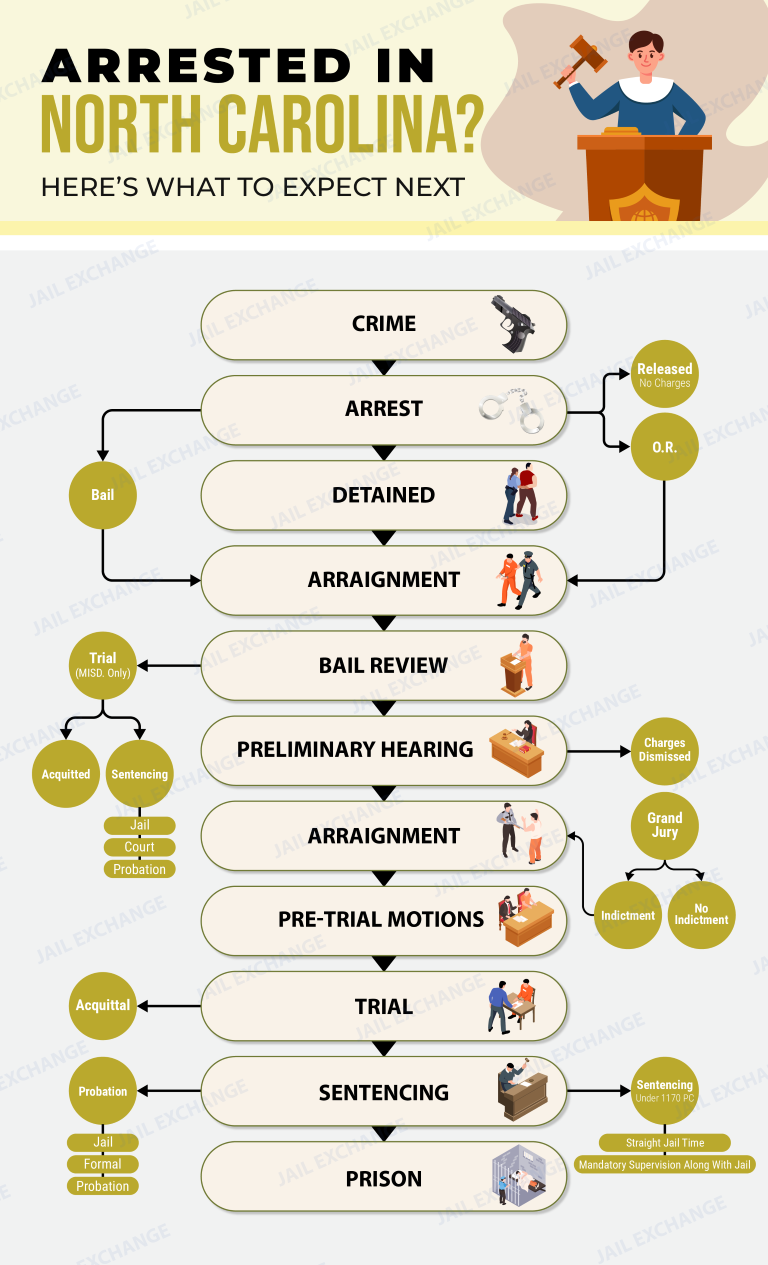
Oasis Commissary (operated online at jailcanteen.com) allows families and friends to purchase pre-approved snack boxes, food packages, confectionery goods, hygiene products, and apparel kits sent directly to an incarcerated loved one. Each package is packed to comply with local facility security rules, ensuring items clear intake smoothly without being rejected at the loading dock.
Important: Package Deadlines and Delivery Windows Vary
Detention centers do not manage care package deliveries under identical schedules. While some facilities allow weekly orders, others restrict deliveries to bi-weekly or monthly distribution windows, and spending limits vary from jail to jail. You should verify the facility's active cutoff schedule and order allowances by calling them directly. If an order is submitted after the weekly processing deadline, delivery will be held until the following cycle, leaving your loved one waiting an extra cycle for fresh snacks, thermal wear, or personal care supplies.
Step-by-Step Instructions to Place a Commissary Package Order
- Confirm the inmate's legal first and last name, date of birth, and assigned booking or inmate ID number.
- Navigate to www.jailcanteen.com on your computer or mobile device.
- Select your state and detention center to open the jail's authorized product catalog.
- Search for the inmate to link the order to their active housing record.
- Browse available snack boxes, meats, hygiene kits, and clothing options, adding items up to the facility's allowed spending limit.
- Proceed to checkout, enter your debit or credit card billing details, and submit payment.
- Save your digital receipt and confirmation tracking number for your records.
What the Inmate Needs to Do
The inmate does not need an internet account to receive care packages. Oasis Commissary fulfills the order in tamper-evident security containers and delivers it directly to the facility commissary department. Jail staff inspect the shipment and deliver the items during regular housing unit commissary distribution, where the inmate signs for receipt.
Official Provider: Oasis Commissary (jailcanteen.com)
Customer Service Telephone: 1-800-956-2747 or 1-618-548-6034
Support Hours: Monday – Friday, 8:00 AM – 5:00 PM CST
Supported Languages: English and Spanish
Other Services Provided by Oasis Commissary
In addition to Care Packages, Oasis Commissary provides trust deposit services at participating facilities:
- Inmate Trust Money Deposits: Send money directly into an inmate's jail trust account for independent canteen shopping.
• Learn more on our website: Inmate Trust Deposits Guide | • Visit official vendor page: Oasis Trust Deposits
Buy Commissary for an Inmate in the Alamance County Detention Center
Alamance County Detention Center Inmate Commissary - Sending Money or Purchasing Commissary for an Inmate
Alamance County Detention Center allows inmates to purchase commissary. This can be snacks, hygiene products, stamps, stationary, clothing and even electronics.
You can buy commissary for an inmate using an online service called Oasis Commissary / jailcanteen.com.

There is a monthly limit of $200-300 on how much inmates can spend on commissary items.
This amount is subject to change so call the facility at 336-570-6317 in order to confirm the amount that cannot be exceeded.
Inmates have access to both an in-house commissary store, and commissary packages that can be purchased and shipped to the inmate by friends and family.
Scroll down for information on the Alamance County Detention Center's service they use for you being able to purchase commissary items online and have them shipped directly to the inmate.
You can also go to our Inmate Money page for information on how to send money to an inmate.

JailATM provides a secure electronic payment portal that allows friends and family members to deposit funds directly into an incarcerated person's jail trust and commissary account. Deposited money provides the financial balance needed for your loved one to purchase personal hygiene items, snacks, over-the-counter medical sundries, and correspondence supplies from the facility commissary.
Important: Facility Deposit Rules and Window Intake Vary
Once a person is booked and moved to a housing unit, facilities do not always allow cash drop-offs or phone payments directly to the jail window. Some might and you should confirm this by calling the facility and asking. But if you do not register online and fund your loved one's trust account immediately, they may be forced to wait days or weeks for standard paper processing, leaving them without essential soap, clean undergarments, basic medical sundries or snacks.
Step-by-Step Instructions to Register and Deposit Funds
- Obtain the inmate's legal first and last name, date of birth, and assigned facility booking ID number.
- Navigate to deposits.jailatm.com/webdeposits/ on your computer or mobile device.
- Click Sign In or Register to set up your verified user account using your email address and password.
- Select the state and the detention facility where the inmate is currently housed.
- Search for the inmate using their ID number or legal last name to confirm an exact roster match.
- Enter your desired deposit dollar amount and review the calculated transaction and convenience fees.
- Input your debit or credit card billing details, complete payment authorization, and save your digital receipt.
What the Inmate Needs to Do
The inmate does not need an internet account to receive funds. Once the electronic transaction clears, the balance posts directly to their jail trust ledger according to facility accounting schedules. The inmate can review their updated balance at a dayroom pod kiosk or on their weekly trust statement and place orders on their regular commissary day.
Official Provider: JailATM Official Website
Customer Service Telephone: 1-877-810-0614
Support Hours: Monday – Friday, 8:00 AM – 5:00 PM CST
Supported Languages: English and Spanish
Other Services Provided by JailATM
In addition to Trust & Commissary Money Deposits, JailATM provides several other communication, store, and visitation services at participating facilities:
- Commissary Gift Packs & Store Ordering: Order pre-approved snack boxes, food packages, and hygiene bundles sent directly to the jail.
• Learn more on our website: Commissary Gift Packs Guide | • Visit official vendor page: JailATM Store Orders - Digital Messaging & Picture Sharing: Send electronic messages and photos directly to an inmate's housing unit kiosk.
• Learn more on our website: Digital Messaging Guide | • Visit official vendor page: JailATM Messaging - Remote Video Visitation: Schedule and join live video visits from home using your computer or smartphone.
• Learn more on our website: Video Visitation Guide | • Visit official vendor page: JailATM Video Visits
Deposit Money for an Inmate in the Alamance County Detention Center
Every person booked into the Alamance County Detention Center (109 S. Maple Street, Graham) has their own spending account, and loved ones can top it up from home.
- Go to JailATM and open an account for yourself.
- Look up the person you're helping.
- Pick a debit or credit card. Before anything is charged, the screen lists what the service fee will be.
What Alamance keeps quiet: whether a lobby kiosk exists, whether a mailed money order is accepted, and whether the front desk will take a deposit in person. Staff answer those questions only by phone at 336-570-6317, and they may want the inmate's name and DOB before they help.
Sending items instead of cash: a separate commissary store is linked from the Sheriff's website. Ordering there needs its own account, and packages can be up to 3 weeks on the way.
The front office keeps weekday hours, 8 a.m. until 5 p.m., with holidays off.
The Alamance County Detention Center in Graham, which includes an 80-bed annex, takes ordinary paper mail at its South Maple Street address. Staff inspect every piece for contraband, obscene material and rule problems before passing it out on weekdays. The jail treats mail as a privilege and has a zero-tolerance policy on violations.
Letters, legal mail and publications:
Inmate's Full Name & Inmate ID #
Alamance County Detention Center
109 South Maple Street
Graham, NC 27253
- Who it's from: Your name and mailing address need to appear in the upper left corner. An envelope or postcard without them will most likely be destroyed instead of delivered.
- Pen color: Letters should be written in blue or black ink only; the jail bars colored ink, felt markers and crayons.
- Leave these out: Drawings (on the letter or the envelope), glitter, confetti, lipstick marks and perfume.
- Cards: Plain greeting cards only, never the kind that play music.
- Reading material: Books, newspapers and magazines have to be new and come straight from the publisher, addressed the same way as a letter.
- Who can write: Letters from relatives and friends are accepted in Graham. Co-defendants, people held in other jails or prisons, and anyone under a no-contact order are not.
- Postage: Don't tuck stamps inside. Inmates buy their own through the jail commissary.
- Packages: They come only from the outside vendor that handles commissary orders.
- Money: Use the jail's online deposit option rather than putting money in a letter.
People move in and out of the jail daily, so check the inmate list before you mail anything.
PayTel Communications provides telecommunications services that allow incarcerated individuals to place outbound calls from housing units to family and friends. Because correctional facilities do not accept incoming calls, establishing a PayTel prepaid account links calling funds directly to your 10-digit telephone number so calls connect without carrier restrictions.
Important: Mobile Phones Automatically Block Inmate Calls
Mobile cellular carriers automatically block collect calls originating from jail phone systems. While some residential landlines might allow direct monthly billing, mobile phones and internet-based lines require an active prepaid balance, which you can verify by checking with your provider. If you do not register online and fund your account right away, your loved one will receive an automated operator message stating that your number cannot accept calls.
Step-by-Step Instructions to Register and Fund a Phone Account
- Visit www.paytel.com or call PayTel customer service at 1-800-729-8355.
- Click Open an Account and register using your primary 10-digit telephone number and email address.
- Select the state and facility where the inmate is currently detained.
- Link the inmate to your profile using their full legal name and booking ID number.
- Select your deposit dollar amount and complete payment using a credit or debit card.
- Confirm that your mobile phone allows calls from automated or unknown correctional numbers.
What the Inmate Needs to Do
The inmate dials your 10-digit number from any dayroom phone and enters their assigned PIN. The automated system verifies that your phone number has an active prepaid balance and prompts you to accept the call. All non-privileged conversations are recorded and monitored by facility staff.
Official Provider: PayTel Official Website
Customer Service Telephone: 1-800-729-8355
Support Hours: Monday – Friday, 8:00 AM – 9:00 PM EST; Saturday, 9:00 AM – 6:00 PM EST
Supported Languages: English and Spanish
Other Services Provided by PayTel Communications
In addition to Prepaid Phone Calling Accounts, PayTel provides digital communications at participating facilities:
- Inmate Messaging & Digital Communications: Send electronic messages and photos directly to an inmate's terminal.
• Learn more on our website: Inmate Messaging Guide | • Visit official vendor page: PayTel Messaging
JailATM Digital Messaging allows friends and family to exchange electronic letters and family photos directly with an incarcerated individual through housing unit kiosks. Messages and approved digital attachments clear facility screening in hours, eliminating the lengthy transit delays associated with traditional postal mail.
Important: Electronic Mail Screening and Rules Vary
Inmates cannot receive incoming phone calls, and traditional postal mail rules differ across correctional agencies. While some facilities still allow regular handwritten letters, many jails have transitioned to digital-only mail scanning or restrict postal delivery, which you can verify by checking facility rules. If you do not register online and purchase messaging credits immediately, your loved one may face lengthy periods without direct written contact from family.
Step-by-Step Instructions to Register and Send Messages
- Go to deposits.jailatm.com/webdeposits/ and sign in or create a user profile.
- Select Messaging from the available services dashboard.
- Select your state and facility, then search for the inmate using their full legal name or booking ID.
- Purchase messaging credits using a major debit or credit card.
- Compose your message in the text editor and attach approved JPEG photos if permitted by facility guidelines.
- Submit your message to the facility's screening queue.
What the Inmate Needs to Do
All electronic correspondence is screened by facility staff before delivery. Once approved, the message arrives in the inmate's inbox on their housing unit JailATM kiosk. The inmate logs in with their PIN, opens the message, views any attached photos, and types an electronic reply using their available credits.
Official Provider: JailATM Official Website
Customer Service Telephone: 1-877-810-0614
Support Hours: Monday – Friday, 8:00 AM – 5:00 PM CST
Supported Languages: English and Spanish
Other Services Provided by JailATM
In addition to Digital Messaging & Picture Sharing, JailATM provides several other communication, financial, and visitation services at participating facilities:
- Inmate Trust & Commissary Money Deposits: Send money directly into an inmate's jail trust account for independent commissary spending.
• Learn more on our website: Inmate Trust Deposits Guide | • Visit official vendor page: JailATM Trust Deposits - Commissary Gift Packs & Store Ordering: Order pre-approved snack boxes, food packages, and clothing directly to the jail.
• Learn more on our website: Commissary Orders Guide | • Visit official vendor page: JailATM Store Orders - Remote Video Visitation: Schedule and join live video visits from home using your computer or smartphone.
• Learn more on our website: Video Visitation Guide | • Visit official vendor page: JailATM Video Visits
JailATM (operated by Tech Friends, Inc.) provides secure handheld tablets to incarcerated individuals in county detention facilities. Operating on an encrypted facility network, these tablets give inmates access to digital messaging, scanned mail review, video calls, institutional requests, educational materials, and entertainment options directly from their housing pods.
Important: Tablet Hardware Deployment and Rental Rules Vary
Detention centers do not manage tablet distribution identically. While some agencies issue individual personal tablets to every detainee at booking, others utilize shared pod docking stations or restrict tablet use to specific dayroom hours, which you should confirm with the facility directly. Although core educational and legal resources are generally provided free of charge, sending messages, listening to music, or making phone calls from the tablet requires an active balance funded by outside contacts.
Step-by-Step Instructions to Support and Fund JailATM Tablets
- Confirm that JailATM / Tech Friends tablets are active at your loved one's specific detention facility.
- Navigate to deposits.jailatm.com/webdeposits/ on your computer or mobile device.
- Sign into your verified user profile and link the inmate's legal name and booking ID number.
- Select Tablet Funds or Inmate Trust Deposits from your services dashboard.
- Specify your deposit amount, review convenience fees, and enter your credit or debit card billing details.
- Submit payment, save your confirmation receipt, and notify your loved one that funds have posted to their account.
What the Inmate Needs to Do
The inmate unlocks their assigned tablet using their unique inmate PIN or biometric scan. Their available balance appears on the screen, allowing them to download music, read scanned correspondence, write messages, and participate in scheduled video visits. Devices are returned to charging carts during facility quiet hours and shift counts.
Official Provider: JailATM Official Website
Customer Service Telephone: 1-877-810-0614
Support Hours: Monday – Friday, 8:00 AM – 5:00 PM CST
Supported Languages: English and Spanish
Other Services Provided by JailATM
In addition to Tablet Services, JailATM provides several other communication, financial, and store services:
- Inmate Trust & Commissary Money Deposits: Send money directly into an inmate's jail trust account for independent commissary spending.
• Learn more on our website: Inmate Trust Deposits Guide | • Visit official vendor page: JailATM Trust Deposits - Commissary Gift Packs & Store Ordering: Order pre-approved snack boxes, food packages, and clothing directly to the jail.
• Learn more on our website: Commissary Orders Guide | • Visit official vendor page: JailATM Store Orders - Digital Messaging & Picture Sharing: Send electronic messages and photos directly to an inmate's kiosk or tablet.
• Learn more on our website: Digital Messaging Guide | • Visit official vendor page: JailATM Messaging - Remote Video Visitation: Schedule and join live video visits from home using your computer or smartphone.
• Learn more on our website: Video Visitation Guide | • Visit official vendor page: JailATM Video Visits
- Jail (Main): 336-570-6317
- Adult Probation: 336-570-6847
- Burlington Police: 336-229-3503
- Criminal Court: 336-570-5202
- Dispatch: 336-570-6777
- District Attorney: 336-570-5210
- Public Defender: 919-354-7200
- Sheriff: 336-570-6300
The Alamance County Detention Center serves the following cities and towns of Alamance County: Alamance, Burlington, Elon, Graham, Green Level, Haw River, Mebane, Ossipee, Saxapahaw and Swepsonville.