
Chatham County Detention Center
Chatham County Detention Center
Jail Phone Number
919-545-7802Chatham County Inmate Search: Track Down a Loved One Held in Pittsboro
A person arrested by a Sheriff's deputy or a local officer is brought to the Chatham County Detention Center, 627 Renaissance Drive, Pittsboro, NC 27312. You will find steps here for locating the person, reading the charge, and reaching the right office about lawyers, visits, deposits, letters and hearings.
The Sheriff runs an online jail search. Try the last name, then read each matching row. A brand-new arrest might not show on the list right away, and mugshots show up only when the Sheriff chooses to post them.
Want a human voice right now? Dial the jail at 919-545-7814. Spell the name and give a birthday. Then ask where the person stands: held or released, which charges, and which bond. Our bail page explains release in detail. Our court page explains hearings.
Read inmate search answers
 Read inmate search answers
1. How do I search the Chatham County jail list?
Here is the quick way to look someone up:
- Open the Sheriff's jail search in a browser.
- Enter the last name and nothing more. Too many matches? Add a first initial.
- Scan the matching rows for the charge, the booking date and any ID number.
- Rows that show a booking or ID number are worth copying down, because desk staff work faster with it.
- No luck? Check back tomorrow, because new bookings post slowly.
Still blank? Ring 919-545-7814 and ask for Booking.
↑ Back to the question list2. Nobody by that name shows on the list. What happened?
Several simple things can leave a name off:
- Too fresh. The booking may still be in progress.
- Back home. The person may already be out. A magistrate may have allowed it, or a relative may have paid.
- Different spelling. Test nicknames, a former surname, or the name without a hyphen or space.
- Transferred. The person may sit in a neighboring jail, in a state facility or with a federal agency.
- Under 18. Minors are housed away from grown-ups.
Jail staff can sort this out quickly at 919-545-7814. If they say no booking happened, ask which agency made the arrest.
↑ Back to the question list3. Which lockup would hold someone arrested near Pittsboro?
The adult jail we can confirm is the Chatham County Detention Center, 627 Renaissance Drive, Pittsboro, NC 27312. Call 919-545-7814, or 919-545-7815. Ask whether the person sits in a separate unit or building, and what that place is for.
- Arrested over the county line? The jail there may hold them, so phone that Sheriff's Office.
- State or federal hold? Check the federal and state prison answers lower down.
- Immigration hold? Check the ICE answer lower down.
- A teenager? Check the youth answer lower down.
4. Will the Chatham County search show mugshots?
Our research could not tell whether it does. Glance at the result screen for a picture beside the name. North Carolina law does not plainly open booking photos, so each agency decides for itself. Anyone may ask for the basics of an arrest, such as who was taken in, their age and home address, what the charge is, and where and when it happened.
Want a photo? Phone 919-545-7814, or phone the arresting agency.
- ICE booking photos come only through an ICE public records request.
- Federal booking photos are not handed out, except by the U.S. Marshals Service in a case like a fugitive search.
5. Will the state text me if they are released?
Yes. The free state service VINE, also known as SAVAN, does this. Once registered, a call, text or email reaches you the moment the person leaves or changes places. County jails and state prisons are both covered.
- Sign up at VINELink, or dial 877-627-2826, which answers day and night.
- It lists where a person is held, so it doubles as a second search.
- Need word today? Ask the jail staff instead.
6. What happens with bond after someone is arrested in Chatham County?
A magistrate normally decides, soon after booking. The magistrates sit at the courthouse, 40 E. Chatham Street, Pittsboro, NC 27312. Call 919-545-3519 on weekdays. Outside business hours, try 919-542-2911.
The magistrate may choose among four paths:
- an unsecured bond, with nothing paid now;
- custody release, where a person or group agrees to supervise;
- a secured bond, which needs a cash payment, a pledge of land, or a bail bondsman;
- home confinement with electronic monitoring, which only comes with a secured bond.
Murder, rape and kidnapping charges wait for a judge. A domestic violence arrest can be held up to 48 hours until a judge acts. Someone who is not released must be brought before a District Court judge inside 72 hours.
To post a bond, see the magistrate. If none is free, the jail may take it, so call first. A bondsman may charge as much as 15 percent, and that fee is not refunded. Verify a license with the state bondsman lookup. More help: our bail guide and the North Carolina bail laws.
↑ Back to the question list7. Where do the charges come from, and who can read them to me?
Phone 919-545-7814. Ask the desk to list the charges from booking.
Once a case reaches court, the state's eCourts portal lists the charges, hearing dates and case events at no cost. Criminal case files are kept by the Clerk of Superior Court, who answers at 919-545-3500, in the courthouse at 40 E. Chatham Street, Pittsboro, NC 27312. Have the name and birthday ready.
The District Attorney, listed at that courthouse, picks the final charges. Reach that office at 919-545-3510.
↑ Back to the question list8. What if we cannot afford to hire a defense attorney?
At the first appearance, the person requests counsel paid for by the court. The person signs a sworn money statement on court form AOC-CR-226, and then the judge rules on who qualifies. The court may later bill them for some of the cost.
- Public defender: 40 E. Chatham Street, Pittsboro, NC 27312, 919-545-3514. The state's county defender page has more.
- Statewide office, Indigent Defense Services: 919-354-7200.
- Should the defender's office be unable to act, the judge appoints a lawyer in private practice.
You may hire your own lawyer instead. Keep case talk off the jail phone.
↑ Back to the question list9. What are the visiting hours and dress rules at the Chatham County jail?
We have no firm word on visiting days, hours or dress, so confirm before you drive over. Ring 919-545-7814 and ask:
- Which days of the week allow visits, and at what hours?
- Do I need to reserve a slot? Can we use video?
- Which photo ID is needed, and what is the youngest age allowed?
- Which outfits get a visitor sent home?
- Where do my phone, purse and keys go?
Our visiting guide shares common rules. Visits are sometimes scrapped at the last minute, so ring that morning too.
↑ Back to the question list10. How do deposits to the account work?
Money placed on an account covers snacks, soap and often phone time. At 919-545-7814, ask how to deposit now, what fees apply, and the most an account may hold. Know exactly how the person's name is spelled.
Common ways to add money are in our deposit guide; the commissary guide lists what it buys. Do not mail cash.
↑ Back to the question list11. How do calls, texts and video from inside work?
Every jail picks its own phone provider and prices. Ask 919-545-7814 how to start an account, what each call costs, and if texts, email or tablets are available. Expect most lines to be recorded, so keep case talk for your lawyer.
More on this: phone service in jails and messaging by email or text.
↑ Back to the question list12. Sending a letter: what address do I use?
Before mailing anything, ask 919-545-7814 for the exact name line and street address, and whether an ID number is part of it. A wrong address can slow a letter down.
Ask what may be tucked in, like cards, photos or books. Your return address goes on the outside. The mail guide lists common rules. Currency has no place in an envelope.
↑ Back to the question list13. Who can collect their clothes and other things?
The jail keeps your loved one's belongings in storage from booking day to release day. To plan a pickup, phone 919-545-7814. The jail sits at 627 Renaissance Drive, Pittsboro, NC 27312.
Ask which hours work, whether the person must be freed first, whether a friend may collect the items, and which ID that friend needs. Ask too about clothing for a court date.
↑ Back to the question list14. Who helps if they are ill, injured or out of medicine?
Call 919-545-7814 and ask who handles medical questions. Share the name, the symptoms, the medicines and doses, and the doctor's number.
Also tell your loved one to hand in a written sick-call form, which leaves a paper record. In a true emergency, call 911. Should you fear for their mental state, say that plainly when you call.
↑ Back to the question list15. How could I tell whether a warrant is active?
Warrants outside town limits go to deputies, and Pittsboro officers take those inside town. Ask the Sheriff's Office through the jail line, 919-545-7814, or Pittsboro police at 919-542-3200. To look up a case, ask the Superior Court clerk's criminal section at 919-545-3500, or use the state's eCourts case search. Do not turn yourself in before speaking to a lawyer. Then call the issuing court. The clerk's address is 40 E. Chatham Street, Pittsboro, NC 27312.
↑ Back to the question list16. How can I look up a Chatham County hearing date?
District Court takes misdemeanors and the early steps of felonies. Superior Court tries felonies. Both hold court at the courthouse, 40 E. Chatham Street, Pittsboro, NC 27312. The clerk answers 919-545-3500 from 8:30 a.m. to 5:00 p.m., Monday through Friday. Ask which courtroom has the case.
- Search by name on the state's court date lookup.
- Find courthouse details on the state's county court page.
Our court guide walks through a case. Missing a hearing can bring an order for arrest, and the next bond must be at least double the last one.
↑ Back to the question list17. Which federal court covers this county?
This county sits in the Middle District of North Carolina for federal cases. The main courthouse is the L. Richardson Preyer Federal Building, 324 W. Market Street, Greensboro, NC 27401, and the clerk's line is 336-332-6000.
- Early in a federal case, the judge hears arguments on jail versus release until the trial (18 U.S.C. 3142). That is the detention hearing.
- Federal detainees waiting for trial are held by the U.S. Marshals Service, often in a local jail. Its Middle District office is at 324 West Market Street, Suite 234, Greensboro, NC 27401, 336-332-8700.
- A federal public defender is at 301 North Elm Street, Suite 410, Greensboro, NC 27401, 336-333-5455.
- After a sentence, check the Bureau of Prisons locator.
18. ICE wants to hold the person: what then?
Typical steps in an immigration hold:
- Form I-247A is ICE's detainer. The agency sends it to ask for a short extra hold.
- Federal rule 8 CFR 287.7(d) lets a jail hold them up to 48 hours after they would otherwise be released.
- Since October 1, 2025, North Carolina adds a step. If ICE pairs a detainer with an administrative warrant for a person facing a charge, a state judicial official signs the hold order and the jail tells ICE when release is due.
- Search the ICE Online Detainee Locator using a name plus country of birth.
- Nothing there? Ask jail staff, then browse the ICE field office list.
19. How can I look up someone in a North Carolina prison?
After a prison sentence, the Department of Adult Correction takes charge. Staff study each person's needs and risk before choosing a prison. A stay in the county jail may come first.
- The state offender search takes a name or offender number. It lists prison, probation and parole cases from 1972 on, but no county jails.
- The department's phone is 919-733-2126, at 214 West Jones St., Raleigh, NC 27603.
- Details on each prison's visiting and mail are on our North Carolina prisons page.
A misdemeanor term over 90 days, or any term for impaired driving, may be served in a county jail that joins the state program.
↑ Back to the question list20. Where are people under 18 kept?
The adult jail is not for minors. Juvenile court, a part of District Court, hears their cases in the courthouse at 40 E. Chatham Street, Pittsboro, NC 27312, 919-545-3500. Files stay private.
If a teen is held, a judge must review it within five calendar days, and that hearing cannot be waived (G.S. 7B-1906). The state usually picks the youth center closest to home. To learn where a teen is, reach the juvenile court counselors at 919-542-3340. Ask about the next hearing and a lawyer.
↑ Back to the question list21. Which police departments serve Chatham County?
Who made the arrest? The jail record may say, and staff can tell you. These are the agencies we can confirm:
- Sheriff's deputies cover the county. Reach that office on the jail line, 919-545-7814, at 627 Renaissance Drive, Pittsboro, NC 27312.
- Pittsboro Police Department, 635 East Street, Pittsboro, NC 27312, 919-542-3200.
- State Highway Patrol, Troop D, District I, works out of Siler City, 919-742-2124. The troop headquarters is at 2527 East Market Street, Greensboro, NC 27401, 336-334-5621.
Other towns may run their own departments. Ask the jail who made the arrest, then call that agency for its number.
↑ Back to the question listChatham County bail and bond: Pittsboro, Siler City, and the county jail
After an arrest by Chatham County officers, a person goes to the Chatham County Detention Center, 627 Renaissance Drive, Pittsboro, NC 27312. Read on to learn who sets a bond, how to pay one, and when a judge steps in. We also explain what happens if someone misses court.
You can look up a name with the Sheriff's jail inmate search. Type the last name first. Our Chatham County Inmate Search page also has recent arrests, charges, and warrants.
The magistrate's office is the place to ask about release. Call 919-545-3519 during business hours. Ask if a bond has been set. After that, learn what happens in front of a judge on our court page.
1. Where is the Chatham County Detention Center?
It is at 627 Renaissance Drive, Pittsboro, NC 27312. Call (919) 545-7814 or (919) 545-7815. The Chatham lockup is rated for 110 people.
↑ Back to the question list2. Judge or magistrate: who sets Chatham bonds?
Usually a Chatham County magistrate sets it in Pittsboro. Bennett officers bring arrestees to the Chatham magistrate (NC law, G.S. 15A-511; NC law, G.S. 15A-532). The Chatham judge or the Pittsboro clerk may too. Chatham must have at least 4 magistrates (NC law, G.S. 7A-133). Your Pittsboro loved one stays in the Chatham County Detention Center meanwhile.
↑ Back to the question list3. What release can a Chatham magistrate order?
A Chatham County magistrate picks one of four Pittsboro options (NC law, G.S. 15A-534, part a).
• House arrest keeps the Chatham defendant home in Moncure. Chatham adds a secured bond.
• With custody release, a Chatham program supervises. The Chatham defendant can choose a Pittsboro secured bond instead.
• An unsecured bond in Pittsboro needs no cash now. Miss Chatham court, and your Chatham family member owes it.
• A Chatham secured bond uses cash, land, or a Pittsboro surety.
Since December 1, 2025, Chatham can't use a written promise alone.
↑ Back to the question list4. When does a Chatham magistrate require a secured bond?
Non-violent Pittsboro cases begin with no-money options in Chatham (NC law, G.S. 15A-534, part b).
Chatham flight risks change that in Pittsboro. The Chatham magistrate weighs harm risks too. Pittsboro witness risks count too in Chatham.
With 3 such Chatham convictions in 10 years, a Chatham County magistrate must use a secured bond (NC law, G.S. 15A-534, part b). A new Chatham felony on probation means a Pittsboro danger finding (NC law, G.S. 15A-534, part d2).
↑ Back to the question list5. Does Chatham County have a bail schedule?
Chatham has no fixed price list in Pittsboro. Chatham's chief district judge weighs in for Pittsboro. The Chatham policy suggests Pittsboro amounts. For Chatham, the senior Pittsboro superior judge issues the policy (NC law, G.S. 15A-535).
The Pittsboro magistrate weighs the charge and record (NC law, G.S. 15A-534, part c). Ties to Bennett help. Past no-shows hurt a Chatham defendant.
First small Chatham misdemeanors often get unsecured bonds in Pittsboro. Gun charges in Pittsboro run higher in Chatham. Chatham felony bonds often reach thousands in Pittsboro. Chatham cash bonds run hundreds to thousands in Pittsboro.
↑ Back to the question list6. How do I post a Chatham bond?
Post a Chatham bond with Pittsboro's magistrate. If the office is empty, the Chatham County Detention Center can take it (NC law, G.S. 15A-537). Call (919) 545-7814 first.
Pay a Pittsboro bond in cash, land, or a Chatham surety (NC law, G.S. 15A-531). A Chatham surety may be a Pittsboro bail agent. A Siler City relative can sign unpaid with enough Chatham property.
A Chatham bondsman may charge up to 15% (NC law, G.S. 58-71-95). Pittsboro officers can't sign as Chatham sureties, except for family (NC law, G.S. 15A-541). Verify any Chatham bondsman at the NC Department of Insurance bondsman lookup. Chatham collateral returns within 15 days of Pittsboro closure.
↑ Back to the question list7. Which Chatham charges need a Pittsboro judge?
In Chatham, these need a Pittsboro judge (NC law, G.S. 15A-533, part b and c): first-degree arson; first-degree burglary; kidnapping; forcible rape and many sex crimes; armed robbery; human trafficking; murder or attempted murder; capital crimes; sex crimes against a child 15 or younger; assault with a deadly weapon with intent to kill causing serious injury; shooting into an occupied building or car.
A Pittsboro judge presumes no Pittsboro terms work. Still, the Chatham judge may allow Pittsboro release. Some repeat Chatham gun cases match (NC law, G.S. 15A-533, part d through g).
↑ Back to the question list8. What does Iryna's Law mean for Chatham County?
In Pittsboro, since December 1, 2025, violent Chatham charges face a presumption against Pittsboro release (NC law, G.S. 15A-534, part b1). In Pittsboro, people say Iryna's Law in Chatham.
In Chatham, Class A-G felonies with force count (NC law, G.S. 15A-531, part 9). Sex-offender registration felonies count in Pittsboro. Some Chatham fentanyl trafficking counts in Pittsboro.
A first violent Chatham charge needs a secured bond or Pittsboro monitor. Chatham repeat violent charges bring a Pittsboro monitor if available. A Chatham County judge writes reasons for Chatham (NC law, G.S. 15A-534, part d).
↑ Back to the question list9. How long can Chatham County hold someone on a domestic charge?
In Chatham, domestic cases go to a Pittsboro judge first (NC law, G.S. 15A-534.1, part a). Chatham threats against a Pittsboro spouse count. A Pittsboro 50B order violation counts in Chatham.
The Chatham County Detention Center may hold the Chatham defendant up to 48 hours (NC law, G.S. 15A-534.1, part b). Then the Pittsboro magistrate acts in Pittsboro. Pittsboro judges often order Chatham no-contact terms.
↑ Back to the question list10. Which Chatham County cases have special bond rules?
Yes. These apply in Chatham:
• Pittsboro DWI: a sober Chatham adult may take the Chatham defendant sooner (NC law, G.S. 15A-534.2).
• Looting in Pittsboro: a Pittsboro judge decides within 24 hours (NC law, G.S. 15A-534.8).
• School threats in Chatham: the Chatham judge decides within 48 hours (NC law, G.S. 15A-534.7).
• Chatham child victims: Pittsboro stay-away orders are required (NC law, G.S. 15A-534.4).
• Threats to Chatham officials: a Chatham County judge decides within 48 hours (NC law, G.S. 15A-534.9).
• Pittsboro meth cases: Chatham judges may presume release unsafe (NC law, G.S. 15A-534.6).
↑ Back to the question list11. What happens to a Chatham County bond after a new arrest?
Out on release? A Chatham County judge sets new Pittsboro terms (NC law, G.S. 15A-533, part h). Most Chatham traffic cases, except DWI, don't count in Pittsboro. The Chatham County Detention Center may hold the Fearrington detainee 48 hours. After that, the Chatham magistrate steps in for Chatham.
In Chatham, the new bond may double in Pittsboro (NC law, G.S. 15A-534, part d3). A doubled Chatham bond is $1,000 or more in Pittsboro. For good cause, Chatham can revoke Pittsboro release (NC law, G.S. 15A-534, part f).
↑ Back to the question list12. How do I ask a Chatham County judge to lower a bond?
A Chatham district judge sees the Chatham defendant within 72 hours (NC law, G.S. 15A-601). The next Pittsboro session may come first in Chatham. If Chatham courts close long, the Pittsboro limit is 96 hours. Chatham district court also sits in Siler City.
Before that, a Chatham County magistrate can change it in Pittsboro (NC law, G.S. 15A-534, part e). Later, a Chatham district judge can in Pittsboro.
Still denied? Write to a Chatham superior court judge (NC law, G.S. 15A-538). The Chatham DA can seek Pittsboro changes too (NC law, G.S. 15A-539).
↑ Back to the question list13. What does missing Chatham County court cost?
Skipping Chatham court on purpose is a Pittsboro crime (NC law, G.S. 15A-543). On a Pittsboro misdemeanor, a Chatham no-show is Class 2. Skip a Chatham felony date, and the new Pittsboro charge is a Class I felony.
The Chatham court forfeits the full Pittsboro bond (NC law, G.S. 15A-544.3). Only listed Chatham reasons work, like Pittsboro surrender. Chatham sureties get 150 days to ask the Pittsboro clerk (NC law, G.S. 15A-544.5). The Pittsboro clerk mails notice within 30 days (NC law, G.S. 15A-544.4).
On day 150, a Chatham final judgment and Pittsboro lien follow (NC law, G.S. 15A-544.6). Picked up again, your Chatham family member faces a doubled Chatham bond (NC law, G.S. 15A-534, part d1).
↑ Back to the question list14. Can I get off someone's bond in Pittsboro?
A Pittsboro surety can surrender the Chatham defendant early (NC law, G.S. 15A-540, part a). Then the Pittsboro clerk releases the Chatham surety. Once Chatham court is missed, a Pittsboro surety may arrest the Bennett detainee (NC law, G.S. 15A-540, part b). New Chatham terms follow from Pittsboro's magistrate (NC law, G.S. 15A-540, part c).
Otherwise, a Chatham bond lasts until Pittsboro judgment (NC law, G.S. 15A-534, part h). Chatham dismissal or probation can end it in Pittsboro.
↑ Back to the question list15. How do Chatham district and superior courts differ?
Criminal court for Chatham County is held at the Pittsboro Justice Center. District court also sits in Siler City. Chatham shares judges with Orange County.
Pittsboro misdemeanors stay in Chatham District Court 18 (NC law, G.S. 7A-133). Chatham felonies move to Pittsboro superior court after indictment (NC law, G.S. 7A-41). The District 18 DA prosecutes Chatham cases in Pittsboro (NC law, G.S. 7A-60).
↑ Back to the question list16. Who defends a Chatham County case for free?
Yes. The District 18 Public Defender covers Chatham County: 40 E. Chatham Street, Pittsboro, 919-545-3514. Request one at first appearance in Pittsboro. A Chatham County judge reviews income (Indigent Defense Services directory).
↑ Back to the question list17. Do Bennett 16- and 17-year-olds go to adult jail?
Pittsboro juvenile court handles most Chatham under-18 cases (NC law, G.S. 7B-1501). Some Pittsboro cases move to Chatham superior court. The Chatham judge decides detention within 5 days (NC law, G.S. 7B-1906). Chatham added 17-year-olds in Pittsboro in 2019. Chatham juveniles face no money bail in Pittsboro.
↑ Back to the question list18. Which federal court covers Chatham County?
Chatham is in the U.S. District Court for the Middle District of North Carolina (28 U.S.C. 113). Court meets in Durham, Greensboro, and Winston-Salem. The clerk: Greensboro, L. Richardson Preyer Federal Building, 324 W. Market St., 336-332-6000. Chatham bondsmen don't work there.
↑ Back to the question list19. Who can confirm a Chatham County bond amount?
Phone the Chatham County Detention Center: (919) 545-7814. The Pittsboro clerk can also help Pittsboro families on weekdays. Give the Chatham officer your Chatham family member's birth date.
↑ Back to the question list20. Chatham County bail contacts
- Jail: Chatham County Detention Center, 627 Renaissance Dr., Pittsboro, NC 27312; (919) 545-7814
- Courts: Chatham County Courthouse, Pittsboro
- Districts: District Court 18; Superior Court 18; Prosecutorial 18
- Public defender: District 18 Public Defender; 919-545-3514
- Inmate search: Chatham County Inmate Search
Judges and magistrates set release terms case by case. Nothing here is legal advice.
↑ Back to the question listChatham County Detention Center ON-SITE VISITATION SCHEDULE
627 Renaissance Drive
Pittsboro, NC 27312
919-545-7802
- Visits are 30 minutes.
- Visits are Saturday and Sunday only.
- You must be on the inmate's visitor list.
- Visitation schedule depends on the block that the inmate is housed.
- Inmates are allowed one visit per day however the weekly limit is determined by the inmates classification.
- A maximum of 2 guests are allowed per inmate.
- Visitors must have a government issued photo ID.
- Dress professionally with non-revealing clothing.
ON SITE VISITATION SCHEDULE - ALWAYS CALL 919-545-7802 TO SCHEDULE A VISIT!
| DAY | HOURS |
| SUN | CALL FOR TIME |
| SAT | CALL FOR TIME |
Chatham County Criminal Courts in Pittsboro After an Arrest
Chatham County hears criminal cases through District Court and Superior Court, both at the Chatham County Courthouse, 40 E. Chatham St., Pittsboro, NC 27312. Arrested people are held at the Chatham County Detention Center, 627 Renaissance Drive, Pittsboro, NC 27312. These answers walk through a case from its first hearing.
Cannot tell if your person remains in jail? Use the Sheriff's online inmate search. Our Inmate Lists page lists who is in custody, plus charges and help from public defenders.
Trying to learn a hearing date? Phone the Clerk of Superior Court, 919-545-3500, and say which person you mean. For help with release, use our bail page.
1. Where will the criminal case be heard?
Courthouse addresses and telephone numbers
- Chatham County Courthouse, 40 E. Chatham St., Pittsboro, NC 27312, 919-545-3500
A family trying to understand a case in Chatham County can begin with the charge listed on the court papers.
State court: The Chatham County District Court handles most misdemeanors and the opening felony hearings. The Chatham County Superior Court handles felony trials and appeals for a new trial from District Court.
A felony charge generally begins with an initial appearance and a District Court probable-cause stage before Superior Court takes over for trial.
↑ Back to the question list2. What happens after an arrest and how does release work?
Families often hear about booking before they hear about court. A magistrate can review conditions for release while the criminal case is pending.
Release can involve a written promise to appear, an unsecured bond, a secured bond, or other conditions. A secured bond does not mean the person is already guilty. A judge may review release terms, and restrictions can include staying away from an alleged victim.
For certain arrests, extra review or holding rules apply. A person held in custody should be told the charges and brought before judicial officials under the applicable rules. Missing a required appearance can result in an order for arrest, so the next date deserves immediate attention.
↑ Back to the question list3. How are misdemeanor cases handled and punished?
Ordinary misdemeanor accusations are decided by a District Court judge first; a convicted defendant can seek a new trial in Superior Court.
Important misdemeanor sentencing figures: North Carolina uses Classes A1, 1, 2, and 3. A1 ranges from 1–60 days at prior-conviction Level I to 1–150 days at Level III; Class 1 reaches 45, 45, or 120 days by level; Class 2 reaches 30, 45, or 60 days; Class 3 reaches 10, 15/20, or 20 days depending on the person’s prior convictions and permitted sentencing disposition.
The word “maximum” does not mean everyone goes to jail. Some combinations of class and prior record require or allow community punishment instead. Ordinary fine ceilings are $200 for Class 3 and $1,000 for Class 2, while Class A1 and Class 1 fines are generally left to the court unless a particular crime has its own rule (G.S. 15A-1340.23).
↑ Back to the question list4. How does a felony case move through the courts?
A felony normally begins in District Court but is tried in Superior Court if it goes forward.
After a first appearance, a probable-cause hearing may be scheduled; an indictment can change whether a preliminary hearing is needed. In Superior Court, the parties exchange evidence, argue motions and may negotiate a plea. Someone pleading not guilty to a felony is entitled to a jury trial. The prosecutor must prove the case beyond a reasonable doubt.
Class A through I felonies carry different sentencing possibilities. Prior-record points, offense class, aggravating or mitigating factors and the date of the crime can substantially change the lawful range. The court uses the structured-sentencing grid in G.S. 15A-1340.17, not a single fixed statewide number for all felonies.
↑ Back to the question list5. What happens with serious violent crimes?
Accusations such as murder, serious sexual assault and armed robbery carry far more serious consequences than routine misdemeanors. A Superior Court jury may hear the evidence, with appointed or retained defense counsel. In some cases there are special rules for bonds, mandatory minimums, and life imprisonment.
First-degree murder may be punished by life without parole or death under the statutes governing capital cases; other homicides have different classifications and punishments. Sentences for rape and robbery depend on the precise offense statute and any aggravating factors. A family should never rely on a broad label like “assault” to calculate a sentence.
↑ Back to the question list6. How do juvenile cases work?
A complaint involving a young person can follow juvenile delinquency procedures rather than the ordinary adult criminal docket. Youth hearings are generally in District Court, with different goals and privacy protections. For many delinquent acts the juvenile system has jurisdiction over offenses committed before age 16, while some 16- and 17-year-olds accused of specified lower-level conduct may also be handled there under the applicable statutes.
Intake staff may recommend diversion or formal proceedings. A juvenile can be placed under supervision, ordered into services, or in appropriate cases detained or committed. Serious charges may trigger special transfer rules. Parents or guardians should ask about counsel and the youth’s next hearing.
↑ Back to the question list7. How does North Carolina decide fines and sentences?
Here is the key to reading a North Carolina sentence: the judge first looks at the offense class, then the defendant’s prior convictions or prior-record points. The law limits both the length and the type of sentence. “Community” punishment may mean probation or conditions instead of immediate jail; “intermediate” punishment can be more restrictive; “active” punishment means incarceration.
For misdemeanors, examples of the longest grid terms are Class A1 up to 150 days, Class 1 up to 120, Class 2 up to 60 and Class 3 up to 20, for the applicable highest prior-conviction level. These are not automatic sentences. Fines: ordinarily Class 3 up to $200 and Class 2 up to $1,000; the usual statutory text leaves A1 and Class 1 fine amounts to the judge unless another law controls. For felonies, the North Carolina felony grid in G.S. 15A-1340.17 specifies the allowable minimum and maximum prison term according to class and prior-record level.
Some crimes have their own minimums, enhancements, restitution obligations, court costs, sex-offender requirements, or driving restrictions. The offense date matters because the legislature has updated the sentencing charts, including changes effective for crimes committed on or after December 1, 2025.
↑ Back to the question list8. Are there city courts or other local criminal courts?
North Carolina does not operate a separate municipal criminal-court system like some states. City police departments may arrest a person and city ordinances may lead to enforcement, but ordinary state criminal prosecutions go through District Court and Superior Court. Magistrates handle functions such as issuing warrants and setting release conditions.
This is why someone arrested by a city police officer in Chatham County generally receives a state-court case, not a separate “city criminal court” proceeding. A local police holding area is not the county courthouse.
↑ Back to the question list9. What if the charge is a federal crime?
Most crimes prosecuted by a county District Attorney remain in state court. A separate federal criminal case can arise from violating a federal statute, such as certain interstate fraud, trafficking offenses, federal firearm offenses, bank robbery involving a federally insured bank, or crimes on federal property. Not every serious state crime is automatically a federal crime.
Usual federal venue for Chatham County: U.S. District Court for the Middle District of North Carolina. Federal contact: Greensboro federal clerk, 336-332-6000. L. Richardson Preyer Federal Building and Courthouse, 324 W. Market Street, Greensboro, NC 27401
Federal magistrate judges handle initial appearances and detention hearings; federal prosecutors work for the U.S. Attorney. Federal felony cases generally involve a grand jury indictment unless properly waived. The U.S. Sentencing Guidelines and federal statutes, not North Carolina’s state sentencing grid, govern federal sentences.
This is general court information, not legal advice. If the accused cannot afford an attorney, ask at the first appearance about appointed counsel.
↑ Back to the question list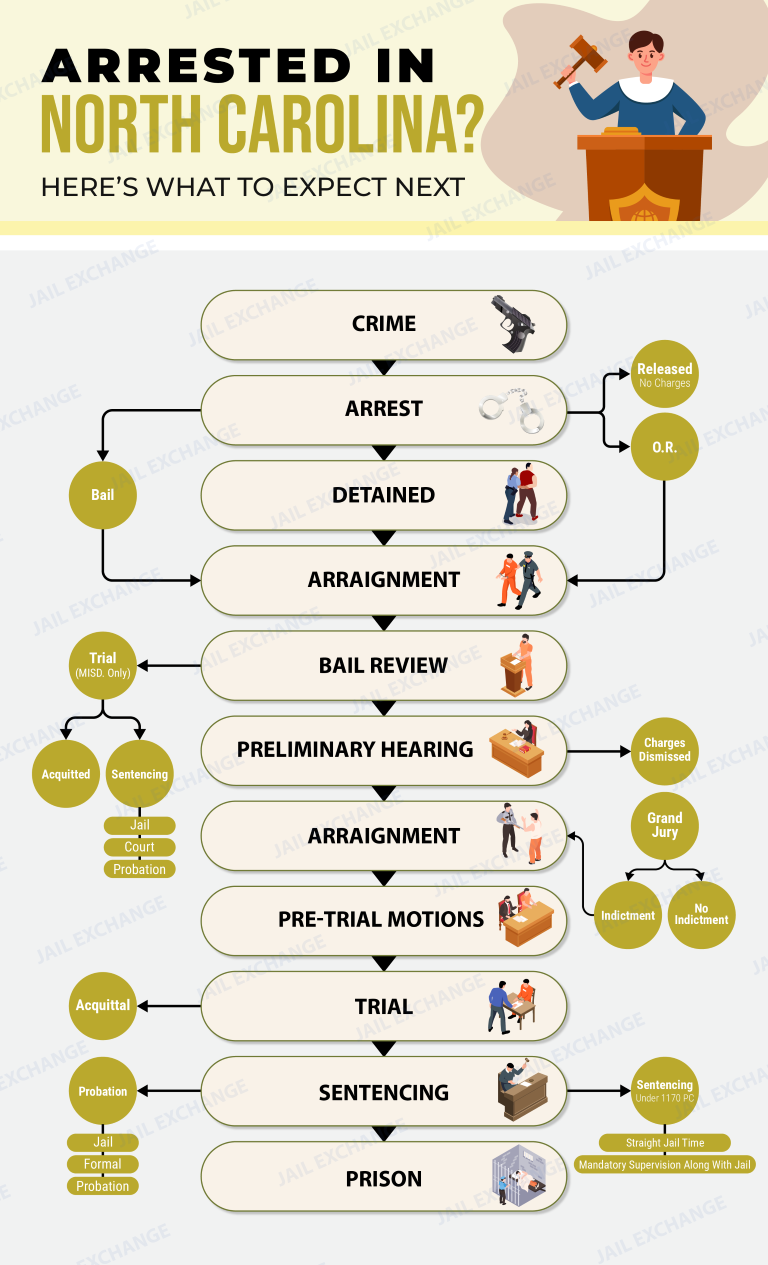
Information for this service is currently unavailable.

Inmate Canteen Trust & Phone Deposits allow friends and family members to transfer money directly into an incarcerated person's jail trust account or telephone calling balance using a credit or debit card. Deposited funds give your loved one the financial balance needed to buy personal care goods, over-the-counter medication, snacks, and phone talk time from the facility canteen.
Important: Facility Banking Policies Vary Across Jails
Once a person is booked and moved to a cell, facilities do not always allow cash drop-offs or phone payments directly to the jail window. Some might and you should confirm this by calling the facility and asking. But if you do not register online and fund your loved one's trust account immediately, they may be forced to wait days or weeks for standard paper processing, leaving them without essential soap, clean undergarments, basic medical sundries or snacks.
Step-by-Step Instructions to Register and Deposit Funds
- Confirm the inmate's legal first and last name, date of birth, and assigned booking or inmate ID number.
- Navigate to www.inmatecanteen.com on your computer or mobile device.
- Click on Deposit Funds and select whether to fund the Trust Account (for commissary) or Phone Account (for talk time).
- Select the state and facility where the inmate is currently housed.
- Search for the inmate to confirm their active housing record matches the facility roster.
- Enter your deposit dollar amount, review convenience fees, and enter your debit or credit card billing details.
- Submit payment and save the digital confirmation receipt for your financial records.
What the Inmate Needs to Do
The inmate does not need an internet connection to receive trust funds. Once payment clears, the balance posts directly to their accounting profile in the jail's internal system. The inmate can review their updated balance at the pod kiosk terminal and place their regular weekly commissary order or make outbound phone calls.
Official Provider: Inmate Canteen Official Website
Customer Service Telephone: 1-715-690-2965
Support Hours: Monday – Friday, 8:00 AM – 5:00 PM CST
Supported Languages: English and Spanish
Other Services Provided by Inmate Canteen (TurnKey Corrections)
In addition to Trust & Phone Deposits, Inmate Canteen provides several other communication, financial, and commissary services at participating correctional facilities:
- Commissary & Snack Packs: Order pre-approved snack boxes, food packages, and clothing directly to the jail.
• Learn more on our website: Commissary Orders Guide | • Visit official vendor page: Inmate Canteen Commissary - Remote Video Visitation: Schedule and join live face-to-face video visits from your computer or smartphone.
• Learn more on our website: Video Visitation Guide | • Visit official vendor page: Inmate Canteen Video Visits - Digital Messaging & Chirp Texts: Send electronic messages and photos directly to housing pod kiosks and handheld devices.
• Learn more on our website: Digital Messaging Guide | • Visit official vendor page: Inmate Canteen Messaging
Deposit Money for an Inmate in the Chatham County Detention Center
The Easiest and Securest Way of Depositing Money for an Inmate
There are several methods for depositing money on an inmate's account:
1. To send money online to an inmate in the Chatham County Detention Center use Inmate Canteen.

2. If you prefer to use your credit or debit card and deposit money over the phone, unfortunately Inmate Canteen does not accept phone calls, but you can ask questions using the chat box on their home page.
3. Deposit cash or use a debit or credit card using a dedicated kiosk for this purpose. The machine is located in the lobby or visitation area of the Chatham County Detention Center.
4. The Chatham County Detention Center may also allow you to *mail an inmate a money order or cashier’s check from a trusted source such as the Post Office, a local bank, or Western Union. The money order should be be made out to either the inmate or the Chatham County Sheriff's Office, with the inmate’s name and ID# on the memo line of the check. To confirm this option call the facility at 919-545-7802.
Inmate Canteen Customer Service can be reached at 715-690-2965, or by email at support@inmatecanteen.com.
*When mailing a money order or cashier’s check, send it an envelope by itself. Never send it with a letter or photos for your inmate, unless the facility allows it. Never send personal checks or cash.
5. The Chatham County Detention Center has a reception desk that may accept cash, money orders or cashier checks. Call 919-545-7802 to find out the specific hours for drop off times.
Letters, postcards and greeting cards for someone in the Chatham County Detention Center in Pittsboro go to a separate mail-processing address, not to the jail on Renaissance Drive. Lawyers, publishers and stores mail straight to the jail. All mail is checked for contraband, obscene material and rule breaks, a step that helps keep out paper soaked in drugs and then dried. Search the Sheriff's inmate list first, since people leave the jail every day.
Personal letters, postcards and cards:
Inmate's Full Name & Inmate ID#
Chatham County Detention Center #5302
P.O. Box 18247
Greensboro, NC 27419
Legal mail, books, newspapers and magazines:
Inmate's Full Name & Inmate ID#
Chatham County Detention Center
627 Renaissance Drive
Pittsboro, NC 27312
- Your return address: Put your full name and address on the top left of every envelope or postcard. Leaving it off usually means the mail is destroyed.
- Name and number: Address it to the inmate's full name with their inmate ID number below.
- Ink: Blue or black. Crayon, felt markers, colored ink, lipstick and perfume are not allowed.
- No add-ons: Leave out drawings, glitter and confetti, and keep the envelope free of doodles.
- Cards: Greeting cards should be plain, with no sound chip.
- Newspapers: A local or national paper can come in if it is mailed by the publisher.
- Magazines: News, sports and special-interest magazines can come from the publisher. Anything with profanity, weapons, nudity or adult content is taken and not delivered.
- Books: New, mailed by the publisher, and free of heavy violence or obscene content. Books that break the rules are thrown out.
- Stamps: Do not send them. Inmates buy stamps through the commissary, and inmates with no money get a few stamps, envelopes and paper each week.
- Who can't write: Inmates can't write to their co-defendants, to people held in any jail or prison, or to anyone covered by a no-contact order.
To put money on the account, deposit it online. Short notes can go by tablet messaging.

PayTel Communications provides telecommunications services that allow incarcerated individuals to place outbound calls from housing units to family and friends. Because correctional facilities do not accept incoming calls, establishing a PayTel prepaid account links calling funds directly to your 10-digit telephone number so calls connect without carrier restrictions.
Important: Mobile Phones Automatically Block Inmate Calls
Mobile cellular carriers automatically block collect calls originating from jail phone systems. While some residential landlines might allow direct monthly billing, mobile phones and internet-based lines require an active prepaid balance, which you can verify by checking with your provider. If you do not register online and fund your account right away, your loved one will receive an automated operator message stating that your number cannot accept calls.
Step-by-Step Instructions to Register and Fund a Phone Account
- Visit www.paytel.com or call PayTel customer service at 1-800-729-8355.
- Click Open an Account and register using your primary 10-digit telephone number and email address.
- Select the state and facility where the inmate is currently detained.
- Link the inmate to your profile using their full legal name and booking ID number.
- Select your deposit dollar amount and complete payment using a credit or debit card.
- Confirm that your mobile phone allows calls from automated or unknown correctional numbers.
What the Inmate Needs to Do
The inmate dials your 10-digit number from any dayroom phone and enters their assigned PIN. The automated system verifies that your phone number has an active prepaid balance and prompts you to accept the call. All non-privileged conversations are recorded and monitored by facility staff.
Official Provider: PayTel Official Website
Customer Service Telephone: 1-800-729-8355
Support Hours: Monday – Friday, 8:00 AM – 9:00 PM EST; Saturday, 9:00 AM – 6:00 PM EST
Supported Languages: English and Spanish
Other Services Provided by PayTel Communications
In addition to Prepaid Phone Calling Accounts, PayTel provides digital communications at participating facilities:
- Inmate Messaging & Digital Communications: Send electronic messages and photos directly to an inmate's terminal.
• Learn more on our website: Inmate Messaging Guide | • Visit official vendor page: PayTel Messaging
PayTel Inmate Messaging provides a two-way digital communication platform that allows families to exchange electronic text messages and digital photo attachments with an incarcerated loved one. Messages are delivered directly to the inmate's terminal or tablet screen within hours, bypassing long postal mail processing times.
Important: Digital Mail Screening Rules Vary by Facility
Inmates cannot receive incoming phone calls, and traditional postal mail rules differ across jurisdictions. While some detention centers still allow regular handwritten letters, many facilities now restrict physical paper mail or mandate electronic messaging, which you can verify by checking facility rules. If you do not register online and set up message credits immediately, your loved one may face lengthy periods without direct written contact from family.
Step-by-Step Instructions to Register and Send Messages
- Go to www.paytel.com or launch the PayTel mobile app.
- Register your account, complete identity verification, and link your incarcerated contact.
- Navigate to the Messaging section of your dashboard.
- Purchase messaging credits using a credit or debit card.
- Type your message and attach approved JPEG photos if permitted by facility guidelines.
- Send your message to the facility's screening queue.
What the Inmate Needs to Do
All electronic correspondence is screened by correctional staff before delivery. Once approved, messages appear in the inmate's inbox on their housing unit terminal or tablet. The inmate opens the message, reads your note, and types an electronic reply using available account credits.
Official Provider: PayTel Official Website
Customer Service Telephone: 1-800-729-8355
Support Hours: Monday – Friday, 8:00 AM – 9:00 PM EST; Saturday, 9:00 AM – 6:00 PM EST
Supported Languages: English and Spanish
Other Services Provided by PayTel Communications
In addition to Inmate Messaging, PayTel provides telephone calling accounts at participating facilities:
- Prepaid Phone Calling Accounts: Prepay for telephone calling minutes so your loved one can call your mobile phone directly.
• Learn more on our website: Prepaid Calling Accounts Guide | • Visit official vendor page: PayTel Prepaid Calling
PayTel Communications provides secure handheld wireless tablets designed specifically for correctional housing units. Operating over a private, encrypted facility network, these devices allow incarcerated individuals to make phone calls, exchange digital messages, access legal research materials, complete rehabilitative courses, stream approved media, and submit facility requests directly from their cells.
Important: Tablet Hardware Deployment and Rental Rules Vary
Detention centers do not manage tablet distribution identically. While some agencies issue individual personal tablets to every detainee at booking, others utilize shared pod docking stations or restrict tablet use to specific dayroom hours, which you should confirm with the facility directly. Although core educational and legal resources are generally provided free of charge, sending messages, listening to music, or making phone calls from the tablet requires an active balance funded by outside contacts.
Step-by-Step Instructions to Support and Fund PayTel Tablets
- Confirm that PayTel handheld tablets are active at your loved one's specific detention facility.
- Navigate to www.paytel.com or launch the PayTel mobile app.
- Sign into your verified user profile and link the inmate's legal name and booking ID number.
- Select Tablet Services / Messaging or Inmate PIN Debit to add funds.
- Specify your deposit dollar amount, review convenience fees, and enter your credit or debit card billing details.
- Submit payment, save your confirmation receipt, and notify your loved one that their device balance is available.
What the Inmate Needs to Do
The inmate unlocks their assigned tablet using their PIN. Their available balance appears on the screen, allowing them to download songs, read digital books, write messages, and place outbound telephone calls to approved contacts. Devices are docked during quiet hours and shift changes for secure recharging and data synchronization.
Official Provider: PayTel Official Website
Customer Service Telephone: 1-800-729-8355
Support Hours: Monday – Friday, 8:00 AM – 9:00 PM EST; Saturday, 9:00 AM – 6:00 PM EST
Supported Languages: English and Spanish
Other Services Provided by PayTel Communications
In addition to Tablet Services, PayTel provides calling and digital messaging options:
- Prepaid Phone Calling Accounts: Prepay for telephone calling minutes so your loved one can call your mobile phone directly.
• Learn more on our website: Prepaid Calling Accounts Guide | • Visit official vendor page: PayTel Prepaid Calling - Inmate Messaging & Digital Communications: Send electronic messages and photos directly to an inmate's terminal.
• Learn more on our website: Inmate Messaging Guide | • Visit official vendor page: PayTel Messaging
- Jail (Main): 919-545-7802
- Sheriff: 919-542-2911
The Chatham County Detention Center serves the following cities and towns of Chatham County: Bennett, Bonlee, Bear Creek, Bynum, Goldston, Gulf, Moncure, Pittsboro and Siler City.