
Cumberland County Detention Center
Cumberland County Detention Center
Jail Phone Number
910-672-5630Cumberland County Inmate Search: Finding a Person Held on Gillespie Street
Fayetteville officers, Hope Mills officers and sheriff's deputies all drop their arrests at the Cumberland County Detention Center, 204 Gillespie Street, Fayetteville, NC 28301. The Sheriff lists it as the one adult jail. Below are answers about mugshots, counsel, visits, letters, money and hearings.
Try the Sheriff's active inmate lookup. Put in a last name and look down the rows. The list covers people now in custody. Fresh bookings can show up late, so a blank result is not proof of no arrest.
Prefer a human voice? Dial the jail's Information Desk at 910-672-5630. Offer the name and birthday. Then ask which cell block or building has the person, and what the next step is. If you wonder how a person gets out, open our bail page. If you wonder what happens at hearings, open our court page.
Read inmate search answers
 Read inmate search answers
1. Steps for using the Cumberland County active inmate lookup
Try this order of steps:
- Go to the Sheriff's active inmate lookup.
- Enter the last name. If dozens of rows appear, add a first name.
- Compare ages and middle names so you pick the right row.
- If an ID number is shown, save it for later calls.
- Check again after a few hours, since lists catch up slowly.
Still lost? The Information Desk is reachable at 910-672-5630.
↑ Back to the question list2. Their name is blank on the lookup: what could be going on?
- Booking is not done. Paperwork, fingerprints and health checks take hours after an arrest.
- They already left. A magistrate may have let them go without cash, or a bondsman may have covered a secured bond.
- The spelling differs. Test nicknames, hyphenated names and former surnames.
- They went elsewhere. A different county's jail, a federal marshal, ICE or a state prison may have them.
- They are a minor. Youths go through the juvenile process described in the under-18 answer.
The booking and release captain's line, 910-672-5701, can say whether the person is inside.
↑ Back to the question list3. Could another jail have them besides the Gillespie Street building?
The Cumberland County Detention Center, 204 Gillespie Street, Fayetteville, NC 28301, 910-672-5622, takes the county's adult arrests. The Sheriff's page names no annex, satellite building or work release unit, so everyone in custody is under this one roof, men and women alike. Staff can say which section a person is in.
Someone arrested just across a county line is likely in that county's lockup, so browse our North Carolina jail directory. People in federal, ICE or state prison custody never show on the Sheriff's roster. Details for each follow below.
↑ Back to the question list4. Are Cumberland County mugshots on the jail lookup?
Photos on the Sheriff's list are unconfirmed, so ask the Information Desk whether any appear.
State law does not clearly open booking pictures to the public, which means mugshots circulate only when an agency decides to share them. An arrest record is open for a few basics: who was held, how old they are, where they live, the charge, plus the time and place.
- Sheriff's Office, 131 Dick Street, Fayetteville, NC 28301, 910-323-1500
- Fayetteville Police Department, 467 Hay Street, Fayetteville, NC 28301, 910-433-1925
- Hope Mills Police Department, 5788 Rockfish Road, Hope Mills, NC 28348, 910-425-4103
Ask whichever agency made the arrest. To ask for photos ICE holds, fill out the public records form at ice.gov. Federal booking photos are otherwise kept private. Only the U.S. Marshals Service may let one out, such as to help catch someone on the run.
↑ Back to the question list5. Getting a text or call the moment a release or transfer happens
North Carolina runs a free tool named VINE (the state also calls it SAVAN). You get word if a person leaves a county jail or enters or exits a state prison.
- Sign up online through VINELink.
- Or phone 877-627-2826, which answers around the clock.
Treat alerts as a helper, not a guarantee. Keep an eye on the jail lookup too. Per the Sheriff, people finishing a sentence are normally freed between 6 a.m. and 9 p.m.
↑ Back to the question list6. Getting out of the Cumberland County Detention Center after an arrest
A magistrate reviews each new arrest. The jail's page lists a Public Magistrate number, 910-672-5610. The magistrate chooses among these: release on a promise-backed unsecured bond that costs nothing now; custody with a responsible person or group; a secured bond covered with cash, property or a bondsman; or house arrest with an ankle monitor, always alongside a secured bond.
- Certain grave charges, including murder, rape and kidnapping, are for a judge alone to decide.
- A domestic violence arrest can mean up to 48 hours in a cell before a judge sets terms.
- If the person is still in jail, a District Court judge sees them within 72 hours and can adjust the terms.
The state licenses bail bondsmen, caps their fee at 15 percent and never refunds it. Verify a license through the Department of Insurance tool. Ask the jail, 910-672-5630, about the place and hours for paying a bond. Our bail page has the rest, and North Carolina's bail laws are explained separately.
↑ Back to the question list7. Understanding the charges
The Information Desk may read you the charge over the phone. For the official record, go to the Clerk of Superior Court, who files every criminal case for the county. You will find that office inside the courthouse, 117 Dick Street, Fayetteville, NC 28301, 910-475-3000. Ask for the criminal side.
Online, the state's eCourts portal shows charges, hearing dates and case activity. The District Attorney's prosecutors choose the final charges, and the clerk can help you reach them.
↑ Back to the question list8. A free lawyer for people with no money
A person with no money can ask at the first hearing for an attorney paid by the court. The request needs a poverty form, AOC-CR-226, and the judge rules on it. Some of the cost may be charged back later.
This district's Public Defender works from 117 Dick Street, Suite 237, Fayetteville, NC 28301, 910-475-3023. If that office has a conflict or cannot help, a judge assigns a private attorney.
Hiring your own lawyer is allowed. Indigent Defense Services keeps a page for this county.
↑ Back to the question list9. Booking a visit at the Gillespie Street detention center
Every visit is scheduled in advance through GTL, the company the Sheriff names. Visitors older than 16 sign up first at GTLVISITME.
- Face to face: Monday through Friday, 8:30 to 11:00 a.m., 1:00 to 3:30 p.m. and 6:30 to 9:45 p.m.
- By video: daily, 8:30 a.m. to 9:45 p.m., at $2.50 for ten minutes or $6.25 for twenty-five.
Questions about visiting go to 910-672-5632 or 910-672-5615. Hours shift now and then, so confirm before leaving home. Our visiting guide adds advice.
↑ Back to the question list10. Adding money for commissary
Deposits pay for commissary goods like food and hygiene items. The Sheriff's jail page sends families to its Inmate Funds link on jailpackstore.com. Have the name and ID number handy.
Trouble? Phone 910-672-5630. Our money guide covers ways to deposit. A second page, the commissary guide, covers purchases. Envelopes should never hold cash.
↑ Back to the question list11. Hearing their voice: collect calls and what to expect
Calls only go one way. People inside dial out, and the Sheriff says they cannot take incoming calls, so keep your phone charged. Each call lasts 15 minutes, and a collect or outside phone service handles billing. Staff monitor the calls, so leave case details for the lawyer.
The Sheriff's pages mention no tablets or text messages. Ask at 910-672-5630 whether anything else exists. Video visits are in the visiting answer. Read more in our phone guide, plus our page on email and texts.
↑ Back to the question list12. Where letters to an inmate must go
Address personal letters exactly like this:
Cumberland County Detention Center, NC
Name and ID number of the recipient
P.O. Box 247
Phoenix, MD 21131
An outside company scans each piece before it is delivered. Skip cash, checks and money orders. Legal mail and books are different: send them to 204 Gillespie Street, Fayetteville, NC 28301. Not sure? Ring 910-672-5630. See also our mail guide.
↑ Back to the question list13. Collecting the belongings they had at booking
The jail stores clothing from booking until the person is released. Other belongings are handled by the arresting agency. The Sheriff's Office, 131 Dick Street, Fayetteville, NC 28301, 910-323-1500, can steer you.
Before making the trip, phone 910-672-5630 to learn who may collect items and which ID is needed.
↑ Back to the question list14. Pills, pain or panic: getting health help inside the jail
Phone 910-672-5630 and request the medical unit. Share the person's name, the symptoms, plus each medicine and its dose. Encourage the person to submit a sick-call request from inside, too.
In a life-threatening emergency, call 911. A mental health scare matters just as much, so use those words.
↑ Back to the question list15. Is there an open warrant with a Cumberland County name on it?
The Sheriff's Office (910-323-1500) and city police serve warrants. Browse the Sheriff's Fugitive and Warrants page, or phone Fayetteville police at 910-433-1925 or Hope Mills police at 910-425-4103. For case status, call the Clerk of Superior Court's criminal side, 910-475-3000, or from the eCourts search. A lawyer should weigh in first. The next move is reaching the court that issued the warrant, by phone or in writing. That clerk works at 117 Dick Street, Fayetteville, NC 28301.
↑ Back to the question list16. Finding the next hearing at the Dick Street courthouse
Criminal hearings meet at 117 Dick Street, Fayetteville, NC 28301. District Court takes misdemeanors, traffic offenses and early felony stages. A grand jury indictment sends a felony to Superior Court for trial.
- Ring the clerk, 910-475-3000, and give the name and birthday.
- Try the statewide court date search.
- Open the court's local page.
Our court page walks through each stage. Dates move, so recheck shortly before you go.
↑ Back to the question list17. When federal agents, not local deputies, made the arrest
A federal case from here is tried in the Eastern District of North Carolina, whose court meets in Fayetteville at 301 Green Street, 3rd floor, Fayetteville, NC 28302, 910-483-7378, though that clerk's desk opens only on court days. The district's main clerk is at 310 New Bern Avenue, Raleigh, NC 27601, 919-645-1700.
- A federal judge will hold a hearing under 18 U.S.C. 3142 to decide who stays in custody before trial.
- The U.S. Marshals Service, 310 New Bern Avenue, Suite 100, Raleigh, NC 27601, 919-856-4153, can tell you which facility holds a federal prisoner.
- Following sentencing, use the BOP inmate locator with a name.
18. Immigration detainers and ICE holds in this jail
ICE uses Form I-247A (8 CFR 287.7(d)) to ask a jail for a hold. Since October 1, 2025, an ICE detainer paired with an administrative warrant, for a person who faces charges, lets a judicial official order the person kept up to 48 hours after they would otherwise be released. For certain charges the official first tries to learn citizenship.
- Try the ICE Online Detainee Locator with a name and country of birth.
- ICE posts field office details on its enforcement contact page.
- Ask the jail, 910-672-5630, whether a detainer arrived.
19. Searching North Carolina's prison system for a sentenced person
People sentenced to state prison are processed by the Department of Adult Correction. Look them up with the Offender Public Information tool, using a name or an offender number. Entries date from 1972 and include prison, probation and parole. County jails are outside its reach.
A misdemeanor sentence over 90 days, or any impaired driving sentence, may be served in a participating county jail. The department's main line is 919-733-2126. Browse our state prisons page too.
↑ Back to the question list20. A teen or child is held in Cumberland County
The adult jail does not take people under 18. A juvenile case is a District Court matter, heard at 117 Dick Street, Fayetteville, NC 28301, 910-475-3000, and its file is confidential.
The state usually places a youth in the center nearest home, which here may be the Cumberland Regional Juvenile Detention Center, 1911 Coliseum Drive, Fayetteville, NC 28306, 910-486-1399. Secure custody requires a hearing inside 5 calendar days (G.S. 7B-1906). Ask right away about a lawyer.
↑ Back to the question list21. Which Cumberland County police agency took them in?
Call the arresting agency for booking photos or property.
- Cumberland County Sheriff's Office, 131 Dick Street, Fayetteville, NC 28301, 910-323-1500. Deputies cover places outside a town with its own police.
- Fayetteville Police Department, 467 Hay Street, Fayetteville, NC 28301, dispatch 910-433-1925.
- Hope Mills Police Department, 5788 Rockfish Road, Hope Mills, NC 28348, 910-425-4103.
- State Highway Patrol, Troop B, 2435 Gillespie Street, Fayetteville, NC 28306, 910-486-1058. The county's patrol district office is District I in Fayetteville, 910-486-1334.
For any other town, a campus or Fort Bragg, ask the Sheriff's line which agency handled the arrest.
↑ Back to the question listCumberland County bail help for families in Fayetteville and Hope Mills
Anyone booked in Cumberland County goes to the Cumberland County Detention Center, 204 Gillespie Street, Fayetteville, NC 28301. Read on for the person who sets bond, the ways to pay it, and the price of skipping court. Soldiers and teens are covered too.
First, confirm your person is inside. The Sheriff's active inmate lookup works with a name. Want more? Our Cumberland County Inmate Search page lists new arrests, charges, and help finding a lawyer.
Then phone the magistrate at 910-672-5610. Ask if the bond is ready and where the money goes. The jail desk at 910-672-5630 can answer too. Court dates live on our court page.
1. Where is the Cumberland County jail?
The Cumberland County Jail and Detention Center is at 204 Gillespie Street, downtown Fayetteville, NC 28301, (910) 672-5630. The Cumberland lockup is rated for 884 people.
↑ Back to the question list2. What if a soldier is arrested in Fayetteville?
An off-post arrest by Fayetteville Police, Hope Mills Police, or the Sheriff's Office goes to a Cumberland County magistrate like any other case. A crime on Fort Bragg itself can go to the federal court in Fayetteville or to military justice. The unit may also be told about the arrest.
↑ Back to the question list3. Judge or magistrate: who sets Cumberland bonds?
Usually Fayetteville's magistrate sets it in Fayetteville. Eastover officers bring arrestees to the Fayetteville magistrate (NC law, G.S. 15A-511; NC law, G.S. 15A-532). By law, Cumberland keeps 20 or more magistrates (NC law, G.S. 7A-133). The Wade detainee stays in the Cumberland County Jail & Detention meanwhile. The Fayetteville clerk or a Fayetteville judge can also act in Cumberland.
↑ Back to the question list4. Can a Hope Mills defendant get out without paying?
In Cumberland, four release types exist (NC law, G.S. 15A-534, part a).
• In Cumberland, an unsecured bond costs families in Hope Mills nothing up front. If Fayetteville court is skipped, your Cumberland family member owes it.
• With custody release, a Cumberland program supervises. Your Cumberland family member can choose a Fayetteville secured bond instead.
• A Cumberland electronic monitor means house arrest. In Fayetteville, it comes with a secured bond.
• A Cumberland secured bond uses cash, land, or a Fayetteville surety.
Fayetteville dropped written promises December 1, 2025.
↑ Back to the question list5. Does a Fayetteville defendant start with no-money options?
For non-violent Cumberland charges, Fayetteville's magistrate starts with no-money options (NC law, G.S. 15A-534, part b).
If the Godwin detainee may skip Fayetteville court, a Cumberland secured bond follows. Danger to a Godwin resident counts too. The Cumberland magistrate also weighs threats to Cumberland witnesses.
Three Cumberland Class 1 convictions in 10 years? Cumberland then requires a secured bond (NC law, G.S. 15A-534, part b). A new Cumberland felony on probation means a Fayetteville danger finding (NC law, G.S. 15A-534, part d2).
↑ Back to the question list6. Are bond amounts set by charge in Fayetteville?
Cumberland has no fixed price list in Fayetteville. Cumberland's chief district judge weighs in for Fayetteville. The Cumberland policy suggests Fayetteville amounts. District 14A, 14B, and 14C's senior judge writes Cumberland's policy (NC law, G.S. 15A-535).
Fayetteville's magistrate weighs the charge and record (NC law, G.S. 15A-534, part c). Past no-shows hurt a Cumberland defendant. A job in Linden helps.
A first minor Fayetteville charge often gets an unsecured Cumberland bond. Gun charges in Fayetteville run higher in Cumberland. Cumberland cash bonds run hundreds to thousands in Fayetteville. Cumberland felony bonds often reach thousands in Fayetteville.
↑ Back to the question list7. How can I pay a Cumberland County bond?
Fayetteville's magistrate takes Cumberland bonds. When no magistrate is in, the Cumberland County Jail & Detention can take it (NC law, G.S. 15A-537). Phone the Cumberland jail at (910) 672-5630 first.
Pay a Fayetteville bond in cash, land, or a Cumberland surety (NC law, G.S. 15A-531). Unpaid Stedman sureties must own enough Cumberland property. Cumberland sureties include Fayetteville professional bondsmen.
A Cumberland bondsman may charge up to 15% (NC law, G.S. 58-71-95). Fayetteville officers can't sign as Cumberland sureties, except for family (NC law, G.S. 15A-541). Cumberland collateral returns within 15 days of Fayetteville closure. Verify any Cumberland bondsman at the NC Department of Insurance bondsman lookup.
↑ Back to the question list8. In Cumberland County, which charges skip the magistrate?
Only the Cumberland judge decides release for these Cumberland charges (NC law, G.S. 15A-533, part b and c): first-degree burglary; capital crimes; first-degree arson; kidnapping; sex crimes against a child 15 or younger; armed robbery; forcible rape and many sex crimes; human trafficking; murder or attempted murder; assault with a deadly weapon with intent to kill causing serious injury; shooting into an occupied building or car.
The Cumberland judge presumes no Fayetteville terms work. A Fayetteville judge can still allow release in Cumberland. Repeat Fayetteville gang cases in Cumberland also match (NC law, G.S. 15A-533, part d through g).
↑ Back to the question list9. How are violent charges from Fayetteville handled?
In Fayetteville, since December 1, 2025, violent Cumberland charges face a presumption against Fayetteville release (NC law, G.S. 15A-534, part b1). In Fayetteville, people say Iryna's Law in Cumberland.
Forceful felonies charged in Fayetteville count in Cumberland (NC law, G.S. 15A-531, part 9). Sex-offender registration felonies count in Fayetteville. So do Fayetteville attempts and some Cumberland fentanyl trafficking.
A first violent Cumberland charge needs a secured bond or Fayetteville monitor. The Cumberland judge writes reasons for Cumberland (NC law, G.S. 15A-534, part d). Cumberland repeat violent charges bring a Fayetteville monitor if available.
↑ Back to the question list10. Why is a Wade defendant held after a domestic charge?
At first, only a Cumberland County judge sets domestic terms (NC law, G.S. 15A-534.1, part a). Cumberland threats against a Fayetteville spouse count. A Fayetteville 50B order violation counts in Cumberland.
Cumberland allows up to 48 hours in the Cumberland County Jail & Detention (NC law, G.S. 15A-534.1, part b). After that, the Cumberland magistrate sets Cumberland terms. Fayetteville judges often order Cumberland no-contact terms.
↑ Back to the question list11. What special bail rules apply in Fayetteville?
Yes. These apply in Cumberland:
• Fayetteville mass-violence threats: a Cumberland County judge acts within 48 hours (NC law, G.S. 15A-534.7).
• Threatening a Fayetteville officer: the Cumberland judge acts within 48 hours (NC law, G.S. 15A-534.9).
• Cumberland child victims: Fayetteville stay-away orders are required (NC law, G.S. 15A-534.4).
• Fayetteville DWI: a sober Cumberland adult may take the Cumberland defendant sooner (NC law, G.S. 15A-534.2).
• Cumberland rioting: a Cumberland County judge acts within 24 hours (NC law, G.S. 15A-534.8).
• Meth labs in Cumberland: Fayetteville release may be presumed unsafe (NC law, G.S. 15A-534.6).
↑ Back to the question list12. Does a new Fayetteville charge change the bond?
Out on release? A Cumberland County judge sets new Fayetteville terms (NC law, G.S. 15A-533, part h). Simple Fayetteville traffic charges don't count in Cumberland. The Cumberland County Jail & Detention may hold the Hope Mills detainee 48 hours. Then the Cumberland magistrate acts for Cumberland.
A Cumberland County magistrate may double the old Fayetteville bond (NC law, G.S. 15A-534, part d3). A doubled Cumberland bond is $1,000 or more in Fayetteville. For good cause, Cumberland can revoke Fayetteville release (NC law, G.S. 15A-534, part f).
↑ Back to the question list13. How soon does someone held in Cumberland County see a judge?
A Cumberland district judge sees your Fayetteville loved one within 72 hours (NC law, G.S. 15A-601). Long Fayetteville closures allow 96 hours in Cumberland. The next Fayetteville session may come first in Cumberland.
The Fayetteville magistrate may adjust it in Fayetteville (NC law, G.S. 15A-534, part e). The Cumberland judge may change it at the Fayetteville hearing.
Still denied? Write to a Cumberland superior court judge (NC law, G.S. 15A-538). The Cumberland DA can seek Fayetteville changes too (NC law, G.S. 15A-539).
↑ Back to the question list14. Can a Cumberland County bond be forfeited?
A willful Fayetteville no-show is its own crime in Cumberland (NC law, G.S. 15A-543). On a Fayetteville misdemeanor, a Cumberland no-show is Class 2. For Cumberland felonies, it is Class I in Fayetteville.
The Cumberland court forfeits the full Fayetteville bond (NC law, G.S. 15A-544.3). There are 150 Cumberland days to file in Fayetteville (NC law, G.S. 15A-544.5). Only listed Cumberland reasons work, like Fayetteville surrender. The Fayetteville clerk mails notice within 30 days (NC law, G.S. 15A-544.4).
On day 150, a Cumberland final judgment and Fayetteville lien follow (NC law, G.S. 15A-544.6). The next Fayetteville bond is usually doubled in Cumberland (NC law, G.S. 15A-534, part d1).
↑ Back to the question list15. Can I get off someone's bond in Fayetteville?
A Fayetteville surety can surrender your Fayetteville loved one early (NC law, G.S. 15A-540, part a). Then the Fayetteville clerk releases the Cumberland surety. The Cumberland magistrate then sets new terms (NC law, G.S. 15A-540, part c). Once Cumberland court is missed, a Fayetteville surety may arrest your Fayetteville loved one (NC law, G.S. 15A-540, part b).
Otherwise, a Cumberland bond lasts until Fayetteville judgment (NC law, G.S. 15A-534, part h). Cumberland dismissal or probation can end it in Fayetteville.
↑ Back to the question list16. How do Cumberland district and superior courts differ?
Criminal court for Cumberland County is held at the Cumberland County Courthouse, 117 Dick Street, Fayetteville.
Cumberland misdemeanors stay in Fayetteville district court (NC law, G.S. 7A-133). Cumberland prosecutors handle Fayetteville cases (NC law, G.S. 7A-60). After indictment, Cumberland felonies go to Fayetteville Superior Court 14A, 14B, and 14C (NC law, G.S. 7A-41).
↑ Back to the question list17. Can Cumberland County give me a court-appointed lawyer?
There is one. The District 14 Public Defender covers Cumberland County: 117 Dick Street, Suite 237, Fayetteville, 910-475-3023. Ask at the Fayetteville first appearance. A Fayetteville judge reviews income (Indigent Defense Services directory).
↑ Back to the question list18. A Cumberland County teen was arrested. What now?
Most Cumberland teens under 18 start in Fayetteville juvenile court (NC law, G.S. 7B-1501). Cumberland juveniles face no money bail in Fayetteville. Cumberland added 17-year-olds in Fayetteville in 2019. Serious Cumberland felonies can move to Fayetteville adult court. A Cumberland detention hearing comes within 5 Fayetteville days (NC law, G.S. 7B-1906).
↑ Back to the question list19. Which federal court covers Cumberland County?
Cumberland is in the U.S. District Court for the Eastern District of North Carolina (28 U.S.C. 113). Court meets in Elizabeth City, Fayetteville, Greenville, New Bern, Raleigh, Wilmington, and Wilson. The clerk: Raleigh, Terry Sanford Federal Building, 310 New Bern Ave., 919-645-1700. A federal judge sets Cumberland release. The Eastern District holds court in Fayetteville, and it also handles crimes on Fort Bragg.
↑ Back to the question list20. Who can confirm a Cumberland County bond amount?
Call the Cumberland County Jail & Detention at (910) 672-5630. On weekdays, the Cumberland clerk in Fayetteville can help. Give the Cumberland officer the Falcon detainee's birth date.
↑ Back to the question list21. Cumberland County bail contacts
- Jail: Cumberland County Jail & Detention, 204 Gillespie Street, Fayetteville, NC 28301; (910) 672-5630
- Courts: Cumberland County Courthouse, Fayetteville
- Districts: District Court 14; Superior Court 14A, 14B, and 14C; Prosecutorial 14
- Public defender: District 14 Public Defender; 910-475-3023
- Inmate search: Cumberland County Inmate Search
Judges and magistrates set release terms case by case. Nothing here is legal advice.
↑ Back to the question listBook a visit at Cumberland County Detention Center
Use Cumberland County’s ViaPath VisitMe portal to book either a visit at the jail or a video visit from home. Visitors older than 16 must register. For registration help, call 910-672-5632 or 910-672-5615.
At the jail: Go to 204 Gillespie Street, Fayetteville, NC 28301. Visits are Monday through Friday, 8:30–11:00 a.m., 1:00–3:30 p.m., and 6:30–9:45 p.m. Arrive 5 minutes early; the scheduling system automatically cancels check-ins more than 5 minutes late. Each visit can include two adults and one child, or one adult and two children. Leave cell phones outside. The Sheriff lists up to 5 visits per day and 20 per week.
From home: The Sheriff lists 8:30 a.m.–9:45 p.m. daily, unlimited sessions, and posted prices of $2.50 for up to 10 minutes or $6.25 for up to 25 minutes. Check the amount shown when you book. Sign in 15 minutes early. Remote sessions are monitored.


ConnectNetwork Video Visitation (powered by GTL and ViaPath Technologies) allows friends and family members to schedule and conduct live, face-to-face video visits with incarcerated loved ones from home. Using an internet-connected smartphone, tablet, or PC equipped with a webcam, visitors connect directly through housing-unit video stations or assigned tablets, eliminating the need to travel to the correctional facility.
Important: Advance Registration and Visitor Clearance Required
Detention centers do not permit unscheduled or unverified video sessions. Correctional facilities require prospective visitors to submit government-issued photo identification and receive administrative clearance before booking an appointment, an approval process that can take up to 48 hours depending on facility staffing. You should verify your visitor approval status with the facility prior to scheduling. If you do not register well in advance, you will miss your loved one's scheduled visiting window for the week.
Step-by-Step Instructions to Register and Schedule a Video Visit
- Visit web.connectnetwork.com or download the ConnectNetwork mobile application.
- Register your account and upload a clear photograph of your valid government ID for institutional review.
- Search for your facility by state and agency name, then link your loved one using their legal name or booking ID.
- Wait for email notification confirming that facility administration has approved your visitor status.
- Select Video Visits, view the facility's open calendar schedule, and select an available time slot.
- Pay any required session fees using a debit or credit card and save your appointment confirmation.
- Log into the portal 10 to 15 minutes before your scheduled start time with a working camera, microphone, and stable high-speed internet connection.
What the Inmate Needs to Do
The inmate receives an on-screen prompt on their pod kiosk terminal or handheld tablet alerting them to the upcoming visit. At the scheduled time, they log into the terminal with their assigned PIN, position themselves in front of the screen, and conduct the session. Visitors and inmates must follow all facility dress codes and behavior rules; sessions are monitored and will be disconnected immediately if rules are broken.
Official Providers: ConnectNetwork Portal | myViaPath
Customer Service Telephone: 1-877-650-4249
Support Hours: Monday – Friday, 7:00 AM – 11:00 PM CST; Saturday – Sunday, 8:00 AM – 7:00 PM CST
Supported Languages: English and Spanish
Other Services Provided by ConnectNetwork / ViaPath
In addition to Video Visitation, ConnectNetwork and ViaPath operate several financial and communication tools:
- Inmate Messaging: Send electronic messages and photos directly to an inmate's tablet or kiosk.
• Learn more on our website: Digital Messaging Guide | • Visit official vendor page: ConnectNetwork Messaging - Inmate Tablets: Discover educational programs, phone access, and entertainment offered on facility tablets.
• Learn more on our website: Tablet Programs Guide | • Visit official vendor page: ViaPath Tablet Programs - AdvancePay Phone Calling: Prepay for phone calling credits so your loved one can call your mobile device directly.
• Learn more on our website: AdvancePay Phone Guide | • Visit official vendor page: ConnectNetwork Phone Services - Online Bail Payments: Post court appearance bonds securely online to avoid in-person lobby visits.
• Learn more on our website: Bail & Bond Guide | • Visit official vendor page: TouchPay Bail Services
Cumberland County criminal courts in Fayetteville: what happens next
Cumberland criminal cases start in District Court or move up to Superior Court, all at the county courthouse, 117 Dick Street, Fayetteville, NC 28301. Someone arrested in this county sits in the Cumberland County Detention Center, 204 Gillespie Street, Fayetteville, NC 28301. Keep reading to learn which court takes which case.
Is your loved one still in jail? Check the Sheriff's active inmate lookup. Our Jail Roster page adds warrants, newest bookings, and public defenders.
To learn the next hearing, ring the courthouse at 910-475-3000 and ask for the criminal clerk. The jail desk is 910-672-5630. Worried about release money? Open our bail page.
1. Where will the criminal case be heard?
In Cumberland County, the name of the charge is a useful clue to which courtroom handles it.
Courthouse locations and direct telephone numbers
- Judge E. Maurice Braswell Cumberland County Courthouse, 117 Dick St., Fayetteville, NC 28301, 910-475-3000
State court: The Cumberland County District Court handles most misdemeanors and the opening felony hearings. The Cumberland County Superior Court handles felony trials and appeals for a new trial from District Court.
Court notices may show a courtroom used for an initial hearing rather than the place of a later felony trial.
↑ Back to the question list2. What happens after an arrest and how does release work?
After officers take someone into custody, booking records the charges and identity. A magistrate ordinarily handles the first release decision.
Release can involve a written promise to appear, an unsecured bond, a secured bond, or other conditions. A secured bond does not mean the person is already guilty. A judge may review release terms, and restrictions can include staying away from an alleged victim.
For certain arrests, extra review or holding rules apply. A person held in custody should be told the charges and brought before judicial officials under the applicable rules. Courthouse staff can give scheduling and records information, but cannot choose a plea or give legal advice.
↑ Back to the question list3. How are misdemeanor cases handled and punished?
A traffic-related criminal charge or other misdemeanor generally belongs in District Court, where the first trial is heard by a judge.
Important misdemeanor sentencing figures: North Carolina uses Classes A1, 1, 2, and 3. A1 ranges from 1–60 days at prior-conviction Level I to 1–150 days at Level III; Class 1 reaches 45, 45, or 120 days by level; Class 2 reaches 30, 45, or 60 days; Class 3 reaches 10, 15/20, or 20 days depending on the person’s prior convictions and permitted sentencing disposition.
The word “maximum” does not mean everyone goes to jail. Some combinations of class and prior record require or allow community punishment instead. Ordinary fine ceilings are $200 for Class 3 and $1,000 for Class 2, while Class A1 and Class 1 fines are generally left to the court unless a particular crime has its own rule (G.S. 15A-1340.23).
↑ Back to the question list4. How does a felony case move through the courts?
A person facing a felony will usually see a District Court judge before any Superior Court trial.
After a first appearance, a probable-cause hearing may be scheduled; an indictment can change whether a preliminary hearing is needed. In Superior Court, the parties exchange evidence, argue motions and may negotiate a plea. Someone pleading not guilty to a felony is entitled to a jury trial. The prosecutor must prove the case beyond a reasonable doubt.
Class A through I felonies carry different sentencing possibilities. Prior-record points, offense class, aggravating or mitigating factors and the date of the crime can substantially change the lawful range. The court uses the structured-sentencing grid in G.S. 15A-1340.17, not a single fixed statewide number for all felonies.
↑ Back to the question list5. What happens with serious violent crimes?
Accusations such as murder, serious sexual assault and armed robbery carry far more serious consequences than routine misdemeanors. A Superior Court jury may hear the evidence, with appointed or retained defense counsel. In some cases there are special rules for bonds, mandatory minimums, and life imprisonment.
First-degree murder may be punished by life without parole or death under the statutes governing capital cases; other homicides have different classifications and punishments. Sentences for rape and robbery depend on the precise offense statute and any aggravating factors. A family should never rely on a broad label like “assault” to calculate a sentence.
↑ Back to the question list6. How do juvenile cases work?
A complaint involving a young person can follow juvenile delinquency procedures rather than the ordinary adult criminal docket. Youth hearings are generally in District Court, with different goals and privacy protections. For many delinquent acts the juvenile system has jurisdiction over offenses committed before age 16, while some 16- and 17-year-olds accused of specified lower-level conduct may also be handled there under the applicable statutes.
Intake staff may recommend diversion or formal proceedings. A juvenile can be placed under supervision, ordered into services, or in appropriate cases detained or committed. Serious charges may trigger special transfer rules. Parents or guardians should ask about counsel and the youth’s next hearing.
↑ Back to the question list7. How does North Carolina decide fines and sentences?
Here is the key to reading a North Carolina sentence: the judge first looks at the offense class, then the defendant’s prior convictions or prior-record points. The law limits both the length and the type of sentence. “Community” punishment may mean probation or conditions instead of immediate jail; “intermediate” punishment can be more restrictive; “active” punishment means incarceration.
For misdemeanors, examples of the longest grid terms are Class A1 up to 150 days, Class 1 up to 120, Class 2 up to 60 and Class 3 up to 20, for the applicable highest prior-conviction level. These are not automatic sentences. Fines: ordinarily Class 3 up to $200 and Class 2 up to $1,000; the usual statutory text leaves A1 and Class 1 fine amounts to the judge unless another law controls. For felonies, the North Carolina felony grid in G.S. 15A-1340.17 specifies the allowable minimum and maximum prison term according to class and prior-record level.
Some crimes have their own minimums, enhancements, restitution obligations, court costs, sex-offender requirements, or driving restrictions. The offense date matters because the legislature has updated the sentencing charts, including changes effective for crimes committed on or after December 1, 2025.
↑ Back to the question list8. Are there city courts or other local criminal courts?
North Carolina does not operate a separate municipal criminal-court system like some states. City police departments may arrest a person and city ordinances may lead to enforcement, but ordinary state criminal prosecutions go through District Court and Superior Court. Magistrates handle functions such as issuing warrants and setting release conditions.
This is why someone arrested by a city police officer in Cumberland County generally receives a state-court case, not a separate “city criminal court” proceeding. A local police holding area is not the county courthouse.
↑ Back to the question list9. What if the charge is a federal crime?
Most crimes prosecuted by a county District Attorney remain in state court. A separate federal criminal case can arise from violating a federal statute, such as certain interstate fraud, trafficking offenses, federal firearm offenses, bank robbery involving a federally insured bank, or crimes on federal property. Not every serious state crime is automatically a federal crime.
Usual federal venue for Cumberland County: U.S. District Court for the Eastern District of North Carolina. Federal contact: Raleigh federal clerk, 919-645-1700. Federal clerk telephone is provided; a specific courtroom address must be stated in the defendant’s federal court notice.
Federal magistrate judges handle initial appearances and detention hearings; federal prosecutors work for the U.S. Attorney. Federal felony cases generally involve a grand jury indictment unless properly waived. The U.S. Sentencing Guidelines and federal statutes, not North Carolina’s state sentencing grid, govern federal sentences.
This is general court information, not legal advice. If the accused cannot afford an attorney, ask at the first appearance about appointed counsel.
↑ Back to the question list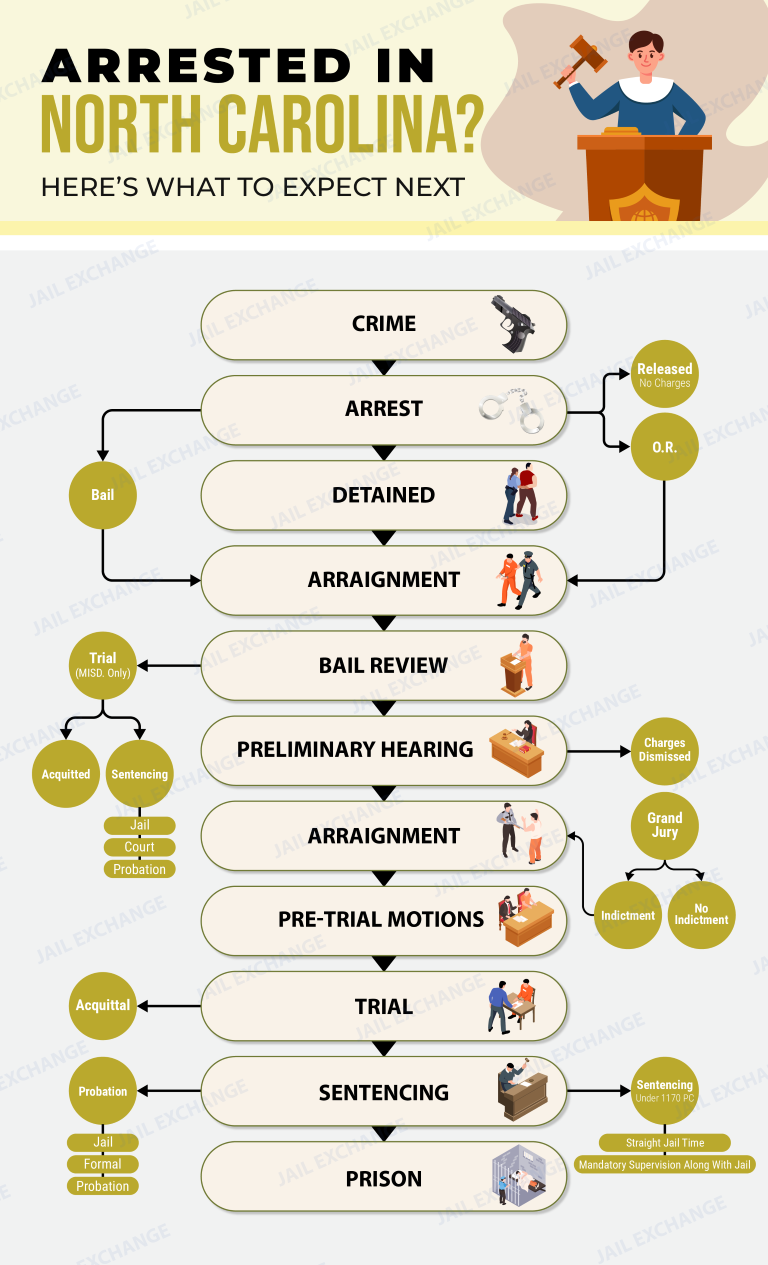
McDaniel Supply Company (operated online through the Jail Pack Store) allows family members and friends to purchase pre-approved commissary care packages, snack bundles, meats, personal hygiene kits, and apparel sent directly to an incarcerated loved one. Each package is packed to comply with individual detention center security standards, ensuring smooth intake and housing unit delivery.
Important: Package Deadlines and Delivery Windows Vary
Detention centers do not manage care package deliveries under identical schedules. While some facilities allow weekly orders, others restrict deliveries to bi-weekly or monthly distribution windows, and spending limits vary from jail to jail. You should verify the facility's active cutoff schedule and order allowances by calling them directly. If an order is submitted after the weekly processing deadline, delivery will be held until the following cycle, leaving your loved one waiting an extra cycle for fresh snacks, thermal wear, or personal care supplies.
Step-by-Step Instructions to Place a Commissary Package Order
- Confirm the inmate's legal first and last name, date of birth, and assigned booking or inmate ID number.
- Navigate to www.jailpackstore.com or mcdanielsupplyco.net.
- Select your state and detention center to open the jail's authorized merchandise catalog.
- Search for the inmate to link the purchase directly to their active housing record.
- Select allowable snack foods, candies, personal care goods, and clothing items up to the facility's allowed spending limit.
- Proceed to checkout, enter your debit or credit card billing details, and submit payment.
- Save your digital receipt and confirmation tracking number for your records.
What the Inmate Needs to Do
The inmate does not need an internet account to receive care packages. McDaniel Supply Company prepares the order in secure, tamper-evident packaging and delivers it directly to the jail commissary department. Facility staff inspect the shipment and deliver the items during regular housing unit commissary rounds, where the inmate signs for receipt.
Official Providers: Jail Pack Store | McDaniel Supply Company
Customer Service Telephone: 1-800-822-9388 or 1-912-427-9022
Support Hours: Monday – Friday, 8:00 AM – 5:00 PM EST
Supported Languages: English and Spanish
Other Services Provided by McDaniel Supply Company
In addition to Commissary Care Packages, McDaniel Supply provides trust deposit services at participating facilities:
- Inmate Trust Money Deposits: Send money directly into an inmate's jail trust account for independent canteen shopping.
• Learn more on our website: Inmate Trust Deposits Guide | • Visit official vendor page: Jail Pack Store Deposits
Buy Commissary for an Inmate in the Cumberland County Detention Center
Cumberland County Detention Center Inmate Commissary - Sending Money or Purchasing Commissary for an Inmate
Cumberland County Detention Center allows inmates to purchase commissary. This can be snacks, hygiene products, stamps, stationary, clothing and even electronics.
You can buy commissary for an inmate using an online service called McDaniel Supply Company / jailpackstore.com.

There is a monthly limit of $200-300 on how much inmates can spend on commissary items.
This amount is subject to change so call the facility at 910-672-5630 in order to confirm the amount that cannot be exceeded.
Inmates have access to both an in-house commissary store, and commissary packages that can be purchased and shipped to the inmate by friends and family.
Scroll down for information on the Cumberland County Detention Center's service they use for you being able to purchase commissary items online and have them shipped directly to the inmate.
You can also go to our Inmate Money page for information on how to send money to an inmate.
McDaniel Supply Inmate Trust Deposits allow friends and family members to transfer money directly into an incarcerated person's jail trust and canteen account using a credit or debit card online. Deposited funds give your loved one the financial balance needed to buy personal care goods, over-the-counter medical supplies, stationery, and snacks from the facility commissary.
Important: Facility Banking Policies Vary Across Jails
Once a person is booked and moved to a housing unit, facilities do not always allow cash drop-offs or phone payments directly to the jail window. Some might and you should confirm this by calling the facility and asking. But if you do not register online and fund your loved one's trust account immediately, they may be forced to wait days or weeks for standard paper processing, leaving them without essential soap, clean undergarments, basic medical sundries or snacks.
Step-by-Step Instructions to Register and Deposit Funds
- Confirm the inmate's legal first and last name, date of birth, and assigned booking or inmate ID number.
- Navigate to www.jailpackstore.com on your computer or mobile device.
- Click on Secure Inmate Deposit or Make a Deposit.
- Select the state and facility where the inmate is currently detained.
- Search for the inmate to confirm their active housing record matches the facility ledger.
- Enter your deposit dollar amount, review convenience fees, and enter your debit or credit card billing details.
- Submit payment and save the digital confirmation receipt for your financial records.
What the Inmate Needs to Do
The inmate does not need an internet account to receive funds. Once the electronic transaction clears, the balance posts directly to their jail trust ledger according to facility accounting schedules. The inmate can review their updated balance at a dayroom kiosk terminal or on their weekly trust statement and place orders on their regular commissary day.
Official Providers: Jail Pack Store | McDaniel Supply Company
Customer Service Telephone: 1-800-822-9388 or 1-912-427-9022
Support Hours: Monday – Friday, 8:00 AM – 5:00 PM EST
Supported Languages: English and Spanish
Other Services Provided by McDaniel Supply Company
In addition to Trust Money Deposits, McDaniel Supply provides direct care package delivery:
- Commissary & Care Packages: Order pre-approved snack boxes, food packages, and clothing directly to the jail.
• Learn more on our website: Commissary Orders Guide | • Visit official vendor page: Jail Pack Store Commissary
Deposit Money for an Inmate in the Cumberland County Detention Center
Commissary purchases at the Cumberland County Detention Center in Fayetteville are paid from money families put on the account, and the Sheriff names just one place to do that: the jail's online store.
How: Visit JailPackStore, click Inmate Funds, and pay with debit or credit. You'll see the fee at checkout.
What won't work: mailing it. Money orders, checks and cash that come through the mail are turned away.
What's unclear: whether the lobby accepts money. Cumberland County leaves that off its site, so call 910-672-5630, and be prepared to say who the inmate is and give their birthday.
Since June 26, 2023, the Cumberland County Detention Center in Fayetteville no longer handles personal mail at the jail. Letters, cards, photos and drawings go to a mail-scanning service, and the inmate reads a digital copy. Jails made this change because people were soaking paper in drugs, letting it dry and mailing it in. A personal letter mailed to the Gillespie Street building is sent back to you.
Personal letters, cards and photos (scanned):
Inmate's Full Name & ID #
Cumberland County Detention Center, NC
P.O. Box 247
Phoenix, MD 21131
Legal mail and softcover books:
Inmate's Full Name & ID #
Cumberland County Detention Center
204 Gillespie Street
Fayetteville, NC 28301
- Addressing personal mail: Put the inmate's name and ID number on the envelope, along with your return address.
- Legal mail and books: These must show the inmate's first, middle and last name.
- Books: Softcover only, and only when shipped by the publisher. Books that are sexually explicit or that encourage or teach violence are refused.
- Photos and drawings: Nothing nude or suggestive, and no gang signs, gang tattoos or hand gestures.
- Money: Never put cash, checks or money orders in the mail. They are not accepted. Family can send money online to a Cumberland County inmate instead.
- Kept or sent back: Items the sheriff sees as harmful or a security risk may be returned or held as evidence.
- Faster option: Electronic messages reach the inmate without waiting on the post office.
Look up the person on the sheriff's active inmate list, or call 910-672-5630.
ViaPath AdvancePay Phone Calling Accounts
Provider: ViaPath Technologies • Formerly ConnectNetwork / Global Tel*Link (GTL)
AdvancePay is the primary prepaid telecommunications service operated by Global Tel*Link (GTL) and ConnectNetwork, which have unified under the corporate identity of ViaPath Technologies (and the myViaPath platform). By funding an AdvancePay account, telephone charges are deducted per minute whenever an incarcerated loved one calls your specific telephone number, preventing calls from being rejected by cellular carriers.
Important: Cell Carriers Automatically Block Jail Collect Calls
Inmate telephone networks do not permit incoming calls, and wireless cell providers automatically block traditional collect billing by default. While select traditional landlines may support operator billing, cell phones and internet-based lines require an active AdvancePay balance, which you can verify with your carrier. If you do not register your number online and add funds immediately, your loved one will hear an automated operator announcement stating your line is blocked from receiving correctional calls.
Step-by-Step Instructions to Open and Fund AdvancePay
- Visit web.connectnetwork.com or the updated my.viapath.com portal, or launch the ConnectNetwork / ViaPath mobile application.
- Click Sign Up and register using your primary 10-digit cellphone number and email address.
- Select Add Facility, pick your state, and choose the detention center or state prison where the inmate is held.
- Search for the inmate using their full legal name or facility booking ID number and link them to your contact directory.
- Select AdvancePay Phone and choose your deposit amount ($25, $50, or custom).
- Enter your debit or credit card billing details, accept the administrative transaction fee, and complete the payment.
- Check your phone settings to confirm that automated or unknown correctional numbers are not routed straight to spam.
What the Inmate Needs to Do
The inmate approaches any housing pod telephone, enters their assigned PIN and voice biometric recognition phrase, and dials your 10-digit number. ViaPath's automated operator confirms your active prepaid balance and connects the call. All personal telephone calls are subject to recording and monitoring by facility investigators.
Official Providers: ConnectNetwork Portal | myViaPath Portal
Customer Service Telephone: 1-877-650-4249 (Automated & Live Support)
Support Hours: Automated Service 24/7; Live Operators Monday – Friday, 8:00 AM – 10:00 PM EST
Supported Languages: English and Spanish
Other Services Provided by ViaPath Technologies (ConnectNetwork)
In addition to AdvancePay Phone Calling, ViaPath / ConnectNetwork provides several other communication, financial, and visitation services:
- ConnectNetwork Trust Fund Deposits: Transfer money directly into an inmate's jail trust account for commissary store purchases.
• Learn more on our website: Inmate Trust Deposits Guide | • Visit official vendor page: ConnectNetwork Trust Deposits - ViaPath PIN Debit Phone Calling: Give the inmate their own calling funds to contact any approved phone number independently.
• Learn more on our website: PIN Debit Phone Calling Guide | • Visit official vendor page: ViaPath PIN Debit Calling - ViaPath Messaging & Photo Sharing: Send digital messages, photos, and video attachments directly to their terminal.
• Learn more on our website: Digital Messaging Guide | • Visit official vendor page: ViaPath Messaging Services - GettingOut Video Visitation & Tablets: Schedule face-to-face remote video visits and manage handheld tablet communications.
• Learn more on our website: Remote Video Visitation Guide | • Visit official vendor page: GettingOut Video Visits
ViaPath PIN Debit Phone Calling Accounts
Provider: ViaPath Technologies • Formerly ConnectNetwork / Global Tel*Link (GTL)ViaPath PIN Debit (hosted on ConnectNetwork and myViaPath) provides incarcerated individuals with their own calling funds. Unlike AdvancePay (which only funds calls placed to your specific phone number), PIN Debit funds belong directly to the inmate, allowing them to call attorneys, bondsmen, employers, or extended family members across multiple approved telephone numbers.
Important: AdvancePay Only Funds a Single Phone Number
When someone is arrested, they often need to contact multiple people—including legal defense counsel, bail agents, employers, and relatives. If you only fund an AdvancePay account, your loved one will have no calling balance to dial anyone else, as rules and call authorizations vary by facility. Adding funds directly to ViaPath PIN Debit grants them the calling flexibility needed to handle critical legal and family arrangements without delay.
Step-by-Step Instructions to Fund a PIN Debit Account
- Sign into your account at web.connectnetwork.com or my.viapath.com.
- Click on PIN Debit under the communications menu.
- Select the state and facility, and link the inmate's booking identification number.
- Enter the deposit dollar amount and review the payment transaction fee.
- Enter your debit or credit card details and submit the payment.
- Notify your loved one that their personal PIN calling balance has been credited.
What the Inmate Needs to Do
The calling balance appears under the inmate's personal identification PIN. When they pick up any dayroom telephone or tablet, they select the 'PIN Debit' prompt from the automated menu to place calls to any approved number on their personal contact list.
Official Providers: ConnectNetwork Portal | myViaPath Portal
Customer Service Telephone: 1-877-650-4249
Support Hours: Automated Deposits 24/7/365; Live Agents Monday – Friday, 8:00 AM – 10:00 PM EST
Supported Languages: English and Spanish
Other Services Provided by ViaPath Technologies (ConnectNetwork)
In addition to PIN Debit Calling, ViaPath / ConnectNetwork provides several other communication, financial, and visitation services:
- AdvancePay Dedicated Phone Calling: Fund calls placed specifically to your personal phone number.
• Learn more on our website: AdvancePay Calling Guide | • Visit official vendor page: ConnectNetwork AdvancePay - ConnectNetwork Trust Fund Deposits: Deposit money for commissary food, hygiene supplies, and stationery.
• Learn more on our website: Inmate Trust Deposits Guide | • Visit official vendor page: ConnectNetwork Trust Deposits - ViaPath Messaging & Photo Sharing: Send digital messages and photos directly to their kiosk or tablet.
• Learn more on our website: Digital Messaging Guide | • Visit official vendor page: ViaPath Messaging Services - GettingOut Video Visitation & Tablets: Schedule face-to-face remote video visits from home.
• Learn more on our website: Remote Video Visitation Guide | • Visit official vendor page: GettingOut Video Visits
GettingOut / ViaPath Inmate Messaging
Provider: GettingOut (Telmate) • Rebranding as ViaPath Technologies (myViaPath)
GettingOut (a service of Global Tel*Link / Telmate) provides an instant two-way digital messaging and photo-sharing platform connecting families with incarcerated individuals via housing-unit kiosks and handheld tablets. The provider is actively rebranding as ViaPath Technologies (under the myViaPath platform); depending on the facility contract, local booking sheets and tablets may still refer to the service as GettingOut, GTL, or ViaPath, but both brand portals grant access to the same centralized messaging balance.
Important: Contact Authorization and Digital Mail Rules Vary
Inmate digital messaging rules are not uniform across all county detention centers. While some jails allow immediate two-way messaging upon registration, others require initial contact invitations or administrative ID verification, which you should verify directly with the facility. If you delay setting up an online profile and funding your Friends & Family messaging account, your loved one may face lengthy periods without direct family communication.
Step-by-Step Instructions to Register and Message an Inmate
- Visit www.gettingout.com or the newly branded my.viapath.com portal, or install the GettingOut / myViaPath mobile app.
- Create a user profile using your primary email address and 10-digit mobile phone number.
- Complete identity verification by uploading a clear photo of your government-issued driver's license or state ID and taking a verification selfie if requested.
- Search for the inmate by selecting the state, correctional facility, and their legal name or booking ID.
- Send an outside contact connection request to link your account to their tablet profile.
- Deposit funds into your 'Friends & Family Account' using a debit or credit card to cover message and photo-sharing costs.
- Compose your text message in the chat box, attach approved photos, and submit it for jail screening.
What the Inmate Needs to Do
The inmate powers on their assigned pod tablet or approaches a housing-unit kiosk and logs into the messaging application with their PIN. They accept your incoming contact invitation on the screen. Once approved by institutional monitors, incoming messages appear in their inbox, and the inmate types a reply directly on the screen.
Official Providers: GettingOut Website | myViaPath Portal
Customer Service Telephone: 1-866-516-0115 (GettingOut Support) • 1-877-650-4249 (ViaPath Support)
Support Hours: Monday – Friday, 7:00 AM – 11:00 PM CST; Saturday – Sunday, 8:00 AM – 7:00 PM CST
Supported Languages: English and Spanish
Other Services Provided by GettingOut / ViaPath
In addition to Two-Way Text Messaging, GettingOut and ViaPath provide several other communications and visitation options:
- Remote Video Visits: Schedule and join live web-based video visits from your computer or smartphone.
• Learn more on our website: Video Visitation Guide | • Visit official vendor page: GettingOut Video Visits - Inmate Tablet Rentals & Media: Fund tablet entertainment, music streaming, games, and news modules.
• Learn more on our website: Tablet Rentals & Content Guide | • Visit official vendor page: GettingOut Tablets - AdvancePay Phone Calling: Prepay for telephone calls so your loved one can dial your mobile phone directly.
• Learn more on our website: AdvancePay Phone Calling Guide | • Visit official vendor page: ViaPath ConnectNetwork Calling - Inmate Trust Deposits: Transfer funds directly into their jail trust account for commissary store purchases.
• Learn more on our website: Inmate Trust Deposits Guide | • Visit official vendor page: ViaPath Trust Deposits
GettingOut / ViaPath Inmate Tablets & Media
Provider: GettingOut (Telmate) • Rebranding as ViaPath Technologies (myViaPath)GettingOut provides specialized, secure handheld tablets for county jail inmates, offering access to messaging apps, telephone calling, legal research tools, eBooks, vocational training, and premium entertainment rentals. As part of GTL and Telmate's transition to ViaPath Technologies, tablet firmware and management platforms are moving to the myViaPath system.
Important: Tablet Feature Availability Varies by Facility
Jails manage tablet distribution according to individual facility contracts. While basic educational and legal materials are often provided without cost, access to music streaming, games, podcasts, and premium movies requires an active funded account. You should confirm the tablet rules with the facility directly. Registering and funding their media balance right away ensures your loved one has productive resources and recreation during their stay.
Step-by-Step Instructions to Fund Inmate Tablet Services
- Confirm that GettingOut / ViaPath handheld tablets are active at your loved one's specific detention facility.
- Navigate to www.gettingout.com or my.viapath.com.
- Sign into your verified user profile and link the inmate's legal name and booking ID number.
- Select Make a Deposit and choose either your Friends & Family Account (for messaging) or the inmate's personal Inmate Account (for entertainment and song rentals).
- Choose your deposit amount, review convenience fees, and complete payment with a credit or debit card.
- Notify your loved one that their tablet account balance has been funded.
What the Inmate Needs to Do
The inmate unlocks their assigned tablet or signs one out from the pod charging station using their biometric verification or PIN. Once logged in, their available balance appears on the screen, allowing them to download songs, stream educational content, and communicate with approved family members.
Official Providers: GettingOut Website | myViaPath Portal
Customer Service Telephone: 1-866-516-0115 (GettingOut) • 1-877-650-4249 (ViaPath)
Support Hours: Monday – Friday, 7:00 AM – 11:00 PM CST; Saturday – Sunday, 8:00 AM – 7:00 PM CST
Supported Languages: English and Spanish
Other Services Provided by GettingOut / ViaPath
In addition to Tablet Media & Rentals, GettingOut and ViaPath provide several other communication and account services:
- Two-Way Text Messaging: Send electronic letters and photos straight to the inmate's screen.
• Learn more on our website: Two-Way Text Messaging Guide | • Visit official vendor page: GettingOut Messaging - Remote Video Visits: Meet face-to-face over secure live video from home.
• Learn more on our website: Video Visitation Guide | • Visit official vendor page: GettingOut Video Visits - AdvancePay Phone Calling: Prepay for phone calling credits so your loved one can call your telephone directly.
• Learn more on our website: AdvancePay Phone Calling Guide | • Visit official vendor page: ViaPath ConnectNetwork Calling - Inmate Trust Deposits: Transfer cash directly into an inmate's jail ledger for commissary purchases.
• Learn more on our website: Inmate Trust Deposits Guide | • Visit official vendor page: ViaPath Trust Deposits
Nearby counties
- Jail (Main): 910-672-5630
- Sheriff: 910-323-1500
The Cumberland County Detention Center serves the following cities and towns of Cumberland County: Falcon, Fayetteville, Godwin, Hope Mills, Linden, Spring Lake, Stedman and Wade.