
McDowell County Jail
McDowell County Jail
Jail Phone Number
828-652-2236McDowell County Inmate Search: Finding Your Person After an Arrest in Marion
Arrests made here end at the McDowell County Detention Center, 593 Spaulding Road, Marion, NC 28752. We cover how to track down your person, read the charges, and handle visits, mail, money, mugshots and court dates.
First, open the jail search. Type a surname, then click each hit for its details. Someone booked minutes ago can be absent, so an empty screen proves nothing.
Next, phone 828-652-2236 and speak with jail staff. Offer the full name and a birthday. Ask where your person sits, what the counts are and how much bond was set. To see what follows, use our bail page along with our court page.
Read inmate search answers
 Read inmate search answers
1. Walking through the McDowell County jail search from start to finish
Work through this routine:
- Use a phone, tablet or laptop to reach the jail search.
- Start with the surname. Too many hits? Typing a first name shortens the list.
- Test nicknames, middle names, married names and odd spellings.
- Open a hit and read it all. Copy any ID or booking figure, since staff find people faster with one.
- Remember when the arrest happened. New bookings often lag.
No luck? Dial the Detention Center at 828-652-2236 and say your relative was picked up recently.
↑ Back to the question list2. No result for the name. Does that mean they are free?
Typical explanations:
- Paperwork in progress. Fingerprints and forms come first.
- Back home already. A magistrate may free someone on an unsecured bond or into a helper's care. A bondsman might have covered a secured bond.
- A different lockup. The person could sit in a nearby county's jail. Our bail page says arrests from Mitchell County can be held here too.
- A different agency. Federal officers, ICE or state prison staff may hold the person. Each has an answer further down.
- A minor. Children skip the adult jail.
Your best move is a call to 828-652-2236. The Sheriff's Office main line, 828-652-2235, is staffed Monday to Friday, 8:30 a.m. to 5:00 p.m.
↑ Back to the question list3. Could they be in another jail or lockup?
Booking for adults happens at the McDowell County Detention Center. The Sheriff's Office runs that building from 593 Spaulding Road, Marion, NC 28752, 828-652-2236. Our bail page says it has 171 beds and books arrests from Marion, Old Fort, Nebo, Pleasant Gardens and part of Little Switzerland. We found no annex or work release unit. Ask staff if your person was moved to a program.
That page also says Mitchell County arrests may be held here. Arrested elsewhere? Then the jail in that other county has the person. Our North Carolina jail directory lists each one.
Look to the later answers for federal, immigration and state prison cases.
↑ Back to the question list4. Do McDowell County arrests come with mugshots?
On the jail search, check each match for a photo. We cannot promise one. Booking photos are not clearly public in North Carolina. In practice, mugshots show up only if the agency that made the arrest chooses to release them.
Reporters and families can ask for the basics of any arrest: name, age, home address, charge, time, and the street or town where it happened. To ask about a picture, phone the arresting agency: the Sheriff's Office at 828-652-2235, Marion police at 828-652-5205 or Old Fort police at 828-668-4244.
- To ask for an ICE picture, file through the ICE records request page.
- No federal agency hands out mugshots, with one exception: the U.S. Marshals Service may release a photo of a fugitive.
5. Can the state alert me when my person is freed or transferred?
A free state service named VINE can call, text or email you after a release or transfer from a county lockup or state prison, and its records show where a person is held. Join on VINELink, or phone 877-627-2826 day or night.
- Choose North Carolina and look up the name.
- Pick the matching record.
- Add the number or address where you want the word to arrive.
Treat notices as a back-up. The jail, at 828-652-2236, knows the live status.
↑ Back to the question list6. Getting out: how McDowell County release and bond work
A magistrate decides, and one is on duty around the clock. The magistrates' office is inside the courthouse, 21 S. Main Street, Marion, NC 28752, 828-655-4119. Overnight, ring 828-652-4000. The choices:
- An unsecured bond. No cash changes hands today. If court is missed, the whole amount comes due.
- Release into the custody of a grown-up or group that agrees to supervise.
- A secured bond: cash, land or a bondsman puts up the money.
- Home confinement with an ankle monitor, offered only beside a secured bond.
A signed promise to appear was removed as an option on December 1, 2025. For some grave charges, only a judge sets terms. After a domestic violence arrest, a judge gets up to 48 hours. Three days is the limit before a District Court judge sees anyone who is still held. That hearing is a chance to ask for new terms.
Call the jail on 828-652-2236 first, then bring payment. Bondsmen need a state license. A licensed bondsman may ask for at most 15 percent of the bond. Once paid, that fee stays with the bondsman. Verify any bondsman at the state license check. Skipping court triggers a new bond set at twice the old one. For more, open our bail page and our page on state bail laws.
↑ Back to the question list7. What exactly are they accused of doing?
Jail staff can read the counts aloud at 828-652-2236. Have a full name and birthday nearby.
After filing, the Clerk of Superior Court keeps the case file at the courthouse, 21 S. Main Street, Marion, NC 28752, 828-655-4100. The free court records portal has entries showing charges, hearing dates and case events.
The prosecutor's office, called the District Attorney, picks the final counts. Call it at 828-655-4110. Expect them to shift as a case moves.
↑ Back to the question list8. How does an arrested person end up with an attorney?
A person with little money asks the judge at first appearance for a court-appointed attorney. The person completes an affidavit about money, and the judge then decides. The court can bill the person back later.
The public defender for this district is Defender District 41, 21 S. Main Street, Marion, NC 28752, 828-655-4123. Indigent Defense Services, which oversees appointed counsel statewide, answers at 919-354-7200.
Hiring your own attorney is always possible too. Pass along the full name and any jail ID number.
↑ Back to the question list9. How do I arrange a visit with someone in the McDowell County jail?
Video visits run through a company named NCIC. Book one on the NCIC scheduling page or phone 800-943-2189. A local video visit costs 27 cents a minute.
For anything about visits inside the building, such as days, ID and dress, call 828-652-2236 before you drive over. Ask if the jail offers visits in person, from home, or both. Our visiting guide adds tips.
↑ Back to the question list10. Putting dollars on the jail account
Two routes work:
- Go online to the inmate canteen site and choose this jail from its list.
- Use a kiosk in the Sheriff's Office lobby, 593 Spaulding Road, Marion, NC 28752. It runs around the clock.
Both add fees. Have the person's complete name on hand, plus any ID number. Mailing cash is a bad idea. Browse the money guide and the commissary guide for details.
↑ Back to the question list11. Staying in touch: calls, messages and video from the jail
Nobody inside takes incoming calls. Outgoing calls use prepaid NCIC accounts, opened by phoning 800-943-2189. A local call is 17 cents a minute and an in-state call is 21 cents. Three-way calling is forbidden.
NCIC messages cost 25 cents for a typed letter and 35 cents for a picture. Ask the jail whether calls are taped, and Discuss the details of the charge with your attorney alone. Our phone page and email page say more.
↑ Back to the question list12. Where do letters and photos go?
Since July 1, 2026, all inmate mail goes to a Texas box. Write these lines:
- The person's name and SO number
- McDowell County Detention Center
- Post Office Box 591
- Longview, TX 75606
Add your own return address. Each letter may run five pages, printed on one side. Use paper that is 8.5 inches wide by 11 tall, or smaller. One photo may ride along. Staff scan the mail and destroy the paper. Legal mail, medical mail, books and magazines follow other rules, so ask at 828-652-2236 first. Our mail guide gives the basics.
↑ Back to the question list13. Picking up clothes, phones and other property
Whatever arrived with the person stays at the jail. Before dropping off or collecting anything, phone 828-652-2236. Ask what the jail accepts and what ID you need. The Sheriff's Office sits at 593 Spaulding Road, Marion, NC 28752, with weekday hours of 8:30 a.m. to 5:00 p.m.
↑ Back to the question list14. How do I get care for a sick or injured inmate?
Call 828-652-2236 and ask to be connected to medical staff. Give the name, the health problem, the medicines and the doctor's phone number. Ask your person to send in a written health request too.
Anything urgent and dangerous should go to 911. If you fear for the person's mental health, say so on the call.
↑ Back to the question list15. Is there a warrant out in McDowell County?
Deputies handle warrants for the rural parts of the county. Marion and Old Fort officers handle them inside their towns. Ring the Sheriff's Office on 828-652-2235, Marion police on 828-652-5205 or Old Fort police on 828-668-4244 and ask. To check on a case, ask the criminal clerks at 828-655-4100 or try the state's eCourts portal. A warrant can exist long before an arrest, so a clean jail search rules nothing out. Before clearing a warrant, get legal advice. Next, ring the court that issued it. For a local case, the clerk works from 21 S. Main Street, Marion, NC 28752.
↑ Back to the question list16. Finding the next McDowell County court date
Criminal cases sit at the McDowell County Courthouse, 21 S. Main Street, Marion, NC 28752. The Clerk of Superior Court picks up at 828-655-4100, Monday to Friday, 8:30 a.m. to 5:00 p.m. Small crimes, traffic cases and the first look at a felony are District Court business. Superior Court hears the felony trial itself after a grand jury votes an indictment.
Try the state's court dates search or the records portal. Both take a name. Our court page explains every stage.
↑ Back to the question list17. Is a federal agency holding the person?
Federal charges for this county are handled by the Asheville division, one piece of the federal court system's Western District of North Carolina. The Asheville courthouse is at 100 Otis Street, Room 309, Asheville, NC 28801, 828-771-7200.
- An early hearing lets a federal judge rule on detention (18 U.S.C. 3142).
- Until trial, the U.S. Marshals Service keeps custody, often in a county jail. The Marshals' office for the western half of the state is at 401 West Trade Street, Charlotte, NC 28202, 704-350-8000. Phone and ask where.
- Federal defenders in Asheville work from 1 Page Avenue, Suite 210, Asheville, NC 28801, 828-232-9992.
- Use the BOP inmate locator once the sentence starts. It searches by name or register number.
18. Could this be an immigration hold?
- ICE asks for the hold on federal Form I-247A, which it hands to the jail. People call that form a detainer.
- Rule 8 CFR 287.7(d) lets the jail keep the person up to 48 hours after they would otherwise be released.
- Since October 1, 2025, state law sends a person with a detainer and a warrant, charged with a crime, before a judicial official, who orders the hold. For some charges, jail staff must also try to learn citizenship.
- Then ICE officers take the person away to one of its centers.
- Next, run the name through the ICE detainee locator, adding the birth country. A blank result means you should ask the jail at 828-652-2236.
19. Is my person in a North Carolina prison now?
A judge who orders prison time sends the person first to an intake unit run by the state, where staff assess them before choosing a prison. The state offender database takes a name or an offender number. Its records cover prison, probation and parole since 1972. People held in county jails are in a different system. For questions, call the Department of Adult Correction at 919-733-2126.
A few shorter sentences are served inside county jails. For prison visiting and mail, use our North Carolina prisons guide.
↑ Back to the question list20. What happens when a young person is arrested?
No child goes into the adult jail. Their case goes to juvenile court, a part of District Court at the courthouse, 21 S. Main Street, Marion, NC 28752, 828-655-4100. A secure-custody hearing for a youth cannot be skipped, and it must come inside five calendar days.
Youths typically go to the detention center nearest home. Ask the Sheriff's Office at 828-652-2235 where yours is. These files are confidential.
↑ Back to the question list21. Which department arrested them, and what is its number?
It depends on where the arrest took place. Call the one that fits:
- McDowell County Sheriff's Office, 593 Spaulding Road, Marion, NC 28752, 828-652-2235. Begin here for arrests outside the towns.
- Marion Police Department, 270 S. Main Street, Marion, NC 28752, 828-652-5205
- Old Fort Police Department, 38 S. Catawba Avenue, Old Fort, NC 28762, 828-668-4244
- Communications center (non-emergency), 828-652-3231 or 828-652-4000
- State Highway Patrol, Troop G, District II, Marion, 828-652-2181. The troop's headquarters is at 600 Tunnel Road, Asheville, NC 28805, 828-298-4253.
McDowell County bail help for families in Marion and Old Fort
Anyone arrested in McDowell County goes to the McDowell County Detention Center, 593 Spaulding Road, Marion, NC 28752. Read on to learn who sets bond, which kinds of bond exist, and how payment works.
Try the inmate lookup first, typing in a surname. Our Jail Roster shows warrants and charges too, along with the newest bookings.
Then phone the detention center at 828-652-2236 and ask if a dollar amount for release has been chosen. If so, ask where payment is taken. Our court page shows what follows.
1. Where is the McDowell County jail?
The McDowell County Detention Center is at the Sheriff's Office, 593 Spaulding Road, Marion, NC 28752, (828) 652-2236. The McDowell lockup is rated for 171 people. It also holds people arrested in Mitchell County.
↑ Back to the question list2. Who sets release terms in McDowell?
In Marion, a McDowell County magistrate usually does. A Marion judge or the Marion clerk may too. Marion officers bring arrestees to the McDowell magistrate (NC law, G.S. 15A-511; NC law, G.S. 15A-532). By law, McDowell keeps 4 or more magistrates (NC law, G.S. 7A-133). Meanwhile, your Marion loved one waits at the McDowell County Detention Center.
↑ Back to the question list3. Can a Nebo defendant get out without paying?
The Marion magistrate picks one of four Marion options (NC law, G.S. 15A-534, part a).
• With custody release, a McDowell program supervises. Your Marion loved one can choose a Marion secured bond instead.
• In McDowell, an unsecured bond costs Marion families nothing up front. If Marion court is skipped, your Marion loved one owes it.
• A McDowell electronic monitor means house arrest. In Marion, it comes with a secured bond.
• Post cash, land, or a McDowell surety for a Marion secured bond.
Since December 1, 2025, McDowell can't use a written promise alone.
↑ Back to the question list4. Does a Marion defendant start with no-money options?
For non-violent McDowell charges, the McDowell magistrate starts with no-money options (NC law, G.S. 15A-534, part b).
If the McDowell defendant may skip Marion court, a McDowell secured bond follows. Marion's magistrate weighs harm risks too. Marion witness risks count too in McDowell.
Three McDowell Class 1 convictions in 10 years? McDowell then requires a secured bond (NC law, G.S. 15A-534, part b). A new McDowell felony on probation means a Marion danger finding (NC law, G.S. 15A-534, part d2).
↑ Back to the question list5. Does McDowell County have a bail schedule?
McDowell has no fixed price list in Marion. McDowell's chief district judge weighs in for Marion. The McDowell magistrate uses McDowell's suggested amounts. District 41's senior judge writes McDowell's policy (NC law, G.S. 15A-535).
In Marion, evidence and record matter (NC law, G.S. 15A-534, part c). A job in Marion helps. McDowell counts missed court against your Marion loved one.
First small McDowell misdemeanors often get unsecured bonds in Marion. McDowell cash bonds run hundreds to thousands in Marion. Gun charges in Marion run higher in McDowell. McDowell felony bonds often reach thousands in Marion.
↑ Back to the question list6. Who can sign as surety for a Marion bond?
Marion's magistrate takes McDowell bonds. Call (828) 652-2236 first. After hours, the McDowell County Detention Center can accept it (NC law, G.S. 15A-537).
McDowell takes cash, land, or a Marion surety (NC law, G.S. 15A-531). Unpaid Pleasant Gardens sureties must own enough McDowell property. A McDowell surety may be a Marion bail agent.
Bondsman fees in Marion top out at 15% (NC law, G.S. 58-71-95). Check a Marion bondsman with the NC Department of Insurance bondsman lookup. McDowell jailers can't be sureties, except for Marion family (NC law, G.S. 15A-541). Collateral reaches families in Marion within 15 days.
↑ Back to the question list7. Which serious Pleasant Gardens charges go straight to a judge?
In McDowell, these need a Marion judge (NC law, G.S. 15A-533, part b and c): human trafficking; shooting into an occupied building or car; forcible rape and many sex crimes; armed robbery; murder or attempted murder; sex crimes against a child 15 or younger; first-degree arson; first-degree burglary; kidnapping; capital crimes; assault with a deadly weapon with intent to kill causing serious injury.
For them, McDowell presumes no Marion release is safe. Still, a McDowell County judge may allow Marion release. Some repeat McDowell gun cases match (NC law, G.S. 15A-533, part d through g).
↑ Back to the question list8. How are violent charges from Marion handled?
McDowell now presumes a violent Marion defendant stays jailed (NC law, G.S. 15A-534, part b1). In Marion, people say Iryna's Law in McDowell.
In McDowell, Class A-G felonies with force count (NC law, G.S. 15A-531, part 9). McDowell registration felonies count too in Marion. So do Marion attempts and some McDowell fentanyl trafficking.
A first violent McDowell charge needs a secured bond or Marion monitor. A Marion judge writes reasons for McDowell (NC law, G.S. 15A-534, part d). McDowell defendants charged twice get a Marion monitor.
↑ Back to the question list9. Can a McDowell magistrate set bond on a domestic charge?
At first, only the McDowell judge sets domestic terms (NC law, G.S. 15A-534.1, part a). A Marion 50B order violation counts in McDowell. McDowell threats against a Marion spouse count.
The McDowell County Detention Center may hold your McDowell family member up to 48 hours (NC law, G.S. 15A-534.1, part b). After that, a McDowell County magistrate sets McDowell terms. Marion judges often order McDowell no-contact terms.
↑ Back to the question list10. What other charges in McDowell County mean a longer wait?
Yes. These apply in McDowell:
• McDowell rioting: a Marion judge acts within 24 hours (NC law, G.S. 15A-534.8).
• Meth labs in McDowell: Marion release may be presumed unsafe (NC law, G.S. 15A-534.6).
• Threatening a Marion officer: a McDowell County judge acts within 48 hours (NC law, G.S. 15A-534.9).
• DWI in McDowell: an impaired Marion defendant may wait 24 hours (NC law, G.S. 15A-534.2).
• Marion mass-violence threats: the McDowell judge acts within 48 hours (NC law, G.S. 15A-534.7).
• McDowell child victims: Marion stay-away orders are required (NC law, G.S. 15A-534.4).
↑ Back to the question list11. Someone on a McDowell bond got arrested again. Now what?
Out on release? A Marion judge sets new Marion terms (NC law, G.S. 15A-533, part h). Simple Marion traffic charges don't count in McDowell. The McDowell County Detention Center may hold your McDowell family member 48 hours. Then the Marion magistrate acts for McDowell.
The McDowell magistrate may double the old Marion bond (NC law, G.S. 15A-534, part d3). A McDowell County judge can revoke the old Marion release for cause (NC law, G.S. 15A-534, part f). A doubled McDowell bond is $1,000 or more in Marion.
↑ Back to the question list12. Can a Marion bond be lowered?
Within 72 hours, the Little Switzerland detainee sees a Marion judge (NC law, G.S. 15A-601). McDowell may act sooner, at the next Marion session. Long Marion closures allow 96 hours in McDowell.
A McDowell County magistrate may adjust it in Marion (NC law, G.S. 15A-534, part e). The McDowell judge may change it at the Marion hearing.
Still denied? Write to a McDowell superior court judge (NC law, G.S. 15A-538). McDowell prosecutors may ask too (NC law, G.S. 15A-539).
↑ Back to the question list13. What happens if someone misses court in McDowell County?
A willful Marion no-show is its own crime in McDowell (NC law, G.S. 15A-543). Misdemeanor no-shows in McDowell are Class 2 in Marion. For McDowell felonies, it is Class I in Marion.
A Marion judge enters a full forfeiture in McDowell (NC law, G.S. 15A-544.3). McDowell sureties get 150 days to ask the Marion clerk (NC law, G.S. 15A-544.5). Valid McDowell reasons include the Marion case ending. The Marion clerk mails notice within 30 days (NC law, G.S. 15A-544.4).
On day 150, a McDowell final judgment and Marion lien follow (NC law, G.S. 15A-544.6). The next Marion bond is usually doubled in McDowell (NC law, G.S. 15A-534, part d1).
↑ Back to the question list14. When does a McDowell bond end?
A Marion surety can surrender the McDowell defendant early (NC law, G.S. 15A-540, part a). Then the Marion clerk releases the McDowell surety. After a missed McDowell date, a Marion surety may bring your McDowell family member in (NC law, G.S. 15A-540, part b). Marion's magistrate then sets new terms (NC law, G.S. 15A-540, part c).
A Marion bond normally runs to McDowell judgment (NC law, G.S. 15A-534, part h). McDowell dismissal or probation can end it in Marion.
↑ Back to the question list15. Which court will hear a case from Little Switzerland?
Criminal court for McDowell County is held in Marion. McDowell shares judges with Rutherford County.
Marion misdemeanors stay in McDowell District Court 41 (NC law, G.S. 7A-133). The District 41 DA prosecutes McDowell cases in Marion (NC law, G.S. 7A-60). McDowell felonies move to Marion superior court after indictment (NC law, G.S. 7A-41).
↑ Back to the question list16. Is there a public defender for McDowell County?
There is one. The District 41 Public Defender covers McDowell County: 21 S. Main Street, Marion, 828-655-4123. Request one at first appearance in Marion. A Marion judge reviews income (Indigent Defense Services directory).
↑ Back to the question list17. A McDowell County teen was arrested. What now?
Marion juvenile court handles most McDowell under-18 cases (NC law, G.S. 7B-1501). Juvenile court in Marion has no McDowell money bail. Some Marion cases move to McDowell superior court. McDowell added 17-year-olds in Marion in 2019. A McDowell detention hearing comes within 5 Marion days (NC law, G.S. 7B-1906).
↑ Back to the question list18. Do McDowell bondsmen work in federal court?
McDowell falls under the U.S. District Court for the Western District of North Carolina (28 U.S.C. 113). Court meets in Asheville, Bryson City, Charlotte, Shelby, and Statesville. The clerk: Charlotte, Charles R. Jonas Federal Building, 401 W. Trade St., 704-350-7400. McDowell bondsmen don't work there.
↑ Back to the question list19. Who can confirm a McDowell County bond amount?
Call the McDowell County Detention Center at (828) 652-2236. Have your McDowell family member's birth date ready for Marion staff. On weekdays, the McDowell clerk in Marion can help.
↑ Back to the question list20. McDowell County bail contacts
- Jail: McDowell County Detention Center, 593 Spaulding Road, Marion, NC 28752; (828) 652-2236
- Courts: McDowell County Courthouse, Marion
- Districts: District Court 41; Superior Court 41; Prosecutorial 41
- Public defender: District 41 Public Defender; 828-655-4123
- Inmate search: McDowell County Inmate Search
Judges and magistrates set release terms case by case. Nothing here is legal advice.
↑ Back to the question listMcDowell County Jail Visitation
The McDowell County Sheriff directs families to NCIC Video Visit. Create an account, find the person held at the McDowell County jail in North Carolina, and choose an available visit. If you need help with the account or booking, call 800-943-2189.
Call the detention desk at 828-652-2236 to confirm the person is still in Marion and to ask which visiting option applies. If staff tell you to come to the jail, go to 593 Spaulding Road, Marion, NC 28752. Check the available times and any cost before paying.
See the Sheriff’s detention information for the jail’s current booking link.

NCIC Video Visitation provides a secure online platform that enables families and loved ones to conduct scheduled face-to-face video visits with incarcerated individuals from home. Using an internet-connected smartphone, tablet, or personal computer equipped with a webcam, visitors can connect directly without traveling to the facility.
Important: Advance Registration and Visitor Clearance Required
Detention centers do not permit unscheduled or unverified video sessions. Correctional facilities require prospective visitors to submit government-issued photo identification and receive administrative clearance before booking an appointment, an approval process that can take up to 48 hours depending on facility staffing. You should verify your visitor approval status with the facility prior to scheduling. If you do not register well in advance, you will miss your loved one's scheduled visiting window for the week.
Step-by-Step Instructions to Register and Schedule a Video Visit
- Visit NCIC Scheduling and sign into your account.
- Register your visitor profile and upload a clear photograph of your government-issued ID (driver's license or passport) for facility background review.
- Wait for email notification confirming facility visitor approval.
- Select Video Visitation, choose the detention facility, and select the inmate.
- Browse the available schedule calendar, select an open time slot, and pay the visitation fee using a credit or debit card.
- Log into the website or mobile app 10 minutes prior to the start time on a device with a functioning camera, microphone, and reliable high-speed internet connection.
What the Inmate Needs to Do
The inmate receives a visitation notification on their housing unit video kiosk or terminal. At the appointed time, they log in with their PIN and sit before the terminal. Inmates and visitors must strictly observe jail dress and conduct rules; sessions are monitored by staff and will terminate immediately upon any violation.
Official Provider: NCIC Official Website
Customer Service Telephone: 1-800-943-2189
Support Hours: 24 hours a day, 7 days a week, 365 days a year
Supported Languages: English and Spanish
Other Services Provided by NCIC Inmate Communications
In addition to Remote Video Visitation, NCIC provides calling and digital messaging services at participating facilities:
- Prepaid Phone Calling Accounts: Prepay for phone calling credits so your loved one can call your telephone directly.
• Learn more on our website: Prepaid Calling Accounts Guide | • Visit official vendor page: NCIC Prepaid Calling - Inmate Messaging Services: Send electronic messages and photos directly to an inmate's housing unit terminal.
• Learn more on our website: Inmate Messaging Guide | • Visit official vendor page: NCIC Messaging
McDowell County criminal courts in Marion: District Court and Superior Court
McDowell County hears a criminal case first in District Court, while felonies finish in Superior Court. Both use the courthouse at 21 S. Main Street, Marion, NC 28752. Arrested people wait in the McDowell County Detention Center, 593 Spaulding Road, Marion, NC 28752.
See who is being held with the inmate lookup. Our Inmate Lists page lists warrants and the latest bookings.
Call the Clerk of Superior Court at 828-655-4100 to ask about a hearing. Say the full name and ask for the date and courtroom. If you want the person released, our bail guide helps.
1. Where will the criminal case be heard?
Courthouse addresses and telephone numbers
- McDowell County Courthouse, 21 S. Main St., Marion, NC 28752, 828-655-4100
When somebody is accused of a crime in McDowell County, the courtroom depends on the charge and stage of the case.
State court: The McDowell County District Court handles most misdemeanors and the opening felony hearings. The McDowell County Superior Court handles felony trials and appeals for a new trial from District Court.
Court notices may show a courtroom used for an initial hearing rather than the place of a later felony trial.
↑ Back to the question list2. What happens after an arrest and how does release work?
Families often hear about booking before they hear about court. A magistrate can review conditions for release while the criminal case is pending.
Release can involve a written promise to appear, an unsecured bond, a secured bond, or other conditions. A secured bond does not mean the person is already guilty. A judge may review release terms, and restrictions can include staying away from an alleged victim.
For certain arrests, extra review or holding rules apply. A person held in custody should be told the charges and brought before judicial officials under the applicable rules. Missing a required appearance can result in an order for arrest, so the next date deserves immediate attention.
↑ Back to the question list3. How are misdemeanor cases handled and punished?
Ordinary misdemeanor accusations are decided by a District Court judge first; a convicted defendant can seek a new trial in Superior Court.
Important misdemeanor sentencing figures: North Carolina uses Classes A1, 1, 2, and 3. A1 ranges from 1–60 days at prior-conviction Level I to 1–150 days at Level III; Class 1 reaches 45, 45, or 120 days by level; Class 2 reaches 30, 45, or 60 days; Class 3 reaches 10, 15/20, or 20 days depending on the person’s prior convictions and permitted sentencing disposition.
The word “maximum” does not mean everyone goes to jail. Some combinations of class and prior record require or allow community punishment instead. Ordinary fine ceilings are $200 for Class 3 and $1,000 for Class 2, while Class A1 and Class 1 fines are generally left to the court unless a particular crime has its own rule (G.S. 15A-1340.23).
↑ Back to the question list4. How does a felony case move through the courts?
A person facing a felony will usually see a District Court judge before any Superior Court trial.
After a first appearance, a probable-cause hearing may be scheduled; an indictment can change whether a preliminary hearing is needed. In Superior Court, the parties exchange evidence, argue motions and may negotiate a plea. Someone pleading not guilty to a felony is entitled to a jury trial. The prosecutor must prove the case beyond a reasonable doubt.
Class A through I felonies carry different sentencing possibilities. Prior-record points, offense class, aggravating or mitigating factors and the date of the crime can substantially change the lawful range. The court uses the structured-sentencing grid in G.S. 15A-1340.17, not a single fixed statewide number for all felonies.
↑ Back to the question list5. What happens with serious violent crimes?
Accusations such as murder, serious sexual assault and armed robbery carry far more serious consequences than routine misdemeanors. A Superior Court jury may hear the evidence, with appointed or retained defense counsel. In some cases there are special rules for bonds, mandatory minimums, and life imprisonment.
First-degree murder may be punished by life without parole or death under the statutes governing capital cases; other homicides have different classifications and punishments. Sentences for rape and robbery depend on the precise offense statute and any aggravating factors. A family should never rely on a broad label like “assault” to calculate a sentence.
↑ Back to the question list6. How do juvenile cases work?
A complaint involving a young person can follow juvenile delinquency procedures rather than the ordinary adult criminal docket. Youth hearings are generally in District Court, with different goals and privacy protections. For many delinquent acts the juvenile system has jurisdiction over offenses committed before age 16, while some 16- and 17-year-olds accused of specified lower-level conduct may also be handled there under the applicable statutes.
Intake staff may recommend diversion or formal proceedings. A juvenile can be placed under supervision, ordered into services, or in appropriate cases detained or committed. Serious charges may trigger special transfer rules. Parents or guardians should ask about counsel and the youth’s next hearing.
↑ Back to the question list7. How does North Carolina decide fines and sentences?
Here is the key to reading a North Carolina sentence: the judge first looks at the offense class, then the defendant’s prior convictions or prior-record points. The law limits both the length and the type of sentence. “Community” punishment may mean probation or conditions instead of immediate jail; “intermediate” punishment can be more restrictive; “active” punishment means incarceration.
For misdemeanors, examples of the longest grid terms are Class A1 up to 150 days, Class 1 up to 120, Class 2 up to 60 and Class 3 up to 20, for the applicable highest prior-conviction level. These are not automatic sentences. Fines: ordinarily Class 3 up to $200 and Class 2 up to $1,000; the usual statutory text leaves A1 and Class 1 fine amounts to the judge unless another law controls. For felonies, the North Carolina felony grid in G.S. 15A-1340.17 specifies the allowable minimum and maximum prison term according to class and prior-record level.
Some crimes have their own minimums, enhancements, restitution obligations, court costs, sex-offender requirements, or driving restrictions. The offense date matters because the legislature has updated the sentencing charts, including changes effective for crimes committed on or after December 1, 2025.
↑ Back to the question list8. Are there city courts or other local criminal courts?
North Carolina does not operate a separate municipal criminal-court system like some states. City police departments may arrest a person and city ordinances may lead to enforcement, but ordinary state criminal prosecutions go through District Court and Superior Court. Magistrates handle functions such as issuing warrants and setting release conditions.
This is why someone arrested by a city police officer in McDowell County generally receives a state-court case, not a separate “city criminal court” proceeding. A local police holding area is not the county courthouse.
↑ Back to the question list9. What if the charge is a federal crime?
Most crimes prosecuted by a county District Attorney remain in state court. A separate federal criminal case can arise from violating a federal statute, such as certain interstate fraud, trafficking offenses, federal firearm offenses, bank robbery involving a federally insured bank, or crimes on federal property. Not every serious state crime is automatically a federal crime.
Usual federal venue for McDowell County: U.S. District Court for the Western District of North Carolina. Federal contact: Charlotte federal clerk, 866-851-1605. Charles R. Jonas Federal Building, 401 W. Trade Street, Room 1200, Charlotte, NC 28202
Federal magistrate judges handle initial appearances and detention hearings; federal prosecutors work for the U.S. Attorney. Federal felony cases generally involve a grand jury indictment unless properly waived. The U.S. Sentencing Guidelines and federal statutes, not North Carolina’s state sentencing grid, govern federal sentences.
This is general court information, not legal advice. If the accused cannot afford an attorney, ask at the first appearance about appointed counsel.
↑ Back to the question list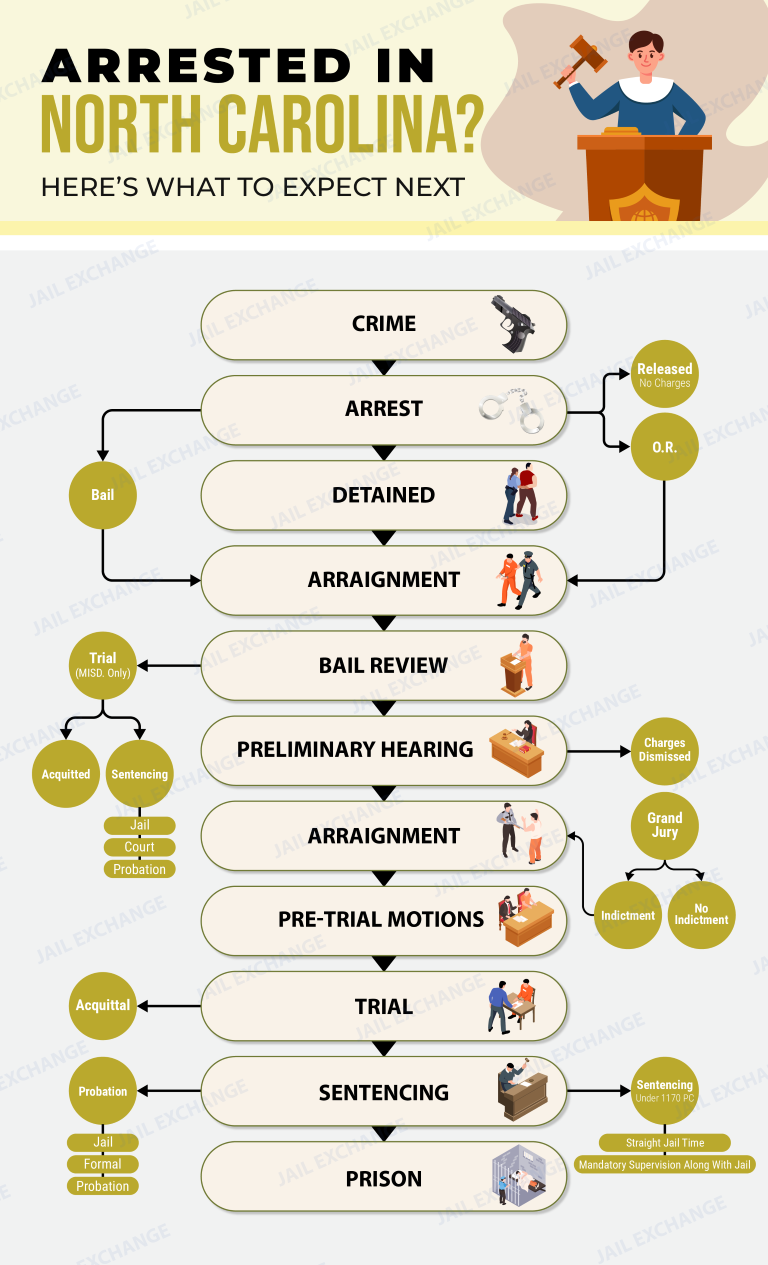

Inmate Canteen (operated by TurnKey Corrections) allows friends and family members to purchase pre-approved commissary packages, including brand-name snacks, confectionery goods, personal hygiene products, stationery, and apparel kits sent directly to an incarcerated loved one. Every package is packed to adhere strictly to facility security regulations, ensuring items pass institutional intake without being rejected at the loading dock.
Important: Package Deadlines and Delivery Windows Vary
Detention centers do not manage care package deliveries under identical schedules. While some facilities allow weekly orders, others restrict deliveries to bi-weekly or monthly distribution windows, and spending limits vary from jail to jail. You should verify the facility's active cutoff schedule and order allowances by calling them directly. If an order is submitted after the weekly processing deadline, delivery will be held until the following cycle, leaving your loved one waiting an extra cycle for fresh snacks, thermal wear, or personal care supplies.
Step-by-Step Instructions to Place a Commissary Package Order
- Confirm the inmate's legal first and last name, date of birth, and assigned booking or inmate ID number.
- Navigate to www.inmatecanteen.com and sign in or create a user profile.
- Select Commissary / Store and choose your state and detention center.
- Search for the inmate to unlock the facility's approved product catalog.
- Select allowable snack foods, candies, personal care goods, and clothing items up to the facility's allowed spending limit.
- Proceed to checkout, enter your debit or credit card billing details, and submit payment.
- Save your digital receipt and confirmation tracking number for your records.
What the Inmate Needs to Do
The inmate does not need an internet account to receive care packages. TurnKey Corrections prepares the order in secure, tamper-evident packaging and delivers it directly to the jail commissary department. Facility staff inspect the shipment and deliver the items during regular housing unit commissary rounds, where the inmate signs for receipt.
Official Provider: Inmate Canteen Official Website
Customer Service Telephone: 1-715-690-2965
Support Hours: Monday – Friday, 8:00 AM – 5:00 PM CST
Supported Languages: English and Spanish
Other Services Provided by Inmate Canteen (TurnKey Corrections)
In addition to Commissary Care Packages, Inmate Canteen provides several other communication, financial, and visitation services:
- Tablets & Chirp Units: Learn how secure handheld devices allow inmates to communicate, read, and message.
• Learn more on our website: Tablet Programs Guide | • Visit official vendor page: Inmate Canteen Devices - Remote Video Visitation: Schedule and join live face-to-face video visits from your computer or smartphone.
• Learn more on our website: Video Visitation Guide | • Visit official vendor page: Inmate Canteen Video Visits - Digital Messaging: Send electronic messages and photos directly to housing pod kiosks and handheld devices.
• Learn more on our website: Digital Messaging Guide | • Visit official vendor page: Inmate Canteen Messaging - Trust & Phone Deposits: Deposit money directly into an inmate's jail trust account or phone calling balance.
• Learn more on our website: Trust & Phone Deposits Guide | • Visit official vendor page: Inmate Canteen Deposits
Buy Commissary for an Inmate in the McDowell County Jail
McDowell County Jail Inmate Commissary - Sending Money or Purchasing Commissary for an Inmate
McDowell County Jail allows inmates to purchase commissary. This can be snacks, hygiene products, stamps, stationary, clothing and even electronics.
You can buy commissary for an inmate using an online service called Inmate Canteen.
Inmate Canteen Customer Service can be reached at 715-690-2965, or by email at support@inmatecanteen.com.

There is a monthly limit of $200-300 on how much inmates can spend on commissary items.
This amount is subject to change so call the facility at 828-652-2236 in order to confirm the amount that cannot be exceeded.
Inmates have access to both an in-house commissary store, and commissary packages that can be purchased and shipped to the inmate by friends and family.
Scroll down for information on the McDowell County Jail's service they use for you being able to purchase commissary items online and have them shipped directly to the inmate.
You can also go to our Inmate Money page for information on how to send money to an inmate.
Inmate Canteen Trust & Phone Deposits allow friends and family members to transfer money directly into an incarcerated person's jail trust account or telephone calling balance using a credit or debit card. Deposited funds give your loved one the financial balance needed to buy personal care goods, over-the-counter medication, snacks, and phone talk time from the facility canteen.
Important: Facility Banking Policies Vary Across Jails
Once a person is booked and moved to a cell, facilities do not always allow cash drop-offs or phone payments directly to the jail window. Some might and you should confirm this by calling the facility and asking. But if you do not register online and fund your loved one's trust account immediately, they may be forced to wait days or weeks for standard paper processing, leaving them without essential soap, clean undergarments, basic medical sundries or snacks.
Step-by-Step Instructions to Register and Deposit Funds
- Confirm the inmate's legal first and last name, date of birth, and assigned booking or inmate ID number.
- Navigate to www.inmatecanteen.com on your computer or mobile device.
- Click on Deposit Funds and select whether to fund the Trust Account (for commissary) or Phone Account (for talk time).
- Select the state and facility where the inmate is currently housed.
- Search for the inmate to confirm their active housing record matches the facility roster.
- Enter your deposit dollar amount, review convenience fees, and enter your debit or credit card billing details.
- Submit payment and save the digital confirmation receipt for your financial records.
What the Inmate Needs to Do
The inmate does not need an internet connection to receive trust funds. Once payment clears, the balance posts directly to their accounting profile in the jail's internal system. The inmate can review their updated balance at the pod kiosk terminal and place their regular weekly commissary order or make outbound phone calls.
Official Provider: Inmate Canteen Official Website
Customer Service Telephone: 1-715-690-2965
Support Hours: Monday – Friday, 8:00 AM – 5:00 PM CST
Supported Languages: English and Spanish
Other Services Provided by Inmate Canteen (TurnKey Corrections)
In addition to Trust & Phone Deposits, Inmate Canteen provides several other communication, financial, and commissary services at participating correctional facilities:
- Commissary & Snack Packs: Order pre-approved snack boxes, food packages, and clothing directly to the jail.
• Learn more on our website: Commissary Orders Guide | • Visit official vendor page: Inmate Canteen Commissary - Remote Video Visitation: Schedule and join live face-to-face video visits from your computer or smartphone.
• Learn more on our website: Video Visitation Guide | • Visit official vendor page: Inmate Canteen Video Visits - Digital Messaging & Chirp Texts: Send electronic messages and photos directly to housing pod kiosks and handheld devices.
• Learn more on our website: Digital Messaging Guide | • Visit official vendor page: Inmate Canteen Messaging
Deposit Money for an Inmate in the McDowell County Jail
Family and friends can add money for someone at the McDowell County Jail, run by the McDowell County Sheriff's Office at 593 Spaulding Road in Marion, in ways the Sheriff lists.
- Website: Open Inmate Canteen, make an account and choose McDowell County Detention Center. Pay by debit or credit card. Convenience fees apply.
- Lobby kiosks: Kiosks in the Sheriff's Office lobby are open 24 hours a day. Convenience fees apply here too.
- Money orders: The jail chooses not to publish a mailing address for money orders. The only way to get it is to call the facility at 828-652-2236; have the person's full name and date of birth ready. Do not send money to the Longview, Texas post office box. That box is only for letters.
Money can be spent on commissary or moved to the phone account for calls. Inmate Canteen does not take deposits by phone.
Since July 1, 2026, personal mail for the McDowell County Jail in Marion, which the Sheriff calls the McDowell County Detention Center, no longer goes to Spaulding Road. Letters are sent to a mail-scanning service, which turns them into electronic copies for the inmate and then destroys the paper. Jails switched to scanning because people were mailing in pages soaked in drugs such as meth or heroin and then dried. Legal and medical mail, books and magazines still go to the jail itself.
Personal letters and photos (scanned):
Inmate's Full Name & SO #
McDowell County Detention Center
PO Box 591
Longview, TX 75606
Legal mail, medical mail, books and magazines:
Inmate's Full Name & SO #
McDowell County Detention Center
593 Spaulding Road
Marion, NC 28752
- Name and number: Every envelope needs the inmate's name and their Sheriff's Office booking number, along with your return address. Search for the person on the jail lookup first.
- Page limit: Five pages at most, each 8.5 x 11 inches or smaller.
- Front side only: Write on one side of each sheet, because the scanner does not pick up the back.
- Pictures: One photo per letter.
- Keep copies: The scanning service does not return originals, so never mail a photo or paper you want back.
- Ink and extras: Write in dark blue or black ink, and leave off crayon, markers, lipstick, perfume, glitter and confetti.
- Magazines and books: News, sports and special-interest magazines are fine if they come new from the publisher. Books must also ship new from a publisher or a store, and adult or very violent material is taken.
- Stamps: Don't enclose any. Inmates buy them, and indigent inmates get a few with envelopes and paper every week.
For something faster than the post office, the jail offers electronic messages, and you can deposit money online.
NCIC Inmate Communications provides telecommunications services that allow incarcerated individuals to place outbound voice calls from dayroom telephones to family and friends. Because correctional facilities do not permit incoming phone calls, establishing an NCIC prepaid calling account connects calls directly to your cell phone or landline without being blocked by wireless carriers.
Important: Mobile Phones Automatically Block Inmate Calls
Cellular phone carriers automatically reject standard collect calls originating from jail phone systems. While some residential landlines might permit direct monthly billing, mobile devices and internet-based telephone lines require an active prepaid calling balance, which you can verify by checking with your provider. If you do not register online and fund an NCIC account right away, your loved one will receive an automated disconnect announcement when attempting to call your number.
Step-by-Step Instructions to Register and Fund an Account
- Visit account.ncic.com or call NCIC customer care at 1-800-943-2189.
- Click Create Account and register using the primary 10-digit telephone number where you want to receive calls.
- Select the state and correctional facility where your loved one is currently detained.
- Search for and add the inmate using their full legal name or booking ID number.
- Select your deposit dollar amount and enter your debit or credit card billing details.
- Submit payment and ensure your mobile phone settings allow calls from automated or unfamiliar correctional numbers.
What the Inmate Needs to Do
The inmate dials your 10-digit number from any dayroom telephone and keys in their assigned PIN. The automated system verifies that your phone number has an active prepaid balance and prompts you to press a digit to accept the call. All personal telephone conversations are recorded and monitored by facility staff.
Official Provider: NCIC Official Website
Customer Service Telephone: 1-800-943-2189
Support Hours: 24 hours a day, 7 days a week, 365 days a year
Supported Languages: English and Spanish
Other Services Provided by NCIC Inmate Communications
In addition to Prepaid Phone Calling, NCIC provides several other digital communication and visitation services at participating facilities:
- Remote Video Visitation: Schedule and join live face-to-face video visits from home using your computer or smartphone.
• Learn more on our website: Video Visitation Guide | • Visit official vendor page: NCIC Video Visits - Inmate Messaging Services: Send electronic messages and photos directly to an inmate's housing unit terminal.
• Learn more on our website: Inmate Messaging Guide | • Visit official vendor page: NCIC Messaging
Inmate Canteen Digital Messaging allows friends and family members to send electronic text messages and digital photos directly to an incarcerated loved one. Messages are delivered electronically to housing unit kiosks and Chirp handheld devices within hours, avoiding the lengthy delivery times associated with postal mail.
Important: Electronic Mail Guidelines Vary by Facility
Correctional facilities enforce strict rules regarding incoming correspondence. While some jails continue to accept paper letters, many facilities restrict physical postal mail or mandate digital message screening, which you can verify by checking facility rules. If you do not register online and set up message credits immediately, your loved one may face lengthy periods without direct written contact from family.
Step-by-Step Instructions to Register and Send Messages
- Go to www.inmatecanteen.com and sign in or create a user profile.
- Select Email / Messaging and choose your state and detention facility.
- Search for the inmate using their legal first and last name or booking ID number.
- Purchase messaging credits using a credit or debit card.
- Type your message in the text box and attach approved digital images if permitted by the facility.
- Submit your message to the facility's screening queue.
What the Inmate Needs to Do
All electronic correspondence is screened by facility staff before delivery. Once approved, messages appear in the inmate's inbox on their housing unit kiosk or assigned handheld Chirp device. The inmate opens the message, reads your note, and types an electronic reply using their available account credits.
Official Provider: Inmate Canteen Official Website
Customer Service Telephone: 1-715-690-2965
Support Hours: Monday – Friday, 8:00 AM – 5:00 PM CST
Supported Languages: English and Spanish
Other Services Provided by Inmate Canteen (TurnKey Corrections)
In addition to Digital Messaging, Inmate Canteen provides several other communication, financial, and commissary services at participating correctional facilities:
- Commissary & Snack Packs: Order pre-approved snack boxes, food packages, and clothing directly to the jail.
• Learn more on our website: Commissary Orders Guide | • Visit official vendor page: Inmate Canteen Commissary - Remote Video Visitation: Schedule and join live face-to-face video visits from your computer or smartphone.
• Learn more on our website: Video Visitation Guide | • Visit official vendor page: Inmate Canteen Video Visits - Trust & Phone Deposits: Deposit money directly into an inmate's jail trust account or phone calling balance.
• Learn more on our website: Trust & Phone Deposits Guide | • Visit official vendor page: Inmate Canteen Deposits
Information for this service is currently unavailable.
Nearby counties
- Jail (Main): 828-652-2236
- Sheriff: 828-652-2235
The McDowell County Jail serves the following cities and towns of McDowell County: Black Mountain, Dysartsville, Glenwood, Marion, Nebo and Old Fort. At times this facility may also house inmates arrested in the following counties: Mitchell County.