
Moore County Detention Center
Moore County Detention Center
Jail Phone Number
910-947-2980Moore County Inmate Search: Track Down Someone Held in Carthage
Anyone booked after an arrest in Moore County lands at the Moore County Detention Center, 302 S. McNeil Street, Carthage, NC 28327. This page walks through finding the person. It then covers release, counsel, visitors, deposits, letters and hearings.
The Sheriff offers a free online lookup of people in custody. It lets you type a name, pull up every inmate, browse charges, or see recent bookings for a number of days you choose. Our mugshots answer comes after the steps.
Need a human right away? Dial 910-947-2980 with a name and a birthday ready. For the longer story, open the bail page or the court page.
Read inmate search answers
 Read inmate search answers
1. How do I use the Moore County jail lookup tool?
The tool is split into three tabs named Inmates, Charges and Days. Try this order:
- Go to the Sheriff's lookup page.
- Under Inmates, enter a last name. Prefer to browse? Pick the choice that lists all inmates and scroll.
- Switch to Charges to read the offense behind each booking.
- Switch to Days when the arrest was recent. Choose how far back to look.
- Jot down every detail, and phone the jail to confirm.
Arrest happened hours ago? Booking may still be in progress. Dial 910-947-2980 and ask a deputy to look in the live booking system. Test a few spellings of the surname as well.
↑ Back to the question list2. Their name does not appear. What now?
A name can go missing for plain reasons:
- Booking underway. Entering a new arrest can take some hours.
- Already released. Maybe the magistrate set an unsecured bond. Maybe a friend paid the bond.
- Sent elsewhere. Think of another sheriff's jail, a state prison or federal agents.
- Spelling trouble. Type the nickname, the middle name or the birth surname instead.
- A teenager. People under 18 are kept away from adults. Read the youth answer further down.
Phoning is quicker than guessing. The jail line is 910-947-2980. Ask if they are inside right now.
↑ Back to the question list3. Could they be sitting in a jail other than Carthage's?
Deputies and town officers alike bring adults to a single place, the Moore County Detention Center, 302 S. McNeil Street, Carthage, NC 28327, 910-947-2980. The Sheriff's Office operates it, and the building was rated for roughly 272 people.
Ask staff whether your person sleeps in a special housing area or leaves for work release. Also ask whether a town police station kept them briefly before the transfer.
Was the arrest made just past the border? Then the next county's Sheriff may be holding them. Our North Carolina jail list has that facility. Transfers to state prison, federal agents or immigration officers are explained near the end.
↑ Back to the question list4. Does the Moore County lookup have mugshots?
Booking photos, the pictures people call mugshots, go public only when a Sheriff decides to post them. State law does not plainly require release. Want a particular photo? Phone the Sheriff's Office on 910-947-2931. If a town officer made the arrest, try that department instead. Its number sits in the final answer.
Anyone can learn a few things about an arrest. Officers must share the charge, plus the time and place they took the person in. The arrested person's name, age and street are open too.
- ICE photographs are released through FOIA only; file that request on the ICE site.
- The federal government withholds its booking photos. The one exception is the U.S. Marshals Service, which can release a picture while it seeks a fugitive.
5. Is it possible to be notified once they are freed or transferred out of Moore County?
North Carolina's free SAVAN service, run through VINE, sends you a call, text or email each time a person is freed from, or shifted between, county and state custody. Use it to check where a person is housed right now too.
- Register on VINELink.
- Prefer a voice? Dial 877-627-2826, which answers all day and night.
An alert can lag behind real events. For something pressing, phone the jail on 910-947-2980.
↑ Back to the question list6. What steps get someone released after an arrest in Moore County?
The first decision on release belongs to a magistrate. Magistrates are on duty at all hours, so someone can sometimes leave within hours. Their office line is 910-722-5019.
The magistrate may choose any of these:
- An unsecured bond asks for nothing today. The full amount becomes a debt if the person fails to show up in court.
- Custody release to someone reliable, or an agency, that agrees to monitor the defendant.
- A secured bond, which is secured by cash, by property, or by hiring a bondsman.
- House arrest with a tracking device, allowed only alongside a secured bond.
Certain serious charges, like murder, rape or kidnapping, are left to a judge. A domestic violence charge can keep a person in jail for as long as two days, until a judge speaks to release. A new arrest during a release also goes to a judge.
No one stays locked up for long before seeing a District Court judge. That first appearance must happen within 72 hours, and the judge may change the conditions. Skip a court date and the next bond is at least twice the first, or $1,000 when none existed.
Before you pay anything, phone 910-947-2980 and learn how the jail takes bonds. A bondsman can keep up to 15 percent, and that fee never comes back. Verify a license with the state insurance department's lookup. For more depth, read our bail page or our overview of North Carolina bail law.
↑ Back to the question list7. What exactly were they arrested for?
The Charges tab of the Sheriff's lookup gives the booking offense first.
Once the state files a case, the Clerk of Superior Court becomes keeper of the paperwork. That criminal office sits inside the courthouse at 102 Monroe Street, Carthage, NC 28327, 910-722-5000. Offer the person's legal name and birthday. Prefer a screen? The state's eCourts search displays charges, hearing dates and other case events.
The District Attorney's office decides which counts the state will pursue. Their line is 910-722-5010.
↑ Back to the question list8. Can a person who has no money still get legal help?
Someone without money for counsel requests an appointed attorney at the first court appearance. The person signs a sworn statement of poverty, called an affidavit of indigency, and the judge rules on it. If found guilty, the person may be told to repay part of the lawyer's fee.
Carthage cases rely on appointed private lawyers rather than a local public defender office. A judge assigns the attorney, and public funds cover that fee. See the Indigent Defense Services page for this county, or ring the agency on 919-354-7200.
You may also retain your own attorney whenever you like. Pass that attorney's name to the jail so meetings can be arranged.
↑ Back to the question list9. Before I drive to Carthage for a visit, what do I need to know?
Hours and rules change, so phone first. Use 910-947-2980 and ask:
- Has this person been cleared for visitors?
- Does the jail run in-person visits, screen visits, or neither?
- Which weekdays and hours are open? Do I reserve a time?
- Who can come along, and which photo ID is accepted?
The jail's own site sends families to NCIC for visit details. For extra pointers, see our visiting page. Carry nothing in for the person unless staff has okayed it.
↑ Back to the question list10. Where do I send deposits for commissary and calls?
Cash held in an inmate's name pays for snacks, hygiene goods and phone minutes. The jail's site routes deposits through JailATM, and you only need the inmate's full name.
A second link on the jail's site leads to the canteen's care package store. Ask staff on 910-947-2980 about caps and fees.
More detail is in our deposit page and our commissary page. Please keep cash out of the mail.
↑ Back to the question list11. Will I be able to talk to them by phone, message or screen?
For phone service, the jail's site points to NCIC. Most calls start inside the jail, so you may need to fund an account first. Rates and rules are set by that company.
Recordings are likely, so discuss case details with counsel alone. Ask the jail on 910-947-2980 whether tablets, messages or screen visits exist.
Related guides: calling from jail and emailing an inmate.
↑ Back to the question list12. How should a letter to the Moore County jail look?
Before stamping anything, reach the jail on 910-947-2980. Get the correct delivery address and the way the name should be written. Learn which items are welcome, like photos, greeting cards or paperbacks.
Use ordinary paper in an ordinary envelope. Address the envelope to the inmate's complete legal name and mark your own return address. Never tuck money inside. Our mailing page covers the usual limits.
↑ Back to the question list13. How do I collect clothes or other items they had on them?
Whatever the jail took when booking the person sits in storage until release. To collect something, ring 910-947-2980. Find out who may take items, what hours work, and what ID is required. Go to 302 S. McNeil Street, Carthage, NC 28327.
People who are being freed normally walk out with their own belongings. Ask about wallets and cash too.
↑ Back to the question list14. How do I get help for an inmate who is ill?
Phone 910-947-2980 and request the medical unit. Say the legal name, the symptoms, and each medicine along with its dose, plus your loved one's doctor and number.
From inside, the inmate can ask for care with a written request. Life in danger? Use 911. Fear a mental health crisis? Tell the staff plainly.
↑ Back to the question list15. How do I find out if someone has an active warrant?
The Sheriff's Office serves warrants outside towns. Town police do it inside them. Try the Sheriff at 910-947-2931, Southern Pines police at 910-692-2732, or Pinehurst police at 910-295-3781. The Clerk of Superior Court's criminal office, 910-722-5000, can check a case; so can the state's eCourts search. To resolve it, consult a lawyer first. After that, call the court that is behind the order. The clerk works at 102 Monroe Street, Carthage, NC 28327.
↑ Back to the question list16. Where do I get their next hearing date in Moore County?
Cases are heard at the courthouse, 102 Monroe Street, Carthage, NC 28327. The clerk's office posts the court calendar. Call 910-722-5000 and offer a full name and a birth date.
Online, use the state's hearing date search or this court location page. District Court hears misdemeanors first, and the opening steps of felony cases. A felony reaches Superior Court only once grand jurors have indicted. For the stages that follow, see our Moore court guide.
↑ Back to the question list17. Which court applies if federal agents made the arrest?
The federal Middle District of North Carolina normally covers Moore. Look for the L. Richardson Preyer Federal Building, 324 W. Market Street, Greensboro, NC 27401. The clerk answers at 336-332-6000.
- A federal judge decides between jail and freedom until trial at the first hearing (18 U.S.C. 3142).
- Before trial the U.S. Marshals Service is in charge of the person, often housing them in a county jail. Reach the Marshals at 324 West Market Street, Suite 234, Greensboro, NC 27401, 336-332-8700.
- Those without funds can get a federal public defender at 301 North Elm Street, Suite 410, Greensboro, NC 27401, 336-333-5455.
- Once sentenced, the Federal Bureau of Prisons locator tool shows where the person is.
One exception: offenses on the Fort Bragg and Camp Mackall portions of the county belong to the Eastern District. Its Fayetteville courthouse is at 301 Green Street, Fayetteville, NC 28302, 910-483-7378, and the Eastern Marshals work from 310 New Bern Avenue, Suite 100, Raleigh, NC 27601, 919-856-4153.
↑ Back to the question list18. Will immigration officers pick them up?
The general sequence looks like this:
- Step one is a detainer from ICE (Form I-247A) paired with a warrant.
- Federal rules (8 CFR 287.7(d)) let the jail keep the person up to 48 hours after they would otherwise be released.
- Since October 1, 2025, state law (Session Law 2025-85) also has a judicial official sign the hold if the person is facing a charge. For some charges, staff must also try to learn citizenship.
- After the hold, ICE agents pick up the person and take them to an ICE site.
- The ICE Online Detainee Locator works with a name plus birth country, or with an A-number.
Whether a detainer exists is something staff at 910-947-2980 can tell you. Paying a bond does not erase one.
↑ Back to the question list19. Could they already be in a North Carolina state prison?
A prison term hands the person to the Department of Adult Correction, which sorts them by need and picks a site. Others stay in the local jail until the state assigns a bed.
- The Department of Adult Correction search page accepts a surname or an offender ID. Entries date to 1972 and include prisoners, probationers and parolees. Someone held only locally will not be listed.
- The department's headquarters number is 919-733-2126.
- Our page on North Carolina prisons adds rules for visits and mail.
Not every sentence ends in a prison. Misdemeanor terms past 90 days, and all impaired driving terms, can be served at a county jail enrolled in a state program.
↑ Back to the question list20. Where do young people under 18 go?
Juvenile cases belong to District Court and stay confidential. The courthouse is 102 Monroe Street, Carthage, NC 28327. Call the Clerk of Superior Court at 910-722-5000 with questions about a young person's case.
A minor held in secure custody gets a court hearing within five calendar days. Nobody may waive that hearing. Minors go to a state youth detention center, usually the one nearest home, rather than a jail cell with adults. Ask the clerk, or the jail on 910-947-2980, which center has the youth. A few grave felony cases can be shifted to adult court.
↑ Back to the question list21. Who do I call at the arresting police agency?
Reach the agency that took the person in if you want a report, a photo or a warrant check.
- Moore County Sheriff's Office, 302 S. McNeil Street, Carthage, NC 28327, 910-947-2931. Deputies cover land outside the towns and any town lacking its own police. Emergencies go to 911.
- Southern Pines Police Department, 450 W. Pennsylvania Avenue, Southern Pines, NC 28387, 910-692-2732
- Pinehurst Police Department, non-emergency line 910-295-3781
- Highway Patrol: the Aberdeen office of District VI (Troop H) answers at 910-728-4488. Troop H headquarters: 2206 Fowler Secrest Road, Monroe, NC 28110, 704-283-8559.
The county also holds Aberdeen, Carthage, Cameron, Foxfire, Pinebluff, Robbins, Taylortown, Vass and Whispering Pines, and Sandhills Community College runs campus police. Dial the Sheriff's Office above and ask which agency answers for the street.
↑ Back to the question listHow bail works in Moore County: Carthage and Southern Pines
Anyone arrested in Moore County, from Southern Pines to Carthage, is taken to the Moore County Detention Center, 302 S McNeil Street, Carthage, NC 28327. Keep reading to learn how a magistrate picks a bond, the ways to pay, and the days after release.
Use the sheriff's Moore County Inmate Search, which lists inmates, their charges and recent bookings. Our Recent Arrests page is a second place to look, with warrants and property pickup help.
Call 910-947-2980 and reach the detention center right away. Is a bond in place, and where do you pay it? Those are your two questions. Court dates are on our Moore court page.
1. Where is the Moore County Detention Center?
It is at 302 S. McNeill Street, Carthage, NC 28327, (910) 947-2980. The Moore lockup is rated for 272 people.
↑ Back to the question list2. What about arrests during a golf tournament in Pinehurst?
Arrests in Pinehurst or Southern Pines go to a Moore County magistrate and the Carthage jail. Visitors from out of state should be ready to show home and travel details to get an unsecured bond.
↑ Back to the question list3. Judge or magistrate: who sets Moore bonds?
In Carthage, the Carthage magistrate usually does. By law, Moore keeps 6 or more magistrates (NC law, G.S. 7A-133). The Moore defendant stays in the Moore County Detention Center meanwhile. Pinebluff officers bring arrestees to the Carthage magistrate (NC law, G.S. 15A-511; NC law, G.S. 15A-532). The Moore judge or the Carthage clerk may too.
↑ Back to the question list4. Which bond types does Moore County use?
The Moore magistrate has four Carthage choices (NC law, G.S. 15A-534, part a).
• A Moore secured bond uses cash, land, or a Carthage surety.
• In Moore, an unsecured bond costs Carthage families nothing up front. If Carthage court is skipped, your Carthage loved one owes it.
• House arrest keeps the Moore defendant home in Taylortown. Moore adds a secured bond.
• With custody release, a Moore program supervises. Your Moore family member can choose a Carthage secured bond instead.
A written promise ended in Moore on December 1, 2025.
↑ Back to the question list5. When must Moore County use a money bond?
Non-violent Carthage cases begin with no-money options in Moore (NC law, G.S. 15A-534, part b).
If the Moore defendant may skip Carthage court, a Moore secured bond follows. The Carthage magistrate weighs harm risks too. Carthage's magistrate also weighs threats to Moore witnesses.
Three Moore Class 1 convictions in 10 years? Moore then requires a secured bond (NC law, G.S. 15A-534, part b). A new Moore felony on probation means a Carthage danger finding (NC law, G.S. 15A-534, part d2).
↑ Back to the question list6. Does Moore County have a bail schedule?
Moore has no fixed price list in Carthage. District 29's senior judge writes Moore's policy (NC law, G.S. 15A-535). Moore's chief district judge weighs in for Carthage. The Moore policy suggests Carthage amounts.
Carthage's magistrate weighs the charge and record (NC law, G.S. 15A-534, part c). Past no-shows hurt a Moore defendant. Ties to Foxfire help.
First small Moore misdemeanors often get unsecured bonds in Carthage. Trafficking charges in Moore go higher in Carthage. Moore felony bonds often reach thousands in Carthage. In Carthage, misdemeanor bonds may reach thousands in Moore.
↑ Back to the question list7. Who can sign as surety for a Carthage bond?
The Carthage magistrate takes Moore bonds. If the magistrate cannot be reached, the Moore County Detention Center can accept it (NC law, G.S. 15A-537). Call (910) 947-2980 first.
Pay a Carthage bond in cash, land, or a Moore surety (NC law, G.S. 15A-531). A Cameron relative can sign unpaid with enough Moore property. A Moore surety may be a Carthage bail agent.
Bondsman fees in Carthage top out at 15% (NC law, G.S. 58-71-95). Collateral reaches Moore families within 15 days. Carthage officers can't sign as Moore sureties, except for family (NC law, G.S. 15A-541). Verify any Moore bondsman at the NC Department of Insurance bondsman lookup.
↑ Back to the question list8. In Moore County, which charges skip the magistrate?
Only a Moore County judge decides release for these Moore charges (NC law, G.S. 15A-533, part b and c): capital crimes; first-degree arson; human trafficking; first-degree burglary; armed robbery; shooting into an occupied building or car; kidnapping; assault with a deadly weapon with intent to kill causing serious injury; murder or attempted murder; forcible rape and many sex crimes; sex crimes against a child 15 or younger.
For them, Moore presumes no Carthage release is safe. A Carthage judge can still allow release in Moore. Repeat Carthage gang cases in Moore also match (NC law, G.S. 15A-533, part d through g).
↑ Back to the question list9. How are violent charges from Carthage handled?
In Carthage, since December 1, 2025, violent Moore charges face a presumption against Carthage release (NC law, G.S. 15A-534, part b1). In Carthage, people say Iryna's Law in Moore.
Forceful felonies charged in Carthage count in Moore (NC law, G.S. 15A-531, part 9). Moore registration felonies count too in Carthage. So do Carthage attempts and some Moore fentanyl trafficking.
A first violent Moore charge needs a secured bond or Carthage monitor. Carthage's magistrate must write reasons (NC law, G.S. 15A-534, part d). Moore defendants charged twice get a Carthage monitor.
↑ Back to the question list10. After a Carthage domestic violence arrest, what happens?
In Moore, domestic cases go to the Moore judge first (NC law, G.S. 15A-534.1, part a). Moore threats against a Carthage spouse count. Breaking a Moore 50B order in Carthage counts.
The Moore County Detention Center may hold your Carthage loved one up to 48 hours (NC law, G.S. 15A-534.1, part b). Then a Moore County magistrate acts in Carthage. Carthage judges often order Moore no-contact terms.
↑ Back to the question list11. What other charges in Moore County mean a longer wait?
Moore families should know these:
• Carthage mass-violence threats: a Moore County judge acts within 48 hours (NC law, G.S. 15A-534.7).
• Carthage DWI: a sober Moore adult may take the Robbins detainee sooner (NC law, G.S. 15A-534.2).
• Threatening a Carthage officer: a Moore County judge acts within 48 hours (NC law, G.S. 15A-534.9).
• Meth labs in Moore: Carthage release may be presumed unsafe (NC law, G.S. 15A-534.6).
• Children harmed in Carthage: Carthage's magistrate orders no contact (NC law, G.S. 15A-534.4).
• Looting in Carthage: a Carthage judge decides within 24 hours (NC law, G.S. 15A-534.8).
↑ Back to the question list12. Someone on a Moore bond got arrested again. Now what?
A new Moore charge goes to a Moore County judge (NC law, G.S. 15A-533, part h). Simple Carthage traffic charges don't count in Moore. The Moore County Detention Center may hold the Moore defendant 48 hours. After that, the Carthage magistrate steps in for Moore.
In Moore, the new bond may double in Carthage (NC law, G.S. 15A-534, part d3). A doubled Moore bond is $1,000 or more in Carthage. For good cause, Moore can revoke Carthage release (NC law, G.S. 15A-534, part f).
↑ Back to the question list13. How soon does someone held in Moore County see a judge?
Within 72 hours, the Moore defendant sees a Carthage judge (NC law, G.S. 15A-601). If Moore courts close long, the Carthage limit is 96 hours. The next Carthage session may come first in Moore. Moore district court also sits in Southern Pines.
Before that, the Moore magistrate can change it in Carthage (NC law, G.S. 15A-534, part e). The Moore judge may change it at the Carthage hearing.
Still denied? Write to a Moore superior court judge (NC law, G.S. 15A-538). Moore prosecutors may ask too (NC law, G.S. 15A-539).
↑ Back to the question list14. Can a Moore County bond be forfeited?
A willful Carthage no-show is its own crime in Moore (NC law, G.S. 15A-543). Misdemeanor no-shows in Moore are Class 2 in Carthage. For Moore felonies, it is Class I in Carthage.
The Moore court forfeits the full Carthage bond (NC law, G.S. 15A-544.3). Moore sureties get 150 days to ask the Carthage clerk (NC law, G.S. 15A-544.5). The Carthage clerk mails notice within 30 days (NC law, G.S. 15A-544.4). Only listed Moore reasons work, like Carthage surrender.
On day 150, a Moore final judgment and Carthage lien follow (NC law, G.S. 15A-544.6). Picked up again, your Carthage loved one faces a doubled Moore bond (NC law, G.S. 15A-534, part d1).
↑ Back to the question list15. Can I get off someone's bond in Carthage?
Before a missed Carthage date, a Moore surety may surrender the Taylortown detainee (NC law, G.S. 15A-540, part a). Then the Carthage clerk releases the Moore surety. Once Moore court is missed, a Carthage surety may arrest the Vass detainee (NC law, G.S. 15A-540, part b). New Moore terms follow from Carthage's magistrate (NC law, G.S. 15A-540, part c).
Otherwise, a Moore bond lasts until Carthage judgment (NC law, G.S. 15A-534, part h). A Carthage deferral can end it in Moore.
↑ Back to the question list16. Which court will hear a case from Cameron?
Criminal court for Moore County is held in Carthage. District court also sits in Southern Pines. Moore shares judges with Hoke.
Moore misdemeanors stay in Carthage district court (NC law, G.S. 7A-133). After indictment, Moore felonies go to Carthage Superior Court 29 (NC law, G.S. 7A-41). Moore prosecutors handle Carthage cases (NC law, G.S. 7A-60).
↑ Back to the question list17. Can someone arrested in Carthage get a free lawyer?
There is no Moore public defender office in Carthage. The Moore judge appoints a state-paid Moore lawyer. Request one in Carthage at first appearance (Indigent Defense Services directory). If convicted, the Robbins detainee may repay Moore County's costs to the state.
↑ Back to the question list18. Do Carthage 16- and 17-year-olds go to adult jail?
Carthage juvenile court handles most Moore under-18 cases (NC law, G.S. 7B-1501). Moore added 17-year-olds in Carthage in 2019. A Moore detention hearing comes within 5 Carthage days (NC law, G.S. 7B-1906). Serious Moore felonies can move to Carthage adult court. Moore juveniles face no money bail in Carthage.
↑ Back to the question list19. Which federal court covers Moore County?
Moore is in the U.S. District Court for the Middle District of North Carolina (28 U.S.C. 113). Court meets in Durham, Greensboro, and Winston-Salem. The clerk: Greensboro, L. Richardson Preyer Federal Building, 324 W. Market St., 336-332-6000. A federal judge sets Moore release. Crimes on the Fort Bragg and Camp Mackall parts of Moore County go to the Eastern District instead.
↑ Back to the question list20. Who can confirm a Moore County bond amount?
Phone the Moore County Detention Center: (910) 947-2980. Have your Moore family member's birth date ready for Carthage staff. The Carthage clerk can also help Carthage families on weekdays.
↑ Back to the question list21. Moore County bail contacts
- Jail: Moore County Detention Center, 302 South McNeill Street, Carthage, NC 28327; (910) 947-2980
- Courts: Moore County Courthouse, Carthage
- Districts: District Court 29; Superior Court 29; Prosecutorial 29
- Inmate search: Moore County Inmate Search
Judges and magistrates set release terms case by case. Nothing here is legal advice.
↑ Back to the question listMoore County Detention Center Visitation
Start with the Moore County Sheriff’s visitation link or go to NCIC Video Visit. Select Moore County’s detention center in North Carolina and the person you want to visit. Check the available options for a visit at the jail or from home. Confirm any charge in the booking system before paying.
Call detention at 910-947-2980 to check eligibility or confirm where to report for an onsite visit. The jail is at 302 S. McNeill Street, Carthage, NC 28327. Follow the address and check-in instructions in your reservation or from detention staff.

NCIC Video Visitation provides a secure online platform that enables families and loved ones to conduct scheduled face-to-face video visits with incarcerated individuals from home. Using an internet-connected smartphone, tablet, or personal computer equipped with a webcam, visitors can connect directly without traveling to the facility.
Important: Advance Registration and Visitor Clearance Required
Detention centers do not permit unscheduled or unverified video sessions. Correctional facilities require prospective visitors to submit government-issued photo identification and receive administrative clearance before booking an appointment, an approval process that can take up to 48 hours depending on facility staffing. You should verify your visitor approval status with the facility prior to scheduling. If you do not register well in advance, you will miss your loved one's scheduled visiting window for the week.
Step-by-Step Instructions to Register and Schedule a Video Visit
- Visit NCIC Scheduling and sign into your account.
- Register your visitor profile and upload a clear photograph of your government-issued ID (driver's license or passport) for facility background review.
- Wait for email notification confirming facility visitor approval.
- Select Video Visitation, choose the detention facility, and select the inmate.
- Browse the available schedule calendar, select an open time slot, and pay the visitation fee using a credit or debit card.
- Log into the website or mobile app 10 minutes prior to the start time on a device with a functioning camera, microphone, and reliable high-speed internet connection.
What the Inmate Needs to Do
The inmate receives a visitation notification on their housing unit video kiosk or terminal. At the appointed time, they log in with their PIN and sit before the terminal. Inmates and visitors must strictly observe jail dress and conduct rules; sessions are monitored by staff and will terminate immediately upon any violation.
Official Provider: NCIC Official Website
Customer Service Telephone: 1-800-943-2189
Support Hours: 24 hours a day, 7 days a week, 365 days a year
Supported Languages: English and Spanish
Other Services Provided by NCIC Inmate Communications
In addition to Remote Video Visitation, NCIC provides calling and digital messaging services at participating facilities:
- Prepaid Phone Calling Accounts: Prepay for phone calling credits so your loved one can call your telephone directly.
• Learn more on our website: Prepaid Calling Accounts Guide | • Visit official vendor page: NCIC Prepaid Calling - Inmate Messaging Services: Send electronic messages and photos directly to an inmate's housing unit terminal.
• Learn more on our website: Inmate Messaging Guide | • Visit official vendor page: NCIC Messaging
Moore County Criminal Courts in Carthage: Where Cases Go
A criminal case in Moore County begins in District Court and, for felonies, ends up in Superior Court. Both are at the courthouse, 102 Monroe St, Carthage, NC 28327. People held after arrest stay at the Moore County Detention Center, 302 S McNeil Street, Carthage, NC 28327.
Open the sheriff's Moore County Inmate Search to see current inmates and charges. Our Jail Roster has more on arrests and warrants.
The Clerk of Superior Court, 910-722-5000, can tell you the next court date. Ask for the case number too. For help with release, go to our Moore bail guide.
1. Where will the criminal case be heard?
The first question after a Moore County arrest is often whether the charge is a misdemeanor or felony.
Courthouse locations and direct telephone numbers
- Moore County Courthouse, 102 Monroe St., Carthage, NC 28327, 910-722-5000
State court: The Moore County District Court handles most misdemeanors and the opening felony hearings. The Moore County Superior Court handles felony trials and appeals for a new trial from District Court.
District and Superior Court serve different purposes, even when they use rooms in the same courthouse.
↑ Back to the question list2. What happens after an arrest and how does release work?
Families often hear about booking before they hear about court. A magistrate can review conditions for release while the criminal case is pending.
Release can involve a written promise to appear, an unsecured bond, a secured bond, or other conditions. A secured bond does not mean the person is already guilty. A judge may review release terms, and restrictions can include staying away from an alleged victim.
For certain arrests, extra review or holding rules apply. A person held in custody should be told the charges and brought before judicial officials under the applicable rules. Missing a required appearance can result in an order for arrest, so the next date deserves immediate attention.
↑ Back to the question list3. How are misdemeanor cases handled and punished?
Ordinary misdemeanor accusations are decided by a District Court judge first; a convicted defendant can seek a new trial in Superior Court.
Important misdemeanor sentencing figures: North Carolina uses Classes A1, 1, 2, and 3. A1 ranges from 1–60 days at prior-conviction Level I to 1–150 days at Level III; Class 1 reaches 45, 45, or 120 days by level; Class 2 reaches 30, 45, or 60 days; Class 3 reaches 10, 15/20, or 20 days depending on the person’s prior convictions and permitted sentencing disposition.
The word “maximum” does not mean everyone goes to jail. Some combinations of class and prior record require or allow community punishment instead. Ordinary fine ceilings are $200 for Class 3 and $1,000 for Class 2, while Class A1 and Class 1 fines are generally left to the court unless a particular crime has its own rule (G.S. 15A-1340.23).
↑ Back to the question list4. How does a felony case move through the courts?
The state may seek an indictment from a grand jury before a felony proceeds to Superior Court.
After a first appearance, a probable-cause hearing may be scheduled; an indictment can change whether a preliminary hearing is needed. In Superior Court, the parties exchange evidence, argue motions and may negotiate a plea. Someone pleading not guilty to a felony is entitled to a jury trial. The prosecutor must prove the case beyond a reasonable doubt.
Class A through I felonies carry different sentencing possibilities. Prior-record points, offense class, aggravating or mitigating factors and the date of the crime can substantially change the lawful range. The court uses the structured-sentencing grid in G.S. 15A-1340.17, not a single fixed statewide number for all felonies.
↑ Back to the question list5. What happens with serious violent crimes?
Accusations such as murder, serious sexual assault and armed robbery carry far more serious consequences than routine misdemeanors. A Superior Court jury may hear the evidence, with appointed or retained defense counsel. In some cases there are special rules for bonds, mandatory minimums, and life imprisonment.
First-degree murder may be punished by life without parole or death under the statutes governing capital cases; other homicides have different classifications and punishments. Sentences for rape and robbery depend on the precise offense statute and any aggravating factors. A family should never rely on a broad label like “assault” to calculate a sentence.
↑ Back to the question list6. How do juvenile cases work?
A complaint involving a young person can follow juvenile delinquency procedures rather than the ordinary adult criminal docket. Youth hearings are generally in District Court, with different goals and privacy protections. For many delinquent acts the juvenile system has jurisdiction over offenses committed before age 16, while some 16- and 17-year-olds accused of specified lower-level conduct may also be handled there under the applicable statutes.
Intake staff may recommend diversion or formal proceedings. A juvenile can be placed under supervision, ordered into services, or in appropriate cases detained or committed. Serious charges may trigger special transfer rules. Parents or guardians should ask about counsel and the youth’s next hearing.
↑ Back to the question list7. How does North Carolina decide fines and sentences?
Here is the key to reading a North Carolina sentence: the judge first looks at the offense class, then the defendant’s prior convictions or prior-record points. The law limits both the length and the type of sentence. “Community” punishment may mean probation or conditions instead of immediate jail; “intermediate” punishment can be more restrictive; “active” punishment means incarceration.
For misdemeanors, examples of the longest grid terms are Class A1 up to 150 days, Class 1 up to 120, Class 2 up to 60 and Class 3 up to 20, for the applicable highest prior-conviction level. These are not automatic sentences. Fines: ordinarily Class 3 up to $200 and Class 2 up to $1,000; the usual statutory text leaves A1 and Class 1 fine amounts to the judge unless another law controls. For felonies, the North Carolina felony grid in G.S. 15A-1340.17 specifies the allowable minimum and maximum prison term according to class and prior-record level.
Some crimes have their own minimums, enhancements, restitution obligations, court costs, sex-offender requirements, or driving restrictions. The offense date matters because the legislature has updated the sentencing charts, including changes effective for crimes committed on or after December 1, 2025.
↑ Back to the question list8. Are there city courts or other local criminal courts?
North Carolina does not operate a separate municipal criminal-court system like some states. City police departments may arrest a person and city ordinances may lead to enforcement, but ordinary state criminal prosecutions go through District Court and Superior Court. Magistrates handle functions such as issuing warrants and setting release conditions.
This is why someone arrested by a city police officer in Moore County generally receives a state-court case, not a separate “city criminal court” proceeding. A local police holding area is not the county courthouse.
↑ Back to the question list9. What if the charge is a federal crime?
Most crimes prosecuted by a county District Attorney remain in state court. A separate federal criminal case can arise from violating a federal statute, such as certain interstate fraud, trafficking offenses, federal firearm offenses, bank robbery involving a federally insured bank, or crimes on federal property. Not every serious state crime is automatically a federal crime.
Usual federal venue for Moore County: U.S. District Court for the Middle District of North Carolina. Federal crimes arising on Fort Bragg or Camp Mackall portions of this county may fall within the Eastern District, even though other portions generally fall in the Middle District. Federal contact: Greensboro federal clerk, 336-332-6000. L. Richardson Preyer Federal Building and Courthouse, 324 W. Market Street, Greensboro, NC 27401
Federal magistrate judges handle initial appearances and detention hearings; federal prosecutors work for the U.S. Attorney. Federal felony cases generally involve a grand jury indictment unless properly waived. The U.S. Sentencing Guidelines and federal statutes, not North Carolina’s state sentencing grid, govern federal sentences.
This is general court information, not legal advice. If the accused cannot afford an attorney, ask at the first appearance about appointed counsel.
↑ Back to the question list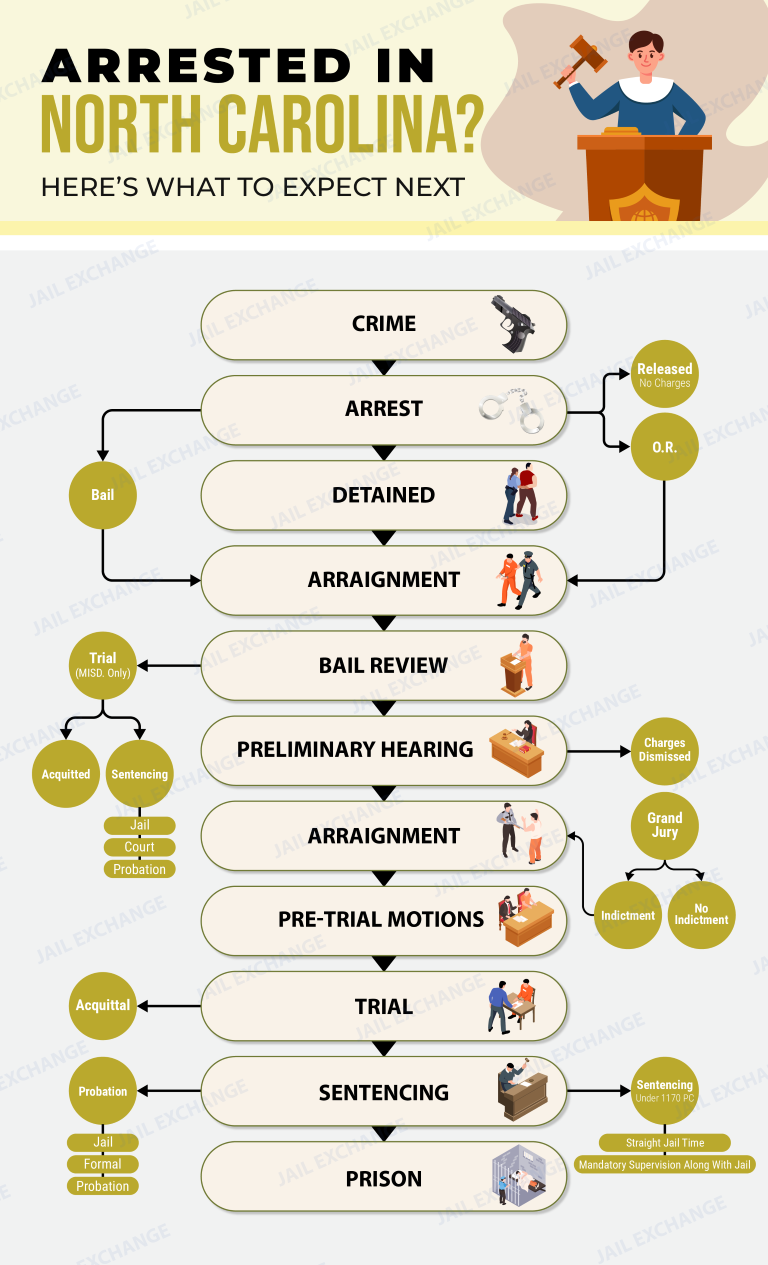
Oasis Commissary (operated online at jailcanteen.com) allows families and friends to purchase pre-approved snack boxes, food packages, confectionery goods, hygiene products, and apparel kits sent directly to an incarcerated loved one. Each package is packed to comply with local facility security rules, ensuring items clear intake smoothly without being rejected at the loading dock.
Important: Package Deadlines and Delivery Windows Vary
Detention centers do not manage care package deliveries under identical schedules. While some facilities allow weekly orders, others restrict deliveries to bi-weekly or monthly distribution windows, and spending limits vary from jail to jail. You should verify the facility's active cutoff schedule and order allowances by calling them directly. If an order is submitted after the weekly processing deadline, delivery will be held until the following cycle, leaving your loved one waiting an extra cycle for fresh snacks, thermal wear, or personal care supplies.
Step-by-Step Instructions to Place a Commissary Package Order
- Confirm the inmate's legal first and last name, date of birth, and assigned booking or inmate ID number.
- Navigate to www.jailcanteen.com on your computer or mobile device.
- Select your state and detention center to open the jail's authorized product catalog.
- Search for the inmate to link the order to their active housing record.
- Browse available snack boxes, meats, hygiene kits, and clothing options, adding items up to the facility's allowed spending limit.
- Proceed to checkout, enter your debit or credit card billing details, and submit payment.
- Save your digital receipt and confirmation tracking number for your records.
What the Inmate Needs to Do
The inmate does not need an internet account to receive care packages. Oasis Commissary fulfills the order in tamper-evident security containers and delivers it directly to the facility commissary department. Jail staff inspect the shipment and deliver the items during regular housing unit commissary distribution, where the inmate signs for receipt.
Official Provider: Oasis Commissary (jailcanteen.com)
Customer Service Telephone: 1-800-956-2747 or 1-618-548-6034
Support Hours: Monday – Friday, 8:00 AM – 5:00 PM CST
Supported Languages: English and Spanish
Other Services Provided by Oasis Commissary
In addition to Care Packages, Oasis Commissary provides trust deposit services at participating facilities:
- Inmate Trust Money Deposits: Send money directly into an inmate's jail trust account for independent canteen shopping.
• Learn more on our website: Inmate Trust Deposits Guide | • Visit official vendor page: Oasis Trust Deposits
Buy Commissary for an Inmate in the Moore County Detention Center
Moore County Detention Center Inmate Commissary - Sending Money or Purchasing Commissary for an Inmate
Moore County Detention Center allows inmates to purchase commissary. This can be snacks, hygiene products, stamps, stationary, clothing and even electronics.
You can buy commissary for an inmate using an online service called Oasis Commissary / jailcanteen.com.

There is a monthly limit of $200-300 on how much inmates can spend on commissary items.
This amount is subject to change so call the facility at 910-947-2980 in order to confirm the amount that cannot be exceeded.
Inmates have access to both an in-house commissary store, and commissary packages that can be purchased and shipped to the inmate by friends and family.
Scroll down for information on the Moore County Detention Center's service they use for you being able to purchase commissary items online and have them shipped directly to the inmate.
You can also go to our Inmate Money page for information on how to send money to an inmate.

JailATM provides a secure electronic payment portal that allows friends and family members to deposit funds directly into an incarcerated person's jail trust and commissary account. Deposited money provides the financial balance needed for your loved one to purchase personal hygiene items, snacks, over-the-counter medical sundries, and correspondence supplies from the facility commissary.
Important: Facility Deposit Rules and Window Intake Vary
Once a person is booked and moved to a housing unit, facilities do not always allow cash drop-offs or phone payments directly to the jail window. Some might and you should confirm this by calling the facility and asking. But if you do not register online and fund your loved one's trust account immediately, they may be forced to wait days or weeks for standard paper processing, leaving them without essential soap, clean undergarments, basic medical sundries or snacks.
Step-by-Step Instructions to Register and Deposit Funds
- Obtain the inmate's legal first and last name, date of birth, and assigned facility booking ID number.
- Navigate to deposits.jailatm.com/webdeposits/ on your computer or mobile device.
- Click Sign In or Register to set up your verified user account using your email address and password.
- Select the state and the detention facility where the inmate is currently housed.
- Search for the inmate using their ID number or legal last name to confirm an exact roster match.
- Enter your desired deposit dollar amount and review the calculated transaction and convenience fees.
- Input your debit or credit card billing details, complete payment authorization, and save your digital receipt.
What the Inmate Needs to Do
The inmate does not need an internet account to receive funds. Once the electronic transaction clears, the balance posts directly to their jail trust ledger according to facility accounting schedules. The inmate can review their updated balance at a dayroom pod kiosk or on their weekly trust statement and place orders on their regular commissary day.
Official Provider: JailATM Official Website
Customer Service Telephone: 1-877-810-0914
Support Hours: Monday – Friday, 8:00 AM – 5:00 PM CST
Supported Languages: English and Spanish
Other Services Provided by JailATM
In addition to Trust & Commissary Money Deposits, JailATM provides several other communication, store, and visitation services at participating facilities:
- Commissary Gift Packs & Store Ordering: Order pre-approved snack boxes, food packages, and hygiene bundles sent directly to the jail.
• Learn more on our website: Commissary Gift Packs Guide | • Visit official vendor page: JailATM Store Orders - Digital Messaging & Picture Sharing: Send electronic messages and photos directly to an inmate's housing unit kiosk.
• Learn more on our website: Digital Messaging Guide | • Visit official vendor page: JailATM Messaging - Remote Video Visitation: Schedule and join live video visits from home using your computer or smartphone.
• Learn more on our website: Video Visitation Guide | • Visit official vendor page: JailATM Video Visits
Deposit Money for an Inmate in the Moore County Detention Center
Someone at the Moore County Detention Center in Carthage can see their balance any time on the kiosk in their housing unit. Getting money onto that trust account from the outside happens through JailATM, the single deposit company named on the Moore County site.
Online, start to finish: open JailATM and make yourself an account. Choose the Moore County Detention Center from the list, search for the inmate, and pay by credit or debit card. Before the payment is final, the screen tells you what the fee will be.
What the county leaves out: it posts nothing about a lobby kiosk, cash at a window, mailing a money order, or the name a money order would be made out to. Those are questions for the jail itself at 910-947-2980. Say who you're sending to and give their date of birth so staff can pull up the right person.
The Moore County Detention Center in Carthage gets its mail through a post office box, and the same box serves personal letters, legal papers and publications. Staff open and inspect mail for drugs, weapons and rule breaks before passing it on. The county's inmate information lookup shows who is in custody, which helps you avoid mailing to someone already released.
All mail for an inmate:
Inmate's Full Name & Inmate ID#
Moore County Detention Center
PO Box 159
Carthage, NC 28327
- Return address: Fill in your complete name and address in the top left. Letters without one will most likely be destroyed.
- Inmate's details: Write the person's full name on the envelope, followed by their inmate ID number.
- Newspapers: Allowed when the publisher mails them.
- Magazines: Sports, news and special-interest magazines can be sent. Any with profanity, weapons, nudity or adult themes are confiscated.
- Books: New, shipped by a publisher or a store, and free of extreme violence, pornography or obscenity, or they will be thrown out.
- Ink: Blue or black. Markers, crayons, colored ink and lipstick don't belong on the letter.
- Keep it plain: No drawings on the paper or envelope, and nothing extra inside like glitter or confetti.
- Cards: If you send one, keep it simple, with no music.
- Stamps and packages: You can't mail stamps, and packages come only from the jail's care package vendor.
- Consequences: Repeated contraband can cost an inmate mail, visits or phone use, and senders may face charges.
To add money to an account, use the online deposit service.
NCIC Inmate Communications provides telecommunications services that allow incarcerated individuals to place outbound voice calls from dayroom telephones to family and friends. Because correctional facilities do not permit incoming phone calls, establishing an NCIC prepaid calling account connects calls directly to your cell phone or landline without being blocked by wireless carriers.
Important: Mobile Phones Automatically Block Inmate Calls
Cellular phone carriers automatically reject standard collect calls originating from jail phone systems. While some residential landlines might permit direct monthly billing, mobile devices and internet-based telephone lines require an active prepaid calling balance, which you can verify by checking with your provider. If you do not register online and fund an NCIC account right away, your loved one will receive an automated disconnect announcement when attempting to call your number.
Step-by-Step Instructions to Register and Fund an Account
- Visit account.ncic.com or call NCIC customer care at 1-800-943-2189.
- Click Create Account and register using the primary 10-digit telephone number where you want to receive calls.
- Select the state and correctional facility where your loved one is currently detained.
- Search for and add the inmate using their full legal name or booking ID number.
- Select your deposit dollar amount and enter your debit or credit card billing details.
- Submit payment and ensure your mobile phone settings allow calls from automated or unfamiliar correctional numbers.
What the Inmate Needs to Do
The inmate dials your 10-digit number from any dayroom telephone and keys in their assigned PIN. The automated system verifies that your phone number has an active prepaid balance and prompts you to press a digit to accept the call. All personal telephone conversations are recorded and monitored by facility staff.
Official Provider: NCIC Official Website
Customer Service Telephone: 1-800-943-2189
Support Hours: 24 hours a day, 7 days a week, 365 days a year
Supported Languages: English and Spanish
Other Services Provided by NCIC Inmate Communications
In addition to Prepaid Phone Calling, NCIC provides several other digital communication and visitation services at participating facilities:
- Remote Video Visitation: Schedule and join live face-to-face video visits from home using your computer or smartphone.
• Learn more on our website: Video Visitation Guide | • Visit official vendor page: NCIC Video Visits - Inmate Messaging Services: Send electronic messages and photos directly to an inmate's housing unit terminal.
• Learn more on our website: Inmate Messaging Guide | • Visit official vendor page: NCIC Messaging
NCIC Inmate Messaging allows friends and family members to exchange electronic text messages and digital photos directly with an incarcerated loved one. Messages are delivered electronically to housing unit terminals and tablets within hours, avoiding the lengthy transit times associated with physical postal mail.
Important: Electronic Messaging Screening Rules Differ
Inmates cannot receive incoming phone calls, and traditional postal mail rules differ across correctional agencies. While some facilities still allow regular handwritten letters, many jails have transitioned to digital-only mail scanning or restrict postal delivery, which you can verify by checking facility rules. If you do not register online and purchase messaging credits immediately, your loved one may face lengthy periods without direct written contact from family.
Step-by-Step Instructions to Register and Send Messages
- Go to account.ncic.com and sign in or create a user profile.
- Select Messaging from your dashboard options.
- Select your state and detention center, then search for the inmate using their full legal name or booking ID.
- Purchase a messaging credit bundle using a debit or credit card.
- Type your message in the composition window and attach approved JPEG photos if permitted by the facility.
- Submit your message to the facility's screening queue.
What the Inmate Needs to Do
All electronic correspondence is screened by facility staff before delivery. Once approved, messages appear in the inmate's inbox on their housing unit terminal or tablet. The inmate opens the message, reads your note, and types an electronic reply using their available credits.
Official Provider: NCIC Official Website
Customer Service Telephone: 1-800-943-2189
Support Hours: 24 hours a day, 7 days a week, 365 days a year
Supported Languages: English and Spanish
Other Services Provided by NCIC Inmate Communications
In addition to Inmate Messaging, NCIC provides calling and video visitation services at participating facilities:
- Prepaid Phone Calling Accounts: Fund a calling balance tied directly to your phone number.
• Learn more on our website: Prepaid Calling Accounts Guide | • Visit official vendor page: NCIC Prepaid Calling - Remote Video Visitation: Schedule and join live face-to-face video visits from your computer or smartphone.
• Learn more on our website: Video Visitation Guide | • Visit official vendor page: NCIC Video Visits
NCIC Inmate Communications deploys secure, corrections-grade handheld tablets to incarcerated individuals in county detention centers. Operating on a secure internal wireless network, these devices allow inmates to conduct remote video visits, make voice telephone calls, send electronic messages, stream music, read eBooks, and access self-help and educational resources directly from their housing pods.
Important: Tablet Hardware Deployment and Rental Rules Vary
Detention centers do not manage tablet distribution identically. While some agencies issue individual personal tablets to every detainee at booking, others utilize shared pod docking stations or restrict tablet use to specific dayroom hours, which you should confirm with the facility directly. Although core educational and legal resources are generally provided free of charge, sending messages, listening to music, or making phone calls from the tablet requires an active balance funded by outside contacts.
Step-by-Step Instructions to Support and Fund NCIC Tablets
- Verify that NCIC handheld tablets are active at your loved one's specific detention facility.
- Navigate to account.ncic.com on your computer or mobile device.
- Sign into your verified user account and link the inmate's legal name and booking ID number.
- Select Tablet Media / Messaging or Inmate PIN Debit to add funds to their available balance.
- Specify your deposit dollar amount, review convenience fees, and enter your credit or debit card billing details.
- Submit payment, save your confirmation receipt, and notify your loved one that their device balance is available.
What the Inmate Needs to Do
The inmate unlocks their assigned tablet using their PIN or biometric login. Their available balance appears on the screen, allowing them to download songs, read digital books, write messages, and communicate with approved family members. Devices are returned to charging carts during quiet hours and shift counts for overnight recharging.
Official Provider: NCIC Official Website
Customer Service Telephone: 1-800-943-2189
Support Hours: 24 hours a day, 7 days a week, 365 days a year
Supported Languages: English and Spanish
Other Services Provided by NCIC Inmate Communications
In addition to Tablet Services, NCIC provides several other communication, financial, and visitation options:
- Prepaid Phone Calling Accounts: Prepay for phone calling credits so your loved one can call your telephone directly.
• Learn more on our website: Prepaid Calling Accounts Guide | • Visit official vendor page: NCIC Prepaid Calling - Remote Video Visitation: Schedule and join live face-to-face video visits from your computer or smartphone.
• Learn more on our website: Video Visitation Guide | • Visit official vendor page: NCIC Video Visits - Inmate Messaging Services: Send electronic messages and photos directly to an inmate's terminal or tablet.
• Learn more on our website: Inmate Messaging Guide | • Visit official vendor page: NCIC Messaging - Inmate Trust & Commissary Money Deposits: Send canteen funds directly into an incarcerated person's jail trust account.
• Learn more on our website: Trust Deposits Guide | • Visit official vendor page: NCIC Trust Deposits
- Jail (Main): 910-947-2980
- Sheriff: 910-947-2931
The Moore County Detention Center serves the following cities and towns of Moore County: Aberdeen, Cameron, Carthage, Eagle Springs, Foxfire, Highfalls, Hoffman, Pinebluff, Pinehurst, Robbins, Southern Pines, Taylortown, Vass and Whispering Pines.