
McHenry County Jail
McHenry County Jail
Jail Phone Number
701-537-5633McHenry County Inmate Search and Custody Information
For an arrest in Towner, Velva or another McHenry County community, get the current placement from the arresting agency. Rugby and Bottineau are separate facilities and should be checked only as applicable.
Call 701-537-5633 and ask for the current booking location. Give the full name and date of birth privately, and tell staff when and where the arrest happened.
Once the agency names the receiving jail, use that facility’s lookup or booking desk. Keep the McHenry County court case number separate from the booking number issued by the jail.
Read inmate search answers
 Read inmate search answers
1. Who confirms a booking after a Towner area arrest?
Start with the McHenry County Sheriff contact at 701-537-5633. Ask whether a deputy still has custody, whether a transfer is underway and what jail accepted the person.
↑ Back to the question list2. Where should I look once I know the receiving jail?
If the agency confirms Heart of America Correctional & Treatment Center, call 701-776-2221. The facility is at 110 Industrial Park Road, Rugby, ND 58368. See the official facility information.
If the agency confirms Bottineau County Correctional Center, call 701-228-3422. The facility is at 314 5th Street West, Bottineau, ND 58318. See the official facility information.
↑ Back to the question list3. What if the person is missing from the roster?
Ask the jail whether intake is complete and how it lists people boarded for McHenry County. Search spelling variations and check the report date if you are using a PDF. If the receiving jail cannot locate the person, ask the arresting agency to confirm the handoff.
↑ Back to the question list4. Can I find a booking photo or charges?
Photo availability and the fields shown depend on the receiving jail. Ask that facility which records it publishes. Use the official court case to check how a charge was filed or resolved.
↑ Back to the question list5. Which office handles warrant questions?
Contact the agency named on the warrant or the court handling the case. For a McHenry County matter you can ask the sheriff at 701-537-5633 where to direct the request. A booking list only reflects custody information.
↑ Back to the question list6. How do I visit, call or mail the person?
Ask the receiving jail for its rules on approved visitors, calls, messaging and mail. A Towner arrest does not determine which vendor the facility uses. Wait for the jail to confirm the booking before paying for a service.
↑ Back to the question list7. Can I send funds or arrange bail?
Check the McHenry County bail guide and call the facility that holds the person. Ask whether any other hold applies, where the court accepts bond and how to identify a separate commissary deposit.
↑ Back to the question list8. Where do I look for the court date?
Search North Dakota court records using the case or defendant information. For a case filed in McHenry County, use the local court guide to find the clerk even if the jail is in another county.
↑ Back to the question list9. What should I do if the person is a minor?
Contact the arresting agency or the child’s lawyer for the actual placement. Ask the McHenry County agency how an authorized parent or guardian can obtain custody and hearing information.
↑ Back to the question list10. Can I receive a custody alert?
Use North Dakota SAVIN / VINELink to look for a matching record and register for available notices. For a time-sensitive custody change in McHenry County, confirm directly with staff.
↑ Back to the question list11. Where do I search after a transfer to prison?
Use the North Dakota DOCR resident lookup for eligible state records and the Bureau of Prisons locator for federal prison custody. If a recent federal arrest does not show up there, ask the lawyer which facility is holding the person before trial.
↑ Back to the question listMcHenry County bail and bond: Towner court, jails in other counties
McHenry County sends people who must stay in custody to regional jails in other counties, including Rugby and Bottineau.
The Sheriff's Department in Towner makes the arrest and the Clerk of District Court in Towner keeps the case file. Look up a name with McHenry County Inmate Search.
If the search does not settle where a person is, call the Sheriff's Department at 701-537-5633.
1. Where is my husband if McHenry County deputies arrested him?
McHenry County has no jail where long stays happen, so the answer is a regional jail. Start with McHenry County Inmate Search. If his name is not there, call the McHenry County Sheriff's Department in Towner at 701-537-5633. Deputies know which regional jail took him.
2. Which regional jails take McHenry County prisoners?
McHenry County uses regional jails in other counties, among them the Heart of America Correctional and Treatment Center in Rugby and the Bottineau County Correctional Center in Bottineau. Which one holds a given person depends on space and the case, so the Sheriff's Department is the office that can say. The Rugby facility is reached through the Pierce County Sheriff at 701-776-5245, and Bottineau through its Sheriff at 701-228-2740.
3. Where is the McHenry County courthouse?
It is at 407 South Main Street in Towner. The Clerk of District Court answers at 701-537-5729, and the Sheriff's Department is in the same building, Suite 303 at 407 Main Street South. Court papers, hearing dates and filed bail orders come from the clerk.
4. How do I pay bail on a McHenry County charge?
Bail goes to the court that set it. Because the person is held in another county, call the clerk at 701-537-5729 first for the case number and the exact amount. Then call the Sheriff's Department at 701-537-5633 to learn which jail has the person and how that jail accepts the payment. Do not wire money to a stranger who says he can speed things up.
5. What if he is held in Rugby or Bottineau when the courthouse is closed?
The courthouse closes for the night. Whether a jail accepts bail at night is that jail's own rule. Call the jail that holds him, through the Sheriff's number for that county, and ask before you drive. A release still needs court authority.
6. Does McHenry County have a set price list for charges?
No. North Dakota has no dollar chart for bail, and the statewide Rule 63 release rule contains no amounts. The magistrate picks a figure at the first appearance after weighing the offense, the person's ties and work, and any history of missing court.
7. Is a deposit smaller than the full bond ever allowed?
Yes. A judge can order a deposit under an appearance bond, and Rule 46 caps that deposit at ten percent of the bond amount. The deposit is returned once the release conditions have been met. Other options include a promise to appear and an unsecured bond.
8. Who is a legal bail bondsman here?
Anyone who writes bail bonds for a fee must hold a license under N.D.C.C. chapter 26.1-26.6. Call the Insurance Department at 701-328-2440 to check one. Ask for the price, the collateral and the terms for a missed court date in writing, and keep every receipt.
9. Can a farm or house secure the bond?
Yes, if the judge approves. The owner describes the property and files a declaration of adequate assets. Ask the clerk whether land outside McHenry County counts. The process is slower than cash, so start early.
10. Why was my sister held without any bail amount?
Rule 63 allows a jail to hold a person arrested for a Class AA, A, B or C felony, for certain injury or domestic violence misdemeanors, or on a warrant that already sets conditions, until a judge sees them. That judge should see the person within 48 hours of arrest where possible. Rule 46 has no list of offenses that block bail.
11. Can a held person ask for a review?
Yes. If a person is still in custody 48 hours after the release hearing because of an inability to meet the conditions, Rule 46 lets them request a review. A lawyer can also ask for a new hearing, and for good cause a judge may lower or raise bail under N.D.C.C. section 29-08-22.
12. What if I cannot afford a lawyer?
Ask the judge for appointed counsel at the first appearance. The Commission on Legal Counsel for Indigent Defense contracts with attorneys and takes calls at 701-845-8632. The clerk at 701-537-5729 can tell you who the court names.
13. What happens if my son, 16, is arrested in McHenry County?
The clerk at 701-537-5729 gives the juvenile hearing date. The Sheriff's Department at 701-537-5633 says where the young person is being kept. Juvenile cases do not show in the adult search.
14. What does missing court do to the bond?
The court declares the bail forfeited and a warrant follows. A surety hears from the clerk and may pay within 90 days or ask the judge to excuse the forfeiture. Surrendering the defendant or paying the full bond ends the surety's liability.
15. How and when is the money returned?
Under N.D.C.C. section 29-08-28, cash bail belongs to the defendant even when a family member pays. The clerk holds it until the case ends, and the judge may apply it to fines, costs or restitution first. Jail account deposits for phone calls or snacks are not bail and are not returned this way.
Key contacts for McHenry County bond questions
- Jail
- McHenry County jail information; regional jails in Rugby and Bottineau take McHenry prisoners
- Bond help
- Bail and bond guide for the county
- Custody lookup
- McHenry County Inmate Search
- Sheriff's Department
- 407 Main Street South, Suite 303, Towner, ND 58788; 701-537-5633
- Clerk of court
- McHenry County Courthouse, 407 South Main Street, Towner, ND 58788; 701-537-5729
- Rugby jail
- Pierce County Sheriff, 110 Industrial Drive, Rugby, ND 58368; 701-776-5245
- Bottineau jail
- Bottineau County Correctional Center, 314 5th Street West, Bottineau, ND 58318; Sheriff 701-228-2740
- Public defense
- Commission on Legal Counsel for Indigent Defense, 701-845-8632
- Bail agents
- North Dakota Insurance Department, 701-328-2440
Call the clerk or the jail to confirm your own case before money moves. These are general explanations, not legal advice.
The McHenry County Sheriff recommends that you might want to use a bail bond agent licensed to do business in McHenry County.
However if you don't want to use a bail bond agent:
- You can always pay a cash bond yourself, or use your home in McHenry County, or in some cases the state of North Dakota, but the benefit of using a bail bond agent is that they take responsibility for making sure the inmate shows up for court in McHenry County, and if they don't, then they take the financial responsibility.
- The typical fee for a bond in North Dakota is between 10-20% of the bail amount; usually 15% or less. So if an offender has a bail of $10,000.00, their bond will be $1,500.00.
- Pay by cash, cashier's check, money order or credit card at the McHenry County Jail, or the courthouse in McHenry County where the offense took place.
Call 701-537-5633 to find out the exact bond (plus other fees) amount, or look it up online by looking up the information on the McHenry County inmate locator.

Confirm a jail visit after a McHenry County arrest
Call the McHenry County Sheriff’s Office in Towner at 701-537-5633. Ask where the person is being held before going to the Sheriff’s Office or paying for any visit.
The state lists Pierce County as a detention provider for McHenry County. If the Sheriff confirms the person is in Rugby, follow the Heart of America Correctional & Treatment Center visiting instructions.
McHenry County Criminal Court Guide
McHenry County criminal court guide. The first challenge after an arrest is finding the right courtroom, not guessing how serious the charge sounds.
Use the linked questions to learn where to appear, what the first hearing means, what a conviction might bring, and when federal court is involved. Knowing what the judge can decide—and what comes next—helps families ask better questions.
Cases arising in McHenry County ordinarily go through the Northeast Judicial District. The District Court hears criminal matters at the county courthouse in Towner. A municipal ordinance accusation, if one applies, may be handled by a separate city court.
1. Where are the criminal courts, and how do I contact them?
McHenry County District Court and Clerk: 407 S Main St, Towner, ND 58788. Telephone: 701-537-5729. The county belongs to the Northeast Judicial District. Call the published clerk number about filing questions or a listed hearing; the clerk cannot provide legal advice.
District Courts in North Dakota hear both misdemeanors and felonies. State law does not divide these cases between a county District Court and a separate state Circuit Court. The judge handling a case can be assigned from elsewhere in the judicial district.
Some cities handle ordinance violations in municipal court. The county District Court contact above is for state criminal charges; a municipal ticket identifies the separate city court if one is involved. No unverified municipal street address or phone number has been inserted here.
↑ Back to the question list2. What happens immediately after an arrest?
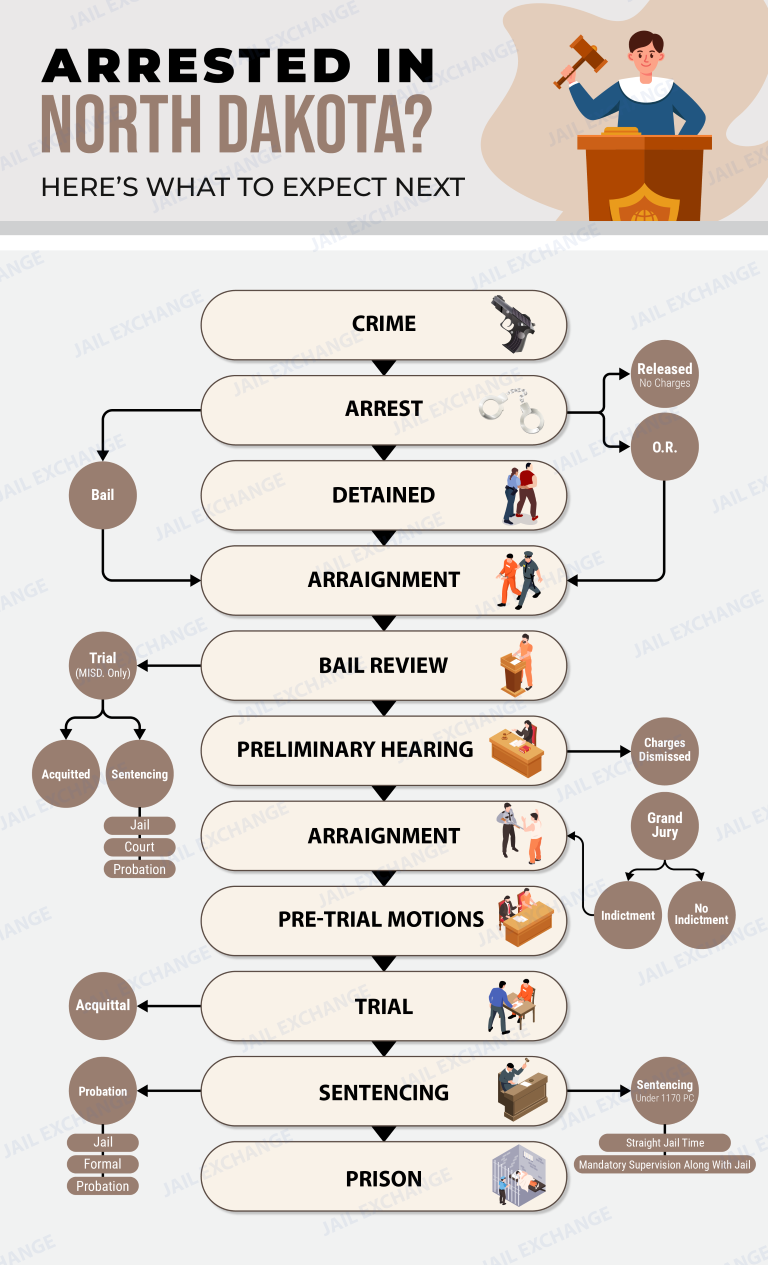
When police take someone into custody in McHenry County, staff record identity information, check warrants, collect fingerprints and photographs, and arrange a health and safety screening. A person may be released after a citation or arrest, or may be held until the next judicial decision.
For a McHenry County arrest, the charging paperwork and initial judicial order control the next hearing. The courthouse in Towner can explain its public filing and calendar procedures, but it does not operate as a jail. When someone is not released after arrest, they may be held in a jail in the county or a neighboring county’s jail, depending on the local custody arrangements. The courthouse handles the criminal case; it is not the jail.
↑ Back to the question list3. Can someone get out of jail before trial, and how does bond work?
North Dakota release decisions focus on whether the person will return to court and whether conditions can protect others. A judge may permit release on a promise to appear, set conditions, or require a financial bond. A bond amount is not a finding of guilt.
Conditions can include returning for every hearing, avoiding contact with a named person, reporting to a supervising agency, or obeying travel limits. If the bond involves money, ask for the actual written order before paying anyone; release and refunds depend on the terms set by the court.
↑ Back to the question list4. How does a misdemeanor case move through court?
A misdemeanor generally proceeds in state District Court. The accused is told the charge and rights, enters a plea, and may later have a hearing or trial; many cases resolve through a negotiated plea.
The two ordinary misdemeanor classes have different limits: a Class B misdemeanor permits no more than 30 days and $1,500, while a Class A misdemeanor permits up to 360 days and $3,000. Some crimes carry extra rules, court costs or treatment requirements. A conviction is not automatic simply because police wrote a report.
↑ Back to the question list5. What happens if the charge is a felony?
Felonies are prosecuted in North Dakota District Court, not in a separate statewide circuit court. The case may involve an initial appearance, a probable-cause step, arraignment, evidence disclosure, motions, and either plea or trial.
Sentencing starts with the statute that defines the convicted offense. North Dakota uses Classes C, B, A, and AA for felonies; prior convictions, mandatory provisions, restitution, and the judge’s orders may affect the result. A case can be resolved by dismissal, plea, or trial, and the sentence cannot be predicted just from the original arrest accusation.
↑ Back to the question list6. What changes when the accusation involves violence?
A charge involving death, serious injury, a weapon, or sexual violence may lead prosecutors to seek stricter release conditions. The case can also require forensic testing and expert witnesses, making the timetable less predictable.
Under N.D.C.C. § 12.1-32-02.1, certain qualifying felonies involving a firearm or dangerous weapon can require mandatory imprisonment, including four years for specified Class AA, A or B felonies and two years for qualifying Class C felonies. The facts and exact charges must meet the statute; the rule is not automatic for every violent accusation.
↑ Back to the question list7. What happens when someone under 18 is accused?
Juvenile cases are usually handled through North Dakota’s juvenile court system, which looks at the young person’s needs, family situation, and community safety. Possible outcomes include diversion, supervision, services, or placement under a court order.
A youth’s hearing may be confidential, and information available to the public can be narrower than in an adult case. Parents should ask counsel about detention review, school needs, appropriate services and whether a juvenile petition has actually been filed.
↑ Back to the question list8. What fines and jail or prison sentences are possible?
North Dakota Century Code § 12.1-32-01 sets the standard punishment ceilings below. These are maximum legal limits for the class, not typical sentences handed out in McHenry County. The exact offense may require a different minimum or special sentence.
| Offense class | Maximum ordinary penalty |
|---|---|
| Infraction | No ordinary jail term; fine up to $1,000. |
| Class B misdemeanor | Up to 30 days in jail, a fine up to $1,500, or both. |
| Class A misdemeanor | Up to 360 days in jail, a fine up to $3,000, or both. |
| Class C felony | Up to 5 years in prison, a fine up to $10,000, or both. |
| Class B felony | Up to 10 years in prison, a fine up to $20,000, or both. |
| Class A felony | Up to 20 years in prison, a fine up to $20,000, or both. |
| Class AA felony | Life imprisonment, with or without the possibility of parole as provided by law. |
A judge may consider probation, imprisonment, restitution, a fine, treatment, or a lawful combination of penalties. Previous convictions, weapon allegations, and special laws can change the sentencing calculation. An infraction generally means a fine rather than jail, except the statute includes special treatment for certain repeat infractions.
↑ Back to the question list9. What if the charge is a federal crime?
Federal prosecutions from McHenry County are handled by the U.S. District Court for the District of North Dakota, not by the county District Court. Federal jurisdiction can arise from federal drug trafficking, crimes involving federal property, qualifying interstate fraud, immigration offenses, and certain firearm laws. A crime is not federal merely because it is serious.
The federal district has staffed offices in Bismarck and Fargo and additional courthouses in Minot and Grand Forks. One useful staffed federal contact is the Quentin N. Burdick U.S. Courthouse, 655 1st Ave N, Suite 130, Fargo, ND 58102, telephone 701-297-7000. The particular case docket or summons—not the county alone—determines where a person must appear.
Federal courthouse directory
- Bismarck — William L. Guy Federal Building and U.S. Courthouse: 220 E Rosser Ave, Suite 476, Bismarck, ND 58501; 701-530-2300
- Fargo — Quentin N. Burdick U.S. Courthouse: 655 1st Ave N, Suite 130, Fargo, ND 58102; 701-297-7000
- Minot — Bruce M. Van Sickle U.S. Courthouse: 100 1st St SW, Minot, ND 58701; 701-530-2300 (telephone reaches staffed Bismarck or Fargo office)
- Grand Forks — Ronald N. Davies U.S. Courthouse: 102 N 4th St, Grand Forks, ND 58203; 701-297-7000 (telephone reaches staffed Bismarck or Fargo office)
A federal defendant may appear before a U.S. magistrate judge, receive a detention hearing, be formally charged by indictment or another permitted procedure, and later enter a plea or go to trial. Federal sentencing uses statutes and federal guidelines; any prison sentence is generally administered by the Federal Bureau of Prisons.
↑ Back to the question listGeneral public information about criminal courts, not individual legal advice. A defense attorney can explain the exact charges, possible punishment, court order, and available defenses.
Information for this service is currently unavailable.
Minot, Rugby or Bottineau. McHenry County sends the people it arrests to jails in those nearby counties: the Ward County Detention Center, the Heart of America Correctional & Treatment Center, or the Bottineau County Correctional Center. The McHenry County Jail listing covers them, but the money follows the rules of whichever jail has the person.
The McHenry County Sheriff's Office in Towner keeps each person's location off its public pages. Reach it at 701-537-5633, weekdays 8:00 a.m. to 4:30 p.m., and give the person's full name and date of birth.
- Bottineau: Inmate Canteen online, or the kiosk in the Bottineau County Sheriff's Office lobby at 314 5th Street West, Suite 4.
- Minot or Rugby: that jail's own online service, kiosk and mailing address. Nothing goes to the Towner address.
Bail is separate from the money for commissary and calls.
McHenry County, North Dakota, does not have a jail of its own that the state inspects. The McHenry County Sheriff's Office in Towner sends the people it arrests to jails in nearby counties under agreements, and the 2026 state inspection reports name three of them: the Ward County Detention Center in Minot, Ward County; the Heart of America Correctional & Treatment Center in Rugby, Pierce County; and the Bottineau County Correctional Center in Bottineau, Bottineau County.
Mail for someone held at the Ward County Detention Center in Minot:
Inmate's Full Name & Inmate ID#
Ward County Detention Center
P.O. Box 907
Minot, ND 58702
- Find out which jail first: Search the person's name on the statewide inmate search. If it shows Rugby or Bottineau instead of Minot, use the address on that jail's own page.
- On the envelope: The person's full booked name and their inmate ID number go above the jail's address, and your full name and return address go in the top left corner.
- The rules are the host jail's: All three jails want blue or black ink only, nothing drawn on the envelope, and no glitter, perfume or lipstick.
- Books and magazines: Have the publisher mail new copies directly to the jail where the person is held.
- Stamps: Leave stamps out of the envelope; people in these jails purchase postage from the jail store.
- Money: Use the host jail's online deposit rather than mailing cash.
The sheriff's office in Towner can tell you where a McHenry County arrest is being held: 701-537-5633.
Information for this service is currently unavailable.
Information for this service is currently unavailable.
Information for this service is currently unavailable.
McHenry County County Jails
McHenry County Juvenile Facilities
Nearby counties
- Sheriff: 701-537-5633
The McHenry County Jail serves the following cities and towns of McHenry County: Balfour, Bergen, Butte, Drake, Granville, Karlsruhe, Kramer, Kief, Lowell, Makoti, Max, Minot, Sawyer, Surrey, Velva, Voltaire, Upham and Westhope.