
Sioux County Jail
Sioux County Jail
Jail Phone Number
701-854-3481Sioux County Inmate Search and Custody Information
Identify which agency made the arrest around Fort Yates or elsewhere in Sioux County. A county case and a Standing Rock tribal case can go through different custody systems.
Call 701-854-3481 and ask for the current booking location. Give the full name and date of birth privately, and tell staff when and where the arrest happened.
Once the agency names the receiving jail, use that facility’s lookup or booking desk. Keep the Sioux County court case number separate from the booking number issued by the jail.
Read inmate search answers
 Read inmate search answers
1. Who confirms a booking after a Fort Yates area arrest?
Start with the Sioux County Sheriff contact at 701-854-3481. Ask whether a deputy still has custody, whether a transfer is underway and what jail accepted the person.
↑ Back to the question list2. Where should I look once I know the receiving jail?
If the agency confirms Mercer County Jail, call 701-745-3333. The facility is at 410 Van Slyck Avenue, Stanton, ND 58571. See the official facility information.
↑ Back to the question list3. What if the person is missing from the roster?
Ask the jail whether intake is complete and how it lists people boarded for Sioux County. Search spelling variations and check the report date if you are using a PDF. If the receiving jail cannot locate the person, ask the arresting agency to confirm the handoff.
↑ Back to the question list4. Can I find a booking photo or charges?
Photo availability and the fields shown depend on the receiving jail. Ask that facility which records it publishes. Use the official court case to check how a charge was filed or resolved.
↑ Back to the question list5. Which office handles warrant questions?
Contact the agency named on the warrant or the court handling the case. For a Sioux County matter you can ask the sheriff at 701-854-3481 where to direct the request. A booking list only reflects custody information.
↑ Back to the question list6. How do I visit, call or mail the person?
Ask the receiving jail for its rules on approved visitors, calls, messaging and mail. A Fort Yates arrest does not determine which vendor the facility uses. Wait for the jail to confirm the booking before paying for a service.
↑ Back to the question list7. Can I send funds or arrange bail?
Check the Sioux County bail guide and call the facility that holds the person. Ask whether any other hold applies, where the court accepts bond and how to identify a separate commissary deposit.
↑ Back to the question list8. Where do I look for the court date?
Search North Dakota court records using the case or defendant information. For a case filed in Sioux County, use the local court guide to find the clerk even if the jail is in another county.
↑ Back to the question list9. What should I do if the person is a minor?
Contact the arresting agency or the child’s lawyer for the actual placement. Ask the Sioux County agency how an authorized parent or guardian can obtain custody and hearing information.
↑ Back to the question list10. Can I receive a custody alert?
Use North Dakota SAVIN / VINELink to look for a matching record and register for available notices. For a time-sensitive custody change in Sioux County, confirm directly with staff.
↑ Back to the question list11. Where do I search after a transfer to prison?
Use the North Dakota DOCR resident lookup for eligible state records and the Bureau of Prisons locator for federal prison custody. If a recent federal arrest does not show up there, ask the lawyer which facility is holding the person before trial.
↑ Back to the question listSioux County bail and bond: Fort Yates court and Standing Rock cases
Sioux County sends people who must stay in custody to the jail that serves this county, a facility in another county.
Because the county includes Standing Rock Reservation land, a person may also be held by the tribe, so learn which agency made the arrest. Use Sioux County Inmate Search for county bookings.
The Sheriff's Department in Fort Yates, 701-854-3481, tells you where a county prisoner is held.
1. How do I tell whether my nephew is in custody after an arrest in Sioux County?
Use Sioux County Inmate Search first. Then ask the first question that matters: which agency arrested him. The Sioux County Sheriff's Department in Fort Yates, 701-854-3481, handles county arrests. A tribal officer's arrest is a separate matter, and the tribe's own detention center holds those cases.
2. Does Sioux County keep prisoners in Fort Yates?
Sioux County sends people who must stay in custody to a jail in another county, the jail that serves this county. The Sheriff's Department names the building for each person and arranges the transport. Ask it about visits, mail and phone rules for that jail.
3. What are the two kinds of arrests in Sioux County?
Sioux County includes Standing Rock Reservation land. The Standing Rock Law Enforcement and Adult Detention Center is the tribe's own facility. Find out which agency made the arrest and which court filed the charge before you pay anyone.
4. Where do I go for the state court file?
The Sioux County Courthouse is at 300 2nd Avenue in Fort Yates, and the Clerk of District Court answers at 701-854-3853. The clerk can tell you whether a case exists in state court, the hearing date and the amount on a filed bail order.
5. Where do I pay bail on a state charge?
The money for a state-court bail goes to the judge's order, wherever it is handed over. Call the clerk at 701-854-3853 for the case number and amount, then call the Sheriff's Department at 701-854-3481 to learn which jail holds your relative and how it takes payment. Do not send money until both calls are done.
6. How do I find out which court has the charge?
Ask the arresting agency for the case or report number, then ask the state clerk at 701-854-3853 whether a state case with that name exists. If it does not, the charge may belong to another court, and the arresting agency can say which. Pay bail only on an order you have seen, and only to the office that order names.
7. How soon does a judge see a person arrested by the county?
Rule 5 requires officers to take an arrested person before the nearest available magistrate without unnecessary delay. Administrative Rule 63 asks for every effort to have a held person before a judge within 48 hours of arrest. The magistrate explains the right to bail and sets release terms.
8. Where do I find the dollar amount?
On the court order. North Dakota has no statewide dollar chart for bail, Rule 63 contains no amounts, and Rule 46 sets no fixed figure. Ask the clerk to read the filed order to you.
9. Must the whole bond be paid?
Not always. A judge may use a promise to appear, an unsecured bond, a deposit under an appearance bond or a surety bond. Rule 46 caps a deposit at ten percent of the bond amount and requires it to be returned when conditions are met.
10. How do I check a bail agent?
Bail agents hold a license under N.D.C.C. chapter 26.1-26.6. The Insurance Department at 701-328-2440 can confirm one. A fee paid to an agent is not returned. Ask for the collateral terms and the missed-court terms in writing.
11. Can trust land or a house back a bond?
A surety describes the property and files a declaration of adequate assets, and the judge must approve it. Land held in trust may raise questions about ownership, so ask the clerk at 701-854-3853 before you collect papers.
12. Why would a person be held with no bail yet?
Rule 63 allows a jail to hold a person arrested for a Class AA through C felony, for certain domestic violence or injury misdemeanors, or on a warrant that already sets conditions, until a judge sees them. That is a pause for the hearing. Rule 46 has no list of crimes that bar bail.
13. Who is my free lawyer?
Ask for appointed counsel at the first appearance in state court. The Commission on Legal Counsel for Indigent Defense contracts with attorneys and answers at 701-845-8632. For a charge in any other court, ask that court about counsel.
14. Where is a juvenile taken?
Call the clerk at 701-854-3853 about a state juvenile case, or the arresting tribal agency about a tribal one. The Sheriff's Department at 701-854-3481 says where a youth held on a county arrest is kept. Juveniles do not appear in the adult search.
15. What if the bond is forfeited?
The court declares the bail forfeited and a warrant follows. Ninety days is the window the surety gets after the clerk's notice to pay or move to set aside the forfeiture. Get legal advice at once.
16. Who gets the cash back?
N.D.C.C. section 29-08-28 makes deposited bail the defendant's property, even when another person pays it. The judge may apply the clerk's held deposit to fines, costs or restitution when the case ends. Deposits for phone time are not bail.
Key contacts for Sioux County bond questions
- Jail
- Sioux County jail information; the Sheriff's Department names the facility holding each person
- Bond help
- Bail and bond guide for the county
- Custody lookup
- Sioux County Inmate Search
- Sheriff's Department
- PO Box L, Fort Yates, ND 58538; 701-854-3481
- Clerk of court
- Sioux County Courthouse, 300 2nd Avenue, Fort Yates, ND 58538; 701-854-3853
- Public defense
- Commission on Legal Counsel for Indigent Defense, 701-845-8632
- Bail agents
- North Dakota Insurance Department, 701-328-2440
Your facts may differ from what is described here, so confirm payment steps with the clerk or the jail. The page is general information, not legal advice.
The Sioux County Sheriff recommends that you might want to use a bail bond agent licensed to do business in Sioux County.
However if you don't want to use a bail bond agent:
- You can always pay a cash bond yourself, or use your home in Sioux County, or in some cases the state of North Dakota, but the benefit of using a bail bond agent is that they take responsibility for making sure the inmate shows up for court in Sioux County, and if they don't, then they take the financial responsibility.
- The typical fee for a bond in North Dakota is between 10-20% of the bail amount; usually 15% or less. So if an offender has a bail of $10,000.00, their bond will be $1,500.00.
- Pay by cash, cashier's check, money order or credit card at the Sioux County Jail, or the courthouse in Sioux County where the offense took place.
Call 701-854-3481 to find out the exact bond (plus other fees) amount, or look it up online by looking up the information on the Sioux County inmate locator.

Sioux County Criminal Court Guide
Sioux County criminal court guide. Relatives may hear terms such as initial appearance, bond, arraignment, or probation without anyone explaining them.
Below are explanations of jail intake, bond decisions, serious charges, juvenile cases, statutory fines, and U.S. District Court proceedings. The penalty figures are legal limits, not a prediction about any particular defendant.
Cases arising in Sioux County ordinarily go through the South Central Judicial District. The District Court hears criminal matters at the county courthouse in Fort Yates. A municipal ordinance accusation, if one applies, may be handled by a separate city court.
1. Where are the criminal courts, and how do I contact them?
Sioux County District Court and Clerk: 300 2nd Ave, Fort Yates, ND 58538. Telephone: 701-854-3853. The county belongs to the South Central Judicial District. Call the published clerk number about filing questions or a listed hearing; the clerk cannot provide legal advice.
District Courts in North Dakota hear both misdemeanors and felonies. State law does not divide these cases between a county District Court and a separate state Circuit Court. The judge handling a case can be assigned from elsewhere in the judicial district.
Some cities handle ordinance violations in municipal court. The county District Court contact above is for state criminal charges; a municipal ticket identifies the separate city court if one is involved. No unverified municipal street address or phone number has been inserted here.
↑ Back to the question list2. What happens immediately after an arrest?
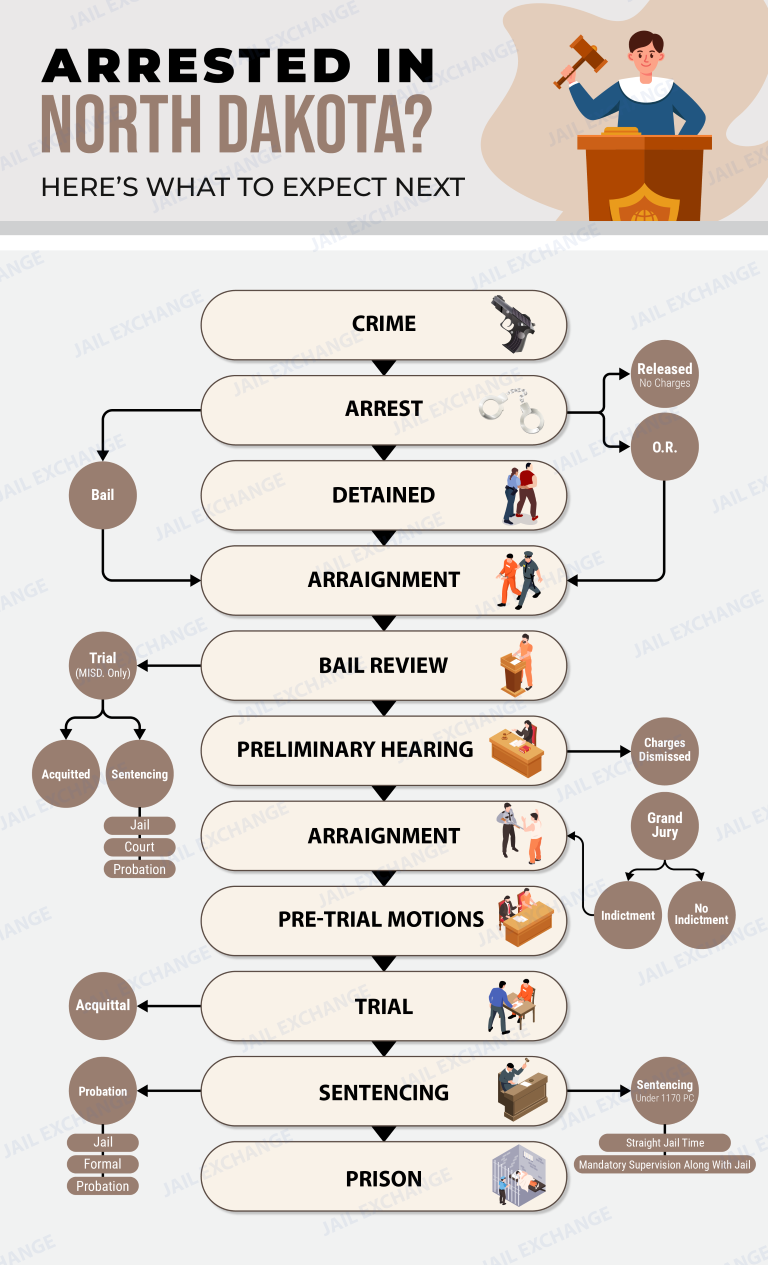
For a custodial arrest connected to Sioux County, the first hours usually involve identifying the accused, logging possessions, checking for other warrants, and arranging an appearance before a judicial officer. A family may not immediately receive a court date.
For a Sioux County arrest, the charging paperwork and initial judicial order control the next hearing. The courthouse in Fort Yates can explain its public filing and calendar procedures, but it does not operate as a jail. When someone is not released after arrest, they may be held in a jail in the county or a neighboring county’s jail, depending on the local custody arrangements. The courthouse handles the criminal case; it is not the jail.
↑ Back to the question list3. Can someone get out of jail before trial, and how does bond work?
Being arrested does not automatically mean a person must pay money to get out. Courts can use nonfinancial release conditions, but a judicial officer can also order bond or detention based on the charge and circumstances.
Conditions can include returning for every hearing, avoiding contact with a named person, reporting to a supervising agency, or obeying travel limits. If the bond involves money, ask for the actual written order before paying anyone; release and refunds depend on the terms set by the court.
↑ Back to the question list4. How does a misdemeanor case move through court?
Someone charged with a misdemeanor in Sioux County may have multiple dates: an initial appearance, a hearing to settle outstanding issues, and possibly a trial. A guilty plea ends the trial stage and moves the case to sentencing.
The two ordinary misdemeanor classes have different limits: a Class B misdemeanor permits no more than 30 days and $1,500, while a Class A misdemeanor permits up to 360 days and $3,000. Some crimes carry extra rules, court costs or treatment requirements. A conviction is not automatic simply because police wrote a report.
↑ Back to the question list5. What happens if the charge is a felony?
In a Sioux County felony matter, an early judicial proceeding determines the next steps and release conditions. More hearings may follow as both sides review reports, witness statements, and legal challenges.
Sentencing starts with the statute that defines the convicted offense. North Dakota uses Classes C, B, A, and AA for felonies; prior convictions, mandatory provisions, restitution, and the judge’s orders may affect the result. A case can be resolved by dismissal, plea, or trial, and the sentence cannot be predicted just from the original arrest accusation.
↑ Back to the question list6. What changes when the accusation involves violence?
When the accusation involves violence, evidence such as medical findings, recordings, and eyewitness accounts may become important. A defense lawyer can challenge the evidence and seek appropriate release terms.
Under N.D.C.C. § 12.1-32-02.1, certain qualifying felonies involving a firearm or dangerous weapon can require mandatory imprisonment, including four years for specified Class AA, A or B felonies and two years for qualifying Class C felonies. The facts and exact charges must meet the statute; the rule is not automatic for every violent accusation.
↑ Back to the question list7. What happens when someone under 18 is accused?
For children accused of wrongdoing in Sioux County, the juvenile court may involve parents or guardians and consider services, treatment, and supervision. Certain serious cases can raise questions about adult-court jurisdiction under state law.
A youth’s hearing may be confidential, and information available to the public can be narrower than in an adult case. Parents should ask counsel about detention review, school needs, appropriate services and whether a juvenile petition has actually been filed.
↑ Back to the question list8. What fines and jail or prison sentences are possible?
North Dakota Century Code § 12.1-32-01 sets the standard punishment ceilings below. These are maximum legal limits for the class, not typical sentences handed out in Sioux County. The exact offense may require a different minimum or special sentence.
| Offense class | Maximum ordinary penalty |
|---|---|
| Infraction | No ordinary jail term; fine up to $1,000. |
| Class B misdemeanor | Up to 30 days in jail, a fine up to $1,500, or both. |
| Class A misdemeanor | Up to 360 days in jail, a fine up to $3,000, or both. |
| Class C felony | Up to 5 years in prison, a fine up to $10,000, or both. |
| Class B felony | Up to 10 years in prison, a fine up to $20,000, or both. |
| Class A felony | Up to 20 years in prison, a fine up to $20,000, or both. |
| Class AA felony | Life imprisonment, with or without the possibility of parole as provided by law. |
A judge may consider probation, imprisonment, restitution, a fine, treatment, or a lawful combination of penalties. Previous convictions, weapon allegations, and special laws can change the sentencing calculation. An infraction generally means a fine rather than jail, except the statute includes special treatment for certain repeat infractions.
↑ Back to the question list9. What if the charge is a federal crime?
Federal prosecutions from Sioux County are handled by the U.S. District Court for the District of North Dakota, not by the county District Court. Federal jurisdiction can arise from federal drug trafficking, crimes involving federal property, qualifying interstate fraud, immigration offenses, and certain firearm laws. A crime is not federal merely because it is serious.
The federal district has staffed offices in Bismarck and Fargo and additional courthouses in Minot and Grand Forks. One useful staffed federal contact is the William L. Guy Federal Building and U.S. Courthouse, 220 E Rosser Ave, Suite 476, Bismarck, ND 58501, telephone 701-530-2300. The particular case docket or summons—not the county alone—determines where a person must appear.
Federal courthouse directory
- Bismarck — William L. Guy Federal Building and U.S. Courthouse: 220 E Rosser Ave, Suite 476, Bismarck, ND 58501; 701-530-2300
- Fargo — Quentin N. Burdick U.S. Courthouse: 655 1st Ave N, Suite 130, Fargo, ND 58102; 701-297-7000
- Minot — Bruce M. Van Sickle U.S. Courthouse: 100 1st St SW, Minot, ND 58701; 701-530-2300 (telephone reaches staffed Bismarck or Fargo office)
- Grand Forks — Ronald N. Davies U.S. Courthouse: 102 N 4th St, Grand Forks, ND 58203; 701-297-7000 (telephone reaches staffed Bismarck or Fargo office)
A federal defendant may appear before a U.S. magistrate judge, receive a detention hearing, be formally charged by indictment or another permitted procedure, and later enter a plea or go to trial. Federal sentencing uses statutes and federal guidelines; any prison sentence is generally administered by the Federal Bureau of Prisons.
↑ Back to the question listGeneral public information about criminal courts, not individual legal advice. A defense attorney can explain the exact charges, possible punishment, court order, and available defenses.
Information for this service is currently unavailable.
With no jail of its own in Sioux County, where does the money go? To Bismarck's Burleigh/Morton Detention Center, where people held for Sioux County stay. Their account is there.
- Mail it as a money order or cashier's check made payable to the person. Address: Burleigh/Morton Detention Center, PO Box 2499, Bismarck, ND 58502. Your own full name and address go in the envelope's top left corner. Keep cash and personal checks out.
- Bring cash to the self-service lobby kiosk at 4000 Apple Creek Road, Bismarck, 24 hours a day.
- Click through the detention center's deposit link, which opens Inmate Canteen.
Not certain where the person is? Try the Sioux County Sheriff's Office at 701-854-3481 or the Burleigh/Morton jail at 701-255-3113. The Burleigh County Sheriff's Department, which runs that jail, answers at 701-222-6651. Give the full name and birth date when asked.
Sioux County, whose county seat is Fort Yates, has no county jail. The state's latest inspection of the Burleigh Morton Detention Center on Apple Creek Road in Bismarck, Burleigh County, North Dakota, lists Sioux County among the places it holds people for, so letters for someone held by Sioux County go to that center's post office box in Bismarck.
Send mail for a Sioux County inmate to:
Inmate's Full Name & Inmate ID#
Burleigh/Morton Detention Center
PO Box 2499
Bismarck, ND 58502
- Look them up: Before you write, make sure the person is still in custody with the inmate search.
- By mail only: The Bismarck center says mail for inmates has to be mailed to the facility. Notes cannot be left at the front counter.
- Money orders: A money order or cashier's check can be mailed to the same post office box. Make it payable to the inmate. Another way is to put money on their account online.
- The envelope: Put your own full name and full address in the top left corner.
For questions about a Sioux County case, call the Sioux County Sheriff's Office in Fort Yates at 701-854-3481 .
Information for this service is currently unavailable.
Information for this service is currently unavailable.
Information for this service is currently unavailable.
Sioux County County Jails
Sioux County Juvenile Facilities
Nearby counties
- Sheriff: 701-854-3481
The Sioux County Jail serves the following cities and towns of Sioux County: Cannon Ball, Fort Yates, Selfridge and Solen.