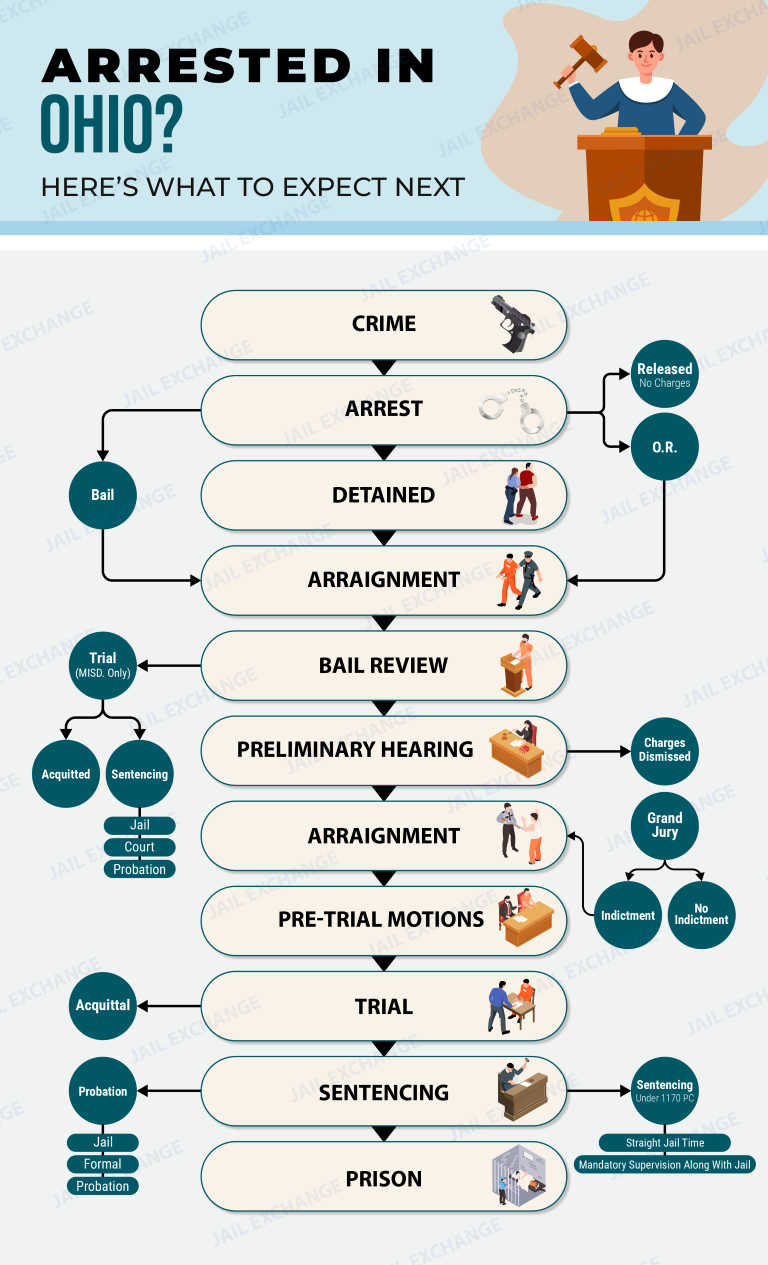
Williams County Jail Criminal Court Process
Criminal Court Process for Williams County Ohio
Williams County sits in Ohio's far northwest corner, bordering Indiana and Michigan, and Bryan is its county seat. The Bryan Municipal Court, whose territory reaches across the whole county, takes misdemeanors, OVI and traffic cases and the opening hearings of felony cases. Indicted felonies are tried in the General Division of the Williams County Court of Common Pleas at the courthouse on the Bryan square. Felony cases belong to the elected Williams County Prosecuting Attorney, and municipal-court misdemeanors are handled by the city or village prosecutor. Williams County does not keep long-term inmates in a jail of its own; adults who are held go to the regional Corrections Center of Northwest Ohio near Stryker.
- Williams County Court of Common Pleas (General and Domestic Relations Division), Williams County Courthouse, 1 Courthouse Square, Bryan, OH 43506
- Williams County Court of Common Pleas, Probate and Juvenile Division, 1 Courthouse Square, 1st Floor, Bryan, OH 43506, (419) 636-2934
- Bryan Municipal Court, 1399 East High Street, Bryan, OH 43506, (419) 636-6939
- Corrections Center of Northwest Ohio (CCNO), 3151 County Road 2425, Stryker, OH 43557, (419) 428-3800
- Court-appointed lawyers: arranged by the judge in the court that has the case; misdemeanor and first-appearance requests start at the Bryan Municipal Court, (419) 636-6939
- Williams County Prosecuting Attorney, Williams County Courthouse, 1 Courthouse Square, Bryan, OH 43506
Which court hears your case. Every misdemeanor, OVI and traffic case arising anywhere in Williams County, from Montpelier and Edgerton to Pioneer, West Unity and Edon, is filed in the Bryan Municipal Court; the county has no separate county court, and the latest statewide mayor's court list shows no mayor's court operating here. Felony arrests also start in the Bryan Municipal Court, where the first appearance, bond and any preliminary hearing take place. After the Williams County grand jury indicts, or the defendant waives indictment and accepts a bill of information, the case moves to the Common Pleas Court's General Division at the courthouse. Appeals go to Ohio's Sixth District Court of Appeals.
Where pretrial detainees are held. Williams County is one of the member counties of the Corrections Center of Northwest Ohio, a regional jail that also serves Defiance, Fulton, Henry and Lucas counties. After processing by the arresting agency, an adult who is not released goes to CCNO at 3151 County Road 2425 outside Stryker and remains there while the case is pending. CCNO's business line is (419) 428-3800 on weekdays; the Williams County Sheriff's Office in Bryan can also confirm whether someone is in custody.
- Local courts in Williams County (municipal, county and mayor's courts)
- Misdemeanor (for example, petty theft, a first OVI, assault, criminal trespass)
- Felony (for example, burglary, felony theft, drug trafficking, felonious assault)
- Violent felony (for example, murder, rape, aggravated robbery)
- Juveniles (under 18) arrested in Williams County
- Federal cases (U.S. District Court) from Williams County
Local courts in Williams County (municipal, county and mayor's courts)
One court handles every lower-level criminal and traffic matter in Williams County. That makes it easy to know where to go: whatever town the ticket came from, the hearing will be in Bryan.
Municipal court
- Bryan Municipal Court — 1399 East High Street, Bryan, OH 43506, (419) 636-6939. Countywide territory: the city of Bryan, the villages of Alvordton, Blakeslee, Edgerton, Edon, Holiday City, Montpelier, Pioneer, Stryker and West Unity, and all twelve townships.
County court
Williams County has no county court, because the Bryan Municipal Court's jurisdiction already reaches every part of the county.
Mayor's courts
None appear on the state's most recent list for Williams County. Village police in places such as Montpelier or Edgerton send their citations to the Bryan Municipal Court.
The municipal court's clerk can tell a defendant the next date, whether a warrant has been issued, and how to pay a waivable ticket.
Misdemeanor (for example, petty theft, a first OVI, assault, criminal trespass)
For a misdemeanor, a Williams County officer has two choices: issue a summons or citation and let the person go, or make a custodial arrest. Shoplifting at a Bryan retailer, an underage alcohol charge or a trespass complaint typically produces a citation. An OVI arrest, a domestic-violence charge, an assault with injuries or an outstanding warrant usually means a trip to CCNO.
Getting out and getting to court
Many misdemeanor bonds are preset on the Bryan Municipal Court's schedule, so a relative may be able to post bond shortly after booking. If bond is not on the schedule, the defendant waits for the next session of the municipal court, which is often conducted by video from the jail. The judge may release the person on their own recognizance or set a 10 percent, cash or surety bond; commercial bail bond companies operate in Ohio. Under the bail amendment Ohio voters approved in 2022, the judge looks at public safety, prior convictions, how serious the charge is and whether the person is likely to come back to court when choosing an amount.
Arraignment is the first formal court date. The defendant hears the charge, learns the maximum penalty and enters a plea. Pleading not guilty sets up a pretrial meeting between defense counsel and the prosecutor, and a large share of Williams County cases are resolved there through a reduced charge or an agreed sentence.
What the law allows
- M1 (first-degree): as much as 180 days and $1,000. Petty theft under $1,000 and assault both fall here.
- M2: as much as 90 days and $750.
- M3: as much as 60 days and $500.
- M4: as much as 30 days and $250; criminal trespass is normally an M4, and aggravated trespass is an M1.
- Minor misdemeanor: a fine only, no more than $150.
First-offense OVI
A first OVI conviction is an M1. The court must impose either three straight days in jail or a 72-hour driver intervention program, and six days applies for a breath, blood or urine result of .17 or above, or for some refusal situations. Fines run from $375 to $1,075. Expect an administrative license suspension at the time of a failed or refused test, followed by a court suspension of one to three years after conviction. Limited driving privileges for work, school or treatment are common, and an ignition interlock can sometimes earn unlimited privileges.
Counsel, deadlines and results
The Bryan Municipal Court appoints counsel for defendants who cannot afford a lawyer and face possible jail. The defendant completes a financial disclosure form, and a modest application fee may apply. A demand for a jury trial must be made in writing; a misdemeanor jury in Ohio has eight people and must be unanimous. The speedy-trial statute sets 90 days for M1 and M2 cases and 45 days for M3 and M4 cases, measured from arrest or summons, unless the defense waives time or asks for delays.
Possible results include dismissal, a diversion agreement, intervention in lieu of conviction, a fine, community control with probation conditions, or a jail sentence that may be served at CCNO. Expect one to four months from citation to resolution in most cases, and ask later about sealing the record if you are eligible.
Felony (for example, burglary, felony theft, drug trafficking, felonious assault)
Williams County felony cases often grow out of investigations by the Sheriff's Office, the Bryan and Montpelier police departments, or multi-agency drug task forces working along the Ohio Turnpike corridor. A person arrested on a felony complaint is held at CCNO and brought before the Bryan Municipal Court for an initial appearance, usually within a day.
The steps
First appearance. The municipal judge explains the felony complaint, decides bond and conditions such as no-contact orders or drug testing, and appoints counsel if the defendant qualifies. The municipal court cannot accept a plea to a felony.
Preliminary hearing. Ohio's criminal rules require this probable-cause hearing within 10 consecutive days if the defendant is jailed, or 15 days if released, unless it is waived or an indictment is returned first. In practice, many Williams County felony cases go straight to the grand jury.
Indictment. The Prosecuting Attorney presents evidence to the grand jury in Bryan. A defendant who wants to resolve the case quickly can instead waive indictment and plead to a bill of information.
Common Pleas arraignment and pretrials. After indictment, the defendant is arraigned in the Common Pleas Court, the prosecution provides discovery, and the court schedules pretrial conferences. Plea negotiations settle most cases.
Trial and sentencing. A defendant who goes to trial faces a jury of 12 that must agree unanimously, or may waive a jury in writing. In Bryan, the judge generally reads a presentence investigation report before deciding the sentence.
Under Ohio's speedy-trial law, the state has 270 days from arrest to bring a felony to trial, and each day spent in jail solely on that case is counted three times. Continuances requested by the defense toll the time.
Prison ranges by degree
- F5: 6 to 12 months, with community control presumed for many first-time nonviolent offenders. Stealing property worth $1,000 to $7,500 is charged at this level.
- F4: 6 to 18 months; theft of $7,500 to $150,000 lands here.
- F3: 9 to 36 months, or 12 to 60 months for designated offenses; a burglary of an unoccupied structure is typically an F3.
- F2: 2 to 8 years as the minimum term. Felonious assault and the burglary of an occupied home with someone likely present are F2s.
- F1: 3 to 11 years as the minimum term.
F1 and F2 sentences for crimes committed since March 22, 2019 are indefinite under the Reagan Tokes Law, with a maximum of up to 50 percent beyond the minimum the judge selects. Drug trafficking ranges from F5 to F1 depending on the drug and quantity, and a firearm specification tacks on mandatory prison time. Treatment-based intervention in lieu of conviction can be an option when addiction contributed to the offense.
Lawyers and time
Defendants in Common Pleas who cannot afford counsel have a lawyer appointed by the court; ask at the first appearance or through the Bryan Municipal Court at (419) 636-6939. A typical felony case runs four to twelve months.
Violent felony (for example, murder, rape, aggravated robbery)
Homicides, rapes and armed robberies are handled with the same court sequence as other felonies in Williams County, but the stakes and the time involved are far greater. The Prosecuting Attorney's office typically takes such cases to the grand jury quickly, and the Ohio Bureau of Criminal Investigation often assists local detectives with forensic work.
Detention before trial
Bonds in violent cases are usually very high, and the court must account for public safety, the defendant's history and the gravity of the charge. For certain serious offenses, the prosecution can request a hearing to hold the defendant without bail. Defendants who remain in custody stay at CCNO and are transported to Bryan for hearings.
Sentences Ohio law sets
- Aggravated murder carries one of three outcomes: a death sentence, life with no possibility of parole, or life with parole eligibility set at 20, 25 or 30 years. No Ohio execution has taken place since 2018.
- Murder carries 15 years to life.
- Rape is an F1 with a Reagan Tokes indefinite sentence, and life imprisonment is possible when the victim was younger than 13 and the case involves force or other listed circumstances.
- Aggravated robbery is an F1; adding a gun specification makes extra prison time mandatory.
Victims and timing
Victims and their families have rights under Marsy's Law, Ohio's 2017 constitutional amendment, including notice of hearings, the right to attend and the right to speak at bond, plea and sentencing. Violent felony cases in Williams County commonly take a year or more, and two years is not unusual when expert testimony or extensive discovery is involved.
Juveniles (under 18) arrested in Williams County
Juvenile delinquency cases in Williams County go to the Probate and Juvenile Division of the Court of Common Pleas, on the first floor of the courthouse at 1 Courthouse Square in Bryan, (419) 636-2934. The Williams County Prosecuting Attorney files the complaints, and the court's intake staff review each referral from police and schools.
Unofficial handling
A first-time or minor offense can often be handled unofficially or through diversion. The youth may be asked to complete community service, pay restitution, attend counseling or follow a curfew, and the matter ends without an adjudication if the youth complies. Repeat or serious charges are filed formally.
Where youths are detained
Williams County shares a secure juvenile facility with Defiance, Fulton and Henry counties: the Northwest Ohio Juvenile Detention, Training and Rehabilitation District, located east of Stryker. A youth who cannot safely be released to a parent is held there, and a detention hearing must take place promptly, generally within 72 hours or by the next court day, to decide whether detention continues.
Dispositions
After an adjudication, the court can order probation, community service, treatment, electronic monitoring, a residential program, or for felony-level conduct, commitment to the Ohio Department of Youth Services. DYS commitments are typically indefinite and may extend to age 21.
Transfer to adult court
Some 16- and 17-year-olds charged with the gravest offenses, and in narrower situations 14- and 15-year-olds, must be bound over to the adult Common Pleas Court. For other youths 14 and up, the prosecutor can seek a discretionary bindover, which requires an amenability hearing. Ohio also allows Serious Youthful Offender cases, which pair a juvenile disposition with a stayed adult sentence that can be imposed if the youth fails in the juvenile system.
Juvenile court records are generally kept confidential, and sealing or expungement is available for many cases once they close.
Federal cases (U.S. District Court) from Williams County
Which federal court
Federal charges from Williams County are handled by the U.S. District Court for the Northern District of Ohio, Western Division, and are usually heard at the James M. Ashley and Thomas W.L. Ashley U.S. Courthouse in Toledo, 1716 Spielbusch Avenue, Toledo, OH 43604, (419) 213-5500. With the Indiana and Michigan lines and the Ohio Turnpike running through the county, drug and firearm investigations here sometimes cross state lines, which is one reason a case may be charged federally. Other common federal cases include child exploitation, fraud, illegal reentry and bank robbery. A case becomes federal when a federal agency is involved and the U.S. Attorney's Office chooses to prosecute.
Federal offices
- U.S. Attorney, Northern District of Ohio: headquartered at 801 West Superior Avenue, Suite 400, Cleveland, OH 44113, (216) 622-3600, with a branch office in Toledo.
- Federal Public Defender: the Northern District's defender has a Toledo office, and the court also appoints private panel lawyers under the Criminal Justice Act.
- U.S. Marshals, Toledo office: 1716 Spielbusch Avenue, Suite 313A, Toledo, OH 43604, (419) 376-3094.
How it unfolds
- A U.S. magistrate judge in Toledo conducts the initial appearance and appoints counsel when needed.
- If prosecutors seek detention, a hearing is generally held within three court days. The Bail Reform Act lets the judge release the defendant under conditions supervised by U.S. Pretrial Services, or order detention if no conditions will assure appearance and safety.
- A defendant charged by complaint must be indicted within 30 days.
- The Speedy Trial Act sets a 70-day trial clock after indictment, subject to many exclusions.
- Most cases end with a guilty plea; a trial jury of 12 must be unanimous.
- Before sentencing in Toledo, a U.S. Probation officer writes a presentence report; the judge weighs the advisory Sentencing Guidelines but cannot go below a mandatory minimum.
- Sentences are served in the Bureau of Prisons without parole, at about 85 percent with good-conduct time, followed by supervised release.
- Any appeal from the Toledo courthouse goes to the Sixth Circuit in Cincinnati.
Detention
The Marshals Service decides where federal pretrial detainees are housed, using contract jails. CCNO in Stryker, the same regional jail Williams County uses, shares operating costs with the Marshals Service under contract, so some federal detainees from the area are held there. Williams County relatives can search the Federal Bureau of Prisons inmate locator for a detainee from Bryan using a name or register number. Williams County prisoners still awaiting trial in a Marshals-contract jail may turn up on its posted roster. Federal prosecutions of juveniles are rare.
The information on this Williams County page explains the general court process and does not replace advice from a lawyer who knows your case. Court rules, locations and phone numbers can change, so check with the Bryan Municipal Court at (419) 636-6939 before a hearing, and ask the judge at your first appearance for appointed counsel if you cannot afford an attorney.