
Bennett County Sheriff's Office
Bennett County Sheriff's Office
Bennett County Sheriff's Office
605-685-6515How do you find someone who is in jail in Bennett County?
The Bennett County Sheriff's Office currently contracts jail services through the City of Winner, South Dakota.
Search for information about an inmate in the Bennett County Sheriff's Office and view their jail mugshot:
- Review the Jail Roster, or
- Call the Bennett County Sheriff's Office at 605-685-6515
- Look up the offender's criminal charges
- Find out their bond, and
- View their public mugshot in the roster.
If you cannot find the mugshot of the offender that has been arrested, it is because Bennett County or the state of South Dakota has recently changed their policy regarding publicly posting them in the jail roster. However, you can write the jail at the following address and request a copy of an inmate's mugshot be mailed or sent by email to you. Make sure to include your email address in all correspondence.
Mail to:
Bennett County Sheriff's Office
201 State Street
Martin, SD 57551
Attention: Media Relations - Inmate Mugshot Request
Mail, click on the link below, or call the facility at 605-685-6515 for the information you are looking for.
Bennett County Sheriff's Office Inmate Search
How do I find out if someone was arrested in Bennett County?
There are five ways to find out if someone was arrested in Bennett County:
1. Look them up on the official jail inmate roster.
2. Look them up on vinelink.com, a national inmate tracking resource.
3. Call the jail at 605-685-6515. This is available 24 hours a day.
4. Write or visit the jail and request information.
You can reach them at:
Bennett County Sheriff's Office
201 State Street
Martin, SD 57551
5. Do a search online using this person’s name, the town or city you think they were arrested in, and the crime you think they were arrested for. Sometimes the local newspaper, police department or sheriff’s office will have a daily police blotter published on their website.
What information is included in jail booking records and the jail roster?
Jail booking records, also known as the jail roster, typically include the following information:
• Full name of the inmate
• Inmate's physical characteristics (age, sex, height, weight, etc.)
• Inmate’s mugshot(s)
• Booking number, Inmate ID#, Jacket #, etc.
• Booking date and time
• Charges or offense details – the applicable statute
• Bond or bail amount, if applicable
• Court date, if set, plus the court name and location
• Previous arrests in this jurisdiction, conviction details, and sentence
- Note that not all this information will be included. Most booking records and jail inmate rosters contain only the basic information such as name, date of arrest and the criminal charge.
- The amount and quality of the information depends on the state’s laws and the jail’s policies.
How often are jail booking records and rosters updated?
Most jails update their records at least once per day. Some booking information is updated as often as every 15 minutes in the roster. From the time a person is first arrested until when they are booked in the jail, it can be as short as a couple of hours, up to 24 hours, or even longer if they were arrested during a major event such as a protest or riot in which hundreds of people were arrested at the same time.
How do I find an inmate in the Bennett County Sheriff's Office?
There are seven ways to find an inmate in Bennett County or the Bennett County Sheriff's Office:
1. Look them up on the official jail inmate roster.
2. Look them up on vinelink.com, a national inmate tracking resource.
3. Call the jail at 605-685-6515. This is available 24 hours a day.
4. Call local police departments in Bennett County. Sometimes the local jails will hold recent arrestees for up to 72 hours before transporting them the Bennett County Sheriff's Office.
5. Check with the jails in neighboring counties and look up their rosters. It is always possible they were arrested there instead of Bennett County.
6. Write or visit the jail and request information.
Bennett County Sheriff's Office
201 State Street
Martin, SD 57551
7. Do a search online using this person’s name, the town or city you think they were arrested in, and the crime you think they were arrested for. Sometimes the local newspaper, police department or sheriff’s office will have a daily police blotter published on their website as well.
How do I find an inmate in a South Dakota state prison?
You can find an inmate in the South Dakota Department of Corrections by searching for them on the State Prison Locator, Vinelink.com (a nationwide inmate locator resource), or by calling the Department of Corrections.
How do I find an inmate in federal prison?
- The United States Bureau of Prisons maintains an up-to-date inmate locator where you can look up any inmate that has been in federal prison from 1982 to the present day.
- If they are currently in custody, you can see what institution they are in.
- If they are in transport, meaning they are being shuttled from one prison to another, that information will not be available. If they are no longer in custody, it will list their discharge date.
- Other information provided is their BOP Registry Number (inmate ID#), their race, age and release date.
- If they are in custody, there are links to how to visit them, send them money, communicating with them and sending the prison a concern you may have about them.
How do I find a detainee in an ICE facility?
- The US Immigration and Custom’s Enforcement maintains an up-to-date online detainee locator of all foreign detainees aged 18 and older that are in the custody of ICE.
- When searching by name, a detainee's first and last names are required and must be an exact match. When inputting a hyphenated last name into the Online Detainee Locator System, include the hyphen for the locator to find the individual (e.g., Doe-Smith).
- You can also search by using an A-number (Alien Registration Number) if you have it at the same link. The A-Number must be exactly nine digits long. If the A-Number has fewer than nine digits, add zeros at the beginning.
- You are also required to select the detainee's correct Country of Birth from the drop-down menu provided on the page.
NOTE: If an alien is arrested for a state crime, you will still be able to locate them in the police jail or the county jail where they were arrested. If it was a misdemeanor crime, they would do their time in the Bennett County Sheriff's Office or the county jail where they were arrested and convicted.
If they were convicted of a South Dakota state felony and sent to state prison, and not deported, then you can locate them in the South Dakota state prison system.
How do I find an inmate in juvenile detention?
In the United States, a juvenile is a person under the age of 18. If a juvenile is arrested for a crime, it is unlikely that their name will be publicly listed on an inmate search page or detention center roster, or will be released to the public. Only the juvenile’s parents or legal guardians will be given that information.
If the crime is a serious felony such as Capital Murder, some states will release their name to the public, either when they are first arrested or after they are convicted. However, in general, it is unlikely that an inmate who is a juvenile will have their name released in any public way.
How can I see if someone is in jail or prison in Bennett County or the state of South Dakota?
For online searches, if you want to see if someone is in jail in Bennett County.
If you want a list of all the other county jail inmate searches in South Dakota.
If you want a list of all the county jails in the United States.
If you want to look up an inmate in any of the South Dakota state prisons. To look up the prisons in South Dakota.
How do I get information on someone in jail in Bennett County?
If you want detailed information on a particular inmate in in jail in Bennett County, and you can’t find it online in the jail inmate roster, your only other option is to either call the jail at 605-685-6515, go to the jail in person and ask, or write them at:
Bennett County Sheriff's Office
201 State Street
Martin, SD 57551
That said, most jails will limit the amount of information that they give to the public about an inmate in their roster because the offender is considered innocent until proven guilty, and thus is afforded a certain amount of privacy.
Once an offender is convicted, you are far more likely to find out information about them.
If you are good at using Google, you can dig into a person’s past and learn as much information about anyone as someone in the media can.
You can also search a website that has all the public records about people. One of the best online websites we found will cost you only $1.00.
Who can I call to find an inmate in Bennett County?
To find an inmate in custody or ask about their roster in Bennett County call 605-685-6515 24 hours a day.
Does the jail or prison have to keep the inmate in the county or state where they are charged or convicted?
No. Even though 99.9% of all pre-trial and convicted inmates are kept in the state where they were arrested and/or convicted, they can be kept in any US jail or prison that will have them. This is seen in circumstances where a jurisdiction is overcrowded, or an inmate is moved for their safety. That said, a person must stand trial where they were arrested unless the presiding judge or prosecuting attorney agrees to move the offender’s trial to a different jurisdiction if it is likely they will not get a fair trial.
What if I can’t find an inmate and I know they are in custody in Bennett County?
If you know an inmate is in custody in Bennett County, and you can’t find them, it can mean one of several things:
1. Either you or the jail has the spelling of the inmate’s name inputted incorrectly.
2. The jail has not yet updated their booking information or roster.
3. The inmate has already been released.
4. The inmate has either been arrested or is being housed in another jail.
5. The inmate is underage; therefore, it is illegal to post their information, or the inmate you are trying to find had their age incorrectly listed as someone under age 18.
I know the person was arrested and in jail, but my search in the roster comes back as “no record found.” What happened?
Same answer as that above. If you know an inmate is in custody in Bennett County, but your search comes back in the roster as “no record found.”, it can mean one of several things:
1. Either you or the jail has the spelling of the inmate’s name wrong.
2. The jail has not yet updated their booking information or roster.
3. The inmate has already been released.
4. The inmate has either been arrested or is being housed in another jail.
5. The inmate is underage; therefore it is illegal to post their information, or the inmate you are trying to find had their age incorrectly listed as someone under age 18.
I was released from jail in Bennett County, but my record still shows. When will it go away?
If your record of arrest and booking is still showing online, even though you were released, it is because some jails allow that information to remain public indefinitely. Unfortunately, even though the charges against you may have been dropped, many jails will not erase that information from their public records voluntarily.
In a situation like this your only option will be to get an attorney and request they petition the court to force the jail to remove this information. That said, if you were in fact found guilty of the crime you were arrested for, it is unlikely they will remove the information surrounding your arrest and conviction.
An inmate’s family member just died; how can I let them know right away?
The death of a family member is one of the few times, if not the only time, that a jail will take a message for an inmate. Because of the sensitivity of the tragic news, when a family member has died, the news will be transmitted by a member of the clergy, a counselor or someone who is very high ranking within the jail.
Jail management understands that a sudden death of a loved one could cause a violent emotional response that jeopardizes the safety of staff or other inmates.
An inmate’s family member just died; will they be allowed to attend the funeral?
The death of a family member is one of the few times, if not the only time, that a jail will allow an inmate, whether it pre-trial or post-conviction, to be allowed outside of the jail. Even if they are allowed outside the jail, they will have to have at least two armed escorts. An inmate attending a funeral is an extraordinary cost, use of staff and potential danger to the public. That is why it is rarely allowed.
This is not always the case though, and whether an inmate can attend a funeral depends on the inmate’s security classification, whether the jail has the staff to handle it, official jail policy, whether or not the inmate has an attorney that can push the right people, including the judge overseeing the inmate’s case, etc.
What determines whether an inmate is placed in low or high security facilities?
An inmate’s security classification depends on the following:
1. The inmate’s current crime.
2. The inmate previous crimes.
3. The inmate’s history for violence within the walls of the facility.
4. The inmate’s gang affiliation.
5. The jail's current distribution of inmates.
What information is available about an inmate?
The information that a jail or court releases publicly about an inmate depends on the laws in the state, the policy of the jail, and the sheriff’s or warden’s individual decision.
Jail booking records and rosters can include more or less, the following information:
• Full name of the inmate
• Inmate's physical characteristics (age, sex, height, weight, etc.)
• Inmate’s mugshot(s)
• Booking number, Inmate ID#, Jacket #, etc.
• Booking date and time
• Charges or offense details – the applicable statute
• Bond or bail amount, if applicable
• Court date, if set, plus the court name and location
• Previous arrests in this jurisdiction, conviction details, and sentence
What is vinelink.com?
Vinelink, which you will see referenced when discussing public information about offenders and inmates, is a national public roster that both allows the public to look up and see the person’s status, plus be able to track their movements, whether it involves being transferred from one facility to another or being released from custody.
The tracking feature is especially helpful for those who are victims of, or witnesses to, a crime and fear that the release of an offender may be dangerous to them or someone close to them.
Anyone can register with Vine to receive automated notifications via email, text or phone. It is available in 48 states and 2,900 jails and prisons.
Here is a short video explaining why it started and how it works.
How do I find old Bennett County jail and inmate records from years ago?
To find jail records that go back many years really depends on how far you want to go back, however you would need to send a written request to the county sheriff as follows:
Bennett County Sheriff
Att: Jail Records
201 State Street
Martin, SD 57551
Let them know the inmate’s name, any aliases, date of birth, the date range that the inmate may have been incarcerated, the crime they were charged with/convicted of, and any other helpful information you can think of.
How can I have my jail record sealed?
To have your jail records sealed, you will have to have the crime you were convicted of expunged. You should know up front that not all crimes are eligible for expungement.
1. Hire a lawyer that specializes in expungement.
2. If your crime is eligible, they will contact the District Attorney's office in the judicial district where you were charged or convicted.
3. They will file a petition with the court where you were charged or convicted.
4. The entire process may take 1-2 years.
Where can I get Prison records from the state of South Dakota?
To get prison records from the state of South Dakota, you will need to send a written request to the state prison system in South Dakota.
Let them know the inmate’s name, any aliases, date of birth, the date range that the inmate may have been incarcerated, the crime they were charged with/convicted of, the name of the facility you believe they were incarcerated in, plus any other helpful information you can think of.
For inmate services and facility information such as:
- Directions
- Booking Process
- Visiting an Inmate
- Sending Money
- Mailing
- Emailing or Texting
- Receiving phone calls
- Bail Bond Information
- Court Information
Click the links above, or the button below.
Bennett County Bail and Release
Anyone jailed after a Bennett County arrest ends up at the Winner City Jail, 217 E 3rd St., Winner, SD 57580, a lockup run by the City of Winner over in Tripp County. Bennett has no jail of its own, so its Sheriff's Office in Martin pays Winner for beds while the court case stays home. Below: who sets bond, sample amounts, paying it, and snags that can follow.
Step one is checking that your loved one is still inside, with the official inmate lookup. Next comes our Jail Roster page, which digs into the arrest from every side. It covers a fresh booking, who is in custody now, the charges, any open warrant and booking photos. It also explains a court-picked lawyer and the property bag handed back at release.
Ring the Winner jail at 605-842-3328 right away. Spell out the name, add a birth date, and get answers to three questions: the bond figure, whether the case is waiting on a judge, and where the money goes. Once a hearing is set, our court page picks up the story in Martin.
1. Who names the bond amount after a Bennett County arrest?
A judge sets it, or sometimes a clerk magistrate does. Bennett sits in the Sixth Judicial Circuit, and both its magistrate court and circuit court run through one Clerk of Courts office, 202 Main, Martin, SD 57551, 605-685-6969.
Under SDCL 23A-4-1, an officer brings the person to a nearby magistrate, and the law's words are "without unnecessary delay." That can happen in a courtroom or by video. Nobody has to plead yet. The magistrate covers the charge, a lawyer, silence and release terms (SDCL 23A-4-3).
For lots of charges, the clerk can fix an amount on the spot from the circuit's printed schedule (SDCL 16-12C-10). Sixth Circuit judges who hold a bond hearing must write down why a bare promise to come back does or doesn't do the job.
↑ Back to the question list2. Which release options can a South Dakota magistrate pick?
South Dakota builds release like a ladder. The bottom rung comes first, and the judge only steps up when a lower rung won't get the person to court (SDCL 23A-43-2, 23A-43-3):
- Personal recognizance (PR). The person signs and promises to return, with zero dollars paid. An unsecured bond is a cousin of PR: the money is owed only after a skipped hearing.
- A watcher. Some trusted adult or agency vouches for the person.
- Fences. Limits on travel, company or address, and maybe mental health terms.
- A small deposit. Cash up to a tenth of the full amount, refunded when all terms are kept.
- Surety or the whole sum in cash. Either a licensed bail agent guarantees the full amount, or relatives put up all of it.
- Anything else needed, sobriety checks included.
Four factors guide the judge (SDCL 23A-43-4). Those are the offense, the weight of the proof, any psychiatric findings, and whether release would invite flight or endanger someone.
↑ Back to the question list3. What does bond cost on common Bennett County charges?
Bennett's circuit works from the 2027 bond schedule the Sixth Circuit adopted, live since July 1, 2026. Sample ranges a clerk may pick from:
- DUI, first offense: $225 to $1,000
- Most remaining Class 1 misdemeanors: $95 to $1,000
- Marijuana, two ounces or under: PR, no cash
- DUI, third time or more (a felony): $1,000 to $5,000
- Burglary, grand theft: $1,000 to $10,000
- Robbery, rape: $1,000 to $25,000
- Kidnapping, murder or first-degree manslaughter: the case goes straight to a judge
- Domestic abuse: bond is a judge's call alone
If a Class 2 misdemeanor isn't on the ticket table, a judge sets bond for it too. Your person's real figure comes from the Clerk of Courts, 605-685-6969, during weekday hours.
↑ Back to the question list4. Does a domestic abuse arrest change the bond rules?
Yes. In these cases no deputy may simply release someone off the schedule. A magistrate or circuit judge gets notified and then rules on bond and conditions (SDCL 25-10-40). Typical conditions: stay out of the shared home, keep away from the alleged victim, skip alcohol and drugs, go to counseling (SDCL 25-10-41).
A strict silence applies until the first hearing. Until then, the person in Winner may not reach the alleged victim, nor any member of that home, and that covers calls, texts, letters and messages relayed through a cousin. Breaking it is a fresh Class 1 misdemeanor (SDCL 25-10-43). Families help most by refusing to play messenger. The Sheriff's Office answers questions at 605-685-6515.
↑ Back to the question list5. When does a judge order 24/7 breath tests?
After a DUI or another alcohol or drug arrest, a judge may make 24/7 Sobriety Program testing (SDCL 1-11-20) part of the release terms. Bennett runs its testing out of the Sheriff's Office, 201 State Street, Martin, SD 57551. Go to the north entrance, which serves only prisoners and program members.
- Breath (PBT): every morning 7:00 to 9:00 a.m., and every evening 7:00 to 9:00 p.m.
- Urine (UA): Mondays, Wednesdays and Fridays, 7:00 to 10:00 a.m.
- Cost: $1.00 per PBT, $10.00 per UA, and a $30.00 state fee owed within 30 days of starting.
Program rules: zero alcohol, no stepping inside a bar or any business selling liquor, no marijuana or street drugs, and pills only with a valid prescription. Hold off on mouthwash, toothpaste, cough syrup and tobacco for 15 minutes before blowing. Fail or miss a test and an arrest may follow, with no bond until a hearing. Questions: 605-685-6515.
↑ Back to the question list6. Where does a family hand over bond for a Winner prisoner?
The Winner City Jail's mailing address is 217 E 3rd St., Winner, SD 57580. Families in Martin should phone before heading over. A short plan:
- Dial 605-842-3328. Name the prisoner and supply their date of birth.
- Get the bond figure, plus the charge or charges it goes with.
- Ask whether Winner's front desk takes the money or whether it must go to the Clerk of Courts in Martin.
- Ask what kinds of money work at the counter, and what payee to write on a check.
- Check whether a judge must sign off first, which is normal in domestic cases.
- Carry ID that has your photo. Don't leave without a written receipt.
If the person walks out, line up a ride back from Winner.
↑ Back to the question list7. What does the Martin Clerk of Courts do with bond money?
This office holds the court's files and its money. The Sixth Circuit's written bond policy says cash bonds stay with the clerk until a judge signs a release. Find it at 202 Main, Martin, SD 57551, 605-685-6969. Doors are open 8:00 a.m. to noon and 12:30 to 4:30 p.m., Monday to Friday, Mountain time.
Clerk magistrates may also set bond under the schedule and take guilty pleas on small charges (SDCL 16-12C-10, 16-12C-11). Before driving in, ask three things: can bond be posted at this window, what payment works, and how quickly word reaches the Winner jail.
↑ Back to the question list8. What forms of payment work for Bennett bonds?
Payment rules can shift, so check with the jail at 605-842-3328 or the clerk at 605-685-6969 before you set out. If you pay cash in person, get a receipt. Don't drop cash in the mail.
South Dakota's court payment site, UJS ePayments, lets you pay restitution, court costs or fines with a card. Bail is a separate matter. One bonus: a case lookup there flags any active warrant. The site's smallest payment is $25 unless the balance is lower.
↑ Back to the question list9. What does a bail agent promise, and who licenses them?
For a fee, a bondsperson guarantees the full bond, which comes due if the defendant skips court. Pierre's Division of Insurance licenses every one of them (SDCL 58-22): 124 South Euclid Avenue, 2nd Floor, Pierre, SD 57501, 605-773-3563. That office checks licenses and takes complaints.
- Unlicensed bonding can bring a Class 6 felony charge (SDCL 58-22-4).
- Jailers, deputies and police officers are barred from any profit tied to a bail bond (SDCL 58-22-3).
- Drumming up business in a cellblock is off limits to agents (SDCL 58-22-32).
- Have the agent write down the fee, any collateral and its return. Every payment or item you give the agent should come with a written receipt.
- A cousin or parent who signs as a personal surety gives a sworn property statement, and the judge decides whether it covers the bond (SDCL 23A-43-20). Practicing attorneys are barred from this role.
South Dakota's courts publish an official bail bond agent roster. Before signing with any agent on a Martin case, check what state law lets a bondsman charge and hold as collateral.
↑ Back to the question list10. Can a hold keep them in Winner after bond is paid?
Yes. One bond pays for one case only. Ask the Winner jail at 605-842-3328 for a full list of holds first. Watch for these:
- An outside warrant from another county, or from out of state.
- Tribal charges. Oglala Sioux Tribe court handles its own release. Its court office is in Pine Ridge, SD 57770, 605-867-5151.
- Probation trouble. A probation officer may have a say. Bennett's Court Services office: 200 E 3rd St, Winner, SD 57580, 605-842-3551.
- Judge-only cases. Domestic abuse charges and 24/7 violations often wait for a judge.
- An ICE or federal hold. No state bond touches it.
11. Can a Sixth Circuit judge deny bail completely?
Yes, but rarely. South Dakota's Constitution gives a right to bail on every charge except a capital one, and even then only when guilt looks very clear (S.D. Const. art. VI, § 8). Otherwise the judge has to offer some path out, though that path may cost money or carry tight terms (SDCL 23A-43-3).
Freedom can be lost afterward. Each release order warns that breaking a term brings a warrant (SDCL 23A-43-6), and a failed 24/7 test can mean jail without bond until a hearing.
The State's Attorney speaks for the state on bond, from an office at 501 2nd Avenue, Martin, SD 57551, 605-685-6986, open weekdays 8:00 a.m. to 4:30 p.m.
↑ Back to the question list12. Can the family ask the court in Martin to cut the bond?
Yes. If the terms keep someone behind bars for 24 hours past the release hearing, SDCL 23A-43-8 lets them ask for review. Judges can rework terms whenever they choose (SDCL 23A-43-7), and a circuit judge can redo terms a magistrate set (SDCL 23A-43-14).
- The defense lawyer files the motion.
- Bring paper proof: pay stubs, a lease, relatives close by, and the most the family can truly pay.
- Suggest terms that answer the judge's fears, like twice-a-day breath tests in Martin.
To learn how such a hearing lands on the docket, phone 605-685-6969.
↑ Back to the question list13. Does Bennett County cover the cost of a defense lawyer?
Yes. Someone without money for a private attorney asks the judge for one during the first hearing (SDCL 23A-40-6). Adults fill out form UJS-224R, and youths use UJS-224A. Bennett pays those lawyers out of county funds (SDCL 23A-40-7, 23A-40-8).
- Repayment may be ordered later, win or lose (SDCL 23A-40-10).
- The county can record a lien for the cost, though a family homestead is safe from foreclosure (SDCL 23A-40-11, 23A-40-15).
- Petty offenses and Class 2 misdemeanors (SDCL 23A-40-6.1) get no free lawyer when the defendant is free on bond and no jail sentence is possible.
Forms and answers: Clerk of Courts, 202 Main, Martin, SD 57551, 605-685-6969.
↑ Back to the question list14. Which courts handle Bennett County cases?
- Sixth Circuit magistrate and circuit court, via the Clerk of Courts, 202 Main, Martin, SD 57551, 605-685-6969. Misdemeanors start and finish in magistrate court, which also handles a felony's first steps. Felonies then move up.
- Sixth Circuit Drug & DUI Court, 8 E. Second Ave., Fort Pierre, SD 57532, 605-220-3850. A defense lawyer can say whether a Martin case qualifies.
- Oglala Sioux Tribe court, Pine Ridge, SD 57770, 605-867-5151, for tribal charges on Pine Ridge Reservation land.
- U.S. District Court for federal charges, Western Division, 515 Ninth Street, Rapid City, SD 57701.
15. Where does cash bond money go when a case closes?
After the last term is met, the court frees the bail (SDCL 23A-43-26). Sixth Circuit policy counts cash bond as the defendant's own money, even if a grandparent posted it. Before any refund, the court may first subtract fines, costs, restitution and lawyer fees. Leftovers go to the defendant, or to their attorney when the defendant signs off.
Skipping court is far worse. Posted money is forfeited, and the no-show itself becomes a crime (SDCL 23A-43-31). Released on a felony or a DUI? Then the missed date counts as a Class 6 felony on top. Out on a misdemeanor? Then it is one more Class 1 misdemeanor. Forfeiture can be undone by a judge in the interest of justice (SDCL 23A-43-22). Refund questions: 605-685-6969.
↑ Back to the question list16. How do we collect their belongings and leftover account money?
Everything the person carried at booking waits at the Winner City Jail, 217 E 3rd St., Winner, SD 57580. Phone 605-842-3328 before release day. Find out how the leftover account money is returned and what day the personal items can go home. Show ID with your photo at the desk. If you're collecting for the person, staff may want written permission from them, so ask first.
For account basics, read our inmate money guide.
↑ Back to the question list17. Who holds the release hearing when Bennett County charges are federal?
A federal judge in Rapid City. Bennett's federal cases are heard in the Western Division of the U.S. District Court for the District of South Dakota, 515 Ninth Street, Rapid City, SD 57701. Major crimes on reservation land often go there under the Major Crimes Act (18 U.S.C. 1153).
- That first appearance is also when the court settles jail versus home. Either side may ask for a brief pause, five days at most for the defense and three for prosecutors (18 U.S.C. 3142).
- Before trial, deputy U.S. marshals hold federal prisoners. Rapid City office: 515 9th Street, Suite 323, Rapid City, SD 57701, 605-342-6331. Ask there which facility has the person.
- After a federal sentence, search the Federal Bureau of Prisons inmate locator.
18. Does an immigration detainer stay in force after bond is posted?
Yes. Posting bail in Winner settles the state side only, and the federal hold stays. Here is the order of events:
- Federal immigration officers (ICE) send Winner's jail a Form I-247A, their standard detainer.
- The request: hold the person up to 48 hours after they would otherwise be released, giving ICE time for pickup (8 CFR 287.7(d)).
- Questions go to ICE's field office in St. Paul, which oversees South Dakota: 1 Federal Drive, Suite 1601, Fort Snelling, MN 55111, 612-843-8600.
- Track the person on the ICE Online Detainee Locator using a name and birth country.
- SB 7, a 2025 state law, voids local rules that would gag staff on immigration status when federal officers ask.
19. Which prison takes someone sentenced on a Martin felony?
A misdemeanor sentence is jail time in a county lockup. Prison time for a felony is handled by the South Dakota Department of Corrections (SDCL 22-6-1). Class 5 and 6 felonies are presumed to get probation (SDCL 22-6-11). For those, a year or less in jail can stand in for prison (SDCL 22-6-1.1). For where local jail time gets served, call the Sheriff's Office at 605-685-6515.
- The DOC offender locator finds people serving state time. Enter a last name or the DOC number.
- JE's South Dakota state prisons page describes every prison.
- Reach the DOC central office at 500 East Capitol Avenue, Pierre, SD 57501, 605-773-3478.
20. What changes when a Bennett County teen is picked up?
A child who is at least 10 and breaks a law that carries a criminal penalty lands in circuit court as a juvenile matter (SDCL 26-8C-2). In most cases a parent comes to get the child. Locking a child up is allowed only for reasons spelled out in law, and the intake officer must use the least strict place that works (SDCL 26-8C-3). Adult court is reachable only through a transfer hearing (SDCL 26-11-4), and only a circuit judge can order it.
Parents wondering where a youth is being held, or when court is, can call the Sheriff's Office at 605-685-6515. Juvenile probation runs through Court Services, 200 E 3rd St, Winner, SD 57580, 605-842-3551.
↑ Back to the question listBennett County Criminal Court Guide
Criminal cases filed in Bennett County are heard in Martin, where one Clerk of Courts office at 202 Main, Martin, SD 57551 serves both the magistrate and circuit courts. Adults waiting on those cases sit in the Winner City Jail, 217 E 3rd St., Winner, SD 57580, because the county has a jail contract with that city. This guide maps the route from arrest to sentence.
First, make sure no release has happened yet, using the official inmate lookup. Then come back to our Inmates in Custody page, which takes on the arrest end of things. It covers who's locked up today, the latest bookings, pending charges, a live warrant and mugshots. It also covers appointed lawyers and claiming property.
Next, phone the Martin clerk at 605-685-6969. Get three facts: the case number, the coming hearing and whether the file is in magistrate or circuit court. Getting someone home before trial is the job of our bail page.
1. Misdemeanor or felony: which Martin court decides it?
Every courtroom in the state belongs to the Unified Judicial System, which has seven circuits. Bennett falls in the Sixth. Its two trial courts share the Martin clerk's office:
- Magistrate court (SDCL 16-12B-11) rules on misdemeanors plus city ordinance tickets. It also issues warrants (SDCL 16-12B-5), fixes bond (SDCL 16-12B-7) and runs first appearances (SDCL 16-12B-10). Pleas are allowed there on any charge topping out at $2,000 or a year behind bars (SDCL 16-12B-8).
- Circuit court owns felonies and juvenile cases.
Felonies start small. Bond and the first appearance happen in magistrate court, and then the file moves up for a plea or trial in circuit court.
↑ Back to the question list2. Where is the courthouse for Bennett County cases?
Court business runs through the Clerk of Courts at 202 Main, Martin, SD 57551, 605-685-6969, fax 605-685-1075. Window hours are 8:00 a.m. to noon and 12:30 to 4:30 p.m., Monday through Friday, on Mountain time. The Sheriff's Office is attached to the courthouse, at 201 State Street, Martin, SD 57551, 605-685-6515.
- Court Services, which supervises Bennett probationers, has its office at 200 E 3rd St, Winner, SD 57580, 605-842-3551.
- Sixth Circuit Drug & DUI Court meets at 8 E. Second Ave., Fort Pierre, SD 57532, 605-220-3850. People get in by referral. Whether a Bennett file fits is a question for defense counsel. The statewide Division of Treatment Courts answers at 605-773-4161.
Before a hearing, call the clerk to confirm the courtroom and time.
↑ Back to the question list3. Where do Martin city ordinance cases go?
To the same magistrate court that hears county misdemeanors. Ordinance violations belong to magistrate court by statute (SDCL 16-12B-11), so a ticket written under a Martin ordinance lands on the county docket.
Paperwork for those cases runs through the Clerk of Courts, 202 Main, Martin, SD 57551, 605-685-6969. Owed fines may be settled with a card through the state's ePayments site, or by signing a payment plan at the clerk's window. Tribal ordinance cases on Pine Ridge Reservation land go to Oglala Sioux Tribe court instead.
↑ Back to the question list4. What does the first hearing in Martin look like?
SDCL 23A-4-1 tells officers to bring an arrested person to the nearest open magistrate, and its phrase is "without unnecessary delay." The hearing can run in person or over a video screen. Pleading waits for a later day.
Under SDCL 23A-4-3, the magistrate walks through these points:
- what the complaint accuses the person of
- the choice of paying for a lawyer or requesting an assigned one
- pretrial release and any bond
- that no statement is required
- for felony complaints only, a chance at a preliminary hearing
Sixth Circuit judges also fill in a bond findings form explaining why a simple promise to return is or isn't enough.
↑ Back to the question list5. How is a Martin DUI or other misdemeanor handled?
The State's Attorney starts a misdemeanor with a complaint in magistrate court. The person then enters a plea. Saying not guilty sets up a trial.
- Class 1: the cap is one year in county jail (SDCL 22-6-2), plus or instead of a $2,000 fine. First and second DUIs sit here.
- Class 2: a 30-day jail cap, with a fine of up to $500 on top or instead.
- Where the top penalty is $500 or 30 days, a clerk magistrate (SDCL 16-12C-11) can accept the plea and pass sentence.
The speedy trial rule (SDCL 23A-44-5.1) gives the state 180 days, starting at the first appearance in Martin. Postponements the defense requests are excluded from that clock. For DUI sentences and probation, a judge may require the 24/7 Sobriety Program (SDCL 1-11-21).
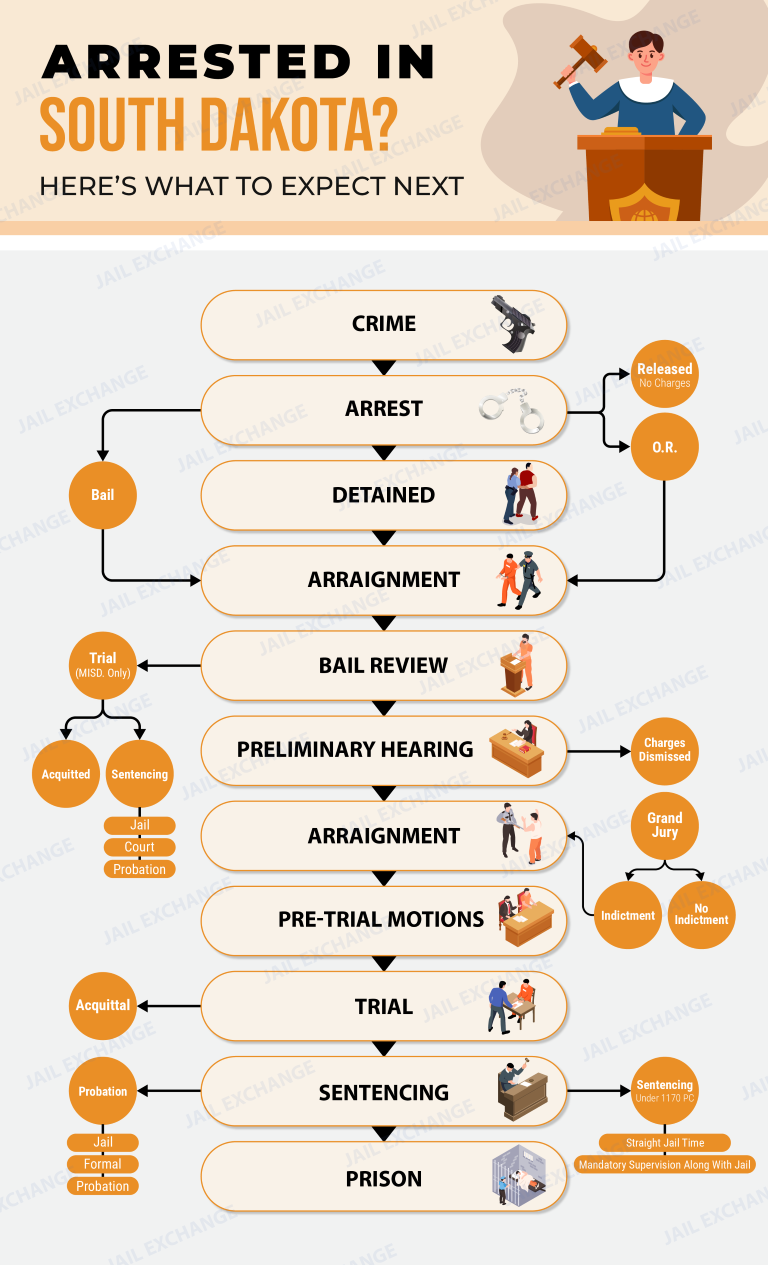
↑ Back to the question list6. What are the stages of a Bennett County felony case?
- Bond and first appearance, both in magistrate court.
- Preliminary hearing (SDCL 23A-4-3). Here a judge asks if there is enough evidence to go on. Bennett defendants held in Winner get one within 15 days; those out on bond, within 45. Waiving it is allowed, and an indictment wipes it out.
- Formal charge. The State's Attorney typically charges by information, a written accusation. Bennett grand juries, six to ten people each (SDCL 23A-5-1), gather only if a circuit judge calls them in.
- Circuit court, for the plea, motions and any trial, still under the 180-day rule.
- Sentence, once guilt is admitted or proven.
Maximum terms rise with the class. Class 6, the lowest, allows two years at most (SDCL 22-6-1), with a fine capped at $4,000. After that come five years for Class 5, ten for Class 4, fifteen for Class 3, 25 for Class 2 and 50 for Class 1. Probation is presumed for Class 5 and Class 6 (SDCL 22-6-11).
↑ Back to the question list7. Do violent charges face stricter rules here?
Yes, at several stages:
- Bond. The clerk's schedule skips murder, kidnapping and first-degree manslaughter, so a judge sets those bonds. Holding someone with no bail at all takes a capital charge and strong proof (S.D. Const. art. VI, § 8).
- Heavier classes. Class C and Class B felonies carry life. A Class A felony carries death or life. Fines for Class 2 felonies and above can reach $50,000.
- Domestic abuse. A judge sets bond (SDCL 25-10-40), and the person must leave the alleged victim's home and family alone until that first hearing.
- Jury strikes. The top four felony classes (SDCL 23A-20-20) let each side drop 20 would-be jurors for any reason.
- Federal reach. The Major Crimes Act (18 U.S.C. 1153) sends crimes like murder or robbery by an Indian person in Indian country to federal court.
8. Which offices prosecute and defend in Bennett?
Adult and juvenile crimes here are charged by the State's Attorney, 501 2nd Avenue, Martin, SD 57551, 605-685-6986, open weekdays 8:00 a.m. to 4:30 p.m. Mountain time. Staff there can't advise private people or act as anyone's lawyer.
On defense, the county funds an appointed lawyer whenever someone can't pay for one (SDCL 23A-40-7, 23A-40-8). Ask for one at the first appearance, or turn in form UJS-224R to the Clerk of Courts, 202 Main, Martin, SD 57551, 605-685-6969. Repayment can be ordered later (SDCL 23A-40-10), and a county lien may follow, though it can never take the homestead (SDCL 23A-40-15).
Appeals work differently. The state Office of Indigent Legal Services, set up in 2024, takes direct criminal appeals.
↑ Back to the question list9. Where can I see Bennett County court dates online?
- The state runs Find a Court Date at no charge. Look up coming hearings with a name or case number. A county calendar for the next ten court days, today included, is there too.
- UJS eCourts shows docket entries in public files, and searches are free.
- PARS returns case summaries back to 1989 for $20 a search, charged even on a blank result.
- Courthouse access terminals let you look at what a PARS summary lists.
For anything older than 1989, or a fast answer, ring the clerk at 605-685-6969 with the defendant's full legal name and birthday ready.
↑ Back to the question list10. How do you learn about a warrant and clear it?
Bennett deputies serve arrest and bench warrants. Ask about one at the Sheriff's Office, 201 State Street, Martin, SD 57551, 605-685-6515, or after hours through Dispatch, 605-842-1014. On tribal land, Oglala Sioux Tribe Public Safety handles tribal warrants from 977 Horse Thief Road, Pine Ridge, SD 57770, 605-867-8101. Online, see the DOC Most Wanted list naming escapees and walkaways, the state Sex Offender Registry, and the case search on UJS ePayments, which marks active warrants. Clearing one starts with a lawyer's call. After that, the person turns in at the courthouse whose judge signed it, or the clerk can talk about a fresh court date: 202 Main, Martin, SD 57551, 605-685-6969.
↑ Back to the question list11. When does Oglala Sioux Tribe court take the case?
Some Bennett land lies inside the Pine Ridge Reservation, where Oglala Sioux Tribe police patrol. A tribal member arrested by tribal officers on a tribal charge usually ends up in tribal court. Custody then passes to the tribe's jail in Pine Ridge, SD 57770, run by the tribe's Department of Corrections, 605-867-8187. See its JE facility page.
These tribal offices are all in Pine Ridge, SD 57770:
- Tribal Court Administration: 605-867-5151
- Tribal prosecutor (Attorney General): 605-867-2095
- Tribe headquarters: 107 West Main Street, Pine Ridge, SD 57770, 605-867-5821
Serious crimes on the reservation can go to federal court instead. Arrests by county deputies go to state court in Martin and the Winner jail.
↑ Back to the question list12. What happens if Bennett County charges turn federal?
The Western Division of the U.S. District Court for the District of South Dakota handles any federal case out of Bennett, from the federal building at 515 Ninth Street, Rapid City, SD 57701.
- The federal judge settles detention at the opening hearing (18 U.S.C. 3142). Only short delays are allowed: three days if the government asks, five if the defense does.
- The U.S. Attorney's Office, which prosecutes federal cases, sits at 201 Federal Building, 515 Ninth Street, Rapid City, SD 57701, 605-342-7822.
- U.S. Probation and Pretrial Services, in Room 257 of that building, prepares reports for the judge, 605-399-5920.
- Pretrial, the defendant is in the hands of deputy U.S. marshals, whose office is at 515 9th Street, Suite 323, Rapid City, SD 57701, 605-342-6331.
- After a sentence, check the Federal Bureau of Prisons inmate locator.
13. Could immigration officers step in when the Martin case ends?
Yes, on release day. The charge in Martin keeps going as usual, but here is what a detainer adds:
- ICE lodges a Form I-247A at the defendant's jail.
- The form seeks a hold up to 48 hours after they would otherwise be released (8 CFR 287.7(d)), so agents have time to arrive.
- For this state, the responsible office is ICE's St. Paul Field Office, 1 Federal Drive, Suite 1601, Fort Snelling, MN 55111, 612-843-8600.
- After ICE takes over, use the ICE Online Detainee Locator.
- Last, state law. SB 7 (2025) bars county or city rules that block staff from reporting someone's immigration status to federal officers.
14. After a felony sentence, where does prison time happen?
Time for a misdemeanor is jail time, served at the county level. Prison terms for felonies are carried out by the South Dakota Department of Corrections (SDCL 22-6-1). For Class 5 and Class 6 felonies, county jail of a year or less is an option (SDCL 22-6-1.1).
- Locate people serving state time with the DOC offender locator.
- Probation is a Court Services job. Parole decisions sit with the state Board of Pardons and Paroles, 605-367-5040.
- Read up on every facility through our South Dakota state prisons page.
15. How are charges against a child under 18 handled?
Children 10 and over fall under juvenile court (SDCL 26-8C-2), which is part of circuit court. The State's Attorney prosecutes those cases as well. Most kids picked up by officers go home with a parent. Keeping a child locked up takes one of the reasons listed in SDCL 26-8C-3, in the least strict setting that works.
A move to adult court is allowed only after a transfer hearing (SDCL 26-11-4). Juvenile probation runs through Court Services, 200 E 3rd St, Winner, SD 57580, 605-842-3551. Families can ask the Sheriff's Office at 605-685-6515 where the youth is being held.
↑ Back to the question list16. What rights do victims have in Bennett County?
Marsy's Law sits in South Dakota's Constitution (S.D. Const. art. VI, § 29). Victims who ask get timely notice of court dates. They may speak up at release, plea and sentencing hearings. The law also promises full restitution and a quick alert when the accused leaves custody by release or escape.
- Free custody alerts come through SAVIN, online or at 844-299-4608. Juvenile cases are not in SAVIN; for those, the State's Attorney keeps victims informed.
- That office sits at 501 2nd Avenue, Martin, SD 57551, 605-685-6986.
- Tribal case victims can reach Oglala Sioux Tribe Victim Services, Pine Ridge, SD 57770, at 605-867-1508.
Information for this service is currently unavailable.
Winner, not Martin. The Bennett County Sheriff's Office in Martin keeps no one overnight; it contracts with the City of Winner, and people arrested in Bennett County are lodged in the Winner City Jail.
Online? Kiosk? Cash at the window? Winner's jail answers none of those in public. Ring the Bennett County Sheriff's Office at 605-685-6515 with the person's full name and birth date; they can confirm the person is in Winner and how that jail takes deposits.
The mail rules are spelled out:
- Use a money order or cashier's check. Cash and personal checks that arrive by mail are refused.
- Payee: the person, or the Tripp County Sheriff's Office.
- Memo line: their name and ID number.
- Envelope: that payment alone, addressed to the person's full name and ID number, Winner City Jail, 217 E 3rd St., Winner, SD 57580.
Bennett County, South Dakota, does not run a jail in Martin. The Bennett County Sheriff's Office contracts with the City of Winner, so people arrested in Bennett County are held at the Winner City Jail on East 3rd Street in Winner, Tripp County. That 156-bed city jail holds people for several South Dakota counties, and letters for anyone from Bennett County go there.
Where to mail letters, books and legal papers:
Inmate's Full Name & Inmate ID #
Winner City Jail
217 E 3rd St.
Winner, SD 57580
- Name and number: The first line holds the person's full name and inmate ID number, which you can look up on the inmate search.
- Your return address: Put your full name and address in the top left corner of every envelope, or the Winner jail will most likely not deliver it.
- Paper and pen: Use blue or black ink. The jail rejects letters done in crayon, felt marker or colored ink, and letters with drawings.
- No add-ons: Nothing sprinkled or sprayed on the letter, so skip the glitter, confetti, perfume and lipstick kisses.
- Cards: Plain, with no music.
- Reading material: A new book, newspaper or magazine is accepted only when the publisher ships it to Winner.
- Bringing items: Personal hygiene items are allowed, but call the Winner City Jail at 605-842-3328 before you bring anything. Cigarettes, soda and candy are not allowed.
- Off limits: Someone held in Winner may not exchange letters with a co-defendant, another prisoner or a person named in a no-contact order.
The Bennett County Sheriff's Office in Martin can be reached at 605-685-6515, and the Winner jail also offers electronic messages.
Information for this service is currently unavailable.
Information for this service is currently unavailable.
Information for this service is currently unavailable.
Bennett County County Jails
- Bennett County Sheriff's Office: 605-685-6515
- Bennet County Sheriff: 605-685-6516
The Bennett County Sheriff's Office serves the following cities and towns of Bennett County: Martin and Tuthill.