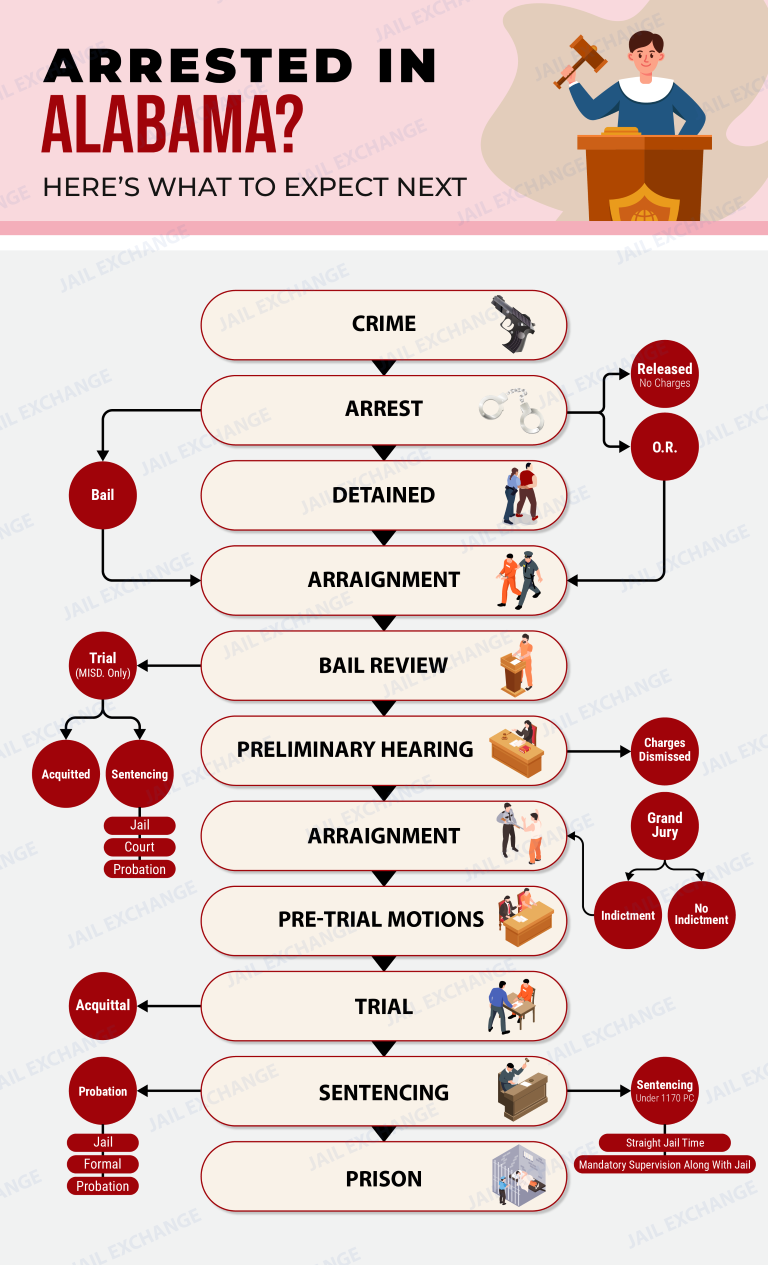
Cullman County Detention Center Criminal Court Process
Criminal Court Process for Cullman County Alabama
Cullman County Criminal Court Guide
Criminal cases in Cullman County, from the first appearance through trial, appeal and sentencing, are the subject of this guide. State charges are tried in the county seat's Second Avenue courthouse, and the city of Cullman runs its own municipal court. Defendants waiting on court sit in the Cullman County Detention Center, 1900 Beech Avenue SE, Cullman, AL 35055.
Check custody before the courthouse trip by using the official jail search. Beyond that lookup, our Inmates in Custody page walks through recent arrests, outstanding warrants, charges, mugshots and getting property back after release.
For the next hearing, phone the circuit clerk at 256-775-4654 with the defendant's legal name and, if you have one, the case number. Get the day, the clock time, the room and what kind of hearing it is. Still need them out of jail? Our bail and bond page covers amounts, payment and bondsmen.
1. Which court gets a Cullman County criminal charge?
For a lesser charge, the arresting agency mostly settles where it goes. A city officer's ticket for something like disorderly conduct or a first DUI lands in Cullman Municipal Court. Tickets from deputies or state troopers are filed in the county's District Court, which now takes Hanceville arrests too.
Felonies always begin in District Court, whoever made the arrest, and move up to Circuit Court when grand jurors indict. Anyone under 18 is sent to juvenile court. The county makes up a judicial circuit of its own, the 32nd. Lost on where the file sits? The circuit clerk at 256-775-4654 can search it by name.
↑ Back to the question list2. Where are the courthouse and the circuit clerk?
Circuit and District Court both work out of the county courthouse at 500 2nd Avenue SW, Suite 303, Cullman, AL 35055. The circuit clerk keeps both courts' files; the clerk's desk is 256-775-4654, and the main courthouse number is 256-775-4660. Hours run 8:00 a.m. to 4:30 p.m. on weekdays, with the office closed from noon to 1:00 p.m.
On a court day, carry three things: the hearing notice, photo identification and the case number. Leave extra time for the security line and for finding the courtroom. Anyone can read a court file at the clerk's counter without paying. For bond payments, clerk staff will point you to the correct window.
↑ Back to the question list3. What does Cullman Municipal Court handle?
City charges, including many traffic tickets and lower-level crimes inside the city limits, are heard by the city's own municipal judge. That court sits in City Hall at 204 2nd Avenue NE, Cullman, AL 35055, phone 256-775-7136, and the office is open weekdays from 8:00 a.m. to 4:00 p.m.
A defendant who might get jail time and has no money for an attorney asks for one by filling out an Affidavit of Substantial Hardship. The court also explains that someone unable to make bail stays locked up as long as 72 hours and may then qualify for a signature bond. Skipping a city date often brings a warrant and a cash-only bond that rises with each miss.
↑ Back to the question list4. Why did Hanceville cases move to District Court?
By ordinance in February 2026, Hanceville closed both its police department and its city court. Cullman is now the single municipal court left in the county. Hanceville arrests are made by sheriff's deputies, and those charges get filed in the county's District Court.
The smaller towns, Good Hope, Garden City, Dodge City, Baileyton and Vinemont among them, generally have their criminal charges filed in District Court as well. If a ticket names a town and leaves you guessing, phone the circuit clerk at 256-775-4654 or walk into 500 2nd Avenue SW, Suite 303, Cullman, AL 35055. Staff can pull up the case and give you the court, the date and the room.
↑ Back to the question list5. What should we expect at a first appearance?
The first appearance is short. The judge confirms identity, reads out the accusation, explains that the defendant may stay silent and asks about counsel. Bond and release terms are reviewed too. Guilt is never decided at this stage.
Rule 4.3 drives the timing. For a warrantless arrest, the probable-cause ruling is due inside 48 hours. On a warrant, a defendant who has not met bond should come before a judge within 72 hours. Someone accused of a felony also learns about the option to request a preliminary hearing. Ask the courthouse at 256-775-4660 what time the hearing starts.
↑ Back to the question list6. How does a misdemeanor move toward a result?
Plenty of misdemeanors here start with a citation listing a court date, so the person never sees a cell. When officers do make a booking, it happens at the county detention center, 1900 Beech Avenue SE, Cullman, AL 35055, phone 256-735-2400. A magistrate picks bail off the schedule, and relatives may post cash, pledge land or hire a licensed bonding company.
Arraignment is where the plea is entered, and a defendant short on money can ask there for a court-appointed attorney. Lots of cases settle: diversion, a plea to something smaller, or dismissal once restitution is paid. If a case is tried, a judge decides it, in District Court or the city's court, since juries are not used at that level.
↑ Back to the question list7. What punishment can a misdemeanor carry in Alabama?
Alabama law caps the sentence for each class. Court costs and restitution may be added on:
- Class A, for example paraphernalia possession, third-degree criminal mischief or fourth-degree theft: as much as 12 months and $6,000.
- Class B: up to six months and $3,000.
- Class C, for example public intoxication or disorderly conduct: three months at most and $500.
- First DUI: jail time capped at 12 months, with a $600 to $2,100 fine.
A fourth DUI inside ten years gets charged in this county as a Class C felony. Fines punish a conviction; bail only guarantees a return to court. Ask the defense lawyer how those ranges fit the charge actually filed.
↑ Back to the question list8. How do Cullman felonies get from District to Circuit Court?
Booking and a first appearance come first. After that, the case waits in District Court until the grand jury meets. The defense may demand a preliminary hearing, so a judge can test whether the proof justifies moving forward. Rule 5.1 gives 30 days from arrest to make that demand.
Next, the 32nd Circuit District Attorney presents the evidence to county grand jurors. Once they indict, Circuit Court takes over for arraignment and discovery, ending in a plea or a jury verdict. A plea deal on a felony here often closes the case six to twelve months after arrest. The circuit clerk at 256-775-4654 can tell you which stage a case has reached.
↑ Back to the question list9. How long can a felony sentence run?
Alabama sorts felonies into four classes. Typical charges from this county fall like this:
- Class D, like meth possession or third-degree theft: 366 days up to five years.
- Class C, like second-degree theft or receiving stolen property in the second degree: up to ten years.
- Class B, like stealing a vehicle (first-degree theft), first-degree assault or manslaughter: two to 20 years.
- Class A, like murder: 10 to 99 years or life.
On many nonviolent C and D cases, the state's presumptive standards lean toward probation, drug court, community corrections or a brief split sentence. The Habitual Felony Offender Act stretches ranges for people with prior felonies. Anyone under 21 on the offense date may request youthful offender treatment; that keeps the record private and holds the sentence to 3 years or less.
↑ Back to the question list10. Do violent felonies follow different rules here?
They take the same District-to-Circuit route, but getting out is tougher. Aniah's Law covers murder, some first-degree assaults, first-degree rape and other listed crimes. For those, prosecutors may ask for an evidence hearing and seek to keep the defendant in the county detention center with no bail. A vote on May 19, 2026 added attempted murder, plus shooting at an occupied dwelling or vehicle.
Where bond is granted on a domestic charge, expect a no-contact order. Domestic violence by strangulation or suffocation is a Class B felony. Using a gun in a murder brings a 20-year minimum, and a capital murder conviction can only end in a death sentence or life behind bars with no chance of parole. Such cases regularly last over a year. The jail is at 1900 Beech Avenue SE, Cullman, AL 35055, 256-735-2400.
↑ Back to the question list11. Who is the prosecutor, and can we get a free lawyer?
The 32nd Judicial Circuit's District Attorney files state charges from an office at 500 2nd Avenue SW, Room 207, Cullman, AL 35055, 256-736-2800. That office represents the people of Alabama, never the defendant, so the accused needs a defense lawyer of their own.
Without money for an attorney, a defendant can ask the court to appoint one, usually at the first appearance or at arraignment. That request comes with a sworn form showing earnings, debts and dependents. Under Rule 6.3 the question can be reopened if finances shift, and relatives covering bond do not, alone, make someone ineligible. Get the form from the circuit clerk at 256-775-4654. At the state level, appointed defense is run through the Office of Indigent Defense Services, 100 North Union Street, Suite 680, Montgomery, AL 36104, 334-242-7059.
↑ Back to the question list12. Can a District or city court conviction be appealed?
Yes. Neither District Court nor the city court uses a jury. After a guilty verdict in either one, the defendant has a 14-day window to appeal to Circuit Court, where the case starts over with a fresh trial, and a jury can hear it. Appointed counsel stays on through that appeal.
Two weeks pass fast, so speak with the lawyer on the day of the verdict. Appeals are filed with the circuit clerk at 500 2nd Avenue SW, Suite 303, Cullman, AL 35055, 256-775-4654. On a city case, the municipal court office at 204 2nd Avenue NE, Cullman, AL 35055, 256-775-7136, handles its share of the paperwork.
↑ Back to the question list13. Which office knows the next hearing date?
A call to the circuit clerk at 256-775-4654 is fastest. Share the legal name, birthday and any case number printed on a ticket or notice. Then ask what day and hour the next setting is, which courtroom, and what the hearing is about.
Court calendars and office details appear on the county clerk website. Across Alabama, Alacourt Access sells records at $9.99 per name search, one case included. Reading a file at the counter costs nothing. Booking charges can shift when prosecutors file, so trust the court file over the jail record.
↑ Back to the question list14. Does someone have a Cullman County warrant?
Deputies carry out county warrants. Ask the sheriff's office at 256-734-0342, or go to 1910 Beech Avenue SE, Cullman, AL 35055. Alacourt Access may turn up a linked case, though a clean search there does not prove no warrant exists. After a missed state court date, the clerk at 500 2nd Avenue SW, Suite 303, Cullman, AL 35055, 256-775-4660, can explain how a new date is set. City warrants go through the municipal court at 256-775-7136. See a lawyer before going in. Surrendering by plan, with an attorney and a bondsman ready, beats being picked up unexpectedly at work or on the road.
↑ Back to the question list15. How does juvenile court work for local youth?
Delinquency matters go before the juvenile judge in the courthouse. Intake and probation officers screen each referral through the circuit clerk's family division at 500 2nd Avenue SW, Suite 303, Cullman, AL 35055, 256-775-4654. The county lists a juvenile detention center on the Beech Avenue campus, 1900 Beech Avenue SE, Cullman, AL 35055, 256-735-2400. Some youths instead go to a regional center like the Neaves-Davis Center for Children, 817 Cook Avenue, Huntsville, AL 35801, 256-532-0300.
Ala. Code § 12-15-207 calls for a detention hearing inside 72 hours. Juveniles have no adult-style bail; the judge rules on whether release is safe. Section 12-15-204 automatically treats a 16- or 17-year-old as an adult for certain grave felonies. For other charges, § 12-15-203 allows prosecutors to request transfer to adult court once a child turns 14.
↑ Back to the question list16. Which federal court takes Cullman County cases?
28 U.S.C. § 81 places this county in the Northeastern Division of Alabama's Northern District federal court, which meets at 660 Gallatin Street SW, Huntsville, AL 35801, 256-534-6495. Common federal cases from here grow out of drug and gun finds on Interstate 65 or task-force work, plus fraud and child exploitation.
The opening hearing belongs to a federal magistrate judge, who applies the Bail Reform Act to the release question, usually by setting conditions rather than a cash figure. The Speedy Trial Act expects an indictment in 30 days and trial in 70, though extensions are common. Parole does not exist federally, and roughly 85 percent of each sentence gets served. Pretrial custody is handled by the Marshals Service at 1729 5th Avenue North, Room 240, Birmingham, AL 35203, 205-829-6611.
↑ Back to the question list17. How does an immigration detainer affect a criminal case?
A detainer runs alongside the criminal case, not inside it. With Form I-247A, immigration officials ask the Beech Avenue jail to keep a person as long as 48 hours past their scheduled release so its officers can take over. It is a request to the jail; it convicts no one and does not close the state charge.
Immigration enforcement for this area runs out of New Orleans: 181 James Drive W, St. Rose, LA 70087, 504-318-2360. Once ICE has custody, search the ICE Online Detainee Locator System by A-number together with birth country; lacking that number, search by legal name with the birth date and birth country. A lawyer should read the detainer itself, since it can change bond and plea decisions.
↑ Back to the question list18. What rules apply after release while the case is pending?
Every release order has strings attached. The defendant has to attend each hearing, stay out of trouble, report any move to the court and get permission before traveling outside Alabama. Judges may pile on more, such as staying clear of an alleged victim or limits on travel.
Beginning October 1, 2026, amended Rule 7.3 adds a duty to give the court a working email and a mobile number for notices, unless the person lacks one or the release terms forbid using it. Report changes promptly. A text that never arrives still does not cancel a court date. Keep the order with the case papers, and call the clerk at 256-775-4660 if it goes missing. Our state bail rules page explains more.
↑ Back to the question list19. How do I track a prisoner going to an ADOC prison?
Following a state prison sentence, expect the person to remain on Beech Avenue until a bed opens with the Alabama Department of Corrections. Next comes a reception unit for screening, then assignment to a prison that fits the results. The sentencing date by itself does not reveal when that transport will happen.
Enter an AIS number (six digits) or a name in the ADOC inmate search, checking birth dates when names repeat. It lists current prisoners only and leaves out youthful offender records. Once a prison is named, our state prison directory has mail and visiting details. Federal sentences are tracked instead through the Bureau of Prisons inmate locator.
↑ Back to the question list