Jefferson County Jail – Bessemer Criminal Court Process
Criminal Court Process for Jefferson County Alabama
Jefferson County Criminal Court Guide
Criminal cases in Jefferson County, Alabama run through the 10th Judicial Circuit, and this page traces each step. Adults held on state charges are booked into the Jefferson County Jail in Birmingham, 809 Richard Arrington Jr. Blvd. N, Birmingham, AL 35203, or, for the western Bessemer Cutoff, the Jefferson County Jail in Bessemer, 1822 2nd Avenue North, Bessemer, AL 35020.
Confirm custody first with the sheriff's custody search, which covers people held in both county jails. Visit our Inmates in Custody page for new bookings, charges, warrants, mugshots and help collecting property after release.
Next, reach the clerk for whichever division has the case: Birmingham at 205-325-5355 or Bessemer at 205-497-8510. Give the legal name and a case number if you have one, and ask for the next hearing date, time and courtroom. Our bail and bond page helps when release is still pending.
1. Which Jefferson County court gets the case?
Location decides the division first. A crime in the western Bessemer Cutoff is filed at the Bessemer Justice Center, 1851 2nd Avenue North, Bessemer, AL 35020. Everything else goes to the Birmingham courts, where criminal cases are heard at the Criminal Justice Center, 801 Richard Arrington Jr. Blvd. N, Birmingham, AL 35203.
- A ticket or misdemeanor written by city police normally goes to that city's municipal court.
- One written by a deputy or a state trooper goes to District Court.
- A felony starts in District Court for the warrant and any preliminary hearing, and reaches Circuit Court when the grand jury returns an indictment.
- Family Court takes cases against children under 18.
To learn where a file sits, call a clerk: Birmingham 205-325-5355, Bessemer 205-497-8510.
↑ Back to the question list2. Where are the Birmingham Division criminal courtrooms?
State criminal cases for the Birmingham side are heard at the Criminal Justice Center, 801 Richard Arrington Jr. Blvd. N, Birmingham, AL 35203. Both criminal Circuit Court and District Court sit in that building, and so does the District Attorney for the Birmingham Division, 205-325-5252.
Two blocks of Richard Arrington Jr. Boulevard separate those courtrooms from the circuit clerk, who works in the Jefferson County Courthouse, 716 Richard Arrington Jr. Blvd. N, Birmingham, AL 35203, 205-325-5355. It is open on weekdays from 8:00 a.m. to 5:00 p.m. Staff there can find a case, give hearing dates and make copies. Case details for this side of the county can also be found on the Birmingham clerk's website. Bring a photo ID if you plan to go through courthouse security.
↑ Back to the question list3. What area does the Bessemer Division serve?
The Bessemer Division covers the western end of the county. That includes Bessemer, Hueytown, Brighton, Lipscomb and Midfield, the McCalla, Oak Grove and Sylvan Springs areas, and small parts of west Hoover. It has its own courthouse, clerk, prosecutors, magistrates and Pre-Trial Release desk.
- Bessemer Justice Center and circuit clerk: 1851 2nd Avenue North, Bessemer, AL 35020, 205-497-8510, weekdays 8:00 a.m. to 5:00 p.m.
- District Attorney, Bessemer Division: 1851 2nd Avenue North, Suite 110, Bessemer, AL 35020, 205-497-8610.
- Pre-Trial Release at the Bessemer jail: 1822 2nd Avenue North, Bessemer, AL 35020, 205-481-8529.
Bail papers from one division do not move with a case that switches sides. If a file seems lost, ask both clerks.
↑ Back to the question list4. Which city courts hear local ordinance charges?
About 25 towns and cities hold court on their own ordinance charges and many traffic tickets. The two largest are:
- Birmingham Municipal Court, David J. Vann Municipal Justice Center, 801 17th Street North, Birmingham, AL 35203, 205-254-2161. The office is open weekdays 7:30 a.m. to 5:00 p.m., and the cashier window closes at 4:30 p.m.
- Bessemer Municipal Court, 23 15th Street North, Bessemer, AL 35020, 205-426-8602. Court meets Mondays and Thursdays at 4 p.m. and Wednesdays and Fridays at 8 a.m. Domestic violence court is Tuesdays at 9 a.m.
Other city courts include Adamsville, Brighton, Brookside, Fairfield, Fultondale, Gardendale, Graysville, Homewood, Hoover, Hueytown, Irondale, Kimberly, Leeds, Lipscomb, Midfield, Morris, Mountain Brook, Pleasant Grove, Sylvan Springs, Tarrant, Trafford, Trussville, Vestavia Hills and Warrior. Call that city hall for its court line.
↑ Back to the question list5. Where do Center Point, Clay and Pinson cases go?
Center Point, Clay and Pinson pay the Sheriff's Office for police coverage. Because deputies make those arrests, the cases usually go to District Court instead of a city court. City hall in each town can tell you how a particular case was filed.
A few very small towns, such as Mulga, Maytown, North Johns, West Jefferson and Cardiff, often send their cases to District Court or to a nearby city's court. If you cannot tell which court has a case from one of these places, ask the Sheriff's Office at 2200 Reverend Abraham Woods Jr. Blvd., Birmingham, AL 35203, 205-325-5700. Staff will need the date of arrest and the legal name to locate the report.
↑ Back to the question list6. What happens at the first Jefferson court appearance?
Alabama Rule 4.3 sets two clocks. If police had no warrant, the state must convince a judge of probable cause by hour 48. After a warrant arrest, anyone unable to post bond goes before a judge by hour 72. Domestic violence bail follows its own rule: only a judge sets it, within 24 hours.
At that first setting, the District Court judge explains the charges, reviews bail and names a public defender for anyone who qualifies. Pre-Trial Release staff at the Birmingham jail, 205-325-5716, or the Bessemer jail, 205-481-8529, may approve a signature bond on smaller amounts before that hearing.
↑ Back to the question list7. How are DUI, shoplifting and other misdemeanors handled?
Many misdemeanor arrests end in release the same day, through a signature bond, cash, property or a bondsman. City jails set their own release terms on city charges. Typical charges and their maximum penalties:
- Shoplifting goods worth under $500 is theft in the fourth degree, a Class A misdemeanor. Possible punishment reaches one year of jail time and $6,000.
- A first DUI brings a fine of $600 to $2,100 and up to a year in jail. A fourth DUI within ten years becomes a Class C felony.
- Harassment is a Class C misdemeanor with up to three months in jail.
Municipal and District Court judges decide these cases without juries. Results often include fines, probation, DUI school, anger classes or a diversion program that ends in dismissal. For appointed counsel on a state charge, call the Public Defender's Office at 205-588-4220.
↑ Back to the question list8. How does a felony move toward trial in Birmingham or Bessemer?
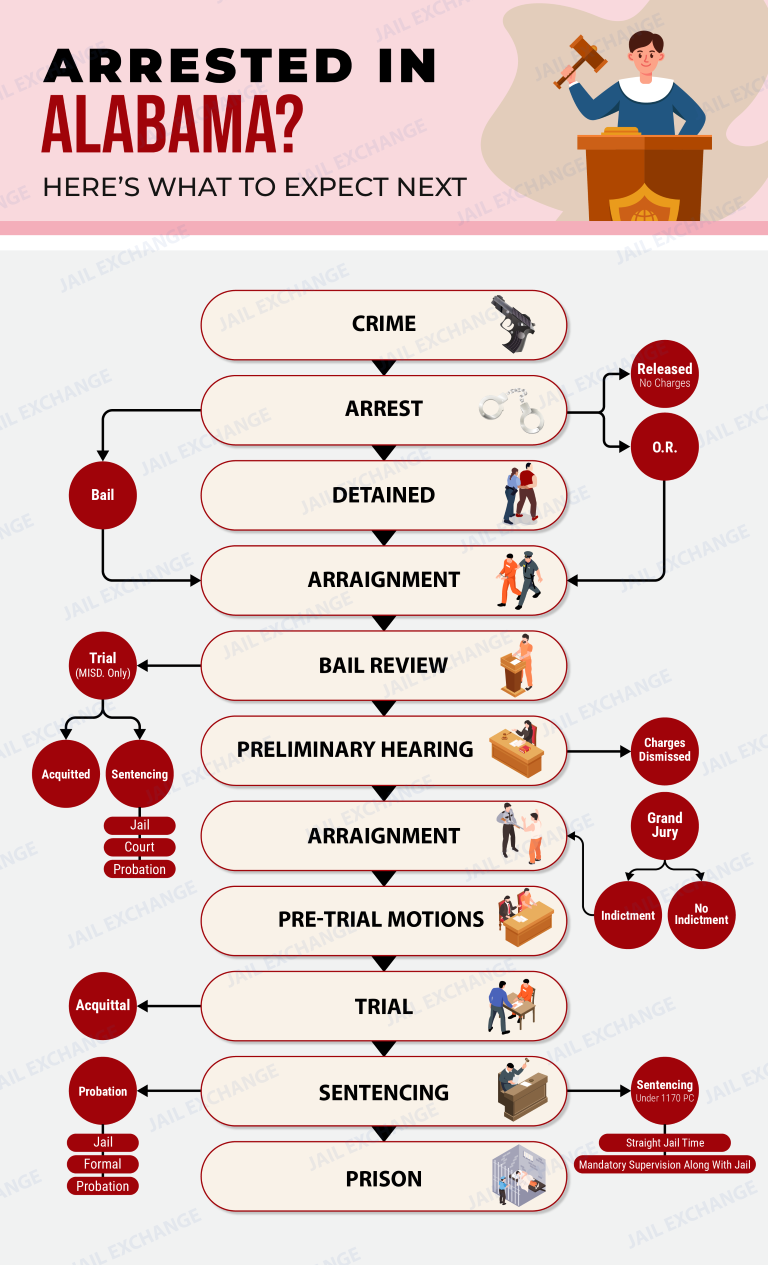
Felony arrests are booked into the county jail on the side of the county where the crime happened. A District Court judge reviews bail at the first appearance. After that, the case follows these steps:
- Preliminary hearing: if the defense asks, a District judge checks the evidence for probable cause.
- Grand jury: the case goes to the grand jury for the correct division.
- Arraignment and pretrial: in Circuit Court, a not-guilty plea is entered and both sides share evidence. Most cases end in a plea deal.
- Trial or sentencing: a jury of twelve decides contested cases.
Prison ranges climb by class. A Class D felony runs 366 days to 5 years. Class C can reach 10 years, and Class B runs 2 to 20 years. Possessing drugs or third-degree theft is usually Class D; car theft is Class B. A person who committed the offense before turning 21 may seek youthful offender treatment. If granted, the record stays sealed and the sentence can't top 3 years.
↑ Back to the question list9. What changes when the charge is violent?
People charged with murder or armed robbery are held at the Birmingham jail, 809 Richard Arrington Jr. Blvd. N, Birmingham, AL 35203, 205-325-5670, while prosecutors review the case. Under Aniah's Law, prosecutors on either side of the county can request a no-bail hearing in murder, kidnapping, first-degree robbery and similar cases. Amendment 1 from the May 19, 2026 election adds two more: attempted murder, and shooting at an occupied house or car. When bail is allowed, it tends to be high and often comes with GPS monitoring and stay-away orders.
Both murder and first-degree robbery fall in Class A, with 10 to 99 years or life. A firearm brings a 20-year mandatory minimum. A capital murder conviction carries either death or a life term with no parole. Capital defendants receive two qualified appointed lawyers.
↑ Back to the question list10. How does a Jefferson defendant get a lawyer?
The county Public Defender's Office takes state cases in both the Birmingham and Bessemer divisions. Its main line is 205-588-4220. Since a judge rules on eligibility, the request belongs at the earliest hearing. Families can also ask the clerk how the request works.
Alabama Rule 6.3 lets the court revisit the question if money problems change later. Policy questions for the whole state belong with the Office of Indigent Defense Services, 100 North Union Street, Suite 680, Montgomery, AL 36104, 334-242-7059. Cities appoint lawyers on municipal charges that could lead to jail time. Jail calls and video visits are recorded. Details of the case belong in private talks with defense counsel.
↑ Back to the question list11. Where can I find a hearing date or file online?
These official sources show case numbers and upcoming settings:
- The county court website lists both clerk offices and their hours.
- Birmingham cases: the Birmingham clerk site or 205-325-5355.
- Bessemer cases: the Bessemer clerk site or 205-497-8510.
- Alacourt Access, the paid statewide search, charges $9.99 per case looked up by name.
The jail roster may show only charge codes, so check the court record for the full charge. Court dates move often, so call the clerk before you travel to the courthouse.
↑ Back to the question list12. How do I deal with a Jefferson County warrant?
Deputies answer warrant questions at the Sheriff's Office, 2200 Reverend Abraham Woods Jr. Blvd., Birmingham, AL 35203, 205-325-5700. If the warrant may come from a city, also call that city's police. A defense lawyer can often arrange a planned surrender with bond ready, which tends to go more smoothly than being picked up at a job or house. To schedule a surrender at the Birmingham jail, 809 Richard Arrington Jr. Blvd. N, Birmingham, AL 35203, call 205-325-5670. You can look for a related case on Alacourt Access, but a search result does not clear a warrant. The clerk at 716 Richard Arrington Jr. Blvd. N, Birmingham, AL 35203, 205-325-5355, can share hearing dates and copies.
↑ Back to the question list13. How do appeals from city or District Court work?
Someone found guilty in municipal or District Court has 14 days to take the case to Circuit Court. The appeal gives the person a brand-new trial, and a jury is available if one is requested. Municipal and District Court judges decide cases without a jury, so the appeal is often the first chance at one.
Fourteen days passes quickly, so speak with a lawyer as soon as the verdict comes in. For a state case, call the Birmingham circuit clerk at 716 Richard Arrington Jr. Blvd. N, Birmingham, AL 35203, 205-325-5355, or the Bessemer clerk at 1851 2nd Avenue North, Bessemer, AL 35020, 205-497-8510. For a city case, ask the city court that decided it how to file the notice.
↑ Back to the question list14. How are Jefferson County juvenile cases handled?
Children's cases are heard by Family Court at 120 2nd Court North, Birmingham, AL 35204, 205-325-5491, or to its Bessemer office. Juvenile probation intake reviews each complaint and either sends the child home, handles it informally or files a petition. A child who is a danger, may run away or has no safe caregiver is held at the Ross-Bell Youth Detention Center, 140 Second Court North, Birmingham, AL 35204, 205-325-5498. Ala. Code §12-15-207 gives the court 72 hours to decide at a hearing whether detention continues. Juvenile court never uses cash bail.
A youth case may end in informal adjustment, probation or counseling. For more serious cases, the judge may order a DYS commitment, meaning the Alabama Department of Youth Services takes custody. Some charges against 16- and 17-year-olds send the case straight to adult court (§12-15-204), and prosecutors can seek a transfer hearing for youths 14 and older (§12-15-203).
↑ Back to the question list15. Which court takes federal cases from Birmingham?
The Northern District of Alabama handles federal prosecutions from here. Its Southern Division meets in the federal courthouse named for Hugo L. Black, 1729 5th Avenue North, Birmingham, AL 35203, 205-278-1700.
Soon after being arrested, the accused is brought to a magistrate judge, who may also hold a detention hearing if asked. The Bail Reform Act focuses that hearing on flight risk and danger rather than dollars. Because the Marshals pay for space in the county jails, federal prisoners can appear on the county roster. The Marshals office is at 1729 5th Avenue North, Room 240, Birmingham, AL 35203, 205-829-6611. Once a federal term is imposed, the BOP's online locator lists the assigned prison.
↑ Back to the question list16. Will an ICE hold put the Alabama charges on pause?
It does not. ICE sends Form I-247A to the Birmingham or Bessemer jail to ask for as many as 48 extra hours of custody after release, so its officers can collect the person. Meanwhile the state prosecution keeps going, and any bond on it still has to be paid for the person to leave state custody.
ICE's New Orleans Field Office covers Alabama at 181 James Drive W, St. Rose, LA 70087, 504-318-2360. When ICE needs a short hold in Alabama, it often uses the county jails in Gadsden (Etowah), Carrollton (Pickens) and Bay Minette (Baldwin). The ICE Online Detainee Locator searches by A-number and country of birth. A lawyer should check how a plea could affect immigration status.
↑ Back to the question list17. What follows a state prison sentence?
Shorter terms may be served locally, while longer ones usually mean state prison. The person stays put at the jail until the Alabama Department of Corrections calls for them. Reception staff then look at physical and mental health, the security level needed and any gang ties before naming a prison.
After the transfer, search ADOC's inmate records by name or AIS number. Details for every state prison are in our Alabama prison directory. Until then, the Birmingham jail at 205-325-5670 or the Bessemer jail at 205-481-4160 can say if the person has left yet.
↑ Back to the question list