Cochise County Jail - Willcox Jail Criminal Court Process
Criminal Court Process for Cochise County Arizona
The Criminal Court Process in Cochise County
Cochise County, in Arizona’s southeastern corner, shares roughly 80 miles of border with Mexico, and that geography shapes its criminal caseload. State felonies are heard by the Superior Court of Arizona in Cochise County, which has two main locations:
- Cochise County Superior Court, Bisbee, 100 Quality Hill Road, Bisbee, AZ 85603. Clerk of the Superior Court: (520) 432-8600
- Cochise County Superior Court, Sierra Vista, 100 Colonia de Salud, Suite 200, Sierra Vista, AZ 85635. Clerk’s office: (520) 803-3060
Six justice courts handle misdemeanors, first appearances and early felony proceedings. In Benson, Bisbee, Sierra Vista and Willcox, the city court is consolidated with the local justice court, so the same building and phone number serve both:
- Bisbee Justice Court (Precinct 1), 207 N. Judd Drive, Bisbee, AZ 85603: (520) 432-9540
- Douglas Justice Court (Precinct 2), 1012 N. G Avenue, Douglas, AZ 85607: (520) 805-5640
- Benson Justice Court (Precinct 3), 126 W. 5th Street, Benson, AZ 85602: (520) 586-8100
- Willcox Justice Court (Precinct 4), 450 S. Haskell Avenue, Willcox, AZ 85643: (520) 384-7000
- Sierra Vista Justice Court (Precinct 5), 100 Colonia de Salud, Sierra Vista, AZ 85635: (520) 803-3800
- Bowie Justice Court (Precinct 6), 201 N. Central Avenue, Bowie, AZ 85605: (520) 847-2303
Douglas, Huachuca City and Tombstone also run their own municipal courts. The Cochise County Attorney prosecutes felonies and county misdemeanors, and city prosecutors handle cases filed in the municipal courts. The main county jail is at 203 N. Judd Drive in Bisbee.
Federal prosecutions arising here belong to the Tucson Division of the U.S. District Court for the District of Arizona, which sits in the Tucson federal courthouse, 405 W. Congress Street, Tucson, AZ 85701, (520) 205-4200. There is no federal courthouse in Cochise County itself. A state crime is a violation of Arizona law, investigated by local police or the sheriff and charged by the County Attorney. Federal charges come from laws Congress wrote, and they often involve federal land, border crossings, travel between states, or a U.S. agency. Because of the ports of entry at Douglas and Naco and heavy Border Patrol activity, much of the county’s federal docket involves smuggling drugs or people across the border and illegal entry or reentry; bank robbery and crimes on Fort Huachuca or federal lands such as the Coronado National Forest are federal as well. Cochise County contains no Indian reservation.
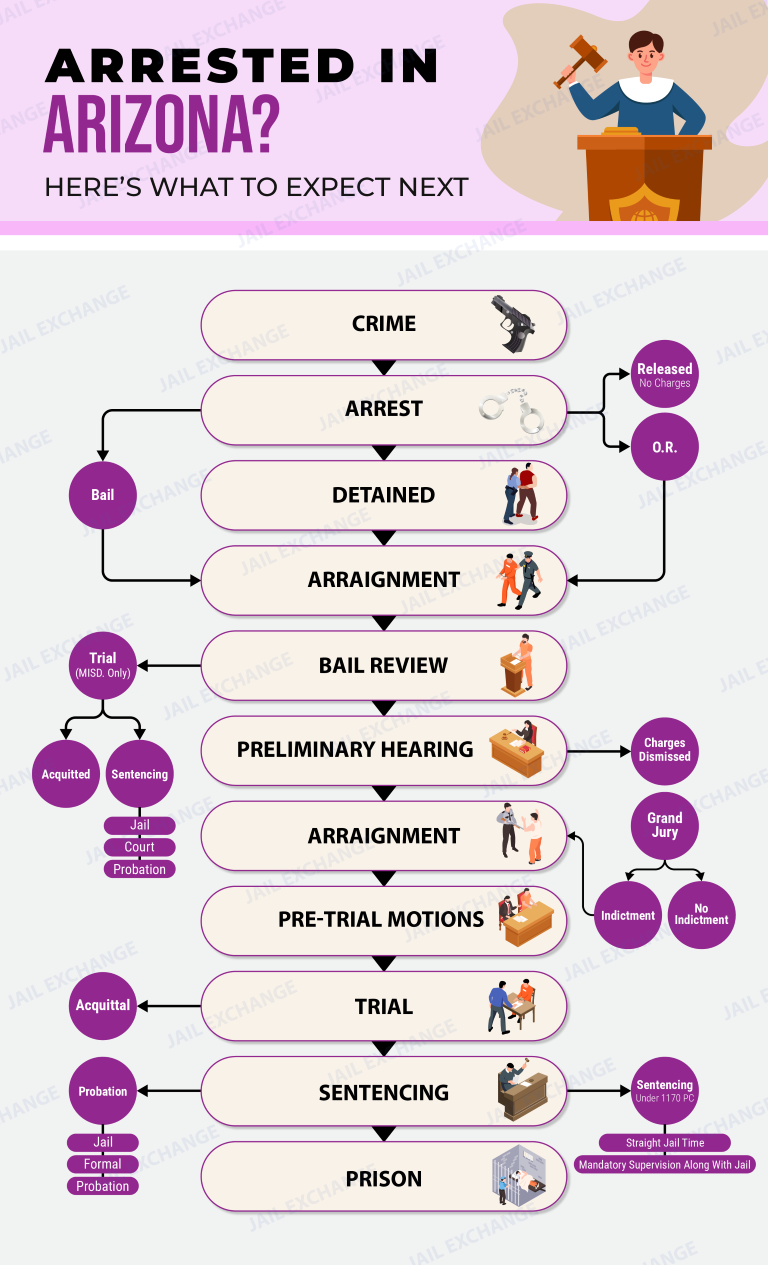
The three boxes below trace how each level of charge moves in Bisbee and the outlying courts.
- Misdemeanor charges (DUI, disorderly conduct, theft under $1,000, domestic assault)
- Felony charges (burglary, possession for sale, aggravated DUI, fraud)
- Violent and serious felonies (homicide, sexual assault, armed robbery)
- Cochise County Superior Court locations
- When a Cochise case is federal
- Finding a person held after a Cochise arrest
- ICE detainers and the Cochise jail
Misdemeanor charges (DUI, disorderly conduct, theft under $1,000, domestic assault)
Where the case is filed depends on where the arrest happened. A sheriff’s deputy or state trooper files in the justice precinct covering that area, and a city officer in Douglas, Huachuca City or Tombstone files in that town’s court. Officers often issue a citation instead of booking. If the person is held, a judge sees them within a day, and for most misdemeanors Arizona expects release on a signed promise to show up.
Maximum penalties depend on the class. The most serious misdemeanors, class 1, cover most DUI, family-violence assault and shoplifting cases, with as much as six months of jail and a $2,500 fine. Class 2 offenses carry up to four months and $750, and class 3 offenses up to 30 days and $500, with surcharges added on top. When jail time could follow and the person is broke, the court assigns a lawyer and may ask for a small payback later.
Only certain misdemeanors come with a jury, DUI among them, and in these courts the panel is six people; other cases are tried by the judge. Most Cochise County misdemeanors resolve through plea agreements, diversion programs or dismissals rather than trial. Domestic violence cases often include counseling, and DUI sentences include mandatory jail days, fines and an ignition interlock. Most of these wrap up in a few months.
Minors are treated separately. Misdemeanors committed by anyone under 18 go to the Juvenile Court, a division of the Cochise County Superior Court, much of whose work is handled at the Sierra Vista complex on Colonia de Salud. The County Attorney commonly offers first-time youth diversion, which keeps the matter out of formal court if the teen completes assigned conditions. Lesser violations such as minor-in-possession, tobacco, curfew and many traffic offenses can be referred to a justice or municipal court.
Felony charges (burglary, possession for sale, aggravated DUI, fraud)
Once booked on a felony, the person meets a justice of the peace before 24 hours pass, usually by video from the Bisbee jail or from a holding facility in Sierra Vista or Willcox. Release conditions are addressed, and anyone found unable to afford counsel is appointed a lawyer. The Cochise County Public Defender represents most adults charged with felonies, with conflict cases sent to other appointed attorneys.
The prosecutor then has 10 days (jailed) or 20 days (released) to hold a preliminary hearing in justice court or take the case to a grand jury. A judge who finds probable cause, or a grand jury that returns an indictment, sends the case to Superior Court in Bisbee or Sierra Vista for arraignment. From that date, Rule 8 gives the state 150 days to bring an in-custody defendant to trial and 180 days for someone released, though defense requests and complex evidence often stretch that.
Felonies range from class 1, the most serious, to class 6. Judges have discretion with some class 6 offenses to designate them as misdemeanors, either at sentencing or after successful probation. Repeat offenders face the enhanced sentencing ranges of A.R.S. 13-703, and prison terms require at least 85% to be served before release. Unless the charge carries a possible 30 years or more, the jury is eight people. Plea agreements resolve the large majority of felonies, usually within six months to a year.
A juvenile charged with a felony is ordinarily brought to Juvenile Court by petition. When a youth is detained, a petition must be filed within 24 hours and a detention hearing held within 24 hours after that, counting weekends and holidays. Cochise County closed its own juvenile detention center at the end of 2020 and now houses detained youth under an intergovernmental agreement in another county, most recently at Pinal County’s youth facility in Florence. The County Attorney has discretion under A.R.S. 13-501(B) to charge a youth 14 or older as an adult for class 1 or 2 felonies, specified class 3 felonies, dangerous offenses, or as a chronic felony offender. Juvenile jurisdiction normally ends at 18 but can be extended to 19 if the state files notice before a 17-year-old’s adjudication.
Violent and serious felonies (homicide, sexual assault, armed robbery)
Serious violent cases go through the same felony stages, with higher stakes at each one. The Arizona Constitution allows bail to be denied when the proof is evident for capital offenses and sexual assault, and for other dangerous felonies when a hearing shows that no conditions can protect the public. Arizona Supreme Court rulings beginning in 2017 limited automatic no-bail rules for some offenses, so judges now weigh the specific facts more often.
Charges involving a gun, another deadly weapon or serious physical injury are “dangerous” offenses under A.R.S. 13-704, meaning mandatory prison and no probation. A first armed robbery conviction carries 7 to 21 years. Sexual assault is a flat-time offense of 5.25 to 14 years for a first conviction, served day for day, along with lifetime registration requirements. First-degree murder carries either death or life imprisonment. Executions in Arizona resumed in 2025 following a review of the state’s procedures. In a capital case, the jury expands to 12 and the defendant receives two qualified appointed attorneys.
Under the Victims’ Bill of Rights, Article 2, Section 2.1 of the state constitution, victims may sit in on hearings, speak about release, plea deals and the sentence, say no to a defense interview, and get paid back for losses. Advocates who work for the prosecutor help them use each right. Here in Cochise County, a murder or sex-crime file can stay open one to three years before it ends.
Teenagers face mandatory adult prosecution for the gravest charges. A.R.S. 13-501(A) requires the County Attorney to charge a 15-, 16- or 17-year-old as an adult for first- or second-degree murder, forcible sexual assault, armed robbery, other violent felony offenses, or felonies committed as a chronic felony offender. Those cases begin directly in Superior Court and are tried like any adult case, but a person under 18 at the time of the crime can't be put to death or given a must-serve life term with no release.
Cochise County Superior Court locations
The main courthouse sits on Quality Hill in Bisbee, with a branch in Sierra Vista:
- Bisbee courthouse on Quality Hill (main Superior Court): 100 Quality Hill Road, Bisbee, AZ 85603 · 520-432-8600
- Sierra Vista Superior Court branch: 100 Colonia de Salud, Suite 200, Sierra Vista, AZ 85635 (no separate line listed; use the main court number)
When a Cochise case is federal
Smuggling, immigration and drug cases near the border often go federal. They are filed in the U.S. District Court for the District of Arizona, Tucson division:
- The first appearance happens at Tucson federal courthouse, 405 West Congress Street, Tucson, AZ 85701 (clerk 520-205-4200).
- Pretrial services interviews the defendant.
- A detention hearing may follow if the government asks.
- The Marshals hold anyone not released.
Marshals contact: U.S. Marshals Service, 405 West Congress Street, Suite 2300, Tucson, 520-879-6900.
Finding a person held after a Cochise arrest
- Cochise County Inmate Search: search last name, then first.
- VINELink (https://vinelink.vineapps.com/): Arizona, then the name.
- Federal Bureau of Prisons Inmate Locator (https://www.bop.gov/inmateloc/): register number or name; call 520-879-6900 for unsentenced people.
- ADCRR Inmate Data Search (https://inmatedatasearch.azcorrections.gov/): inmate number or last name.
- ICE Online Detainee Locator System (https://locator.ice.gov/odls/): A-number plus birth country, or call 520-295-4100.
ICE detainers and the Cochise jail
ICE can file a detainer asking for up to 48 hours of extra custody after release, counting weekends and holidays. Cochise County's 287(g) warrant service agreement lets deputies serve ICE warrants inside the jail. State law, A.R.S. 11-1051, forbids policies that limit immigration enforcement. None of this ends the county case.
Immigration cases go to the ICE office in Tucson (part of the Phoenix Field Office), 6431 South Country Club Road, Tucson, 520-295-4100. Detention sites include:
- Eloy Detention Center: 1705 East Hanna Road, Eloy, AZ 85131 · 520-464-3000
- Florence Service Processing Center: 3250 North Pinal Parkway, Florence, AZ 85132 · 520-868-5862
- Central Arizona Florence Correctional Center: Florence, AZ · 520-868-9095
This summary describes the general criminal process in Cochise County and is not legal advice. People who are charged should find a defense lawyer or ring the public defender in Bisbee at (520) 432-8478.
Call the Bisbee court at 520-432-8600 to confirm a hearing date before you travel.