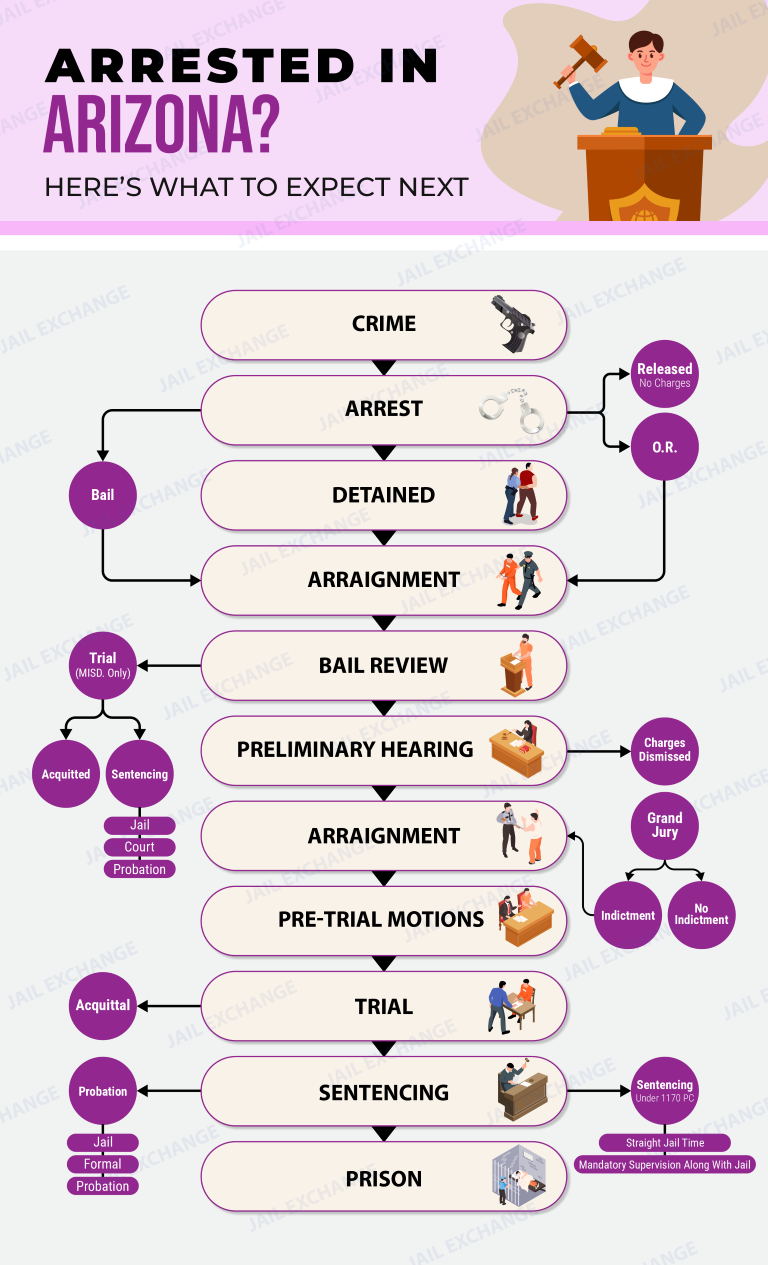
With more than four and a half million residents, Maricopa County runs one of the largest trial court systems in the country, and a criminal charge here can land in any of dozens of courtrooms depending on where the arrest occurred and how serious it is. Felonies and all juvenile cases are handled by the Superior Court of Arizona in Maricopa County. Its criminal departments sit in downtown Phoenix at the Central Court Building, 201 W. Jefferson Street, and the South Court Tower, 175 W. Madison Street, Phoenix, AZ 85003; the court’s information center is (602) 506-3204. Juvenile cases are heard at the Durango Juvenile Court Center, 3131 W. Durango Street, Phoenix, AZ 85009, and the Southeast Juvenile Court Center, 1810 S. Lewis Street, Mesa, each with a detention facility on site.
Misdemeanors are divided between two other kinds of courts:
Because the list is long, the azcourts.gov court finder is the fastest way to confirm which justice or city court has a particular case. Felonies are prosecuted by the Maricopa County Attorney’s Office, headquartered at 225 W. Madison Street in Phoenix.
Federal crimes from Maricopa County are tried a few blocks away at the Sandra Day O’Connor U.S. Courthouse, 401 West Washington Street, Phoenix, AZ 85003, the headquarters of the U.S. District Court for the District of Arizona; clerk (602) 322-7200. The dividing line is the source of the law. Offenses defined by Arizona statutes, which make up the vast majority of arrests, are charged by the County Attorney or a city prosecutor in the courts above. The U.S. Attorney prosecutes violations of federal law: large-scale drug and human smuggling networks that run through Phoenix, illegal reentry and other immigration offenses, bank robbery, federal firearms and child-exploitation crimes, fraud against federal programs, and crimes on federal property such as Luke Air Force Base or the Tonto National Forest. Several reservations also lie partly or wholly in the county: the Salt River Pima-Maricopa Indian Community, the Fort McDowell Yavapai Nation, part of the Gila River Indian Community, and the Tohono O’odham Nation’s San Lucy District near Gila Bend. Under the Major Crimes Act, serious felonies such as murder, kidnapping and sexual abuse committed by Native Americans on those lands are prosecuted in federal court, while each tribe’s own court handles many lesser offenses. Select a category below.
Which court hears a misdemeanor depends on the agency that made the arrest. A Phoenix police citation goes to Phoenix Municipal Court and is prosecuted by the Phoenix City Prosecutor; a Mesa or Tempe ticket goes to that city’s court; a stop by a sheriff’s deputy or state trooper on a freeway or in an unincorporated area usually goes to the justice court for that precinct. Most people are cited and released. Those who are booked, as often happens after a domestic-violence call, are brought to the Initial Appearance Court inside the Fourth Avenue Jail, 201 S. 4th Avenue in Phoenix, within 24 hours, where a commissioner sets release terms. Arizona law presumes release on recognizance unless the judge finds a reason to require more.
How much punishment is possible turns on the misdemeanor’s class. Class 1 misdemeanors, the category for a first DUI, most domestic-violence assaults and shoplifting, carry up to six months in jail and a $2,500 fine; class 2 offenses up to four months and $750; class 3 offenses up to 30 days and $500. Surcharges can nearly double the base fine. Defendants who face possible jail and can’t afford a lawyer may request appointed counsel; most city courts contract with private defense firms, and in the justice courts the Maricopa County Public Defender or contract counsel takes the case.
Many cities offer diversion for first-time shoplifting, minor drug possession or domestic-violence offenses, ending in dismissal after classes or counseling. Cases that do not settle are usually tried to the judge; a six-person jury is reserved mainly for DUI and offenses with a historical jury-trial right. Trial must start within 150 days of arraignment for a jailed defendant and 180 days for one who is released. Most Maricopa misdemeanor cases close within one to four months.
Under 18: Juvenile misdemeanors are filed in the Superior Court’s Juvenile Department at the Durango or Southeast center, depending on where the youth lives. Juvenile Probation reviews each referral, and a large share of first-time offenders are offered diversion with community service, education programs or a teen court rather than a formal petition. Certain minor violations, including underage drinking, tobacco and vaping, curfew and traffic tickets, may go to a justice or city court instead. A youth taken into detention at Durango or Southeast receives a detention hearing within about 24 hours, and the Public Defender represents eligible juveniles. Juvenile jurisdiction ends at 18, except that the state may extend it to 19 for a 17-year-old by filing a notice before adjudication (A.R.S. 8-202).
Almost every felony arrest in the county funnels through the Initial Appearance Court at the Fourth Avenue Jail, which holds hearings every day of the year so that each person is seen within 24 hours. The judicial officer reviews probable cause for the arrest, sets release conditions or bond, and determines whether the person qualifies for appointed counsel. Maricopa County splits indigent defense among several agencies: the Public Defender, the Legal Defender, the Legal Advocate and private attorneys assigned through the Office of Public Defense Services, which allows conflict-free representation for co-defendants.
The County Attorney must then obtain a grand jury indictment or win a preliminary hearing, which Rule 5.1 requires within 10 days for jailed defendants and 20 days for those released. Maricopa relies heavily on its standing grand juries, so many defendants never have a preliminary hearing. Next comes a not-guilty arraignment, often by video for jailed defendants, followed by an Initial Pretrial Conference where discovery such as the police report is exchanged and a trial date is set, and a Pretrial Management Conference about four weeks before trial. Plea offers are frequently made early and can expire if not accepted. Trial must begin within 150 days of arraignment for an in-custody defendant or 180 days otherwise, with an eight-person jury in most felony trials.
Murder aside, which is class 1, Arizona grades felonies on a scale running from class 2 down to class 6. First offenders in non-dangerous cases are often eligible for probation; presumptive prison terms run from one year (class 6) to five years (class 2), and prior convictions raise the ranges significantly under A.R.S. 13-703. Personal-use drug possession on a first or second conviction requires probation under Prop 200, and class 6 felonies may become misdemeanors under A.R.S. 13-604. Anyone sent to prison serves at least 85% of the sentence. A typical felony case in Maricopa County takes six months to a year.
Under 18: A 14- to 17-year-old charged with a non-violent felony usually faces a delinquency petition in Juvenile Court, with possible outcomes ranging from probation and treatment to commitment with the Arizona Department of Juvenile Corrections. The County Attorney has the option under A.R.S. 13-501(B) to file in adult court instead when the youth is at least 14 and the charge is a class 1 or 2 felony, an enumerated class 3 felony, a dangerous offense, or any felony by a chronic felony offender. The county’s Juvenile Department works out of the Durango and Southeast court centers in Phoenix and Mesa.
Violent felony cases in Maricopa County follow the felony track described above, but release is far less likely. The Arizona Constitution (art. 2, § 22) lets a judge deny bail for capital offenses and sexual assault when the proof is evident or the presumption great, and prosecutors can seek a separate hearing to prove that no conditions would reasonably protect the community. Defendants held without bail typically stay at Lower Buckeye or another Sheriff’s jail for the duration.
Offenses involving a deadly weapon or serious physical injury are “dangerous” under A.R.S. 13-704, eliminating probation. First-offense ranges include:
Victims are guaranteed participation rights under the Arizona Victims’ Bill of Rights, Article 2, Section 2.1: notice of every critical hearing, the right to refuse a defense interview, to be heard on release, plea and sentencing, and to receive prompt restitution. The County Attorney’s victim services advocates help navigate these. Homicide and sexual-assault cases in Maricopa County routinely take two years or more, and capital cases often last four or five.
Under 18: A.R.S. 13-501(A) directs the County Attorney to prosecute 15-, 16- and 17-year-olds as adults when the charge is first- or second-degree murder, forcible sexual assault, armed robbery or another violent felony offense, or when a chronic felony offender commits any felony. Those teens are often held in juvenile detention while their cases proceed in the adult criminal courts downtown. A 14-year-old accused of a violent crime may be charged as an adult at the prosecutor’s discretion. Youths cannot be sentenced to death, and sentencing courts must weigh age when considering life terms.
This summary explains the usual path of a case and is not legal advice. Anyone charged in Maricopa County should consult a criminal defense attorney or call the Maricopa County Public Defender at (602) 506-7711.