Boone County Jail & Detention Center Criminal Court Process
Criminal Court Process for Boone County Arkansas
Understanding the Boone County Criminal Courts
Boone County, centered on the Ozark hub of Harrison, has a compact court system in which state and federal courts sit only a few blocks apart. The Boone County Circuit Court takes felony filings and trials, appeals from district court, and every juvenile case through its juvenile division. You'll find the circuit clerk at 100 N. Main Street, Suite 200, Harrison, AR 72601, (870) 741-5560. Boone is one of four counties in the 14th Judicial Circuit, alongside Baxter, Marion and Newton, and the circuit judges and the elected Prosecuting Attorney for the 14th Judicial District serve all four.
The Boone County District Court takes misdemeanor, traffic and violation cases and conducts first appearances on felony arrests. It operates in two places:
- Harrison Department, 201 N. Main Street, Harrison, AR 72601: (870) 741-2788
- Alpena Department, Alpena, AR 72611: (870) 437-2272
Court-appointed lawyers come from the public defender office for the 14th Judicial District, an office that operates under the Arkansas Public Defender Commission.
Boone County is the seat of the Harrison Division of the U.S. District Court for the Western District of Arkansas, which uses the federal building at 402 N. Walnut Street, Harrison, AR 72601. The building has no full-time clerk’s staff, so the court directs calls to (833) 853-0345, and hearings are scheduled there as needed. A state crime is one that violates an Arkansas statute, such as theft from a Harrison business or a domestic battery, and it is prosecuted by the 14th District prosecutor in state court. A federal crime is one defined by Congress or one that strikes at a federal interest: distributing methamphetamine through a network that reaches other states, sending threats or child sexual abuse material over the internet, robbing a federally insured bank, mail fraud, or possessing a firearm after a felony conviction. Federal agencies such as the FBI, DEA and ATF investigate those cases, and the U.S. Attorney’s Office prosecutes them.
Pick the kind of charge you want to learn about.
- Misdemeanor matters (theft below the felony amount, first DWI, battery, trespass)
- Boone County felonies: burglary, large thefts, drug sales, repeat DWI
- Violent felony matters (capital murder, murder, rape, aggravated robbery)
- Boone County court addresses and phone numbers
- Federal charges out of Boone County
- Looking up inmates in county, state and federal custody
- ICE detainers and where Boone County detainees go
Misdemeanor matters (theft below the felony amount, first DWI, battery, trespass)
When Harrison police, the Boone County Sheriff’s Office or a state trooper charges a misdemeanor, the case is set in the Harrison or Alpena department of district court. Many Boone County stops end with a written ticket listing a court day, and nobody gets booked. When someone does get booked, a judge sees them quickly, and on these charges release usually comes on a signature or a modest bond.
Penalty ceilings in Arkansas depend on the class of misdemeanor. The ceiling for Class A is twelve months locked up plus $2,500. A Class B offense is capped at 90 days and $1,000, and a Class C offense at 30 days and $500. Shoplifting goods worth $1,000 or less is Class A theft. Battery in the third degree is a Class A misdemeanor. Most trespass charges are Class C, though entering an occupied house or building raises it to Class B. On a first DWI, the judge may order between one day and a year of jail and a fine from $150 up to $1,000, and the driver also faces license penalties and an alcohol safety program.
No jury sits in district court, so the judge weighs the proof alone. A conviction can be taken to circuit court within 30 days for a fresh trial, and a jury is available there. Defendants who might be jailed and lack funds can request free counsel. A fee tied to income may be charged. A first offense in Boone County most often ends with a fine, probation or a suspended sentence.
Minors accused of misdemeanors are usually sent to the juvenile division of Boone County Circuit Court instead of district court. Juvenile staff screen each referral. For a youth with a clean record, the prosecutor can offer diversion, where community service, counseling or paying back the loss ends the case with no finding. Traffic tickets and a few minor offenses such as curfew or tobacco violations can still be handled in district court.
Boone County felonies: burglary, large thefts, drug sales, repeat DWI
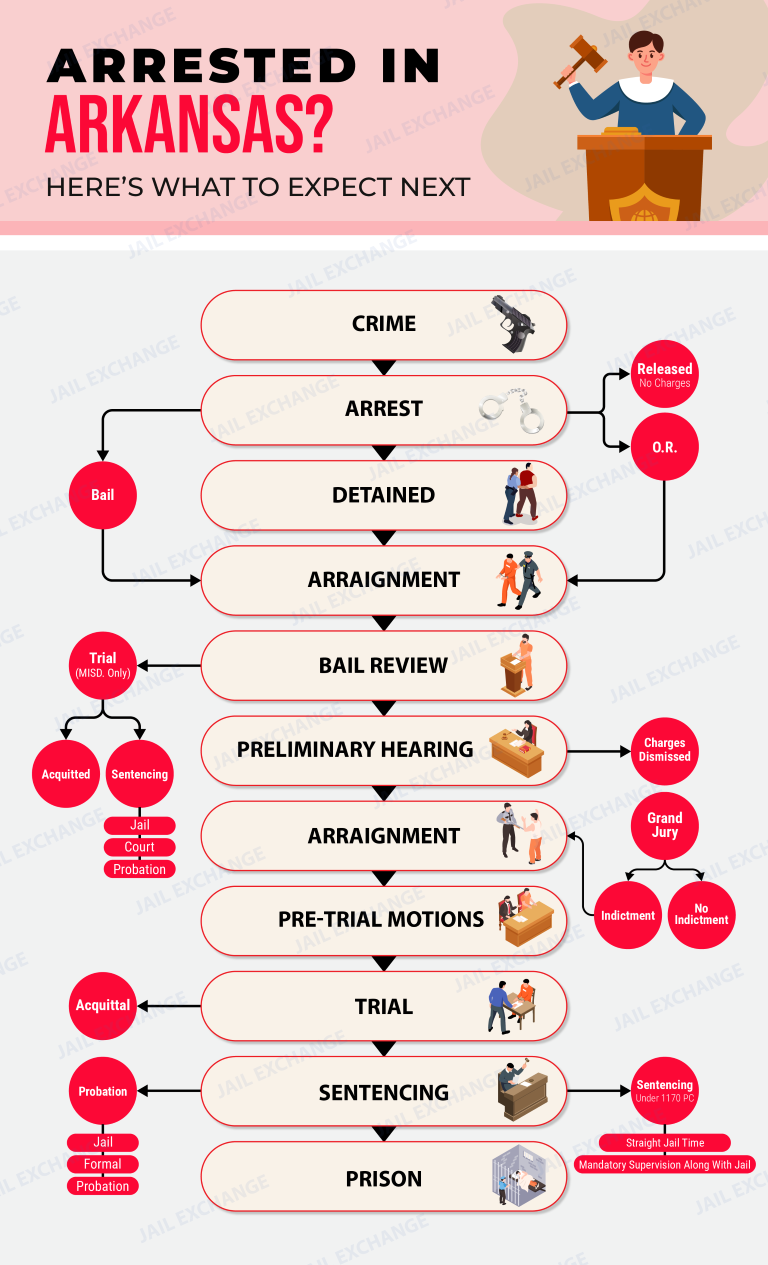
A felony defendant held in the Boone County jail first goes before a district judge, usually in Harrison. The judge checks probable cause there (inside 48 hours for a warrantless arrest), sets bond or other release terms, and rules on whether a public defender is warranted. Under the Arkansas Constitution, only capital offenses with evident proof can be held without bail. Bail bonds are written by bondsmen licensed by a state board, the Professional Bail Bond Company and Professional Bail Bondsman Licensing Board.
In Arkansas, felonies are almost always charged by information rather than grand jury indictment. The 14th District Prosecuting Attorney files the information in Boone County Circuit Court, and the defendant is arraigned. Rule 28.1 gives prosecutors 12 months to start trial, leaving out delays like continuances. A circuit court jury of 12 decides guilt, and Arkansas juries typically recommend the sentence as well.
Arkansas has five felony classes. A Class Y felony carries 10 to 40 years or life. Class A ranges from 6 to 30 years, Class B from 5 to 20, Class C from 3 to 10, and Class D up to 6. The fine ceiling is $15,000 in the two higher lettered classes and $10,000 in the two lower ones. Burglary of a residence is Class B, while burglary of a commercial building is Class C. Theft of property worth over $1,000 is a felony, with higher classes at $5,000 and $25,000. Delivery charges climb with the type and amount of drug. A fourth DWI inside ten years becomes a felony. Most cases resolve through plea agreements, and first offenders often receive probation.
A minor's felony case usually opens in juvenile court. Detained youths get a hearing inside 72 hours. Starting at age 16, however, the prosecutor may file any felony directly in the adult criminal division under Ark. Code 9-27-318, and the court can hold a transfer hearing. If the case stays in juvenile court, the judge can order probation, treatment programs or commitment to the Division of Youth Services, and may designate a serious case for extended juvenile jurisdiction.
Violent felony matters (capital murder, murder, rape, aggravated robbery)
The most serious felonies pass through the same court stages, but release is far less likely. When a capital murder charge is supported by strong evidence, the judge can deny bail, and bonds for other violent crimes tend to be very high. A capital murder conviction leaves two options, execution or a life term without parole. A conviction for rape, aggravated robbery or first-degree murder falls in Class Y and means no less than a decade in prison. Death-penalty cases require two qualified defense attorneys for an indigent defendant.
Under the Protect Arkansas Act, signed in 2023, crimes committed from January 1, 2025, forward carry stricter release rules. Capital murder, rape, aggravated robbery and certain other convictions now require 100% of the sentence to be served, and offenses such as second-degree murder and manslaughter require at least 85%. Arkansas has 23 men on death row as of April 2026. No execution has taken place since 2017, and nitrogen hypoxia became an authorized method in 2025.
Arkansas law gives victims here a say. They get notice of hearings and releases, can attend, can talk with the prosecutor before any plea, can address the judge before sentencing and may seek repayment of losses. The 14th District prosecutor’s victim-witness coordinator can assist. Violent felony cases frequently take a year or longer to finish.
For the gravest crimes, a teenager may be tried in adult court. The prosecutor may file charges against a 14- or 15-year-old in the criminal division for capital murder, first-degree murder, rape, aggravated robbery, kidnapping and a handful of other listed offenses, and against older teens for any felony. If a detained youth’s case is contested, the transfer hearing is due within 30 days, and transfer requires clear and convincing evidence. Nobody who was under 18 at the time of the crime can receive a death sentence, and the 2017 Fair Sentencing of Minors Act ensures a juvenile sentenced for capital murder will have a parole hearing someday.
Boone County court addresses and phone numbers
Both county courts are on North Main Street in downtown Harrison:
- Boone County Circuit Court: 100 North Main, Suite 200, Harrison, AR 72601, circuit clerk 870-741-5560
- Boone County District Court: 201 North Main, Suite 3, Harrison, AR 72601, 870-741-2788
Circuit court hears felony trials, juvenile matters and district court appeals. District court covers traffic, misdemeanors and each felony's early hearings.
Federal charges out of Boone County
Harrison is one of the few small Arkansas towns with a federal courtroom. It handles cases such as drugs moved over state lines, firearms held by people barred from having them, and crimes inside the Buffalo National River park. These belong to the U.S. District Court for the Western District of Arkansas, Harrison Division, which meets at the federal building in Harrison, 402 North Walnut Street, Harrison, AR 72601, 833-853-0345.
- First, a magistrate judge sees the accused, usually within a business day.
- A Pretrial Services officer then sends the court a background report.
- Should prosecutors push for detention, a hearing on it is usually set inside about five days.
- For a felony to reach trial, a grand jury has to indict.
- The U.S. Marshals guard anyone held: U.S. Marshals Service, 30 South 6th Street, Fort Smith, AR 72901, 479-289-7470 or 479-424-5000 (call either).
One arrest can open a state case and a federal case at once. Neither one ends the other.
Looking up inmates in county, state and federal custody
- Boone County jail: Boone County Inmate Search. Look up a surname and check charges and booking time.
- VINE: VINELink (https://vinelink.vineapps.com/). Set Arkansas, search the name and see the facility. Alerts cost nothing.
- Federal Bureau of Prisons: Federal Bureau of Prisons Inmate Locator (https://www.bop.gov/inmateloc/). A register number or name finds the federal prison.
- Arkansas Division of Correction: Arkansas Division of Correction Inmate Search (https://apps.ark.org/inmate_info/). Search name or ADC number for the unit and dates.
ICE detainers and where Boone County detainees go
When ICE files a detainer, it asks the Harrison jail to keep the person up to 48 hours past release. Weekends and holidays count toward the 48 hours. The local charges stay pending either way.
ICE's ICE New Orleans Field Office, 181 James Drive W, St. Rose, LA 70087, 504-318-2360 covers this county. Its detainees are mostly housed in Louisiana:
- LaSalle ICE Processing Center: 830 Pinehill Road, Jena, LA 71342 · 318-992-1600
- Pine Prairie ICE Processing Center: 1133 Hampton Dupre Road, Pine Prairie, LA 70576 · 337-599-2400
Search the ICE Online Detainee Locator System (https://locator.ice.gov/odls/) by A-number, or use the full name with birth country.
This walk-through of Boone County court steps is offered as general help, not legal advice. Contact a criminal defense attorney for help with a specific case, or call the Boone County Circuit Clerk at (870) 741-5560 with questions about a public defender.
Before court, phone the circuit clerk at 870-741-5560 to check a felony date and courtroom. District court at 870-741-2788 can confirm traffic and misdemeanor settings.