Clark County Jail Criminal Court Process
Criminal Court Process for Clark County Arkansas
Navigating a Criminal Case in Clark County
Clark County, home to Arkadelphia’s two universities and a long stretch of Interstate 30 between Little Rock and Texarkana, runs its criminal courts out of the county seat. The Clark County Circuit Court is responsible for felony prosecutions, appeals from district court and the juvenile division. Its clerk is located in the courthouse at 401 Clay Street, Arkadelphia, AR 71923, (870) 246-4281. Clark County is a judicial circuit unto itself, the 9th Judicial Circuit–East, meaning one circuit judge and one elected Prosecuting Attorney for the 9th Judicial District–East.
Misdemeanors, traffic cases and first appearances belong to the Clark County District Court:
- Arkadelphia Department (which also handles Gurdon cases), Arkadelphia, AR 71923: (870) 246-9552
- Caddo Valley Department, 137 Malvern Road, Arkadelphia, AR 71923: (870) 246-8283
- Amity Department, Amity, AR 71921: (870) 342-5822
Public defenders for the 9th District–East, paid for by the state through the Arkansas Public Defender Commission, represent defendants who cannot afford an attorney.
For federal purposes, Clark County is in the Hot Springs Division of the U.S. District Court for the Western District of Arkansas, which sits at the United States Courthouse, 100 Reserve Street, Hot Springs, AR 71901. The Hot Springs office is unmanned, so the court asks the public to call (833) 853-0345. State and federal crimes differ mainly in who made the rule and whose interests are at stake. A shoplifting at a Caddo Valley store, a dorm-room assault or a burglary in Gurdon violates Arkansas law and is handled by the 9th District–East prosecutor. Federal prosecutors step in when Congress has made the conduct a crime or a federal interest is harmed, such as large drug shipments moving along I-30, firearms trafficking, possession of a gun by someone previously convicted of a felony, financial aid or federal benefits fraud, bank robbery, or offenses on U.S. Army Corps of Engineers property at DeGray Lake.
Select a category for a description of how that sort of case typically goes.
- When the charge is a misdemeanor: theft under the felony threshold, first DWI, battery, trespass
- Clark County felonies, from burglary and big thefts to drug sales and a repeat DWI
- Violent Clark County cases such as killings, rape and armed robbery
- Clark County court addresses and phone numbers
- Clark County charges that go to federal court
- How to look up a Clark County inmate
- ICE detainers and where Clark County detainees are taken
When the charge is a misdemeanor: theft under the felony threshold, first DWI, battery, trespass
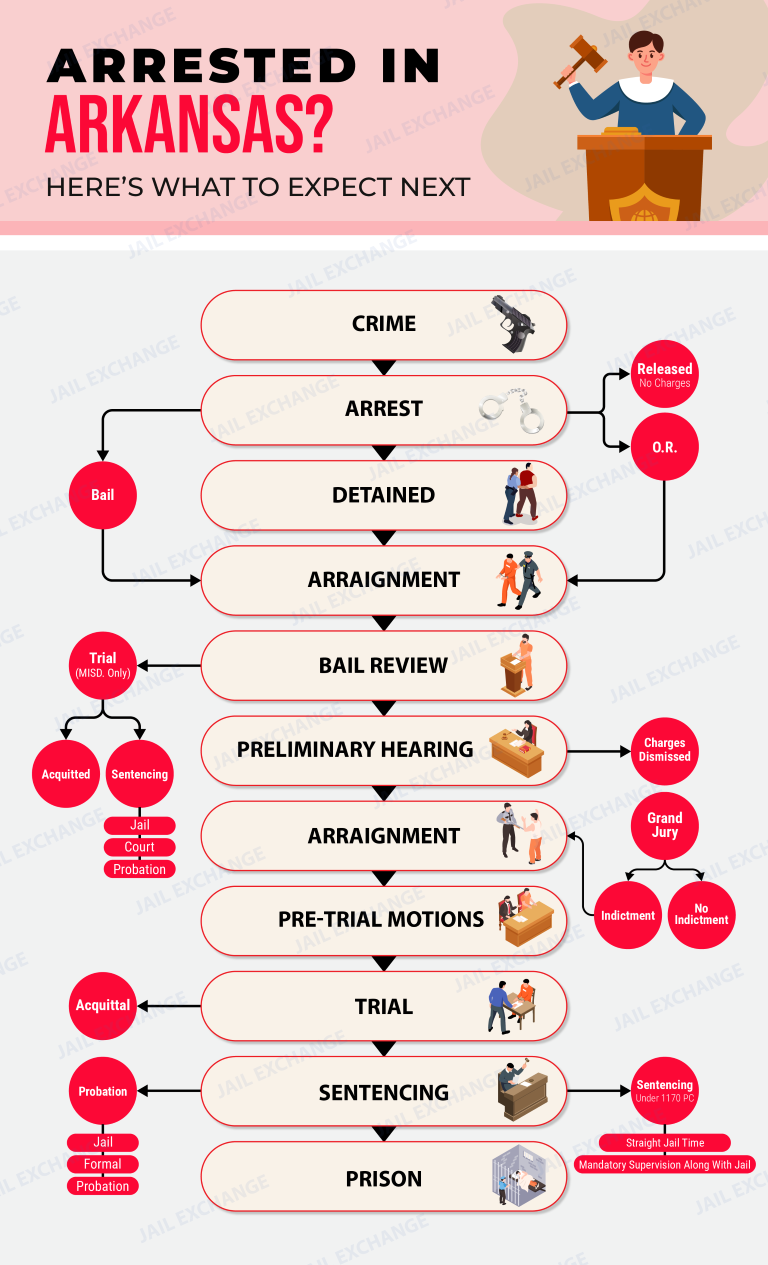
College students, travelers on I-30 and longtime residents all pass through Clark County’s district court on misdemeanor charges. The department that hears a case depends on where the offense took place and which agency filed it. Most start with a ticket. Someone who is jailed must be brought to a judge promptly, and release on a signature or small bond is the norm.
Under Arkansas law, the highest penalties for misdemeanors are a year in jail and $2,500 for Class A, 90 days and $1,000 for Class B, and 30 days and $500 for Class C. Theft of property worth up to $1,000 counts as a Class A misdemeanor, and so does battery in the third degree. Simple trespass is Class C. Going into a building someone occupies makes it Class B. A first DWI is penalized under its own section of the code: 24 hours to a year in jail, $150 to $1,000 in fines, an alcohol education program and losing the license for a time, though an interlock device is often allowed instead. Underage drivers face separate, lower blood-alcohol limits.
District court judges try cases without juries. A defendant can appeal a conviction to Clark County Circuit Court within 30 days and get a new trial there, where a jury may be requested. A public defender may be appointed for an indigent defendant facing jail, and Arkansas judges may set a user fee depending on income. Most cases end with a fine, probation, a suspended sentence or completion of classes.
When a minor is accused of a misdemeanor, the case is usually referred to the juvenile division of Clark County Circuit Court in Arkadelphia. Intake staff and the prosecutor often offer diversion to first offenders; if the youth completes the required classes, community service or restitution, the case closes without an adjudication. Traffic and some minor offenses involving teens, such as curfew or tobacco violations, can be handled in district court.
Clark County felonies, from burglary and big thefts to drug sales and a repeat DWI
After a felony arrest, the person stays in sheriff's custody, sometimes in a boarding jail, until the first appearance. At that hearing a judge confirms probable cause, which must be done within 48 hours after an arrest without a warrant, sets bail and considers appointing a public defender. Arkansas’s constitution makes bail available for every offense except capital crimes where the proof is evident. Bail bondsmen operating in the county are licensed by the Professional Bail Bond Company and Professional Bail Bondsman Licensing Board.
The 9th District–East Prosecuting Attorney files felony charges by information in circuit court, since Arkansas seldom convenes grand juries. An arraignment follows, and then the case is set for pretrial hearings. Rule 28.1 requires trial within 12 months of arrest or charge, excluding certain delays. Twelve jurors hear a felony trial, and in Arkansas the jury generally sets the sentence if it convicts.
Arkansas uses five felony grades. The mildest, Class D, has a 6-year ceiling, and Class C a 3-to-10-year window. Class B and Class A widen to 5–20 and 6–30 years, while the top grade, Class Y, means somewhere between 10 and 40 years or else life. A Clark County judge can add a fine of as much as $10,000 at the two lowest grades and $15,000 at Class A or B. Burglarizing a residence is graded B; burglarizing a commercial building is graded C. Theft becomes a felony when property is worth more than $1,000. Delivery charges get their class from the substance and amount. The fourth DWI in a ten-year span is charged as a felony. Most felony cases are resolved by plea, often with probation or drug court for first offenders.
A youth's felony usually starts in juvenile court, and if the youth is held, a detention hearing must come within 72 hours. Arkansas law, Ark. Code 9-27-318, gives the prosecutor discretion to file any felony against a youth aged 16 or older in adult court, and a transfer hearing may follow. Juvenile court can impose probation, treatment or commitment to the Division of Youth Services, and extended juvenile jurisdiction is available for serious offenders.
Violent Clark County cases such as killings, rape and armed robbery
The steps in a violent felony case mirror other felonies, but release is much harder. A capital defendant can be held without bail when the evidence is strong, and judges commonly set high bonds for other violent charges. Arkansas law allows only death or life without parole for capital murder, while rape, aggravated robbery and first-degree murder are Class Y felonies. Indigent capital defendants receive two qualified defense lawyers.
Crimes committed on or after January 1, 2025, fall under the Protect Arkansas Act of 2023. For crimes on its full-term list, which includes capital murder, rape and aggravated robbery, no early release is allowed, and those convicted of second-degree murder, manslaughter and certain other offenses must serve at least 85% before release. Arkansas’s most recent execution was in 2017. As of April 2026, 23 men were under a death sentence, and a 2025 law added nitrogen hypoxia as an execution method alongside lethal injection.
Victims are owed timely word of hearings and release. Arkansas law also lets them attend, talk things over with the prosecutor, address the judge at sentencing and collect restitution. The prosecutor’s victim-witness coordinator can help, and the Crime Victims Reparations program may help with certain costs. A year or longer is common for these cases.
Clark County teenagers accused of the most serious crimes may be tried as adults. A 14- or 15-year-old charged with capital murder, first-degree murder, rape, aggravated robbery, kidnapping or another listed offense can be prosecuted in the criminal division, and youths 16 and older can be charged there for any felony. A detained youth is entitled to a transfer hearing within 30 days, and transfer requires clear and convincing evidence. Arkansas can't seek death against someone who was 17 or younger at the time, and a 2017 state law means even a juvenile capital murder conviction eventually leads to a parole hearing.
Clark County court addresses and phone numbers
Circuit court is in Arkadelphia, and district court has three departments:
- Clark County Circuit Court: 401 Clay Street, Arkadelphia, AR 71923, circuit clerk 870-246-4281
- District Court, Arkadelphia Department (also Gurdon cases): Arkadelphia, 870-246-9552
- District Court, Caddo Valley Department: 137 Malvern Road, Arkadelphia, AR 71923, 870-246-8283
- District Court, Amity Department: Amity, AR 71921
Circuit court handles felonies, juvenile cases and appeals. District court hears misdemeanors and traffic and holds first appearances after felony arrests.
Clark County charges that go to federal court
Federal cases from this county often grow out of drug traffic on Interstate 30, felons with guns or fraud against federal programs. They are heard in the Hot Springs Division of the U.S. District Court for the Western District of Arkansas, at the federal courthouse in Hot Springs, 100 Reserve Street, Hot Springs, AR 71901, 833-853-0345.
- A U.S. magistrate judge conducts the opening hearing.
- Pretrial Services hands the judge a background report.
- The prosecutor can ask that the defendant stay jailed, which leads to a detention hearing.
- A grand jury indictment comes before any felony trial.
- The U.S. Marshals have custody of federal prisoners: U.S. Marshals Service, 30 South 6th Street, Fort Smith, AR 72901, 479-289-7470 or 479-424-5000 (call either).
One arrest can lead to charges in Arkadelphia and in federal court. Each case is handled separately.
How to look up a Clark County inmate
- Clark County jail: Clark County Inmate Search. A surname search lists charges and when the person was booked.
- VINE: VINELink (https://vinelink.vineapps.com/). Select Arkansas, search the name, and see which jail holds the person. Alerts are free.
- Federal Bureau of Prisons: Federal Bureau of Prisons Inmate Locator (https://www.bop.gov/inmateloc/). Search a name or register number.
- Arkansas Division of Correction: Arkansas Division of Correction Inmate Search (https://apps.ark.org/inmate_info/). Look up a state prisoner by name or ADC number.
ICE detainers and where Clark County detainees are taken
ICE files a detainer to ask the Arkadelphia jail for as much as 48 extra hours of custody past release, counting weekends and holidays. The county case is not dropped because of it.
The ICE New Orleans Field Office, 181 James Drive W, St. Rose, LA 70087, 504-318-2360 covers Arkansas, and many detainees are moved to Louisiana:
- LaSalle ICE Processing Center: 830 Pinehill Road, Jena, LA 71342 · 318-992-1600
- Pine Prairie ICE Processing Center: 1133 Hampton Dupre Road, Pine Prairie, LA 70576 · 337-599-2400
Search the ICE Online Detainee Locator System (https://locator.ice.gov/odls/) with an A-number. The fallback is the full name with birth country.
This is a general sketch of Clark County's criminal courts. It isn't legal advice, so bring any pending charge to a defense lawyer, or phone the Clark County Circuit Clerk at (870) 246-4281 with questions on getting a public defender.
Call the circuit clerk at 870-246-4281 to confirm a felony court date. District court, reached at 870-246-9552, can confirm misdemeanor and traffic settings.