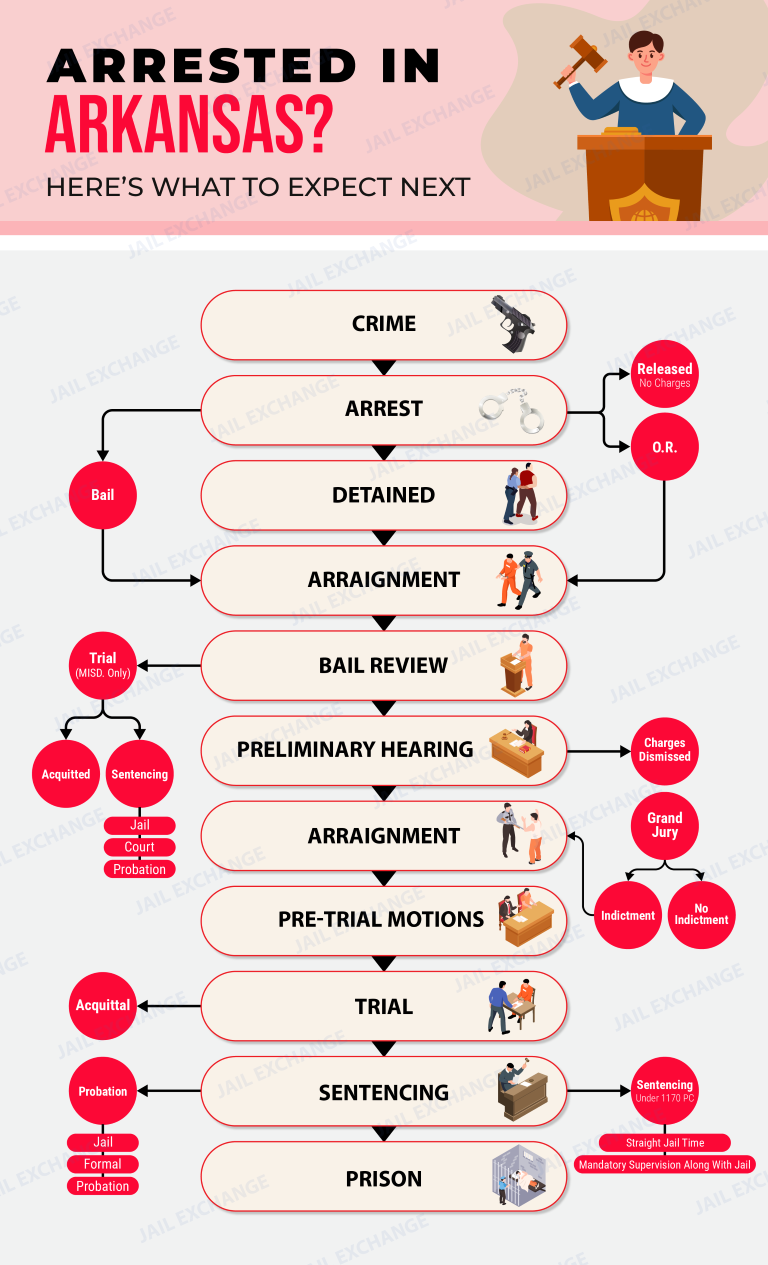
Columbia County Detention Center Criminal Court Process
Criminal Court Process for Columbia County Arkansas
Columbia County Criminal Courts: From Arrest to Verdict
Columbia County sits on the Louisiana line in south Arkansas, and Magnolia, home of Southern Arkansas University, is its county seat and court center. Felony trials take place in the Columbia County Circuit Court at the Columbia County Courthouse, 1 Court Square, Magnolia, AR 71753. The Circuit Clerk’s office answers at (870) 235-3700. Columbia is part of the Thirteenth Judicial Circuit, whose six counties are Columbia, Union, Ouachita, Calhoun, Dallas and Cleveland. Besides felonies, the circuit court runs the county’s juvenile court through its juvenile division and hears new trials on cases appealed from district court.
Misdemeanors and traffic charges, along with first appearances in many felony arrests, belong to the Columbia County District Court. Its Magnolia department can be reached at (870) 234-7312, and a separate Waldo department handles cases from that town at (870) 693-2198. Charges under state law, felony or misdemeanor, are brought by the elected Prosecuting Attorney for the Thirteenth Judicial District. Qualifying defendants are represented by the district’s public defenders, funded by the state's Public Defender Commission.
Unlike most of its circuit neighbors to the north, Columbia County falls within the U.S. District Court for the Western District of Arkansas. Its federal cases go to the El Dorado Division, which sits in the federal building at 101 S. Jackson Avenue, El Dorado, AR 71730; the clerk’s office there is at (870) 862-1202. A state crime is one that violates Arkansas law and is charged in Magnolia by the district prosecuting attorney. A federal crime is one that Congress has outlawed, and those cases generally have an interstate or national connection: hauling drugs from Louisiana or Texas, a felon possessing a firearm, robbing a bank with federally insured deposits, mail and wire fraud, or cheating a federal program such as student financial aid. The U.S. Attorney for the Western District decides whether to bring those charges, often after an investigation by federal agents working with local police.
The links that follow sort Columbia County cases by type of charge.
- Magnolia and Waldo misdemeanors: low-value theft, first DWI, battery, trespass
- Columbia County felony charges: burglary, major theft, drug sales, fourth-offense DWI
- Columbia County violent felonies: capital murder, murder, rape, aggravated robbery
- Magnolia and Waldo court addresses and phones
- Federal prosecution of Columbia County cases
- Searching for a Columbia County inmate
- ICE holds on Columbia County prisoners
Magnolia and Waldo misdemeanors: low-value theft, first DWI, battery, trespass
Police in Magnolia, Waldo and the county’s smaller towns, the sheriff’s office and state troopers all file misdemeanor cases in district court. Often the person simply receives a ticket with a court date. Jail time before seeing a judge must be brief, and under Arkansas’s release rules a judge adds only the conditions it takes to get the defendant back for each hearing. Where a money bond is set, licensed bail bond companies regulated by a state licensing board can post it for a fee.
Class A misdemeanors such as third-degree battery and theft of property valued at $1,000 or under are punishable by as much as 12 months and $2,500. The limits for Class B are 90 days and $1,000, and for Class C they are 30 days and $500. Criminal trespass is charged as one of the two lower classes depending on the location. A first conviction for DWI carries between 24 hours and one year behind bars, a fine of $150 to $1,000 and a suspension of driving privileges, typically with an ignition interlock device needed to drive on a restricted permit.
Each case is decided by the district judge, not a jury. A defendant who loses may appeal to the Columbia County Circuit Court within 30 days and have it tried all over again, jury included if the defendant wants one. Most people, though, resolve their cases sooner by pleading to the charge or a lesser one and receiving fines, probation, classes or a suspended sentence.
Children and teenagers under 18 accused of misdemeanors usually land in the Magnolia circuit court's juvenile docket. Before any petition is filed, the prosecutor may offer diversion, letting a young person with no record avoid an adjudication by meeting conditions such as curfew, school attendance, restitution or counseling. Juvenile traffic violations can still be heard in district court.
Columbia County felony charges: burglary, major theft, drug sales, fourth-offense DWI
After a warrantless felony arrest, Arkansas requires a judge to determine within 48 hours whether reasonable cause supported it. At the defendant’s first appearance, commonly before a district judge, bond is set and appointed counsel is addressed. People requesting a public defender sign an affidavit describing their finances, and the court has authority to order a contribution toward the cost of representation.
The Thirteenth District prosecutor generally charges felonies by information filed in circuit court; grand jury indictments are uncommon in Arkansas. Once the defendant is arraigned in Magnolia, the case proceeds through discovery, plea negotiation and motions. Rule 28.1 sets a 12-month deadline for trial, though time attributable to the defense or other excluded periods does not count. A 12-person jury decides guilt, and Arkansas juries typically go on to set the punishment as well.
Arkansas sentences felonies by class. Class Y means 10 to 40 years or life; Class A, 6 to 30 years; Class B, 5 to 20; Class C, 3 to 10; Class D, no more than 6. Residential burglary is graded as Class B, and burglary of a business or other commercial structure as Class C. Once the value of stolen property exceeds $1,000, the theft is a felony. Drug delivery charges climb in seriousness with the type and amount of the substance, and a fourth DWI in ten years becomes a felony. A large share of these cases resolve by plea, frequently with probation for defendants without serious prior records.
Columbia County teenagers accused of felonies may land in either court. Prosecutors can file a felony against a 16- or 17-year-old as a juvenile matter or as an adult case, and a transfer hearing allows a judge to move the case after considering factors such as maturity, prior history, violence and prospects for rehabilitation. Detained youths must be given a detention hearing within 72 hours. Juvenile court dispositions range from probation to commitment to the state Division of Youth Services, and an Extended Juvenile Jurisdiction designation can keep a youth under the court’s control past 18 with an adult sentence available if the youth does not comply.
Columbia County violent felonies: capital murder, murder, rape, aggravated robbery
Prosecutions for the most serious violent crimes move through the same circuit court stages, but release is harder to obtain and the penalties are much longer. Under the state constitution, a capital defendant facing strong evidence may be refused bail, so a capital murder defendant can be held without bond until trial.
Rape, aggravated robbery and first-degree murder carry Class Y sentences starting at 10 years. A capital murder conviction in Magnolia ends in one of only two sentences: execution, or prison for life without parole. For offenses committed on or after January 1, 2025, the Protect Arkansas Act requires anyone found guilty of capital murder, rape or aggravated robbery to serve 100% of their sentences, and those convicted of second-degree murder to serve at least 85%. Arkansas last carried out an execution in 2017, and 23 men were awaiting execution in April 2026. State law authorizes lethal injection and, since 2025, nitrogen hypoxia.
Victims of violent crimes in Columbia County are protected by Ark. Code 16-90-1101 and related sections. Those provisions give victims notice of hearings, a say before plea deals and release decisions, and to deliver an impact statement before sentencing. The prosecuting attorney’s victim-witness staff serve as the point of contact.
For juveniles, Arkansas law permits adult charges against a 14- or 15-year-old charged with the most serious violent crimes, such as capital or first-degree murder, rape, kidnapping or a terroristic act. A judge can still return such a case to juvenile court or designate it for Extended Juvenile Jurisdiction after a hearing. No one who was under 18 when the offense occurred can be sentenced to death, and a juvenile convicted of capital murder is eligible for parole after 30 years under the Fair Sentencing of Minors Act of 2017.
Magnolia and Waldo court addresses and phones
Columbia County's criminal cases are heard by these courts:
- Columbia County Circuit Court: Columbia County Courthouse, 1 Court Square, Suite 3, Magnolia, AR 71753, 870-235-3700
- District Court, Magnolia Department clerk: 82 Columbia Road 300, Magnolia, AR 71753, 870-234-7312
- District Court, judge's office: 517 North Jackson Street, Magnolia, 870-234-4727
- District Court, Waldo Department: 870-693-2198
Magnolia's circuit court tries felonies and also hears youth cases and appeals from district court. Misdemeanors, traffic tickets and a felony defendant's first appearance stay in district court.
Federal prosecution of Columbia County cases
Offenses like interstate drug trafficking, a felon caught with a firearm, bank robbery or fraud on a federal program are tried in the El Dorado Division of the U.S. District Court for the Western District of Arkansas, at the federal courthouse in El Dorado, 101 South Jackson Avenue, El Dorado, AR 71730, 833-853-0345.
- A magistrate judge conducts the first appearance.
- Pretrial Services gives the judge a background study.
- A detention hearing is held when prosecutors ask that the defendant stay jailed.
- A felony trial requires a grand jury indictment first.
- The U.S. Marshals are responsible for federal detainees: U.S. Marshals Service, 30 South 6th Street, Fort Smith, AR 72901, 479-289-7470 or 479-424-5000 (call either).
Columbia County and federal prosecutors can both bring charges over the same incident, and the cases are handled apart.
Searching for a Columbia County inmate
- Columbia County jail: Columbia County Inmate Search. Enter a surname to view charges and the booking time.
- VINE: VINELink (https://vinelink.vineapps.com/). Pick Arkansas, enter the name and learn the current facility, with free alerts.
- Federal Bureau of Prisons: Federal Bureau of Prisons Inmate Locator (https://www.bop.gov/inmateloc/). Federal inmates come up by name or register number.
- Arkansas Division of Correction: Arkansas Division of Correction Inmate Search (https://apps.ark.org/inmate_info/). Search a name or ADC number for the state unit.
ICE holds on Columbia County prisoners
A detainer from ICE asks the Magnolia jail to hold someone no more than 48 hours beyond release, counting weekends and holidays. The local case stays open.
The ICE New Orleans Field Office, 181 James Drive W, St. Rose, LA 70087, 504-318-2360 serves Arkansas, and detainees are often transferred to Louisiana:
- LaSalle ICE Processing Center: 830 Pinehill Road, Jena, LA 71342 · 318-992-1600
- Pine Prairie ICE Processing Center: 1133 Hampton Dupre Road, Pine Prairie, LA 70576 · 337-599-2400
Search the ICE Online Detainee Locator System (https://locator.ice.gov/odls/) by A-number, or by full name and country of birth.
The information on this page gives a broad picture of Columbia County criminal court, not legal advice. For a real case, ask a defense attorney, or you can phone the Columbia County Circuit Clerk at (870) 235-3700 to learn how appointed counsel is requested.
For felony settings, the Magnolia circuit clerk answers at 870-235-3700. For district court dates, call the Magnolia clerk at 870-234-7312 or the Waldo department at 870-693-2198.