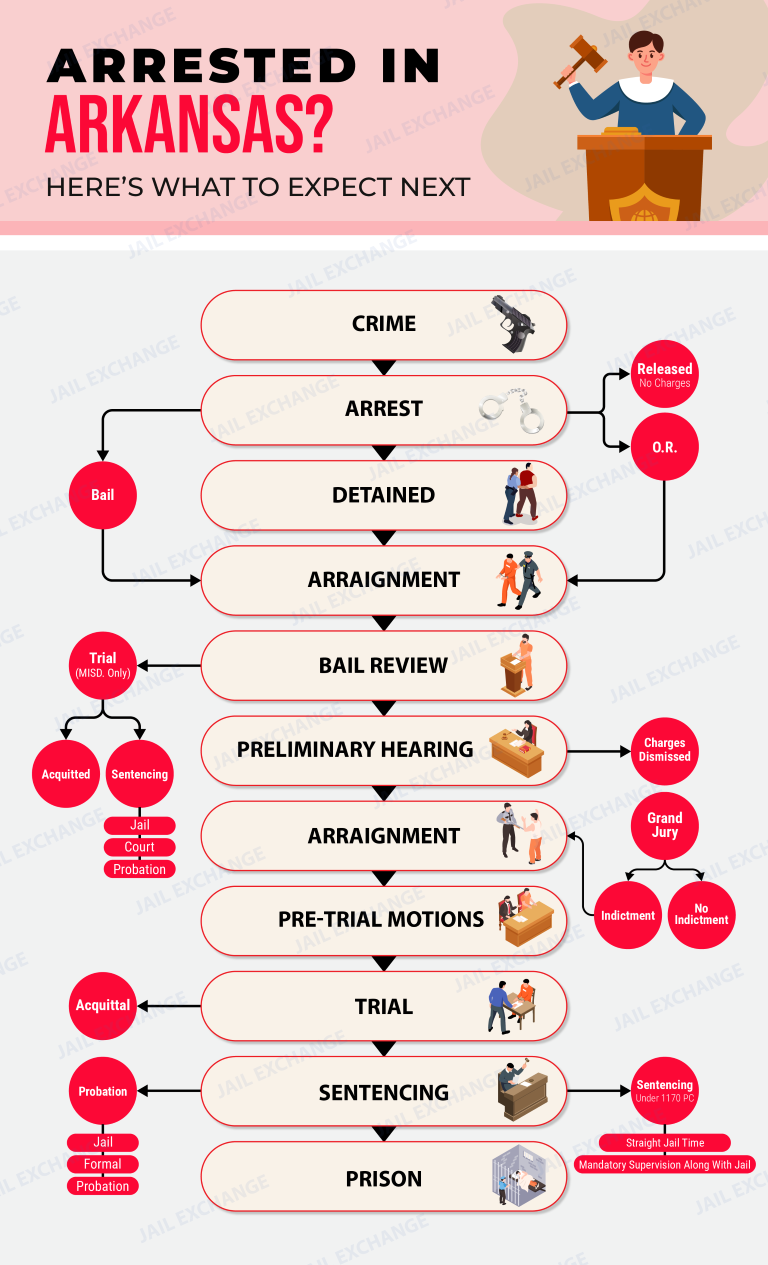
Izard County Detention Center Criminal Court Process
Criminal Court Process for Izard County Arkansas
From Arrest to Verdict in Izard County
Izard County is a hilly stretch of the Ozarks between the White and Strawberry rivers, with Melbourne as its county seat and Horseshoe Bend, Calico Rock and Mount Pleasant among its towns. Its criminal courts are small and closely tied to neighboring counties. Serious charges go to the Izard County Circuit Court, which belongs to the 16th Judicial Circuit along with Cleburne, Fulton, Independence and Stone counties. The circuit’s judges travel to the Izard County Courthouse, 80 E. Main Street, Melbourne, AR 72556, and the Circuit Clerk there answers at (870) 368-4316. That court decides felonies, sits as the juvenile court, and retries misdemeanors appealed from below.
Misdemeanors and traffic matters begin in the Izard County District Court, with departments for Melbourne and Horseshoe Bend. Its clerk’s office in Melbourne can be reached at (870) 368-4390, and the presiding district judge also serves Independence and Fulton counties from Batesville. Felony bond hearings and probable-cause reviews often happen here before a case moves up.
Izard County shares its elected prosecutor with the rest of the 16th Judicial District, and that office is headquartered in Batesville. Appointed lawyers come from the district’s public defender staff, whose salaries the state covers via the Arkansas Public Defender Commission. Arrested adults are booked into the Izard County Detention Center on Circle Drive in Melbourne. Calico Rock is also home to the North Central Unit, a state prison, but people held there are already serving sentences and are not part of the local court docket.
Izard County has no federal courthouse. Federal prosecutions arising here go to Jonesboro, home of the Eastern District of Arkansas’s Northern Division, and are heard at the U.S. Courthouse, 615 S. Main Street, Jonesboro, AR 72401 (clerk: (870) 972-4610). The dividing line is simple to state: Arkansas laws are enforced in Melbourne, and laws passed by Congress are enforced in federal court. Theft from a neighbor, a bar fight or drunk driving on a county road violates Arkansas statutes and is prosecuted locally. Counterfeiting, trafficking methamphetamine from out of state, lying on a federal firearms form, defrauding Social Security or Medicare, or threatening a federal officer violates federal statutes and is handled by the U.S. Attorney in federal court. Federal prison terms are served in Bureau of Prisons facilities rather than state units.
Each link below opens a walk-through for one family of charges.
- Lower-level offenses (theft of property under the felony line, first-offense DWI, battery, trespass)
- Felony prosecutions (burglary, felony theft, drug delivery, DWI as a felony)
- Violence-based felonies (murder including capital murder, rape, aggravated robbery)
- Where Izard County cases are heard
- Federal cases from Izard County
- Finding someone in custody
- ICE holds in Izard County
Lower-level offenses (theft of property under the felony line, first-offense DWI, battery, trespass)
Many Izard County misdemeanors begin with a citation that lists an appearance date, and nobody is booked. When deputies or Melbourne or Horseshoe Bend officers do take someone to the jail, the Arkansas rules require a prompt appearance before a judicial officer, and for warrantless arrests a judge’s probable-cause sign-off is due inside two days. Release on recognizance or on conditions is the starting point; a judge who sets a money bond can accept cash, and licensed bondsmen also write bonds in the county.
Most offenses at this level fall into one of three classes. Class A, which covers ordinary third-degree battery and minor shoplifting, can bring $2,500 in fines and as much as a year in the Circle Drive jail. Class B penalties stop at $1,000 and 90 days. Simple trespass is usually Class C, where the maximum drops to 30 days and $500. First-offense DWI stands outside the class structure and carries its own penalties, including possible jail, a fine, alcohol safety classes and license restrictions.
District court has no juries; the judge decides guilt or innocence. A month-long window follows any conviction for appealing to the Izard County Circuit Court, where a new trial starts from zero and jurors can be requested. Appointed counsel is available when a defendant faces jail and cannot afford a lawyer, and courts in Arkansas may order a modest public defender fee unless the defendant shows it would be a hardship.
Youths under 18 who are accused of misdemeanors usually appear before the juvenile judge of the circuit court in Melbourne, though some traffic and alcohol citations are written into district court. Many first-time referrals end with an informal agreement through juvenile intake, such as community service, a written apology or restitution, without a formal delinquency finding.
Felony prosecutions (burglary, felony theft, drug delivery, DWI as a felony)
Someone jailed in Melbourne on a felony is first seen by a district or circuit judge, who reviews the arrest, decides on bond and takes an application for a public defender. The prosecutor then has to formally charge the case in circuit court, usually through a document called an information rather than a grand jury indictment. Except for a capital charge backed by strong evidence, Arkansas law treats bail as a right.
At the circuit court arraignment the defendant enters a plea, and discovery, motions and plea talks follow. Rule 28.1 sets a one-year deadline to bring the case to trial, although time the defense uses or consents to is not counted. Felony trials use a 12-member jury, and a unanimous verdict is needed to convict. Arkansas is one of the few states where the jury, not just the judge, usually fixes the sentence after a conviction, though most Izard County felonies settle by plea long before then.
Arkansas sorts felonies into five classes. Class D carries up to six years, Class C three to 10, Class B five to 20, Class A six to 30, and Class Y 10 to 40 or life. Commercial burglary is generally a Class C offense, residential burglary a Class B. Theft becomes a felony once the value passes the statutory threshold, and drug delivery charges climb in class with weight. A fourth DWI committed within 10 years is a Class D felony.
For a juvenile, a felony charge can lead down two paths. A 16- or 17-year-old may be charged in the criminal division for any felony, and a judge may be asked to shift the case to the other division at a transfer hearing; when the youth is detained, that hearing must come within 30 days. A detention hearing is required within 72 hours of custody. Because Izard County lacks a juvenile lockup, detained youth are sent to a contracted regional center outside the county. If a delinquency finding is made, the judge may order probation, counseling, fines or a state commitment to Youth Services.
Violence-based felonies (murder including capital murder, rape, aggravated robbery)
Homicide, rape and armed robbery cases follow the felony path but move more slowly and with more at stake. For capital murder, Arkansas allows just two sentences: death, or life with no parole. Rape, first-degree murder and aggravated robbery are Class Y, the most serious felony class. For crimes committed in 2025 or later, Arkansas’s Protect Arkansas Act means no early release for new capital murder, rape and aggravated robbery convictions, and an 85% floor for second-degree murder plus several other violent and sexual crimes.
Death sentences are still imposed in Arkansas, yet the last execution took place in April 2017; roughly two dozen condemned men live in the Varner Supermax unit near Grady. A capital defendant in Izard County gets lawyers trained for death penalty cases, who often work with the Public Defender Commission’s capital defense lawyers. Bond in a capital case can be denied outright when the proof is evident.
Crime victims in Arkansas are entitled by statute to notification, to sit in on hearings and to give a statement when sentence is passed or parole is weighed. The 16th District prosecutor’s victim-witness program serves Izard County victims.
Teens aged 14 and 15 can be filed on as adults in Izard County only for the gravest charges, such as murder (capital or first-degree), terroristic acts, rape, aggravated robbery, kidnapping or first-degree battery. A juvenile judge can instead keep the case under Extended Juvenile Jurisdiction, which allows juvenile rehabilitation while holding an adult sentence in reserve if the youth fails. Offenders who were younger than 18 cannot be executed, and since a 2017 state law no juvenile offender can receive life without parole.
Where Izard County cases are heard
Two buildings in Melbourne hold most of the county's criminal work, with a second district court location in Horseshoe Bend:
- Izard County Circuit Court: Izard County Courthouse, 80 East Main Street, Melbourne, AR 72556, circuit clerk 870-368-4316
- Izard County District Court, Melbourne: 300 Circle Drive, Melbourne, AR 72556, clerk 870-368-4390
- Izard County District Court, Horseshoe Bend: 704 West Commerce Street, Horseshoe Bend, 870-670-5113
- 16th District Prosecuting Attorney: 368 East Main Street, Batesville, 870-793-8825
- 16th District Public Defender: Heber Springs office, 501-362-4611
Misdemeanors, traffic tickets and first bond hearings start in district court. Felonies, juvenile cases and fresh trials on appeals from district court go up to circuit court at the courthouse.
Federal cases from Izard County
A federal charge filed here goes to Jonesboro, where the Northern Division of the U.S. District Court for the Eastern District of Arkansas sits at the federal courthouse in Jonesboro, 615 South Main Street, Jonesboro, AR 72401, 870-972-4610.
- A magistrate judge hears the first appearance and explains the charge.
- A pretrial services officer reports on whether release is safe.
- The government can request that the defendant be held until trial.
- A grand jury must indict before a felony case goes to trial.
- The U.S. Marshals hold anyone not released: U.S. Marshals Service, 600 West Capitol Avenue, Little Rock, AR 72201, 501-324-6256.
One arrest in Izard County can lead to a state case in Melbourne and a federal case in Jonesboro at the same time.
Finding someone in custody
- Izard County Detention Center: Izard County Inmate Search. A name search shows current bookings.
- VINE: VINELink (https://vinelink.vineapps.com/). Set the state to Arkansas, find the facility holding the person, and turn on alerts.
- Federal Bureau of Prisons: Federal Bureau of Prisons Inmate Locator (https://www.bop.gov/inmateloc/). Look up federal prisoners by name or register number.
- Arkansas Division of Correction: Arkansas Division of Correction Inmate Search (https://apps.ark.org/inmate_info/). Search by name or ADC number to find the state prison unit.
ICE holds in Izard County
An ICE detainer asks the Melbourne jail to keep a person up to 48 hours after he or she would normally go free. That clock pauses on Saturdays, Sundays and holidays. The local case still moves forward on its own schedule.
The ICE New Orleans Field Office, 181 James Drive W, St. Rose, LA 70087, 504-318-2360 oversees Arkansas, and many north Arkansas detainees are sent to Louisiana:
- LaSalle ICE Processing Center: 830 Pinehill Road, Jena, LA 71342 · 318-992-1600
- Pine Prairie ICE Processing Center: 1133 Hampton Dupre Road, Pine Prairie, LA 70576 · 337-599-2400
Search the ICE Online Detainee Locator System (https://locator.ice.gov/odls/) with an A-number, or with a name and birth country.
This overview explains how criminal cases move in Izard County; please do not treat it as legal advice. A person facing charges is best served by a defense lawyer’s advice; to ask about appointed counsel, phone the Izard County Circuit Clerk at (870) 368-4316.
Before you drive to Melbourne, call the circuit clerk at 870-368-4316 for felony or juvenile dates, or the district clerk at 870-368-4390 for misdemeanor and traffic dates.