Little River Detention Center Criminal Court Process
Criminal Court Process for Little River County Arkansas
Criminal Cases in Little River County, Arkansas: From Arrest to Verdict
Little River County fills the far southwest corner of Arkansas, with Oklahoma on its western edge and the Red River curling along the south. Nearly every criminal matter here ends up in Ashdown. Felony prosecutions go to the Little River County Circuit Court; it belongs to the Ninth West Judicial Circuit, a four-county circuit shared with Howard, Pike and Sevier. Two circuit judges ride that circuit. Papers are filed with the Circuit Clerk at 351 North Second Street, Ashdown, AR 71822, (870) 898-7212. The same circuit judges run the juvenile docket and rehear appealed district court cases.
Lesser crimes, speeding tickets and the opening steps of a felony case land in the Little River County District Court.Departments:
- Ashdown department (Foreman cases are handled here too), Courtroom Building, 2115 North Constitution Avenue, Ashdown: (870) 898-7230
- Winthrop department, P.O. Box 176, Winthrop, AR 71866: (870) 381-7864
Every state charge here, felony or misdemeanor, is filed by the Prosecuting Attorney for the Ninth West Judicial District. That elected office assigns deputies to each of the four counties. Arrested adults are booked into the Little River County Detention Centeron U.S. 71 north of town.
Some cases bypass Ashdown entirely. For federal purposes, Little River is part of the Texarkana Division of the U.S. District Court (Western District of Arkansas). Its Texarkana courtroom sits in the federal building at 500 N. State Line Ave., Texarkana. Nobody staffs that office between hearings; call the court’s toll-free number, (833) 853-0345. What decides the forum? Whose law was broken. Statutes passed in Little Rock are enforced by the local prosecutor in Ashdown. Laws written by Congress are enforced by the U.S. Attorney. Think of meth or firearms hauled over the Oklahoma or Texas line, immigration violations, mail and wire fraud, a holdup at an FDIC-insured bank, or crimes on the Corps of Engineers acreage surrounding Millwood Lake.
Select a charge type below for a walk-through of a typical case.
- Ashdown district court cases: shoplifting-level theft, a first DWI, battery, trespass
- Circuit court felonies: burglary, felony theft, drug delivery, felony DWI
- The heaviest violent charges: homicide, rape and aggravated robbery
- Little River County court offices
- Federal court for Little River County
- Inmate searches for Little River County
- ICE detainers in Little River County
Ashdown district court cases: shoplifting-level theft, a first DWI, battery, trespass
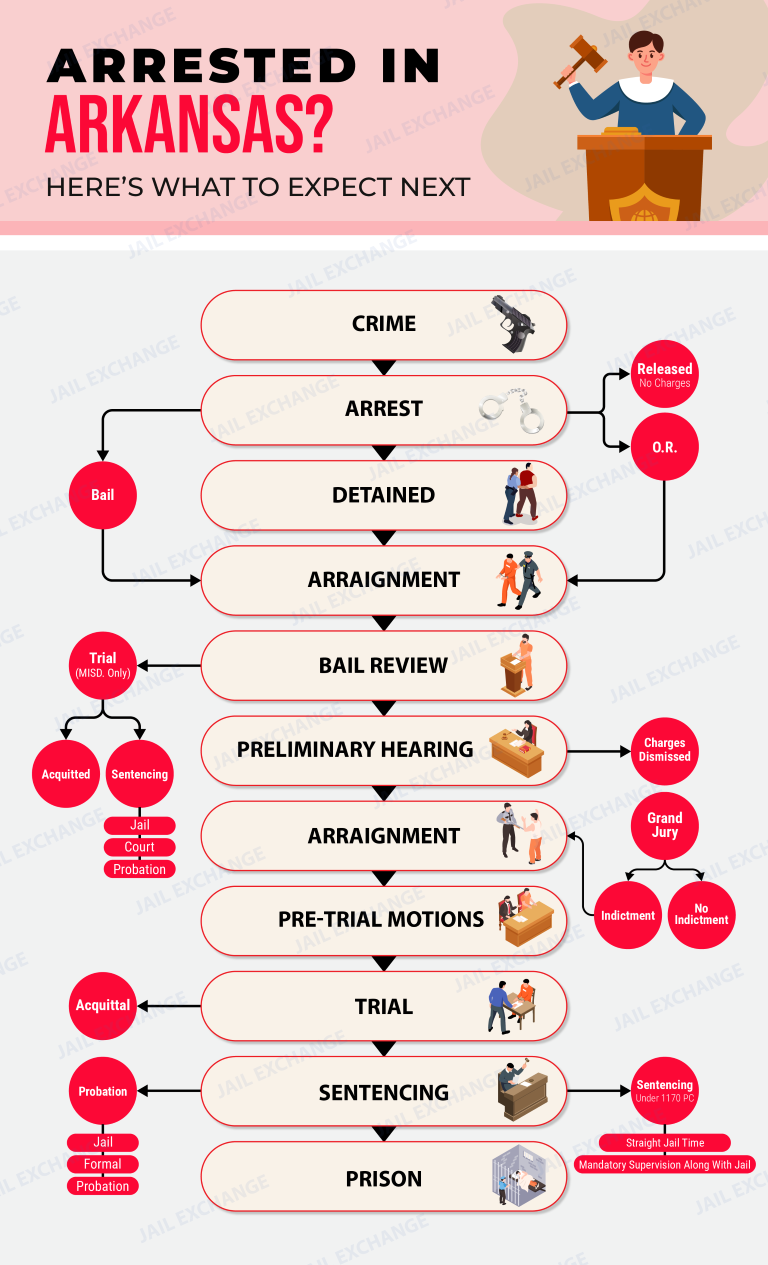
Most Little River misdemeanors start with a ticket that names a district court date. Officers may also arrest and book. Someone kept in custody goes before a judge promptly; Rule 8.1 of the state’s criminal procedure rules forbids “unnecessary delay.” For a warrantless arrest, a judge has 48 hours to find probable cause. Bail is a constitutional guarantee in Arkansas (Art. 2, § 8) for almost every charge. Judges are steered toward the lightest conditions likely to bring the person back. If a cash figure is set, relatives often hire a bondsman licensed by the state’s bail licensing board.
The maximums depend on class. Class A: a year at most, and up to $2,500. Stealing goods worth no more than $1,000 belongs there, as does third-degree battery. Class B: ninety days and $1,000. Class C: thirty days and $500. Trespass charges generally sit in one of those two lower tiers. First-offense DWI stands outside the class system; its own range runs from one day to a year in jail, with fines from $150 up to $1,000 and a suspended license.
A district judge, never a jury, rules on guilt in Ashdown. Anyone dissatisfied with that verdict gets thirty days to appeal. The circuit court then tries the case fresh, and a jury becomes available. A judge facing a defendant who risks jail yet has no money for counsel may appoint a public defender. Arkansas pays for that system through its Public Defender Commission. State law also tells the judge to impose a user fee, somewhere from ten dollars to four hundred, at the moment of appointment; it can be waived as too burdensome. A typical case ends in weeks or a few months.
Kids under 18 are different. Their misdemeanors usually skip district court and go to the circuit court’s juvenile judge in Ashdown. First offenses are frequently diverted. The youngster agrees to restitution, counseling or community work, and no formal delinquency case follows. Minors’ driving tickets, curfew cases and underage drinking or tobacco citations may still go before the district judge.
Circuit court felonies: burglary, felony theft, drug delivery, felony DWI
Once someone is arrested on a felony, a district judge often takes the first appearance, probable cause and bond, sometimes by video from the detention center. Grand juries are rare in Arkansas. Instead the Ninth West prosecutor files a charging paper called a felony information in circuit court, and arraignment follows in Ashdown. Under Rule 28.1, the state has twelve months from arrest or charging to start the trial. Time the defense asks for, or agrees to, is not counted.
Felony classes set the ranges. The top for Class D is six years; for Class C, 3 to 10; Class B, 5 to 20; Class A, 6 to 30. Class Y, the top tier, carries ten to forty years or life. Fines go as high as $10,000 for the two lowest classes and $15,000 for Classes A and B. Theft turns felonious once the loot is worth over $1,000. Burglary of a house: Class B. Burglary of a store or shop: Class C. A fourth DWI within ten years turns into a felony; that brings one to six years. Plenty of first-timers walk out with probation or a suspended sentence. A long record, though, usually means prison in the Arkansas Division of Correction. Twelve jurors hear a circuit court trial, and Arkansas juries normally fix the punishment as well.
Teenagers present the prosecutor with a choice. Ark. Code 9-27-318 hands that choice over. At sixteen or seventeen, any felony may go to either juvenile or adult court. At fourteen or fifteen, adult court is open only for a short list: kidnapping; rape; terroristic acts; first-degree battery; aggravated robbery; and capital or first-degree murder. Either side may then seek a transfer hearing, where the court weighs how serious the offense was, the youth’s past and maturity, and whether treatment could work before age 21. Any youth locked up awaiting the case is entitled to a detention hearing inside 72 hours; families can learn from the juvenile division where their child is being kept. A youth kept in juvenile court may be labeled an Extended Juvenile Jurisdiction offender. Supervision then continues past 18; an adult sentence stays suspended in the background.
The heaviest violent charges: homicide, rape and aggravated robbery
Homicide, rape and robbery cases use the felony route above. They simply move slower and risk far more. For capital charges, Arkansas lets a judge refuse bail outright when guilt is evident or strongly presumed. Other violent crimes tend to bring steep bonds.
A capital murder conviction leaves two options: death, or life with no parole. As of April 2026, the state held 23 condemned men. No execution has happened since April 2017, but lethal injection remains on the books, and the legislature approved nitrogen hypoxia in 2025. Class Y, with its ten-to-forty-or-life range, covers rape, aggravated robbery and first-degree murder; second-degree murder drops to Class A. For capital murder, rape or aggravated robbery, the Protect Arkansas Act requires the full term to be served when the crime occurred on or after January 1, 2025; second-degree murder falls on its 85-percent list. Rape also means sex-offender registration.
Victims hold rights under the Arkansas Crime Victims Rights Act, beginning at Ark. Code 16-90-1101: notice, a voice at sentencing and restitution among them. The Ninth West prosecutor’s staff can walk victims through those rights and the Attorney General’s reparations fund.
For teenagers, these are precisely the offenses that can be charged in adult court at 14 or 15. A teen who stays in the juvenile division on such a charge is a prime candidate for Extended Juvenile Jurisdiction. Execution is off the table for anyone under 18 when the offense happened. And since a 2017 law, the Fair Sentencing of Minors Act, someone convicted of capital murder for a crime committed as a minor becomes parole-eligible after thirty years instead of dying in prison.
Little River County court offices
District court sits with the jail on North Constitution Avenue, and the circuit clerk works from the courthouse downtown:
- Little River County Circuit Court: 351 North Second Street, Suite 5, Ashdown, AR 71822, circuit clerk 870-898-7212
- Little River County District Court, Ashdown department: Courtroom Building, 2115 North Constitution Avenue, Ashdown, AR 71822, 870-898-7230
- District Court, Winthrop department: P.O. Box 176, Winthrop, AR 71866, 870-381-7864
Misdemeanors, traffic and ordinance cases, plus the earliest hearings in felonies, belong to district court. Circuit court hears felony trials, juvenile delinquency and appeals of district court rulings, retrying those from the start.
Federal court for Little River County
A federal charge from Little River County is filed in the U.S. District Court for the Western District of Arkansas, Texarkana Division, at the federal courthouse in Texarkana, 500 North State Line Avenue, Texarkana, AR 71854, 833-853-0345.
- An initial appearance is held before a magistrate judge.
- Pretrial services reports on background and risk.
- The government decides whether to seek detention.
- Felony cases continue after a grand jury indicts.
- Those detained are held by the U.S. Marshals: U.S. Marshals Service, 30 South 6th Street, Fort Smith, AR 72901, 479-289-7470 or 479-424-5000 (call either).
The same conduct can bring both an Ashdown case and a federal case in Texarkana, each moving on its own.
Inmate searches for Little River County
- Little River County Detention Center: Little River County Inmate Search. Search by name to see current inmates.
- VINE: VINELink (https://vinelink.vineapps.com/). Use Arkansas to find custody status and set alerts.
- Federal Bureau of Prisons: Federal Bureau of Prisons Inmate Locator (https://www.bop.gov/inmateloc/). A name or register number pulls up federal inmates.
- Arkansas Division of Correction: Arkansas Division of Correction Inmate Search (https://apps.ark.org/inmate_info/). Search name or ADC number for the state prison unit.
ICE detainers in Little River County
When ICE lodges a detainer, the Ashdown jail is asked to keep the person up to 48 hours beyond a normal release, weekends and holidays included. The county prosecution keeps going during that time.
The ICE New Orleans Field Office, 181 James Drive W, St. Rose, LA 70087, 504-318-2360 covers Arkansas, and southwest Arkansas detainees are often transferred to Louisiana:
- LaSalle ICE Processing Center: 830 Pinehill Road, Jena, LA 71342 · 318-992-1600
- Pine Prairie ICE Processing Center: 1133 Hampton Dupre Road, Pine Prairie, LA 70576 · 337-599-2400
Find a detainee with the ICE Online Detainee Locator System (https://locator.ice.gov/odls/) by A-number, or by name and native country.
This page offers a broad description of how Little River County criminal cases work and does not replace legal advice. Get individual guidance on a pending charge from a criminal defense attorney; the Circuit Clerk at (870) 898-7212 can explain how to ask for appointed counsel.
Before you make the drive to Ashdown, call the circuit clerk at 870-898-7212 about felony or juvenile hearings, or the district clerk at 870-898-7230 about misdemeanor and traffic dates.