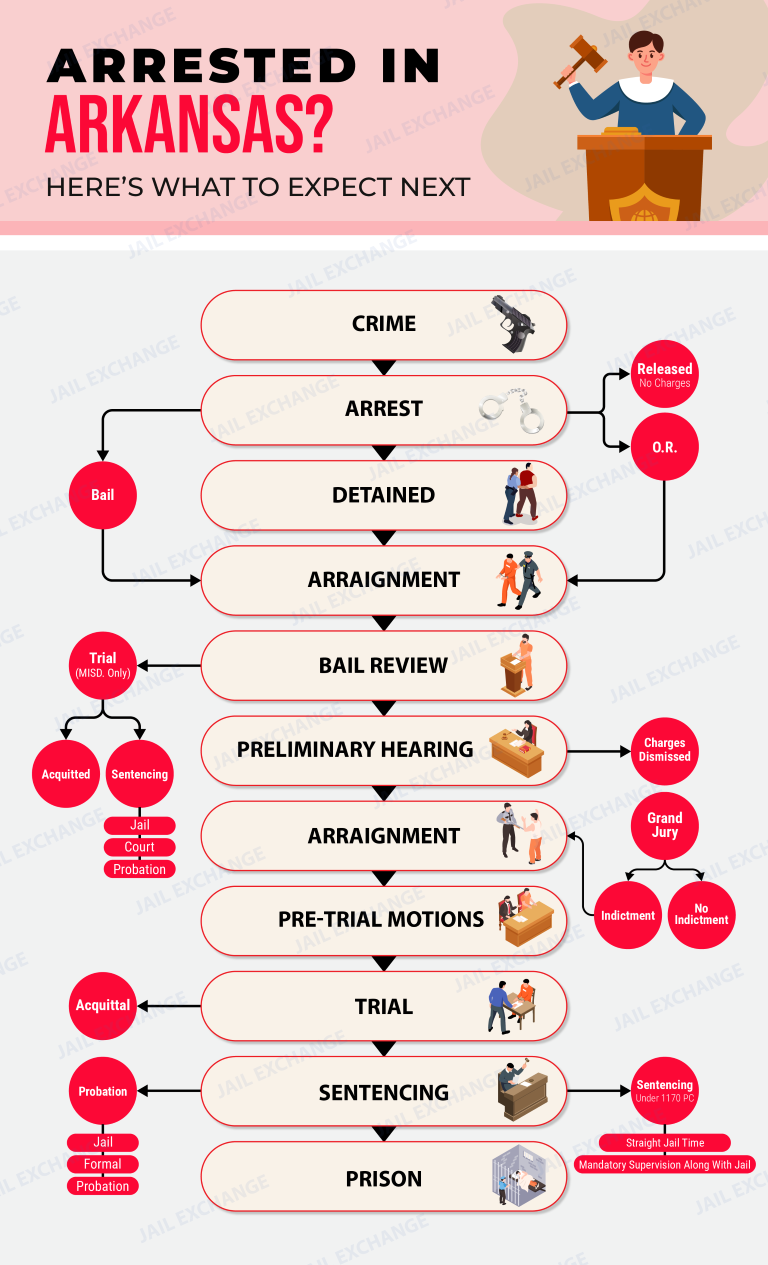
Nevada County Jail Criminal Court Process
Criminal Court Process for Nevada County Arkansas
Nevada County Criminal Courts: How a Case Unfolds
Nevada County, home to roughly 8,300 people, runs its criminal cases through two state courts that share one building in Prescott. The Nevada County Circuit Court handles every felony, hears appeals from the lower court and includes the county’s juvenile division. It meets in the Nevada County Courthouse, 215 E. 2nd Street South, Prescott, AR 71857; phone the circuit clerk’s office at (870) 887-2511. The county sits in the 8th Judicial Circuit–North, a two-county circuit it shares with Hempstead County, so the same circuit judges ride between Prescott and Hope.
Misdemeanors, traffic citations and the opening stages of felony cases start in the Nevada County District Court, Prescott Department, located in Suite 104 of the same courthouse at 215 East 2nd Street; the district court clerk answers at (870) 887-6016. State charges are filed by the elected Prosecuting Attorney for the 8th Judicial District–North, whose main office is in the Hempstead County Courthousein Hope.
Federal matters go to the Texarkana Division of the U.S. District Court for the Western District of Arkansas, which sits in the United States Courthouse and Post Office, 500 North State Line Avenue, Texarkana, AR 71854; the district’s clerk line is (833) 853-0345. What separates a state case from a federal one is the lawmaking body behind the charge. A shoplifting, a bar fight or a drunk-driving stop violates the Arkansas Code and stays with the local prosecutor. Breaking a law passed by Congress, for example running drugs on Interstate 30, robbing an insured bank or a felon carrying a gun, can be charged by the U.S. Attorney after investigation by agencies such as the FBI, DEA or ATF.
Choose a charge type below.
- Misdemeanor offenses (theft of property worth $1,000 or less, a first DWI, battery, trespass)
- Prescott felony cases (break-ins, thefts over $1,000, drug dealing, a fourth DWI)
- Grave violent cases (killings, rape, armed robbery)
- Nevada County court offices
- Federal court for Nevada County
- Inmate searches for Nevada County
- ICE detainers in Nevada County
Misdemeanor offenses (theft of property worth $1,000 or less, a first DWI, battery, trespass)
When a Nevada County deputy or a Prescott police officer stops someone for a low-level offense, the person usually walks away with a ticket naming a day to show up in Prescott district court. Anyone jailed instead is owed a prompt hearing under Rule 8.1 of the Arkansas Rules of Criminal Procedure, and an arrest without a warrant calls for a judge to approve the grounds within two days. State rules favor the lightest workable release terms, so plenty of misdemeanor defendants are released on their word or a small bond from a licensed company.
Penalties follow the class of the offense. Misdemeanor limits are a year and $2,500 for Class A, 90 days and $1,000 for Class B, and 30 days and $500 for Class C. Theft of $1,000 or under and third-degree battery rank as Class A, while trespass is mostly Class C. A first DWI stands outside the classes: one day to a year behind bars, $150 to $1,000 in fines, a suspended license and alcohol classes.
In district court, the judge alone decides guilt. An appeal to Nevada County Circuit Court within 30 days starts the case over, and a jury can be requested this time. Defendants who could be jailed but cannot pay an attorney may request appointed counsel; public defenders in Arkansas are funded through the state’s Arkansas Public Defender Commission, and judges may assess a public defender user fee that can be reduced or waived based on finances.
Under 18: Teen misdemeanors are mostly sent to the juvenile division of Nevada County Circuit Court, where a juvenile officer reviews the case and may recommend an informal adjustment such as counseling, restitution or community work instead of a formal delinquency petition. Traffic tickets issued to young drivers are commonly handled in district court. Arkansas law gives a detained youth a hearing on detention inside 72 hours. A young person may have counsel throughout a delinquency case, start to finish.
Prescott felony cases (break-ins, thefts over $1,000, drug dealing, a fourth DWI)
A felony arrest in Nevada County typically leads to a first appearance in district court in Prescott, where the judge reviews the charge, checks probable cause for a warrantless arrest, fixes bond and decides on appointed counsel. From there the file goes to circuit court. Instead of using a grand jury, the 8th North prosecutor ordinarily files a felony information, a written charge that the Arkansas Constitution permits in place of an indictment.
Rule 28.1 sets the speedy-trial clock: a defendant must generally be brought to trial within 12 months of arrest or charge, not counting delays the defense causes or requests. Felony juries in Arkansas have 12 members, and the verdict must be unanimous. When a jury convicts, it typically also hears evidence on punishment and recommends a sentence within the statutory range.
Those ranges are set by class. Class D allows up to 6 years; Class C runs 3 to 10 years; Class B runs 5 to 20; Class A runs 6 to 30; Class Y runs 10 to 40 years or life. Fines can reach $10,000 for Class B, C and D and $15,000 for Class A and Y. Breaking into a home counts as residential burglary, a Class B felony, while entering a store or other business to commit a crime is Class C commercial burglary. Theft rises to a Class D felony above $1,000, to Class C above $5,000 and to Class B above $25,000. Delivering methamphetamine or cocaine is graded by weight, from Class C for small amounts up to Class Y for 200 grams or more. Four DWIs inside ten years make the last one a Class D felony, and later ones rank higher.
Under 18: Arkansas gives the prosecutor real discretion here. For a 16- or 17-year-old accused of any felony, the prosecutor may file in either the juvenile division or the criminal division of circuit court. If the case lands in one division, either side may ask the court to transfer it to the other, and the judge looks at things like how serious the offense was, the teen’s past record and maturity, and whether rehabilitation services are available before age 21. If it stays in juvenile court, outcomes include probation, a live-in program, or commitment to the Division of Youth Services. For certain serious offenses the prosecutor may also request Extended Juvenile Jurisdiction, which lets the court impose a juvenile disposition now while holding an adult sentence in reserve.
Grave violent cases (killings, rape, armed robbery)
Article 2, Section 8 of the Arkansas Constitution guarantees bail before conviction except in capital cases where the proof is evident or the presumption great, so a capital murder defendant can be kept with no bond.
- Capital murder: the only crime in Arkansas punishable by death; the alternative is life without parole. The state has 23 men under death sentences, executes at the Cummins Unit, and authorized nitrogen hypoxia alongside lethal injection in 2025. Its most recent execution was in April 2017.
- First-degree murder: a Class Y felony carrying 10 to 40 years or life. A second-degree murder conviction is graded one step lower, as Class A.
- Rape and aggravated robbery: both Class Y felonies, punishable by 10 to 40 years or life.
Arkansas’s Protect Arkansas Act (Act 659 of 2023) cut back early release for offenses dated January 1, 2025, or later. Capital murder, rape and aggravated robbery convictions now require the full term to be served, while those found guilty of second-degree murder, manslaughter and several other listed crimes must serve at least 85%. Victims are entitled by statute to get notice of hearings, attend them, and talk to the judge before sentencing, and the prosecutor’s office in Hope assigns a victim-witness coordinator to help families through the process.
Under 18: For 14- and 15-year-olds, adult-court charges may be filed directly only for a short list of grave offenses, including capital murder, first-degree murder, kidnapping, aggravated robbery, rape and first-degree battery. Older teens charged with these crimes can also be prosecuted as adults under the general felony rule. A transfer hearing remains available, and the youth bears the burden of proving by clear and convincing evidence that the case belongs in juvenile court. Death is off the table for anyone convicted of a crime committed as a minor, and since a 2017 Arkansas law on sentencing minors, a teen convicted of capital murder receives life with the possibility of parole after 30 years rather than life without parole.
Nevada County court offices
Both of Nevada County's criminal courts are in the Prescott courthouse:
- Circuit Court and Circuit Clerk: 215 East 2nd Street South, Suite 103, Prescott, AR 71857, 870-887-2511
- District Court, Prescott Department: 215 East 2nd Street South, Suite 104, Prescott, AR 71857, 870-887-6016
The Prescott district court starts most cases, including lesser crimes, tickets and the early stage of felonies. Circuit court tries felonies, handles juvenile cases and reviews district court appeals.
Federal court for Nevada County
Nevada County federal charges go to the U.S. District Court for the Western District of Arkansas, Texarkana Division, at the federal courthouse in Texarkana, 500 North State Line Avenue, Texarkana, AR 71854, 833-853-0345.
- A magistrate judge conducts the initial appearance.
- Pretrial services gives the court a background report.
- The government can seek pretrial detention.
- A grand jury hands up most federal felony indictments.
- The U.S. Marshals hold federal prisoners for the court: U.S. Marshals Service, 30 South 6th Street, Fort Smith, AR 72901, 479-289-7470 or 479-424-5000 (call either).
One Interstate 30 stop near Prescott might lead to a state case, a federal case, or one of each.
Inmate searches for Nevada County
- Nevada County Jail: Nevada County Inmate Search. Check who is held at the Prescott jail.
- VINE: VINELink (https://vinelink.vineapps.com/). Pick Arkansas to look up custody across the state.
- Federal Bureau of Prisons: Federal Bureau of Prisons Inmate Locator (https://www.bop.gov/inmateloc/). Federal prisoners are searchable by name or register number.
- Arkansas Division of Correction: Arkansas Division of Correction Inmate Search (https://apps.ark.org/inmate_info/). Look up state inmates by name or ADC number.
ICE detainers in Nevada County
Through a detainer, ICE can ask the Prescott jail to hold someone up to 48 hours past release, and weekends and holidays count. The state case proceeds on its own.
The ICE New Orleans Field Office, 181 James Drive W, St. Rose, LA 70087, 504-318-2360 serves Arkansas, and detainees from this area often go to Louisiana:
- LaSalle ICE Processing Center: 830 Pinehill Road, Jena, LA 71342 · 318-992-1600
- Pine Prairie ICE Processing Center: 1133 Hampton Dupre Road, Pine Prairie, LA 70576 · 337-599-2400
Enter an A-number in the ICE Online Detainee Locator System (https://locator.ice.gov/odls/), or try a full name plus birth country.
Here is a broad picture of the Nevada County criminal process, offered as general help and not as legal advice. Someone with a pending charge should see a defense attorney or ask the Nevada County Circuit Clerk about appointed counsel at (870) 887-2511.
Phone the jail (870-887-2616) first, then call the circuit clerk (870-887-2511) for felony or juvenile dates or the Prescott district court clerk (870-887-6016) for misdemeanor dates.