Navigating the Los Angeles County Criminal Courts
Los Angeles County runs the largest trial court in the United States, with dozens of courthouses spread from Lancaster to Long Beach and from Malibu to Pomona. All of them belong to one institution, the Superior Court of California, County of Los Angeles. California eliminated its municipal courts around 2000 by merging them into a single superior court in each county, so even a misdemeanor filed in the City of Los Angeles is a superior court case, not a “city court” matter. The flagship criminal building is the Clara Shortridge Foltz Criminal Justice Center, 210 W. Temple Street, Los Angeles, CA 90012, named for California’s first woman lawyer and the person who first championed the idea of a public defender. County listings give its felony intake line as (213) 893-0751 and its misdemeanor intake line as (213) 974-1568. Next door to the downtown jails, the Central Arraignment Courts at 429 Bauchet Street, Los Angeles, CA 90012 handle many in-custody first appearances.
Outside downtown, criminal cases are heard in regional courthouses close to where the arrest happened. Some of the major ones:
- Airport Courthouse, 11701 S. La Cienega Boulevard, Los Angeles, CA 90045 (West District)
- Van Nuys Courthouse West, 14400 Erwin Street Mall, Van Nuys, CA 91401, and San Fernando Courthouse, 900 Third Street, San Fernando, CA 91340 (San Fernando Valley)
- Michael D. Antonovich Antelope Valley Courthouse, 42011 4th Street West, Lancaster, CA 93534 (North District)
- Pasadena Courthouse, 300 E. Walnut Street, Pasadena, CA 91101 (Northeast District)
- Pomona Courthouse South, 400 Civic Center Plaza, Pomona, CA 91766 (East District)
- Compton Courthouse, 200 W. Compton Boulevard, Compton, CA 90220 (South Central District)
- Governor George Deukmejian Courthouse, 275 Magnolia Avenue, Long Beach, CA 90802 (South District)
- Torrance Courthouse, 825 Maple Avenue, Torrance, CA 90503 (Southwest District)
- Norwalk Courthouse, 12720 Norwalk Boulevard, Norwalk, CA 90650 (Southeast District)
Many other branch courthouses also hear misdemeanors, so rely on the courthouse and department printed on your citation or bail paperwork, and use the court’s online location finder for directions and phone numbers. Then choose the type of charge below.
- Misdemeanor charges (petty theft, a first DUI, simple battery, trespassing)
- Felony charges (burglary, grand theft, selling drugs, felony DUI)
- Violent and serious felonies (murder, rape, armed robbery)
Misdemeanor charges (petty theft, a first DUI, simple battery, trespassing)
Who prosecutes a misdemeanor in Los Angeles County depends on the city where it happened. Inside the City of Los Angeles, the Los Angeles City Attorney files the charges. Long Beach has its own elected City Prosecutor, and Santa Monica, Pasadena, Burbank, Glendale, Inglewood, Torrance, Redondo Beach and Hermosa Beach also prosecute their own misdemeanors. Everywhere else, including unincorporated areas patrolled by the Sheriff’s Department, the Los Angeles County District Attorney handles them.
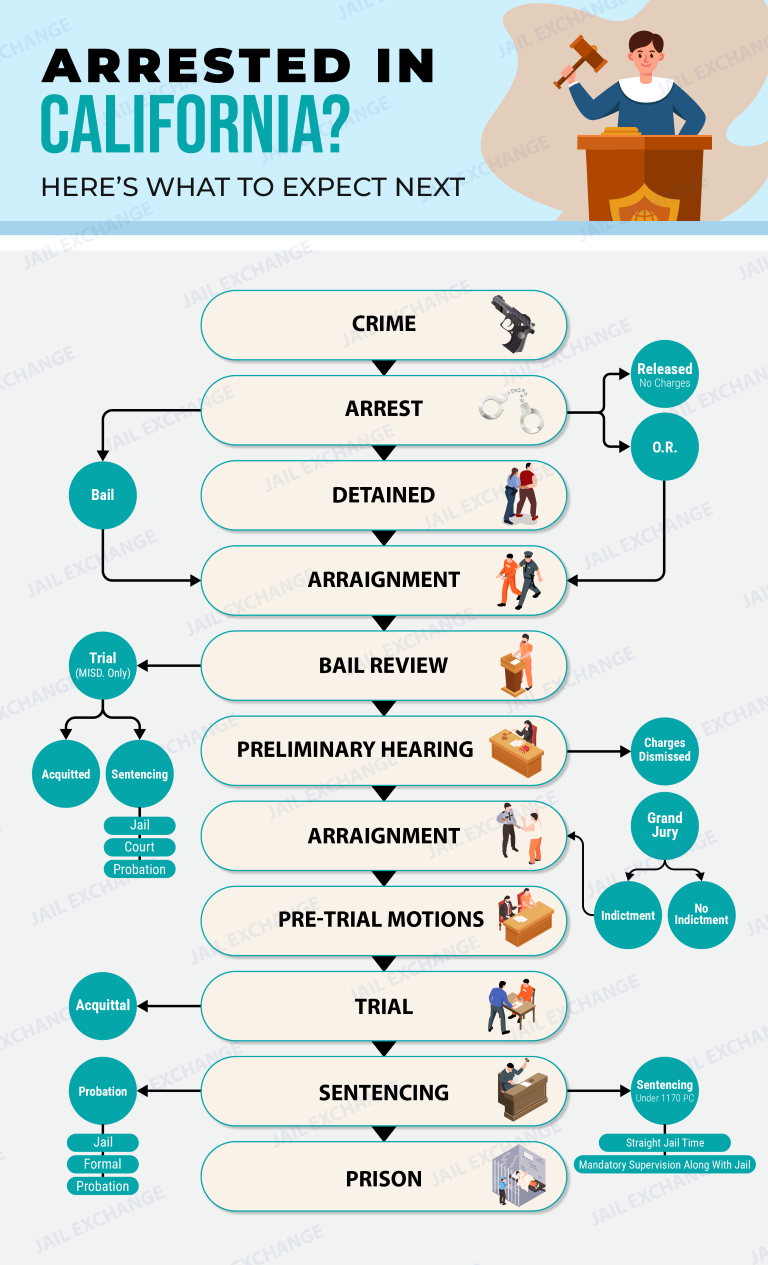
A large share of misdemeanor arrests end with a citation rather than a booking. The person signs a promise to appear and receives a date at the courthouse that serves the area. Someone who is booked, whether at a police station jail or the Sheriff’s Inmate Reception Center downtown, must be arraigned within 48 hours, excluding Sundays and holidays.
At arraignment the defendant hears the charges, usually pleads not guilty and learns the release terms. People who can’t afford a private lawyer and face possible jail are represented by the Los Angeles County Public Defender, the first government-run public defender office in the country, founded in 1914. California courts no longer charge defendants for appointed counsel. Under state law, a defense lawyer can often appear for a misdemeanor client who isn’t present.
Most misdemeanors are settled at pretrial conferences through a plea, a reduction or a dismissal. A judge may grant misdemeanor diversion, dismissing the charge once the person completes counseling, classes or other terms; DUI, domestic violence and offenses requiring sex-offender registration are excluded. Cases that go to trial are decided by 12 jurors, and the defendant can insist on trial within 30 days of arraignment if in custody or 45 days if out, though that time is usually waived.
Most misdemeanors are capped at six months in county jail and a $1,000 fine; some allow up to a year. Summary probation, fines, community labor and classes are the typical outcomes. The whole process usually lasts anywhere from a few weeks to a few months.
Felony charges (burglary, grand theft, selling drugs, felony DUI)
City prosecutors stop at misdemeanors. Every felony in the county, including those arising in Los Angeles, Long Beach and Pasadena, is filed by the Los Angeles County District Attorney. A defendant held in custody is arraigned on the felony complaint within 48 hours, either downtown at the Central Arraignment Courts or the Foltz center, or at the regional courthouse for the district where the arrest occurred. Release and bail are decided there. Since In re Humphrey (2021), the California Supreme Court has required judges to consider a person’s ability to pay before setting bail.
Indigent defense in Los Angeles has three layers. The Public Defender takes most appointments at arraignment. When it has a conflict, the case goes to the county’s separate Alternate Public Defender, and if that office is also conflicted, the court appoints a private attorney from a contracted panel.
The preliminary hearing comes within 10 court days of arraignment unless the defense waives the deadline. A judge listens to the evidence and decides whether it is enough to hold the defendant for trial. The District Attorney sometimes goes to the county criminal grand jury instead, especially in high-profile cases, which replaces the preliminary hearing. Once a case is held to answer, the DA files an “information,” a second arraignment follows, and trial must start within 60 days unless time is waived. Waivers are the norm, and pleas resolve the great majority of felonies.
The Los Angeles County Probation Department writes a presentence report after a conviction, and sentencing usually occurs within 20 court days. Many lower-level felonies are served in county jail under 2011 realignment, and “wobblers” may be charged or reduced as misdemeanors. The county also operates a broad set of collaborative courts, such as drug, veterans and mental health courts, that can offer treatment-based alternatives for eligible defendants. A felony case usually takes several months and often more than a year.
Violent and serious felonies (murder, rape, armed robbery)
Many of the county’s homicide and major-crime trials take place at the Foltz center downtown, though regional courthouses try serious cases as well. The procedure is the familiar felony sequence of arraignment, preliminary hearing or grand jury indictment, and trial. Bail is the first place the difference shows. Under article I, section 12 of the California Constitution, a judge can deny bail for a violent or sexual-assault felony on clear and convincing evidence that releasing the person carries a substantial likelihood of great bodily harm to others. Defendants in these cases frequently remain in the Sheriff’s custody until verdict.
These offenses qualify as strikes. A prior strike doubles the sentence, and two prior strikes can bring 25 years to life. For violent felonies, no less than 85% of the prison sentence has to be served.
- Murder: 15 years to life for second degree; 25 years to life for first degree. With a special circumstance, such as murder during a robbery or rape, the possible penalties are life without parole or death. Seeking death is solely the District Attorney’s decision, and California has been under an execution moratorium since 2019.
- Armed robbery: robbery carries up to nine years, and a gun enhancement can add 10 years, 20 years or 25 years to life depending on whether the firearm was used, fired or caused great bodily injury. Judges have had authority to strike those enhancements since 2018.
- Rape: up to eight years, more with aggravating factors, plus sex-offender registration at the highest tier.
Experienced trial lawyers from the Public Defender and Alternate Public Defender handle many of these cases, and two qualified attorneys are appointed whenever the prosecution seeks death. Marsy’s Law guarantees victims notice of proceedings, the right to be heard at sentencing and restitution. Given the investigation, forensic work and expert testimony involved, these cases typically take one to three years, and murder cases often take five or more.
This summary of how Los Angeles County criminal cases generally proceed is not legal advice. Anyone facing charges should speak with a criminal defense attorney or call the Los Angeles County Public Defender at (213) 974-2811 (the Alternate Public Defender’s main office is (213) 974-6626).