
Denver County Jail
Denver County Jail
Jail Phone Number
720-913-3600Picked up in Denver County: finding someone behind bars
The jail is the Downtown Detention Center, located in Denver; use Denver County Inmate Search or phone 720-337-0400. The Colorado Judicial docket shows future hearings by name. State cases are heard at the Denver County Court, Lindsey-Flanigan Courthouse, 520 W. Colfax Avenue, Denver, CO 80204.
To learn about warrants, phone the same number, the jail. Family members looking for someone in the Downtown Detention Center will find the building at 490 West Colfax Avenue, Denver, CO 80204. Rules and hours shift, so call the same number first.
Our Denver County bail and bond page explains release from the Downtown Detention Center in Denver, and our Denver County court guide follows the case from first appearance onward. Family may load money onto a phone account so the person can call.
Read inmate search answers
 Read inmate search answers
1. Where does Denver County hold people after an arrest?
Go to the Downtown Detention Center at 490 West Colfax Avenue, Denver, CO 80204 when you need the lockup. Denver also runs the Denver County Jail at 10500 East Smith Road 720-913-3642), which holds people for longer stays.
↑ Back to the question list2. How do I look up a Denver County inmate online?
Open Denver County Inmate Search to start. Not listed yet? Recent arrests in Denver lag behind. VINELink can send alerts if someone is released.
↑ Back to the question list3. How do I check Denver County for a warrant?
The official lookup is the Denver County Court public portal.
A lawyer may help arrange a surrender.
↑ Back to the question list4. How does bail work in Denver County?
- Who decides: a judge picks the amount and type.
- How fast: nearly everyone jailed in Denver should get a bond hearing within 48 hours after they arrive.
- Signature bond: the person pays nothing now and promises to show up in Denver court.
- Cash bond: you pay the entire amount.
- With a bail company, the cost is a fee that's kept; state law sets the most it can be at 15%, or $50 minimum.
- House as bond: property in Colorado may secure the bond when the paid-off share reaches 1.5 times the bond.
- The court may attach rules: curfews, testing or no-contact orders.
- Still held? A hold from elsewhere can stop release.
- Go to every court hearing: missing one can trigger new arrest orders and bond forfeiture.
- Before paying: call 720-337-0400 and ask about the current bond.
For everything else, use our Denver County bail guide.
↑ Back to the question list5. Where and when is the first Denver County court hearing?
A judge first sees the person at an advisement hearing. Phone the court at 720-337-0410 for the next hearing.
↑ Back to the question list6. Can someone arrested in Denver County get a free lawyer?
A free attorney is possible: the court reviews finances then may assign a public defender. The local public defender office answers at 303-620-4999.
↑ Back to the question list7. How do I visit someone arrested in Denver County?
Most visits are set up in advance. Read about visitation and remote visits.
↑ Back to the question list8. How can I talk with a Denver County inmate by phone?
Calls are made from the jail only; you can't call in. See: phone accounts, messaging, tablets.
↑ Back to the question list9. How do I put money on a Denver County inmate's account?
Commissary offers snacks, soap and paper. Use whatever method the Denver jail takes. Steps: deposits and commissary.
↑ Back to the question list10. How do I write to a Denver County inmate?
Envelopes should carry the person's whole booked name, the booking number and the Denver jail address. Skip anything taped on. Look at the mail guide.
↑ Back to the question list11. Where does a teen arrested in Denver County go?
A juvenile judge handles charges against teens as a rule. Detained youth may go to the Gilliam Youth Services Center, 303-291-8951. Staff at the jail at 720-337-0400 can inform parents where the youth is.
↑ Back to the question list12. What if a Denver County inmate needs medicine or care?
If someone needs insulin, phone 720-337-0400 so medical staff hears about it quickly. Keep the pill bottle handy when calling.
↑ Back to the question list13. What happens after a federal arrest in Denver County?
A federal arrest that starts in Denver County won't go through the state court system. Its hearings happen inside the Alfred A. Arraj U.S. Courthouse in Denver, 901 19th Street, Denver, CO 80294 — the clerk's office answers at 303-844-3433. Not long after the arrest, the defendant meets a U.S. magistrate judge for a first hearing.
Federal cases don't use a bail grid. So the magistrate holds a short detention hearing to figure out if the suspect stays locked up until trial and under which conditions. In the meantime, lots of federal prisoners wait in a local lockup by contract with the U.S. Marshals. For their location, call the Marshals on 303-728-7800. When prison time is handed down, the federal BOP steps in, and its BOP inmate locator lists where the defendant was sent.
↑ Back to the question list14. What if ICE puts a Denver County inmate on hold?
Step one: When someone is booked, fingerprint scans get run through federal databases ICE has access to.
Step two: Once ICE shows interest, it sends a detainer using Form I-247A to jail staff.
Step three: That detainer asks for 48 extra hours at most past the usual release time. The 48 hours run without pause, with weekends and holidays counted.
Step four: Colorado's statute, C.R.S. 24-76.6-102, says county jails may not keep someone longer just because ICE sent a detainer. As a result, Denver County lets the person go once the county case allows unless a court order says otherwise.
Step five: ICE officers may show up at release time to take custody. If that doesn't happen, the detained person walks out.
Search for someone ICE holds with the ICE detainee locator. Enter the A-number with birth country.
ICE.gov lists the Aurora center (details, 3130 North Oakland Street, Aurora, CO 80010). Detainee questions: 303-361-6612 from 8 until 4; detainees can't take calls.
The Denver field office is at 12445 East Caley Avenue, Centennial, CO 80111; phone 720-873-2899.
↑ Back to the question list15. Where does someone from Denver County go after a prison sentence?
Following a prison sentence, transfer isn't immediate; the person often sits in county jail first. Reception at CDOC sets the custody level over a few weeks.
Later, CDOC assigns the inmate to a prison that fits the rating. Check the DOC locator — for facility addresses, open our Colorado prisons guide.
↑ Back to the question list16. Can I get Denver County mugshots?
Try the Denver jail roster first; the Denver record may not include mugshots. Reporters asking for a mugshot may request it from the Denver County sheriff's office by way of the jail line at 720-337-0400.
A photo taken by ICE can only be asked for on ICE's online FOIA form, and ICE needs to sign off.
Booking photos from federal cases are not given to ordinary people and news outlets. Only one exception exists: the U.S. Marshals Service, holder of federal mugshots, may make public an image for someone on the run when that helps catch them or caution people, as well as whenever there is an immediate safety risk to the public.
↑ Back to the question list17. Which Denver County facts and numbers should I keep?
- Jail: Downtown Detention Center, 490 West Colfax Avenue, Denver, CO 80204, 720-337-0400
- Free lawyer office: 303-620-4999
- Release alerts: VINELink (free)
- Federal court: Arraj courthouse, Denver — 303-844-3433
- ICE search: online detainee locator
- State court: Denver County Court, Lindsey-Flanigan Courthouse, 520 W. Colfax Avenue, Denver, CO 80204, 720-337-0410
- Bond review: usually within two days after booking
18. Which police and sheriff numbers serve Denver County?
- Denver Police non-emergency: 720-913-2000
- Denver County Sheriff's Office (through the jail): 720-337-0400
Unincorporated areas are served by the sheriff; 911 works everywhere.
↑ Back to the question listWho to call in Denver County
- Roster
- Denver County Inmate Search
- Jail location
- Downtown Detention Center, 490 West Colfax Avenue, Denver, CO 80204, 720-337-0400
- Jail and sheriff line
- 720-337-0400
- Clerk's office
- 720-337-0410
Rules change often — call before you visit.
Denver bail and bond: the two jails, the bonding office, and the steps to release
Denver has no separate county government, so one set of offices handles everything. The Denver Sheriff runs two jails: the Downtown Detention Center at 490 W. Colfax Avenue, and the Denver County Jail at 10500 E. Smith Road. Everyone arrested is processed downtown first.
Start with Denver County Inmate Search for his custody status, charge list and bond. Bond is paid through Denver County Court, not the Sheriff. You can pay in person at the downtown jail or online through the court's public portal.
The bonding office phone is 720-337-0062. Read about both jails here, and see the bond help page. Fresh arrests show up late since everyone is processed downtown first. Slow fingerprint checks add time. Still nothing after a long wait?
1. Is my brother in the Downtown Detention Center or the County Jail?
Use Denver County Inmate Search first.
Call the downtown desk at 720-337-0400. For the Smith Road jail, the line is 720-913-3642.
↑ Back to the question list2. Where is the Denver bond window?
Go to the County Court Bonding Office in the lobby of the Downtown Detention Center, 490 W. Colfax Avenue. The Sheriff's Department does not take bond money. The office phone is 720-337-0062.
The bond cannot be posted until the arrested person is fully booked and fingerprints have cleared. Bring valid photo ID.
↑ Back to the question list3. What hours is the bonding office open?
The Denver bonding office in the Downtown Detention Center lobby keeps long hours every day of the week. Call 720-337-0062 to check the current hours before you drive downtown.
The Denver Sheriff’s Court Services page identifies this window as the County Court’s Bonding Office. Call 720-337-0062 about payment and the window hours. For the person’s location or readiness for pickup, check the Sheriff’s custody and visitation page and confirm the release location with detention staff.
↑ Back to the question list4. How long after I pay does my son walk out?
The Sheriff lists a two-hour release window that begins once every party has signed the bond. The clock starts when the paperwork is finished, not when you arrive. Pick him up at the downtown center. Bring a phone charger and a coat.
↑ Back to the question list5. Where can I see what his bond is?
Open Denver County Inmate Search and read the bond line in his record. A blank line means he may still be in processing or waiting to see a judge. The bonding office at 720-337-0062 can answer what the search cannot.
Call the bonding office for the amount that fits the charge. Domestic violence, child abuse, sex offenses and DUI with prior convictions are left to the judge at the first appearance. A judge can change any amount.
↑ Back to the question list6. What forms of payment does the bonding office take?
The Sheriff site lists credit card payments and says valid ID is required. The court also runs an online bond portal where a person can post bond for someone else. Ask 720-337-0062 whether cash or a money order is also taken.
State law lets a card vendor add up to 3.5 percent, and it caps the jail's bond processing fee at $10 (C.R.S. 16-4-102). Get the final total before you pay, and keep every receipt.
↑ Back to the question list7. Can a booking fee keep him in jail?
Any booking charge stays separate from bond money.
Under Colorado law, a booking fee can never be a condition of release on a money bond (C.R.S. 16-4-102).
↑ Back to the question list8. Can I use a bail bondsman in Denver?
Yes. A licensed bonding company can post the bond for a fee. Colorado caps what a licensed agent may charge: the greater of $50 or 15 percent of the bail (C.R.S. 10-2-707). The Sheriff states that premiums paid to a professional bonding company are not refunded. Bonding agents can also post bond through the court's online portal. Pick a company on your own, get all costs on paper, and learn the rules for a missed court date.
No bondsman can promise a release time. The same rule applies to everyone: fingerprints must clear first.
↑ Back to the question list9. Will the court take real estate as security?
Colorado law lets a judge accept real estate in this state as the security. Free-and-clear equity must reach 1.5 times the bond, and the court takes a deed of trust for that amount (C.R.S. 16-4-104). A property bond is slow because the court reviews the papers first.
The court's bond page says property bond reviews are done in person, by appointment. Call the bonding office at 720-337-0062 to set one up.
↑ Back to the question list10. How soon does a Denver judge see him?
Colorado requires a court appearance as soon as practicable and within 48 hours after arriving at the jail, with an individual bond order entered in that time (C.R.S. 16-4-102). Denver County Court holds the first advisement at the Lindsey-Flanigan Courthouse.
↑ Back to the question list11. The record says hold, no bond. Why?
A judge must act before some people go free. Colorado's Constitution, article II, section 19, permits holding a capital defendant without bail on evident proof or a great presumption. It also allows denial after a hearing for certain violent crimes in listed situations, such as one committed while on parole.
An outside-county hold or a probation violation also blocks release. An ICE hold is separate; if that person misses the next court date, the Sheriff says the bond is forfeited and not refunded.
↑ Back to the question list12. Does the judge have to keep the bond where it is?
A judge can lower, raise, or change the conditions, and Colorado law starts from the idea that people in custody are eligible for release on bond (C.R.S. 16-4-103). His lawyer may request a fresh hearing; bring pay stubs, a lease and family letters.
↑ Back to the question list13. Can the court give him a lawyer for free?
The Colorado Public Defender handles felonies and state-level misdemeanors from its Denver office at 1560 Broadway, Suite 300, phone 303-620-4999. For a city ordinance case, ask the Denver County Court judge about counsel. The judge can appoint counsel at his first appearance.
↑ Back to the question list14. How are Denver teens detained?
Youth held in Denver go to the Gilliam Youth Services Center, 2844 Downing Street, which the state's Division of Youth Services runs for ages 10 to 18. Call 303-291-8951 to ask about visits and status. Youth records are confidential and stay off the adult search.
↑ Back to the question list15. What follows a missed Denver court date?
The Sheriff says the bond is forfeited and a new arrest warrant is issued. Contact a lawyer and the bonding company that same day. Waiting makes it harder to fix.
↑ Back to the question list16. How does a bond refund work?
The Sheriff says a bond is returned at case end if every condition was met. Money paid to a professional bonding company stays with the company. Hold onto receipts and ask 720-337-0062 how to claim a refund.
↑ Back to the question list17. What does a Denver bail scam look like?
Gift cards, payment apps and crypto requests mark a fraud. If someone calls claiming to be a Denver deputy, hang up and dial 720-337-0400 yourself.
↑ Back to the question list18. Which public offices matter after a Denver arrest?
Denver families can reach these public offices:
- Downtown Detention Center (Van Cise-Simonet): 490 W. Colfax Avenue, Denver, CO 80204; 720-337-0400; dsdinfo@denvergov.org.
- Denver County Jail: 10500 E. Smith Road, Denver, CO 80239; 720-913-3642.
- County Court Bonding Office: lobby of the Downtown Detention Center; 720-337-0062; the Sheriff lists 7 a.m. to 10:30 p.m. daily.
- Denver County Court (criminal): Lindsey-Flanigan Courthouse, 520 W. Colfax Avenue, Room 160; 720-337-0410.
- Denver District Court (criminal): Lindsey-Flanigan Courthouse, Room 135; 303-606-2300; weekdays 8 a.m. to 4 p.m.
- Denver Juvenile Court: 520 W. Colfax Avenue, Room 125; 303-606-2307.
- Denver District Attorney: case line 720-913-9000; County Court misdemeanor cases 720-913-9011.
- Public Defender, Denver office: 1560 Broadway, Suite 300; 303-620-4999; Denver@coloradodefenders.us.
- Gilliam Youth Services Center: 2844 Downing Street, Denver, CO 80205; 303-291-8951.
19. Which Colorado bond rules apply in Denver?
Colorado sets these rules for every Denver case:
- 48 hours: a court enters a bond order within 48 hours of his arrival at the jail.
- PR: release on a signed promise alone.
- Unsecured: money is owed only if he skips court.
- Cash: the full sum, paid through the County Court Bonding Office.
- Agent bond: the fee may not exceed 15 percent, or $50 when larger.
- Property: Colorado land holding equity of 1.5 times the bond.
- Traffic and petty: cash bond is barred.
- Later fees: the $10 bond charge and a card surcharge of up to 3.5 percent may be billed after release and cannot delay it.
- Remote payment: HB25-1015 requires online cash bond by credit card; Denver County Court runs an online bond portal.
- No bail: Amendment I (2024) adds first-degree murder when proof is evident or the presumption great.
The statute is at Colorado bail law, C.R.S. Title 16, Article 4 (https://content.leg.colorado.gov/sites/default/files/images/olls/crs2024-title-16.pdf), and each bond type is at Colorado Judicial Branch guide to bond types (https://www.coloradojudicial.gov/self-help/types-bonds).
↑ Back to the question list20. Where does a Denver federal case go?
Federal cases from Denver go to the U.S. District Court for the District of Colorado at the Alfred A. Arraj U.S. Courthouse in Denver, 901 19th Street, Denver, CO 80294, 303-844-3433. The steps:
- A first appearance before a magistrate judge.
- A Pretrial Services interview.
- A detention hearing if prosecutors ask to hold him.
- Release on federal terms if the judge allows it.
Until sentencing, the U.S. Marshals decide where he stays: U.S. Marshals Service, 901 19th Street, 3rd Floor, Denver, CO 80294, 303-728-7800.
↑ Back to the question list21. Denver no longer lists him. Where should I look?
Pick the search that fits the agency holding him:
- Federal: Federal Bureau of Prisons Inmate Locator (https://www.bop.gov/inmateloc/); before sentencing, the Marshals at 303-728-7800.
- State prison: Colorado Department of Corrections inmate search (https://www.doc.state.co.us/oss/).
- Denver jails: Denver County Inmate Search.
Our Denver inmate search page gathers more lookups.
↑ Back to the question list22. Will a Denver jail hold someone for ICE?
C.R.S. 24-76.6-102 (https://content.leg.colorado.gov/sites/default/files/images/olls/crs2024-title-24.pdf) forbids Colorado jails to arrest or overstay-hold anyone solely on a civil immigration detainer. Once a Denver judge's order allows release, city custody ends, though ICE may act under federal authority.
Denver falls under the ICE Denver Field Office, 12445 East Caley Avenue, Centennial, CO 80111, 720-873-2899. Search the ICE Online Detainee Locator System (https://locator.ice.gov/odls/) with the A-number and birth country.
↑ Back to the question list23. How do I use VINE for a Denver jail?
VINE is free and shows custody status:
- Go to VINELink (https://vinelink.vineapps.com/) and choose Colorado.
- Type his name or ID number.
- Click the listing for status and location.
- Register for a text, call or email when he is moved or released.
24. Where are Denver hearing dates and warrants listed?
These tools cost nothing:
- County Court cases and warrants: the Denver County Court public portal, or 720-337-0410.
- District Court dockets: Colorado Judicial Branch docket search (https://www.coloradojudicial.gov/dockets); choose Denver.
- Records: court record request form (https://www.coloradojudicial.gov/recorddocument-request-form), or 303-606-2300.
- Jail questions: Downtown Detention Center, 720-337-0400.
Someone with a warrant may surrender at 490 W. Colfax, preferably with a lawyer beside him.
↑ Back to the question list25. Who should I phone before paying?
Two calls save trouble:
- The Bonding Office, 720-337-0062, for the amount, the hours and accepted payment.
- The Downtown Detention Center, 720-337-0400, to confirm he is booked and held there.
Denver bail contacts
- Jails: Denver jails: Downtown Detention Center, 490 W. Colfax Avenue, Denver, CO 80204, 720-337-0400; Denver County Jail, 10500 E. Smith Road, Denver, CO 80239, 720-913-3642
- Bond guide: Denver bail and bond pages
- Custody lookup: Denver County Inmate Search
- Bonding office: County Court Bonding Office, lobby of the Downtown Detention Center, 490 W. Colfax Avenue; 720-337-0062; online portal through Denver County Court; hours: see question 3
- Courts: Denver County Court, Lindsey-Flanigan Courthouse, 520 W. Colfax Avenue, Denver, CO 80204; clerk 720-337-0410 (misdemeanors and first advisements). Denver District Court handles felonies. Second Judicial District
- Public defense: Colorado Public Defender, Denver office, 1560 Broadway, Suite 300, 303-620-4999
- Juvenile: Gilliam Youth Services Center, 2844 Downing Street, Denver, CO 80205; 303-291-8951
Details here may change; check with the bonding office or the jail first. This overview is not legal advice.
Denver County Jail: in-person visits, lobby video and home video
Use the Denver custody lookup before you choose an appointment. This guide is for 10500 E. Smith Road, Denver, CO 80239, not Downtown. If you need help confirming a visit or facility, call 720-913-3791 Tuesday–Friday, 9 a.m.–2 p.m. Mountain Time, with the person’s full legal name, date of birth and booking or arrest date if known.
In-person family visits
Start with Denver’s in-person eligibility form. Appointments are Friday and Saturday at noon, 1, 2 or 3 p.m. Mountain Time. Visits are up to 30 minutes, no more than two per week or one per day. Arrive 15 minutes early with current valid ID. A late arrival cancels an in-person appointment.
Video at the jail or from home
Sign in to Securus Video Connect, choose Denver County Jail and the person, and book the correct visit type at least 24 hours in advance. Each session is up to 30 minutes.
- Lobby video: Friday–Sunday at noon, 1, 6, 7 or 8 p.m. Mountain Time. Up to two per week and one per day. Arrive 15 minutes early with a current driver’s license, state ID, passport, military ID or consulate ID.
- From home: 7–10 a.m., 11:30 a.m.–2 p.m., or the 8:30 p.m. slot, Mountain Time, as available. One per day. Check the price for your appointment before paying.
Adults must supervise minors. Dress with shoulders and chest covered and wear shoes. Public video may be monitored and recorded. Do not bring weapons, illegal drugs or contraband onto jail property, including in your vehicle.
Professional or attorney visits
Use Denver’s separate facility access and clearance process, not the family booking flow. Have photo ID and bar or agency credentials ready.

Securus Video Connect allows families to conduct scheduled face-to-face video visits with incarcerated loved ones from home. Using a computer with a webcam or the Securus mobile app, visitors can join live video sessions without traveling to the facility or waiting in jail visitor lobbies.
Important: Advance Registration and Visitor Clearance Required
Detention centers do not permit unscheduled or unverified video sessions. Correctional facilities require prospective visitors to submit government-issued photo identification and receive administrative clearance before booking an appointment, an approval process that can take up to 48 hours depending on facility staffing. You should verify your visitor approval status with the facility prior to scheduling. If you do not register well in advance, you will miss your loved one's scheduled visiting window for the week.
Step-by-Step Instructions to Register and Schedule a Video Visit
- Visit securustech.online or open the Securus mobile app.
- Register your account and upload a clear photograph of your government-issued ID (driver's license or passport) for facility background review.
- Wait for email confirmation indicating that facility administration has granted visitor approval.
- Select Schedule a Visit, choose your detention facility, and select the inmate.
- Browse the available schedule calendar, select an open 20- or 30-minute time slot, and pay the fee using a credit or debit card.
- Log into the website or app 10 minutes prior to the start time on a device with a functioning camera, microphone, and reliable high-speed internet connection.
What the Inmate Needs to Do
The inmate receives an alert on their housing unit video kiosk or personal tablet. At the scheduled time, they log in with their PIN and sit in front of the terminal. Inmates and visitors must strictly observe jail dress and conduct rules; sessions are monitored by staff and will terminate immediately upon any violation.
Official Provider: Securus Technologies Official Website
Customer Service Telephone: 1-800-844-6591
Support Hours: 24 hours a day, 7 days a week, 365 days a year
Supported Languages: English and Spanish
Other Services Provided by Securus Technologies
In addition to Securus Video Connect, Securus and its subsidiary JPay offer several other communication, financial, and visitation services:
- AdvanceConnect Prepaid Calling: Prepay for phone calling credits so your loved one can call your mobile phone directly.
• Learn more on our website: AdvanceConnect Calling Guide | • Visit official vendor page: Securus AdvanceConnect - Direct Bill Phone Calling: Establish an invoiced monthly billing account for qualified residential landlines.
• Learn more on our website: Direct Bill Phone Calling Guide | • Visit official vendor page: Securus Direct Bill - JPay Money Deposits (Trust & Canteen): Send money directly into an inmate's jail trust account for commissary store purchases.
• Learn more on our website: Money Deposits Guide | • Visit official vendor page: JPay Money Transfers - JPay Email Messaging & Photos: Send electronic letters, photos, and VideoGrams directly to their tablet or kiosk.
• Learn more on our website: Email Messaging Guide | • Visit official vendor page: JPay Email Services
Denver’s Criminal Courts: A Simple Roadmap
Denver does things its own way. Elsewhere in Colorado, one “combined” office runs the County Court and District Court together. Denver is the exception: the city is a county all by itself, it forms the entire 2nd Judicial District, and it has four separate courts written into the state constitution: District, County, Probate and Juvenile.
Three of those matter for criminal cases, and all three hear criminal matters in the same place, the Lindsey-Flanigan Courthouse, 520 West Colfax Avenue, Denver, CO 80204. Here’s the twist: Denver County Court isn’t run by the state. The City and County of Denver operates and funds it, and the city chooses its judges. Because it also acts as Denver’s municipal court, there’s no separate city court for ordinance tickets.
Colorado has 23 judicial districts (the 23rd, split off from the 18th, arrived in January 2025), and Denver is the only one made up of a single city. Denver voters elect the Denver District Attorney, who prosecutes felonies and state-law misdemeanors. Cases about breaking city ordinances are prosecuted by the Denver City Attorney’s Office instead.
1. Misdemeanors and city violations: shoplifting, first DUI, trespassing, disturbing the peace
On state charges, people short on money may be assigned counsel by the Denver trial office of the Colorado State Public Defender; the agency’s main line is (303) 764-1400. A judge reviews the person’s finances to decide if they qualify. Conflict cases, like co-defendants who can’t share one office, go to private lawyers through the state’s Office of Alternate Defense Counsel. For city ordinance charges, Denver runs its own Office of the Municipal Public Defender for people who qualify. Searching for a case for free: The state court system has no free website for reading full criminal case files. For District Court dates, the free Colorado Judicial docket search shows what’s coming up. Copies of District Court records can be requested through the state’s online record request form, or by calling the District Court clerk. Denver County Court keeps its own records, separate from the state, so for misdemeanor, traffic or ordinance cases, check denvercountycourt.org or call its clerk. For paid statewide searches, see the vendor list in the Judicial Branch’s public records access guide.
- Denver District Court (state-run) handles felonies. Its criminal clerk is in Room 135; the clerk’s offices answer at (303) 606-2300.
- Denver County Court handles misdemeanors, traffic cases, the first appearances in felony cases, and violations of Denver city ordinances. Its criminal clerk is in Room 160, (720) 337-0410.
- Denver Juvenile Court handles cases where kids are accused of crimes (called delinquency cases). Its clerk is in Room 125.
In Denver, the same act can be charged two ways. A Denver police officer might write it up as a state misdemeanor, prosecuted by the DA, or as a city ordinance violation, prosecuted by the City Attorney. Both land in Denver County Court. Plenty of people just get a summons, paperwork naming their court date, and never see a cell. Anyone booked into the Downtown Detention Center on Colfax gets a fast trip to a judge, and state law gives the court 48 hours from jail arrival to settle bond. Bond is the deal that lets someone leave jail while the case continues, either by paying money or by promising to come back. For traffic and petty offenses and some minor misdemeanors, state law bars a cash bond.
The first hearing is the arraignment, where the person hears the charges and pleads guilty or not guilty. A case can end with a plea bargain, a deal between the prosecutor and the defense. If there’s a trial, six jurors decide.
Under Colorado’s 2022 rules, state misdemeanors top out this way: class 1, 364 days and $1,000; class 2, 120 days and $750. Petty offenses carry less, and drug misdemeanors have their own levels. DUI has separate penalties. City ordinance violations have their own maximums set by Denver’s code. Probation, fines, classes and community service are common results.
Under 18: In Denver, kids’ criminal cases go to the separate Denver Juvenile Court, also at Lindsey-Flanigan, instead of adult County Court. A first-time misdemeanor case can be sent to juvenile diversion through the Denver DA, where finishing a plan (like counseling, restitution or service) gets the case dismissed. Some ordinance and traffic tickets for teens can still be handled in Denver County Court. A detained youth must be brought to a detention hearing in two court days or less. Detained Denver youth are held at the state Division of Youth Services’ Gilliam Youth Services Center. Kids whose families qualify can have a public defender.
↑ Back to the question list2. Felonies: car theft, burglary, fentanyl dealing, identity theft
Felonies carry possible prison sentences. In Denver, the opening hearing takes place in Denver County Court: the judge delivers the advisement, going over the accusations and the accused’s rights, and deals with bond. When the Denver DA files the formal charging document, Denver District Court takes the case.
On request, the defense gets a preliminary hearing in higher-class felonies and in cases where the accused is jailed. A judge listens to part of the evidence and rules on “probable cause,” meaning whether there’s a sound basis to go on. Colorado sets a 35-day deadline after the request. The Denver DA also convenes grand juries, panels of Denver residents meeting in secret to vote on indictments, for big or complicated cases. After a not-guilty plea, trial must start within six months unless the defense causes delay. Felony juries have 12 people.
Colorado’s presumptive (normal) prison ranges go up by class. A typical Denver car-theft or burglary charge falls somewhere between class 5 (one to three years) and class 3 (four to twelve years), with class 4 (two to six) in between. Class 6 is a year to 18 months; class 2 is eight to twenty-four years. Fentanyl and other drug felonies use the DF1–DF4 scale. A case can end in probation or community corrections rather than prison.
Under 18: Denver Juvenile Court keeps teen felony cases unless moved, focusing on rehabilitation, meaning helping the young person change. Judges there pick from probation, treatment, restitution and custody with the state’s youth corrections agency. Moving to adult court requires a transfer hearing that considers age, record and the offense. Eligibility depends on age and the felony.
↑ Back to the question list3. Violent felonies: carjacking, shootings, sexual assault, murder
Violent cases move through the same courts, but release gets much harder. High bonds and protection orders are common, and judges may hold someone without bond on the gravest murder accusations. Colorado’s highest felony class, class 1, includes first-degree murder. The state stopped using the death penalty in mid-2020, leaving life without parole as the adult sentence.
Prosecutors can attach the “crime of violence” tag to shootings, carjackings and similar charges. That tag removes probation and forces a prison term no shorter than the range’s midpoint, and as long as twice its maximum. Sex offenses may bring registration and lifetime supervision.
Colorado’s constitution guarantees crime victims a set of rights, spelled out in the Victims’ Rights Act: being told about key hearings, attending them, and speaking at sentencing.
Under 18: Only teens aged 16 or 17 can be “direct filed” into adult court, and only when charged with first-degree murder or another top-two-class felony, or with certain violent sex crimes. Other teens can only get to adult court through a transfer hearing. Teen offenders can never receive life without parole here; after 40 years, someone serving a class 1 sentence becomes eligible for parole.
↑ Back to the question list4. Denver courts and jails
These offices handle Denver criminal cases:
- Denver County Court (criminal): Lindsey-Flanigan Courthouse, 520 W. Colfax Avenue, Room 160, Denver, CO 80204; 720-337-0410
- Denver District Court (criminal): Lindsey-Flanigan Courthouse, Room 135; 303-606-2300; weekdays 8 a.m. to 4 p.m.
- Denver Juvenile Court: 520 W. Colfax Avenue, Room 125; 303-606-2307
- Bonding Office: Downtown Detention Center lobby; 720-337-0062
- District Attorney: 720-913-9000
- Public Defender: 1560 Broadway, Suite 300; 303-620-4999
- Downtown Detention Center: 490 W. Colfax Avenue; 720-337-0400
- Denver County Jail: 10500 E. Smith Road; 720-913-3642
- Youth detention: Gilliam Youth Services Center, 2844 Downing Street; 303-291-8951
Bond steps are on our Denver bail page; the statute is Colorado bail law, C.R.S. Title 16, Article 4 (https://content.leg.colorado.gov/sites/default/files/images/olls/crs2024-title-16.pdf).
↑ Back to the question list5. Denver bond rules
- A bond order is due within 48 hours of arrival at the jail.
- Cash bond is barred for petty and traffic counts.
- Denver judges choose the lightest terms that protect the public and secure his return.
- Under HB25-1015, Denver cash bonds can be paid online by credit card.
- Amendment I (2024) lets a judge refuse bail for first-degree murder when proof is evident or the presumption great.
Bond types are explained at Colorado Judicial Branch guide to bond types (https://www.coloradojudicial.gov/self-help/types-bonds).
↑ Back to the question list6. Federal cases from Denver
Federal court is right downtown. Colorado’s U.S. District Court (the federal trial court) is headquartered a short walk from Lindsey-Flanigan in the Alfred A. Arraj building, 901 19th Street (ZIP 80294), with more courtrooms next door in the Byron G. Rogers Courthouse at 1929 Stout Street. The clerk is at (303) 844-3433. Denver’s federal criminal cases are heard here. What makes a crime federal? It breaks a law written by Congress rather than the Colorado legislature, and the U.S. Attorney prosecutes it. In Denver, examples include bank robbery, large drug-trafficking rings, gun crimes by people with felony records, fraud, or crimes at Denver International Airport, such as bringing weapons through security or trouble on a plane. Crimes at federal sites, like the U.S. Mint on Colfax, can be federal too. Denver has no active military base and no tribal reservation.
The U.S. District Court for the District of Colorado takes Denver federal cases:
- Courthouse: the Alfred A. Arraj U.S. Courthouse in Denver, 901 19th Street, Denver, CO 80294, 303-844-3433
- U.S. Marshals: U.S. Marshals Service, 901 19th Street, 3rd Floor, Denver, CO 80294, 303-728-7800
A magistrate judge rules on detention, and the Marshals handle custody.
↑ Back to the question list7. Finding someone in a Denver case
- City jails: Denver County Inmate Search
- State prison: Colorado Department of Corrections inmate search (https://www.doc.state.co.us/oss/)
- Federal prison: Federal Bureau of Prisons Inmate Locator (https://www.bop.gov/inmateloc/); pre-sentence, 303-728-7800
- VINE: VINELink (https://vinelink.vineapps.com/) for status and alerts.
Our Denver inmate page has more searches.
↑ Back to the question list8. ICE detainers in Denver
C.R.S. 24-76.6-102 (https://content.leg.colorado.gov/sites/default/files/images/olls/crs2024-title-24.pdf) stops Denver deputies from holding anyone on a civil ICE detainer alone.
- Field office: ICE Denver Field Office, 12445 East Caley Avenue, Centennial, CO 80111, 720-873-2899
- Locator: ICE Online Detainee Locator System (https://locator.ice.gov/odls/)
9. Denver dockets and warrants
- Dockets: Colorado Judicial Branch docket search (https://www.coloradojudicial.gov/dockets)
- Records: court record request form (https://www.coloradojudicial.gov/recorddocument-request-form)
- Warrants: Denver County Court public portal, or 720-337-0410
Read this as a general, plain-language overview of Denver’s criminal courts, not as legal advice. If you’re facing charges, get a defense lawyer’s help; the state public defender’s main number is (303) 764-1400.
Phone the District Court clerk at 303-606-2300 or the County Court at 720-337-0410 to confirm the hearing, and the Downtown Detention Center at 720-337-0400 to confirm he is still held before you travel or pay.
↑ Back to the question list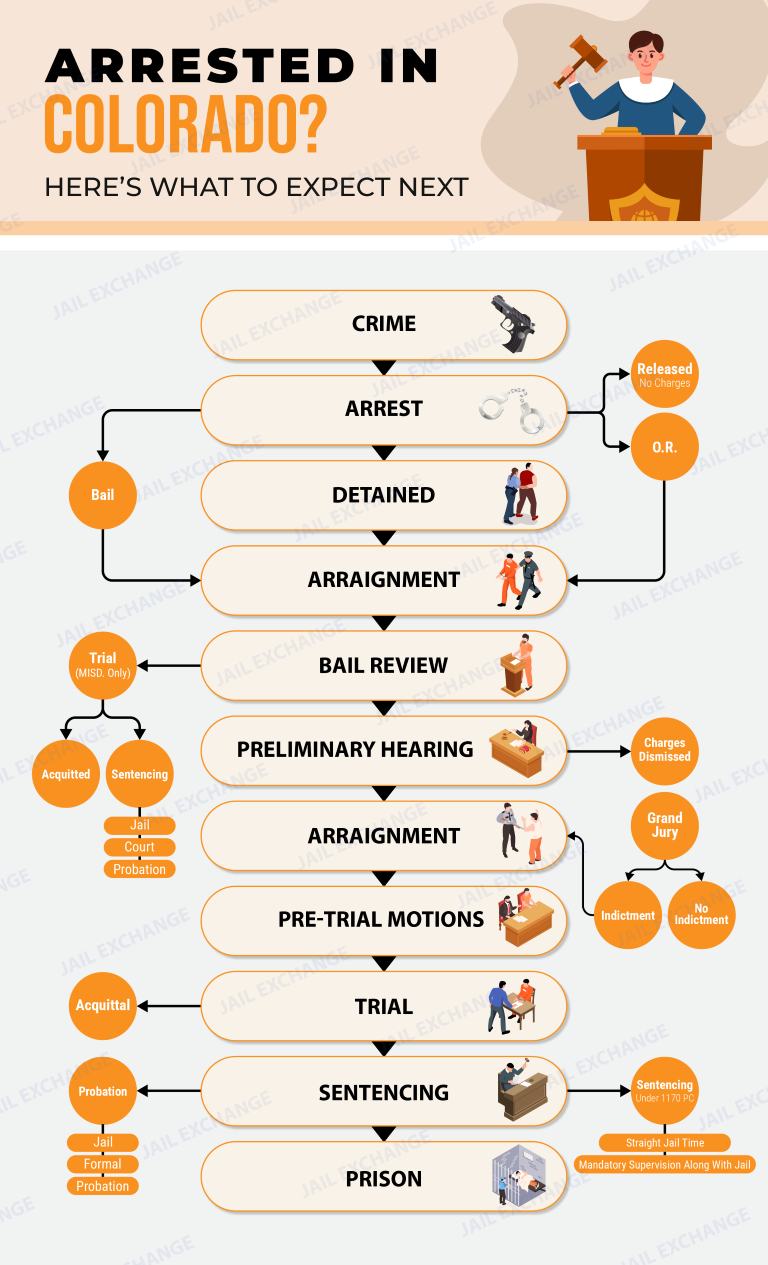
People at the County Jail can buy food and hygiene items through commissary every other week. For a deposit, look up their CD number and use Access Corrections or the cash and card kiosk in the County Jail lobby on East Smith Road. If mailing a deposit, use a U.S. Postal Service money order with their name and CD number. Send it to the Denver Sheriff Department, PO Box 1108, Denver, CO 80201, not to the address for personal letters.

Access Secure Deposits (Smart Deposit) allows families and friends to securely transfer money directly into an incarcerated person's jail trust account using a debit or credit card. Deposited funds become immediately available for your loved one to purchase essential hygiene goods, over-the-counter medication, food items, and writing materials from the facility commissary.
Important: Inmate Banking Policies Vary by Facility
Once a person is booked and moved to a cell, facilities do not always allow cash drop-offs or phone payments directly to the jail. Some might and you should confirm this by calling the facility and asking. But if you do not register online and fund your loved one's trust account immediately, they may be forced to wait days or weeks for standard paper processing, leaving them without essential soap, clean undergarments, basic medical sundries or snacks.
Step-by-Step Instructions to Register and Access Service
- Obtain the inmate's legal first and last name, date of birth, and official six- to ten-digit Booking or Inmate ID number.
- Visit the official Access Corrections portal at www.accesscorrections.com or download the Access Corrections mobile app.
- Select the state and the exact detention facility or county jail where the inmate is currently housed.
- Add the inmate as a contact and confirm their identity from the facility roster.
- Enter your debit or credit card billing information, choose your deposit amount, review the facility processing fee, and submit your payment.
- Save and print your transaction confirmation number for verification.
What the Inmate Needs to Do
The inmate does not need internet access to receive your deposit. Once approved, the funds post directly to their facility account balance. The inmate can verify their balance at the dayroom kiosk or on their trust statement and start ordering items on the next designated commissary day.
Official Provider: Access Corrections / Keefe Group Official Website
Customer Service Telephone: 1-866-345-1884
Support Hours: 24/7/365
Supported Languages: English and Spanish
Other Services Provided by Access Corrections / Keefe Group
In addition to Access Secure Deposits (Trust Money), Access Corrections / Keefe Group provides several other communication, financial, and visitation services at participating correctional facilities:
- Digital Messaging & Photos: Send digital letters and pictures straight to the inmate's kiosk or tablet.
• Learn more on our website: Digital Messaging & Photos Guide | • Visit official vendor page: Access Corrections / Keefe Group Digital Messaging & Photos - Commissary Care Packages: Order pre-approved food boxes, thermal clothes, and snack bundles directly to the jail.
• Learn more on our website: Commissary Care Packages Guide | • Visit official vendor page: Access Corrections / Keefe Group Commissary Care Packages
Deposit Money for an Inmate in the Denver County Jail
Sending money to someone at the Denver County Jail on East Smith Road? Have their full name and CD number ready. The money posts to their jail account, where it can be spent on food, hygiene items, over-the-counter medicine and writing supplies.
- Online: Use Access Corrections and pay with a debit or credit card. You will need the CD number. Look over the processing fee before you pay.
- Phone: Call 866-345-1884 any time, in English or Spanish, to pay by card.
- In person: Hand a postal money order to the information desk, with the person's name and CD number written on it. The kiosk for cash and card deposits is at the Downtown Detention Center, 490 West Colfax Avenue.
- Money order by mail: Use only a U.S. Postal Service money order. Make it out to the person's full name and write their CD number on the money order and on the envelope. Mail it to the person's name and CD number, Denver Sheriff Department, P.O. Box 1108, Denver, CO 80201.
A money order with changes or erasures will be refused. Never mail cash, and never send money to the Tampa, Florida address, which is only for personal letters. Money can be taken back out only if the person agrees and has enough in the account, and you must show a valid government-issued ID. For other questions about deposits, call 720-913-3600.
The Denver County Jail on East Smith Road is one of the two jails run by the Denver Sheriff Department, and it follows the same mail rules as the downtown jail. Personal letters are not sent to the jail. They go to a mail-scanning service, and the person in custody reads a scanned copy on a tablet or kiosk in their housing unit. Scanning keeps out paper that has been soaked in drugs and dried, a common way drugs are smuggled. Anything mailed to the wrong address is returned to you.
Personal letters and photos (scanned):
Inmate's Full Name & CD #
Denver Sheriff Department
PO Box 20707
Tampa, FL 33622
Legal mail, books, magazines and postal money orders (sheriff's office box):
Inmate's Full Name & CD #
Denver Sheriff Department
P.O. Box 1108
Denver, CO 80201
- CD number: Every envelope needs the person's name and their CD number. Mail without the CD number is sent back. Find it on the inmate search.
- Photos: You can include up to 10 photos, none bigger than 8 x 10 inches. Extra or oversized photos are thrown away, and Polaroids are not taken.
- Getting the original back: The scanner keeps the paper unless you tuck in a self-addressed stamped envelope, in which case your original is mailed back. Items that can't be scanned are thrown out.
- Return address: Fill in your full name and address in the top left corner.
- Books, magazines and newspapers: They must be mailed by the publisher or a regional distributor to the sheriff's box, not to the scanning service. Staff check them for contraband before handing them out. No hardcover books.
- Money orders: Only U.S. Postal Service money orders are accepted, and any with changes or erasures are refused. Make it out to the person's full name and put their CD number on it and on the envelope. If you are unsure, call 720-913-3600 to confirm. Online deposits are another choice: add money here.
- Lawyers and courts: Legal mail goes to the sheriff's box in an official envelope with the law firm, attorney or court named and "Legal Mail" marked clearly. It is opened in front of the person and delivered within one business day.
- Turned away: Packages, mail from another person in custody, mail sent through a third-party mailing service, and anything with bank or credit card numbers, ID documents or Social Security details.
Quick notes can also go through electronic messages.
Securus AdvanceConnect is a prepaid calling account that links directly to your mobile phone or landline number, allowing you to receive outbound calls from an incarcerated individual. Because correctional phone systems never allow incoming calls, funding an AdvanceConnect balance ensures calls are accepted immediately without being blocked by cell carriers.
Important: Mobile Networks Block Inmate Calls Without Prepaid Funds
Correctional facilities do not allow collect billing to cell phones, and mobile carriers automatically block incoming collect calls from detention centers. While some residential landlines may allow direct billing, mobile phones and VoIP services require an active prepaid AdvanceConnect balance, which you can verify with your phone provider. If you do not register online and fund your account right away, your loved one will hear an automated error message stating that your number cannot accept calls.
Step-by-Step Instructions to Register and Fund AdvanceConnect
- Go to securustech.online or open the Securus mobile app.
- Select Sign Up and create your account using your 10-digit telephone number and email address.
- Search for your facility by state and agency name, then add the inmate using their full legal name or booking ID.
- Select AdvanceConnect under calling accounts.
- Choose your deposit amount, review convenience and transaction fees, and enter your credit or debit card billing details.
- Authorize payment and confirm that your mobile phone allows calls from automated or unknown correctional numbers.
What the Inmate Needs to Do
The inmate picks up any dayroom phone or logs onto their handheld tablet, dials your 10-digit number, and enters their assigned PIN. The automated system verifies that your AdvanceConnect account has an active balance and connects the call. All calls are subject to recording and monitoring by facility staff.
Official Provider: Securus Technologies Official Website
Customer Service Telephone: 1-800-844-6591
Support Hours: 24 hours a day, 7 days a week, 365 days a year
Supported Languages: English and Spanish
Other Services Provided by Securus Technologies
In addition to AdvanceConnect Prepaid Calling, Securus Technologies and its subsidiary JPay provide several other communication, financial, and visitation services:
- Direct Bill Phone Calling: Establish a monthly billed calling account for verified landline numbers.
• Learn more on our website: Direct Bill Phone Calling Guide | • Visit official vendor page: Securus Direct Bill - Securus Video Connect: Schedule and join live video visits from home using your computer or smartphone.
• Learn more on our website: Video Visitation Guide | • Visit official vendor page: Securus Video Connect - JPay Money Deposits (Trust & Canteen): Send money directly into an inmate's jail trust account for commissary store purchases.
• Learn more on our website: Money Deposits Guide | • Visit official vendor page: JPay Money Transfers - JPay Email Messaging & Photos: Send electronic messages, photo attachments, and VideoGrams directly to their tablet or kiosk.
• Learn more on our website: Email Messaging Guide | • Visit official vendor page: JPay Email Services
Securus Direct Bill is an invoiced telephone calling service designed for approved residential landlines, law offices, and commercial businesses. Instead of prepaying funds in advance, calls received from an incarcerated individual are billed directly to your account on a monthly itemized billing invoice.
Important: Direct Bill Requires Credit Approval and Qualifying Lines
Direct Bill is not available for mobile cell phones, internet VoIP numbers, or customers with poor or unestablished telephone credit history. Correctional facilities enforce strict telecommunications billing rules, which you can verify by calling Securus customer care. If your line does not meet credit approval standards, you must open an AdvanceConnect prepaid account instead to receive incoming calls from your loved one.
Step-by-Step Instructions to Set Up a Direct Bill Account
- Contact Securus customer service at 1-800-844-6591 or submit an application via securustech.net.
- Provide your billing name, service address, and qualifying residential or business landline telephone number.
- Submit to a standard credit evaluation performed by Securus to determine billing eligibility.
- Establish your authorized monthly credit limit upon approval.
- When your phone rings with a call from the detention center, follow the recorded operator instructions and press the requested key to accept charges.
- Pay your monthly billing invoice online, by phone, or through the mail.
What the Inmate Needs to Do
The inmate dials your phone number from any dayroom telephone and keys in their assigned PIN. The automated system verifies that your account is in good standing and has not exceeded its monthly spending ceiling before connecting the call. All non-privileged conversations are recorded and monitored.
Official Provider: Securus Technologies Official Website
Customer Service Telephone: 1-800-844-6591
Support Hours: 24 hours a day, 7 days a week, 365 days a year
Supported Languages: English and Spanish
Other Services Provided by Securus Technologies
In addition to Direct Bill Calling, Securus and its subsidiary JPay offer several other communication, financial, and visitation services:
- AdvanceConnect Prepaid Calling: Fund a prepaid calling account tied to your mobile phone number.
• Learn more on our website: AdvanceConnect Calling Guide | • Visit official vendor page: Securus AdvanceConnect - Securus Video Connect: Schedule and join live video visits from home using your computer or smartphone.
• Learn more on our website: Video Visitation Guide | • Visit official vendor page: Securus Video Connect - JPay Money Deposits (Trust & Canteen): Send money directly into an inmate's jail trust account for commissary store purchases.
• Learn more on our website: Money Deposits Guide | • Visit official vendor page: JPay Money Transfers - JPay Email Messaging & Photos: Send electronic letters, photos, and VideoGrams directly to their tablet or kiosk.
• Learn more on our website: Email Messaging Guide | • Visit official vendor page: JPay Email Services
Securus eMessaging provides a digital messaging service that allows family members to send electronic letters, digital photos, and eCards directly to an incarcerated loved one via handheld tablets and housing unit kiosks. Messages are screened electronically, delivering communication within hours instead of waiting days for postal mail delivery.
Important: Physical Mail Bans and Stamp Requirements Vary
Inmates cannot receive incoming phone calls, and traditional postal mail rules differ across correctional systems. While some jails continue to accept handwritten letters, many facilities have transitioned entirely to electronic messaging or digital mail scanning, which you can verify by checking facility rules. If you do not register online and purchase eMessaging stamps right away, your loved one may face lengthy periods without direct written contact from family.
Step-by-Step Instructions to Register and Send eMessages
- Go to securustech.online or open the Securus mobile app.
- Sign into your verified profile or create an account with your email and phone number.
- Select eMessaging from your service dashboard.
- Link the inmate to your account by selecting the facility and entering their legal name or booking ID.
- Purchase an eMessaging stamp book using a debit or credit card.
- Type your message in the editor, attach photos or eCards if permitted, and optionally include a prepaid reply stamp.
- Submit your message to the facility's screening queue.
What the Inmate Needs to Do
All electronic correspondence is screened by correctional staff before delivery. Once approved, the message arrives in the inmate's inbox on their assigned Securus tablet or housing unit kiosk. The inmate opens the message, views attached photos, and drafts an electronic reply using their available stamp balance.
Official Provider: Securus Technologies Official Website
Customer Service Telephone: 1-800-844-6591
Support Hours: 24 hours a day, 7 days a week, 365 days a year
Supported Languages: English and Spanish
Other Services Provided by Securus Technologies
In addition to eMessaging, Securus provides calling, video visitation, and trust money services:
- AdvanceConnect Prepaid Calling: Prepay for phone calling credits so your loved one can call your mobile phone directly.
• Learn more on our website: AdvanceConnect Calling Guide | • Visit official vendor page: Securus AdvanceConnect - Securus Video Connect: Schedule and join live video visits from home using your computer or smartphone.
• Learn more on our website: Video Visitation Guide | • Visit official vendor page: Securus Video Connect - JPay Money Deposits (Partner Trust Transfers): Send money directly into an inmate's jail trust account for commissary shopping.
• Learn more on our website: Money Deposits Guide | • Visit official vendor page: JPay Money Transfers
Securus Technologies (Aventiv) deploys secure, corrections-grade community tablets to incarcerated individuals across state prison systems and county jails. Operating over a private, encrypted facility network, these devices provide access to digital messaging (eMessaging), phone calls, educational courses, job search tools, eBooks, podcasts, and streaming music directly from housing units.
Important: Tablet Hardware Deployment and Rental Rules Vary
Detention centers do not manage tablet distribution identically. While some agencies issue individual personal tablets to every detainee at booking, others utilize shared pod docking stations or restrict tablet use to specific dayroom hours, which you should confirm with the facility directly. Although core educational and legal resources are generally provided free of charge, sending messages, listening to music, or making phone calls from the tablet requires an active balance funded by outside contacts.
Step-by-Step Instructions to Support and Fund Securus Tablets
- Verify that Securus handheld tablets are deployed at your loved one's specific facility.
- Log into your account at securustech.online or launch the Securus mobile app.
- Ensure the inmate is linked to your contact list using their legal name and booking ID number.
- Purchase eMessaging Stamps for digital messaging, fund an AdvanceConnect account for phone calls, or deposit funds into their Inmate Debit account for music and media.
- Review all transaction charges, complete payment with a credit or debit card, and save your confirmation receipt.
- Notify your loved one that funds have posted so they can access their media and communication apps.
What the Inmate Needs to Do
The inmate unlocks their assigned tablet using their facility PIN or biometric verification. They can access free rehabilitative and educational materials at no charge, or open communication and media applications to draft messages, place phone calls, or stream music using available balances. Devices are docked during quiet hours and shift changes for secure recharging and data synchronization.
Official Provider: Securus Technologies Official Website
Customer Service Telephone: 1-800-844-6591
Support Hours: 24 hours a day, 7 days a week, 365 days a year
Supported Languages: English and Spanish
Other Services Provided by Securus Technologies
In addition to Tablet Services, Securus provides calling, messaging, video visitation, and trust money transfers:
- eMessaging & Digital Mail: Send electronic messages, photo attachments, and eCards directly to an inmate's tablet.
• Learn more on our website: eMessaging Guide | • Visit official vendor page: Securus eMessaging - AdvanceConnect Prepaid Calling: Prepay for phone calling credits so your loved one can call your telephone directly.
• Learn more on our website: AdvanceConnect Calling Guide | • Visit official vendor page: Securus AdvanceConnect - Securus Video Connect: Schedule and join live video visits from home using your computer or smartphone.
• Learn more on our website: Video Visitation Guide | • Visit official vendor page: Securus Video Connect - JPay Money Deposits (Partner Trust Transfers): Send money directly into an inmate's jail trust account for commissary shopping.
• Learn more on our website: Money Deposits Guide | • Visit official vendor page: JPay Money Transfers
Denver County County Jails
Denver County Juvenile Facilities
Nearby counties
- Jail (Main): 720-913-3600
- Adult Court: 720-865-8301
- Adult Probation: 720-913-4700
- Bail: 720-337-0061
- Booking: 720-913-3600
- Court: 720-865-8301
- District Attorney: 720-913-9000
- Inmate Accounts: 720-337-0198
- Inmate Info: 720-913-3600
- Juvenile: 303-377-7200
- Juvenile Court: 720-337-0570
- Juvenile Probation: 720-913-4200
- Police: 720-913-2000
- Public Defender: 720-620-4999
- Sheriff: 720-337-0400
- Visitation: 720-913-3791
The Denver County Jail serves the following cities and towns of Denver County: Denver.