The Corrigan-Radgowski Correctional Center is in the Uncasville section of Montville, at 986 Norwich-New London Turnpike, Uncasville, CT 06382, phone (860) 848-5700. Two prisons once stood here side by side. Radgowski opened in 1991 and Corrigan in 1994, and they were joined in 2001. The Radgowski building closed in 2021 because fewer people were locked up. Today the center holds both pretrial men (still waiting on their case) and sentenced men. Since Connecticut has no county jails, this is where men from the eastern part of the state usually go when they can’t make bond. The state says it serves the Superior Court locations in New London, Norwich, Danielson and the Windham area.
All crimes in Connecticut are handled by the Superior Court, which works on two levels. Geographical area (GA) courts are the neighborhood courthouses. Arrested people see a judge there first, and most smaller cases end there too. Judicial district (JD) courts, also called “Part A,” handle the gravest felonies. Courthouses that send men to Uncasville include:
Free online case search: The Connecticut Judicial Branch’s case look-up lets anyone search by name or docket number. It shows cases that are still open, upcoming court dates, and convictions from about the last 10 years. Juvenile matters are kept out.
Federal court and tribal land: The closest federal courthouse, the Richard C. Lee U.S. Courthouse, is in New Haven at 141 Church Street (clerk: (203) 773-2140), and it belongs to the U.S. District Court for the District of Connecticut. It handles crimes against national laws. Close to here, that includes crimes at the Naval Submarine Base New London in Groton, drug trafficking on I-95 and I-395, and bank robbery. This area also has tribal land. The Mohegan reservation, home of Mohegan Sun, is right here in Uncasville, and federal law lets Connecticut enforce its own criminal laws there, so most cases go to state court. The Mashantucket Pequot reservation in Ledyard has its own tribal court and police. Who handles a case there can depend on the crime and the people involved. Choose a topic below.
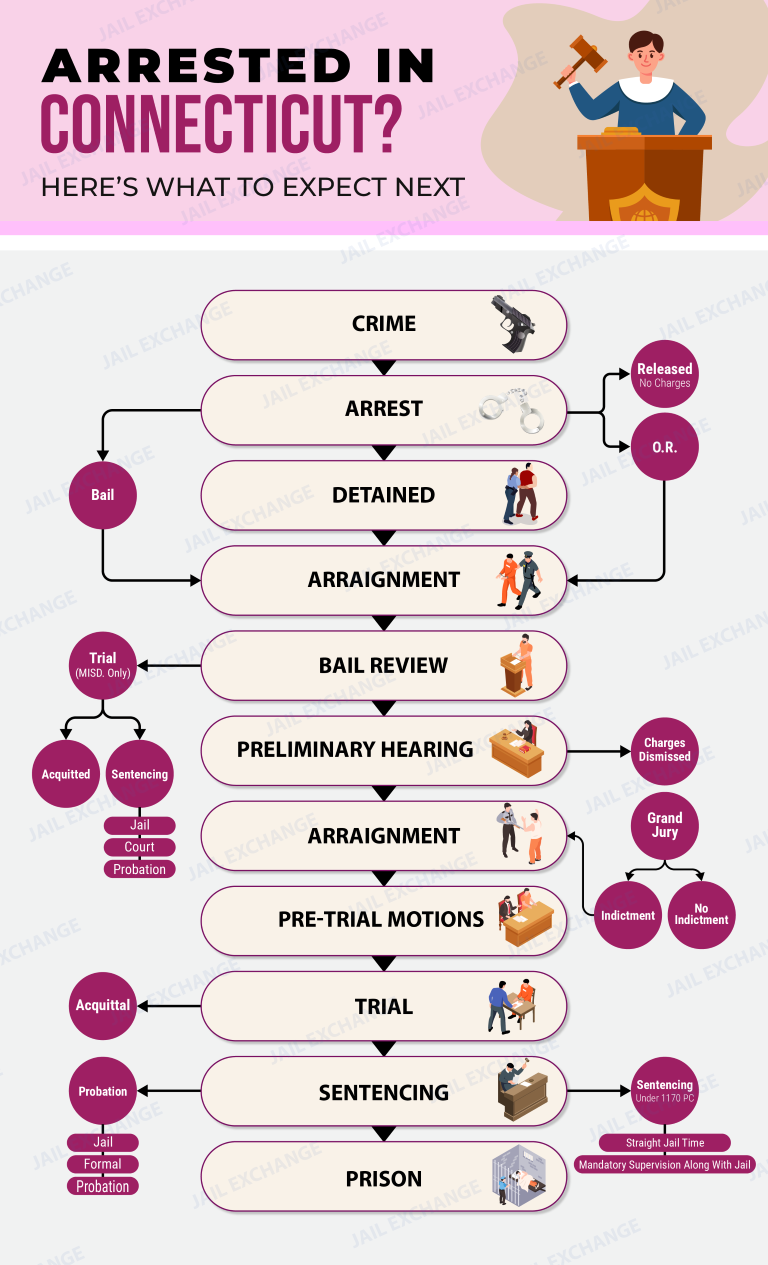
When police in New London County arrest someone for a smaller crime, they often release the person with a court date written on a promise to appear. Other times they set a bond, money that is held to make sure the person comes back. A person who can’t post bond is reported to a bail worker. Those workers belong to the Court Support Services Division of the Judicial Branch. Then the person is taken to the GA court the next day it is open, either Broad Street in New London or Courthouse Square in Norwich.
Step one in court is the arraignment. You learn the charge and enter a plea. A state law passed in 2017 makes it hard to hold someone on money bail when the only charge is a misdemeanor. Judges can still do it in family violence cases or if they find a likely risk the person will miss court, interfere with witnesses, or be a danger. If the person stays locked up, a new bail hearing must happen within 14 days.
Connecticut misdemeanors come in four classes. Class A misdemeanors carry as much as 364 days behind bars plus a fine of $2,000. For class B, the cap is six months and $1,000. Class C stops at three months and $500, and class D at 30 days and $250. Connecticut’s Division of Public Defender Services has lawyers in both New London and Norwich, and they look at a person’s money situation to see if they qualify. Many cases are settled with fines, probation, or a program that wipes away the charge when it’s finished. Juries in misdemeanor trials have six members.
Teens: Connecticut’s “Raise the Age” law sends everyone under 18 to juvenile court. In New London County that is the Superior Court for Juvenile Matters, 978 Hartford Turnpike, Waterford. Teens from Windham County go to the juvenile court at 81 Columbia Avenue, Willimantic. Lots of towns also use a Juvenile Review Board to handle a first small mistake outside of court.
Felonies are crimes that can lead to more than a year in prison. They begin in the GA court too. Prosecutors from the Division of Criminal Justice (the state’s attorneys) handle them. The Norwich GA office mostly deals with class C, D and E felonies, and the New London Judicial District office on Huntington Street takes the more serious felony cases from every town in the district.
From least to most serious, Connecticut’s lower felony classes look like this:
Trials are rare. Most of these cases close with a plea agreement, meaning the person admits to a charge and both sides agree on the sentence. Judges also often order probation or drug treatment. If someone sits at Corrigan through the whole case, court rules generally expect a trial to begin within 8 months. The limit is 12 months for a person who is free on bond, and many delays are excused.
Teens: Felony cases for kids usually stay in the Waterford or Willimantic juvenile court. If a judge says a youth must be held, the youth goes to one of the two juvenile detention centers the Judicial Branch runs, in Bridgeport and Hartford. For many felonies, prosecutors may also seek adult court for a teen of 15, 16 or 17; a judge makes the call after hearing both sides.
Violent crimes from eastern Connecticut are tried at the New London Judicial District courthouse on Huntington Street. Judges usually set bonds so large that most defendants can’t pay, which means they stay at Corrigan from arrest until the case ends. A murder case can take two or three years, sometimes longer.
Connecticut got rid of the death penalty in two steps. A 2012 law stopped it for new crimes, and in 2015 the state Supreme Court used State v. Santiago to end it for the men already sentenced to die. A trial for a crime that can bring life in prison uses 12 jurors instead of 6. If a conflict keeps the public defender off a case, the court names a special public defender. That is a private attorney hired and paid by the state. Crime victims have rights written into the state constitution. For example, they can be notified of hearings and can talk to the judge before sentencing.
Teens: Some cases skip juvenile court on their own: those against youths age 15 and up who are accused of class A felonies or most class B felonies. In the adult system, boys are usually housed at the Cheshire prison called Manson Youth Institution, set aside for males 15 to 21.
Think of this page as a map of the general steps, not legal advice. For a specific case, a defense lawyer can help, or you can reach the Norwich GA 21 public defender office at (860) 889-3838.