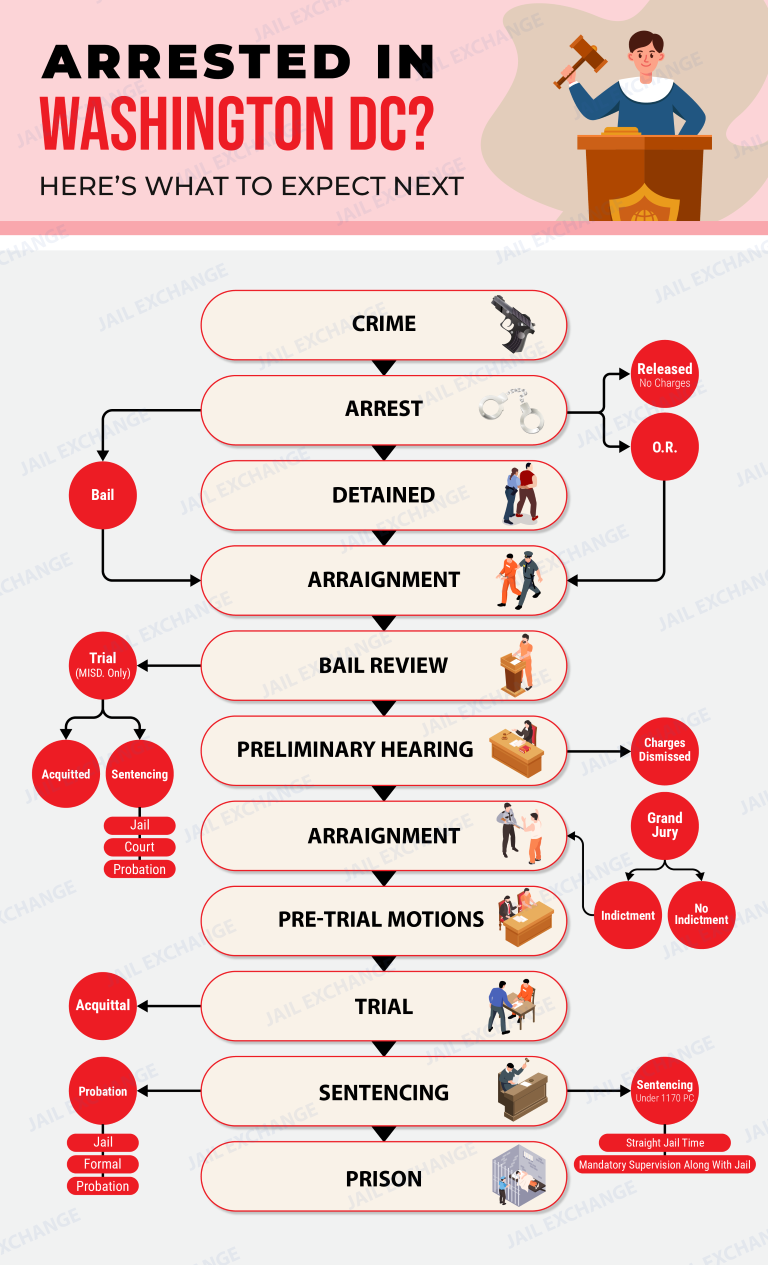
Washington DC Correctional Treatment Facility Criminal Court Process
Criminal Court Process for District of Columbia District of Columbia
How a Criminal Case Moves Through D.C. Superior Court
Washington, D.C. has a single local trial court, the Superior Court of the District of Columbia, which does the work that county and state courts do elsewhere. Its Criminal Division sits in the H. Carl Moultrie Courthouse, 500 Indiana Avenue NW, Washington, DC 20001. The division is open weekdays from 8:30 a.m. to 5 p.m. For case status, call Criminal Information at 202-879-1373; the court’s main line is 202-879-1010.
D.C. is unusual in who prosecutes. The U.S. Attorney’s Office for the District of Columbia serves as both the local and the federal prosecutor for the capital, so it brings felonies and the more serious “U.S. misdemeanors” in Superior Court as well as federal crimes in the U.S. District Court. Its main number is 202-252-7566.
- From arrest to the courthouse
- Arraignment and presentment
- Release, Pretrial Services and detention
- Misdemeanor cases
- Felony cases
- Defense lawyers
- Youth under 18
- Federal cases
- Looking up a case or a person
- Immigration requests
1. From arrest to the courthouse
MPD officers take the arrested person to a district station to be identified, charged and booked. From there one of three things happens: release on a citation with a court date, release after posting a bond or collateral, or transport to the Central Cellblock (300 Indiana Avenue NW, 202-727-4222) to wait for court. The court will not give out paperwork on arrests after 2011 that prosecutors declined to charge, often called “no papered” cases. See the court’s arrests page (https://www.dccourts.gov/superior-court/superior-court-divisions/criminal-division/arrests).
2. Arraignment and presentment
The first court appearance is an arraignment for a misdemeanor and a presentment for a felony. The defendant hears the charges, a lawyer is assigned, and the judge decides on release or detention. The case is then given to a specific judge with a next date. No one is found guilty at this stage, and no witnesses testify.
Felonies and U.S. misdemeanors start in Courtroom C-10. D.C. misdemeanors and criminal traffic cases start in Courtroom 310 or 316, sorted by arresting district. Intrafamily and partner abuse cases start in Courtroom 119. C-10 opens at 11 a.m. on weekdays and holidays and at 12:30 p.m. on Saturdays. More at arraignment information (https://www.dccourts.gov/superior-court/superior-court-divisions/criminal-division/arraignment).
3. Release, Pretrial Services and detention
The Pretrial Services Agency, 633 Indiana Avenue NW (202-220-5500), screens each new defendant and supervises those released with conditions. Under D.C. Code 23-1321 (https://code.dccouncil.gov/us/dc/council/code/sections/23-1321) the default is release on personal recognizance or an unsecured bond. Under D.C. Code 23-1322 (https://code.dccouncil.gov/us/dc/council/code/sections/23-1322) a judge may order detention after a hearing for listed dangerous offenses or a serious flight risk. Any cash bond is paid to the court’s Criminal Finance Office, Room 4003 (202-879-1840).
Our D.C. bail page covers payment hours and rules.
4. Misdemeanor cases
U.S. misdemeanors, such as simple assault, threats, drug possession and many theft charges, are prosecuted by the U.S. Attorney. D.C. misdemeanors, like disorderly conduct, an open container or drinking in public, are prosecuted by the D.C. Attorney General’s office in the court’s D.C. Misdemeanor and Traffic Community Courts. After arraignment, a case may resolve through a plea, a diversion or problem-solving program, or a trial. A sentence of jail time is served at the D.C. Jail or the Correctional Treatment Facility.
5. Felony cases
A felony moves from presentment to a preliminary hearing, where a judge checks for probable cause, unless the grand jury indicts first. After indictment come status hearings, motions, plea talks and, if there is no plea, a jury trial. Sentencing follows the D.C. Voluntary Sentencing Guidelines. A person sentenced to prison on a D.C. Code felony does not stay in a D.C. facility; they are sent to the Federal Bureau of Prisons.
6. Defense lawyers
A defendant who cannot afford a lawyer gets one at the first hearing. The Public Defender Service, 633 3rd Street NW (202-628-1200), takes many of these cases. Others go to private attorneys the court appoints under the Criminal Justice Act. PDS also keeps a Defender Services Office in the courthouse, Room C-215.
7. Youth under 18
Charges against children go to the Family Court branch of Superior Court in the same building. A youth held by court order stays at the Youth Services Center, 1000 Mount Olivet Road NE (202-576-8418), run by the Department of Youth Rehabilitation Services. Some older teens can be charged as adults; they are housed at the Correctional Treatment Facility.
8. Federal cases
Federal crimes go to the U.S. District Court for the District of Columbia at the E. Barrett Prettyman Courthouse, 333 Constitution Avenue NW. Clerk’s office: 202-354-3000; criminal help desk: 202-354-3060. A U.S. magistrate judge handles the first appearance and any detention hearing. The Federal Public Defender, 625 Indiana Avenue NW (202-208-7500), represents people who cannot pay. Court site: dcd.uscourts.gov (https://www.dcd.uscourts.gov/).
9. Looking up a case or a person
- Hearing dates: the Criminal Case Calendar (https://www.dccourts.gov/superior-court/superior-court-case-calendars/criminal-case-calendar), searchable by name
- Warrants: the active warrant list (https://www.dccourts.gov/superior-court/superior-court-divisions/criminal-division/additional-resources/active-warrant-list)
- Person held by the DOC: Records Office 202-523-7060, or VINELink for D.C. (https://vinelink.vineapps.com/search/DC/Person)
- After a felony sentence: BOP inmate locator (https://www.bop.gov/inmateloc/)
See also our D.C. inmate search page.
10. Immigration requests
D.C. Code 24-211.07 (https://code.dccouncil.gov/us/dc/council/code/sections/24-211.07) keeps the DOC, MPD and youth agencies from holding anyone past their release time for immigration officials absent a warrant or order signed by a federal judicial officer. ICE detention can be checked on the ICE online locator (https://locator.ice.gov/odls/).
This overview is general information. A defense attorney can explain how the rules apply to a specific case.