
Washington DC Correctional Treatment Facility
Washington DC Correctional Treatment Facility
Jail Phone Number
202-523-7060Finding someone in custody in Washington, D.C.
Every adult held on a District of Columbia criminal case is in the Department of Corrections’ care at the Central Detention Facility, also known as the D.C. Jail, or the Correctional Treatment Facility in Southeast Washington DC.
The quickest check is a call to the DOC Records Office at 202-523-7060 or a look at District of Columbia Inmate Search.
Read inmate search answers
 Read inmate search answers
1. Where are people held after an arrest in Washington, D.C.?
There is no county jail or sheriff in D.C. The city’s Department of Corrections (DOC) runs two adult buildings side by side in Southeast:
- Central Detention Facility, also known as the D.C. Jail, 1901 D Street SE, Washington, DC 20003. Men only, at low, medium and high custody. Command Center: 202-698-4932.
- Correctional Treatment Facility (CTF), 1901 E Street SE, Washington, DC 20003. It houses all women in DOC custody, plus some low and medium custody men and youths charged as adults. Command Center: 202-790-6601.
The DOC also places some women at Fairview, a privately run halfway house under contract, when a judge or the DOC allows it.
↑ Back to the question list2. How can I find out if someone is in custody?
Call the DOC Records Office at 202-523-7060, or the Command Center at 202-698-4932 (D.C. Jail) or 202-790-6601 (CTF). Call either one. It gives general information on anyone at the D.C. Jail, CTF or a contract halfway house. Have the full name and date of birth ready, and the DCDC number (the DOC inmate ID) or MPD’s PDID number if you know them.
For online status and free alerts on moves or release, use VINELink and choose District of Columbia, or register by phone at 877-329-7894. The DOC explains both on its locate an inmate page. Our District of Columbia Inmate Search page gathers the links.
↑ Back to the question list3. Why can’t I find someone who was just arrested?
For the first day or so, people are with the police, not the DOC. They are booked at an MPD district station, then wait at the Central Cellblock, 300 Indiana Avenue NW (202-727-4222), for their first court hearing. Only those a judge holds are moved to 1901 D or E Street SE. Try the Cellblock or the station that made the arrest, or call Criminal Information at 202-879-1373 to check for a court date.
↑ Back to the question list4. Is there a D.C. warrant search?
Yes. D.C. Superior Court publishes an active warrant list on its website. MPD can confirm a warrant too; call the district station for the area (numbers are in the last question). A person with a warrant should talk to a lawyer about turning in. The Public Defender Service (202-628-1200) can advise people who cannot pay a lawyer.
↑ Back to the question list5. Bail at a glance
- Release terms come from a Superior Court judge at the first hearing.
- Arraignment Court C-10 opens at 11 a.m. weekdays and 12:30 p.m. Saturdays; no Sunday court.
- Most people go home on personal recognizance, often supervised by Pretrial Services.
- Cash bonds are uncommon and go only to the court.
- Criminal Finance Office, Room 4003, 500 Indiana Avenue NW: 202-879-1840.
- Cash or money order; no personal checks.
- Small weekend bonds under $1,000 may be paid electronically on request.
- Detention without bond is possible after a hearing.
- The DOC must release within 5 hours after a court-ordered release reaches the jail.
- Pretrial Services: 202-220-5500.
Read the full rundown on our District of Columbia bail page.
↑ Back to the question list6. What happens at the first court date?
Felony presentments and serious U.S. misdemeanors are heard in Courtroom C-10 of the Moultrie Courthouse, 500 Indiana Avenue NW. D.C. misdemeanors and traffic crimes go to Courtrooms 310 and 316, and domestic violence cases to Courtroom 119. Charges are read aloud, counsel is named for anyone who needs it, the court rules on release and sets the next date. Our D.C. court process page explains the rest of the case.
↑ Back to the question list7. How do I visit someone at the D.C. Jail or CTF?
Visits must be scheduled in advance, and many family visits take place by video. Ask the Command Center for the current rules, then read our visiting and video visit pages before you go.
↑ Back to the question list8. How do I put money on an account?
Deposits fund the person’s commissary and phone accounts. Money orders can be mailed; never mail cash. Write the full name and DCDC number on every deposit. Our money and commissary pages list the current ways to pay.
↑ Back to the question list9. How do calls and messages work?
People held by the DOC get a call at intake and then use phones in their housing unit. You cannot call in to them. Legal calls are set up on request. Read our phone, messaging and tablet guides.
↑ Back to the question list10. How do I address mail?
Put the person’s full name and DCDC number on the first line, then the facility name and address: 1901 D Street SE for the D.C. Jail or 1901 E Street SE for CTF, Washington, DC 20003. Check our mail guide first.
↑ Back to the question list11. What happens to property left at the jail?
The DOC keeps personal property for only 15 days because of limited storage. The person can authorize someone to pick it up, and that person must show current photo ID. ID cards and other documents are released only to the person named.
↑ Back to the question list12. What if the person is under 18?
Youth charged in Family Court are held at the Youth Services Center, 1000 Mount Olivet Road NE, Washington, DC 20002, run by the Department of Youth Rehabilitation Services. Call 202-576-8418. Teens charged as adults go to CTF instead. Details are on the DYRS Youth Services Center page.
↑ Back to the question list13. He takes medicine. Who should I call?
Call the Command Center for the building: 202-698-4932 for the D.C. Jail or 202-790-6601 for CTF. Give his full name, birth date and DCDC number and ask that the medical unit be told. His lawyer can also raise it with the judge.
↑ Back to the question list14. What happens in a federal case in D.C.?
Federal agents such as the FBI, ATF, DEA or Secret Service may make an arrest on a federal charge. The case goes to the U.S. District Court for the District of Columbia, E. Barrett Prettyman Courthouse, 333 Constitution Avenue NW, Washington, DC 20001. Clerk: 202-354-3000. The first hearing is before a U.S. magistrate judge. Federal court uses no bail schedule. Release depends on the Bail Reform Act, and a detention hearing is held if prosecutors ask for one.
If the person is not released, the U.S. Marshals Service decides where to hold them. That can be a local jail used by the Marshals, so call the DOC Records Office at 202-523-7060 to ask whether the person is at the D.C. Jail or CTF. The Federal Public Defender, 625 Indiana Avenue NW (202-208-7500), represents people who cannot pay.
After a federal sentence, the Bureau of Prisons (BOP) assigns a federal prison and arranges the move. Track the person with the BOP inmate locator using a name or BOP register number.
↑ Back to the question list15. How does an ICE detainer work in D.C.?
Step 1. When MPD books someone, the prints go to the FBI, and ICE is alerted to possible matches.
Step 2. ICE may send a detainer on Form I-247A. It asks the jail to tell ICE before release and to hold the person up to 48 hours past their release time. That 48-hour clock never pauses; Saturdays, Sundays and holidays all count.
Step 3. D.C. law changes what happens next. Under D.C. Code 24-211.07, the District will not keep anyone past their release time for ICE without a warrant or order from an Article III federal judge or a U.S. magistrate judge. The I-247A by itself is not enough.
Step 4. Without such an order, the DOC also may not give ICE a person’s release date, address or photo, let ICE use jail space, or open the jail to ICE for a hand-off. Those limits do not apply to people held on federal criminal charges. ICE interviews need a judicial order or the person’s request, with a lawyer present unless the person waives one. The District does not ask about immigration status.
Step 5. The law does not block cooperation that federal law requires, or the sharing of citizenship and immigration status information under 8 U.S.C. 1373.
Step 6. If ICE takes custody, search the ICE detainee locator with a name and country of birth or an A-number. The ICE Washington Field Office, 14797 Murdock Street, Chantilly, Virginia, covers D.C. at 703-633-2100.
↑ Back to the question list16. Where do people go after a felony sentence, since D.C. has no state prison?
Under the National Capital Revitalization and Self-Government Improvement Act of 1997, anyone sentenced to prison for a D.C. Code felony serves that time with the federal Bureau of Prisons. They are not federal prisoners in the legal sense. The case stays a D.C. case, but the bed is federal. Until the BOP moves them, they wait at the D.C. Jail or CTF.
The BOP’s Designation and Sentence Computation Center in Grand Prairie, Texas, picks the prison after it gets the court’s sentencing papers, the probation report and Marshals records. It looks at the security level and supervision the person needs, medical and program needs, and the prison’s security. The BOP tries to place people within 500 driving miles of their release home, but a D.C. resident can be sent much farther. The BOP will not share a pending designation or transfer date. Read the BOP designations page.
Once moved, the person shows up on the BOP inmate locator. Our District of Columbia prisons page explains the background.
↑ Back to the question list17. Can I see D.C. mugshots online?
No. D.C. mugshots are not shown in the D.C. DOC inmate locator, and VINELink has no photos either. A photo taken at an MPD station belongs to the police department, so ask MPD in writing; the department decides whether to release it.
For a photo taken by ICE, submit an ICE FOIA request.
Federal booking photos are usually kept private. An exception: the Marshals Service sometimes releases a picture when it is hunting a dangerous fugitive or someone who escaped.
↑ Back to the question list18. Numbers to keep handy
- DOC Records Office: 202-523-7060
- D.C. Jail Command Center: 202-698-4932
- CTF Command Center: 202-790-6601
- Central Cellblock: 202-727-4222
- Superior Court Criminal Information: 202-879-1373
- Public Defender Service: 202-628-1200
19. D.C. police district phone numbers
- MPD headquarters, 441 4th Street NW: 202-727-9099
- First District, 101 M Street SW: 202-698-0555
- Second District, 3320 Idaho Avenue NW: 202-715-7300
- Third District, 1620 V Street NW: 202-673-6815
- Fourth District, 6001 Georgia Avenue NW: 202-715-7400
- Fifth District, 1805 Bladensburg Road NE: 202-698-0150
- Sixth District, 5002 Hayes Street NE: 202-698-0880
- Seventh District, 2455 Alabama Avenue SE: 202-698-1500
Not sure which district? Use MPD’s district finder. In an emergency, call 911.
↑ Back to the question listContacts for the District of Columbia
- Search
- District of Columbia Inmate Search
- DOC Records
- 202-523-7060
- D.C. Jail
- 202-698-4932
- CTF
- 202-790-6601
- Cellblock
- 202-727-4222
The DOC updates its rules from time to time. Call the Command Center before a trip to Southeast.
Correctional Treatment Facility: how release and bail work in DC
The Washington DC Correctional Treatment Facility, 1901 E Street SE, is run by the DC Department of Corrections.
Look up your family member with Washington DC Correctional Treatment Facility Inmate Search to see if they are held there. The command center is 202-790-6601.
DC judges usually order release on conditions, not money. When they do order a cash bond, it is paid at the Superior Court's Criminal Finance Office downtown, not at the jail.
1. Is my family member held at the Correctional Treatment Facility?
Type the name into Washington DC Correctional Treatment Facility Inmate Search. It tells you whether the person is in custody there. A new arrest may not show for several hours, because people are first held at a police station or in the Central Cell Block. If the search shows nothing, call the facility's command center at 202-790-6601, or the DOC Records Office at 202-523-7060.
The other DC jail, the Central Detention Facility, answers at 202-698-4932.
2. What kind of people does this building hold?
The Correctional Treatment Facility, called CTF, holds women and men. The DC Department of Corrections says it takes only low and medium custody people. Its own pages also say it houses juveniles who are being handled as adults. The youth agency says those teens are kept at its Youth Services Center instead, so ask before you assume.
Many people there are waiting for trial.
3. Where was my relative taken right after the arrest?
Most people start at a Metropolitan Police station or at the Central Cell Block, 300 Indiana Avenue NW, phone 202-727-4222. From there they go to court. The Superior Court says arraignment court is Courtroom C-10 in the Moultrie Courthouse at 500 Indiana Avenue NW, weekdays at 1:30 p.m. and Saturdays at 2:00 p.m. It is closed Sundays.
Only after that hearing does the judge order a person held at Washington DC Correctional Treatment Facility or sent home. Use Washington DC Correctional Treatment Facility Inmate Search to see where the person landed.
4. Does DC even use bail money?
Rarely. DC law makes the first choice release on a promise to return or an unsecured bond. A judge may add rules such as check-ins, curfew, or a stay-away order. Money is allowed only to make sure the person comes back to court. It cannot be used to keep someone locked up for safety, and it cannot be set so high that it works as detention. The Pretrial Services Agency says most defendants are released under supervision instead of financial bonds, and its 2016 guide says almost none go out on a commercial surety bond.
So the first step is to read the order. Washington DC Correctional Treatment Facility Inmate Search shows whether any bail amount exists. For the order itself, call Criminal Information at 202-879-1373.
5. How do I pay a cash bond if a judge ordered one?
Go to the Criminal Finance Office, Room 4003, fourth floor east wing, Moultrie Courthouse, 500 Indiana Avenue NW. It is open Monday to Friday, 9:00 a.m. to 5:00 p.m. Call 202-879-1840 first. The court says bonds may be posted only in cash or by money order. Personal checks are refused.
Bring the full name and the case number. Keep the receipt. The court then sends word to the Department of Corrections.
6. It is a weekend or evening. Can I still pay?
After the office closes, go to Courtroom C-10, which takes payments until it adjourns for the day. On Saturdays and holidays the court may accept an electronic payment for a bond under $1,000. To ask for that, email BondPayPortal@dcsc.gov. For anything larger, plan on a weekday or the courtroom.
7. What about a bail bondsman?
Commercial bondsmen exist in DC, but a court must approve each one by order, and they must follow chapter 11 of title 23 of the DC Code. The law lets them charge the regular bonding fee for the bond and nothing extra for other case services. It sets no percentage. Lists of approved bondsmen must be posted in detention facilities.
Because judges seldom set surety bail, ask the lawyer or the Criminal Finance Office at 202-879-1840 whether a bondsman would even help in this case. Get every fee in writing.
8. Can a house or car be pledged instead of cash?
A judge may accept an agreement to forfeit specific property as a release condition. The judge may ask where the property came from, and must refuse property whose source would not make the person show up. Ask whether the property must be in DC. Ask the Criminal Finance Office at 202-879-1840 before you gather deeds.
9. The judge ordered release. Why is my relative still inside?
Release paperwork has to travel from the courtroom to the jail, and a person can only walk out after DOC clears any holds, such as a warrant from another case. Ask the command center at 202-790-6601 whether the release order has arrived.
DC has a faster option. If the defense lawyer asks and the person agrees, the court can order release from CDF or CTF within five hours. A person who stays locked up for 24 hours because of unmet conditions may ask the judge to review them, and the judge must explain in writing why the conditions stay.
10. The record shows no release. Is that final?
Not always. DC does not use the words non-bailable. A judge can hold someone after a detention hearing if the proof is clear and convincing that no condition will protect the community or assure court dates. A person who was already on release, probation, or parole can be held for up to five days, not counting weekends and holidays.
People convicted and waiting for sentence are also usually held. A lawyer can ask the judge to change an order. Start with 202-628-1200 if there is no lawyer yet.
11. How can I get a lawyer if we cannot pay?
The Public Defender Service for DC is at 633 3rd Street NW, 202-628-1200. Tell the judge at the first hearing that you cannot afford counsel, and the court will appoint one.
Give the lawyer a work history, a stable address, and names of people who will keep in touch with the court. These points matter when the judge weighs release.
12. How do visits and phone money work, and is that bail?
No. Putting money on an inmate account never pays bail. DOC lists Western Union, money orders by mail, and a kiosk at the Video Visitation Center behind CTF that takes cash and cards. Visits are by video and by appointment. Call 888-906-6394, Tuesday to Saturday, 9 a.m. to 5 p.m., to book. Visits run Wednesday to Sunday, 11 a.m. to 10 p.m., and are free.
13. What if my relative is a teenager arrested as an adult?
DC law says youth can be charged as adults in certain serious cases. DOC says CTF holds juveniles being adjudicated as adults, while the youth agency says its Youth Services Center, 1000 Mount Olivet Road NE, houses them in an Adult Transition Unit. Call the Youth Services Center at 202-576-8418 or the youth agency at 202-299-5362.
Juvenile files are confidential, so Washington DC Correctional Treatment Facility Inmate Search may not list a minor. A teen's lawyer can say where the teen sleeps. The Public Defender Service juvenile program is at 202-824-2801.
14. What if the person misses a court date?
A judge can issue a warrant and take the posted money. Missing court on purpose is also a crime. A felony can add one to five years; a misdemeanor adds 90 to 180 days. If a notice was given, missing the date is treated as evidence it was willful. Call the lawyer or Criminal Information at 202-879-1373 at once.
15. Will I get my money back, and how do I spot a scam?
Cash deposited stays the depositor's property until forfeited. Ask the Criminal Finance Office at 202-879-1840 how to request a refund when the case ends. Keep your receipt.
No real office will take gift cards, apps, or payment to a private person for a release. Use only the numbers on this page.
Key contacts for CTF release questions
- Facility
- Washington DC Correctional Treatment Facility, 1901 E Street SE, Washington, DC 20003; command center 202-790-6601
- Bail guide
- Facility bail and bond instructions
- Custody lookup
- Washington DC Correctional Treatment Facility Inmate Search
- Records
- DOC Records Office 202-523-7060
- Pay a bond
- Criminal Finance Office, Room 4003, Moultrie Courthouse, 500 Indiana Avenue NW; Monday to Friday, 9 a.m. to 5 p.m.; 202-879-1840
- Court
- DC Superior Court Criminal Information 202-879-1373
- Cell block
- Central Cell Block, 300 Indiana Avenue NW; 202-727-4222
- Other jail
- Central Detention Facility, 1901 D Street SE; 202-698-4932
- Video visits
- 888-906-6394
- Release agency
- Pretrial Services Agency 202-220-5500
- Public defender
- Public Defender Service 202-628-1200
- Youth
- Youth Services Center, 1000 Mount Olivet Road NE; 202-576-8418
Court orders, hours, payment rules, and phone numbers can change, and some DC detention rules are set to expire at the end of 2026. Confirm with the court or the jail before you send money. Nothing here replaces advice from a lawyer who knows the case.
Visiting someone at the D.C. Correctional Treatment Facility
If your loved one is at the Correctional Treatment Facility (CTF), call the CTF reservations clerk for a face-to-face visit. The adjacent Video Visitation Center is a separate check-in, and the visitation calendar for the Central Detention Facility (D.C. Jail) does not set your CTF appointment.
Face-to-face visits at CTF
- Get on the approved list. Ask the person you want to visit to add you to their list through CTF. Each resident can list up to 12 people. Requests to revise the list can go to the case manager six months after arrival.
- Book by phone. Call 202-790-6595 Monday through Friday, 8 a.m. to 3:45 p.m. Eastern. Give the resident’s full name and DCDC number, the names of the visitors and the number of children coming. Write down the confirmation number and ask which day and time are assigned to the resident. These are phone booking hours, not visiting hours.
- Check in 30 minutes early. Go to the CTF entrance at 1901 E Street SE, Washington, DC 20003. Bring the confirmation number and a valid government-issued photo ID for each adult. If you haven’t checked in by the appointment time, you will not be admitted. Call the same number to cancel.
CTF allows one scheduled face-to-face visit per week on the resident’s assigned day, with separate designated days for protective custody. Up to three people may come: three adults, two adults and one child, or one adult and two children. A responsible adult must stay with anyone under 18. Ask for the assigned time and visit length when you reserve; do not make the trip without a confirmation.
Video visit options
To check video availability for a CTF resident, register or sign in through the D.C. DOC video visitation portal (GTL/ViaPath). Add the resident and look for an available appointment. Confirm whether it is a home session or requires a trip to a visitation site, the exact check-in location, and any price shown before booking. The D.C. Jail’s library and video-center schedule does not establish that those same slots are open to your CTF resident. If the portal shows no options, call the DOC video desk at 202-442-6155 Tuesday through Saturday, 9 a.m. to 5 p.m. Eastern. Have the resident’s full name and DCDC number, or their date of birth and approximate booking date if you don’t have it. Ask which video options are available for their housing unit and how to reserve one.
What to bring and wear
Bring photo ID and keys only, apart from any approved items. Phones, handbags, purses and money cannot go inside CTF; paid lockers are available. Keep weapons, illegal drugs and other contraband off DOC property, including out of vehicles parked there. A supervised child’s visit may allow one bottle, one diaper and one blanket per child; ask staff about anything else.
Wear shoes and opaque, modest clothing. Skip tank or halter tops, exposed midriffs, skin-showing rips, tight or see-through clothes, sweat suits, layers, flip-flops and an all-orange outfit. Loose pants are a safe choice; no shorts except for children 12 or younger. Skirts and dresses must come within three inches of the knee. To request an accommodation, email docinmateada@dc.gov at least five business days ahead if possible.
Attorney and legal visits
Attorneys and eligible legal representatives may visit in person around the clock, separately from family reservations. Check in at CTF with your client’s name, DCDC number, housing unit if known, and case information for the legal-visit form. Bring government photo ID and current D.C. Bar credentials or approved government attorney ID. Authorized investigators should bring their agency ID or advance approval and photo ID. Non-D.C. counsel and other visitors who require clearance should arrange it with the Warden’s Office before traveling. Do not bring recording equipment without prior approval.


ConnectNetwork Video Visitation (powered by GTL and ViaPath Technologies) allows friends and family members to schedule and conduct live, face-to-face video visits with incarcerated loved ones from home. Using an internet-connected smartphone, tablet, or PC equipped with a webcam, visitors connect directly through housing-unit video stations or assigned tablets, eliminating the need to travel to the correctional facility.
Important: Advance Registration and Visitor Clearance Required
Detention centers do not permit unscheduled or unverified video sessions. Correctional facilities require prospective visitors to submit government-issued photo identification and receive administrative clearance before booking an appointment, an approval process that can take up to 48 hours depending on facility staffing. You should verify your visitor approval status with the facility prior to scheduling. If you do not register well in advance, you will miss your loved one's scheduled visiting window for the week.
Step-by-Step Instructions to Register and Schedule a Video Visit
- Visit web.connectnetwork.com or download the ConnectNetwork mobile application.
- Register your account and upload a clear photograph of your valid government ID for institutional review.
- Search for your facility by state and agency name, then link your loved one using their legal name or booking ID.
- Wait for email notification confirming that facility administration has approved your visitor status.
- Select Video Visits, view the facility's open calendar schedule, and select an available time slot.
- Pay any required session fees using a debit or credit card and save your appointment confirmation.
- Log into the portal 10 to 15 minutes before your scheduled start time with a working camera, microphone, and stable high-speed internet connection.
What the Inmate Needs to Do
The inmate receives an on-screen prompt on their pod kiosk terminal or handheld tablet alerting them to the upcoming visit. At the scheduled time, they log into the terminal with their assigned PIN, position themselves in front of the screen, and conduct the session. Visitors and inmates must follow all facility dress codes and behavior rules; sessions are monitored and will be disconnected immediately if rules are broken.
Official Providers: ConnectNetwork Portal | myViaPath
Customer Service Telephone: 1-877-650-4249
Support Hours: Monday – Friday, 7:00 AM – 11:00 PM CST; Saturday – Sunday, 8:00 AM – 7:00 PM CST
Supported Languages: English and Spanish
Other Services Provided by ConnectNetwork / ViaPath
In addition to Video Visitation, ConnectNetwork and ViaPath operate several financial and communication tools:
- Inmate Messaging: Send electronic messages and photos directly to an inmate's tablet or kiosk.
• Learn more on our website: Digital Messaging Guide | • Visit official vendor page: ConnectNetwork Messaging - Inmate Tablets: Discover educational programs, phone access, and entertainment offered on facility tablets.
• Learn more on our website: Tablet Programs Guide | • Visit official vendor page: ViaPath Tablet Programs - AdvancePay Phone Calling: Prepay for phone calling credits so your loved one can call your mobile device directly.
• Learn more on our website: AdvancePay Phone Guide | • Visit official vendor page: ConnectNetwork Phone Services - Online Bail Payments: Post court appearance bonds securely online to avoid in-person lobby visits.
• Learn more on our website: Bail & Bond Guide | • Visit official vendor page: TouchPay Bail Services
DC Jail and the Correctional Treatment Facility: The Criminal Court Process
District of Columbia Criminal Court Guide
Washington, D.C. has a single local trial court, the Superior Court of the District of Columbia, which does the work that county and state courts do elsewhere.
Its Criminal Division sits in the H. Carl Moultrie Courthouse, 500 Indiana Avenue NW, Washington, DC 20001. The division is open weekdays from 8:30 a.m. to 5 p.m. For case status, call Criminal Information at 202-879-1373; the court’s main line is 202-879-1010.
D.C. is unusual in who prosecutes. The U.S. Attorney’s Office for the District of Columbia serves as both the local and the federal prosecutor for the capital, so it brings felonies and the more serious “U.S. misdemeanors” in Superior Court as well as federal crimes in the U.S. District Court. Its main number is 202-252-7566.
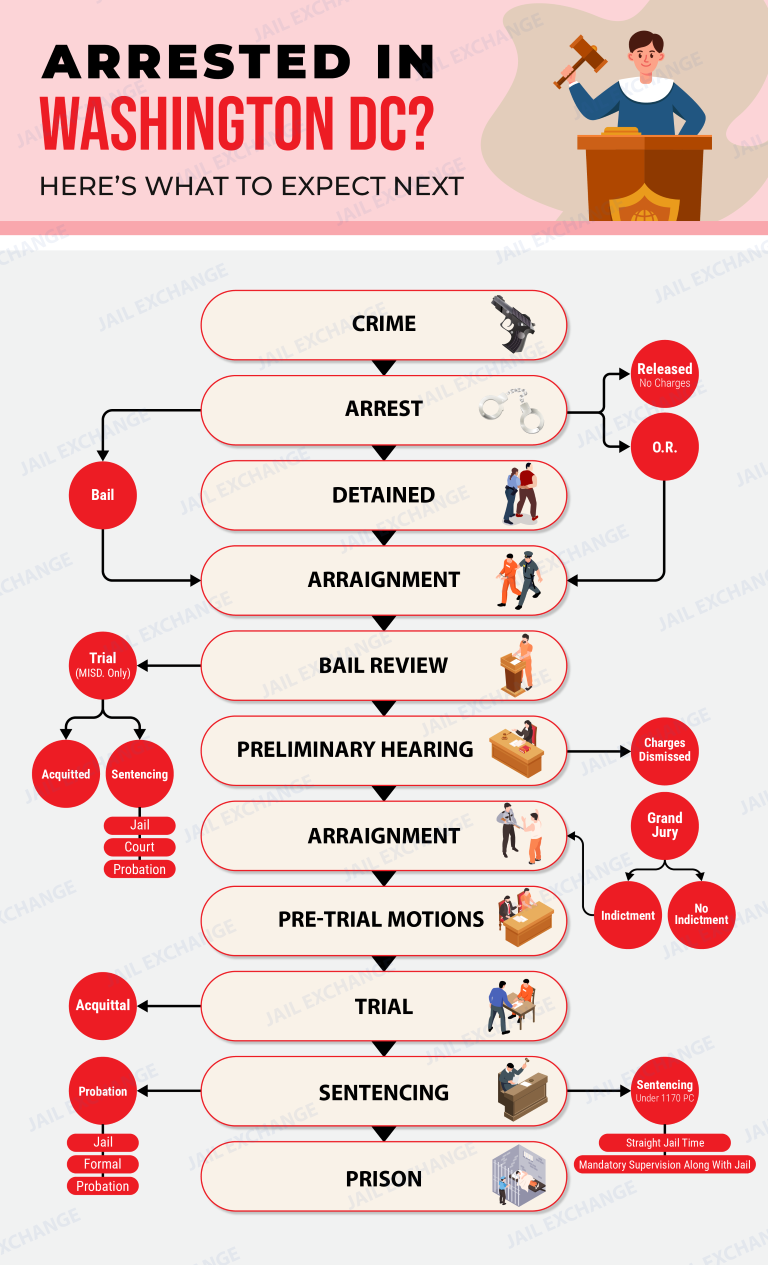
1. From arrest to the courthouse
MPD officers take the arrested person to a district station to be identified, charged and booked. From there one of three things happens: release on a citation with a court date, release after posting a bond or collateral, or transport to the Central Cellblock (300 Indiana Avenue NW, 202-727-4222) to wait for court. The court will not give out paperwork on arrests after 2011 that prosecutors declined to charge, often called “no papered” cases. See the court’s arrests page (https://www.dccourts.gov/superior-court/superior-court-divisions/criminal-division/arrests).
↑ Back to the question list2. Arraignment and presentment
The first court appearance is an arraignment for a misdemeanor and a presentment for a felony. The defendant hears the charges, a lawyer is assigned, and the judge decides on release or detention. The case is then given to a specific judge with a next date. No one is found guilty at this stage, and no witnesses testify.
Felonies and U.S. misdemeanors start in Courtroom C-10. D.C. misdemeanors and criminal traffic cases start in Courtroom 310 or 316, sorted by arresting district. Intrafamily and partner abuse cases start in Courtroom 119. C-10 opens at 11 a.m. on weekdays and holidays and at 12:30 p.m. on Saturdays. More at arraignment information (https://www.dccourts.gov/superior-court/superior-court-divisions/criminal-division/arraignment).
↑ Back to the question list3. Release, Pretrial Services and detention
The Pretrial Services Agency, 633 Indiana Avenue NW (202-220-5500), screens each new defendant and supervises those released with conditions. Under D.C. Code 23-1321 (https://code.dccouncil.gov/us/dc/council/code/sections/23-1321) the default is release on personal recognizance or an unsecured bond. Under D.C. Code 23-1322 (https://code.dccouncil.gov/us/dc/council/code/sections/23-1322) a judge may order detention after a hearing for listed dangerous offenses or a serious flight risk. Any cash bond is paid to the court’s Criminal Finance Office, Room 4003 (202-879-1840).
Our D.C. bail page covers payment hours and rules.
↑ Back to the question list4. Misdemeanor cases
U.S. misdemeanors, such as simple assault, threats, drug possession and many theft charges, are prosecuted by the U.S. Attorney. D.C. misdemeanors, like disorderly conduct, an open container or drinking in public, are prosecuted by the D.C. Attorney General’s office in the court’s D.C. Misdemeanor and Traffic Community Courts. After arraignment, a case may resolve through a plea, a diversion or problem-solving program, or a trial. A sentence of jail time is served at the D.C. Jail or the Correctional Treatment Facility.
↑ Back to the question list5. Felony cases
A felony moves from presentment to a preliminary hearing, where a judge checks for probable cause, unless the grand jury indicts first. After indictment come status hearings, motions, plea talks and, if there is no plea, a jury trial. Sentencing follows the D.C. Voluntary Sentencing Guidelines. A person sentenced to prison on a D.C. Code felony does not stay in a D.C. facility; they are sent to the Federal Bureau of Prisons.
↑ Back to the question list6. Defense lawyers
A defendant who cannot afford a lawyer gets one at the first hearing. The Public Defender Service, 633 3rd Street NW (202-628-1200), takes many of these cases. Others go to private attorneys the court appoints under the Criminal Justice Act. PDS also keeps a Defender Services Office in the courthouse, Room C-215.
↑ Back to the question list7. Youth under 18
Charges against children go to the Family Court branch of Superior Court in the same building. A youth held by court order stays at the Youth Services Center, 1000 Mount Olivet Road NE (202-576-8418), run by the Department of Youth Rehabilitation Services. Some older teens can be charged as adults; they are housed at the Correctional Treatment Facility.
↑ Back to the question list8. Federal cases
Federal crimes go to the U.S. District Court for the District of Columbia at the E. Barrett Prettyman Courthouse, 333 Constitution Avenue NW. Clerk’s office: 202-354-3000; criminal help desk: 202-354-3060. A U.S. magistrate judge handles the first appearance and any detention hearing. The Federal Public Defender, 625 Indiana Avenue NW (202-208-7500), represents people who cannot pay. Court site: dcd.uscourts.gov (https://www.dcd.uscourts.gov/).
↑ Back to the question list9. Looking up a case or a person
- Hearing dates: the Criminal Case Calendar (https://www.dccourts.gov/superior-court/superior-court-case-calendars/criminal-case-calendar), searchable by name
- Warrants: the active warrant list (https://www.dccourts.gov/superior-court/superior-court-divisions/criminal-division/additional-resources/active-warrant-list)
- Person held by the DOC: Records Office 202-523-7060, or VINELink for D.C. (https://vinelink.vineapps.com/search/DC/Person)
- After a felony sentence: BOP inmate locator (https://www.bop.gov/inmateloc/)
See also our D.C. inmate search page.
↑ Back to the question list10. Immigration requests
D.C. Code 24-211.07 (https://code.dccouncil.gov/us/dc/council/code/sections/24-211.07) keeps the DOC, MPD and youth agencies from holding anyone past their release time for immigration officials absent a warrant or order signed by a federal judicial officer. ICE detention can be checked on the ICE online locator (https://locator.ice.gov/odls/).
↑ Back to the question listThis overview is general information. A defense attorney can explain how the rules apply to a specific case.

Access Securepak is an authorized correctional commissary care-package program that allows families to purchase customized food, snack, hygiene, apparel, and electronics packages sent directly to an incarcerated loved one. Every package is custom-packed to meet the strict security regulations of the specific jail or state prison.
Important: Delivery Schedules and Package Quotas
Jail package guidelines are not uniform across detention centers. Some facilities permit orders year-round, while others restrict deliveries to quarterly cycles or strict weekly deadlines that you should confirm with the facility directly. If you delay setting up your account, you risk missing the upcoming delivery cutoff, leaving your loved one waiting an extra cycle for fresh food, warm thermals, or personal toiletries.
Step-by-Step Instructions to Register and Access Service
- Visit the official Access Securepak online store at www.accesscatalog.com.
- Select the state and the specific jail or correctional institution from the dropdown menu.
- Enter the inmate's legal last name and inmate ID to verify their active housing and package eligibility.
- Browse the catalog of approved meats, cheeses, ramen soups, cookies, toiletries, and clothing.
- Add items to your cart up to the facility's maximum weight or dollar limit (usually $50 to $125 per order).
- Check out using your debit or credit card and save the order confirmation tracking number.
What the Inmate Needs to Do
The inmate does not need to order anything themselves. Securepak ships the sealed package directly to the correctional facility's commissary warehouse. Jail staff inspect the box and deliver it to the inmate during regular pod commissary distribution, where the inmate signs for the package.
Official Provider: Access Corrections / Keefe Group Official Website
Customer Service Telephone: 1-800-546-6283
Support Hours: Monday – Friday, 8:30 AM – 11:30 PM EST; Saturday, 11:00 AM – 5:00 PM EST
Supported Languages: English and Spanish
Other Services Provided by Access Corrections / Keefe Group
In addition to Access Securepak (Commissary & Gift Packages), Access Corrections / Keefe Group provides several other communication, financial, and visitation services at participating correctional facilities:
- Inmate Trust Money Deposits: Send cash directly to their personal account so they can buy items independently.
• Learn more on our website: Inmate Trust Money Deposits Guide | • Visit official vendor page: Access Corrections / Keefe Group Inmate Trust Money Deposits - Digital Messaging & Photos: Send fast electronic letters and digital pictures to their tablet.
• Learn more on our website: Digital Messaging & Photos Guide | • Visit official vendor page: Access Corrections / Keefe Group Digital Messaging & Photos
Buy Commissary for an Inmate in the Washington DC Correctional Treatment Facility
Washington DC Correctional Treatment Facility Inmate Commissary - Sending Money or Purchasing Commissary for an Inmate
Washington DC Correctional Treatment Facility allows inmates to purchase commissary. Ask the jail what its commissary sells; snacks and hygiene items are common.
You can buy commissary for an inmate using an online service called Access Securepak.

Call the facility at 202-523-7060 to ask whether there is a limit on how much an inmate can spend on commissary.
Access Securepak's site shows whether friends and family can order commissary for an inmate at this jail.
Scroll down for information on the Washington DC Correctional Treatment Facility's service they use for you being able to purchase commissary items online and have them shipped directly to the inmate.
You can also go to our Inmate Money page for information on how to send money to an inmate.
ViaPath / ConnectNetwork Trust Fund Deposits
Provider: ViaPath Technologies • Formerly ConnectNetwork / GTL Financial
ViaPath Technologies (formerly GTL / ConnectNetwork) operates secure banking software enabling family members to deposit cash or card funds directly into an incarcerated person's jail trust account. Deposited funds allow the inmate to purchase commissary food items, clothing, personal hygiene goods, and medical copays, or transfer balances to phone time.
Important: Jail Trust Account Policies Differ by Agency
Once a person is booked and moved to a cell, facilities do not always allow cash drop-offs or phone payments directly to the jail window. Some might and you should confirm this by calling the facility and asking. But if you do not register online and fund your loved one's trust account immediately, they may be forced to wait days or weeks for standard paper processing, leaving them without essential soap, clean undergarments, basic medical sundries or snacks.
Step-by-Step Instructions to Deposit Trust Funds
- Confirm the inmate's legal name, date of birth, and assigned booking or institutional ID number.
- Log into your account at web.connectnetwork.com or my.viapath.com.
- Select Trust Fund from the available services dashboard.
- Select the facility and confirm your loved one's profile matches the active housing roster.
- Specify the deposit dollar amount and enter your debit or credit card billing details.
- Authorize the transaction and record the confirmation tracking number for your financial records.
What the Inmate Needs to Do
The inmate does not need an internet connection to receive trust funds. Once payment clears, the balance posts directly to their accounting profile in the jail's internal system. The inmate can review their updated balance at the pod kiosk or on their tablet and place their regular weekly store order.
Official Providers: ConnectNetwork Portal | myViaPath Portal
Customer Service Telephone: 1-877-650-4249
Support Hours: Automated Deposits 24/7/365; Live Agents Monday – Friday, 8:00 AM – 10:00 PM EST
Supported Languages: English and Spanish
Other Services Provided by ViaPath Technologies (ConnectNetwork)
In addition to Trust Fund Deposits, ViaPath / ConnectNetwork provides several other communication and calling options:
- AdvancePay Phone Calling Accounts: Keep a dedicated balance to receive telephone calls directly on your cell phone.
• Learn more on our website: AdvancePay Calling Guide | • Visit official vendor page: ConnectNetwork AdvancePay - ViaPath PIN Debit Phone Calling: Give the inmate calling funds to contact any approved phone number independently.
• Learn more on our website: PIN Debit Calling Guide | • Visit official vendor page: ViaPath PIN Debit - ViaPath Messaging & Photo Sharing: Send digital messages and photos directly to their kiosk or tablet.
• Learn more on our website: Digital Messaging Guide | • Visit official vendor page: ViaPath Messaging - GettingOut Video Visitation & Tablets: Schedule face-to-face remote video visits from home.
• Learn more on our website: Video Visitation Guide | • Visit official vendor page: GettingOut Video Visits
Deposit Money for an Inmate in the Washington DC Correctional Treatment Facility
The Easiest and Securest Way of Depositing Money for an Inmate
There are several methods for depositing money on an inmate's account:
1. To send money online to an inmate in the Washington DC Correctional Treatment Facility use GTL/Viapath.

2. If you prefer to use your credit or debit card and deposit money over the phone, you can call them at 877-650-4249.
3. Deposit cash or use a debit or credit card using a dedicated kiosk for this purpose. The machine is located in the lobby or visitation area of the Washington DC Correctional Treatment Facility.
4. The Washington DC Correctional Treatment Facility may also allow you to *mail an inmate a money order or cashier’s check from a trusted source such as the Post Office, a local bank, or Western Union. The money order should be be made out to either the inmate or the District of Columbia Sheriff's Office, with the inmate’s name and ID# on the memo line of the check. To confirm this option call the facility at 202-523-7060.
*When mailing a money order or cashier’s check, send it an envelope by itself. Never send it with a letter or photos for your inmate, unless the facility allows it. Never send personal checks or cash.
5. The Washington DC Correctional Treatment Facility has a reception desk that may accept cash, money orders or cashier checks. Call 202-523-7060 to find out the specific hours for drop off times.
Information for this service is currently unavailable.
ViaPath AdvancePay Phone Calling Accounts
Provider: ViaPath Technologies • Formerly ConnectNetwork / Global Tel*Link (GTL)AdvancePay is the primary prepaid telecommunications service operated by Global Tel*Link (GTL) and ConnectNetwork, which have unified under the corporate identity of ViaPath Technologies (and the myViaPath platform). By funding an AdvancePay account, telephone charges are deducted per minute whenever an incarcerated loved one calls your specific telephone number, preventing calls from being rejected by cellular carriers.
Important: Cell Carriers Automatically Block Jail Collect Calls
Inmate telephone networks do not permit incoming calls, and wireless cell providers automatically block traditional collect billing by default. While select traditional landlines may support operator billing, cell phones and internet-based lines require an active AdvancePay balance, which you can verify with your carrier. If you do not register your number online and add funds immediately, your loved one will hear an automated operator announcement stating your line is blocked from receiving correctional calls.
Step-by-Step Instructions to Open and Fund AdvancePay
- Visit web.connectnetwork.com or the updated my.viapath.com portal, or launch the ConnectNetwork / ViaPath mobile application.
- Click Sign Up and register using your primary 10-digit cellphone number and email address.
- Select Add Facility, pick your state, and choose the detention center or state prison where the inmate is held.
- Search for the inmate using their full legal name or facility booking ID number and link them to your contact directory.
- Select AdvancePay Phone and choose your deposit amount ($25, $50, or custom).
- Enter your debit or credit card billing details, accept the administrative transaction fee, and complete the payment.
- Check your phone settings to confirm that automated or unknown correctional numbers are not routed straight to spam.
What the Inmate Needs to Do
The inmate approaches any housing pod telephone, enters their assigned PIN and voice biometric recognition phrase, and dials your 10-digit number. ViaPath's automated operator confirms your active prepaid balance and connects the call. All personal telephone calls are subject to recording and monitoring by facility investigators.
Official Providers: ConnectNetwork Portal | myViaPath Portal
Customer Service Telephone: 1-877-650-4249 (Automated & Live Support)
Support Hours: Automated Service 24/7; Live Operators Monday – Friday, 8:00 AM – 10:00 PM EST
Supported Languages: English and Spanish
Other Services Provided by ViaPath Technologies (ConnectNetwork)
In addition to AdvancePay Phone Calling, ViaPath / ConnectNetwork provides several other communication, financial, and visitation services:
- ConnectNetwork Trust Fund Deposits: Transfer money directly into an inmate's jail trust account for commissary store purchases.
• Learn more on our website: Inmate Trust Deposits Guide | • Visit official vendor page: ConnectNetwork Trust Deposits - ViaPath PIN Debit Phone Calling: Give the inmate their own calling funds to contact any approved phone number independently.
• Learn more on our website: PIN Debit Phone Calling Guide | • Visit official vendor page: ViaPath PIN Debit Calling - ViaPath Messaging & Photo Sharing: Send digital messages, photos, and video attachments directly to their terminal.
• Learn more on our website: Digital Messaging Guide | • Visit official vendor page: ViaPath Messaging Services - GettingOut Video Visitation & Tablets: Schedule face-to-face remote video visits and manage handheld tablet communications.
• Learn more on our website: Remote Video Visitation Guide | • Visit official vendor page: GettingOut Video Visits
ViaPath PIN Debit Phone Calling Accounts
Provider: ViaPath Technologies • Formerly ConnectNetwork / Global Tel*Link (GTL)ViaPath PIN Debit (hosted on ConnectNetwork and myViaPath) provides incarcerated individuals with their own calling funds. Unlike AdvancePay (which only funds calls placed to your specific phone number), PIN Debit funds belong directly to the inmate, allowing them to call attorneys, bondsmen, employers, or extended family members across multiple approved telephone numbers.
Important: AdvancePay Only Funds a Single Phone Number
When someone is arrested, they often need to contact multiple people—including legal defense counsel, bail agents, employers, and relatives. If you only fund an AdvancePay account, your loved one will have no calling balance to dial anyone else, as rules and call authorizations vary by facility. Adding funds directly to ViaPath PIN Debit grants them the calling flexibility needed to handle critical legal and family arrangements without delay.
Step-by-Step Instructions to Fund a PIN Debit Account
- Sign into your account at web.connectnetwork.com or my.viapath.com.
- Click on PIN Debit under the communications menu.
- Select the state and facility, and link the inmate's booking identification number.
- Enter the deposit dollar amount and review the payment transaction fee.
- Enter your debit or credit card details and submit the payment.
- Notify your loved one that their personal PIN calling balance has been credited.
What the Inmate Needs to Do
The calling balance appears under the inmate's personal identification PIN. When they pick up any dayroom telephone or tablet, they select the 'PIN Debit' prompt from the automated menu to place calls to any approved number on their personal contact list.
Official Providers: ConnectNetwork Portal | myViaPath Portal
Customer Service Telephone: 1-877-650-4249
Support Hours: Automated Deposits 24/7/365; Live Agents Monday – Friday, 8:00 AM – 10:00 PM EST
Supported Languages: English and Spanish
Other Services Provided by ViaPath Technologies (ConnectNetwork)
In addition to PIN Debit Calling, ViaPath / ConnectNetwork provides several other communication, financial, and visitation services:
- AdvancePay Dedicated Phone Calling: Fund calls placed specifically to your personal phone number.
• Learn more on our website: AdvancePay Calling Guide | • Visit official vendor page: ConnectNetwork AdvancePay - ConnectNetwork Trust Fund Deposits: Deposit money for commissary food, hygiene supplies, and stationery.
• Learn more on our website: Inmate Trust Deposits Guide | • Visit official vendor page: ConnectNetwork Trust Deposits - ViaPath Messaging & Photo Sharing: Send digital messages and photos directly to their kiosk or tablet.
• Learn more on our website: Digital Messaging Guide | • Visit official vendor page: ViaPath Messaging Services - GettingOut Video Visitation & Tablets: Schedule face-to-face remote video visits from home.
• Learn more on our website: Remote Video Visitation Guide | • Visit official vendor page: GettingOut Video Visits
GettingOut / ViaPath Inmate Messaging
Provider: GettingOut (Telmate) • Rebranding as ViaPath Technologies (myViaPath)
GettingOut (a service of Global Tel*Link / Telmate) provides an instant two-way digital messaging and photo-sharing platform connecting families with incarcerated individuals via housing-unit kiosks and handheld tablets. The provider is actively rebranding as ViaPath Technologies (under the myViaPath platform); depending on the facility contract, local booking sheets and tablets may still refer to the service as GettingOut, GTL, or ViaPath, but both brand portals grant access to the same centralized messaging balance.
Important: Contact Authorization and Digital Mail Rules Vary
Inmate digital messaging rules are not uniform across all county detention centers. While some jails allow immediate two-way messaging upon registration, others require initial contact invitations or administrative ID verification, which you should verify directly with the facility. If you delay setting up an online profile and funding your Friends & Family messaging account, your loved one may face lengthy periods without direct family communication.
Step-by-Step Instructions to Register and Message an Inmate
- Visit www.gettingout.com or the newly branded my.viapath.com portal, or install the GettingOut / myViaPath mobile app.
- Create a user profile using your primary email address and 10-digit mobile phone number.
- Complete identity verification by uploading a clear photo of your government-issued driver's license or state ID and taking a verification selfie if requested.
- Search for the inmate by selecting the state, correctional facility, and their legal name or booking ID.
- Send an outside contact connection request to link your account to their tablet profile.
- Deposit funds into your 'Friends & Family Account' using a debit or credit card to cover message and photo-sharing costs.
- Compose your text message in the chat box, attach approved photos, and submit it for jail screening.
What the Inmate Needs to Do
The inmate powers on their assigned pod tablet or approaches a housing-unit kiosk and logs into the messaging application with their PIN. They accept your incoming contact invitation on the screen. Once approved by institutional monitors, incoming messages appear in their inbox, and the inmate types a reply directly on the screen.
Official Providers: GettingOut Website | myViaPath Portal
Customer Service Telephone: 1-866-516-0115 (GettingOut Support) • 1-877-650-4249 (ViaPath Support)
Support Hours: Monday – Friday, 7:00 AM – 11:00 PM CST; Saturday – Sunday, 8:00 AM – 7:00 PM CST
Supported Languages: English and Spanish
Other Services Provided by GettingOut / ViaPath
In addition to Two-Way Text Messaging, GettingOut and ViaPath provide several other communications and visitation options:
- Remote Video Visits: Schedule and join live web-based video visits from your computer or smartphone.
• Learn more on our website: Video Visitation Guide | • Visit official vendor page: GettingOut Video Visits - Inmate Tablet Rentals & Media: Fund tablet entertainment, music streaming, games, and news modules.
• Learn more on our website: Tablet Rentals & Content Guide | • Visit official vendor page: GettingOut Tablets - AdvancePay Phone Calling: Prepay for telephone calls so your loved one can dial your mobile phone directly.
• Learn more on our website: AdvancePay Phone Calling Guide | • Visit official vendor page: ViaPath ConnectNetwork Calling - Inmate Trust Deposits: Transfer funds directly into their jail trust account for commissary store purchases.
• Learn more on our website: Inmate Trust Deposits Guide | • Visit official vendor page: ViaPath Trust Deposits
GettingOut / ViaPath Inmate Tablets & Media
Provider: GettingOut (Telmate) • Rebranding as ViaPath Technologies (myViaPath)GettingOut provides specialized, secure handheld tablets for county jail inmates, offering access to messaging apps, telephone calling, legal research tools, eBooks, vocational training, and premium entertainment rentals. As part of GTL and Telmate's transition to ViaPath Technologies, tablet firmware and management platforms are moving to the myViaPath system.
Important: Tablet Feature Availability Varies by Facility
Jails manage tablet distribution according to individual facility contracts. While basic educational and legal materials are often provided without cost, access to music streaming, games, podcasts, and premium movies requires an active funded account. You should confirm the tablet rules with the facility directly. Registering and funding their media balance right away ensures your loved one has productive resources and recreation during their stay.
Step-by-Step Instructions to Fund Inmate Tablet Services
- Confirm that GettingOut / ViaPath handheld tablets are active at your loved one's specific detention facility.
- Navigate to www.gettingout.com or my.viapath.com.
- Sign into your verified user profile and link the inmate's legal name and booking ID number.
- Select Make a Deposit and choose either your Friends & Family Account (for messaging) or the inmate's personal Inmate Account (for entertainment and song rentals).
- Choose your deposit amount, review convenience fees, and complete payment with a credit or debit card.
- Notify your loved one that their tablet account balance has been funded.
What the Inmate Needs to Do
The inmate unlocks their assigned tablet or signs one out from the pod charging station using their biometric verification or PIN. Once logged in, their available balance appears on the screen, allowing them to download songs, stream educational content, and communicate with approved family members.
Official Providers: GettingOut Website | myViaPath Portal
Customer Service Telephone: 1-866-516-0115 (GettingOut) • 1-877-650-4249 (ViaPath)
Support Hours: Monday – Friday, 7:00 AM – 11:00 PM CST; Saturday – Sunday, 8:00 AM – 7:00 PM CST
Supported Languages: English and Spanish
Other Services Provided by GettingOut / ViaPath
In addition to Tablet Media & Rentals, GettingOut and ViaPath provide several other communication and account services:
- Two-Way Text Messaging: Send electronic letters and photos straight to the inmate's screen.
• Learn more on our website: Two-Way Text Messaging Guide | • Visit official vendor page: GettingOut Messaging - Remote Video Visits: Meet face-to-face over secure live video from home.
• Learn more on our website: Video Visitation Guide | • Visit official vendor page: GettingOut Video Visits - AdvancePay Phone Calling: Prepay for phone calling credits so your loved one can call your telephone directly.
• Learn more on our website: AdvancePay Phone Calling Guide | • Visit official vendor page: ViaPath ConnectNetwork Calling - Inmate Trust Deposits: Transfer cash directly into an inmate's jail ledger for commissary purchases.
• Learn more on our website: Inmate Trust Deposits Guide | • Visit official vendor page: ViaPath Trust Deposits
District of Columbia County Jails
District of Columbia Juvenile Facilities
- Jail (Main): 202-523-7060
- Administration: 202-547-7822
- DC Attorney General: 202-727-3400
- DC Criminal Court: 202-879-1373
- DOC Administrative Offices: 202-698-4932
- Metropolitan Police: 202-727-9099
- Public Defender: 202-628-1200