
Milledgeville Youth Development Campus
Milledgeville Youth Development Campus
Physical Address
800 North Glynn StreetMilledgeville, GA 31061
Jail Phone Number
478-445-3050Milledgeville Youth Development Campus: Information for Families
Short-term or long-term? A YDC is a long-term DJJ placement. Youth arrive here after a court commits them to the Department of Juvenile Justice, not while their case is pending. It is a statewide campus: committed youth from any Georgia county can be placed here.
This page is for families of youth at Milledgeville Youth Development Campus, 800 North Glynn Street, Milledgeville, GA 31061. Phone: 478-445-3050.
Read inmate search answers
 Read inmate search answers
1. How do I find out if my child is here?
Call 478-445-3050; juveniles are not in public inmate searches. Because it is kept private to protect the minor, staff will discuss it only with a parent or legal guardian.
↑ Return to the question list2. Is there school here?
School goes on here: Georgia Preparatory Academy, part of DJJ's accredited School District #891, teaches middle and high school grades (DJJ).
Youth can work toward a high school diploma or a GED through the Technical College System of Georgia, plus technical courses (DJJ FAQ).
↑ Return to the question list3. Who do I call with a safety concern?
Raise concerns with the counselor, the facility Director or Assistant Director, or DJJ's Office of the Ombudsman at 855-396-2978 (DJJ).
To report child abuse, call 911 in an emergency or the DFCS hotline at 1-855-GACHILD (1-855-422-4453).
↑ Return to the question list4. Who can write, and how many letters?
Letters are welcome from parents and family, and youth can write as often as they want at set times (DJJ).
Postage is provided for only two postcards a week unless you give the facility extra postage stamps (DJJ).
Before mailing books, photos or anything other than a letter, call 478-445-3050 and ask what is allowed.
How to address a letter
Resident's Full Name
Milledgeville Youth Development Campus
800 North Glynn Street
Milledgeville, GA 31061
5. When will my child phone me?
Your child places phone calls home at scheduled times, and approved visitors can use DJJ's free phone and video visits as well (DJJ).
Families wait for the call, since youth call out. For the schedule, ask the assigned counselor or call 478-445-3050. Because it is kept private to protect the minor, staff will discuss it only with a parent or legal guardian.
↑ Return to the question list6. Does my child need money or clothes?
No. Clothing and hygiene items are provided, and the facility cannot and will not hold money for youth (DJJ FAQ). Jail commissary and deposit accounts do not apply here.
↑ Return to the question list7. Who answers my questions?
Each youth has an assigned counselor; the facility nurse handles medical questions (DJJ FAQ).
Medical staff are on site. Bring your child's medicine, glasses or hearing aids if needed (DJJ FAQ).
↑ Return to the question list8. When can I visit?
You don't book a visit online. Facility staff contact parents and legal guardians to arrange it, and 478-445-3050 can give you the visiting days and times (DJJ).
Nobody outside immediate family is placed on the visit or call list, except the child's lawyer or pastor (DJJ FAQ).
Leave money, gum, snacks, cigarettes and anything else on the contraband list (alcohol, drugs, weapons) behind; vending machine snacks are allowed only if eaten during the visit (DJJ).
Approved visitors can also have free phone and video visits on state-issued smartphones, tablets or computers. If you are not an approved visitor, contact the facility (DJJ).
↑ Return to the question list9. Could my child end up in adult court?
Some charges against children 13 or older start in superior court, the adult court: murder, voluntary manslaughter, rape, aggravated sodomy, aggravated child molestation, aggravated sexual battery and armed robbery committed with a firearm, among others listed in O.C.G.A. § 15-11-560.
Through a transfer hearing, a juvenile court judge can send a case to superior court (O.C.G.A. § 15-11-561).
In Georgia a "child" for delinquency purposes is under 17, so 17-year-olds go to adult court from the start (O.C.G.A. § 15-11-2).
Once a case is in superior court, adult procedures, including adult bond rules, can apply; ask the lawyer where your child will be housed. Call your child's lawyer without delay.
↑ Return to the question listMilledgeville Youth Development Campus: Release Questions for Families
Detention or long-term placement? It is a Youth Development Campus (YDC), a long-term placement, not short-term detention. The Georgia Department of Juvenile Justice (DJJ) runs it for youth committed to DJJ custody for longer-term services and treatment. DJJ places committed youth here from all 159 Georgia counties.
A juvenile judge, not DJJ staff, decides release and bond.
1. Is there bond after commitment?
No bond applies to a commitment; release comes from the commitment order ending, DJJ release, or a court order such as a Good Behavior motion after 12 months (DJJ FAQ).
↑ Back to the questions2. When will my child come home?
Standard commitments last two years and designated felony orders five (DJJ FAQ). For your child's own dates, ask the counselor or call 478-445-3050. These details are kept private to protect the minor, so staff share them only with a parent or guardian.
↑ Back to the questions3. How does bond work in juvenile court?
Youth have a right to bond, but the judge decides whether bond is an option and sets the amount (DJJ FAQ).
Ask your child's appointed lawyer first; otherwise the DA's office, intake officer or juvenile court clerk explains how to proceed (DJJ FAQ).
↑ Back to the questions4. What if my child faces adult charges?
For a child aged 13 to 17 accused of murder, voluntary manslaughter, rape, aggravated sodomy, aggravated child molestation, aggravated sexual battery, armed robbery or aggravated assault with a firearm, or another offense on the statute's list, the case belongs to superior court (O.C.G.A. § 15-11-560).
Through a transfer hearing, a juvenile court judge can send a case to superior court (O.C.G.A. § 15-11-561).
Georgia's juvenile courts handle delinquency cases for children under 17; a 17-year-old is charged in adult court (O.C.G.A. § 15-11-2).
Once a case is in superior court, adult procedures, including adult bond rules, can apply; ask the lawyer where your child will be housed. Ask your child's lawyer about this as early as you can.
↑ Back to the questionsCourt Guide for Families at Milledgeville Youth Development Campus
Detention or long-term placement? A YDC is a long-term DJJ placement. Youth arrive here after a court commits them to the Department of Juvenile Justice, not while their case is pending. Placement is statewide, so youth here may come from any county in Georgia.
The facility is run by DJJ; the case itself belongs to a county juvenile court.
1. Which court handles the case?
The committing juvenile court, in the county where the case was filed, still handles motions in your child's case.
Ask the juvenile court clerk, the intake or probation officer, or the lawyer for dates (DJJ FAQ).
↑ Back to the top of the questions2. Can the commitment end sooner?
After 12 months in secure confinement, a youth on gold card status who meets the program goals may seek early release; the youth, parent or DJJ files a motion with the committing judge (DJJ FAQ).
↑ Back to the top of the questions3. Who decides where my child is placed?
A DJJ screening committee meets within 10 working days of commitment to decide where the youth goes; the parent and child may take part (DJJ FAQ).
↑ Back to the top of the questions4. What are the possible outcomes?
Probation can last up to two years. A general commitment transfers custody to the state, usually for two years, and a designated felony order with restrictive custody runs five years (DJJ FAQ).
↑ Back to the top of the questions5. How soon does a judge see my child?
DJJ says the detention hearing takes place within 72 hours of detention (DJJ FAQ).
A detained child's petition is due within three days after the detention hearing (including weekends); the full hearing follows within 10 days of the petition (DJJ FAQ).
↑ Back to the top of the questions6. When does a Georgia juvenile case go to superior court?
Superior court has exclusive jurisdiction over a child 13 to 17 charged with certain serious violent felonies, including murder, voluntary manslaughter, rape, aggravated sodomy, aggravated child molestation, aggravated sexual battery and armed robbery with a firearm (O.C.G.A. § 15-11-560).
A juvenile judge can transfer other cases to superior court after a transfer hearing (O.C.G.A. § 15-11-561).
Georgia's juvenile courts handle delinquency cases for children under 17; a 17-year-old is charged in adult court (O.C.G.A. § 15-11-2).
If the case moves to superior court, ask the lawyer where your child will be held while it is pending and which bond rules apply. Your child's lawyer can tell you whether this applies.
↑ Back to the top of the questions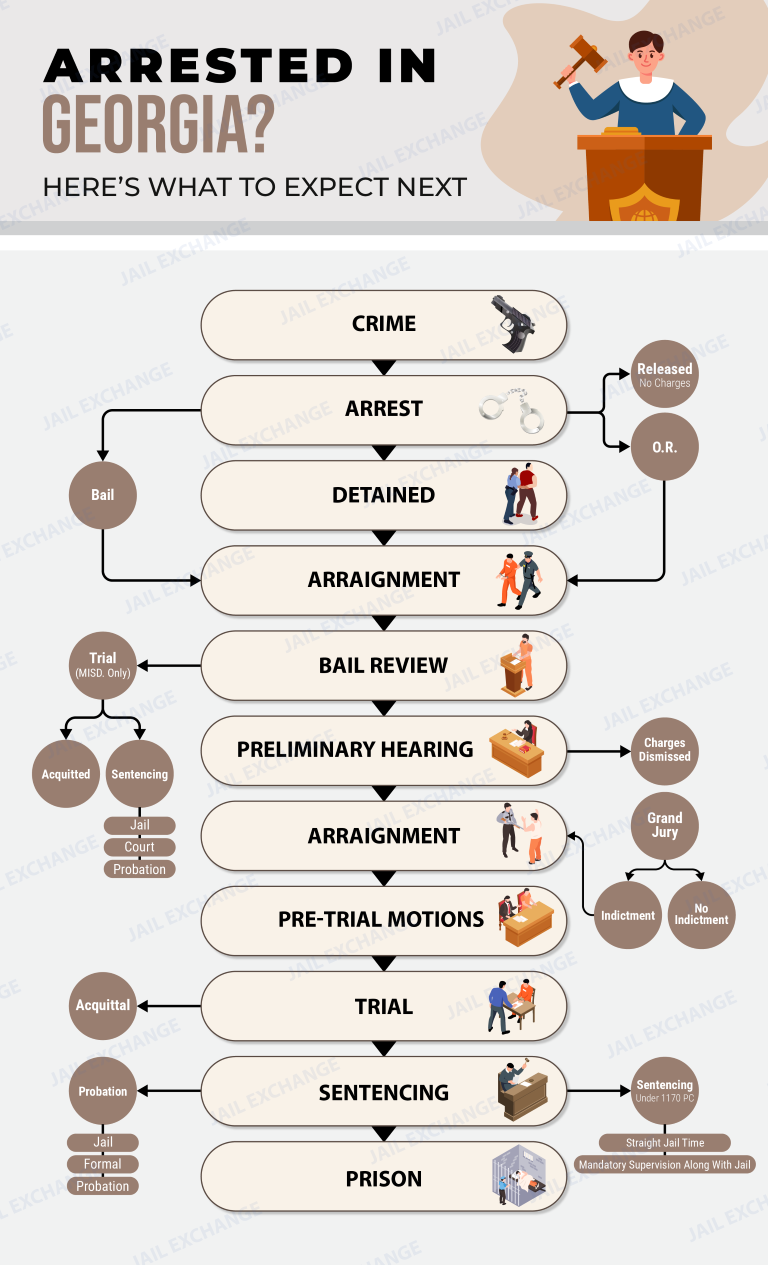
Information for this service is currently unavailable.
Information for this service is currently unavailable.
Information for this service is currently unavailable.
Information for this service is currently unavailable.
Information for this service is currently unavailable.
Information for this service is currently unavailable.
Baldwin County County Jails
Baldwin County Juvenile Facilities
Nearby counties
- Juvenile: 478-445-3050
The Milledgeville Youth Development Campus serves the following cities and towns of Baldwin County: Milledgeville. At times this facility may also house inmates arrested in the following counties: Appling County, Atkinson County, Bacon County, Baker County, Banks County, Barrow County, Bartow County, Ben Hill County, Berrien County, Bibb County, Bleckley County, Brantley County, Brooks County, Bryan County, Bulloch County, Burke County, Butts County, Calhoun County, Camden County, Candler County, Carroll County, Catoosa County, Charlton County, Chatham County, Chattahoochee County, Chattooga County, Cherokee County, Clarke County, Clay County, Clayton County, Clinch County, Cobb County, Coffee County, Colquitt County, Columbia County, Cook County, Coweta County, Crawford County, Crisp County, Dade County, Dawson County, Decatur County, DeKalb County, Dodge County, Dooly County, Dougherty County, Douglas County, Early County, Echols County, Effingham County, Elbert County, Emanuel County, Evans County, Fannin County, Fayette County, Floyd County, Forsyth County, Franklin County, Fulton County, Gilmer County, Glascock County, Glynn County, Gordon County, Grady County, Greene County, Gwinnett County, Habersham County, Hall County, Hancock County, Haralson County, Harris County, Hart County, Heard County, Henry County, Houston County, Irwin County, Jackson County, Jasper County, Jeff Davis County, Jefferson County, Jenkins County, Johnson County, Jones County, Lamar County, Lanier County, Laurens County, Lee County, Liberty County, Lincoln County, Long County, Lowndes County, Lumpkin County, Macon County, Madison County, Marion County, McDuffie County, McIntosh County, Meriwether County, Miller County, Mitchell County, Monroe County, Montgomery County, Morgan County, Murray County, Muscogee County, Newton County, Oconee County, Oglethorpe County, Paulding County, Peach County, Pickens County, Pierce County, Pike County, Polk County, Pulaski County, Putnam County, Quitman County, Rabun County, Randolph County, Richmond County, Rockdale County, Schley County, Screven County, Seminole County, Spalding County, Stephens County, Stewart County, Sumter County, Talbot County, Taliaferro County, Tattnall County, Taylor County, Telfair County, Terrell County, Thomas County, Tift County, Toombs County, Towns County, Treutlen County, Troup County, Turner County, Twiggs County, Union County, Upson County, Walker County, Walton County, Ware County, Warren County, Washington County, Wayne County, Webster County, Wheeler County, White County, Whitfield County, Wilcox County, Wilkes County, Wilkinson County and Worth County.