Criminal Court in Cook County and Chicago: Where Cases Are Heard, Who Prosecutes and Defends, and How They Move from Arrest to Verdict
Cook County is the largest county in Illinois and the second most populous county in the United States, home to the City of Chicago and more than 130 suburbs stretching from Wilmette and Barrington on the north to Chicago Heights and Park Forest on the south. Chicago is the county seat, and the countywide government, the Cook County State's Attorney, the Law Office of the Cook County Public Defender and the Office of the Chief Judge all keep their headquarters in the Loop, within a block of the Richard J. Daley Center. Because of its size, Cook is the only county in Illinois that makes up a judicial circuit entirely by itself. The Circuit Court of Cook County is one of the largest unified trial courts in the country, with roughly 400 circuit and associate judges.
Illinois does not use separate city, municipal, magistrate or county courts. A 1964 constitutional overhaul folded the old Municipal Court of Chicago and well over a hundred other local courts in Cook County into the single Circuit Court that exists today. Every criminal case in the county, whether it is a shoplifting charge out of Evanston or a homicide out of Englewood, is a Circuit Court of Cook County case. Associate judges handle most misdemeanors, traffic offenses and many preliminary matters, while circuit judges preside over felony trials, though in Cook either kind of judge may be assigned to a criminal courtroom by the Chief Judge.
What makes Cook different from the other 101 Illinois counties is how the court is divided internally. Felony trials from Chicago belong to the Criminal Division of the County Department, which sits at the George N. Leighton Criminal Court Building at 26th Street and California Avenue, a site so well known that lawyers simply call it "26th and Cal." Initial appearances and detention hearings for Chicago cases belong to the Pretrial Division, which meets in the same complex every day of the year. Chicago misdemeanors and felony preliminary hearings are handled by the First Municipal District. The suburbs are split among five more municipal districts, each with its own courthouse in Skokie, Rolling Meadows, Maywood, Bridgeview or Markham, and each of those suburban courthouses hears criminal cases from a minor misdemeanor up through first-degree murder. Domestic violence cases from Chicago go to a dedicated courthouse on West Harrison Street, and juvenile delinquency cases go to the Juvenile Center on West Ogden Avenue.
The main offices for criminal cases in Cook County are:
- George N. Leighton Criminal Court Building (Criminal Division felony trials and the Pretrial Division), 2600 S. California Ave., Chicago, IL 60608, (773) 674-3160; Pretrial Division, (773) 674-0513
- Clerk of the Circuit Court, Criminal Division (Leighton), (773) 674-3140; Chicago criminal case information, (773) 674-5882 or (773) 674-5889
- Clerk of the Circuit Court, Criminal Department (First Municipal District misdemeanors and preliminary hearings), Richard J. Daley Center, 50 W. Washington St., Room 1006, Chicago, IL 60602, (312) 603-4641; general Clerk call center, (312) 603-5030
- Office of the Chief Judge, Richard J. Daley Center, 50 W. Washington St., Room 2600, Chicago, IL 60602, (312) 603-6000
- Cook County State's Attorney's Office, 69 W. Washington St., Chicago, IL 60602, (312) 603-1880; Victim Services Bureau, (773) 674-7200
- Law Office of the Cook County Public Defender, 69 W. Washington St., Chicago, IL 60602, (312) 603-0600; 24-hour Arrest Hotline, (844) 817-4448
- Cook County Jail (Cook County Department of Corrections), run by the Cook County Sheriff, 2700 S. California Ave., Chicago, IL 60608, (773) 674-1945; automated help line and housing locator, (773) 674-5245
- Domestic Violence Courthouse, 555 W. Harrison St., Chicago, IL 60607, (312) 325-9000; Clerk's Domestic Violence office, (312) 603-9500
- Second Municipal District (Skokie), 5600 Old Orchard Rd., Skokie, IL 60077, (847) 470-7200
- Third Municipal District (Rolling Meadows), 2121 Euclid Ave., Rolling Meadows, IL 60008, (847) 818-2286
- Fourth Municipal District (Maywood), 1500 Maybrook Dr., Maywood, IL 60153, (708) 865-6060
- Fifth Municipal District (Bridgeview), 10220 S. 76th Ave., Bridgeview, IL 60455, (708) 974-6288
- Sixth Municipal District (Markham), 16501 S. Kedzie Pkwy., Markham, IL 60428, (708) 232-4170
Pretrial detainees from every part of Cook County, city and suburbs alike, are held at the Cook County Jail, directly behind the Leighton courthouse at 2700 S. California Ave. The jail is the only county lockup for adults awaiting trial here, and an underground and enclosed connection moves people between the jail divisions and the courtrooms at 26th Street. The sections below walk through the courthouses, the first days after an arrest, the jail, the prosecutors and defenders, and then the three main levels of charge.
- The courthouses of the Circuit Court of Cook County
- What happens after an arrest in Chicago or the suburbs
- Cook County Jail and pretrial custody
- The Cook County Public Defender and appointed counsel
- The Cook County State's Attorney, Felony Review and diversion
- Misdemeanor (for example, retail theft, a first DUI, battery, criminal trespass)
- Felony (for example, burglary, felony theft, drug delivery, aggravated battery)
- Violent felony (for example, murder, criminal sexual assault, armed robbery)
- Court records, juvenile cases and clearing a record
The courthouses of the Circuit Court of Cook County
The single most useful thing to know about a Cook County criminal case is which building it belongs in, because the answer depends on two things: where the arrest happened and how serious the charge is. The Circuit Court is organized into a County Department, which includes the Criminal Division, the Pretrial Division and the Domestic Violence Division among others; a Municipal Department made up of six geographic districts; and a Juvenile Justice and Child Protection Department. Your paperwork, whether a notice to appear, release order or charging document, will list a courtroom number and an address, and that is the controlling information.
The George N. Leighton Criminal Court Building (26th and California)
The criminal courthouse on Chicago's Southwest Side opened in 1929, the same year as the first jail building next door, after the county moved its criminal courts out of the older courthouse on the Near North Side. Built in a neoclassical style with art deco touches, it was renamed in honor of Judge George N. Leighton, a civil rights lawyer and longtime Cook County and federal judge. The courtroom building is at 2600 S. California Ave., and the adjoining Criminal Court Administration Building is at 2650 S. California Ave. The Clerk of the Circuit Court lists its first appearance courtroom (still widely called Central Bond Court, though cash bail has ended) in Room 111 at 2650 S. California.
Leighton is home to the Criminal Division, which hears felony cases that arise in the City of Chicago after they have been indicted or bound over from a preliminary hearing, and to the Pretrial Division, which holds initial appearances and detention hearings. Several of the county's problem-solving courts also meet here. The building has a law library in Room 4D00, open to the public from 9 a.m. to 4:30 p.m. on weekdays. Visitors should know that cell phones, smartphones, laptops, tablets and other internet-connected or recording devices are banned inside the Leighton courthouse, so plan to leave them in the car or at home.
The Richard J. Daley Center and the First Municipal District
The First Municipal District covers the City of Chicago. Its administrative home is the Daley Center, 50 W. Washington St., where the Clerk's Criminal Department keeps records for Chicago misdemeanors, quasi-criminal matters and felony preliminary hearings in Room 1006. The courtrooms where Chicago misdemeanors are actually heard are spread across neighborhood branch courts:
- Branches 23 and 29, 5555 W. Grand Ave., Chicago, IL 60639
- Branches 35 and 38, 727 E. 111th St., Chicago, IL 60628
- Branches 43 and 44, 3150 W. Flournoy St., Chicago, IL 60612
The Clerk's offices at the branch courts are open Monday through Friday, 8 a.m. to 4 p.m. Traffic cases from Chicago, including many DUI matters, are tracked by the Clerk's Traffic Division at (312) 603-2005.
Restorative Justice Community Courts
Cook County also runs three neighborhood restorative justice courts for young adults charged with nonviolent offenses who live in the community the court serves. They are the Avondale court at 3647 W. George St., Chicago, IL 60618; the Englewood court at 845 W. 69th St., Chicago, IL 60621; and the North Lawndale court at 3605 W. Fillmore St., Chicago, IL 60624. Eligibility is explained in the State's Attorney section below.
The Domestic Violence Courthouse
Domestic violence cases from Chicago, such as domestic battery and violation of an order of protection, are heard at 555 W. Harrison St. in the South Loop. The Clerk's domestic violence office there is open weekdays, 8:30 a.m. to 4:30 p.m. Felony domestic cases from the city that are bound over for trial move to Leighton; suburban domestic violence cases stay in the suburban district courthouse where they were filed.
The five suburban municipal districts
Each suburban courthouse functions as a full-service criminal court for its region. Misdemeanors, traffic cases, preliminary hearings, felony trials and even homicide trials from suburban police departments, the Cook County Sheriff's Police and the Illinois State Police in that area are heard in the district courthouse. The Clerk's office numbers below are the direct lines the Clerk publishes for each district.
- Second District, Skokie (northern suburbs), 5600 Old Orchard Rd., Skokie, IL 60077. Clerk: (847) 470-7250
- Third District, Rolling Meadows (northwest suburbs), 2121 Euclid Ave., Rolling Meadows, IL 60008. Clerk: (847) 818-3000
- Fourth District, Maywood (western suburbs), 1500 Maybrook Dr., Maywood, IL 60153. Clerk: (708) 865-6040
- Fifth District, Bridgeview (southwest suburbs), 10220 S. 76th Ave., Bridgeview, IL 60455. Clerk: (708) 974-6500
- Sixth District, Markham (south suburbs), 16501 S. Kedzie Pkwy., Markham, IL 60428. Clerk: (708) 232-4551
Which suburban courthouse hears a case is set by the location of the offense, not where the accused person lives. If you are unsure which district your suburb falls in, the arresting department and your release paperwork will list it, and the Clerk's call center at (312) 603-5030 can confirm it.
The Juvenile Center
Delinquency cases against young people under 18 are heard by the Juvenile Justice Division at the Cook County Juvenile Center, 2245 W. Ogden Ave., Chicago, IL 60612, (312) 433-4757. Juvenile cases are summarized in the last section of this guide.
What happens after an arrest in Chicago or the suburbs
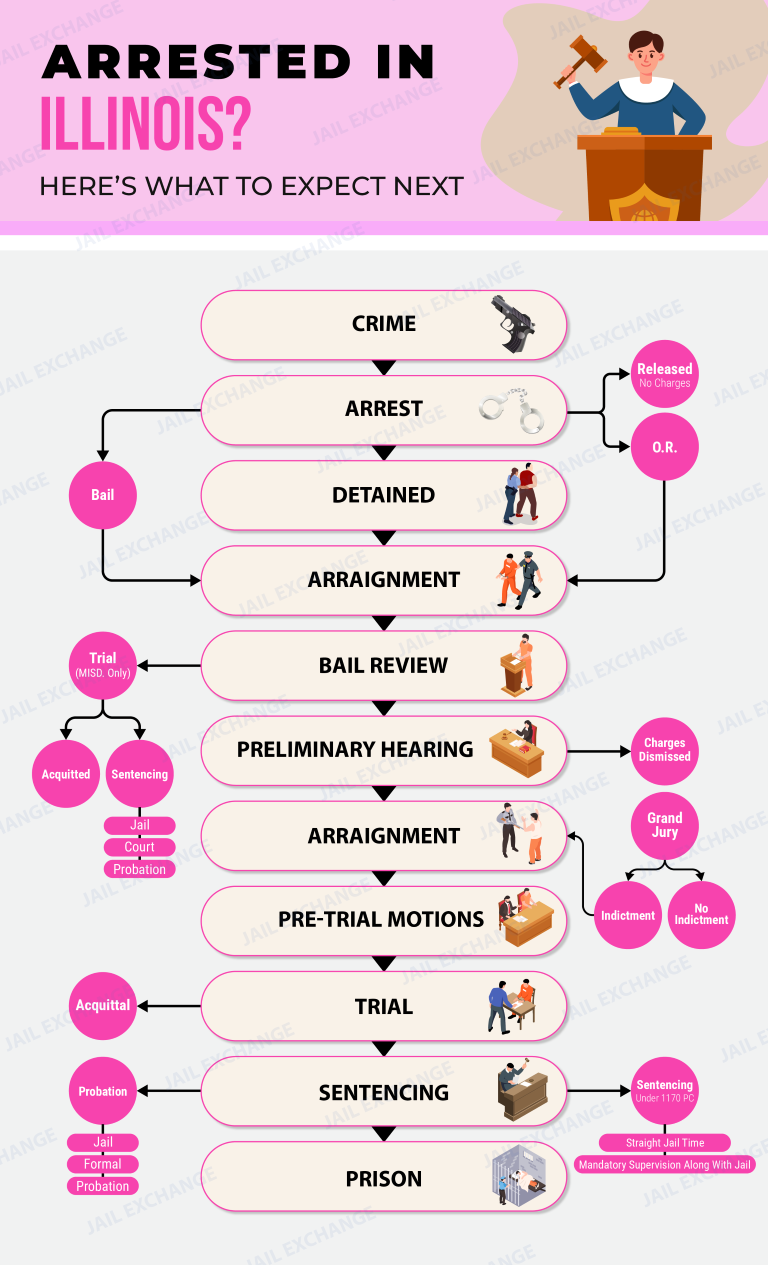
The hours after an arrest in Cook County follow a fairly predictable sequence, although the details differ between an arrest by the Chicago Police Department and one by a suburban department. In either case, Illinois law since September 18, 2023, has meant that no one sits in jail because they cannot post money. Under the Pretrial Fairness Act, part of the SAFE-T Act, cash bail no longer exists in Illinois. A person is either released, often with conditions, or held without release after a detention hearing.
The police station
After a Chicago arrest, the person is taken to a Chicago Police district station or another police processing facility, where they are fingerprinted, photographed and checked for warrants. Many lower-level offenses end right there with a citation or notice to appear and release from the station. For more serious charges, the person stays in police custody while detectives complete reports and seek charging approval. Suburban arrests follow the same pattern in that town's police lockup, and the Cook County Sheriff's Police use their own facilities for arrests in unincorporated areas.
Anyone held at a police station anywhere in Cook County has the right to a free lawyer there. The Public Defender's Arrest Response Division answers its Arrest Hotline at (844) 817-4448 24 hours a day, 365 days a year, and will send an attorney to the station for a person in custody. A family member can make the call. Illinois law also gives a person in custody the right to make phone calls within a reasonable time after arriving at the station.
Charging approval
For most felonies, Chicago and suburban police do not file charges on their own. Detectives present the evidence to prosecutors in the State's Attorney's Felony Review Unit, who decide whether to approve a felony charge, approve a reduced misdemeanor charge, direct further investigation or reject charges. Misdemeanor charges are typically filed by police on a sworn complaint without that review. The approved charge is then filed with the Clerk and the case is sent to the appropriate first appearance courtroom.
First appearance in the Pretrial Division
A person kept in custody is usually brought before a judge within about 48 hours. For Chicago cases on weekdays, that first appearance happens in the Pretrial Division at the Leighton complex. Special calls cover sex offenses, cases involving a death and escape. On weekends and court holidays, the Pretrial Division hears initial appearances for all countywide misdemeanor and felony arrests, including domestic violence cases and suburban arrests, which is why a suburban arrest on a Saturday night can lead to a first appearance at 26th and California rather than in the suburban courthouse. The division is in session every day of the year.
At that first hearing, the judge confirms there is probable cause for the charge, makes sure the accused has a lawyer (most often an assistant public defender from the Public Defender's Pretrial Division), and either sets release conditions or, if the State has filed a petition, holds a detention hearing.
Detention hearings under the Pretrial Fairness Act
Every person charged in Cook County is presumed eligible for pretrial release. The State's Attorney can ask to hold someone only for listed offenses, including forcible felonies such as murder, armed robbery, residential burglary and criminal sexual assault, many gun offenses, domestic violence offenses and some others, or where it argues the person is a willful flight risk. At the hearing, the State must prove by clear and convincing evidence that the proof is evident or presumption great that the person committed a qualifying offense, that the person poses a real and present threat to the safety of a person or the community (or a willful flight risk), and that no set of release conditions can mitigate that risk. Both sides may offer evidence by proffer, and judges review a Public Safety Assessment prepared by pretrial staff.
In practice, detention hearings at Leighton are frequent and contested, and gun possession cases make up a large share of them. If the judge orders detention, the person is taken to the Cook County Jail. A judge must revisit whether continued detention is necessary at each later court date, and a detained person has the right to appeal the detention order to the Illinois Appellate Court, where the Office of the State Appellate Defender may represent them.
Pretrial Services and electronic monitoring
People released with conditions are supervised by the Pretrial Services Division of the Adult Probation Department, which works under the Office of the Chief Judge. Conditions range from periodic check-ins and reminders to curfews, stay-away orders and GPS or electronic monitoring. The Cook County Sheriff also runs a large electronic monitoring program through its Community Corrections division; its phone line is (877) 326-9198. Violating release conditions can lead the State to seek sanctions or, for a qualifying offense, a new detention petition.
After the first appearance
A Chicago misdemeanor case is next sent to a branch court or the Domestic Violence Courthouse. A Chicago felony goes either to a preliminary hearing in the First Municipal District or to the grand jury, and then to a trial courtroom at Leighton. Suburban cases, misdemeanor or felony, are sent back to the district courthouse where the offense occurred for every later court date.
Cook County Jail and pretrial custody
Everyone ordered held before trial in Cook County, whether arrested in Chicago, Oak Park, Schaumburg or Harvey, is sent to the Cook County Jail, formally the Cook County Department of Corrections, which the Cook County Sheriff operates at 2700 S. California Ave., Chicago, IL 60608. The main number is (773) 674-1945. The suburban courthouses keep only short-term lockups for people brought in for court; there are no separate county jails in the suburbs, and Cook does not board its pretrial detainees in other counties.
Size and history
The jail complex covers about 96 acres and roughly eight city blocks on the Southwest Side, and the Sheriff describes it as one of the largest single-site jails in the nation. Its population changes daily; in mid-October 2026 the Sheriff reported just under 6,000 people in custody. The oldest building, Division I, opened in 1929 when the county moved its jail to 26th and California, and the county's electric chair was used there until the last execution in 1962. Division II was built in 1955 as the City of Chicago's House of Correction and was turned over to the Sheriff in 1970, when the two were combined to form the Department of Corrections. Newer buildings followed in the 1970s, 1980s and 1990s.
The divisions
The complex is divided into numbered divisions, each with its own classification level:
- Division II (2700 S. California Ave.): dormitory housing for minimum and medium classification men
- Division III Annex (opened 1985): housing for women and men from minimum to maximum classification
- Division VI (2801 S. Sacramento Ave.): medium and minimum classification housing
- Division IX (2834 W. 31st St., opened 1992): medium and maximum general population, rehabilitation units and protective custody
- Division X (2950 S. California Ave., opened 1992): built for maximum security, converted in 2008 to medical and acute psychiatric use, now housing general population men
- Division XI (3015 S. California Blvd., opened 1995): a 640,000-square-foot facility that holds up to 1,536 men of all classifications
- Division XVI: programming housing, including the Sheriff's Mental Health Transition Center
Division I (the original 1929 building) and Division III are listed by the Sheriff as inactive or overflow housing, and Division IV on Sacramento Avenue is closed. The Sheriff's External Operations unit transports people in custody to court, to hospitals and to clinics.
Health care: Cermak Health Services
Medical, mental health, dental and pharmacy care inside the jail is provided not by the Sheriff but by Cermak Health Services of Cook County, part of the county's public health system. Cermak is located at 2800 S. California Ave., Chicago, IL 60608, (773) 674-7488. Every person booked into the jail is screened by Cermak staff at intake. The jail is also among the largest mental health care providers in Illinois. Families who need a new treatment provider to confirm a methadone or similar medication history can contact Cermak's care coordinator at (773) 674-2457.
Finding someone in custody
To learn whether someone is in the Cook County Jail and where they are housed, call the Sheriff's automated help line at (773) 674-5245; have the person's full name and date of birth ready. Housing locations are written as a division and living unit; for example, "DIV2" followed by "2B" means Division II, tier 2B. The Sheriff's office also offers an online search through its own official pages. The Individual in Custody Services line is (773) 674-1979, the Visitor Information Center is (773) 674-8225, and the Sheriff's legal office is (773) 674-7683. If the person was arrested within the last day or two, they may still be at a police station; the arresting department or the Public Defender's Arrest Hotline at (844) 817-4448 can help find them.
Visiting
The Sheriff offers both in-person and video visits. For in-person visits, visitors schedule an appointment in advance through the Sheriff's scheduling system. For video visits, the person in custody must first add the visitor's name to their visiting list, after which jail staff contact the visitor to set a day and time; the visitor needs a video-call account tied to an email address. The same conduct rules apply to video and in-person visits, and privileges can be revoked for violations. Visitors with disabilities can reach the Sheriff's ADA compliance officer during business hours at (773) 674-7768. For identification, dress and age rules, call the Visitor Information Center at (773) 674-8225 before going.
Release from the jail
When a judge orders someone released, the Sheriff processes the release at the jail, which can take several hours after the court order. The Clerk of the Circuit Court keeps a Bond Room in Division V at 2700 S. California Ave., open from 10 a.m. to 6 p.m. seven days a week, including holidays. A person released on electronic monitoring is fitted with a device before leaving.
The Cook County Public Defender and appointed counsel
Illinois funds trial-level public defense county by county, and Cook County's office is by far the largest in the state. The Law Office of the Cook County Public Defender, led by Public Defender Sharone R. Mitchell, Jr., has its main office at 69 W. Washington St., Chicago, IL 60602, (312) 603-0600, open weekdays from 9 a.m. to 5 p.m. Its attorneys work in every criminal courthouse in the county, including Leighton, the First Municipal District branch courts, the five suburban district courthouses, the Domestic Violence Courthouse, the Juvenile Center and traffic court, and it also runs community-based Freedom Defense Centers in Roseland and Austin.
How a public defender is appointed
A judge, not the Public Defender's office, decides whether a person qualifies. At the first court appearance, the accused completes an Affidavit of Assets and Liabilities describing income, savings and debts, and the judge decides whether the person can afford private counsel. A person who is in custody is typically appointed a public defender at that hearing unless they already have a private lawyer. Someone who hired a private attorney but can no longer pay should tell the judge as soon as possible and ask for a public defender. When an assistant public defender has been assigned but the client does not know the lawyer's name, the main number for that courthouse's office or the headquarters line will help locate them.
Help before court: the Arrest Response Division
Unlike most counties, Cook offers free lawyers at the police station. The Arrest Response Division provides representation 24 hours a day to people arrested and held anywhere in Cook County, including people picked up on warrants. Call (844) 817-4448. The office's Pretrial Division then represents clients from arrest through the initial appearance and any detention hearing, arguing for release on the least restrictive conditions.
Divisions that handle criminal cases
- Felony Trial Division: represents clients in the felony trial courtrooms that hear Chicago cases at Leighton, covering everything from drug possession to first-degree murder.
- First Municipal Division: handles Chicago misdemeanors and felony preliminary hearings, where its lawyers test whether the State has probable cause.
- Suburban Divisions: five divisions based at the Skokie, Rolling Meadows, Maywood, Bridgeview and Markham courthouses, handling suburban cases from misdemeanors through murder.
- Homicide Task Force: experienced trial lawyers who represent people charged with homicide from the first court date after the initial hearing through trial and sentencing.
- Multiple Defendant Division: represents a second or later co-defendant in felony and murder cases, working separately from the other divisions to avoid conflicts.
- Domestic Advocacy Unit: handles domestic battery, order of protection violations and other cases involving family or intimate relationships.
- Problem-Solving Courts: public defenders assigned to each of the county's drug, mental health, veterans and other treatment courts.
- Forensic Science Division: litigates DNA, fingerprint, firearms and cell phone location evidence and reviews cases for other attorneys.
- Investigations Division: interviews witnesses, gathers records and reviews evidence for the defense.
- Client Support Services: social workers and mitigation specialists who address mental health, housing and other needs and help prepare for sentencing.
- Immigration Division: advises defense lawyers on deportation consequences and represents some clients in immigration court.
- Juvenile Justice Division: represents young people 17 and under, including in hearings where the State asks to transfer a case to adult court.
- Legal Resources Division: handles post-trial motions, post-conviction petitions and some appellate work.
Conflicts, appeals and private counsel
When the Public Defender cannot represent a person because of a conflict of interest, for example because the office already represents a co-defendant whose interests are opposed and its Multiple Defendant Division cannot take the case, the judge appoints private counsel paid by the county. On appeal after a conviction, indigent defendants are usually represented by the Office of the State Appellate Defender, whose First District office handles appeals from Cook County to the Illinois Appellate Court. Anyone who can afford a private criminal defense attorney may hire one at any point, and the public defender will withdraw once private counsel files an appearance.
The Cook County State's Attorney, Felony Review and diversion
Every state criminal charge in Cook County, from a misdemeanor battery in Rogers Park to a first-degree murder in Calumet City, is prosecuted by the Cook County State's Attorney's Office. The elected State's Attorney is Eileen O'Neill Burke, who took office in December 2024. The office's main address is 69 W. Washington St., Chicago, IL 60602, and its main phone is (312) 603-1880. With about 750 assistant state's attorneys and roughly 1,300 employees in all, it describes itself as the second largest prosecutor's office in the country. Its lawyers staff courtrooms at Leighton, the Daley Center and Chicago branch courts, the Domestic Violence Courthouse, the Juvenile Center and all five suburban courthouses.
Chicago and the suburban villages can prosecute violations of their own local ordinances, but they cannot bring state misdemeanor or felony charges; those belong to the State's Attorney alone. In Chicago, many ordinance violations are not heard in the Circuit Court at all but at the City's Department of Administrative Hearings, described in the misdemeanor section.
Felony Review
The Felony Review Unit is the gatekeeper for most felony charges in Cook County. Assistant state's attorneys assigned to the unit take calls from Chicago and suburban police around the clock, review evidence (and in serious cases, go to the police station or crime scene), and decide whether to approve felony charges and which charges to approve. In homicide and other major cases, Felony Review prosecutors often interview witnesses and take statements before charges are filed. A rejected felony may be charged as a misdemeanor, sent back for more investigation or dropped.
Bureaus and units
The office is organized into several bureaus and independent units. Among those that deal with criminal cases are the Special Victims Bureau (sexual assault, child abuse, domestic violence and human trafficking), the Multi-Jurisdiction Bureau, the Juvenile Justice and Child Protection unit, the Conviction Integrity Unit, which reviews claims of wrongful convictions, and the Law Enforcement Review Unit.
Victim Services Bureau
Created in 2026, the Victim Services Bureau has more than 80 victim specialists stationed at eight courthouse locations, about a fifth of them licensed mental health professionals. They explain victims' rights, provide courtroom orientation, help prepare victim impact statements, assist with Crime Victims' Compensation applications, make safety-planning and counseling referrals, arrange transportation to court for some victims, and help with U-visa certification and T-visa coordination for immigrant victims. Interpreters are offered in more than 300 languages. Victims can reach the bureau, or find their assigned specialist, at (773) 674-7200.
Felony diversion programs
The State's Attorney decides who is offered a diversion program, and most require the victim's agreement where there is a victim. The office's published felony options include:
- Felony Deferred Prosecution Program (Branch 9): a 12-month program for people charged with a felony who have no prior felony convictions, no violence, weapon or DUI charge, and no violent misdemeanor conviction in the past ten years. Charges are dismissed after completion and repayment of any restitution.
- Drug Deferred Prosecution Program: for Class 4 possession of 5 grams or less of a controlled substance and certain Class 4 cannabis cases; charges are dismissed after the program requirements are met.
- Supporting Education and Employment Development (SEED): a 13-month pre-plea program for young adults charged with certain Class 2, 3 or 4 drug delivery or possession-with-intent offenses who have nonviolent backgrounds; successful participants have their charges dismissed.
- Restorative Justice Community Courts: for young adults charged with nonviolent felonies or misdemeanors who live in North Lawndale, Englewood or Avondale, accept responsibility and are willing to meet with the person harmed. Participants sign a Repair of Harm Agreement, and the charges are dismissed when it is completed. A 2026 expansion opened these courts to some ammunition and expired-license gun possession cases and extended the program to suburban Sauk Village.
The county's Drug Treatment, Mental Health Treatment and Veterans Treatment courts, described in the felony section, also lead to dismissal for many participants.
Misdemeanor diversion
On September 30, 2026, the office announced an expanded Misdemeanor Deferred Prosecution Program for people charged with certain nonviolent misdemeanors, such as drug possession and retail theft. Prosecutors route each eligible person into a behavioral health track, a veterans track or a restorative justice track. The person completes an assessment, follows the recommendations, and returns to court in about 90 days; if the recommendations have been met, the charge is dismissed. Other misdemeanor options include the Chicago Prostitution and Trafficking Intervention Court, which links people charged with misdemeanor prostitution offenses to services and dismisses the case on completion, and the Fitness Diversion Triage Program for people with serious mental illness charged with nonviolent misdemeanors.
Misdemeanor (for example, retail theft, a first DUI, battery, criminal trespass)
Misdemeanors make up the bulk of criminal filings in Cook County, and they are handled in a different set of courtrooms from felonies. A misdemeanor from Chicago is a First Municipal District case heard at one of the neighborhood branch courts, or at the Domestic Violence Courthouse on West Harrison Street if the alleged victim is a family or household member. A misdemeanor from the suburbs stays in the district courthouse that serves the town where it happened: Skokie, Rolling Meadows, Maywood, Bridgeview or Markham. In both places, the case is prosecuted by an assistant Cook County State's Attorney, and an associate judge usually presides.
Many people charged with a misdemeanor in Cook County are never booked into the Cook County Jail. Police often issue a citation or notice to appear and release the person from the station. Under the Pretrial Fairness Act, a person charged only with a misdemeanor generally cannot be held before trial unless the offense is one of the listed domestic violence or similar charges, or the person is shown to be a willful flight risk.
Ordinance tickets versus criminal misdemeanors
It matters whether a Chicago ticket is a city ordinance violation or a state criminal charge. Many city ordinance violations written by Chicago police and city departments are heard by the City's Department of Administrative Hearings, a civil, quasi-judicial body whose central hearing facility is at 400 W. Superior St. Those hearings can result in fines but not jail and do not create a criminal conviction. State misdemeanors such as retail theft, battery, criminal trespass, criminal damage to property and DUI, by contrast, are filed in the Circuit Court and prosecuted by the State's Attorney. Suburban villages also bring some ordinance cases in the district courthouses through their own village prosecutors.
Getting a lawyer for a misdemeanor
Anyone facing possible jail time is entitled to a lawyer, and the Cook County Public Defender represents people on misdemeanors in every courthouse. The First Municipal Division covers Chicago branch courts, the Domestic Advocacy Unit covers the Domestic Violence Courthouse, and the five Suburban Divisions cover the district courthouses. Ask for a public defender at your first court date, or call the main office at (312) 603-0600. To confirm your next court date on a Chicago misdemeanor, call the Clerk's Criminal Department at (312) 603-4641 with your name, date of birth, year of arrest and charge.
Court dates
At the first court date, the defendant receives a copy of the complaint, the judge confirms counsel, and the case is set for status, discovery or trial. Most Cook County misdemeanors are resolved through negotiation, diversion or dismissal. A defendant may choose a jury trial, which in Illinois means 12 jurors unless both sides agree to fewer, or a bench trial before the judge alone; many Cook misdemeanor trials are bench trials. A person held in custody must be tried within 120 days, and a person on release can demand trial and must then be tried within 160 days, not counting delays the defense causes.
Common outcomes in Cook County misdemeanor courtrooms
- Dismissal or diversion: through the State's Attorney's Misdemeanor Deferred Prosecution Program, a restorative justice court, the Fitness Diversion Triage Program or a straightforward dismissal.
- Court supervision: a period of conditions, after which the charge is dismissed and no conviction is entered if the person completes it. Supervision is widely used in Cook County for first offenses.
- Conditional discharge: a conviction with conditions but no probation officer.
- Probation, fines or jail: more common for repeat offenses and domestic violence cases.
Misdemeanor penalties under Illinois law
- Class A misdemeanor (such as most retail theft of $300 or less, battery, domestic battery, a first DUI): up to 364 days in the Cook County Jail and a fine of up to $2,500.
- Class B misdemeanor (such as some criminal trespass offenses): up to 6 months and a fine of up to $1,500.
- Class C misdemeanor (such as some disorderly conduct and assault charges): up to 30 days and a fine of up to $1,500.
A first DUI in Cook County
A first DUI is a Class A misdemeanor, carrying up to 364 days in jail and a $2,500 fine. The driver's license consequences start immediately: the Illinois Secretary of State imposes a statutory summary suspension of 6 months for a first offender who fails a chemical test and 12 months for one who refuses testing. A conviction brings revocation of at least one year. Court supervision can be granted once for a first DUI, which avoids a conviction. Chicago DUI cases and suburban DUI cases are heard in the First Municipal District and the district courthouses respectively, and a petition to rescind the summary suspension is heard in the same court.
How long a misdemeanor takes
A Cook County misdemeanor usually takes from one to six months from the first court date to resolution. Diversion programs and supervision can keep a case open longer, but they end without a conviction if completed.
Felony (for example, burglary, felony theft, drug delivery, aggravated battery)
A felony charge in Cook County almost always begins with approval from the State's Attorney's Felony Review Unit, a first appearance before a Pretrial Division judge (on weekdays for Chicago arrests, and every day for weekend and holiday arrests countywide), and a decision on release or detention. From there, the path splits by geography. A Chicago felony moves to a preliminary hearing in the First Municipal District or to the grand jury, and then to one of the felony trial courtrooms in the Criminal Division at the Leighton building. A suburban felony stays in the Skokie, Rolling Meadows, Maywood, Bridgeview or Markham courthouse, where the same district handles the preliminary hearing, arraignment, trial and sentencing.
Preliminary hearing or grand jury
Illinois requires that a felony charge be tested for probable cause, either by a judge at a preliminary hearing or by a grand jury indictment. If the person is in custody, a preliminary hearing must be held within 30 days. In Cook County, prosecutors very often take felony cases to a grand jury, which meets in secret, hears only the State's evidence and returns an indictment, and that indictment replaces the need for a preliminary hearing. When a preliminary hearing does take place in Chicago, it is handled in the First Municipal District, with Public Defender lawyers from the First Municipal Division cross-examining the State's witness, usually a police officer. If the judge finds probable cause, the case is "held to answer" and the prosecutor files an information.
Arraignment and assignment to a trial courtroom
After indictment or a finding of probable cause, a Chicago case is assigned to a felony trial courtroom at Leighton, where it typically stays with the same judge for the life of the case. At arraignment, the defendant receives the charging document and enters a plea of not guilty, and the State tenders discovery, including police reports, body camera and surveillance video, lab results and witness statements. Suburban felony cases follow the same steps in the district courthouse.
Defense lawyers in felony cases
The Public Defender's Felony Trial Division staffs the courtrooms that hear Chicago felonies at Leighton, and the Suburban Divisions do the same in the five district courthouses. The Multiple Defendant Division handles co-defendants, and the Forensic Science Division assists with DNA, fingerprint, firearms and digital evidence. Anyone who cannot afford counsel should ask the judge for a public defender, or call (312) 603-0600.
Problem-solving courts
Cook County runs several treatment courts, and the State's Attorney and the judge must agree that a defendant is eligible. Under the office's published criteria, in Chicago these courts accept felony cases, and in the suburbs they accept felony or misdemeanor cases. Generally, participants may not have a violent conviction in the past ten years and must be willing to engage in treatment. Each has its own assigned public defenders.
- Drug Treatment Court: 18 to 24 months of probation focused on substance use treatment, housing, education and employment, sometimes beginning with in-custody treatment.
- Mental Health Treatment Court: about 24 months of intensive probation for people with a psychiatric diagnosis, with a focus on treatment, medication, housing and work.
- Veterans Treatment Court: about 24 months of probation for people with verified military service and no dishonorable discharge, with case managers that include federal Veterans Affairs staff.
Successful completion can lead to dismissal of the charge. Separately, the State's Attorney's Felony Deferred Prosecution Program, Drug Deferred Prosecution Program and SEED program (described in the State's Attorney section) offer dismissal for eligible first-time and lower-level defendants.
Felony classes and sentencing ranges
- Class 4 (such as many drug possession cases, aggravated unlawful use of a weapon on a first offense, and some felony theft and retail theft): 1 to 3 years in prison, usually probationable.
- Class 3 (such as some theft and aggravated battery charges, and unlawful possession of a weapon by a felon): 2 to 5 years, though some weapon offenses carry longer ranges such as 2 to 10 years for a felon in possession of a firearm.
- Class 2 (such as burglary and many drug delivery charges): 3 to 7 years.
- Class 1 (such as residential burglary and larger-weight drug delivery): 4 to 15 years.
- Class X (such as armed robbery, armed habitual criminal and heavier drug delivery): 6 to 30 years, with no probation.
Prior felony convictions can raise the range through extended-term sentencing, and a person with two prior Class 2 or greater convictions may be sentenced as a Class X offender on a new Class 1 or 2 felony. People sentenced to prison from Cook County go to the Illinois Department of Corrections, typically after an initial stay at the Cook County Jail and a transfer to the state's reception center. Most Class 1 through 4 felonies earn day-for-day sentence credit, meaning roughly half the sentence is served, while certain serious offenses require 85 percent.
Trials and resolution
Most Cook County felonies end in a negotiated plea, a diversion program or a dismissal. Those that go to trial are heard by a 12-person jury whose verdict must be unanimous, or by the judge alone if the defendant waives a jury, which is common at Leighton. Speedy trial rules require trial within 120 days for a detained defendant and within 160 days of a written demand for a released defendant, though continuances requested by the defense pause the clock. A typical felony case in Cook County takes from six months to a year and a half to resolve, and cases with heavy forensic or video evidence can take longer.
Violent felony (for example, murder, criminal sexual assault, armed robbery)
Cases involving a death, a shooting, a sexual assault or an armed robbery are the most serious matters in Cook County courts, and they draw the heaviest resources from both sides. In Chicago, they are tried in Criminal Division courtrooms at the Leighton building; in the suburbs, they are tried in the district courthouses, which also hear murder cases. The State's Attorney's Felony Review Unit is usually involved from the first hours, often going to the police station to review evidence and interview witnesses before charges are approved, and the Special Victims Bureau handles sexual assault and child abuse prosecutions.
Detention before trial
Nearly every violent felony qualifies for a State petition to deny pretrial release, and in Cook County prosecutors file such petitions in most cases involving a shooting, a death, armed robbery or sexual assault. The Pretrial Division runs separate initial appearance calls for sex offenses and offenses involving a death. At the detention hearing, the judge weighs the nature of the offense, any weapon, the person's history and the Public Safety Assessment against possible release conditions such as home confinement and electronic monitoring. A person ordered detained is held at the Cook County Jail at 2700 S. California Ave. until trial or until a judge later orders release. Detention orders are revisited at each court date and can be appealed.
Defense in homicide and violent cases
The Public Defender's Homicide Task Force represents people charged with murder in Chicago from the first court date after the initial hearing through trial and sentencing, and the Multiple Defendant Division represents co-defendants in murder and other serious felonies. In the suburbs, the Suburban Division lawyers in each courthouse handle these cases. For help locating a defense lawyer, call the Public Defender at (312) 603-0600; for anyone still at a police station, the Arrest Hotline is (844) 817-4448.
Penalties for violent felonies in Illinois
- First-degree murder: 20 to 60 years in prison, served at 100 percent, or natural life where aggravating factors apply, such as the killing of a child under 12 in an especially brutal manner, a peace officer or multiple victims.
- Firearm add-ons for murder and other listed offenses: an additional 15 years if armed with a firearm, 20 years if the firearm was personally discharged, and 25 years to natural life if the discharge caused great bodily harm or death.
- Armed robbery with a firearm: a Class X felony, 6 to 30 years, plus the same 15-, 20- or 25-years-to-life add-ons; no probation.
- Criminal sexual assault: Class 1, 4 to 15 years, not probationable.
- Aggravated criminal sexual assault: Class X, 6 to 30 years, with longer mandatory terms in some circumstances.
- Habitual criminal: a third conviction for a Class X offense or first-degree murder, after two qualifying prior convictions, brings a mandatory sentence of natural life.
Many violent felonies must be served at 85 percent under truth-in-sentencing rules. Illinois abolished the death penalty in 2011, so no Cook County case can result in a death sentence.
Gun cases at 26th and California
Illegal gun possession cases are among the most frequent felony charges in Cook County and the most common charge at detention hearings at Leighton. These include aggravated unlawful use of a weapon (usually Class 4 on a first offense), unlawful possession of a weapon by a felon (Class 3, with a 2-to-10-year range for a firearm) and armed habitual criminal (Class X). Whether to detain someone charged only with possession is one of the most debated questions in the courthouse, and a significant share of these cases end in dismissal or acquittal, often after litigation over whether a stop or search was lawful.
Victims' rights
The Illinois Constitution's Crime Victims' Rights amendment, strengthened as Marsy's Law in 2014, gives victims the right to be treated with fairness and respect, to be notified of court dates, to be present at proceedings, to be heard at sentencing and in some detention matters, and to receive restitution. Victims of violent crime in Cook County are assigned a victim specialist through the State's Attorney's Victim Services Bureau, which can be reached at (773) 674-7200. Specialists help with court orientation, safety planning, impact statements and compensation claims, and support animals are on hand at the Leighton courthouse and the Domestic Violence Courthouse.
How long violent felony cases take in Cook County
These are the slowest cases on the docket. Forensic testing, analysis of video and phone records, expert testimony and extensive motions all take time, and a homicide case in Cook County commonly takes two to several years from arrest to verdict, with some lasting considerably longer. Other violent felonies usually run one to three years. A detained defendant has the 120-day speedy trial right, but defense requests for more time to prepare pause that clock, so most homicide defendants waive it in practice.
Court records, juvenile cases and clearing a record
The Clerk of the Circuit Court of Cook County, an elected countywide official, keeps every criminal file in the county, collects fines and fees, and processes expungement and sealing petitions. Criminal records for Chicago are split between the Criminal Division at Leighton (indicted felonies) and the Criminal Department at the Daley Center (misdemeanors and preliminary hearings); suburban records are kept in each district courthouse.
Looking up a case or court date
- Chicago misdemeanors and preliminary hearings: call the Criminal Department at (312) 603-4641 with the name, any aliases, date of birth, year of arrest and charge.
- Chicago felony cases at Leighton: call the Clerk's Criminal Division at (773) 674-3140, or the case information lines at (773) 674-5882 and (773) 674-5889.
- Suburban cases: call the Clerk's office at the district courthouse listed in the courthouse section above.
- General questions: the Clerk's call center at (312) 603-5030, weekdays 8:30 a.m. to 4:30 p.m.
To review a Chicago misdemeanor file in person, go to the Court File Request Counter in Room 1006 of the Daley Center with a valid photo ID; files from the past four years are kept on site and can usually be viewed the same day unless the case is pending in court. A certified disposition requires the defendant's name, date of birth and date of arrest, and the Daley Center office issues them only for Chicago cases; suburban dispositions come from the district courthouse.
Juvenile delinquency cases
In Illinois, most offenses committed by someone under 18 are handled in juvenile court rather than adult court. In Cook County, those cases are heard by the Juvenile Justice Division at the Juvenile Center, 2245 W. Ogden Ave., Chicago, IL 60612, (312) 433-4757. Young people who are held before their hearing are detained at the Cook County Juvenile Temporary Detention Center on the Near West Side, not at the adult jail. The Public Defender's Juvenile Justice Division represents young clients, including in proceedings where prosecutors seek to transfer a case to adult court. Certain very serious charges against older teenagers can be tried in adult court under Illinois law.
Expungement and sealing
Illinois allows many arrests and court records to be cleared. Arrests that did not lead to a conviction, dismissed cases, acquittals and completed court supervision can generally be expunged, meaning the record is removed, though supervision for some offenses requires a waiting period first. Many convictions, including most misdemeanors and many felonies, can be sealed after a waiting period, which hides them from most employers and the public. Some offenses, such as DUI and most sex offenses, cannot be sealed. Cannabis-related records have their own expungement process under Illinois law. Petitions are filed with the Clerk in the courthouse where the case was heard, and filing fees are set by statute, with fee waivers for people who cannot afford them. The Cook County Public Defender and several legal aid organizations in Chicago help people prepare these petitions.
This guide gives a general picture of how criminal cases are handled by the Circuit Court of Cook County in Chicago and the suburbs; it is not legal advice, and rules, programs and courtroom assignments change often. Anyone charged with a crime in Cook County should speak with a criminal defense lawyer, or contact the Law Office of the Cook County Public Defender at (312) 603-0600 (24-hour Arrest Hotline: (844) 817-4448).