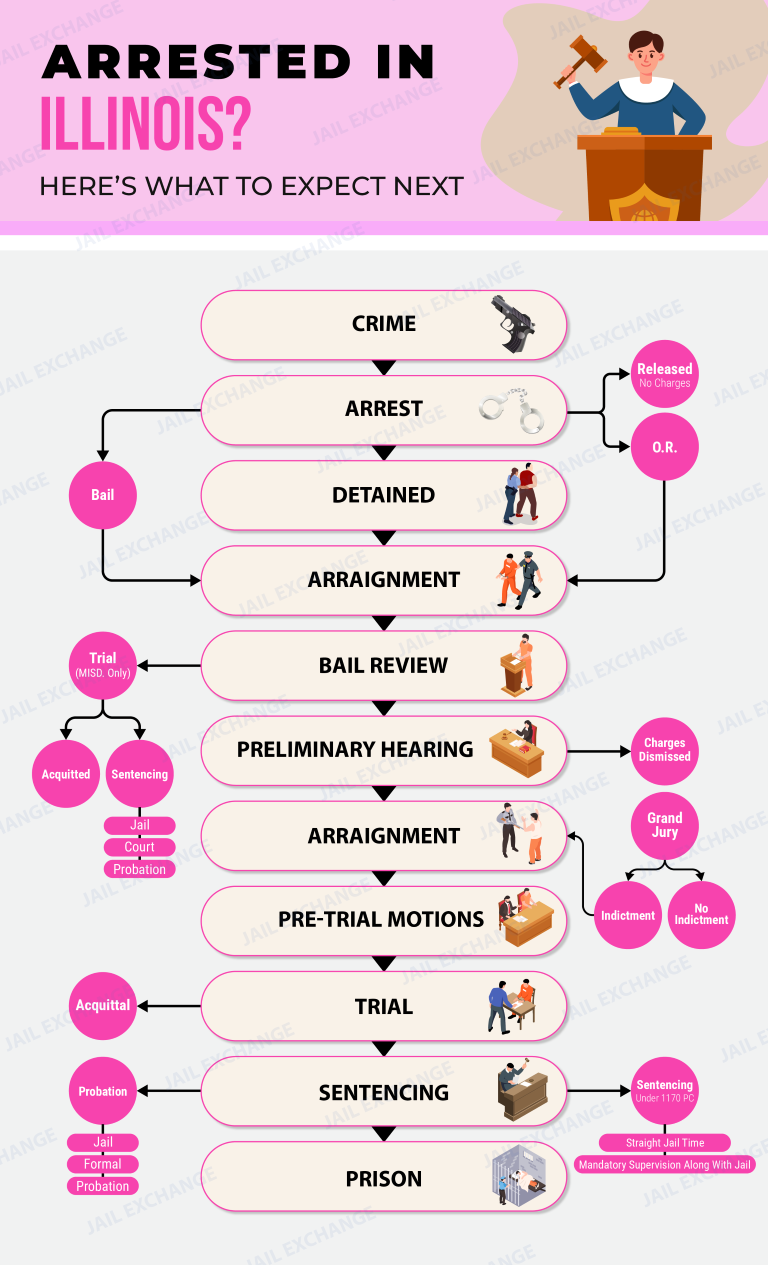
Cook County Jail - Division 8 RTU Criminal Court Process
Criminal Court Process for Cook County Illinois
Cook County and Chicago Criminal Courts: Every Courthouse, Address and Phone
Cook County criminal cases are heard in more than a dozen buildings: the George N. Leighton Criminal Courthouse in Chicago, three Chicago branch courts, the Domestic Violence Courthouse, the Daley Center, the Juvenile Center, five suburban courthouses, four community courts and the federal courthouse. This guide lists every one with its address, phone and the cases it hears, then explains how to look up a case and how appeals work.
For release rules after an arrest, see our bail and release guide. To find someone in the jail, see our inmate search guide.
How is the Circuit Court of Cook County set up?
The county has a single trial court, the Circuit Court of Cook County, but its criminal work is spread over many buildings. Felony trials from Chicago are heard at the Leighton courthouse. Chicago misdemeanors and felony preliminary hearings go to three neighborhood branch courts and the Domestic Violence Courthouse. Chicago traffic cases go to the Daley Center. The suburbs are split into five Municipal Districts (2 through 6), and each one has a courthouse that hears almost every kind of criminal case from its towns. On top of that, the court runs community courts and treatment courts for some people who qualify.
Each listing below gives the street address, the phone for the Clerk's office there, and the kinds of cases heard. The Clerk is the office that tracks court dates and case files. Every address and phone number below was taken from the court's location list and the Clerk's office pages in 2026.
↑ Back to the question listWhat is heard at the Leighton Criminal Courthouse?
- George N. Leighton Criminal Courthouse
Address: 2600 S. California Ave., Chicago, IL 60608
Phone: Clerk's Criminal Division (Room 526) 773-674-3140; court date phone menu 773-674-9255; Criminal Division judges' office 773-674-3160; Pretrial Division 773-674-0513
What is heard: felony trials and sentencing for crimes charged in Chicago; first appearance (detention) hearings for Chicago arrests on weekdays and for the entire county on weekends and holidays; out-of-state and out-of-county warrant hearings; expungement and sealing petitions; most of the drug, mental health and veterans treatment courts - Criminal Court Administration Building
Address: 2650 S. California Ave., Chicago, IL 60608 (joined to Leighton, same security entrance)
Phone: State's Attorney 773-674-2700; Public Defender 773-674-3217
What is heard: offices for the prosecutors, public defenders and court staff who work the Leighton courtrooms; jurors also report here
Leighton stands next to the jail. People held at the Cook County Department of Corrections are walked to court through a tunnel, so families do not need to arrange any ride. Our bail and release guide covers the First Appearance courtrooms one by one.
↑ Back to the question listWhat criminal and traffic matters go to the Daley Center?
- Richard J. Daley Center
Address: 50 W. Washington St., Chicago, IL 60602
Phone: Clerk (Suite 1001) 312-603-5030; Clerk's Criminal Department, Room 1006 (Chicago misdemeanor files, bond refunds, dispositions) 312-603-4641; Traffic Section, Room 400 312-603-2600; traffic ticket help 312-603-2000; First Municipal District office 312-603-6132
What is heard: all traffic tickets written in Chicago, including misdemeanor traffic such as DUI and driving on a suspended license; record copies for Chicago misdemeanor and preliminary hearing cases; some treatment court sessions
Where are Chicago domestic violence cases heard?
- Domestic Violence Courthouse
Address: 555 W. Harrison St., Chicago, IL 60607
Phone: Clerk (Room 110) 312-325-9500; Domestic Violence Division 312-325-9000; State's Attorney Domestic Violence Division 312-325-9220
What is heard: Chicago criminal cases between family members, partners and others covered by the Illinois Domestic Violence Act: misdemeanors, Class 4 felonies, aggravated stalking, and the early stages (through preliminary hearing or indictment) of Class 1 to 3 felonies; also orders of protection and civil no-contact orders
Suburban domestic cases stay at the district courthouse for the town where the arrest happened.
↑ Back to the question listWhich branch court hears a Chicago misdemeanor?
When a person is not held in jail, a Chicago misdemeanor or city ordinance arrest goes to a branch court. Each branch sits inside a police station and takes cases from certain police districts. The court posts this split on each branch location page.
- Branch 23 and Branch 29 (Grand and Central)
Address: 5555 W. Grand Ave., Chicago, IL 60639
Phone: Branch 23 773-804-6154; Branch 29 773-804-6140
What is heard: misdemeanor and ordinance hearings. Branch 23 takes arrests from Police Districts 14, 15, 16, 17 and 25. Branch 29 takes Districts 18, 19, 20 and 24, plus the Marine and Public Transportation units - Branch 35 and Branch 38 (Pullman)
Address: 727 E. 111th St., Chicago, IL 60628
Phone: Branch 35 773-982-3055; Branch 38 773-982-3006
What is heard: misdemeanor and ordinance hearings and felony preliminary hearings for Police Districts 3, 4, 5, 6, 7, 8 and 22, and for arrests by University of Chicago Police - Branch 43 and Branch 44 (Harrison and Kedzie)
Address: 3150 W. Flournoy St., Chicago, IL 60612
Phone: Branch 43 773-265-8927; Branch 44 773-265-8915
What is heard: Branch 43 hears misdemeanor and ordinance cases, and Branch 44 hears felony preliminary hearings, for Police Districts 1, 2, 9, 10, 11 and 12 and several citywide units
Branch court calls start at 9:00 a.m., 1:00 p.m. or 2:30 p.m., depending on the district. The Clerk's branch offices are open 8:00 a.m. to 4:00 p.m., Monday through Friday. Not sure which district made the arrest? The arrest report or ticket lists it, or call the Clerk's Criminal Department at 312-603-4641.
↑ Back to the question listWhere are the suburban courthouses, and which towns go to each?
Each suburban courthouse hears felonies, misdemeanors, traffic tickets, village ordinance tickets, domestic violence cases and first appearances on weekdays for the towns it serves. The Clerk's office in each building can look up a court date by name or case number. Town lists come from the Clerk's suburban districts page.
- 2nd Municipal District, Skokie Courthouse
Address: 5600 Old Orchard Rd., Skokie, IL 60077
Phone: Clerk (Room 136) 847-470-7250; court office 847-470-7500; State's Attorney 847-470-7300; Public Defender 847-470-7400
What is heard: cases from Deerfield, Des Plaines, Evanston, Glencoe, Glenview, Golf, Kenilworth, Lincolnwood, Morton Grove, Niles, Northbrook, Northfield, Oakton, Park Ridge, Skokie, Wilmette and Winnetka; also mental health and veterans court - 3rd Municipal District, Rolling Meadows Courthouse
Address: 2121 Euclid Ave., Rolling Meadows, IL 60008
Phone: Clerk (Room 121) 847-818-3000; court office 847-818-2287; State's Attorney 847-818-2326; Public Defender 847-818-2470
What is heard: cases from the northwest suburbs, among them Arlington Heights, Barrington, Buffalo Grove, Elk Grove Village, Hoffman Estates, Mount Prospect, Norridge, Palatine, Rosemont, Schaumburg, Streamwood, Wheeling and the Cook part of Elgin; also juvenile and treatment court calls - 4th Municipal District, Maywood Courthouse
Address: 1500 Maybrook Dr., Maywood, IL 60153
Phone: Clerk (Room 236) 708-865-6040; court office 708-865-6060; State's Attorney 708-865-6080; Public Defender 708-865-6140
What is heard: cases from the near west suburbs: Bellwood, Berkeley, Berwyn, Broadview, Brookfield, Cicero, Elmwood Park, Forest Park, Franklin Park, Hillside, La Grange Park, Maywood, Melrose Park, North Riverside, Northlake, Oak Park, River Forest, River Grove, Riverside, Stone Park and Westchester - 5th Municipal District, Bridgeview Courthouse
Address: 10220 S. 76th Ave., Bridgeview, IL 60455
Phone: Clerk (Room 121) 708-974-6500; court office 708-974-6286; State's Attorney 708-974-6250; Public Defender 708-974-6470
What is heard: cases from the southwest suburbs, among them Alsip, Bedford Park, Burbank, Chicago Ridge, Evergreen Park, Hickory Hills, Lemont, Oak Forest, Oak Lawn, Orland Park, Palos Heights, Palos Hills, Stickney, Summit, Tinley Park and Worth - 6th Municipal District, Markham Courthouse
Address: 16501 S. Kedzie Pkwy., Markham, IL 60428
Phone: Clerk (Room 119) 708-232-4551; general courthouse line 708-232-4444; court office 708-232-4169; State's Attorney 708-232-4040; Public Defender 708-232-4360
What is heard: cases from the south suburbs, among them Blue Island, Calumet City, Chicago Heights, Country Club Hills, Dolton, Harvey, Hazel Crest, Homewood, Lansing, Markham, Matteson, Midlothian, Park Forest, Riverdale, Sauk Village and South Holland; this Public Defender office also handles youth cases
Clerk counters are open 8:30 a.m. to 4:30 p.m., Monday through Friday, except court holidays.
↑ Back to the question listWhere are the Restorative Justice Community Courts?
These courts are for young adults, ages 18 to 26, charged with a nonviolent felony or misdemeanor who live, work or worship near one of the courts. The person must accept responsibility, and the victim must agree to the process. Instead of a trial, the case is handled through peace circles and a repair-the-harm agreement. Finishing can lead to a dismissal and a clean record. Each court meets one day a week:
- Avondale Restorative Justice Community Court
Address: 3647 W. George St., Chicago, IL 60618 (St. Hyacinth Resurrection Hall)
Phone: no line of its own; the Office of the Chief Judge answers at 312-603-6000
What is heard: Fridays only - Englewood Restorative Justice Community Court
Address: 845 W. 69th St., Chicago, IL 60621 (Salvation Army site)
Phone: 312-433-4757
What is heard: Wednesdays only - North Lawndale Restorative Justice Community Court
Address: 3605 W. Fillmore St., Chicago, IL 60624 (UCAN building)
Phone: no line of its own; the Office of the Chief Judge answers at 312-603-6000
What is heard: Thursdays only; the first of these courts, opened in 2017 - Sauk Village Restorative Justice Community Court
Address: 2700 Kalvelage Dr., Sauk Village, IL 60411 (Community Center)
Phone: 708-232-4169
What is heard: south suburban cases; opened July 15, 2024
Only the lawyers and judge can steer a case into one of these courts, so raise it with the defense lawyer early.
↑ Back to the question listWhat treatment (problem-solving) courts are there?
The court runs about 20 problem-solving courts. They swap jail time for close court supervision, treatment and regular check-ins with a probation officer. Most last about two years. The main hub is the Leighton courthouse, with more calls at the Daley Center and every suburban courthouse.
- Drug treatment courts: four programs, called RAP (men), WRAP (women), ACT, and a suburban drug court. They are for people charged with a nonviolent felony who have a diagnosed substance use disorder.
- Mental health courts: started at Leighton in 2004 and now run at all suburban courthouses too. They serve people with a diagnosed mental illness charged with a mostly nonviolent offense.
- Veterans treatment court: people who served in the military, or still serve, may qualify if the charge is not a crime of violence. The VA and the Illinois Department of Veterans' Affairs are part of the team.
A person cannot sign up alone; the defense lawyer asks for a referral, and the State's Attorney must agree. For questions, call the Criminal Division at 773-674-3160. Details are on the court's problem-solving courts page.
↑ Back to the question listWhere do juvenile cases go?
- Cook County Juvenile Center
Address: 2245 W. Ogden Ave., Chicago, IL 60612
Phone: Juvenile Justice Division 312-433-4757; State's Attorney Juvenile Justice Bureau 312-433-7000
What is heard: delinquency cases for youth under 18 from Chicago, plus child protection cases; some suburban youth cases are heard at the district courthouse instead
The Juvenile Center is joined to the Juvenile Temporary Detention Center at 1100 S. Hamilton Ave. (main line 312-433-7102), where youth are held before court. Juvenile files are closed to the public.
↑ Back to the question listWhere are city and village ordinance tickets heard?
- City of Chicago Department of Administrative Hearings
Address: 740 N. Sedgwick St., Chicago, IL 60654
Phone: 312-742-4747
What is heard: tickets for breaking Chicago city ordinances, such as building, sanitation, vehicle and some public-conduct violations. These hearings can bring fines but no jail time
A Chicago ordinance arrest, as opposed to a ticket, can still go to a branch court listed above.
In the suburbs, a village ordinance ticket is heard in one of two places. Many towns send them to the ordinance call at their district courthouse (Skokie, Rolling Meadows, Maywood, Bridgeview or Markham). Many others use their own administrative hearing officer, who holds hearings at village hall under state law (65 ILCS 5/1-2.1). The ticket shows the hearing place; if it does not, call the village hall.
↑ Back to the question listWhich court hears federal cases in Chicago?
- Everett McKinley Dirksen U.S. Courthouse
Address: 219 S. Dearborn St., Chicago, IL 60604
Phone: Clerk 312-435-5670
What is heard: federal crimes charged anywhere in the Northern District of Illinois, which takes in the whole county; release questions go to a federal magistrate judge
The U.S. Attorney prosecutes these cases, and the Federal Defender Program represents people who can't pay a lawyer. Case records are on PACER.
↑ Back to the question listHow do I look up a criminal case?
Use the Clerk of the Circuit Court's Case Look Up. Here is how:
- Open the Case Look Up page and choose the criminal case search.
- Search by the case number if you have it. If not, search by the person's last and first name.
- Open the case to see the charges, past and future court dates, and the courtroom.
If you can't find the case, call any courthouse listed on this page. Share the defendant's full name and birth date, then request the case number.
↑ Back to the question listWhat happens, step by step, in a felony case here?
- Arrest and charging. Police make the arrest, and the State's Attorney approves the felony charge.
- First Appearance. Within about 48 hours, a judge decides release or detention.
- Preliminary hearing or grand jury. A judge or a grand jury reviews the State's proof and rules on whether the felony charge moves ahead.
- Arraignment. The formal charge is read in the trial courtroom, and the accused answers it with a plea.
- Pretrial hearings. The lawyers trade evidence and argue motions. Many cases end in a plea deal here.
- Trial. A jury or a judge alone decides guilt.
- Sentencing. If the person is found guilty, the judge sets the sentence after a hearing.
Who prosecutes cases here?
The Cook County State's Attorney's Office has a team at every courthouse listed above; the phone for each is in its listing. The executive office is at 69 W. Washington St., Chicago, IL 60602 (312-603-1880). Victims and witnesses can reach the Victim Witness Assistance Unit at Leighton through 773-674-2700. The full list is in the office directory.
↑ Back to the question listHow does the Public Defender help?
The Law Office of the Cook County Public Defender gives free lawyers to people who cannot afford one. A judge appoints the office at the first hearing. Its 24-hour Arrest Hotline, 844-817-4448, will send a lawyer to a police station when someone has just been arrested. The main office is at 69 W. Washington St., Chicago (312-603-0600), and each courthouse office is listed above. The state's court system website also lists self-help resources.
↑ Back to the question listHow can I learn whether there is a warrant?
The Sheriff's Office does not have a public online warrant search. The Sheriff does post a Most Wanted list, but that covers only a few cases. To check for a warrant:
- Look up the case on the Clerk's Case Look Up. A missed court date often shows as a warrant on the docket.
- For a Chicago misdemeanor, call the Clerk's Criminal Department at 312-603-4641. For a felony, call the Criminal Division at 773-674-3140. For a suburban case, call the Clerk at the district courthouse.
- Ask a lawyer to check. A lawyer can usually set up a voluntary surrender in court, which tends to go better than an arrest.
How do people held in the jail get to court?
The Sheriff's External Operations unit drives people in custody from the jail to every courthouse in the county, and to hospitals when needed. Families can't arrange this travel; it is set by the court date. To find out where a person is held, use our inmate search guide. While someone waits for court, our guides explain visits, phone calls, mail and sending money.
↑ Back to the question listWhere does a person serve a sentence?
Short sentences, usually for misdemeanors, are served in the Cook County Department of Corrections. Sentences to prison go to the Illinois Department of Corrections. After sentencing, the person usually waits at the county jail for a few days to a few weeks before transfer. Search them on the IDOC individual in custody search.
↑ Back to the question listHow does an appeal work from a Cook County case?
Cook County appeals go to the Illinois Appellate Court, First District, 160 N. LaSalle St., Chicago, IL 60601. The Clerk of the Appellate Court is at 312-793-5484. Follow these steps:
- Ask the trial judge first. After a jury verdict, file a motion for a new trial. To challenge only the sentence, file a motion to reconsider the sentence within 30 days. After a guilty plea, file a motion to withdraw the plea within 30 days.
- File a notice of appeal. It must be filed with the Clerk of the Circuit Court within 30 days after the judge rules on that motion (or after sentencing if there was no motion). Missing the deadline can end the right to appeal.
- Ask for a lawyer. A person who can't afford one can ask the judge to appoint the Office of the State Appellate Defender.
- The record goes up. The circuit clerk sends the transcripts and court file to the Appellate Court.
- Briefs and decision. Both sides file written arguments. The Appellate Court may decide on the papers or hear oral argument. A loss there can be taken to the Illinois Supreme Court by a petition for leave to appeal.
Pretrial detention orders have a faster appeal under Illinois Supreme Court Rule 604(h). The defense lawyer can explain the deadlines.
↑ Back to the question listDoes the court here work with immigration courts?
No. Immigration cases are civil and are heard by federal immigration judges, not the Circuit Court. Under the Illinois TRUST Act, local police and courts don't hold people for ICE. A non-citizen charged with a crime should tell the defense lawyer, because a plea can affect immigration status.
↑ Back to the question list