Questions answered in this county guide
- Which court handles an arrest or criminal case in Hampden County?
- How do misdemeanor hearings work in Hampden County?
- How are felony charges handled in Hampden County?
- What should families know about major criminal charges in Hampden County?
- How are young people treated in the Hampden County court system?
- What punishments can follow a criminal conviction in Hampden County?
- How does a federal crime differ from a state case in Hampden County?
Which court handles an arrest or criminal case in Hampden County?
Hampden County families may be dealing with a court appearance in Springfield or another nearby city. In Hampden County, most criminal accusations first go to a District Court; Boston Municipal Court handles many cases in Boston. The Hampden County Superior Court handles serious indictments and felony trials. The elected Hampden District Attorney prosecutes state criminal matters. Police charges are accusations, not a final court decision.
Put simply: Criminal court locations can differ by charge and city or town. Check the notice or call the clerk before traveling. The listings below separate District Court, Superior Court, and Juvenile Court information.
- Chicopee District Court — 30 Church St., Chicopee, MA 01020; phone 413-598-0099 (official court listing)
- Holyoke District Court; street address and telephone number: consult official directory (official court listing)
- Palmer District Court — 235 Sykes St., Suite 3, Palmer, MA 01069; phone 413-283-8916 (official court listing)
- Springfield District Court; street address and telephone number: consult official directory (official court listing)
- Westfield District Court — 224 Elm St., Westfield, MA 01085; phone 413-568-8946 (official court listing)
- Hampden County Superior Court; street address and telephone number: consult official Superior Court directory (official court listing)
- Juvenile Court sessions serving Hampden County; juvenile court locations and phones vary by session; see the official Juvenile Court directory (official court listing)
- Prosecutor: Hampden County District Attorney’s Office; assistants present the Commonwealth’s criminal cases.
- Public defense: Committee for Public Counsel Services (CPCS), through staff lawyers or assigned private attorneys, for people who meet the legal requirements.
- Custody: The sheriff’s jail or house of correction commonly holds adults before trial, subject to transfers and special arrangements. Confirm the location with the holding agency.
Which courthouse hears the case? Springfield is not the District Court for every Hampden County arrest; surrounding cities have their own courts. A lower-level criminal offense and many felonies can be decided in District Court. More serious felony cases proceed in Superior Court, usually following a grand jury indictment. Check the court serving the town and follow the address on the summons or release paper.
Where is someone held before trial? Following arrest in Hampden County, police may book the person and either release them under lawful conditions or take them to a holding facility. The sheriff’s office commonly runs the county jail or house of correction, but police holding cells and transfers mean the arrest location is not a guarantee of the current jail. Ask the arresting department or sheriff before visiting.
How do misdemeanor hearings work in Hampden County?
In Hampden County, a lower-level case may begin with a summons telling the person when to appear, or with an arrest followed by booking. Examples that families may encounter include some shoplifting, driving and public-order charges. Not every case carries the same penalty; Massachusetts sets the punishment in the law for each individual offense.
Release and cash bail
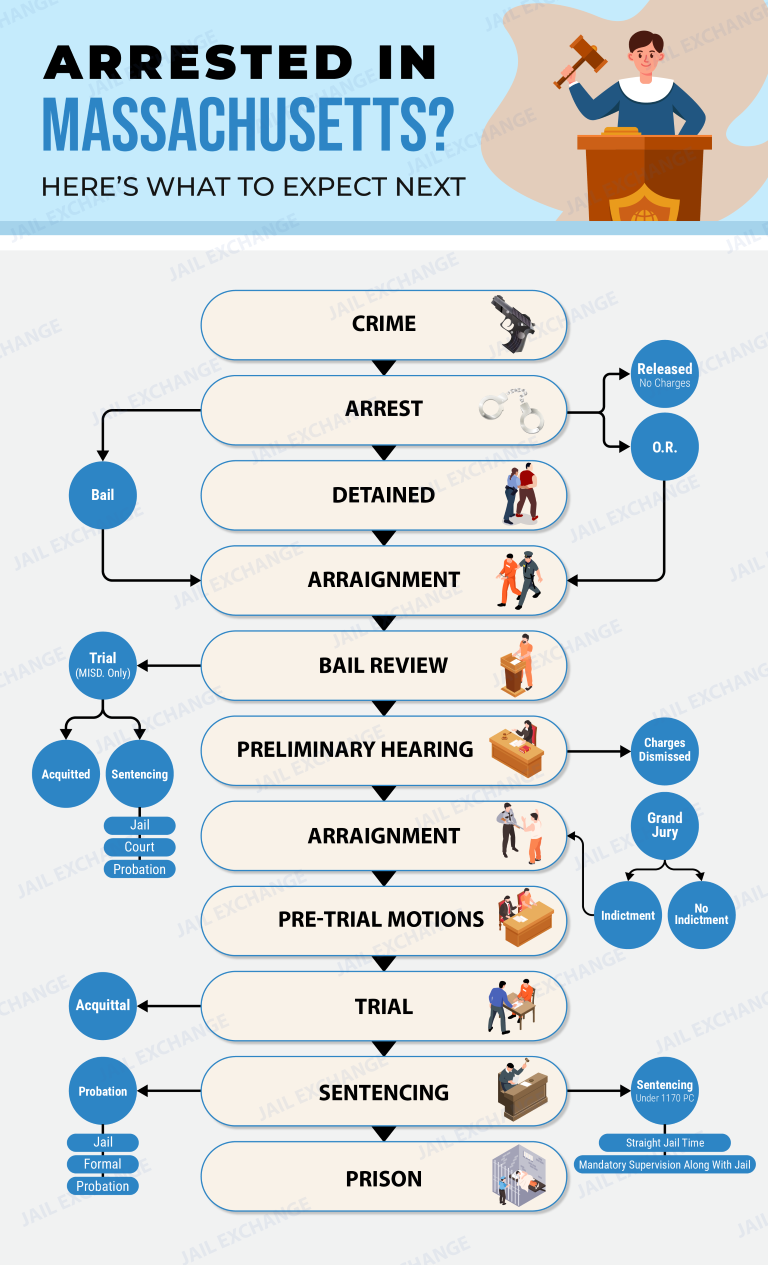
During arraignment, a judge considers release on personal recognizance, which means a promise to come back to court, or other lawful conditions. Cash bail may be ordered when necessary to help ensure the person returns to court. Massachusetts bail is not automatically a percentage paid to a bondsman. If bail is required, ask the clerk or jail exactly where it can be paid and whether there are other conditions. A person unable to afford bail can ask about a bail review.
First appearance and later court dates
Here is the practical point for a family: The arraignment is normally the first hearing in Hampden County court. The criminal accusation is explained, a plea is entered, and the judge addresses release and representation. The court often schedules a pretrial hearing, when lawyers discuss the evidence and whether an agreement is possible. A guilty plea, a dismissal, an approved diversion or a trial can end the case. No particular ending is guaranteed.
How to get a court-appointed lawyer
When paying for a defense lawyer is beyond your means and the charge qualifies for appointed counsel, tell the judge or court staff promptly. The court reviews financial information. CPCS provides public defenders or assigned private lawyers. Even when a person plans to plead guilty, talking with a lawyer can help explain the possible penalties and other consequences.
Jail time, fines and probation
Massachusetts does not use one statewide misdemeanor class with a fixed maximum for every charge. Look up the exact law named on the complaint. District Court sentences can involve a fine, probation, required programs, or time in a jail or house of correction. District Court generally may not impose a state-prison sentence and commonly has a house-of-correction ceiling of 2½ years. An OUI has special license and sentencing rules that depend on prior offenses and the facts.
How are felony charges handled in Hampden County?
A more serious criminal offense is a crime that Massachusetts law makes punishable by state imprisonment, even if this particular case could end with a shorter sentence. A Hampden County felony might begin in District Court for arraignment and release decisions. Some felonies can finish there, while more serious ones must proceed in Superior Court.
Probable cause and a grand jury
The important thing to understand is: For a felony outside District Court’s final authority, the District Court can hold a probable cause hearing. Prosecutors may instead seek an indictment from a grand jury. An indictment means the grand jury found enough evidence to bring a formal charge; it does not mean the defendant is guilty. Once the court matter is indicted, the Superior Court handles the state's attorneys. Not every felony must pass through both a preliminary hearing and a grand jury hearing.
What happens in Superior Court?
After an indictment in Hampden County, the person charged is arraigned on the formal charge, and the judge sets future dates. The prosecutor provides required evidence, while the defense can examine that material, question witnesses and file motions. Many cases resolve with an agreement; others go to trial. At trial, the Commonwealth must prove guilt beyond a reasonable doubt.
Sentences and representation
State-prison penalties depend on the exact felony statute; Massachusetts does not use one Class A–D felony chart like some states. Superior Court can impose state-prison terms where authorized. The court can also consider probation or other lawful sentencing options when available. Anyone facing a serious felony should ask for an attorney immediately, and qualifying defendants may receive representation through CPCS.
What should families know about major criminal charges in Hampden County?
A charge involving serious physical harm, a gun or a sexual assault can bring extra hearings in Hampden County. Examples include armed robbery, aggravated assault and murder. The accused person remains presumed innocent, and the court must follow the laws for release, evidence and trial.
Dangerousness hearings are different from ordinary bail
For anyone trying to follow the process: For certain listed offenses, the District Attorney can ask for a dangerousness hearing under Massachusetts General Laws chapter 276, section 58A. The judge decides whether any release conditions would reasonably protect other people or the community. If the state meets the strict legal requirements, a person may be detained while the case is awaiting trial. This is not the same as simply setting a very high cash bail.
Serious charges and trial
First-degree murder is tried in Superior Court. Other serious indictments also commonly proceed there. Before trial the parties may review medical records, forensic testing and witness statements, and the judge may hear challenges to evidence. At trial, the jury must decide whether the Commonwealth proved the alleged offense beyond a reasonable doubt.
Possible sentences
The sentence for murder is different from the sentence for armed robbery, rape or assault. First-degree murder in most situations carries life imprisonment without parole for an adult convicted of that offense, subject to applicable law and constitutional limits. Massachusetts has no death penalty. Other serious crimes have their own statutory prison ranges and sometimes mandatory terms; never assume every violent felony has the same sentence.
Legal assistance and victims’ information
CPCS may provide defense counsel for eligible people. Victims and witnesses can also ask the Hampden District Attorney’s victim-witness program about notices, safety planning and court support. Complex cases can involve many hearings, and it is not possible to promise how many months a case will take.
How are young people treated in the Hampden County court system?
Put simply: Children and teenagers are not ordinarily processed in the same way as adults. In Hampden County, juvenile delinquency matters go through the Juvenile Court system. Massachusetts in most situations uses delinquency proceedings for eligible offenses committed by youths ages 12 through 17, with exceptions for certain minor first offenses and other circumstances.
Police contact and the first hearing
When a juvenile is arrested, police must notify the parent or guardian and probation. A youth may be released to an appropriate adult or held for a court review under the governing rules. The family should ask for the exact juvenile courthouse and the next appearance date. Youths are not automatically placed in the adult county jail.
Probation, diversion and treatment
Juvenile Court can consider a lawful diversion opportunity, probation, services or other steps depending on the court matter. If a youth is adjudicated delinquent, the response may involve supervision or, in appropriate cases, commitment to the Department of Youth Services (DYS). Detention before a hearing and commitment after an adjudication are different legal decisions.
Very serious juvenile cases
Some eligible youths ages 14 through 17 charged with serious offenses can face a youthful offender indictment and a different range of possible sentences. This is not automatic for every felony. Special laws also govern murder charges involving juveniles. Parents should request a defense attorney familiar with juvenile law immediately.
For juvenile cases arising in Hampden County, the listed regional sessions include Springfield, Holyoke, Palmer. Use the individual notice or the Massachusetts courthouse locator to verify where to appear.
What punishments can follow a criminal conviction in Hampden County?
In Hampden County, Massachusetts does not assign one standard jail term to every misdemeanor or felony.
- House of correction: Many eligible local sentences are limited to 2½ years, depending on the offense and court authority.
- State prison: Available for offenses whose laws authorize it; the maximum and minimum depend on the statute.
- Fines and probation: The statute and sentencing law control whether a fine, probation, restitution, or other conditions apply.
- Murder: Adult first-degree murder generally carries life without parole; other murder charges have different sentencing rules.
A charge such as OUI, drug distribution, or assault may carry mandatory penalties or enhanced consequences for prior convictions. No chart can determine a particular defendant’s sentence without the alleged offense and criminal history.
How does a federal crime differ from a state case in Hampden County?
A federal case from Hampden County is prosecuted in the U.S. District Court for the District of Massachusetts, rather than the local state criminal court. Federal crimes can involve certain interstate fraud schemes, federal drug trafficking, offenses involving federal property or federal officials, and immigration or firearms offenses covered by federal statutes. An act does not become a federal crime just because it is serious.
The District of Massachusetts holds court in Boston, Worcester, and Springfield. Which courthouse hears a particular case depends on federal court assignment. A federal defendant ordinarily appears before a federal magistrate judge, may face a detention hearing, and can be charged by a grand jury before plea negotiations or trial. Federal sentencing follows federal statutes and applicable federal guidelines. The U.S. Marshals Service arranges pretrial custody; the Federal Bureau of Prisons handles most federal prison sentences.
This Hampden County guide is general information, not personal legal advice. The court assignment, custody location, bail order and exact sentencing rules depend on the charge and case. A criminal defense lawyer or court clerk can help clarify the next step.