
Montmorency County Jail
Montmorency County Inmate Search: Following a Loved One to the Alpena Jail
Montmorency County sends its inmates north and east to Alpena. Anyone arrested here is housed at the Alpena County Jail, 4900 M32 W, Alpena, MI 49707. Below you will find answers on locating a person, reading the charges, mugshots, visits, money, mail and court.
The quickest tool is the jail's own list of current inmates. Enter a name and see what comes up. Fresh bookings can lag, so check again later if the name is absent.
A phone call settles most doubts. Dial 989-354-9830, say the full name and birth date, and find out if the person is in custody, what the charges are, and how much the bond is. Then open our bail page or court page for the next steps.
Read inmate search answers
 Read inmate search answers
1. How do I use the Montmorency County jail search?
No jail building stands in Montmorency, so Alpena keeps the list you need. The steps:
- Open the current inmate list.
- Fill in the name as the form asks. If nothing appears, try another spelling.
- Open a matching entry and copy down whatever details it gives.
- Phone the jail to confirm the charges, bond and release plans, because staff hold the newest facts.
Should the link fail, visit the Alpena County corrections page and pick the current inmates option. The jail line is 989-354-9830.
↑ Back to the question list2. Why can't I spot their name in the results?
An empty result is not proof the person is out. Think through these possibilities:
- Booking in progress. The ride to Alpena plus the paperwork may take several hours.
- Still with the officers. The deputy or trooper who made the arrest may not have finished.
- Back on the street. An interim bond, or a judge at the first hearing, may have set the person loose.
- Different county. If the arrest happened elsewhere, that county's jail has the person.
- Spelling. Test nicknames, middle names and maiden names.
Ring the jail at 989-354-9830 and ask for Corrections. Still no luck? The Sheriff's Office in Atlanta answers at 989-785-4238.
↑ Back to the question list3. Where could they be held after a Montmorency County arrest?
The Sheriff's website states that inmates from this county live at the Alpena County Correctional Facility. That is the Alpena County Jail, 4900 M32 W, Alpena, MI 49707, in the city of Alpena. Call 989-354-9830. The lobby is staffed Monday to Friday, 9 a.m. to 4 p.m.
The Sheriff's Office sits in Atlanta at 11045 M-32 West, Atlanta, MI 49709, phone 989-785-4238. Deputies work out of that building, yet inmates are not kept there. Ask that office about any other holding place.
A person picked up in another county goes to that county's jail. JE's Michigan jail directory helps you find it.Federal cases are covered in the federal answer below.
↑ Back to the question list4. Does the Alpena jail's list display mugshots?
The jail describes the list as a way to look up current inmates. It does not say if mugshots are shown, so open the list and check an entry yourself.
Michigan's Attorney General has opined that photos of suspects taken by officers may be requested like other public records. An agency is allowed to say no when giving one out would seriously invade a person's privacy. Send a written request to the agency behind the arrest, citing the state's FOIA statute. For a county deputy, call 989-785-4238. For a state trooper, call the State Police Alpena post at 989-354-4101.
- To get an ICE photo, use the ICE records page and ask.
- Federal photos are generally not given out, but the Marshals Service may release one, as with a fugitive.
5. How will I hear if they are freed or transferred?
Sign up for MI-VINE, a free state notice system. It sends word when someone is let out, sent elsewhere or gets away, for county jail inmates and state prisoners alike, and it can also pass along court events. Call 800-770-7657 at any hour or register at VINELink.
Do not rely on alerts alone. A person can walk out soon after bond is set, so a call to 989-354-9830 is the safest check.
↑ Back to the question list6. What is the road to release for a Montmorency County arrest?
Once someone is arrested, a judge or magistrate has to see them without unnecessary delay (MCL 764.13). The hearing is often held over video. The 88th District Court, 12265 M-32, Atlanta, MI 49709, tells you when at 989-785-8035.
- Interim bond. For certain minor offenses, a jail deputy in charge may accept a small bond if no magistrate can be reached. Arrests for domestic violence wait for a judge instead.
- The arraignment. Most people go home on a written promise to return, often with rules like staying away from the victim. Cash bail comes into play when the judge decides lesser steps will fail. A few grave charges can be held with no bail.
- Money bail. You may put down ten percent with the court clerk or use an approved surety agent. Since May 1, 2026, a court may keep that ten percent only after a guilty finding on an offense the rule names.
The Alpena Sheriff's Office takes bond payments at any hour at the jail address given earlier. Ask about fees first. An approved agent list is on the Circuit Court resources page. The state insurance office, 877-999-6442, takes questions about agents. Find more on our bail page plus our overview of state bail rules.
↑ Back to the question list7. How do I read the actual accusation?
Call the jail first at 989-354-9830. Once a case is opened, the court file lists the charge. Look the person up in MiCOURT for the 88th District Court. A brand-new case may not appear yet, in which case the Criminal and Traffic Division can help at 989-785-8038.
That court is at 12265 M-32, Atlanta, MI 49709 and works Monday through Friday, 8:30 a.m. to 4:30 p.m. Charges can change as a felony case moves up to Circuit Court.
↑ Back to the question list8. Who stands up for a person with no money for an attorney?
The judge must ask the person at the first hearing whether a lawyer is wanted, and then decide whether the court will pay for one. Being able to afford bond does not close the door.
Defense for people who qualify here comes from the Northeast Michigan Regional Defender Office. Its Montmorency location is 12418 State Street, Atlanta, MI 49709, phone 989-354-2856, website nemichdefenders.org. For questions about how the system works, the Michigan Indigent Defense Commission is at 517-657-3066. Paying for a private attorney is also possible.
↑ Back to the question list9. How do visits work, and when are they?
The Alpena jail sets the rules, and they can shift, so call 989-354-9830 before you go. Our visiting guide has general advice.
- In the lobby. You sit at a kiosk in the Sheriff's Office for a free 25-minute video visit. Hours are Monday to Friday, 9 a.m. to 3:30 p.m., closed on holidays. Each inmate gets one lobby visit per week.
- From your couch. Home video visits run 6:30 a.m. to 9:30 p.m., every day. They cost 20 cents a minute in 30-minute blocks, and each inmate can have one daily.
- Reserving. Book online or at a lobby kiosk. First come, first served.
- Dress and ID. Bring a state or government photo ID. Children under 17 must be with an adult. Hats, tank tops, short skirts and tight shorts are out. Expect a pat-down. The jail may cancel a visit with no warning.
10. How do I get money to them?
Three routes are listed. Use the kiosk in the Alpena lobby with cash or a card, visit JailATM online, or mail a money order for the inmate. Fees apply. The jail's pages cite $3 for cash at the kiosk and $3 or ten percent for a card. Ask the desk for your exact total before paying.
- The weekly commissary spending cap is $150.
- After booking, the jail may take funds from the account for booking and warrant fees, and for housing, medical and dental costs.
Ring 989-354-9830 with questions. Our money guide and commissary guide add detail.
↑ Back to the question list11. Can they call me, text me or video chat?
The jail's pages leave out the phone details. Call 989-354-9830, press 4 for Corrections, and ask how calls reach you, what they cost, and whether tablets or text messages are in use. Also ask whether calls are recorded.
Treat every jail call as overheard. Keep case details for the lawyer. Home video visits, covered in the visiting answer, are another way to see the person. See how jail phone service works and how inmate email and texting works for background.
↑ Back to the question list12. What do I write on a letter to the jail?
Format the envelope like so:
Inmate's full name
Alpena County Sheriff's Office
4900 M32 W
Alpena, MI 49707
No inmate number is needed, says the jail. Only the U.S. Postal Service may carry it. Staff open and inspect each one.
- A missing return address means the letter is tossed.
- Use black or blue ink, pencil, or print it out.
- No glitter, stickers, crayon, colored pencil or perfume.
- Extra stamps, envelopes and blank sheets are thrown away.
- Letters to a crime victim are barred, and mail from other inmates is refused.
For photos, books or cards, ask at 989-354-9830. See also our mail guide.
↑ Back to the question list13. Where do their belongings go?
Its pages do not say how a person's booking items are handled, so phone 989-354-9830 during weekday lobby hours, 9 a.m. to 4 p.m. Learn if a release form must be signed and what ID to show at the desk. The jail is at 4900 M32 W, Alpena, MI 49707.
↑ Back to the question list14. What if they need medical help inside?
Phone the jail at 989-354-9830 and press 7 to reach the nurse. Give the name, the health problem, any medicine with its dose, and the doctor if you know one. Also ask the nurse how care is requested from inside.
Know that the jail repays medical costs from the inmate's funds. For an emergency, 911 is the number to dial.
↑ Back to the question list15. Could a Montmorency County warrant exist for them?
Phone the Montmorency Sheriff's Office, 11045 M-32 West, Atlanta, MI 49709, 989-785-4238 and ask whether one exists under the person's name. Give the full name and birth date. Court files can be searched in MiCOURT, and the clerk's staff can answer too. To clear one, see a lawyer first. Then phone the court that signed the warrant to plan your surrender. Find that court, the 88th District Court, at 12265 M-32, Atlanta, MI 49709, or call 989-785-8035.
↑ Back to the question list16. Where do I look up hearing dates?
Ask whichever court has the case. The 88th District Court, 12265 M-32, Atlanta, MI 49709, hears most first steps; call 989-785-8035. Its calendar page also holds a form for asking to join by video.
- District Court covers misdemeanors, the arraignment, bond, and the early part of a felony.
- Circuit Court takes a felony after the early stage. The 26th Circuit Court in Alpena can be reached at 989-354-9573.
Probation questions go to 989-785-8041. Our court guide lays out the whole path.
↑ Back to the question list17. What changes when a federal agency holds them?
Federal prosecutors file these cases at the federal courthouse for this region, home to the Michigan Eastern District's northern branch, at 1000 Washington Avenue, Bay City, MI 48708. The clerk answers at 313-234-5000.
- At the detention hearing under 18 U.S.C. 3142, a federal judge decides whether the person is held.
- Once a judge orders detention, the person is in Marshals custody. The U.S. Marshals Service works from the Theodore Levin United States Courthouse, 231 West Lafayette Boulevard, Room 300, Detroit, MI 48226, 313-202-0135.
- After sentencing, the person appears in the federal prison inmate locator.
18. What should I do if ICE is involved?
What often happens, step by step:
- First, ICE sends the jail a detainer. The paperwork is called Form I-247A.
- The rule is 8 CFR 287.7(d): the jail may hold the person up to 48 hours after they would otherwise be released. ICE may then collect them.
- The ICE Online Detainee Locator asks for the full name and a birth country.
- If the search shows nothing, phone the Detroit office of ICE's Enforcement and Removal unit, 985 Michigan Avenue, Suite 207, Detroit, MI 48226, 313-771-6601. Its area covers Michigan along with Ohio.
19. Where do I find someone sent to prison?
When a prison term is ordered, deputies take male inmates to Jackson, to the state's Reception and Guidance Center, and female inmates to the intake center in Ypsilanti. Expect about a month and a half of intake. No visits happen in that window, yet letters and deposits go through.
Use the state's Offender Tracking Information System to find a name. JE's state prison guide covers visits and mail for each facility.
↑ Back to the question list20. What about a teen in a Montmorency County case?
A 2021 change in Michigan law made anyone below age 18 a juvenile. Circuit Court's Family Division takes such cases. The law keeps a minor apart from adult inmates in both sight and sound.
Teens who are 14 and up can be moved into adult court by a judge. Certain grave offenses by older teens begin in Circuit Court from day one. To find out where the minor is and when the next hearing falls, call the 88th District Court at 989-785-8035 and ask about the Family Division or Probate Court. The 26th Circuit Court in Alpena is at 989-354-9573.
↑ Back to the question list21. Which agencies make arrests in Montmorency County?
The Sheriff's Office serves the whole county.
- Montmorency County Sheriff's Office, 11045 M-32 West, Atlanta, MI 49709, 989-785-4238
- Michigan State Police, Alpena Post, 3283 W. Washington Ave., Alpena, MI 49707, 989-354-4101
- Village of Hillman office, 989-742-4751. Ask if the village has its own officers.
The county's eight townships are Albert, Avery, Briley, Hillman, Loud, Montmorency, Rust and Vienna. Their offices are not police agencies, but a clerk can direct you to the right one.
↑ Back to the question listMontmorency County bail and bond: the Atlanta court and the Alpena jail
Montmorency County moved its jail work to Alpena, so those arrested here are booked into the Alpena County Jail, 4900 M-32 West, Alpena, MI 49707. The Sheriff's Office remains in Atlanta. Read on to learn how bond works for someone held in Alpena.
The Montmorency County Inmate Search shows whether a booking has been entered under a name. Our Inmate Lists add arrests and warrants. Give a fresh booking a little time.
Bond money is taken by the Alpena Sheriff's Office, 989-354-9830. Choose option 4 for corrections and ask for the amount and ways to pay. Curious about the hearing? See our court page.
1. Is my relative in an Atlanta cell or in Alpena?
Check Montmorency County Inmate Search first. Montmorency stopped running its own jail after the commissioners voted to close it and send inmates to Alpena. News reports from 2021 describe the plan but do not confirm a move date, so the safe plan is to assume the person is at the Alpena County Jail.
If the search shows nothing, the booking may be only minutes old. Wait a short while and look again. For a question the search cannot answer, call the Alpena desk at 989-354-9830 and pick option 4 for Corrections.
↑ Back to the question list2. Where do I hand over bond money for a Montmorency County case?
Alpena County lists its Sheriff's Office at 4900 M-32 West, Alpena, MI 49707. Its page says the front desk is staffed Monday through Friday, 9 a.m. to 4 p.m., and that bonds may be posted there "at any time." Call 989-354-9830 before you drive if it is evening or a weekend.
Bring a photo ID, the full legal name, and the bond amount shown on the record.
↑ Back to the question list3. What can I pay with at the Alpena desk?
The Alpena County page lists cash, a debit or credit card through the JailATM website, and an approved bondsman when the bond type allows one. Cash carries a $2 transaction fee. A card costs $2.50 or 10 percent, whichever is greater. A booking costs $12, and an arrest on a warrant adds $10.
Those fees are charged by the jail, and they are not part of the bond. Ask the desk for the total before you pay.
↑ Back to the question list4. What do PR, NO BOND, 10% and CASH ONLY mean on the record?
PR means the person may leave on a written promise to appear. If the charge involves drugs or alcohol, the jail waits until the person is sober. NO BOND means a judge has not set an amount yet, or has refused one. CASH ONLY must be paid in cash. A 10% bond lets you pay the stated percentage in cash or use an approved bondsman. CASH/SURETY allows a bondsman to post it.
The Alpena page asks families not to call just to ask about a NO BOND entry, so look at Montmorency County Inmate Search for updates.
↑ Back to the question list5. If I post the bond, do I get it back?
It depends on whose name is on the paperwork. Alpena says money paid in the inmate's name goes toward that person's fines and costs, and you do not get it back. Money paid in your own name, with the third-party depositor section signed, comes back after the court process ends. If the person misses court, it is forfeited.
The state court rule says a cash bond put up by the defendant is used first for fines, costs and assessments. A bond posted by someone else is returned unless the person skips court. Keep the receipt.
↑ Back to the question list6. Which court handles a Montmorency charge?
The 88th District Court sits in Atlanta at 12265 M-32, P.O. Box 789, Atlanta, MI 49709. Call 989-785-8035 for hearing dates and for the clerk. Misdemeanors and the first steps of a felony begin there.
Felony trials move on to the circuit court. Alpena County lists the 26th Circuit Court at 989-354-9573, and the court at the Atlanta number can tell you where your case is.
↑ Back to the question list7. How do I find a bondsman the court allows?
Michigan does not have one state license for bail bond agents. The Department of Insurance and Financial Services licenses them only as insurance producers, and each court decides for itself which agents it approves. For this area, Alpena County says the approved list is posted on the 26th Circuit Court resources page. The court administrator's office is at 720 W. Chisholm Street, Suite 1, Alpena, and the 26th Circuit Court answers at 989-354-9573.
No fee percentage for bondsmen was found in state law, so ask any agent for the price in writing and read the contract before you sign.
↑ Back to the question list8. Can a judge refuse bail in Montmorency County?
Yes, but only in narrow cases. The Michigan Constitution lets a judge deny bail before trial for murder, treason, first-degree criminal sexual conduct, armed robbery, or kidnapping for ransom, when the proof is strong. It also covers a person charged with a violent felony who has two earlier violent felony convictions, or who is on probation, parole or bail for a violent felony.
If bail is denied, the trial must start within 90 days unless the defense caused the delay. A probation hold or a warrant from another place can also keep someone in custody.
↑ Back to the question list9. How soon does a judge see a person arrested here?
Michigan law says without unnecessary delay. A person arrested without a warrant generally cannot be held longer than 48 hours without a judge deciding there was cause for the arrest. Arraignment may be done by video, which matters when the jail is in Alpena and the court is in Atlanta.
At the arraignment the judge picks release on a promise, conditions, or money bail. Ask the district court at 989-785-8035 for the date.
↑ Back to the question list10. Can I use a house or land as security?
Michigan's court rule allows real property if the court agrees and the owner proves its value and ownership. Whether it must lie inside Montmorency County, or can be out of state, is not stated on any court page. Call the district court at 989-785-8035 and ask before you pay for an appraisal or a title search.
↑ Back to the question list11. What happens if a teenager is arrested in Montmorency County?
Since October 2021 a person under 18 cannot be held in an adult jail unless completely kept apart from adults. The Montmorency juvenile detention center was not named on any county page.
Call the 88th District Court at 989-785-8035 or the 26th Circuit Court at 989-354-9573 and ask where the young person is and when the hearing is. A juvenile will not appear on the adult search.
↑ Back to the question list12. Who is the free lawyer if we cannot pay?
Each Michigan county runs its indigent defense system under the state Michigan Indigent Defense Commission. A judge asks about a lawyer at the first hearing, and you fill out a form on your income. No Montmorency public defender office number was posted, so ask the clerk at 989-785-8035. The state commission answers at 517-657-3066 and can name the county plan.
↑ Back to the question list13. What if the person misses a court date?
The judge can issue a warrant and order the bond forfeited. A bondsman is told within 7 days, and gets a hearing date to show why judgment should not be entered for the full bond. The person has 28 days after notice to surrender before judgment may be entered against the bond.
Call a lawyer and the clerk right away. If the person is picked up within a year, the court can undo a forfeiture when justice has not been harmed and the county is repaid its costs.
↑ Back to the question list14. How do I spot a bail scam?
Nobody at the sheriff's desk or the court takes gift cards, crypto, or a wire to a stranger. Hang up on a rushed call and dial 989-354-9830 or 989-785-8035 yourself.
↑ Back to the question listMontmorency County bond contacts
- Jail that serves the county: Alpena County Jail, 4900 M-32 West, Alpena, MI 49707; Corrections 989-354-9830, option 4
- Bond help: Bail and bond instructions for the jail
- Custody lookup: Montmorency County Inmate Search
- Sheriff's Office: 11045 M-32 West, Atlanta, MI 49709; 989-785-4238
- District court: 88th District Court, 12265 M-32, Atlanta, MI 49709; 989-785-8035
- Circuit court: 26th Circuit Court, Alpena; 989-354-9573
- Bondsman list: 26th Circuit Court Court Administrator, 720 W. Chisholm Street, Suite 1, Alpena
- Defense lawyers: Michigan Indigent Defense Commission, 517-657-3066
Phone numbers, desk hours, fees and court rules change. Check them with the Alpena desk or the Atlanta court before you pay anything, because this page cannot speak for a judge.
Montmorency County Court Guide: Criminal Hearings in Atlanta Explained
A Montmorency County arrest leads first to the 88th District Court, 12265 M-32, Atlanta, MI 49709, 989-785-8035. Felony trials move to the 26th Circuit Court, 989-354-9573. Meanwhile, those in custody sit in Alpena, at the Alpena County Jail, 4900 M-32 West, Alpena, MI 49707.
To learn where someone is, try the Montmorency County Inmate Search. Our Jail Roster shows arrests, charges and warrants.
Phone the Atlanta court at 989-785-8035 for hearing dates and the clerk. If your person needs to come home first, our bond page lays out the steps.
1. How can you find the right courthouse in Montmorency County?
Not every arrest leads to a long criminal trial; many cases are handled through scheduled hearings and legal agreements. In Montmorency County, Michigan , lower-level criminal charges and the opening stages of felony cases are generally handled in District Court . Most felony trials and felony sentencing belong in Circuit Court . Juvenile delinquency cases generally go through the Family Division of Circuit Court. The Montmorency County Prosecuting Attorney represents the state. Atlanta is the county seat.
2. Someone you love was arrested in Montmorency County. What do you do first?
Write down the person’s full name and birth date, the arresting agency, the booking location, the court matter number if available, and the next hearing date. Ask the jail whether the person is still in custody and whether a bond or other release order has been entered. The jail handles custody; the court sets bond and court dates. The District Court ordinarily handles a misdemeanor case and the first felony hearings. The Circuit Court ordinarily handles the felony after the preliminary stage. A relative may be able to attend public hearings, but the judge and appointed lawyer—not a jail officer—determine how the legal case moves forward.
District Court handles most misdemeanors and the early stages of felony cases. Circuit Court hears felony trials and sentences, and its Family Division handles juvenile delinquency matters in Montmorency County.
- District Court: Hears most misdemeanors and holds the first hearings in felony cases, including arraignment and preliminary examination.
- Circuit Court: Handles felony trials, pleas, sentencing, and appeals assigned by Michigan law.
- Family Division of Circuit Court: Handles juvenile delinquency proceedings and related matters.
- Montmorency County Prosecuting Attorney: Represents the state in local criminal prosecutions.
- Appointed defense lawyer: People who cannot afford counsel in qualifying criminal cases can request an appointed attorney.
- Local jail and custody: County sheriffs normally manage local jail custody; a court may order release with conditions or continued detention.
Where does a case start? Someone arrested in Montmorency County may first be booked by police and brought before a judge or magistrate. The charge determines which court hears the court matter, and the court paperwork controls where the person charged must appear. Michigan District Courts decide most misdemeanors and handle the first steps of felonies. Circuit Court in most situations takes over a felony after a waiver or a finding of probable cause at the preliminary examination.
What happens to someone waiting in jail? The Montmorency County sheriff or another authorized jail may hold the defendant while a court considers release. Custody and release decisions are recorded as part of the criminal matter. A courthouse and a detention center are not necessarily on the same property.
This guide explains the usual criminal court process in Montmorency County in plain language. The exact charge, criminal history, and judge’s findings affect the outcome. It is general information, not personal legal advice.
↑ Back to the question list2. How does Montmorency County handle less serious criminal charges?
In Montmorency County, a misdemeanor may start with a ticket or a notice to appear, while a more serious situation can lead to arrest and booking. Examples include certain assaults without serious injury, shoplifting and some impaired-driving charges. The criminal accusation written on the paperwork matters because Michigan has different penalties for different misdemeanors.
The opening hearing and release from jail
At arraignment, the judge tells the person charged what offense is charged, explains important rights and addresses a plea and release conditions. Some people can leave on a personal promise to return; others may have money bond, supervision, travel limits or no-contact orders. A judge can also deny release where the law permits. Bail is not a punishment or proof of guilt.
Pretrial conferences and what comes next
The Montmorency County District Court may schedule a pretrial hearing. Lawyers review police reports, videos and other evidence. The prosecuting attorney may offer an agreement, dismiss a charge or proceed to trial. The person charged can contest the evidence rather than accept a plea. Jury-trial rules depend on the offense and the legally available punishment.
What to do if hiring an attorney is unaffordable
If the defendant faces a charge that qualifies for appointed counsel and does not have enough money to hire an attorney, the court can determine eligibility for a public defender or assigned lawyer. Request this help promptly; do not assume a defender is automatically assigned following booking.
Possible misdemeanor results
For someone dealing with an arrest for the first time: Michigan misdemeanors have different maximums. Common statutory limits include 90 or 93 days, one year, and in certain cases two years, with fines fixed by the particular statute. Some offenses also require driver-license action, restitution, classes or probation. The exact charge and prior record matter more than the county name.
↑ Back to the question list3. What is the process for a felony in Montmorency County?
A felony accusation in Montmorency County ordinarily starts with a District Court arraignment, even when the eventual trial would be in Circuit Court. Prosecutors must establish the legal basis for moving the case forward. A felony carries the possibility of a state-prison sentence, although not every conviction results in prison time.
Probable cause conference and preliminary examination
Michigan usually sets a probable cause conference 7 to 14 days after felony arraignment and schedules the preliminary examination roughly 5 to 7 days after that conference, unless a legal waiver, adjournment or exception changes the schedule. At the preliminary examination the state's attorneys must show probable cause that a crime occurred and that this defendant committed it. That decision is not a finding of guilt.
Circuit Court after the preliminary stage
When the alleged offense is bound over, Montmorency County Circuit Court handles the felony case. The accused person may be arraigned again, and the attorneys involved exchange evidence, negotiate, file motions or set a trial. The prosecuting attorney must prove guilt beyond a reasonable doubt at trial. Defendants who cannot afford legal counsel should ask the court about appointed representation.
What a felony sentence can involve
What this means for someone waiting on a court date: Michigan sentencing rules look at the offense statute, a record of earlier convictions, the sentencing guidelines when applicable, and any mandatory minimum. A nonviolent first offender might be eligible for probation or another lawful alternative, but some violent or repeat offenses require custody. Do not use a single felony-class chart to predict all Michigan sentences.
↑ Back to the question list4. What happens with violent or very serious crimes in Montmorency County?
Murder, armed robbery, criminal sexual conduct and assaults causing serious harm are examples of grave charges that could be prosecuted in Montmorency County. Seriousness by itself does not turn a Michigan crime into a federal case. Most such charges remain in the state Circuit Court unless federal law independently applies.
Detention and defense
A judge considers Michigan’s release rules, risk of flight, safety and legally relevant facts. A no-contact order or other condition may be imposed. Some defendants remain in jail while lawyers examine records, DNA or other scientific evidence. These charges need careful legal advice and frequently involve complicated court motions.
Trial and possible prison terms
First-degree murder carries mandatory life without parole for adults under Michigan law, subject to legally applicable exceptions and youth-sentencing rules. Second-degree murder can carry a sentence up to life imprisonment. Armed robbery and several serious criminal sexual conduct crimes can also carry very long terms. Other violent offenses have their own penalty sections. Michigan does not have the death penalty.
Victim and family support
In everyday terms: The Montmorency County Prosecuting Attorney may have a victim-witness unit that explains hearing notices and available services. The defense attorney protects the legal rights of the person charged. The amount of time a case takes depends on witnesses, evidence, motions and the court calendar.
↑ Back to the question list5. Where do cases involving children and teenagers go in Montmorency County?
A youth accused of breaking a criminal law in Montmorency County in most situations appears in the Family Division of Circuit Court instead of an adult District Court. Michigan juvenile proceedings emphasize the child’s age, the offense, safety, and whether services can address the problem.
Intake and the first decision
After police contact, juvenile court intake may review a complaint and decide whether it needs a formal petition. Some matters can be diverted or handled through services without a full court trial. If a youth is held, the law provides for prompt judicial review, and parents or guardians should ask where the child is housed.
Hearings and possible outcomes
If a formal petition is filed, the court explains the allegations and the child’s rights. An adjudication hearing decides whether the state's lawyer proved the allegation under the applicable legal standard. Outcomes can involve supervision, probation, counseling, treatment, restitution, or placement through the youth-services system where authorized.
When a juvenile might face adult-style prosecution
The main point for families is: Special laws permit designation or waiver for certain serious offenses and ages; an adult criminal matter is not automatic simply because someone is charged with a felony. Juvenile and youthful-offender rules are complicated, so ask for an attorney experienced in youth cases. Many juvenile records are not open to the public.
↑ Back to the question list6. How do courts decide penalties for criminal offenses in Montmorency County?
Someone arrested in Montmorency County does not receive a sentence just because the police wrote a charge on a report. The prosecuting attorney has to establish the case or the person charged must enter a valid plea. If there is a conviction, the judge uses the exact charge and Michigan statute. The amounts below are legal limits for the listed offenses, not a promise that the judge will order those amounts. Fines can be accompanied by court costs, assessments and restitution to a victim.
Specific Michigan charges and their statutory punishments
- Simple assault or assault and battery (MCL 750.81(1)): Up to 93 days in jail and/or a fine up to $500 A basic assault charge without a different applicable enhancement.
- First domestic assault (MCL 750.81(2)): Up to 93 days in jail and/or $500 Prior offenses or added facts can raise penalties.
- Second domestic assault (MCL 750.81(4)): Up to 1 year in jail and/or $1,000 Prior qualifying conviction is required.
- First ordinary drunk-driving offense (OWI) (MCL 257.625(9)(a)): Up to 93 days in jail; $100–$500 fine; up to 360 hours community service Driver’s-license consequences and other costs may also apply.
- First high-BAC OWI, BAC at least .17 (MCL 257.625(1)(c), (9)(a)): Up to 180 days in jail; $200–$700 fine May include ignition-interlock and license restrictions.
- OWI with one prior conviction within 7 years (MCL 257.625(9)(b)): $200–$1,000 fine plus a lawful jail or community-service penalty Specific mandatory minimums and alternative sanctions apply.
- Home invasion, third degree (MCL 750.110a(4), (7)): Up to 5 years in prison and/or $2,000 A felony; the precise grade depends on conduct.
- Home invasion, second degree (MCL 750.110a(3), (6)): Up to 15 years in prison and/or $3,000 A felony; may involve entering a dwelling to commit certain crimes.
- Home invasion, first degree (MCL 750.110a(2), (5)): Up to 20 years in prison and/or $5,000 Aggravating factors include a dangerous weapon or someone lawfully present.
- Felony with no specific punishment stated (MCL 750.503): Up to 4 years in prison and/or $5,000 Default rule only: does not replace a statute that sets its own penalty.
- Misdemeanor with no specific punishment stated (MCL 750.504): Up to 90 days in jail and/or $500 Default rule only: many offenses set different limits.
- First-degree murder (adult conviction) (MCL 750.316): Life imprisonment without possibility of parole, subject to applicable constitutional/youth exceptions Michigan does not have the death penalty.
Why a felony's sentencing-guidelines range may be different
Michigan does not have one statewide table saying all Class A felonies get one sentence and all Class B felonies get another. For eligible felonies, the judge calculates an offense-variable score based on how the crime happened and a prior-record-variable score based on the person's record. Those scores, the crime's offense category and its sentencing classification produce a recommended minimum prison-term range. That recommended range is different from the statutory maximum, which is the most prison time allowed for that crime. Courts can depart from a recommendation when lawful and must explain a reasonable departure. Mandatory minimums can override ordinary guideline calculations.
For example, a five-year maximum for third-degree home invasion does not mean that everyone convicted must serve five years. A particular defendant may receive a lower prison minimum, probation or another lawful sentence depending on the sentencing law and case facts. Michigan prison sentences frequently state both a minimum and a maximum; parole eligibility and release do not automatically happen on the minimum date.
What about probation, restitution and jail?
For someone dealing with an arrest for the first time: A judge may order reporting to a probation officer, drug or alcohol testing, classes, treatment, community service, and repayment of a victim's proven losses. Violating probation can lead to another court hearing and a new penalty. Some people serve a local jail term instead of being sent to state prison; others qualify for an alternative sentence. A defendant's lawyer can request the sentencing-information report and explain the actual scored range before sentencing.
↑ Back to the question list7. Which U.S. District Court handles federal criminal cases from Montmorency County?
Montmorency County is part of the U.S. District Court for the Eastern District of Michigan, Northern Division. This court handles violations of federal criminal law; it is separate from Michigan District Court, despite the similar names. The northern Lower Peninsula location of the county determines its federal judicial assignment.
Federal courthouse and contact
- Federal court: U.S. District Court, Eastern District of Michigan, Northern Division
- Courthouse: United States District Court — Eastern District of Michigan, Bay City courthouse. 1000 Washington Avenue, Bay City, MI 48708.
- Clerk’s office telephone: 313-234-5000.
What makes a crime federal?
Examples may involve trafficking drugs in violation of federal law, bank robbery involving a federally insured institution, certain firearm violations, federal tax crimes, fraud that uses interstate communications, immigration crimes, and offenses on federal property. Crossing a state line may be relevant to some laws, but is not required for every federal charge. A serious local assault or theft is not federal simply because it is serious.
Steps in a federal criminal case
A person may be arrested on a federal complaint or indictment and then appears before a U.S. magistrate judge. The judge reviews rights, counsel and detention or release. Serious federal charges ordinarily involve grand jury indictment unless a lawful exception applies. Discovery and motions follow; a plea or jury trial determines the outcome. A federal judge imposes sentence under federal statutes and sentencing rules, with any mandatory minimums applying where required.
Federal custody and sentences
What this means for someone waiting on a court date: The U.S. Marshals Service handles federal pretrial custody and transportation, often through contracted local facilities. People receiving federal prison sentences are generally placed by the Federal Bureau of Prisons. Someone arrested within a Michigan county may therefore be housed far from the county jail and may need to be found through federal channels.
↑ Back to the question list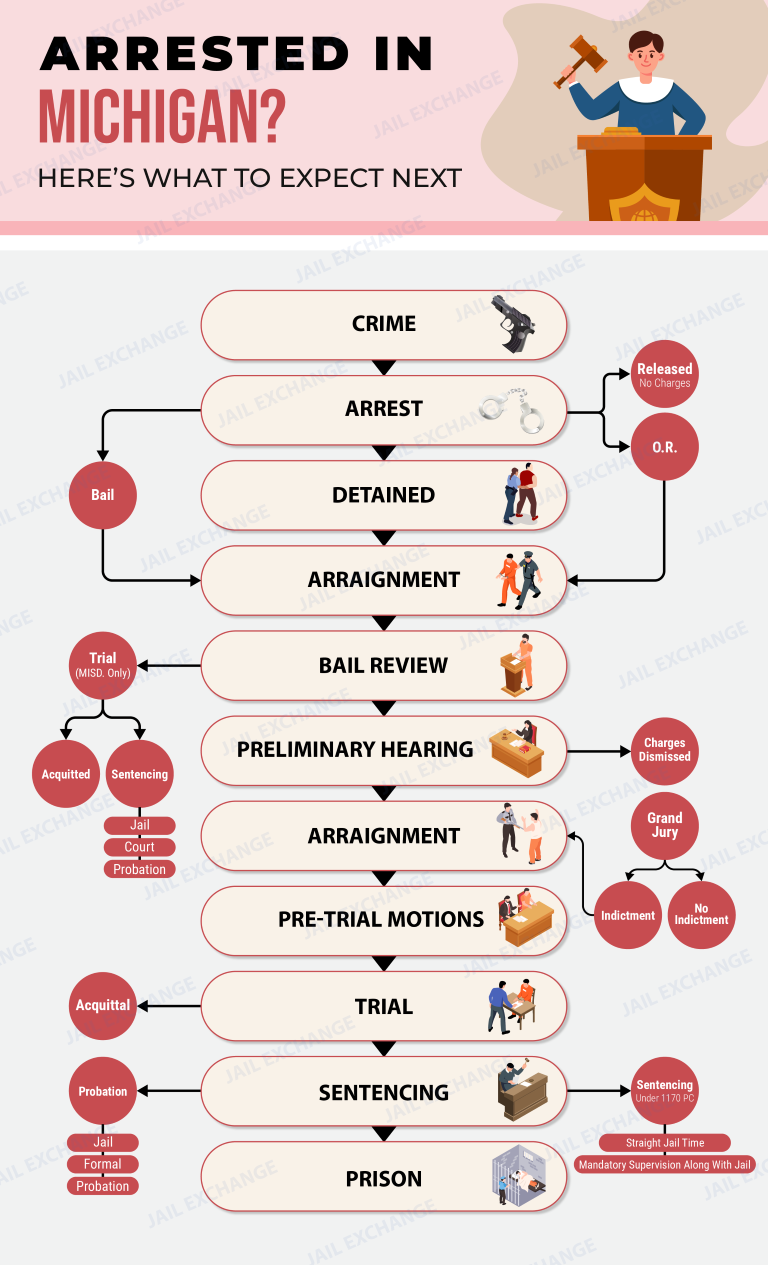
Information for this service is currently unavailable.

Access Secure Deposits (Smart Deposit) allows families and friends to securely transfer money directly into an incarcerated person's jail trust account using a debit or credit card. Deposited funds become immediately available for your loved one to purchase essential hygiene goods, over-the-counter medication, food items, and writing materials from the facility commissary.
Important: Inmate Banking Policies Vary by Facility
Once a person is booked and moved to a cell, facilities do not always allow cash drop-offs or phone payments directly to the jail. Some might and you should confirm this by calling the facility and asking. But if you do not register online and fund your loved one's trust account immediately, they may be forced to wait days or weeks for standard paper processing, leaving them without essential soap, clean undergarments, basic medical sundries or snacks.
Step-by-Step Instructions to Register and Access Service
- Obtain the inmate's legal first and last name, date of birth, and official six- to ten-digit Booking or Inmate ID number.
- Visit the official Access Corrections portal at www.accesscorrections.com or download the Access Corrections mobile app.
- Select the state and the exact detention facility or county jail where the inmate is currently housed.
- Add the inmate as a contact and confirm their identity from the facility roster.
- Enter your debit or credit card billing information, choose your deposit amount, review the facility processing fee, and submit your payment.
- Save and print your transaction confirmation number for verification.
What the Inmate Needs to Do
The inmate does not need internet access to receive your deposit. Once approved, the funds post directly to their facility account balance. The inmate can verify their balance at the dayroom kiosk or on their trust statement and start ordering items on the next designated commissary day.
Official Provider: Access Corrections / Keefe Group Official Website
Customer Service Telephone: 1-866-345-1884
Support Hours: 24/7/365
Supported Languages: English and Spanish
Other Services Provided by Access Corrections / Keefe Group
In addition to Access Secure Deposits (Trust Money), Access Corrections / Keefe Group provides several other communication, financial, and visitation services at participating correctional facilities:
- Digital Messaging & Photos: Send digital letters and pictures straight to the inmate's kiosk or tablet.
• Learn more on our website: Digital Messaging & Photos Guide | • Visit official vendor page: Access Corrections / Keefe Group Digital Messaging & Photos - Commissary Care Packages: Order pre-approved food boxes, thermal clothes, and snack bundles directly to the jail.
• Learn more on our website: Commissary Care Packages Guide | • Visit official vendor page: Access Corrections / Keefe Group Commissary Care Packages
Deposit Money for an Inmate in the Montmorency County Jail
The Easiest and Securest Way of Depositing Money for an Inmate
There are several methods for depositing money on an inmate's account:
1. To send money online to an inmate in the Montmorency County Jail use Access Corrections.

2. If you prefer to use your credit or debit card and deposit money over the phone, you can call them at 866-345-1884.
3. Some jails have an Access Corrections kiosk for cash or card deposits. Call the Montmorency County Jail to ask whether it has one and where it is.
4. Access Corrections also has Kiosk machines that you can find in check cashing stores and retail outlets across the country.
5. The Montmorency County Jail may also allow you to *mail an inmate a money order or cashier’s check from a trusted source such as the Post Office, a local bank, or Western Union. Ask the jail who the money order should be made out to and what to write on it. To confirm this option call the facility at 989-354-9830.
*When mailing a money order or cashier’s check, send it an envelope by itself. Never send it with a letter or photos for your inmate, unless the facility allows it. Never send personal checks or cash.
6. To ask whether the Montmorency County Jail takes deposits in person, and when, call 989-354-9830.
Montmorency County, Michigan has no jail of its own that holds people. The Montmorency County Sheriff's Office says everyone it arrests is housed at the Alpena County Correctional Facility, run by the Alpena County Sheriff's Office in Alpena. Send all mail to that address, not to the Sheriff's Office in Atlanta. The person's name is enough on the envelope, since Alpena says no inmate number is needed.
Mail for someone arrested in Montmorency County (Alpena County Correctional Facility):
Inmate's Full Name & Inmate ID#
Alpena County Sheriff's Office
4900 M32 W
Alpena, MI 49707
- Check where they are: Look them up on the inmate search before you write, in case they have been released or moved.
- How to send it: Use the U.S. Postal Service. You may write every day.
- Return address required: A letter that arrives with no return address is thrown out.
- What to write with: Black or blue pen, pencil, or a typed page.
- Not allowed: Glitter, stickers, crayon or colored pencil, and any odd smell or substance on the paper or envelope. A letter with any of these is sent back.
- Leave out extras: Loose stamps, blank envelopes and extra paper are thrown away.
- Everything is opened: Staff open and inspect personal mail, and anyone in the jail should expect it to be read. Only mail from the person's attorney of record is treated as legal mail.
- Letters that are held back: Threats, escape plans or anything that pushes violence are censored and may lead to charges.
- No mail from other lockups: Letters from another inmate or another jail or prison are refused, and inmates may not write to a crime victim.
- Reading material: Books must be new, never hardcover, and shipped by a publisher or a store. Newspaper and magazine subscriptions have to be mailed by the publisher itself.
- Money: You can deposit money online, use the kiosk in the Alpena Sheriff's Office lobby, or mail a money order made out to the inmate by full name. If you are unsure, call 989-354-9830 to confirm.
For Alpena's Corrections staff, call 989-354-9830 and choose option 4.

CTEL provides secure telecommunication networks for county detention centers and municipal holding facilities. Setting up an AdvancePay prepaid account through CTEL ties calling funds directly to your 10-digit telephone number, ensuring that your incarcerated loved one can dial your phone directly from housing unit telephones without billing disruptions.
Important: Mobile Networks Block Inmate Calls by Default
Correctional facilities never allow incoming calls to inmates, and wireless mobile carriers automatically reject traditional collect calls. While some local landlines might support direct monthly billing, mobile smartphones and VoIP numbers require an active prepaid balance, which you can verify by checking with your telephone service provider. If you do not register online and fund an account right away, your loved one will receive an automated operator message stating your number cannot accept calls.
Step-by-Step Instructions to Register and Fund a Phone Account
- Visit www.ctel.us or contact CTEL customer service at 1-800-583-9683.
- Select Create Account and register using the primary 10-digit mobile or home telephone number where you want to receive calls.
- Select the state and the detention facility where the inmate is currently housed.
- Locate the inmate using their full legal name or facility booking identification number.
- Choose your deposit amount ($25, $50, or custom amount) and enter your credit or debit card billing information.
- Authorize payment, save your confirmation number, and confirm that your mobile phone does not have spam filtering enabled for correctional automated lines.
What the Inmate Needs to Do
The inmate picks up any dayroom telephone, dials your 10-digit number, and keys in their assigned Inmate PIN. The automated system verifies that your phone number has an active prepaid balance and connects the call once you press the prompted number to accept. All personal calls are recorded and monitored by jail staff.
Official Provider: CTEL Official Website
Customer Service Telephone: 1-800-583-9683
Support Hours: Monday – Friday, 8:00 AM – 5:00 PM CST
Supported Languages: English and Spanish
Other Services Provided by CTEL
In addition to Prepaid Calling Accounts, CTEL offers direct billing options for qualified landlines:
- CTEL Collect Calling Services: Establish direct-billed monthly calling accounts for verified residential landline numbers.
• Learn more on our website: Collect Calling Services Guide | • Visit official vendor page: CTEL Collect Calling
CTEL Collect Calling Services provide approved residential landline owners and commercial businesses with the ability to receive inmate phone calls and have all call duration charges billed directly to their monthly telecommunications statement.
Important: Direct Collect Billing Is Restricted to Approved Landlines
Traditional third-party collect billing is subject to strict carrier credit rules and is rarely supported by modern mobile phone providers or cable internet phone services. You should check with your telephone company or call CTEL directly to see if your phone line qualifies. If your phone carrier rejects third-party collect charges, you must establish an AdvancePay prepaid account instead to receive incoming calls from the jail.
Step-by-Step Instructions to Set Up a Direct Bill Account
- Contact CTEL customer billing support at 1-800-583-9683.
- Provide your billing name, physical service address, and residential landline telephone number.
- Allow the representative to test your telephone provider for automated collect billing compatibility.
- Complete the billing verification agreement and establish your monthly credit spending ceiling (usually $50 to $100).
- When an inmate calls, listen through the automated voice greeting identifying the facility and press the requested key to accept charges.
- Review and pay your call charges on your monthly statement.
What the Inmate Needs to Do
The inmate dials your phone number from the dayroom phone bank, chooses the collect call option, and keys in their identification PIN. The automated operator checks that your phone number has not exceeded its authorized monthly credit limit before connecting the line.
Official Provider: CTEL Official Website
Customer Service Telephone: 1-800-583-9683
Support Hours: Monday – Friday, 8:00 AM – 5:00 PM CST
Supported Languages: English and Spanish
Other Services Provided by CTEL
In addition to Collect Calling, CTEL provides mobile prepaid calling options for family members:
- CTEL Prepaid Calling Accounts: Fund a prepaid balance tied directly to your cell phone to receive calls without landline restrictions.
• Learn more on our website: Prepaid Calling Accounts Guide | • Visit official vendor page: CTEL Prepaid Calling
Information for this service is currently unavailable.
Information for this service is currently unavailable.
Montmorency County County Jails
- Jail (Main): 989-354-9830
- Sheriff: 989-785-4238
The Montmorency County Jail serves the following cities and towns of Montmorency County: Albert, Avery, Briley, Hillman, Loud, Montmorency, Rust and Vienna.