
Osceola County Jail
Osceola County Inmate Search: Reaching a Loved One Held at the Reed City Jail
Deputies and local officers bring adults they arrest to the county jail, which belongs to the Sheriff's Office in Reed City. The Osceola County Jail page on our site has the basics, and the Sheriff's Office sits at 325 W. Upton, Reed City, MI 49677. This guide covers lookups, mugshots, bail, money, mail and who to call.
Begin with the county jail lookup, which you search by name. It shows whether your person is in the jail right now. Someone booked or released only moments ago might not appear, so use the phone to be sure.
Ring the Sheriff's Office at 231-832-2288 and ask for the jail. Keep the person's whole name and birthday ready. Find out where your person is held, the charge, and the first hearing date. After that, read our bail guide and court guide.
Read inmate search answers
 Read inmate search answers
1. What is the way to search the Osceola County jail by name?
Plan on a few quick steps:
- Open the jail lookup in your browser.
- Type the surname. A common surname may need the first name as well.
- If nothing comes up, try a different spelling, a nickname or a former surname.
- Check the birth date on a result, so two people with one name don't get mixed up.
- Phone 231-832-2288 to learn the charge, bond amount and release timing.
All the lookup tells you is whether your person is in custody. The rest comes from jail staff.
↑ Back to the question list2. What if I can't find my person in the lookup?
An empty result in the first day or so is very common. Some likely causes:
- Booking still underway. Prints, photos and forms are not done yet.
- A stop at a city station. Local officers may keep a person for a short time first.
- Already home. The person may already have posted bond at the jail or been let out by a judge.
- Another county. Michigan has no one list for every jail, so each county runs its own.
- A young person. Youth under 18 are held somewhere else.
- Another spelling. Try the middle name or an odd spelling of the first.
The Sheriff's Office at 231-832-2288 answers Monday to Friday, 9:00 a.m. to 5:00 p.m. After hours, ask the person who answers how to reach a deputy.
↑ Back to the question list3. Where in Osceola County could they be held?
The county's only adult jail belongs to the Sheriff's Office at 325 W. Upton, Reed City, MI 49677, 231-832-2288. See the jail's page for more. The county lists a single address for the department, so ask which door the jail uses before driving over.
Community Corrections works alongside the jail from 301 W. Upton, Reed City, MI 49677, 231-832-6163. Its programs include a jail work crew, electronic monitoring and pre-trial day reporting. Those are programs, not extra buildings. Ask if your person can join one.
When the arrest took place close to the edge of the county, a neighbor may hold the person. Each page below gives that jail's address and phone:
- Mecosta County Jail
- Newaygo County Jail
- Lake County Jail
- Wexford County Jail
- Missaukee County Jail
- Clare County Jail
- Isabella County Correctional Facility
4. Can I see Osceola County mugshots?
Direct a mugshots request to whichever department made the arrest. An opinion from Michigan's Attorney General treats suspect photos as public records. An agency can still turn down a request if sharing it would intrude on privacy in a clearly unwarranted way. You ask under the state's public records law, which begins at MCL 15.231.
If a deputy made the arrest, phone 231-832-2288 and ask how to file. For a city officer or trooper, use the numbers in the final answer below.
- If the photo is in ICE's files, use the ICE FOIA request page to ask.
- Federal booking photos are generally not released. One exception: the U.S. Marshals Service may release a photo, as in a fugitive search.
5. Will a call or text tell me when custody changes?
Yes. MI-VINE, a state program with no fee, does this. VINE tracks people in county jails and Department of Corrections custody, and it flags a release, a move or an escape. Court events are covered too.
- Phone 800-770-7657, day or night.
- Or register on the VINELink site.
A notice can arrive after the fact. When timing matters, call the Sheriff's Office at 231-832-2288 too.
↑ Back to the question list6. What are the steps to getting out on bail here?
Bond is normally set at the first court hearing, called arraignment, in the 77th District Court. The person often appears on a screen while still at the jail. The court is at 301 W. Upton, Reed City, MI 49677, 231-832-6155.
- Interim bond. For certain minor offenses, a small bond can be paid at the jail, to the deputy on duty, if no magistrate is available (MCL 780.581). When the arrest is tied to domestic violence, release waits for a judge.
- The hearing. Most often the court lets the person go home on a signed pledge to appear, or under a bond where no cash is due at first. Cash bail applies only when the court finds nothing milder will protect people or bring the person back (MCR 6.106).
- The ten percent option. You may be able to pay just a tenth of the bail to the clerk. Under a court rule that changed on May 1, 2026, the court's share is limited: the deposit stays with the court only after a conviction for a listed offense (MCR 6.106(I)(1)). With no conviction, it is refunded, less any fines or costs.
- A bond agent. Agents need an insurance license and approval from the court. Ask the clerk who is on the approved list.
The Sheriff's page names ExpressAccount for bond payments. Check our bail guide and the short Michigan bail laws page before handing money to anyone.
↑ Back to the question list7. How can I learn the charge?
The jail can read out the charge if you phone 231-832-2288. Once a court case exists, look in MiCOURT Case Search. When your search finds nothing, call the criminal clerk at the 77th District Court, 231-832-6155, and pick option 1.
The Prosecuting Attorney picks the formal charges. That office is at 301 W. Upton, Reed City, MI 49677, 231-832-3226.
↑ Back to the question list8. Who helps pay for a lawyer in Osceola County?
At arraignment, Michigan court rules require the judge to raise the subject of a lawyer and check if the person can afford one (MCR 6.005). When the answer is no to the second part, the court names a lawyer. Money for bond does not take away the right to ask for a court lawyer.
Ask the District Court clerk how local appointments work, at 231-832-6155. Statewide, the Michigan Indigent Defense Commission, 517-657-3066, oversees public defense. Hiring a private attorney is always your choice.
↑ Back to the question list9. How do visits work at the jail?
The county sends families to ICSolutions for video visits. Open or sign in to a Friends and Family account on its website. Then call the jail at 231-832-2288 with these questions:
- Is it a face-to-face visit, a screen visit, or both?
- On what days and hours may my person have visitors?
- Who can come, and which ID counts?
- What clothing is fine, and what stays in the car?
Schedules can shift quickly. Our visiting tips add general advice.
↑ Back to the question list10. What is the safe way to add money to an account?
Deposits buy snacks, hygiene items and phone time. The county tells families to use expressaccount.com for commissary deposits, care packages, and bond and bill payments. Choose the correct option and type the full name.
Don't mail cash. If a stranger texts a link or asks you to pay a person, phone the Sheriff's Office at 231-832-2288 before sending anything. More help sits in our deposit guide and commissary guide.
↑ Back to the question list11. How can my person call or video chat with me?
Inmate phones and video chats run through ICSolutions, the service the county names. Make a Friends and Family account on its site. Next, ask the jail at 231-832-2288 about call prices and the hours when calls are allowed.
Calls from jail may be monitored, so discuss the case with the lawyer alone. Learn more from our guide to jail phones and our guide to email and texting.
↑ Back to the question list12. What should I know before writing to the county jail?
Phone 231-832-2288 first. Ask for the right address layout and the ID number to put on it. Ask too if cards, photos or books are allowed.
Address it to the full legal name, and show your own address as the sender. Common rules are in our letter guide. Never tuck cash inside.
↑ Back to the question list13. Can I bring or collect the person's things?
Rules for a person's belongings are the jail's own. To deliver clothing or collect property, call the Sheriff's Office at 231-832-2288. Ask what paperwork the person must sign, which photo ID you need and the best hours. The office is at 325 W. Upton, Reed City, MI 49677.
↑ Back to the question list14. Who do I call about illness or injury in custody?
Phone the jail at once, 231-832-2288, and ask to be connected to the medical team. Give the drug name, the dose and who prescribed it. Tell your person to turn in a medical request inside, too.
If someone could die, call 911 before anything else. If the worry is a mental health crisis, tell the staff at once.
↑ Back to the question list15. How can I check on a warrant in Osceola County?
Deputies handle Sheriff's warrants here. Dial 231-832-2288 and give a full name and a birthday. A court case may also appear on MiCOURT Case Search, and a clerk can help if it is not there. To take care of a warrant, first get legal advice, then call the court behind the warrant to arrange turning yourself in. Write down the court, the date and any case number you are given. Court address: 77th District Court, 301 W. Upton, Reed City, MI 49677, 231-832-6155.
↑ Back to the question list16. Where do I get Osceola County court dates?
Ask the clerk of the court with your case. Our court guide walks through each stage.
- 77th District Court, 301 W. Upton, Reed City, MI 49677, 231-832-6155. It handles lower-level crimes, arraignments, bond and first felony hearings. Choose option 1 for criminal.
- 49th Circuit Court, 301 W. Upton, Reed City, MI 49677, 231-832-3261. Felony cases move up to this court once the preliminary exam is done.
In a felony case, a conference is held a week or two after arraignment. A preliminary exam comes a week after that (MCL 766.4).
↑ Back to the question list17. Where is a federal case heard for Osceola people?
Osceola belongs to the federal Southern Division of the Western District of Michigan. Hearings are often held in Grand Rapids at 399 Federal Building, 110 Michigan St NW, Grand Rapids, MI 49503, 616-456-2381. Ask which courtroom will hear a specific case.
- Detention hearings decide jail or home until trial, and a federal judge runs them (18 U.S.C. 3142).
- The U.S. Marshals Service, in the Gerald R. Ford Federal Building, 110 Michigan Street NW, Suite 744, Grand Rapids, MI 49503, 616-456-2438, can tell you where a federal prisoner is held.
- After sentencing, search the federal Bureau of Prisons locator for the person's site.
18. What happens if ICE asks for a hold?
A hold from immigration authorities goes like this:
- ICE sends a detainer to the jail, and its form number is I-247A.
- A detainer under 8 CFR 287.7(d) lets the jail keep a person up to 48 hours after they would otherwise be released, so ICE can pick them up.
- Search the ICE Online Detainee Locator.
- For questions, call the ICE Detroit field office (Enforcement and Removal Operations), 985 Michigan Avenue, Suite 207, Detroit, MI 48226, 313-771-6601. It handles both Michigan and Ohio.
19. Where do I check on a person sentenced to prison?
When the court orders prison, Sheriff's deputies make the drive to a state intake unit. Men are processed at the Jackson prison intake site, the Reception and Guidance Center. For women, the state uses its Ypsilanti unit. Intake can last 30 to 45 days. Visits stop for that time, though letters and deposits still go through.
- Look for the name or MDOC number on OTIS, the Offender Tracking Information System.
- Each prison's visit and mail rules appear in our guide to Michigan's state prisons.
20. What if a teen or child was taken into custody?
Michigan law calls anyone younger than 18 a juvenile, and adults and youth may not share a cell block or day room. The Family Division of Circuit Court, run here as the Probate Court, takes these cases. Under MCL 712A.4, a judge can send some 14, 15, 16 and 17 year olds to be tried as adults. A few very serious offenses by teens of 14 to 17 begin in Circuit Court.
Call the Probate and Family Court at 301 W. Upton Ave., Reed City, MI 49677, 231-832-6124. Its juvenile register line is 231-832-6127. Ask where the young person is staying and when the hearing will be.
↑ Back to the question list21. Which Osceola County police agency arrested them?
Several agencies serve the county. Ring the arresting agency to ask about a report or a photo.
- Osceola County Sheriff's Office, 325 W. Upton, Reed City, MI 49677, 231-832-2288
- Evart Police Department, 200 S. Main Street, Evart, MI 49631, 231-832-3255. The county gives this same number for Meceola Central Dispatch, so ask for the police desk.
- Reed City police: call the Sheriff's Office above and ask which number to use.
- State Police Post 63, in Mt. Pleasant, MI 48858, at 3580 S. Isabella Rd., 989-773-5951
For smaller towns, the Sheriff's Office can name the department that patrols there. In an emergency, dial 911.
↑ Back to the question listOsceola County bail and bond: Reed City and paying through ExpressAccount
Adults arrested in Osceola County are held at the Osceola County Jail, handled by the Sheriff's Office at 301 W. Upton, Reed City, MI 49677. Read on to learn how bond payments work through ExpressAccount and what to ask before paying.
Enter a name into the Osceola County Inmate Search to see custody and bond. Our Jail Roster shows booking photos and active warrants too.
A call to the Sheriff's Office at 231-832-2288 tells you where your person sits now, in case of a transfer. Next, see our court page.
1. Is my family member booked in Reed City?
Look the name up on Osceola County Inmate Search. The county lists jail inmate processing under the Sheriff's Office, and no separate jail address or phone was posted. Phone the Sheriff's Office at 231-832-2288 to ask where your person is being held, in case a transfer has happened.
↑ Back to the question list2. What exactly does the Sheriff's page tell me about money?
It says to use expressaccount.com for bond and bill payments, commissary deposits, and care packages. That one site covers several kinds of payments, so pick the bond option and match the case number. Phone and video visits run through a separate account with ICSolutions.
↑ Back to the question list3. What are the office hours?
The county office is open Monday through Friday, 9 a.m. to 5 p.m. Some Sheriff services such as permits and fingerprinting are 9 a.m. to 4 p.m. with no appointment. No separate hours were posted for jail bond. For an evening, call 231-832-2288 and ask what is possible.
↑ Back to the question list4. Why do two Upton addresses show up?
The county page lists a mailing address of 325 W. Upton and a location of 301 W. Upton. Both are in Reed City, MI 49677. The 77th District Court is also at 301 W. Upton. Before you go in person, confirm the door with 231-832-2288.
↑ Back to the question list5. Which court hears an Osceola County arrest?
The 77th District Court is at 301 W. Upton, Reed City, MI 49677, 231-832-6155. It handles misdemeanors and the first steps of a felony. Ask the clerk for the hearing date, and for who sets the bond if the person has not been seen yet.
↑ Back to the question list6. How does a 10 percent bond work?
If the judge allows it, you give the court 10 percent of the bail, not all of it. On a $3,000 bail, that is $300, as an example of the math. Since May 1, 2026 the court may keep part of that deposit only if the person is convicted of an offense under MCL 780.66. If charges end without a conviction, the deposit comes back, less any fines and costs.
↑ Back to the question list7. Can I use a bondsman?
If the order permits a surety. Michigan does not have a separate bail agent license. Agents are insurance producers and each court approves them. Ask the 77th District Court clerk at 231-832-6155 which agents are on its list. No state fee rule was found, so ask each agent for the price and security in writing.
↑ Back to the question list8. If someone else posts the bond, what are the risks?
A bond posted in the defendant's name is used first for fines, costs, and assessments. A bond posted by another person is forfeited if the defendant does not appear. Ask the clerk which kind the order allows before you hand over money.
↑ Back to the question list9. Can the court deny bail?
In the narrow cases in the Constitution: murder, treason, first-degree criminal sexual conduct, armed robbery, kidnapping for extortion, and certain violent felonies by repeat offenders or people on release. The judge must find the proof strong. For everyone else, bail must be set at a reasonable level.
↑ Back to the question list10. How fast should a judge see the person?
Without unnecessary delay. The firm outer limit is about 48 hours for a warrantless arrest, when a judge must find cause. A county must keep a judicial officer available every day of the year. Phone 231-832-6155 for the date.
↑ Back to the question list11. Can a house or acreage secure a bond?
The court rule allows it with the judge's consent and proof of value. Ask the 77th District Court at 231-832-6155 whether the land must be in Osceola County. Ask the clerk before paying for an appraisal.
↑ Back to the question list12. What if my child was arrested?
No one under 18 may be held with adults. The Osceola youth detention center was not named on pages read. Ask the 77th District Court at 231-832-6155 to be connected to the family court, and ask where the child is held and the hearing date.
↑ Back to the question list13. Who is the free lawyer in Osceola County?
No local office was listed. The judge asks at the first hearing whether you want a lawyer, and you fill out a financial form. The Michigan Indigent Defense Commission, 517-657-3066, can name the county plan.
↑ Back to the question list14. What if the person misses court?
The judge can order the bond forfeited. A surety gets notice within 7 days, and the person has 28 days after notice to surrender before judgment. Call a lawyer and the court that day.
↑ Back to the question list15. What is a real bail payment page and what is not?
The county sends you to expressaccount.com from its website. Ignore anyone who texts you a link or asks for a transfer to a person. Check numbers with 231-832-2288.
↑ Back to the question listOsceola County bond contacts
- Jail that serves the county: Osceola County jail information
- Bond help: Jail bail and bond guide
- Custody lookup: Osceola County Inmate Search
- Sheriff's Office: 325 W. Upton (mail) and 301 W. Upton (location), Reed City, MI 49677; 231-832-2288
- Bond payments: expressaccount.com
- District court: 77th District Court, 301 W. Upton, Reed City, MI 49677; 231-832-6155
- Defense lawyers: Michigan Indigent Defense Commission, 517-657-3066
For the jail address and bond hours, call the Sheriff's Office at 231-832-2288, and every step above should be double-checked by phone with the Sheriff's Office or the court before you pay.
How Do I pay Bail for Someone Arrested in Osceola County?

eXpress Account provides an electronic bail and bond processing service that allows family members to post court appearance bonds, cash bail, and facility fee contributions online using a credit or debit card. By submitting payments remotely, you eliminate the need to obtain cashier's checks or deliver physical cash directly to the detention facility booking window.
Important: Verify Bond Status Before Submitting Payment
Bail posting rules and release timelines are set by individual detention centers and municipal courts. Some facilities permit partial community bond payments, while others mandate full bail settlement before processing release paperwork. You must contact the jail booking desk to confirm that booking is complete, the bond amount is current, and no additional warrants or holds exist, as card processing charges cannot be refunded once an authorization is completed.
Step-by-Step Instructions to Post Bail Online
- Confirm the inmate's legal first and last name, date of birth, and assigned booking identification number with the facility.
- Navigate to expressaccount.com on your computer or mobile browser.
- Sign into your verified account or select the option to make a bond deposit.
- Select the state and facility where the individual is currently detained.
- Locate the defendant's record to ensure the electronic payment attaches to the active jail booking file.
- Enter the bond payment amount, review the calculated convenience fees, and input your card billing details.
- Authorize payment, print or save your digital confirmation receipt, and call the booking desk to notify staff that the bond has cleared.
What the Inmate Needs to Do
The booking officer verifies electronic receipt of the bond funds within the facility's administrative management system. Staff then print the official appearance bond and conditions of release. The inmate is called to the booking counter to review and sign their paperwork, after which staff complete property return and physical release.
Official Provider: eXpress Account Official Website
Customer Service Telephone: 1-866-422-6833
Support Hours: Monday – Friday, 8:00 AM – 4:00 PM EST
Supported Languages: English and Spanish
Other Services Provided by eXpress Account
In addition to Cash Bail & Bond Deposits, eXpress Account handles communication, trust banking, and care package services:
- Inmate Trust Money Deposits: Send canteen funds directly into an incarcerated person's jail trust account.
• Learn more on our website: Inmate Trust Deposits Guide | • Visit official vendor page: eXpress Account Trust Deposits - Commissary & Gift Package Ordering: Order pre-approved snack boxes, food packages, and clothing delivered directly to the jail.
• Learn more on our website: Commissary Ordering Guide | • Visit official vendor page: eXpress Account Store Packages - Digital Resident Messaging: Send electronic messages and letters directly to facility kiosks or for staff printing.
• Learn more on our website: Digital Messaging Guide | • Visit official vendor page: eXpress Account Messaging
Osceola County Jail Inmate Visitation Schedule

325 W. Upton
Reed City, MI 49677
231-832-2288
- First, you must register an account with IC Solutions, then add Osceola County Jail, then your inmate.
- Second, you can choose a time to visit.
- Offsite Video Visits can be done on Android, IOS (Apple) or Windows devices.
- Inmates will be allowed two, thirty minute onsite visits per week and five, thirty minute visits offsite per week.
- There is no charge for Onsite Video Visits.
- Offsite Video Visits range from $7.50 to $10.00 for 30 minutes.
- All visits must be scheduled 24 hours prior to the appointment or up to 1 weeks in advance.
- CHECK-IN: 10 minutes prior to scheduled visit.
- Valid picture identification (e.g., driver’s license, State I.D., or Military I.D.) is required at Check-In.
- Visitors under the age of 17 must be listed as an additional visitor and accompanied and supervised by an authorized visitor over the age of 18.
- If a visitor loses internet connection during an offsite video visitation session, no refund will be issued.
ON-SITE VISITATION SCHEDULE
| DAY | TIME |
| SUNDAY | 10:00AM - 7:30PM |
| MONDAY | 10:00AM - 7:30PM |
| TUESDAY | 10:00AM - 7:30PM |
| WEDNESDAY | 10:00AM - 7:30PM |
| THURSDAY | 10:00AM - 7:30PM |
| FRIDAY | 10:00AM - 7:30PM |
| SATURDAY | 10:00AM - 7:30PM |
REMOTE VISITATION SCHEDULE
| DAY | TIMES |
| SUNDAY | 7:30AM - 11:30AM 1:00PM - 4:45PM 6:00PM - 9:00PM |
| MONDAY | 7:30AM - 11:30AM 1:00PM - 4:45PM 6:00PM - 9:00PM |
| TUESDAY | 7:30AM - 11:30AM 1:00PM - 4:45PM 6:00PM - 9:00PM |
| WEDNESDAY | 7:30AM - 11:30AM 1:00PM - 4:45PM 6:00PM - 9:00PM |
| THURSDAY | 7:30AM - 11:30AM 1:00PM - 4:45PM 6:00PM - 9:00PM |
| FRIDAY | 7:30AM - 11:30AM 1:00PM - 4:45PM 6:00PM - 9:00PM |
| SATURDAY | 7:30AM - 11:30AM 1:00PM - 4:45PM 6:00PM - 9:00PM |

ICSolutions Video Visitation provides a secure online platform that enables families to conduct scheduled face-to-face video visits with incarcerated loved ones from home using an internet-connected smartphone, tablet, or personal computer equipped with a webcam.
Important: Advance Registration and Visitor Clearance Required
Detention centers do not permit unscheduled or unverified video sessions. Correctional facilities require prospective visitors to submit government-issued photo identification and receive administrative clearance before booking an appointment, an approval process that can take up to 48 hours depending on facility staffing. You should verify your visitor approval status with the facility prior to scheduling. If you do not register well in advance, you will miss your loved one's scheduled visiting window for the week.
Step-by-Step Instructions to Register and Schedule a Video Visit
- Visit www.icsolutions.com and sign into your account.
- Register your visitor profile and upload a clear photo of your government-issued ID (driver's license or passport) for facility background review.
- Wait for email notification confirming facility visitor approval.
- Select Schedule Visit, choose the detention facility, and select the inmate.
- Browse the available schedule calendar, select a time slot, and pay the visitation fee using a credit or debit card.
- Log into the website or app 10 minutes prior to the start time on a device with a functioning camera, microphone, and reliable high-speed internet connection.
What the Inmate Needs to Do
The inmate receives a visitation notification on their housing unit video kiosk or terminal. At the appointed time, they log in with their PIN and sit before the terminal. Inmates and visitors must strictly observe jail dress and conduct rules; sessions are monitored by staff and will terminate immediately upon any violation.
Official Provider: ICSolutions Official Website
Customer Service Telephone: 1-888-506-8407
Support Hours: 24 hours a day, 7 days a week, 365 days a year
Supported Languages: English and Spanish
Other Services Provided by ICSolutions
In addition to Remote Video Visitation, ICSolutions provides calling and voicemail services at participating correctional facilities:
- AdvancePay Prepaid Calling Accounts: Prepay for phone calling minutes so your loved one can call your telephone directly.
• Learn more on our website: AdvancePay Calling Guide | • Visit official vendor page: ICSolutions Prepaid Calling - Inmate Voicemail Services: Leave recorded voice messages that your loved one can listen to on dayroom phones.
• Learn more on our website: Inmate Voicemail Guide | • Visit official vendor page: ICSolutions Voicemail - Access Secure Deposits (Partner Trust Transfers): Deposit trust money into an inmate's account via Keefe Group partner networks.
• Learn more on our website: Inmate Trust Deposits Guide | • Visit official vendor page: Access Corrections Trust Deposits
What Happens in Osceola County Criminal Court After an Arrest
The 77-2 District Court, 231-832-6155, is at 301 W. Upton St., Reed City, MI 49677, and the Circuit Court is also in Reed City. Until a hearing, an arrested adult is held through the Osceola County Jail. Below, a case is followed from the first appearance on.
The Osceola County Inmate Search is the first stop for a booking. Our Inmates in Custody page tracks charges and arrests from this week.
For the location of your person, ring the Sheriff's Office at 231-832-2288. Hoping to pay for release? Open our bond page.
1. Which court handles an arrest or criminal case in Osceola County?
A person accused of a crime still has rights, including the right to challenge the alleged offense in court. In Osceola County, Michigan , lower-level criminal charges and the opening stages of felony cases are generally handled in District Court . Most felony trials and felony sentencing belong in Circuit Court . Juvenile delinquency cases usually go through the Family Division of Circuit Court. The Osceola County Prosecuting Attorney represents the state. Reed City is the county seat.
2. Someone you love was arrested in Osceola County. What do you do first?
Write down the person’s full name and birth date, the arresting agency, the booking location, the court matter number if available, and the next hearing date. Ask the jail whether the person is still in custody and whether a bond or other release order has been entered. The jail handles custody; the court sets bond and court dates. The District Court ordinarily handles a misdemeanor case and the first felony hearings. The Circuit Court ordinarily handles the felony after the preliminary stage. A family member may be able to attend public hearings, but the judge and appointed lawyer—not a jail officer—determine how the legal case moves forward.
- 77-2 District Court — 301 W. Upton St., Reed City, MI 49677. 231-832-6155.
- District Court: Hears most misdemeanors and holds the first hearings in felony cases, including arraignment and preliminary examination.
- Circuit Court: Handles felony trials, pleas, sentencing, and appeals assigned by Michigan law.
- Family Division of Circuit Court: Handles juvenile delinquency proceedings and related matters.
- Osceola County Prosecuting Attorney: Represents the state in local criminal prosecutions.
- Appointed defense lawyer: People who cannot afford counsel in qualifying criminal cases can request an appointed attorney.
- Local jail and custody: County sheriffs normally manage local jail custody; a court may order release with conditions or continued detention.
Where does a case start? A person arrested in Osceola County may first be booked by police and brought before a judge or magistrate. The criminal accusation determines which court hears the court matter, and the court paperwork controls where the defendant must appear. Michigan District Courts decide most misdemeanors and handle the first steps of felonies. Circuit Court in most situations takes over a felony after a waiver or a finding of probable cause at the preliminary examination.
What happens to someone waiting in jail? The Osceola County sheriff or another authorized jail may hold the person charged while a court considers release. Custody and release decisions are recorded as part of the criminal case. A courthouse and a detention center are not necessarily on the same property.
This guide explains the usual criminal court process in Osceola County in plain language. The exact charge, criminal history, and judge’s findings affect the outcome. It is general information, not personal legal advice.
↑ Back to the question list2. How do misdemeanor hearings work in Osceola County?
In Osceola County, a misdemeanor may start with a ticket or a notice to appear, while a more serious situation can lead to arrest and booking. Examples include certain assaults without serious injury, shoplifting and some impaired-driving charges. The criminal accusation written on the paperwork matters because Michigan has different penalties for different misdemeanors.
Getting to the first hearing and discussing release
At arraignment, the judge tells the person charged what offense is charged, explains important rights and addresses a plea and release conditions. Some people can leave on a personal promise to return; others may have money bond, supervision, travel limits or no-contact orders. A judge can also deny release where the law permits. Bail is not a punishment or proof of guilt.
After the first court date
Here is the practical point for a family: The Osceola County District Court may schedule a pretrial hearing. Lawyers review police reports, videos and other evidence. The prosecuting attorney may offer an agreement, dismiss a charge or proceed to trial. The person charged can contest the evidence rather than accept a plea. Jury-trial rules depend on the offense and the legally available punishment.
How a person can obtain defense counsel
If the person charged faces a charge that qualifies for appointed counsel and does not have enough money to hire an attorney, the court can determine eligibility for a public defender or assigned lawyer. Request this help promptly; do not assume a defender is automatically assigned after booking.
Possible misdemeanor results
Michigan misdemeanors have different maximums. Common statutory limits include 90 or 93 days, one year, and in certain cases two years, with fines fixed by the particular statute. Some offenses also require driver-license action, restitution, classes or probation. The exact charge and prior record matter more than the county name.
↑ Back to the question list3. How are felony charges handled in Osceola County?
A felony accusation in Osceola County normally starts with a District Court arraignment, even when the eventual trial would be in Circuit Court. Prosecutors must establish the legal basis for moving the court matter forward. A felony carries the possibility of a state-prison sentence, although not every conviction results in prison time.
Probable cause conference and preliminary examination
The important thing to understand is: Michigan in most situations sets a probable cause conference 7 to 14 days after felony arraignment and schedules the preliminary examination roughly 5 to 7 days after that conference, unless a legal waiver, adjournment or exception changes the schedule. At the preliminary examination the prosecution must show probable cause that a crime occurred and that this defendant committed it. That decision is not a finding of guilt.
How a serious case reaches Circuit Court
When the charge is bound over, Osceola County Circuit Court handles the felony case. The accused person may be arraigned again, and the attorneys involved exchange evidence, negotiate, file motions or set a trial. The prosecutor has to establish guilt beyond a reasonable doubt at trial. Defendants who cannot afford legal counsel should request that the court about appointed representation.
What a felony sentence can involve
Michigan sentencing rules look at the offense statute, a record of earlier convictions, the sentencing guidelines when applicable, and any mandatory minimum. A nonviolent first offender might be eligible for probation or another lawful alternative, but some violent or repeat offenses require custody. Do not use a single felony-class chart to predict all Michigan sentences.
↑ Back to the question list4. What should families know about major criminal charges in Osceola County?
Murder, armed robbery, criminal sexual conduct and assaults causing serious harm are examples of grave charges that could be prosecuted in Osceola County. Seriousness by itself does not turn a Michigan crime into a federal case. Most such charges remain in the state Circuit Court unless federal law independently applies.
Detention and defense
For anyone trying to follow the process: A judge considers Michigan’s release rules, risk of flight, safety and legally relevant facts. A no-contact order or other condition may be imposed. Some defendants remain in jail while lawyers examine records, DNA or other scientific evidence. These charges need careful legal advice and frequently involve complicated court motions.
Trial and possible prison terms
First-degree murder carries mandatory life without parole for adults under Michigan law, subject to legally applicable exceptions and youth-sentencing rules. Second-degree murder can carry a sentence up to life imprisonment. Armed robbery and several serious criminal sexual conduct crimes can also carry very long terms. Other violent offenses have their own penalty sections. Michigan does not have the death penalty.
Victim and family support
The Osceola County Prosecuting Attorney may have a victim-witness unit that explains hearing notices and available services. The defense attorney protects the legal rights of the person charged. The amount of time a case takes depends on witnesses, evidence, motions and the court calendar.
↑ Back to the question list5. How are young people treated in the Osceola County court system?
A youth accused of breaking a criminal law in Osceola County in most situations appears in the Family Division of Circuit Court instead of an adult District Court. Michigan juvenile proceedings emphasize the child’s age, the offense, safety, and whether services can address the problem.
Intake and the first decision
Put simply: After police contact, juvenile court intake may review a complaint and decide whether it needs a formal petition. Some matters can be diverted or handled through services without a full court trial. If a youth is held, the law provides for prompt judicial review, and parents or guardians should ask where the child is housed.
Hearings and possible outcomes
If a formal petition is filed, the court explains the allegations and the child’s rights. An adjudication hearing decides whether the state's lawyer proved the allegation under the applicable legal standard. Outcomes may include supervision, probation, counseling, treatment, restitution, or placement through the youth-services system where authorized.
When a juvenile might face adult-style prosecution
Special laws permit designation or waiver for certain serious offenses and ages; an adult criminal matter is not automatic simply because someone is charged with a felony. Juvenile and youthful-offender rules are complicated, so ask for an attorney experienced in youth cases. Many juvenile records are not open to the public.
↑ Back to the question list6. What punishments can follow a criminal conviction in Osceola County?
Someone arrested in Osceola County does not receive a sentence just because the police wrote a charge on a report. The prosecutor must prove the case or the person charged must enter a valid plea. If there is a conviction, the judge uses the exact charge and Michigan statute. The amounts below are legal limits for the listed offenses, not a promise that the judge will order those amounts. Fines can be accompanied by court costs, assessments and restitution to a victim.
Specific Michigan charges and their statutory punishments
- Simple assault or assault and battery (MCL 750.81(1)): Up to 93 days in jail and/or a fine up to $500 A basic assault charge without a different applicable enhancement.
- First domestic assault (MCL 750.81(2)): Up to 93 days in jail and/or $500 Prior offenses or added facts can raise penalties.
- Second domestic assault (MCL 750.81(4)): Up to 1 year in jail and/or $1,000 Prior qualifying conviction is required.
- First ordinary drunk-driving offense (OWI) (MCL 257.625(9)(a)): Up to 93 days in jail; $100–$500 fine; up to 360 hours community service Driver’s-license consequences and other costs may also apply.
- First high-BAC OWI, BAC at least .17 (MCL 257.625(1)(c), (9)(a)): Up to 180 days in jail; $200–$700 fine May include ignition-interlock and license restrictions.
- OWI with one prior conviction within 7 years (MCL 257.625(9)(b)): $200–$1,000 fine plus a lawful jail or community-service penalty Specific mandatory minimums and alternative sanctions apply.
- Home invasion, third degree (MCL 750.110a(4), (7)): Up to 5 years in prison and/or $2,000 A felony; the precise grade depends on conduct.
- Home invasion, second degree (MCL 750.110a(3), (6)): Up to 15 years in prison and/or $3,000 A felony; may involve entering a dwelling to commit certain crimes.
- Home invasion, first degree (MCL 750.110a(2), (5)): Up to 20 years in prison and/or $5,000 Aggravating factors include a dangerous weapon or someone lawfully present.
- Felony with no specific punishment stated (MCL 750.503): Up to 4 years in prison and/or $5,000 Default rule only: does not replace a statute that sets its own penalty.
- Misdemeanor with no specific punishment stated (MCL 750.504): Up to 90 days in jail and/or $500 Default rule only: many offenses set different limits.
- First-degree murder (adult conviction) (MCL 750.316): Life imprisonment without possibility of parole, subject to applicable constitutional/youth exceptions Michigan does not have the death penalty.
Why a felony's sentencing-guidelines range may be different
Michigan does not have one statewide table saying all Class A felonies get one sentence and all Class B felonies get another. For eligible felonies, the judge calculates an offense-variable score based on how the crime happened and a prior-record-variable score based on the person's record. Those scores, the crime's offense category and its sentencing classification produce a recommended minimum prison-term range. That recommended range is different from the statutory maximum, which is the most prison time allowed for that crime. Courts can depart from a recommendation when lawful and must explain a reasonable departure. Mandatory minimums can override ordinary guideline calculations.
For example, a five-year maximum for third-degree home invasion does not mean that everyone convicted must serve five years. A particular defendant may receive a lower prison minimum, probation or another lawful sentence depending on the sentencing law and case facts. Michigan prison sentences frequently state both a minimum and a maximum; parole eligibility and release do not automatically happen on the minimum date.
What about probation, restitution and jail?
A judge may order reporting to a probation officer, drug or alcohol testing, classes, treatment, community service, and repayment of a victim's proven losses. Violating probation can lead to another court hearing and a new penalty. Some people serve a local jail term instead of being sent to state prison; others qualify for an alternative sentence. A defendant's lawyer can request the sentencing-information report and explain the actual scored range before sentencing.
↑ Back to the question list7. How does a federal crime differ from a state case in Osceola County?
Osceola County is part of the U.S. District Court for the Western District of Michigan, Southern Division. This court handles violations of federal criminal law; it is separate from Michigan District Court, despite the similar names. The western or central Lower Peninsula location of the county determines its federal judicial assignment.
Federal courthouse and contact
- Federal court: U.S. District Court, Western District of Michigan, Southern Division
- Courthouse: United States District Court — Western District of Michigan, Grand Rapids courthouse. 110 Michigan Street NW, Grand Rapids, MI 49503.
- Clerk’s office telephone: 616-456-2381.
What makes a crime federal?
The important thing to understand is: Examples may involve trafficking drugs in violation of federal law, bank robbery involving a federally insured institution, certain firearm violations, federal tax crimes, fraud that uses interstate communications, immigration crimes, and offenses on federal property. Crossing a state line may be relevant to some laws, but is not required for every federal charge. A serious local assault or theft is not federal simply because it is serious.
Steps in a federal criminal case
A person may be arrested on a federal complaint or indictment and then appears before a U.S. magistrate judge. The judge reviews rights, counsel and detention or release. Serious federal charges ordinarily involve grand jury indictment unless a lawful exception applies. Discovery and motions follow; a plea or jury trial determines the outcome. A federal judge imposes sentence under federal statutes and sentencing rules, with any mandatory minimums applying where required.
Federal custody and sentences
The U.S. Marshals Service handles federal pretrial custody and transportation, frequently through contracted local facilities. People receiving federal prison sentences are in most situations placed by the Federal Bureau of Prisons. A person arrested within a Michigan county may therefore be housed far from the county jail and may need to be found through federal channels.
↑ Back to the question list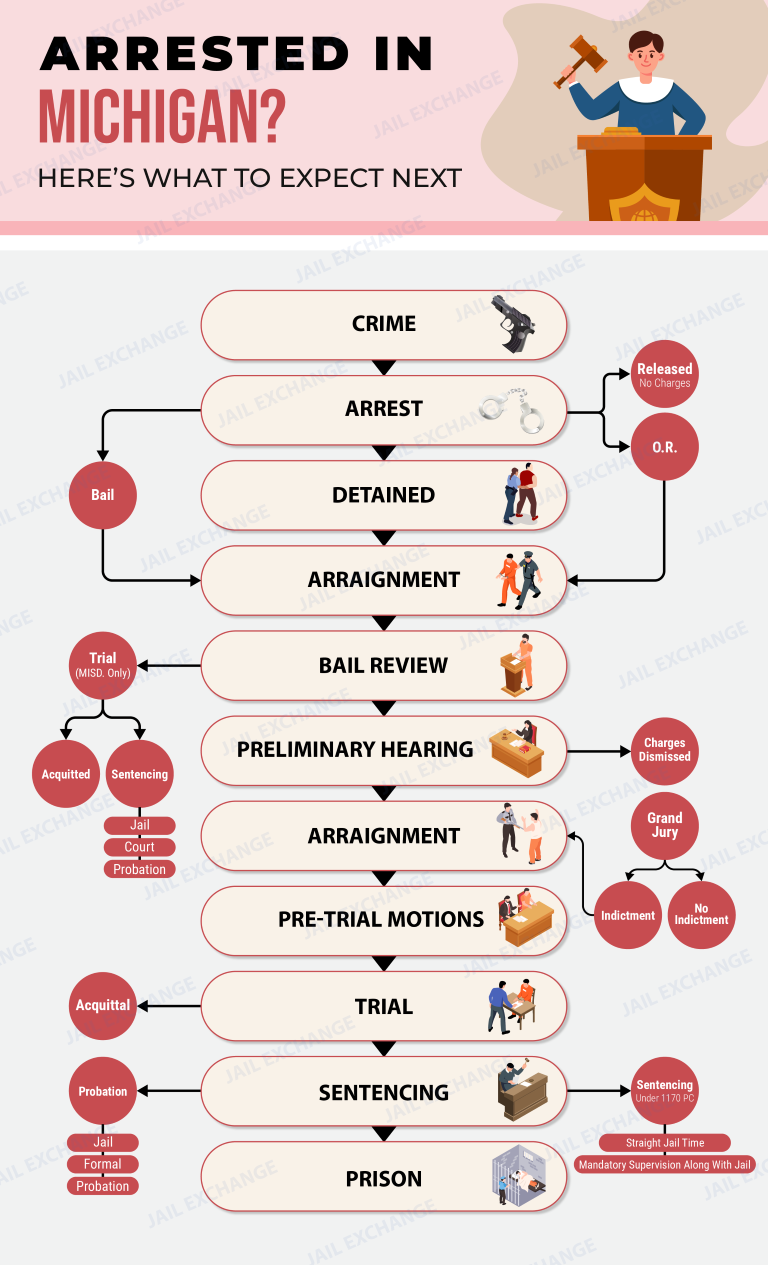
Express Account (TIGGS) Commissary Ordering
Provider: Express Account / The Inmate Goods & Gifts Solution (TIGGS)
Express Account Commissary Ordering enables family members to purchase pre-approved snack boxes, meat and cheese selections, hygiene bundles, and seasonal gift care packages sent directly to an incarcerated loved one. Each package is packed to meet institutional security guidelines, ensuring orders are approved upon arrival at the facility.
Important: Package Deadlines and Delivery Windows Vary
Detention centers do not all follow identical package distribution schedules. Some facilities allow weekly orders while others restrict shipments to bi-weekly or monthly windows, and spending limits differ widely across institutions. You should confirm the facility's active cutoff schedule and order allowances by calling them directly. If an order is placed after the weekly processing deadline, it will be held until the following distribution cycle, leaving your loved one waiting an extra cycle for fresh supplies.
Step-by-Step Instructions to Place a Package Order
- Obtain the inmate's legal first and last name, date of birth, and assigned booking identification number.
- Go to www.expressaccount.com.
- Select Send a Gift or Order Packages.
- Choose the state and facility where the inmate is currently housed.
- Search for the inmate to unlock the facility's authorized product catalog.
- Select pre-approved snacks, beverages, hygiene kits, and clothing items up to the jail's allowed spending limit.
- Enter your billing address and complete checkout with a credit or debit card.
- Save your confirmation receipt and package tracking number for your records.
What the Inmate Needs to Do
The inmate does not need an active online account to receive care packages. TIGGS packages the order in tamper-evident security boxes and delivers it directly to the facility commissary department. Jail officers inspect the shipment and deliver the items during regular housing unit commissary delivery, where the inmate signs for receipt.
Official Provider: Express Account Official Website
Customer Service Telephone: 1-866-422-6833
Support Hours: Monday – Friday, 8:00 AM – 5:00 PM CST
Supported Languages: English and Spanish
Other Services Provided by Express Account (TIGGS)
In addition to Commissary Package Ordering, Express Account handles inmate trust and canteen money transfers:
- Inmate Trust Money Deposits: Deposit funds directly into an inmate's personal account for independent canteen shopping.
• Learn more on our website: Inmate Trust Deposits Guide | • Visit official vendor page: Express Account Trust Deposits
Buy Commissary for an Inmate in the Osceola County Jail
Osceola County Jail Inmate Commissary - Sending Money or Purchasing Commissary for an Inmate
Osceola County Jail allows inmates to purchase commissary. This can be snacks, hygiene products, stamps, stationary, clothing and even electronics.
You can buy commissary for an inmate using an online service called Express Account.

There is a monthly limit of $200-300 on how much inmates can spend on commissary items.
This amount is subject to change so call the facility at 231-832-2288 in order to confirm the amount that cannot be exceeded.
Inmates have access to both an in-house commissary store, and commissary packages that can be purchased and shipped to the inmate by friends and family.
Scroll down for information on the Osceola County Jail's service they use for you being able to purchase commissary items online and have them shipped directly to the inmate.
You can also go to our Inmate Money page for information on how to send money to an inmate.
Express Account (TIGGS) Inmate Trust Deposits
Provider: Express Account / The Inmate Goods & Gifts Solution (TIGGS)Express Account (operated by TIGGS) provides a secure online payment portal allowing family and friends to deposit funds directly into an incarcerated person's jail trust and canteen account using a debit or credit card. Deposited money gives inmates the financial balance required to independently buy food items, hygiene supplies, writing materials, and over-the-counter medication from the facility store.
Important: Facility Banking Rules Differ Across Jails
Once a person is booked and moved to a cell, facilities do not always allow cash drop-offs or phone payments directly to the jail window. Some might and you should confirm this by calling the facility and asking. But if you do not register online and fund your loved one's trust account immediately, they may be forced to wait days or weeks for standard paper processing, leaving them without essential soap, clean undergarments, basic medical sundries or snacks.
Step-by-Step Instructions to Register and Deposit Funds
- Confirm the inmate's legal first and last name, date of birth, and assigned facility booking ID number.
- Navigate to www.expressaccount.com on your computer or mobile browser.
- Click on Send Money or Make a Deposit.
- Select the state and the detention center where your loved one is currently detained.
- Search for the inmate to confirm their active housing record and verify their identity matches the facility roster.
- Choose your deposit amount, review the card processing and convenience fees, and enter your debit or credit card billing information.
- Authorize payment and save the digital receipt and transaction authorization number for your financial records.
What the Inmate Needs to Do
The inmate does not need an internet connection to receive trust funds. Once the electronic payment clears, the funds post directly to their ledger balance in the jail's internal commissary management system. The inmate can verify their balance at a housing pod kiosk or on their weekly trust statement to place orders during the next scheduled commissary cycle.
Official Provider: Express Account Official Website
Customer Service Telephone: 1-866-422-6833
Support Hours: Monday – Friday, 8:00 AM – 5:00 PM CST
Supported Languages: English and Spanish
Other Services Provided by Express Account (TIGGS)
In addition to Inmate Trust Deposits, Express Account provides direct care package delivery services at participating facilities:
- Commissary & Gift Package Ordering: Order pre-approved snack boxes, food packages, and personal care essentials delivered directly to the jail.
• Learn more on our website: Commissary Ordering Guide | • Visit official vendor page: Express Account Package Orders
Deposit Money for an Inmate in the Osceola County Jail
The Easiest and Securest Way of Depositing Money for an Inmate
There are several methods for depositing money on an inmate's account:
1. To send money online to an inmate in the Osceola County Jail use Express Account.
2. If you prefer to use your credit or debit card and deposit money over the phone, you can call them at 866-422-6833.
3. Deposit cash or use a debit or credit card using a dedicated kiosk for this purpose. The machine is located in the lobby or visitation area of the Osceola County Jail.
4. The Osceola County Jail may also allow you to *mail an inmate a money order or cashier’s check from a trusted source such as the Post Office, a local bank, or Western Union. The money order should be be made out to either the inmate or the Osceola County Sheriff's Office, with the inmate’s name and ID# on the memo line of the check. To confirm this option call the facility at 231-832-2288.
*When mailing a money order or cashier’s check, send it an envelope by itself. Never send it with a letter or photos for your inmate, unless the facility allows it. Never send personal checks or cash.
5. The Osceola County Jail has a reception desk that may accept cash, money orders or cashier checks. Call 231-832-2288 to find out the specific hours for drop off times.
The Osceola County Sheriff's Office runs the Osceola County Jail in Reed City. Letters in envelopes are accepted, and the same address handles personal mail, lawyer mail and anything a publisher ships. Staff inspect all mail for contraband, and mail goes out to inmates Monday through Friday with no limit on how much they get.
Mail of every kind:
Inmate's Full Name & Inmate ID#
Osceola County Jail
325 W. Upton
Reed City, MI 49677
- Your address on the outside: Your name and full mailing address belong in the upper left corner of the envelope; a letter missing them is usually destroyed.
- Pen color: Letters to Reed City should be written in blue or black ink.
- Keep it clean: No drawings, felt markers, crayons, colored ink, lipstick or perfume, and nothing like glitter or confetti tucked inside.
- Greeting cards: Plain cards only. Musical ones are refused.
- Books, magazines and newspapers: New, mailed directly by the publisher, and never hardcover. Magazines with profanity, weapons or adult content are taken, and obscene or very violent books are thrown away.
- Packages: A box can be sent only by the company the jail uses for commissary.
- Stamps: Don't send them. Inmates buy their own from commissary.
- Money: Money for commissary is added online, not tucked into a letter as cash.
- Limits on who writes: Co-defendants, people in any jail or prison, and anyone with a no-contact order may not write.
- Contraband: Illegal items go to the Sheriff or prosecutor, and the sender may be charged.
Jail phone: 231-832-2288.
ICSolutions provides secure inmate telecommunications systems that allow incarcerated individuals to place outbound telephone calls from housing pods to friends and family. Because correctional facilities do not accept incoming calls, establishing an AdvancePay prepaid account links funds directly to your 10-digit phone number so calls connect without carrier restrictions.
Important: Wireless Carriers Restrict Inmate Calls by Default
Major mobile cellular carriers do not permit traditional collect calls originating from correctional facilities. While some landlines might support direct monthly billing, mobile devices and internet-based telephone numbers require an active prepaid balance or funded debit account, which you can verify by checking with your provider. If you do not register online and fund an account right away, incoming calls from your loved one will automatically fail to ring through to your phone.
Step-by-Step Instructions to Register and Fund an Account
- Visit www.icsolutions.com or call customer support at 1-888-506-8407.
- Click Create an Account and register using your primary 10-digit telephone number and email address.
- Select the state and facility where the inmate is currently detained.
- Link the inmate to your profile using their full legal name and booking ID number.
- Select Prepaid Collect to link funds to your phone number, or choose Debit Telephone to provide the inmate funds to call any approved number.
- Select your deposit amount and complete payment using a credit or debit card.
- Check your mobile phone settings to ensure unknown or automated numbers are not routed directly to spam.
What the Inmate Needs to Do
The inmate dials your 10-digit number from any dayroom phone and enters their assigned PIN. The automated system verifies that your phone number has an active prepaid balance and prompts you to accept the call. All non-privileged conversations are recorded and monitored by the facility.
Official Provider: ICSolutions Official Website
Customer Service Telephone: 1-888-506-8407
Support Hours: 24 hours a day, 7 days a week, 365 days a year
Supported Languages: English and Spanish
Other Services Provided by ICSolutions
In addition to AdvancePay Prepaid Calling Accounts, ICSolutions provides voicemail and video visitation services at participating facilities:
- Inmate Voicemail Services: Leave one-way voice messages that your loved one can listen to on dayroom phones.
• Learn more on our website: Inmate Voicemail Guide | • Visit official vendor page: ICSolutions Voicemail - Remote Video Visitation: Schedule and join live video visits from home using your computer or smartphone.
• Learn more on our website: Video Visitation Guide | • Visit official vendor page: ICSolutions Video Visits - Access Secure Deposits (Partner Trust Transfers): Deposit trust money into an inmate's account via Keefe Group partner networks.
• Learn more on our website: Inmate Trust Deposits Guide | • Visit official vendor page: Access Corrections Trust Deposits
ICSolutions Inmate Voicemail allows family members and approved contacts to leave a private, recorded voice message for an incarcerated individual. Because outside callers cannot phone an inmate directly, this one-way voice messaging feature ensures critical family updates and legal news reach your loved one even when you cannot be near your telephone to answer live calls.
Important: Voicemail Feature Availability Varies by Facility
Inmate voicemail is not enabled at every correctional facility contracted with ICSolutions. Jails determine whether to offer voicemail services based on local security protocols and monitoring capabilities, which you should confirm with the facility directly. If your loved one's detention center does not support voicemail, you must set up an AdvancePay calling account so they can reach you directly during dayroom phone hours.
Step-by-Step Instructions to Leave an Inmate Voicemail
- Log into your existing profile at www.icsolutions.com or dial 1-888-506-8407.
- Confirm that your loved one's detention facility supports the voicemail feature.
- Dial the facility's dedicated ICSolutions voicemail access telephone number provided on your dashboard.
- Follow the automated voice prompts and enter the inmate's booking identification number.
- Record your personal voice message (typically up to 3 minutes in length).
- Accept the call charges using funds from your prepaid account balance or a credit card.
What the Inmate Needs to Do
When the inmate logs onto any housing unit telephone using their assigned PIN, the automated system notifies them that a new voicemail is waiting in their queue. The inmate follows the audio prompts to play the recording. All messages are subject to monitoring and recording by correctional staff.
Official Provider: ICSolutions Official Website
Customer Service Telephone: 1-888-506-8407
Support Hours: 24 hours a day, 7 days a week, 365 days a year
Supported Languages: English and Spanish
Other Services Provided by ICSolutions
In addition to Inmate Voicemail Services, ICSolutions operates live calling and video visitation options:
- AdvancePay Prepaid Calling Accounts: Prepay for phone calling minutes so your loved one can call your telephone directly.
• Learn more on our website: AdvancePay Calling Guide | • Visit official vendor page: ICSolutions Prepaid Calling - Remote Video Visitation: Schedule and join live video visits from home using your computer or smartphone.
• Learn more on our website: Video Visitation Guide | • Visit official vendor page: ICSolutions Video Visits - Access Secure Deposits (Partner Trust Transfers): Deposit trust money into an inmate's account via Keefe Group partner networks.
• Learn more on our website: Inmate Trust Deposits Guide | • Visit official vendor page: Access Corrections Trust Deposits
eXpress Account Resident Messaging provides an electronic correspondence channel connecting families with incarcerated loved ones. Outside contacts can compose digital messages online, which are either routed straight to housing-unit interactive kiosks for on-screen reading or printed and distributed directly to the resident by facility staff.
Important: Electronic Mail Delivery Format Varies by Jail
Inmates cannot receive incoming telephone calls, and traditional postal mail rules differ across correctional agencies. While some facilities display electronic messages directly on pod kiosks, other institutions print electronic submissions and deliver them during paper mail call. You should verify the facility's message delivery format by calling them directly. If you do not register online and set up message credits, your loved one may face lengthy periods without direct written communication from family.
Step-by-Step Instructions to Register and Send Messages
- Visit expressaccount.com and sign in or create a free profile.
- Verify your email address and primary telephone number.
- Select Messaging from your account options.
- Select the state, correctional facility, and search for the resident using their legal name or booking ID.
- Purchase messaging credits using a debit or credit card.
- Type your message into the text editor, review facility communication terms, and submit it for facility screening.
What the Inmate Needs to Do
All incoming transmissions are subject to review by jail administration. Once cleared, the message is either made available in the resident's inbox at a dayroom kiosk terminal where they log in with their PIN, or facility officers print the message and hand-deliver it during daily mail rounds.
Official Provider: eXpress Account Official Website
Customer Service Telephone: 1-866-422-6833
Support Hours: Monday – Friday, 8:00 AM – 4:00 PM EST
Supported Languages: English and Spanish
Other Services Provided by eXpress Account
In addition to Resident Messaging, eXpress Account provides trust banking, bail, and care package services:
- Inmate Trust Money Deposits: Send canteen funds directly into an incarcerated person's jail trust account.
• Learn more on our website: Inmate Trust Deposits Guide | • Visit official vendor page: eXpress Account Trust Deposits - Commissary & Gift Package Ordering: Order pre-approved snack boxes, food packages, and clothing delivered directly to the jail.
• Learn more on our website: Commissary Ordering Guide | • Visit official vendor page: eXpress Account Store Packages - Cash Bail & Bond Deposits: Post bond funds online 24/7 to assist in securing a resident's release.
• Learn more on our website: Cash Bail & Bond Guide | • Visit official vendor page: eXpress Account Bail Deposits

ICSolutions provides secure, corrections-grade handheld tablets designed for prison and jail living units. Through these handheld devices, incarcerated individuals can communicate with family via digital messaging and video calls, stream approved music, play games, read eBooks, and access institutional legal research databases without leaving their bunks.
Important: Tablet Hardware Deployment and Rental Rules Vary
Detention centers do not manage tablet distribution identically. While some agencies issue individual personal tablets to every detainee at booking, others utilize shared pod docking stations or restrict tablet use to specific dayroom hours, which you should confirm with the facility directly. Although core educational and legal resources are generally provided free of charge, sending messages, listening to music, or making phone calls from the tablet requires an active balance funded by outside contacts.
Step-by-Step Instructions to Fund ICSolutions Tablet Services
- Verify that ICSolutions tablets are deployed at the inmate's current detention center.
- Navigate to www.icsolutions.com and sign into your user profile.
- Select Debit Telephone or Inmate Media Account depending on your facility's funding categories.
- Link the inmate to your account by entering their full legal name or facility inmate ID.
- Select your deposit amount, review convenience fees, and enter your credit or debit card details.
- Submit payment, save your receipt, and notify your loved one that funds have been added.
What the Inmate Needs to Do
The inmate unlocks their assigned tablet using their unique facility PIN. Once logged on, they can open the media store to purchase songs, read digital books, write messages, or initiate phone calls using available credits. Tablets are plugged into secure housing docking carts nightly for charging and administrative monitoring.
Official Provider: ICSolutions Official Website
Customer Service Telephone: 1-888-506-8407
Support Hours: 24 hours a day, 7 days a week, 365 days a year
Supported Languages: English and Spanish
Other Services Provided by ICSolutions
In addition to Tablet Programs, ICSolutions manages several communication, financial, and visitation services:
- Inmate Messaging & Digital Mail: Send electronic messages and photos directly to an inmate's tablet or pod terminal.
• Learn more on our website: Digital Messaging Guide | • Visit official vendor page: ICSolutions Messaging - Prepaid Phone Calling Accounts: Fund calling minutes so your loved one can call your telephone directly.
• Learn more on our website: Phone Calling Guide | • Visit official vendor page: ICSolutions Phone Calling - Remote Video Visitation: Schedule and join live video visits from home using your computer or smartphone.
• Learn more on our website: Video Visitation Guide | • Visit official vendor page: ICSolutions Video Visits
- Jail (Main): 231-832-2288
- Sheriff: 231-832-2288
The Osceola County Jail serves the following cities and towns of Osceola County: Burdell, Cedar, Evart, Hersey, Highland, Le Roy, Lincoln, Hartwick, Marion, Osceola, Richmond, Rose Lake, Sherman, Sylvan, Tustin, Orient and Burdell.