
Dakota County Jail
Dakota County Jail
Jail Phone Number
651-438-4800Dakota County Inmate Search: Locating Someone Held in Hastings
Police officers, deputies and state troopers across the county bring the adults they keep in custody to the Dakota County Jail. It sits within the Law Enforcement Center, 1580 Highway 55, Hastings, MN 55033. The Sheriff's Office runs this 263-bed building as the county's lone adult jail. Read on to track down a loved one, reach them, fund their account, send letters and follow the case.
Put a last name, a first name or both into the Sheriff's jail inmate search. Results include just the people in custody at this moment, so a recent arrest followed by a quick release won't appear. A court date box lets you check who is due before a judge. The Sheriff's Office calls its listings and court times estimates, so use each one as a lead.
Ring Jail Information at 651-438-4800 whenever a listing leaves you unsure. Before dialing, gather the legal name plus the birth date. Then ask staff to walk you through each charge, the bail terms and when court comes next. Payment steps sit in our bail guide, and hearings in Hastings, Apple Valley and West St. Paul are mapped out in our court guide.
Read inmate search answers
 Read inmate search answers
1. How does Dakota County's custody search work?
The form loads fine on a phone. Here is the quickest route through it:
- Pull up the Sheriff's in-custody search.
- Fill in the surname. A first name helps when the surname is a common one.
- Skip the date fields for the broadest results, or set a "date posted" window to trim a long list.
- Curious who is on a particular day's court calendar? Use the court date field.
- Open the matching entry and copy down its details, like the hearing time, so you have them handy.
Some people hand deputies a false name at booking. The Sheriff's Office notes that only fingerprints settle a person's identity, so a hit on the screen is a good sign rather than proof. Staff at 651-438-4800 can check it.
↑ Back to the question list2. No match on the Hastings list yet?
Here is why the list can come up empty:
- Intake is still underway. Deputies need time for fingerprints, a photo and paperwork. Wait a few hours, then try again.
- A citation ended it. On most misdemeanors, Minnesota officers write a ticket and release the person on the spot, unless safety or a court appearance calls for jail (Rule 6.01).
- The first hearing freed them. Plenty of people go home right after seeing a judge.
- A neighbor county booked them. Arrests in Minneapolis, St. Paul or nearby towns outside this county lead to that county's jail. A few people serving a local sentence are also boarded at outside facilities.
- The person is 17 or younger. Minors stay at a youth center that the adult search leaves out.
- The name was entered another way. Retry with a shorter first name, a middle name, or a surname used before marriage.
Jail Information, 651-438-4800, can sort out which one applies.
↑ Back to the question list3. Which jails might hold someone arrested here?
The county keeps one adult jail. Correctional deputies work inside its housing units 24 hours a day. This is called direct supervision, and it puts staff in the same rooms as the people held.
- Hastings jail, Law Enforcement Center, 1580 Highway 55, Hastings, MN 55033, 651-438-4800. Adults charged anywhere in the county wait here for court, and people with short local sentences serve them here.
- Outside boarding. A share of sentenced people are housed at other facilities. Ask the Sheriff's Office at 651-438-4700 where a person went.
To the north, two large urban jails take arrests from Minneapolis and St. Paul:
- Hennepin County Adult Detention Center, 401 South 4th Avenue, Suite 100, Minneapolis, MN 55415, 612-348-5112. People awaiting trial stay here.
- Ramsey County Adult Detention Center, 425 Grove Street, Saint Paul, MN 55101, 651-266-9350. Its 500 beds hold people from arrest until a court rules on the case.
4. Are Dakota County mugshots public?
In most cases, yes. Booking photos count as open records under the state data practices law (Minn. Stat. 13.82, subd. 26). The agency can delay its release when sharing it would harm an active investigation. The charge, custody status and release are public arrest data as well (subd. 2).
Mugshots come from whichever agency did the arrest. If deputies made it, reach the Sheriff's Office at 651-438-4700. If city officers made it, ask that city's police department.
- ICE handles requests for immigration booking photos on its FOIA records page.
- Federal agencies usually keep their booking pictures private, though the U.S. Marshals Service may release one, for example of a fugitive.
5. Will VINE warn me when they leave Hastings?
It can. Minnesota VINE is operated by the Minnesota Department of Public Safety and tracks custody at county jails. It reports a release or a transfer.
- Enrollment happens on VINELink or by phone at 877-664-8463, and no alert goes out before that.
- VINE ends its coverage once someone enters state prison. From then on, the Department of Corrections handles notices through Minnesota Haven.
- When a jail sentence is nearly done, keep checking with the jail at 651-438-4800 for the release time, which is most often close to 5 a.m.
6. What sets bail after a Dakota County arrest?
Anyone jailed after an arrest without a warrant goes before a District Court judge within 36 hours, not counting the arrest day, Sundays or legal holidays (Minn. R. Crim. P. 4.02). Ask court staff where that hearing will be. The main courthouse is the Judicial Center, 1560 Highway 55, Hastings, MN 55033, 651-377-7180.
Judges in Minnesota first consider letting the person go on their word to return. Conditions get added only as far as safety or a return to court requires. A bail figure with no strings must be named too, which is why orders often list two numbers, a smaller one tied to rules and a bigger one without them (Rule 6.02).
- Business hours: cash bail goes to the District Court counter at the Judicial Center, 8 a.m. to 4:30 p.m. on weekdays, holidays excepted.
- Evenings, weekends, holidays: pay at the jail lobby window in the Law Enforcement Center, 1580 Highway 55, Hastings, MN 55033, in cash and in the exact sum.
- Bonding agents: each one needs a state Commerce Department license plus sign-off from the state court bail bond program. Their fee starts at $100 and is never returned (Minn. Stat. 60M.02).
- Refunds: cash bail belongs to the accused person by law, no matter who paid it. Before handing it back, a judge can apply it to fines or restitution (Minn. Stat. 629.53).
- Booking charge: $25 for each booking (Minn. Stat. 641.12), paid back if all charges are dismissed, the person is acquitted or nothing is filed.
Our Hastings bail walkthrough goes deeper, and a short overview of Minnesota bail law sums up the state rules.
↑ Back to the question list7. Where do filed charges show up online?
Filed cases appear on Minnesota Court Records Online (MCRO), which costs nothing. Enter the person's name in the MCRO case lookup. Certain juvenile files stay hidden.
Minnesota sorts offenses into four tiers:
- Petty misdemeanor: no jail, and a fine capped at $300.
- Misdemeanor: a 90-day jail cap and a fine capped at $1,000.
- Gross misdemeanor: up to 364 days in jail, a $3,000 fine, or both.
- Felony: the top tier, where a prison term of a year or more is possible (Minn. Stat. 609.02).
The court's criminal and traffic desk answers charge questions at 651-377-7188. Felony complaints come from the County Attorney's Office at the Judicial Center, 1560 Highway 55, Hastings, MN 55033, 651-438-4438. City prosecutors generally file the smaller cases from their own towns.
↑ Back to the question list8. Who gets a public defender in Dakota County?
Minnesota gives a public defender to people who can't pay for counsel if they face a felony, a gross misdemeanor, or any misdemeanor that carries possible jail time (Minn. Stat. 611.14). The court decides after looking at a financial statement. People who receive income-based public benefits are presumed unable to pay (Minn. Stat. 611.17).
- Make the request at the first appearance.
- Appointments here go to the Public Defender for the First Judicial District, 919 Vermillion Street, Suite 200, Hastings, MN 55033, 651-480-0122.
- Paying for a private attorney instead is an option at any stage.
Attorneys get face-to-face access to clients inside the jail. A lockdown or emergency can slow that down.
↑ Back to the question list9. When are video visits at the Law Enforcement Center?
Every public visit happens on a screen. Use the public kiosks at the Law Enforcement Center, 1580 Highway 55, Hastings, MN 55033, any day of the week, or connect from home through Inmate Canteen, the vendor the jail names.
- Daily windows: 7:30 to 9:45 a.m., 3:00 to 4:45 p.m., and 7:00 to 9:45 p.m. No visit may start once a window closes.
- Time limit: 20 minutes per visit.
- Who can come: adults, plus minors who arrive with an adult.
- ID: carry a driver's license or state photo ID in case staff ask.
- Rules: leave food and drinks behind, dress modestly, and come sober. Anyone carrying a gun, explosives, alcohol or drugs is arrested.
- Monitoring: staff may watch or record any visit.
Lockdowns, court trips and programs can cancel a slot. Anyone held in segregation gets limited kiosk use. Our guide to jail video visits has tips, and the jail answers questions at 651-438-4800.
↑ Back to the question list10. How can family load money onto Inmate Canteen?
The balance buys stamped envelopes, snacks, soft drinks and daily needs. Families have three choices:
- Web deposit: charge a credit card at team3.inmatecanteen.com.
- Lobby kiosk: feed cash or a card into the machine at the Law Enforcement Center, 1580 Highway 55, Hastings, MN 55033. That lobby never closes.
- Postal money order: make it payable to the person held and send it to P.O. Box 247J, Hastings, MN 55033. Loose bills in an envelope are a bad idea, and the jail takes no blame for mail that goes missing.
Turnkey Corrections fixes deposit trouble at iccsupport@tkc32m.com or 715-952-9622. Step-by-step deposit help lives in our money guide, and our commissary explainer covers the store list.
↑ Back to the question list11. How are phone calls and texts paid for?
TKC Telecom and Inmate Canteen handle calls and messages at the Hastings jail. Open an Inmate Canteen account, then load money at team3.inmatecanteen.com. One balance covers text and email replies, video calls, and passes for movies and games.
- Email starts working after the account is set up.
- At-home video visits run on that same account.
- Questions about prices, limits or call recording go to Jail Information, 651-438-4800.
Save case details for the defense lawyer, because visits can be recorded. Browse our phone guide for jails and our guide to texting and email with inmates.
↑ Back to the question list12. What mailing address does the Dakota County jail use?
Letters for someone held there go to this box:
(Person's full name)
Dakota County Law Enforcement Center
P.O. Box 247J
Hastings, MN 55033
- The jail's format uses the name alone, so match the spelling used at booking.
- Newspapers, magazines and books are refused. Banned items either come back to the sender or get stored with the person's belongings.
- The jail already supplies reading books, writing paper, soap and similar hygiene goods, uniforms and shoes, so skip mailing those.
- Check with Jail Information at 651-438-4800 before sending photos or greeting cards.
More pointers sit in our jail letters guide.
↑ Back to the question list13. Who may collect property after release?
Items left behind at release must be claimed within 90 days. The released person can get them, or a helper named on the property release form they signed at the jail.
- The helper shows personal ID at pickup.
- The jail is in the Law Enforcement Center, 1580 Highway 55, Hastings, MN 55033. Ask staff where pickups happen.
- Phone 651-438-4800 before driving over to be sure the form is in place.
14. Sick, hurt or missing medicine behind bars?
Contact Jail Information at 651-438-4800 and ask that the medical unit get the message. Describe the condition, the drug and the dose. Urge your loved one to alert a deputy too.
- Prescription medicine comes in only after the medical unit approves it, in a clean, correctly labeled pharmacy bottle.
- Eyeglasses and other needed health equipment need the same medical approval.
For a life-threatening emergency, dial 911. If you worry your loved one may hurt themselves, tell the jail that first when you phone.
↑ Back to the question list15. Is there a Dakota County warrant out?
Curious whether a warrant exists? Phone the Sheriff's Office, 651-438-4700. Look up a surname, first name or date of birth on the Sheriff's warrant lookup. Anyone who broke supervised release may be on the Department of Corrections Wanted Fugitives list. MCRO lists cases, not warrants. To resolve one, speak with a lawyer, then call court administration at the Judicial Center, 1560 Highway 55, Hastings, MN 55033, 651-377-7188. The court lets people with a bench warrant turn themselves in at 6 a.m. on weekdays at the Law Enforcement Center, 1580 Highway 55, Hastings, MN 55033.
↑ Back to the question list16. Where are hearing dates listed?
Upcoming hearings by name show on the MCRO hearing lookup. The jail search lists court times too, which the Sheriff's Office labels estimates. Our court walkthrough follows a case from start to finish.
The District Court works from three buildings, each staffed 8 a.m. to 4:30 p.m. on weekdays apart from holidays:
- Judicial Center, 1560 Highway 55, Hastings, MN 55033, 651-377-7180
- Western Service Center, 14955 Galaxie Ave. West, Apple Valley, MN 55124, 952-247-7099
- Northern Service Center, 1 West Mendota Rd., Ste. 140, West St. Paul, MN 55118, 651-377-7190
Criminal and juvenile hearing times are given out at 651-377-7188.
↑ Back to the question list17. Arrested by federal agents near the Twin Cities?
The U.S. District Court for the District of Minnesota hears every federal criminal case in the state. The nearest of its four courthouses stands at 316 North Robert Street, St. Paul, MN 55101, and the clerk's line is 612-664-5000.
- Pretrial custody gets decided by a federal judge during a detention hearing (18 U.S.C. 3142).
- Federal defendants kept locked up are in U.S. Marshals Service custody. Its district office is at 300 South 4th Street, Suite 402, Minneapolis, MN 55415, 612-664-5900, and staff can say where someone is housed.
- Large numbers of federal detainees are kept at the Sherburne County Jail in Elk River. That Sheriff's Office sits at 13880 Business Center Drive NW, Suite 100, Elk River, MN 55330, 763-765-3500.
- Post-sentencing, the BOP inmate locator names the federal prison where they were sent.
18. What does an ICE detainer change?
When immigration officers want someone held in Hastings, expect these steps:
- First, ICE sends Hastings deputies its detainer paperwork, Form I-247A.
- Federal rules allow the detainer to request that the person stay up to 48 hours after they would otherwise be released (8 CFR 287.7(d)).
- On February 6, 2025, Minnesota's Attorney General issued an opinion on this. It reads state law to forbid a jail from holding anyone past their release time when an ICE detainer is the only reason.
- ICE's St. Paul Field Office directs any case it takes over: 1 Federal Drive, Suite 1601, Fort Snelling, MN 55111, 612-843-8600.
- Type an A-number into the ICE Online Detainee Locator. Without an A-number, pair the full name with the person's birth country.
19. Where do felony prison sentences lead?
People sent to prison serve that time with the Minnesota Department of Corrections. Until transport, they remain in the Hastings jail. Deputies then drive them to state intake for processing and evaluation.
- Search the state's DOC Offender Locator with the full name. Someone just transferred might not appear for several business days.
- Supervised release in the community typically covers the last third of a prison term.
- Our Minnesota prisons directory lists visiting hours and mail rules prison by prison.
20. What happens to a teen held in Dakota County?
A person counts as a child in Minnesota until turning 18 (Minn. Stat. 260B.007). Their cases go before a juvenile judge in District Court. Officers normally hand a child back to a parent. The exceptions are a child who poses a danger or seems unlikely to come back for court (Minn. Stat. 260B.176).
- Youth who are kept go to the Juvenile Services Center, 1600 Highway 55, Hastings, MN 55033, 651-438-8399. Alternative number: 651-438-4970.
- Secure detention past 36 hours needs a filed petition and a judge's order. Weekends and holidays don't count toward the 36.
- Inside the metro area, an adult jail can hold a child for 6 hours at most, unless a petition gets filed and a judge allows more.
- Teens aged 14 to 17 with a serious charge may face adult court. A judge can also use a blend of youth and adult rules, called EJJ.
21. Which agencies bring arrests to the Hastings jail?
The county is home to about 462,169 people according to the Minnesota State Demographic Center's estimate for April 1, 2025. These agencies book arrests into the Law Enforcement Center:
- Sheriff's Office, Law Enforcement Center, 1580 Highway 55, Hastings, MN 55033, 651-438-4700. For an address not covered by a city force below, ask which agency responded.
- City police: Apple Valley, Burnsville, Eagan, Farmington, Hastings, Inver Grove Heights, Lakeville, Mendota Heights, Rosemount, South St. Paul and West St. Paul.
- Non-emergency dispatch for all of them: Dakota 911 takes these calls at 651-322-2323. Alternative number: 952-322-2323.
- Minnesota State Patrol, headquarters, 445 Minnesota Street, Suite 130, St. Paul, MN 55101, 651-201-7100. Troopers cover state highways and interstates.
Dakota County bail and bond: the Hastings jail, court windows and weekend payment
Dakota County books arrested adults into the Dakota County Jail, sitting in the Law Enforcement Center at 1580 Highway 55, Hastings, MN 55033. A judge picks the release terms, and the jail follows them. The steps below show how it all fits together.
First check the official jail search for the person's name. For custody lists, charges, property pickup and public defenders, see our Dakota County Inmate Search guide page.
Next, ring the jail on 651-438-4800 and ask if bail is set. For court dates, our court page is the place to look.
1. Is my person in the Hastings jail yet?
Type the name into Dakota County Inmate Search. A booking only minutes old may not appear, so check again later. If the search cannot answer your question, the jail information line is 651-438-4800. The Sheriff's Office main line is 651-438-4700.
↑ Back to the question list2. Where do I find the bail amount on a Dakota County warrant?
The county says its Warrant Search page shows the bail on the record. If the record says "Body Only," no bail was set, and the person must be arrested and held until a court review. For someone already booked, look at Dakota County Inmate Search first, then call 651-438-4800.
↑ Back to the question list3. Can I pay bail at a court window instead of the jail?
Yes, on weekdays. The county's bail page names District Court at the Judicial Center, 1560 Highway 55 in Hastings. It takes cash bail from 8 a.m. to 4:30 p.m., Monday to Friday, and is closed on holidays. The court window accepts cash and bonds from bonding agents. It cannot take cards or other electronic payments.
If a warrant allows bail, paying at a window can keep the person from being booked. Anyone may pay for the defendant. The warrant is then turned off and a new court date is set.
↑ Back to the question list4. What if it is evening, a weekend or a holiday?
Go to the jail lobby at the Law Enforcement Center. The county says bail is taken there after 4:30 p.m. and on weekends and holidays. It must be cash in the exact amount. The lobby kiosk the county lists is for putting money on an inmate's account. Call 651-438-4800 first so staff can confirm the amount and the case.
↑ Back to the question list5. Will Dakota County take bail for a warrant from another county?
Only in one case. The county says it accepts bail on an out-of-county warrant at the jail only when that person is already in custody in the Dakota County Jail. If your relative is held somewhere else, pay in the county that holds the person.
↑ Back to the question list6. Where are the Dakota County courthouses?
The Judicial Center is at 1560 Highway 55, Hastings, 651-377-7180. The Northern Service Center is at 1 West Mendota Road, Suite 140, West St. Paul, 651-377-7190. The Western Service Center is at 14955 Galaxie Avenue, Apple Valley, 952-247-7099. Ask which location holds the first hearing.
↑ Back to the question list7. How long can Dakota County hold someone before they see a judge?
Under Minnesota Rule of Criminal Procedure 4.02, a person arrested without a warrant must see a judge within 36 hours. That count leaves out the day of arrest, Sundays and legal holidays. Saturdays do count. A separate rule requires a judge to find probable cause within 48 hours, weekends included.
A misdemeanor suspect who misses the 36-hour mark must be released on a citation.
↑ Back to the question list8. Is there a fee just for being booked?
Dakota County charges $25 per booking under Minnesota Statutes 641.12. The county's refund form says the fee is returned if all charges are dismissed, the person is acquitted, or no formal charge is filed. Ask the jail at 651-438-4800 how to request the refund form.
↑ Back to the question list9. What will a bail bond agent want from my family?
Use an agent licensed by the Minnesota Department of Commerce and approved by the state court system. Chapter 60M requires the agent to charge the rate the surety filed with the state, with a minimum premium of $100. Agents may not hand out rebates.
Ask for the premium, any collateral and the receipt in writing. Collateral should be logged and returned within 21 days after you show proof the case ended. Agents may not solicit inside a jail.
↑ Back to the question list10. What happens to cash bail when the case ends?
Cash bail legally belongs to the defendant, even if a relative paid it (Minnesota Statutes 629.53). The court holds it until the case is finished. A judge may apply it to a fine or restitution, and the balance goes back.
A Dakota County bench order says leftover cash goes first to the case it was posted on, then to any other Dakota County case with a balance, then to the defendant or whoever the defendant names in writing.
↑ Back to the question list11. Which free lawyer handles Dakota County cases?
A court appoints a public defender if the person cannot afford a lawyer. Ask for one at the first hearing, or apply online through the Minnesota Judicial Branch. You cannot choose the lawyer. The Hastings court office at 651-377-7180 can tell you how the local public defender office is reached.
↑ Back to the question list12. What if the arrested person is a teenager?
Dakota County runs the Dakota County Juvenile Services Center in Hastings, a 40-bed center. The county says it serves youth found responsible for delinquent offenses, from Dakota and several nearby counties. To reach a youth housed there, call 651-438-4970. For general questions, Community Corrections answers at 651-438-8399. Juvenile records are private, so the adult search will not list the child.
↑ Back to the question list13. Why would bail be blocked or limited?
Minnesota has no death penalty, so every adult is bailable under the state constitution. Even so, a judge can attach conditions or set money bail if release would endanger public safety or fail to assure a return to court (Rule 6.02). A probation hold or a warrant from another place can also keep a person in.
For a defendant with three or more drunk-driving convictions in ten years, the statute requires the highest bail unless alcohol-monitoring conditions are ordered.
↑ Back to the question list14. How can I tell a real bail call from a scam?
No court or jail takes gift cards or payments to a private person. Look up the numbers yourself: the jail at 651-438-4800 or the Judicial Center at 651-377-7180. Hang up on anyone who rushes you.
↑ Back to the question list15. What should I bring to the Hastings windows?
Bring photo ID, the person's full legal name, birth date and the case or warrant number. Cash must match the bail exactly. Check that the court office is open before you leave. The Hastings Judicial Center answers at 651-377-7180.
↑ Back to the question listDakota County bail contacts
- Jail: Dakota County Jail, Law Enforcement Center, 1580 Highway 55, Hastings, MN 55033; 651-438-4800; see the jail page
- Bond guide: Dakota County bail and bond help
- Custody lookup: Dakota County Inmate Search
- Sheriff: Sheriff's Office 651-438-4700
- Court: Judicial Center, 1560 Highway 55, Hastings, 651-377-7180; West St. Paul 651-377-7190; Apple Valley 952-247-7099
- Juvenile: Dakota County Juvenile Services Center, Hastings; 651-438-4970; Community Corrections 651-438-8399
Hours, fees and phone numbers on county pages change without notice, so confirm with the office before you travel or pay. This guide explains the process in plain words and does not replace a lawyer.

You can pay a cash bail for inmates charged for a crime in Dakota County at the District Court:
1560 Highway 55
Hastings, MN 55033
Bail payments can only be made Monday through Friday between 8 a.m. and 4:30 p.m., except for holidays.
For Dakota County charges, cash, and only in the exact amount, will be accepted at the jail lobby after 4:30 p.m. and on weekends and holidays.
Bail for 'out of county warrants' will only be accepted at the jail if the subject of the warrant is in custody in the Dakota County Jail.
You can also use a bail bonding agent. Search online for 'Dakota County Bail Bond Agent'.
If you have additional questions or need to know the exact amount needed to bail or bond an inmate, call 651-438-4800.
Dakota County Jail Inmate Visitation Schedule
1580 Highway 55
Hastings, MN 55033
651-438-4800
- First, you must register for visits online with Inmate Canteen.

- It is the inmate's responsibility to notify their visitors of the time they have selected.
- No phone calls from the public are accepted inquiring about the time an inmate has selected for visits.
- You must be on time for a visit, or NO visit. No exceptions.
- Visits are for 20 minutes.
- You have to be 18 to set up a visit. Valid, picture ID from the government is required. Minor children can visit with a parent or guardian, but may require a birth certificate.
- Dress profssionally, and non-seductively.. or NO visit will be allowed.
| DAY | TIMES |
| SUNDAY | 8:00AM - 11:00AM 1:00PM - 4:00PM 7:00PM - 9:00PM |
| MONDAY | 8:00AM - 11:00AM 1:00PM - 4:00PM 7:00PM - 9:00PM |
| TUESDAY | 8:00AM - 11:00AM 1:00PM - 4:00PM 7:00PM - 9:00PM |
| WEDNESDAY | 8:00AM - 11:00AM 1:00PM - 4:00PM 7:00PM - 9:00PM |
| THURSDAY | 8:00AM - 11:00AM 1:00PM - 4:00PM 7:00PM - 9:00PM |
| FRIDAY | 8:00AM - 11:00AM 1:00PM - 4:00PM 7:00PM - 9:00PM |
| SATURDAY | 8:00AM - 11:00AM 1:00PM - 4:00PM 7:00PM - 9:00PM |
Attorney Visits
8:00AM - 11:00AM
1:00PM - 4:00PM
7:00PM - 5:00AM

Inmate Canteen Video Visitation allows family members and approved contacts to hold scheduled, face-to-face video visits with incarcerated loved ones from home. Using a computer with a webcam or a mobile device, visitors can connect directly through housing-unit video kiosks without traveling to the correctional facility.
Important: Advance Visitor Clearance Required
Detention centers do not permit unscheduled or unverified video sessions. Correctional facilities require prospective visitors to submit government-issued photo identification and receive administrative clearance before booking an appointment, an approval process that can take up to 48 hours depending on facility staffing. You should verify your visitor approval status with the facility prior to scheduling. If you do not register well in advance, you will miss your loved one's scheduled visiting window for the week.
Step-by-Step Instructions to Register and Schedule a Video Visit
- Visit www.inmatecanteen.com and sign into your account.
- Register your visitor profile and upload a clear photograph of your government-issued ID (driver's license or passport) for facility background review.
- Wait for email notification confirming facility visitor approval.
- Select Video Visitation, choose the detention facility, and select the inmate.
- Browse the available schedule calendar, select an open time slot, and pay the visitation fee using a credit or debit card.
- Log into the website or app 10 minutes prior to the start time on a device with a functioning camera, microphone, and reliable high-speed internet connection.
What the Inmate Needs to Do
The inmate receives a visitation notification on their housing unit video kiosk. At the appointed time, they log in with their PIN and sit before the terminal. Inmates and visitors must strictly observe jail dress and conduct rules; sessions are monitored by staff and will terminate immediately upon any violation.
Official Provider: Inmate Canteen Official Website
Customer Service Telephone: 1-715-690-2965
Support Hours: Monday – Friday, 8:00 AM – 5:00 PM CST
Supported Languages: English and Spanish
Other Services Provided by Inmate Canteen (TurnKey Corrections)
In addition to Remote Video Visitation, Inmate Canteen provides several other communication, financial, and commissary services at participating correctional facilities:
- Commissary & Snack Packs: Order pre-approved snack boxes, food packages, and clothing directly to the jail.
• Learn more on our website: Commissary Orders Guide | • Visit official vendor page: Inmate Canteen Commissary - Digital Messaging & Chirp Texts: Send electronic messages and photos directly to housing pod kiosks and handheld devices.
• Learn more on our website: Digital Messaging Guide | • Visit official vendor page: Inmate Canteen Messaging - Trust & Phone Deposits: Deposit money directly into an inmate's jail trust account or phone calling balance.
• Learn more on our website: Trust & Phone Deposits Guide | • Visit official vendor page: Inmate Canteen Deposits
Dakota County Court Guide: Criminal Hearings in Hastings Explained
The main courthouse for Dakota County is the Judicial Center, 1560 Highway 55, Hastings, MN 55033, in the First Judicial District, with extra court locations in Apple Valley and West St. Paul. If an adult is not released after booking, they wait in the Dakota County Jail, 1580 Highway 55, Hastings, MN 55033.
Is your person still in custody? The official jail search can say. For more, our Inmate Lists page adds new arrests and active warrants.
Begin by phoning court administration, 651-377-7180, to learn which building hosts the hearing. If bail was already ordered, our bail page explains payment.
1. Dakota County court locations
Dakota County, the fast-growing suburban county south of St. Paul and Minneapolis, hears its criminal cases in the Dakota County District Court. The main courthouse is the Judicial Center on Highway 55 in Hastings, the county seat, and the court also sits at county service centers in Apple Valley and West St. Paul. The court is part of the First Judicial District, which also includes Carver, Goodhue, Le Sueur, McLeod, Scott and Sibley counties. The Dakota County Attorney prosecutes all felonies and juvenile cases, while Burnsville, Eagan, Lakeville, Apple Valley and the county's other cities generally use their own city prosecutors for misdemeanors. People arrested and held are booked into the Dakota County Jail at the Law Enforcement Center in Hastings, which the Sheriff runs.
- Dakota County District Court, Judicial Center (First Judicial District), 1560 Highway 55, Hastings, MN 55033, (651) 377-7180
- Dakota County District Court, Western Service Center, 14955 Galaxie Avenue West, Apple Valley, MN 55124, (952) 247-7099
- Dakota County District Court, Northern Service Center, 1 West Mendota Road, Suite 140, West St. Paul, MN 55118, (651) 377-7190
- Dakota County Attorney's Office, Judicial Center, 1560 Highway 55, Hastings, MN 55033, (651) 438-4438
- First Judicial District Public Defender (State Board of Public Defense), appointed counsel for eligible defendants in Dakota County; Dakota County clients can reach its Hastings office at 919 Vermillion Street, Suite 200, Hastings, MN 55033, (651) 480-0122
- Dakota County Sheriff's Office and Jail, Law Enforcement Center, 1580 Highway 55, Hastings, MN 55033, Sheriff's Office (651) 438-4700, jail information (651) 438-4800
- Dakota County Community Corrections (probation), Judicial Center, 1560 Highway 55, Hastings, MN 55033, (651) 438-8288
- Dakota County Juvenile Services Center, 1600 Highway 55, Hastings, MN 55033, (651) 438-8399
Which court hears your case. Minnesota has no municipal courts, so every criminal case in Dakota County, from a petty misdemeanor ticket in Rosemount to a felony assault charge in South St. Paul, belongs to the same Dakota County District Court. A case may be calendared at the Judicial Center in Hastings or at one of the service centers in Apple Valley or West St. Paul, and the citation, summons or bail paperwork names the location. The level of the charge, not the building, decides who prosecutes and how many hearings there are. Misdemeanors and gross misdemeanors that occur inside a city are usually prosecuted by that city's attorney or another lawyer the city hires. Those from the county's townships are prosecuted by the Dakota County Attorney, and every felony anywhere in the county is prosecuted by the County Attorney.
Where pretrial detainees are held. Adults arrested anywhere in Dakota County by the Sheriff's Office, a city police department or the State Patrol who are not released after booking are held in the Dakota County Jail at the Law Enforcement Center, 1580 Highway 55 in Hastings, next to the Judicial Center. They stay there until they post bail, are released on conditions, or the case is resolved. Youth under 18 are held separately at the Juvenile Services Center a short distance away at 1600 Highway 55. The Sheriff's Office number is (651) 438-4700.
Dakota County District Court operates from three buildings, all open 8:00 a.m. to 4:30 p.m. on weekdays except court holidays:
- Judicial Center, Hastings. The county's main courthouse at 1560 Highway 55, sharing a campus with the Law Enforcement Center and jail, the County Attorney's Office and Community Corrections. Court administration: (651) 377-7180.
- Western Service Center, Apple Valley. 14955 Galaxie Avenue West, serving the county's southwestern suburbs. Phone (952) 247-7099.
- Northern Service Center, West St. Paul. 1 West Mendota Road, Suite 140, serving the northern part of the county. Phone (651) 377-7190.
All three buildings belong to one court with one set of records, so a case can be heard in more than one building over its life. Always go to the address shown on your most recent notice, and arrive early to clear security screening at the entrance.
↑ Back to the question list2. What happens after an arrest in Dakota County
Citation or booking
On lower-level charges, Dakota County officers often issue a citation and release the person on the spot. A person who is taken into custody is brought to the jail in Hastings for booking: identification, fingerprints, a photograph, a property inventory and health screening. Some people are released after booking by posting a scheduled bail amount; others are held until a judge decides.
The 36-hour and 48-hour rules
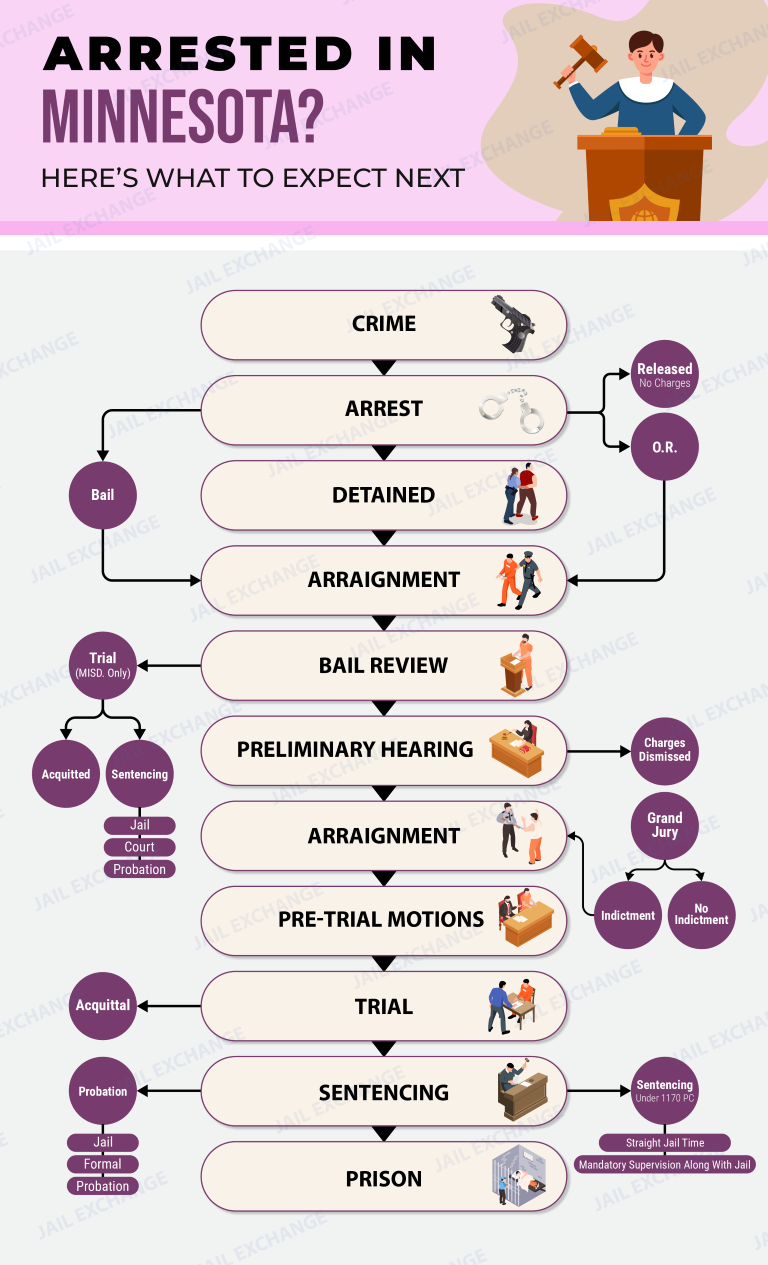
Minnesota's criminal rules require that a person kept in custody appear before a judge within 36 hours of the arrest. The day of the arrest, Sundays and legal holidays are not counted, so a person arrested on a Friday night may not see a judge until Monday. If the arrest was made without a warrant, a judge must separately review the facts and find probable cause within 48 hours, or the person must be released.
The first appearance
For a felony or gross misdemeanor this hearing is called a Rule 5 appearance; for a misdemeanor it is the arraignment. The judge informs the defendant of the charge and the right to counsel, decides whether to appoint the public defender, and sets release terms. Dakota County judges may order release on recognizance or set bail. Typically the court names two amounts: a higher bail with no conditions and a lower bail tied to conditions such as no contact with the alleged victim, alcohol or drug testing, electronic monitoring or staying away from a location. A no-contact order can bar a defendant from returning home if the alleged victim lives there.
Posting bail
Bail can be paid in cash, or a defendant can hire a commercial bail bond company, which is legal in Minnesota and typically charges a nonrefundable premium. Money paid directly to the court as cash bail is generally returned at the end of the case if every condition was followed, less any amounts the court applies to fines or costs. Missing a court date can lead to a warrant and forfeiture of the bail.
↑ Back to the question list3. The Dakota County Jail
The Dakota County Jail is operated by the elected Dakota County Sheriff at the Law Enforcement Center, 1580 Highway 55 in Hastings. It holds adults awaiting trial on charges from every city and township in the county, as well as people serving local sentences. Because the jail shares a campus with the Judicial Center, in-custody defendants can be brought to court without long transports.
Family members trying to locate someone, schedule a visit, send mail or deposit money should call the jail information line at (651) 438-4800. A person who is released from the jail receives paperwork listing the next court date and any conditions; violating those conditions, such as contacting a protected person or drinking when ordered not to, can lead to a new arrest and a higher bail.
↑ Back to the question list4. Getting a public defender in Dakota County
In Dakota County, appointed defense in criminal and juvenile delinquency cases is provided by the First Judicial District Public Defender, part of Minnesota's State Board of Public Defense. The office represents adults charged with felonies, gross misdemeanors and misdemeanors that could bring jail, along with youth in juvenile court.
To get one, ask at your first appearance. You will complete a financial statement, and the judge decides eligibility based on income, assets and household size. If you qualify, the court appoints the public defender's office, and an attorney will contact you or meet you at the next hearing. If you are out of custody and have not heard from your lawyer before your next court date, call Court Administration at (651) 377-7180 to confirm that counsel was appointed. When the public defender has a conflict, for example because it represents a co-defendant, the court arranges outside counsel.
↑ Back to the question list5. Prosecutors and diversion in Dakota County
Two kinds of prosecutors appear in Dakota County courtrooms. The Dakota County Attorney's Office, at the Judicial Center in Hastings ((651) 438-4438), is led by the elected County Attorney and handles every felony, all juvenile delinquency petitions, and misdemeanors and gross misdemeanors from outside city limits. City prosecutors, either a city's own attorneys or private firms under contract, handle misdemeanors and gross misdemeanors such as shoplifting, first-time DWI, domestic assault at the misdemeanor level and trespass when the offense occurred within their city. Whichever office files the case is the one that makes plea offers and decides whether to dismiss.
Pretrial diversion
Minnesota law requires each county attorney to maintain a pretrial diversion program for adults. In Dakota County, diversion is most often offered to people with little or no criminal history who are charged with lower-level, nonviolent offenses. A participant typically agrees to conditions such as classes, community work, restitution or treatment for a set period; if the person completes them, the charge is dismissed or never filed. City prosecutors may offer their own diversion or a continuance for dismissal on misdemeanors. Some charges are excluded from diversion, and the decision to offer it rests with the prosecutor.
Victims
Victims of crime in Dakota County have rights under Minnesota Statutes chapter 611A, including notice of key hearings and plea agreements, the opportunity to be present and the right to give a statement at sentencing. The prosecuting office's victim services staff explain those rights.
↑ Back to the question list6. Treatment courts in Dakota County
Treatment courts, sometimes called specialty or problem-solving courts, offer an intensive alternative to a standard sentence for people whose offenses are tied to addiction, mental illness or military service. The First Judicial District has run such programs in Dakota County for adult drug offenses, repeat DWI and veterans. Participants appear before the same judge frequently, follow a treatment plan, submit to regular testing and work with a team that includes probation, the prosecutor and the defense. Successful graduation can lead to a reduced or dismissed charge or a shorter sentence; failing the program sends the case back for ordinary sentencing.
Entry is voluntary but screened. The prosecutor, Community Corrections and the treatment team all weigh in, and people charged with certain violent offenses are generally excluded. A defendant interested in a treatment court should raise it with the defense attorney early, because referrals usually happen before a plea or as part of a plea agreement. Program details and openings change over time, so ask the defense lawyer or Community Corrections at (651) 438-8288 about current options.
↑ Back to the question list7. Misdemeanor (for example, theft, a first DWI, fifth-degree assault, trespassing)
Most criminal cases in Dakota County are at the low end of the scale, and they come in three tiers. A petty misdemeanor is a noncriminal offense punished only by a fine. A misdemeanor and a gross misdemeanor are crimes; the gross misdemeanor carries considerably more exposure.
How a lower-level case moves
A misdemeanor starts with an arraignment at which the defendant enters a plea, and a gross misdemeanor starts with a Rule 5 appearance. Either way, the case usually moves next to a pretrial conference with the city prosecutor or the County Attorney, where evidence is reviewed and offers are made. The great majority of Dakota County misdemeanors are settled at this stage. A defendant who wants a trial is entitled to a six-person jury, which must be unanimous, and a defendant who files a speedy-trial demand must be tried within 60 days of it. The First Judicial District Public Defender represents qualifying defendants who face possible jail.
Penalties in Dakota County District Court
- Petty misdemeanor in Dakota County: fine only, up to $300.
- Misdemeanor in Hastings, Apple Valley or West St. Paul: up to 90 days in jail and up to $1,000. Shoplifting of $500 or less, trespassing and most fifth-degree assaults are misdemeanors.
- Gross misdemeanor in the First District: up to 364 days and $3,000; examples include theft of more than $500 up to $1,000 and fifth-degree assault within a few years of a prior conviction.
- First DWI in Dakota County: fourth-degree DWI is a misdemeanor. A test of 0.16 or more, a child under 16 in the vehicle or a refusal to submit to testing makes it third-degree DWI, a gross misdemeanor. The Department of Public Safety revokes the license through a separate administrative process, and drivers may need ignition interlock to drive legally. A chemical use assessment is required, and plate impoundment and vehicle forfeiture can follow in aggravated cases.
Typical outcomes
Results include outright dismissal, a continuance for dismissal, a stay of adjudication that results in no conviction once probation is complete, fines, probation supervised by Dakota County Community Corrections, and jail. Most misdemeanor and gross misdemeanor cases in Dakota County close in one to four months.
↑ Back to the question list8. Felony (for example, burglary, felony theft, drug sale, second-degree assault)
A felony is a crime with a possible sentence of more than one year in prison, and in Dakota County all felonies are prosecuted by the County Attorney. Felonies are charged by a sworn complaint; a grand jury indictment is required only for crimes that carry life imprisonment.
The felony hearings
- Rule 5 first appearance. Within 36 hours for a defendant held in the Hastings jail. A Dakota County judge goes over the complaint, decides on appointed counsel and fixes bail and release conditions.
- Rule 8 hearing. The second appearance, where the defense receives discovery and the defendant may enter a plea.
- Omnibus hearing. The judge decides defense challenges, such as motions to suppress evidence from a search or statement, or to dismiss for lack of probable cause.
- Pretrial or settlement conference. Most Dakota County felony cases resolve here through a plea agreement with the County Attorney.
- Trial. A felony jury has 12 members and the verdict must be unanimous. Once a defendant demands a speedy trial, Dakota County must start the trial within 60 days.
- Sentencing. Dakota County Community Corrections prepares a presentence investigation before the judge imposes sentence.
Felony penalties in Dakota County
- Dakota County felony theft: 5 years at most when the value is over $1,000, 10 years when over $5,000, and 20 years when over $35,000.
- Burglary at the Hastings Judicial Center: up to 5 years for third degree, up to 10 for second degree and up to 20 for first degree.
- First-degree drug sale in the First Judicial District: up to 30 years.
- Second-degree assault in Dakota County: assault with a dangerous weapon carries up to 7 years, and a firearm brings a mandatory minimum prison term.
How sentences are set
Dakota County judges apply the Minnesota Sentencing Guidelines. The guidelines grid places the offense's severity level against the defendant's criminal history score; the result is a presumptive sentence that is either a stayed prison term served on probation or an executed prison commitment. A judge can depart up or down only for substantial and compelling reasons stated on the record. A stay of imposition allows a defendant who finishes probation to have the felony recorded as a misdemeanor. A person sent to prison generally serves two-thirds of the term in custody and the rest on supervised release. From charge to sentencing, a Dakota County felony usually runs four to twelve months.
↑ Back to the question list9. Violent felony (for example, murder, criminal sexual conduct, aggravated robbery)
Violent felonies in Dakota County move through the same Rule 5, Rule 8, omnibus and trial stages as other felonies, but bail is usually set very high, conditions are strict, and many defendants stay in the Dakota County Jail until the case ends. A first-degree murder case requires an indictment from a Dakota County grand jury.
Penalties for violent felonies
- First-degree murder in Dakota County: life in prison. Premeditated murder and certain other first-degree murders carry life without the possibility of release; in the remaining first-degree cases, a Dakota County defendant becomes eligible for parole review after 30 years.
- Second-degree murder before the First District court: up to 40 years.
- Third-degree murder before the First District court: up to 25 years.
- First-degree criminal sexual conduct in Dakota County: up to 30 years, with 144 months as the presumptive sentence on a first conviction.
- First-degree aggravated robbery in Hastings: up to 20 years.
Minnesota abolished the death penalty in 1911, so no Dakota County prosecution can seek it. Victims and their families have the right to be notified, to attend proceedings and to speak at sentencing under chapter 611A.
Defense and timeline
Defendants who qualify are represented by the First Judicial District Public Defender, which generally assigns experienced trial attorneys to homicide and serious sexual assault cases. These cases depend on forensic testing, expert testimony and extensive pretrial motions, and they commonly take one to two years or longer to resolve.
↑ Back to the question list10. Juveniles (under 18) arrested in Dakota County
Youth under 18 accused of offenses in Dakota County are handled by the juvenile division of the District Court rather than the adult criminal calendar. The Dakota County Attorney's Office reviews police reports and decides whether to file a delinquency petition. For many first-time and lower-level offenses, the case is instead referred to diversion, where completing requirements such as classes, restitution or community work ends the matter without a petition.
Detention
A youth who must be held is taken to the Dakota County Juvenile Services Center, 1600 Highway 55 in Hastings, which is staffed 24 hours a day ((651) 438-8399). Youth are never placed in the adult jail. A judge must hold a detention hearing within 36 hours of the youth being taken into custody, not counting weekends and holidays, to decide whether the youth stays detained or goes home, often with conditions. The First Judicial District Public Defender represents youth who qualify.
Serious cases
For older youth charged with serious offenses, the County Attorney has additional options. A youth aged 14 to 17 may be prosecuted as an Extended Jurisdiction Juvenile, which combines a juvenile disposition with a stayed adult sentence that can be imposed if the youth violates the terms. The County Attorney may also ask the court to certify a youth 14 or older for adult prosecution; certification is presumed for 16- and 17-year-olds charged with an offense that carries a presumptive prison sentence or that was committed with a firearm. A 16- or 17-year-old accused of first-degree murder is prosecuted in adult court from the start.
Juvenile records in Minnesota are generally confidential, although some felony-level records for youth 16 and older can be open to the public.
↑ Back to the question list11. Federal cases (U.S. District Court) from Dakota County
Alongside the busy state courts in Hastings, Apple Valley and West St. Paul, Dakota County produces a steady flow of federal prosecutions. Those cases belong to the U.S. District Court for the District of Minnesota, and Dakota County is assigned to the court's Third Division in St. Paul. The division's home is the Warren E. Burger Federal Building and U.S. Courthouse, 316 N. Robert Street, St. Paul, MN 55101. Jurors for a Dakota County federal trial report to St. Paul or Minneapolis, and initial appearances and detention hearings are often heard in either city, wherever a magistrate judge is on duty. For Dakota County jurors and families, the Clerk of Court's main number is (612) 664-5000.
When the federal government takes the case
A charge lands in federal court because it breaks a federal statute, and the investigation is usually led by a federal agency: the FBI, the DEA, the ATF, Homeland Security Investigations, U.S. Postal Inspectors or IRS Criminal Investigation. Charges seen often in Dakota County include:
- trafficking in fentanyl, methamphetamine, cocaine or other drugs, especially large shipments or loads crossing state lines;
- possession of a firearm or ammunition by someone with a felony conviction, along with other gun crimes such as straw purchasing;
- fraud, including schemes against businesses, banks, government programs and investors, wire and mail fraud, and identity theft;
- child exploitation offenses involving the internet;
- bank robbery and immigration offenses.
Many begin as an ordinary arrest by the Dakota County Sheriff, Burnsville, Eagan or Lakeville police, or a regional drug task force. Federal prosecutors can adopt such a case, and the state may still bring its own charges for the same act.
The offices that handle a federal case
- Prosecution: the U.S. Attorney's Office for the District of Minnesota. Its St. Paul office, at 316 N. Robert Street, Suite 404, St. Paul, MN 55101, can be reached at (651) 848-1950, and the main office is in the U.S. Courthouse at 300 S. 4th Street, Suite 600, Minneapolis, MN 55415, (612) 664-5600.
- Defense for those who cannot afford a lawyer: the Office of the Federal Defender for the District of Minnesota, 107 U.S. Courthouse, 300 S. 4th Street, Minneapolis, MN 55415, (612) 664-5858. A conflict, such as representing a co-defendant, means the court appoints a private CJA panel lawyer.
- Custody: the U.S. Marshals Service, St. Paul office (651) 848-1435, Minneapolis office (612) 664-5900.
What to expect, step by step
Arrest and first appearance. After an arrest by agents or on a federal warrant or indictment, a U.S. magistrate judge explains the charges at the initial appearance and appoints counsel when needed.
Release or detention. If the prosecutor moves for detention, a hearing is usually held within three court days. Under the Bail Reform Act, the judge must either release the defendant on conditions, supervised by U.S. Probation and Pretrial Services, or order detention because no conditions would reasonably assure court appearances and community safety. Bail bondsmen do not operate in federal court and money bail is rare, which is a sharp contrast to the bail practice in the Hastings courthouse.
Indictment and arraignment. When a case starts by complaint, the grand jury must return an indictment within 30 days of arrest unless a preliminary hearing is held. Arraignment on the indictment follows.
Trial or plea. The Speedy Trial Act sets a 70-day limit from indictment or first appearance, though continuances are common in complex cases. Most defendants take a plea agreement; at trial, a 12-person Dakota County-area jury must be unanimous.
Sentencing and prison. Roughly three months after a guilty plea or verdict, after U.S. Probation prepares a presentence report, the district judge imposes sentence under the advisory U.S. Sentencing Guidelines and any mandatory minimum. The federal system has no parole; with good-conduct time, a person serves at least about 85% of the sentence in a Bureau of Prisons facility and then a term of supervised release. Appeals go to the Eighth Circuit.
Where federal detainees are held
Federal pretrial detainees do not simply stay wherever they were booked; they are placed by the U.S. Marshals Service in county jails it contracts with throughout Minnesota, and sometimes outside the state. A person arrested in Dakota County may therefore be moved to another county's jail while the case is pending. Relatives can call the St. Paul Marshals office to find out where someone is being kept, and after sentencing the Bureau of Prisons inmate locator shows the assigned prison. Federal prosecution of people under 18 seldom happens.
↑ Back to the question listThis guide outlines how criminal cases typically proceed in Dakota County, Minnesota, and is not legal advice. If you or a family member has been charged, consult a criminal defense attorney or ask the judge to appoint the First Judicial District Public Defender at the first appearance. Court Administration at the Hastings Judicial Center can be reached at (651) 377-7180, and the jail information line at (651) 438-4800.
Inmate Canteen (operated by TurnKey Corrections) allows friends and family members to purchase pre-approved commissary packages, including brand-name snacks, confectionery goods, personal hygiene products, stationery, and apparel kits sent directly to an incarcerated loved one. Every package is packed to adhere strictly to facility security regulations, ensuring items pass institutional intake without being rejected at the loading dock.
Important: Package Deadlines and Delivery Windows Vary
Detention centers do not manage care package deliveries under identical schedules. While some facilities allow weekly orders, others restrict deliveries to bi-weekly or monthly distribution windows, and spending limits vary from jail to jail. You should verify the facility's active cutoff schedule and order allowances by calling them directly. If an order is submitted after the weekly processing deadline, delivery will be held until the following cycle, leaving your loved one waiting an extra cycle for fresh snacks, thermal wear, or personal care supplies.
Step-by-Step Instructions to Place a Commissary Package Order
- Confirm the inmate's legal first and last name, date of birth, and assigned booking or inmate ID number.
- Navigate to www.inmatecanteen.com and sign in or create a user profile.
- Select Commissary / Store and choose your state and detention center.
- Search for the inmate to unlock the facility's approved product catalog.
- Select allowable snack foods, candies, personal care goods, and clothing items up to the facility's allowed spending limit.
- Proceed to checkout, enter your debit or credit card billing details, and submit payment.
- Save your digital receipt and confirmation tracking number for your records.
What the Inmate Needs to Do
The inmate does not need an internet account to receive care packages. TurnKey Corrections prepares the order in secure, tamper-evident packaging and delivers it directly to the jail commissary department. Facility staff inspect the shipment and deliver the items during regular housing unit commissary rounds, where the inmate signs for receipt.
Official Provider: Inmate Canteen Official Website
Customer Service Telephone: 1-715-690-2965
Support Hours: Monday – Friday, 8:00 AM – 5:00 PM CST
Supported Languages: English and Spanish
Other Services Provided by Inmate Canteen (TurnKey Corrections)
In addition to Commissary Care Packages, Inmate Canteen provides several other communication, financial, and visitation services:
- Tablets & Chirp Units: Learn how secure handheld devices allow inmates to communicate, read, and message.
• Learn more on our website: Tablet Programs Guide | • Visit official vendor page: Inmate Canteen Devices - Remote Video Visitation: Schedule and join live face-to-face video visits from your computer or smartphone.
• Learn more on our website: Video Visitation Guide | • Visit official vendor page: Inmate Canteen Video Visits - Digital Messaging: Send electronic messages and photos directly to housing pod kiosks and handheld devices.
• Learn more on our website: Digital Messaging Guide | • Visit official vendor page: Inmate Canteen Messaging - Trust & Phone Deposits: Deposit money directly into an inmate's jail trust account or phone calling balance.
• Learn more on our website: Trust & Phone Deposits Guide | • Visit official vendor page: Inmate Canteen Deposits
Buy Commissary for an Inmate in the Dakota County Jail
Dakota County Jail Inmate Commissary - Sending Money or Purchasing Commissary for an Inmate
Dakota County Jail allows inmates to purchase commissary. This can be snacks, hygiene products, stamps, stationary, clothing and even electronics.
You can buy commissary for an inmate using an online service called Inmate Canteen.
Inmate Canteen Customer Service can be reached at 715-690-2965, or by email at support@inmatecanteen.com.
There is a monthly limit of $200-300 on how much inmates can spend on commissary items.
This amount is subject to change so call the facility at 651-438-4800 in order to confirm the amount that cannot be exceeded.
Inmates have access to both an in-house commissary store, and commissary packages that can be purchased and shipped to the inmate by friends and family.
Scroll down for information on the Dakota County Jail's service they use for you being able to purchase commissary items online and have them shipped directly to the inmate.
You can also go to our Inmate Money page for information on how to send money to an inmate.
Inmate Canteen Trust & Phone Deposits allow friends and family members to transfer money directly into an incarcerated person's jail trust account or telephone calling balance using a credit or debit card. Deposited funds give your loved one the financial balance needed to buy personal care goods, over-the-counter medication, snacks, and phone talk time from the facility canteen.
Important: Facility Banking Policies Vary Across Jails
Once a person is booked and moved to a cell, facilities do not always allow cash drop-offs or phone payments directly to the jail window. Some might and you should confirm this by calling the facility and asking. But if you do not register online and fund your loved one's trust account immediately, they may be forced to wait days or weeks for standard paper processing, leaving them without essential soap, clean undergarments, basic medical sundries or snacks.
Step-by-Step Instructions to Register and Deposit Funds
- Confirm the inmate's legal first and last name, date of birth, and assigned booking or inmate ID number.
- Navigate to www.inmatecanteen.com on your computer or mobile device.
- Click on Deposit Funds and select whether to fund the Trust Account (for commissary) or Phone Account (for talk time).
- Select the state and facility where the inmate is currently housed.
- Search for the inmate to confirm their active housing record matches the facility roster.
- Enter your deposit dollar amount, review convenience fees, and enter your debit or credit card billing details.
- Submit payment and save the digital confirmation receipt for your financial records.
What the Inmate Needs to Do
The inmate does not need an internet connection to receive trust funds. Once payment clears, the balance posts directly to their accounting profile in the jail's internal system. The inmate can review their updated balance at the pod kiosk terminal and place their regular weekly commissary order or make outbound phone calls.
Official Provider: Inmate Canteen Official Website
Customer Service Telephone: 1-715-690-2965
Support Hours: Monday – Friday, 8:00 AM – 5:00 PM CST
Supported Languages: English and Spanish
Other Services Provided by Inmate Canteen (TurnKey Corrections)
In addition to Trust & Phone Deposits, Inmate Canteen provides several other communication, financial, and commissary services at participating correctional facilities:
- Commissary & Snack Packs: Order pre-approved snack boxes, food packages, and clothing directly to the jail.
• Learn more on our website: Commissary Orders Guide | • Visit official vendor page: Inmate Canteen Commissary - Remote Video Visitation: Schedule and join live face-to-face video visits from your computer or smartphone.
• Learn more on our website: Video Visitation Guide | • Visit official vendor page: Inmate Canteen Video Visits - Digital Messaging & Chirp Texts: Send electronic messages and photos directly to housing pod kiosks and handheld devices.
• Learn more on our website: Digital Messaging Guide | • Visit official vendor page: Inmate Canteen Messaging
Deposit Money for an Inmate in the Dakota County Jail
The Dakota County Jail is in the Law Enforcement Center at 1580 Highway 55 in Hastings, and its lobby is open 24 hours a day.
- Lobby kiosk: Pay with cash or a credit card. The money goes on the person's account automatically.
- Online: Use Inmate Canteen. The canteen account buys envelopes, snacks and drinks; the phone account on the same site pays for calls, replies to messages and video calls. For a deposit problem, use the site's chat or call 715-952-9622.
- Money order by mail: Money orders only, made out to the person. Mail it to the person's name, Dakota County Law Enforcement Center, P.O. Box 247J, Hastings, MN 55033.
Cash, personal checks and payroll checks sent by mail are returned to the sender or put in the person's property. The jail is not responsible for money lost in the mail.
The Dakota County Jail is in the Law Enforcement Center on Highway 55 in Hastings, Minnesota, and gets its mail through a post office box. Letters and photos are the main things you can send. Books, newspapers and magazines are not allowed at all, because the jail supplies its own reading material. Put the inmate's name on the line above the post office box.
Letters, photos, legal mail and money orders:
Dakota County Law Enforcement Center
P.O. Box 247J
Hastings, MN 55033
- Photos: Prints may be up to 4 by 6 inches. No Polaroids, and nothing sexual, gang-related or showing weapons, drugs or drinking. There is no set number, but staff can send back extras.
- No reading material: Any book, newspaper or magazine mailed in is returned to the sender or stored with the inmate's property.
- Cards: Greeting cards that are decorated, play music, or have glue, glitter or stickers on them are not allowed.
- Scents and marks: Perfume-scented mail and lipstick kisses are turned away.
- Other things to leave out: Stamps, envelopes, blank paper, business cards, brochures, and bills or other mail that came to the inmate's home.
- Money: A money order made out to the inmate can go to the same post office box, but cash, personal checks and paychecks are refused. The jail is not responsible for money lost in the mail. You can also send money online or use the kiosk in the lobby, which is open 24 hours and takes cash or cards.
- Writing: Your return address goes in the upper left corner. Use blue or black ink, not crayon, felt-tip pen or paint.
- Packages: The Hastings jail turns away any package that isn't a commissary order.
Items that break these rules are sent back or kept in property, and inmates can also get electronic messages.
Inmate Canteen Trust & Phone Deposits allow friends and family members to transfer money directly into an incarcerated person's jail trust account or telephone calling balance using a credit or debit card. Deposited funds give your loved one the financial balance needed to buy personal care goods, over-the-counter medication, snacks, and phone talk time from the facility canteen.
Important: Facility Banking Policies Vary Across Jails
Once a person is booked and moved to a cell, facilities do not always allow cash drop-offs or phone payments directly to the jail window. Some might and you should confirm this by calling the facility and asking. But if you do not register online and fund your loved one's trust account immediately, they may be forced to wait days or weeks for standard paper processing, leaving them without essential soap, clean undergarments, basic medical sundries or snacks.
Step-by-Step Instructions to Register and Deposit Funds
- Confirm the inmate's legal first and last name, date of birth, and assigned booking or inmate ID number.
- Navigate to www.inmatecanteen.com on your computer or mobile device.
- Click on Deposit Funds and select whether to fund the Trust Account (for commissary) or Phone Account (for talk time).
- Select the state and facility where the inmate is currently housed.
- Search for the inmate to confirm their active housing record matches the facility roster.
- Enter your deposit dollar amount, review convenience fees, and enter your debit or credit card billing details.
- Submit payment and save the digital confirmation receipt for your financial records.
What the Inmate Needs to Do
The inmate does not need an internet connection to receive trust funds. Once payment clears, the balance posts directly to their accounting profile in the jail's internal system. The inmate can review their updated balance at the pod kiosk terminal and place their regular weekly commissary order or make outbound phone calls.
Official Provider: Inmate Canteen Official Website
Customer Service Telephone: 1-715-690-2965
Support Hours: Monday – Friday, 8:00 AM – 5:00 PM CST
Supported Languages: English and Spanish
Other Services Provided by Inmate Canteen (TurnKey Corrections)
In addition to Trust & Phone Deposits, Inmate Canteen provides several other communication, financial, and commissary services at participating correctional facilities:
- Commissary & Snack Packs: Order pre-approved snack boxes, food packages, and clothing directly to the jail.
• Learn more on our website: Commissary Orders Guide | • Visit official vendor page: Inmate Canteen Commissary - Remote Video Visitation: Schedule and join live face-to-face video visits from your computer or smartphone.
• Learn more on our website: Video Visitation Guide | • Visit official vendor page: Inmate Canteen Video Visits - Digital Messaging & Chirp Texts: Send electronic messages and photos directly to housing pod kiosks and handheld devices.
• Learn more on our website: Digital Messaging Guide | • Visit official vendor page: Inmate Canteen Messaging
Inmate Canteen Digital Messaging allows friends and family members to send electronic text messages and digital photos directly to an incarcerated loved one. Messages are delivered electronically to housing unit kiosks and Chirp handheld devices within hours, avoiding the lengthy delivery times associated with postal mail.
Important: Electronic Mail Guidelines Vary by Facility
Correctional facilities enforce strict rules regarding incoming correspondence. While some jails continue to accept paper letters, many facilities restrict physical postal mail or mandate digital message screening, which you can verify by checking facility rules. If you do not register online and set up message credits immediately, your loved one may face lengthy periods without direct written contact from family.
Step-by-Step Instructions to Register and Send Messages
- Go to www.inmatecanteen.com and sign in or create a user profile.
- Select Email / Messaging and choose your state and detention facility.
- Search for the inmate using their legal first and last name or booking ID number.
- Purchase messaging credits using a credit or debit card.
- Type your message in the text box and attach approved digital images if permitted by the facility.
- Submit your message to the facility's screening queue.
What the Inmate Needs to Do
All electronic correspondence is screened by facility staff before delivery. Once approved, messages appear in the inmate's inbox on their housing unit kiosk or assigned handheld Chirp device. The inmate opens the message, reads your note, and types an electronic reply using their available account credits.
Official Provider: Inmate Canteen Official Website
Customer Service Telephone: 1-715-690-2965
Support Hours: Monday – Friday, 8:00 AM – 5:00 PM CST
Supported Languages: English and Spanish
Other Services Provided by Inmate Canteen (TurnKey Corrections)
In addition to Digital Messaging, Inmate Canteen provides several other communication, financial, and commissary services at participating correctional facilities:
- Commissary & Snack Packs: Order pre-approved snack boxes, food packages, and clothing directly to the jail.
• Learn more on our website: Commissary Orders Guide | • Visit official vendor page: Inmate Canteen Commissary - Remote Video Visitation: Schedule and join live face-to-face video visits from your computer or smartphone.
• Learn more on our website: Video Visitation Guide | • Visit official vendor page: Inmate Canteen Video Visits - Trust & Phone Deposits: Deposit money directly into an inmate's jail trust account or phone calling balance.
• Learn more on our website: Trust & Phone Deposits Guide | • Visit official vendor page: Inmate Canteen Deposits
Inmate Canteen (TurnKey Corrections) provides specialized handheld tablets and Chirp communication units to incarcerated individuals in county detention centers. Running over a secure internal wireless network, these devices allow inmates to send and receive text messages, submit facility requests, review commissary balance accounts, and read digital materials directly from their living areas.
Important: Tablet Hardware Deployment and Rental Rules Vary
Detention centers do not manage tablet distribution identically. While some agencies issue individual personal tablets to every detainee at booking, others utilize shared pod docking stations or restrict tablet use to specific dayroom hours, which you should confirm with the facility directly. Although core educational and legal resources are generally provided free of charge, sending messages, initiating video calls, or making phone calls from the tablet requires an active balance funded by outside contacts.
Step-by-Step Instructions to Support and Fund Tablet Use
- Confirm that TurnKey Corrections / Inmate Canteen tablets or Chirp devices are active at the facility.
- Navigate to www.inmatecanteen.com and sign into your user profile.
- Link the inmate to your account by state, detention facility, and their legal name or booking ID.
- Select Messaging / Chirp Funds or Trust Deposits to add funds to their available balance.
- Specify your deposit amount, review convenience fees, and enter your credit or debit card billing details.
- Submit payment, save your confirmation receipt, and notify your loved one that their device balance is available.
What the Inmate Needs to Do
The inmate logs into their assigned tablet or Chirp device using their personal PIN. They can review their available messaging balance, read incoming family correspondence, and type replies directly on the device. Tablets are returned to docking stations during facility count times and for overnight charging.
Official Provider: Inmate Canteen Official Website
Customer Service Telephone: 1-715-690-2965
Support Hours: Monday – Friday, 8:00 AM – 5:00 PM CST
Supported Languages: English and Spanish
Other Services Provided by Inmate Canteen (TurnKey Corrections)
In addition to Tablet Services, Inmate Canteen provides several other communication, financial, and commissary services:
- Commissary & Care Packages: Order pre-approved snack boxes, food packages, and clothing directly to the jail.
• Learn more on our website: Commissary Orders Guide | • Visit official vendor page: Inmate Canteen Commissary - Remote Video Visitation: Schedule and join live face-to-face video visits from your computer or smartphone.
• Learn more on our website: Video Visitation Guide | • Visit official vendor page: Inmate Canteen Video Visits - Digital Messaging: Send electronic text messages and digital photos directly to housing pod kiosks and handheld devices.
• Learn more on our website: Digital Messaging Guide | • Visit official vendor page: Inmate Canteen Messaging - Trust & Phone Deposits: Deposit money directly into an inmate's jail trust account or phone calling balance.
• Learn more on our website: Trust & Phone Deposits Guide | • Visit official vendor page: Inmate Canteen Deposits
Dakota County Juvenile Facilities
- Jail (Main): 651-438-4800
- Adult Probation: 651-438-8288
- County Attorney: 651-438-4438
- Hastings Police: 651-480-2300
- Juvenile: 651-438-4970
- Juvenile Probation: 651-438-8288
- Public Defender: 651-480-0122
- Sheriff: 651-438-4700
The Dakota County Jail serves the following cities and towns of Dakota County: Apple Valley, Burnsville, Castle Rock, Coates, Douglas, Eagan, Eureka, Farmington, Hampton, Hastings, Inver Grove Heights, Lakeville, Lilydale, Mendota, Mendota Heights, Miesville, New Trier, Nininger, Northfield, Randolph, Ravenna, Rosemount, South Saint Paul, Sunfish Lake, Vermillion and West Saint Paul.