
Dodge County Sheriff
Dodge County Sheriff
Physical Address
Olmsted County Adult Detention Center101 4th Street SE
Rochester, MN 55904 Inmate mailing address
Olmsted County Adult Detention Center
507-328-6790Dodge County Inmate Search: Who Is Held, Where, and What Comes Next
Dodge County runs no full jail. Deputies based in Mantorville book people and then drive them to the Olmsted County Adult Detention Center, which stands at 101 4th Street SE, Rochester, MN 55904. Read on to learn how to spot your person, how release and bail work, and how visits, calls, letters and hearings are handled.
Start with the Sheriff's in-custody list, which shows who sits in jail for the county at this moment. There is no search box. Scroll through it, or press your browser's find key and enter a last name. Entries show the booking date, the reason for the hold and each charge with its level. Very fresh bookings sometimes lag behind.
Second, ring the Sheriff's Office at 507-635-6200. Have the legal name and birthday ready for whoever picks up, and ask where they are housed today, since the county rents its beds and that deal can shift. Our bail guide covers getting someone out, and the court guide explains hearings in Mantorville.
Read inmate search answers
 Read inmate search answers
1. How do I read the Dodge County in-custody list?
The "In Custody" button on the Sheriff's site leads to a page kept on an Olmsted County server. It lists only people held on this county's cases, so it stays fairly short.
- Open the custody list.
- On a phone, choose "Find on page" from the browser menu. On a computer, press Ctrl+F. Type the last name.
- Note the booking date, which tells you when they arrived.
- Read the "Incarceration Reason" and "Detainee Description" lines. These give the reason for the hold.
- Look under the charges. Each has a brief description and a level.
Bail figures and hearing dates come from the Sheriff's Office. Call 507-635-6200 and ask for both.
↑ Back to the question list2. What if the custody list skips their name?
Most gaps have an everyday cause:
- Still in booking. Prints, photos and the ride to Rochester eat up hours. Check back later today.
- Cited and sent home. On most misdemeanors, an officer hands over a ticket with a court date rather than taking the person to jail (Minn. R. Crim. P. 6.01).
- Out already. A relative might have paid bail, or the first-appearance judge let them leave.
- Arrested in another county. The local jail there would book them instead.
- Under 18. Youths stay off this adult list.
- A different spelling. Try spelling it another way, or use a middle or married name.
Two phone numbers settle it fastest: the Sheriff's Office at 507-635-6200 or the Rochester jail at 507-328-6790.
↑ Back to the question list3. Where does Dodge County send the people it arrests?
With no jail beds at home, the county pays a neighbor to hold its people:
- Olmsted County Adult Detention Center, found at 101 4th Street SE, Rochester, MN 55904, 507-328-6790. This jail sits in Olmsted County, not here. Olmsted describes it as housing both men and women: people awaiting trial, people serving sentences, work-release inmates, and boarders from other counties and agencies when room allows.
- Dodge County Sheriff's Office, 22 East 6th Street, Dept 201, Mantorville, MN 55955, 507-635-6200. Its offices fill the east wing of the courthouse. Deputies make arrests, book people and drive them to the jail.
Bed rental deals can change, so the host jail could change too. Before any trip, ask the Sheriff's Office where the person is tonight.
↑ Back to the question list4. Are Dodge County mugshots public?
Yes, as a rule. State data law treats a booking photo as public. The agency holding it may delay its release for a time when sharing it would harm an open investigation (Minn. Stat. 13.82, subd. 26). That same agency must also share basic arrest data: the charge, custody status and release (Minn. Stat. 13.82, subd. 2).
So mugshots come from whoever made the arrest. When deputies did, write to the Sheriff's records unit at dcso.records@dodgecountymn.gov or call 507-635-6200. Reporters ask the same office.
- Immigration photos: ICE handles those requests itself, through its online records request.
- Federal arrest photos: these normally stay sealed, but the U.S. Marshals Service may release one, for example when chasing a fugitive.
5. Can I get a VINE alert about a release from Rochester?
Yes. VINE, a tool the Department of Public Safety runs for the state, watches county jails for custody changes. When one happens, it alerts you.
- Visit Minnesota VINELink, or dial 877-664-8463.
- Enter the first and last name.
- Choose the right match, then finish signing up.
Registration is up to you; no one enrolls you. People who reach state prison are covered by Minnesota Haven, the corrections department's own notice tool, in place of VINE. A daily look at the custody list makes a handy backup.
↑ Back to the question list6. How do judges in Mantorville set bail and release?
Picked up with no warrant and kept in custody? Then a judge has to see the person inside 36 hours. That clock skips the day of arrest, Sundays and legal holidays (Minn. R. Crim. P. 4.02, subd. 5). Probable cause needs a judge's finding inside 48 hours, every day counted (Rule 4.03). First appearances happen in District Court. Ask court staff if it will be face to face or by video.
- Where judges begin. The default is release on the person's written promise to come to court, or on an unsecured bond. Judges add only the lightest conditions needed for public safety and a return to court (Rule 6.02).
- Two dollar figures. A judge must also set a sum that carries no conditions. Many orders therefore show a smaller amount with rules attached and a bigger one with none.
- Paying after hours. Bail for someone held in Rochester follows Olmsted's rules. At night, the lobby there takes exact cash, a money order or an approved agent's bond. Bring the exact sum, since staff hold no change, and leave checks and cards at home.
- Bondsmen. The Department of Commerce licenses them, and the state court bail bond program must approve them. Their fee starts at $100, and you never get it back (Minn. Stat. 60M.02).
Cash posted with the court belongs to the defendant even when relatives paid it (Minn. Stat. 629.53). Confirm the amount and case number with court administration at 507-624-7010 first. For more, open our bail and bond guide. Background on state law is in the Minnesota bail law summary.
↑ Back to the question list7. How do I see the charges filed in Mantorville?
Each charge on the custody list has a short label and a level. When the prosecutor's complaint reaches the court, a case file opens on Minnesota Court Records Online, a free state site. Type the last name, then the first. A few youth matters stay hidden there.
Levels show how much is at stake (Minn. Stat. 609.02 and 609.03):
- Petty misdemeanor: a fine up to $300, with no jail time.
- Misdemeanor: as much as 90 days, a $1,000 fine, or both.
- Gross misdemeanor: as much as 364 days, a $3,000 fine, or both.
- Felony: any crime punishable by a year or longer in prison.
Court staff in Mantorville can help you find the case by phone. Call 507-624-7010.
↑ Back to the question list8. Can the Third District public defender take the case?
A public defender is open to anyone too poor to hire counsel who faces a felony, a gross misdemeanor, or a misdemeanor that carries possible jail. At the first hearing, the judge looks over a sworn money statement to decide. Those already getting means-tested aid are presumed to qualify (Minn. Stat. 611.14 and 611.17).
In this corner of the state, that work falls to the Third Judicial District Public Defender. Its Rochester office is at 206 South Broadway, Suite 500, Rochester, MN 55904, 507-285-7370. The court assigns the attorney, so families can't request a certain one. Paying for a private defense attorney remains a choice too.
↑ Back to the question list9. What are the visiting steps for the Olmsted jail?
Olmsted staff set the visit rules for everyone in their building. Phone 507-328-6790 ahead of time and find out:
- Open visit days and hours, and whether a sign-up is required.
- The ID rules for adults and the age rules for kids.
- If video visits are possible from home or from the lobby.
- What you can bring inside, and what to leave behind.
Visits can be called off for security reasons, so confirm the morning you travel. Our guide to jail visits offers pointers for first-timers.
↑ Back to the question list10. How do I fund their Olmsted jail account?
Funds on account pay for canteen goods and letters bought through jail vending. Since the Olmsted jail holds the person, Olmsted handles every deposit. Call 507-328-6790 and ask which methods work right now, plus any fees and limits. Keep the full legal name handy.
See our deposit guide for the common payment routes and our canteen and commissary guide for what people can buy. Mailing cash is never a good idea.
↑ Back to the question list11. How do calls, messages and photos reach them?
Olmsted points families to two outside companies:
- Calls: ICSolutions sets up prepaid phone accounts at 888-506-8407. A detainee's very first call to you is free for one minute.
- Messages and pictures: sign up at JailATM.com. Help is available at 870-627-5476.
Treat every call and message as if someone else may hear or read it. Save questions about the arrest and the evidence for the defense lawyer. Our jail call guide and our e-message guide explain both services in more depth.
↑ Back to the question list12. What address do letters to the Olmsted jail use?
Olmsted sends its personal mail through a scanning center in Arkansas. Set up the envelope this way:
Olmsted County Jail
Full name and Inmate Number of the person
P.O. Box 16120
Jonesboro, AR 72401
- Staff search all incoming mail.
- Letters, pictures and drawings arrive as digital copies.
- Books, magazines and newspapers get turned away, along with clipped articles, ripped-out pages and photocopies.
The Inmate Number comes from the jail at 507-328-6790. Put your own name and address up in the corner. For general tips, read our mail guide. Never tuck cash into a letter.
↑ Back to the question list13. Who can pick up belongings from the Olmsted jail?
Olmsted staff usually keep the items taken from each person at booking. Before driving to Rochester, call the Olmsted jail at 507-328-6790 and ask:
- Whether the person may sign their things over to you.
- What hours staff hand out property.
- Which photo ID you need to show.
The jail building is at 101 4th Street SE, Rochester, MN 55904.
↑ Back to the question list14. How do I get medicine or care to them?
Phone the jail at 507-328-6790 and ask to reach whoever handles health care. List each prescription with its dose. Add the doctor's name and phone number. Bring up any allergy, pregnancy or fresh injury.
Urge your loved one to tell jail staff from inside as well. If you fear they might hurt themselves, say so before anything else. For an emergency, dial 911.
↑ Back to the question list15. How do I check for a Dodge County warrant?
The Sheriff's Office in Mantorville has a warrants unit. Call 507-635-6200 and ask for it, or browse the Sheriff's active warrants, most wanted and warrants unit pages. Anyone who violated supervised release may be on the state corrections Wanted Fugitives list. Minnesota Court Records Online covers open cases, though warrants are a separate matter. Getting one cleared means seeing a lawyer and then reaching the court whose judge signed it. The county's own courthouse is at 22 East 6th Street, Mantorville, MN 55955, 507-624-7010.
↑ Back to the question list16. When is the next hearing at the Dodge County courthouse?
From traffic tickets to felonies, every state criminal case here goes to District Court, part of the Third Judicial District:
- Courthouse: 22 East 6th Street, Mantorville, MN 55955.
- Court administration: 507-624-7010, Monday to Friday, 8 a.m. to 4:30 p.m.
- Public parking sits on the north side of the building.
The state's hearing lookup lists upcoming dates by name. The omnibus hearing usually lands no more than six weeks (42 days) after the first appearance (Rule 11.01). If the defense asks for a speedy trial, it must begin within 60 days (Rule 11.09).
Skipping a felony hearing creates a second crime. That charge goes away if the person surrenders by choice within 48 hours (Minn. Stat. 609.49). Our court guide lays out every step of a case.
↑ Back to the question list17. Who handles a federal case from this area?
Federal prosecutors bring their cases in U.S. District Court. All of Minnesota forms one federal district, and the courthouse nearest this county stands in St. Paul: Warren E. Burger Federal Building and U.S. Courthouse, 316 North Robert Street, St. Paul, MN 55101. Reach the clerk at 612-664-5000.
- Home or jail while the case waits? That call belongs to a federal judge, who hears both sides at a detention hearing (18 U.S.C. 3142).
- Anyone not released stays in the care of the U.S. Marshals Service. Its St. Paul office, 316 North Robert Street, Suite 670, St. Paul, MN 55101, answers at 651-848-1435 and can say where they are.
- A large share of federal detainees in Minnesota wait at the Sherburne County Jail. The Sherburne Sheriff's Office is at 13880 Business Center Drive NW, Suite 100, Elk River, MN 55330, 763-765-3500.
- Once sentenced, people appear on the Federal Bureau of Prisons locator.
18. How would an immigration hold play out for them?
Expect this sequence if immigration agents get involved:
- ICE sends Form I-247A to Olmsted's jail, or to any other jail holding the person. Officers call this paper a detainer.
- Through that form, immigration agents want the person held up to 48 hours after they would otherwise be released. Agents use that window to come get them (8 CFR 287.7(d)).
- The state's top lawyer, the Attorney General, addressed detainers in a February 6, 2025 opinion. In that view, Minnesota law gives a jail no authority to keep holding a person on a detainer alone once they are due to go free.
- After an ICE pickup, check the ICE Online Detainee Locator. Searching works best with the A-number printed on immigration paperwork. A name plus birth country is the backup.
- The ERO St. Paul Field Office serves this region: 1 Federal Drive, Suite 1601, Fort Snelling, MN 55111, 612-843-8600.
19. How do I follow someone into a Minnesota prison?
The Minnesota Department of Corrections takes charge of anyone given a felony prison sentence. Until transport, the person remains in the jail that holds them. Deputies then drive them to the state intake center, where staff assess and process them.
- Search the DOC Offender Locator by name. Allow a few business days after arrival for the record to appear.
- Our Minnesota prison guide covers visiting and letters for each prison.
- Typically, the final third of a prison term is spent back in the community on supervised release.
20. What happens when a teen under 18 is held?
State law calls anyone under 18 a child, and youth cases go to the juvenile division of District Court (Minn. Stat. 260B.007). Police normally hand a child over to a parent. They hold the child when the child poses a danger, seems unlikely to show up, or would be at risk if let go (Minn. Stat. 260B.176, subd. 1).
- Secure detention past 36 hours, skipping weekends and holidays, requires a filed petition and a judge's ruling.
- Adult jails may hold a child only briefly. The cap is 6 hours in a metro area and 24 hours elsewhere. Weekends and holidays don't count, and a petition plus a judge's OK can allow more (subd. 2).
- Teens 14 to 17 facing grave charges can be certified to adult court or given extended juvenile jurisdiction.
Children never show on the adult custody list. For a youth's location and hearing time, call court administration in Mantorville at 507-624-7010.
↑ Back to the question list21. Which police agencies work in Dodge County?
Roughly 21,377 people live in the county (Minnesota State Demographic Center, April 1, 2025 estimate). People in the county may be arrested by:
- Dodge County Sheriff's Office, 22 East 6th Street, Dept 201, Mantorville, MN 55955, 507-635-6200. Deputies cover all 12 townships, plus Claremont, Dodge Center, Hayfield and Mantorville under city contracts.
- Kasson Police Department patrols Kasson. Contact it through the Kasson city website, or call the Sheriff's line above with questions.
- West Concord Police Department covers West Concord. Use the West Concord city website, or phone the Sheriff's Office with questions.
- Minnesota State Patrol handles state highways. Headquarters: 445 Minnesota Street, Suite 130, St. Paul, MN 55101, 651-201-7100. Choose this county on the State Patrol contact page to reach the local district.
Dodge County bail and bond: arrests, the Rochester jail and the Mantorville court
Dodge County does not have its own jail. Arrested people are driven to Rochester and held in the Olmsted County Adult Detention Center (101 4th Street SE, MN 55904) through a contract that could change. The sections below explain how a judge sets bail and how it gets paid.
Use the official in-custody list to look up a name. Our Jail Roster page tells you who is held, the charges, and how to reach a lawyer.
Since the holding place can shift, phone the Sheriff's Office at 507-635-6200 and ask where your person is and how to pay bail. Our court page covers hearings.
1. Where is a person arrested in Dodge County actually held?
Most are held in Rochester at the Olmsted County Adult Detention Center. A local news report said Dodge detainees usually went to Steele County before Olmsted took them in. Check Dodge County Inmate Search first. If the name is missing, call the Dodge Sheriff at 507-635-6200 and ask which jail has the person today.
↑ Back to the question list2. Is the Rochester arrangement going to change?
Yes, possibly. In August 2026 the Olmsted County Board voted 4 to 3 to raise Dodge's daily housing rate starting in 2027, and Dodge Sheriff Scott Rose said his office would look for other housing. So the jail that holds your relative next year could be different. Ask the Sheriff before you plan a visit or a payment.
↑ Back to the question list3. Where do I post cash bail for a Dodge County case?
Because the person is usually in Olmsted County, payment follows the Olmsted rules. Olmsted lists Court Administration on the 5th floor of the Government Center, 151 Fourth Street SE, Rochester, for weekday daytime hours. Evenings, weekends and holidays go to the detention center lobby. Olmsted says out-of-county detainees' bail is handled at the reception desk. The detention center cannot make change.
Call the Dodge court office at 507-624-7010 to confirm the amount and the case number before you drive.
↑ Back to the question list4. What payment will Rochester accept?
Olmsted's posting page lists cash or a money order at the court counter, with credit cards also accepted there, and no personal checks. After hours at the lobby it lists exact cash, a money order, or a bond from an approved bondsman. Cards and personal checks are not taken at night. Keep the receipt. You need it for the release.
↑ Back to the question list5. Why is the Dodge courthouse in Mantorville?
Dodge County District Court sits in Mantorville, and the main number is 507-624-7010. Court Administrator Brooke Delano leads that office. Hearings for Dodge cases are held there even when the defendant sleeps in Rochester, and staff can tell you if a first appearance will be by video.
↑ Back to the question list6. How fast must a judge see someone in Dodge County?
Within 36 hours of a warrantless arrest, counting out the day of arrest, Sundays and legal holidays. The 48-hour probable-cause deadline is separate and counts every day. The judge then sets bail, release conditions or both under Rule 6.02.
The judge starts from release on a promise to appear or an unsecured bond unless safety or a return to court is at risk.
↑ Back to the question list7. Can a bondsman cover the whole bail?
A licensed, court-approved Minnesota bail agent can post a surety bond. The agent charges the premium the surety filed with the state, never under $100, and cannot give rebates. Premiums on bonds of $10,000 or less require at least half paid before the bond is posted. The balance may be set up as a note.
Get the premium and collateral terms on paper. The premium is a cost, not a deposit.
↑ Back to the question list8. What is the Dodge County Attorney's role in release?
The prosecutor can ask a judge to raise or lower conditions, and a judge or the prosecutor can order release on a citation in some cases. The county attorney's office is at 507-635-6275. Your relative should speak only to a lawyer about the facts of the case.
↑ Back to the question list9. Who is the public defender for Dodge County cases?
The court page lists the Rochester public defender office at 507-285-7370. Ask the judge for a public defender at the first hearing, or apply online with the Minnesota Judicial Branch. The court appoints the lawyer. You cannot pick one.
↑ Back to the question list10. What if the person arrested is a teenager from Kasson or Dodge Center?
Ask the Dodge court office at 507-624-7010 where a young person is held and when the hearing is. Olmsted County no longer has its own juvenile detention center and has sent youth to the Dakota County Juvenile Services Center and the East Central Regional Juvenile Center, so a Dodge youth may also be held away from home. A child's record is private and will not show in the adult search.
↑ Back to the question list11. Do the city attorneys matter for a city ticket or arrest?
Some Dodge cities prosecute their own minor cases. The court page lists city attorney lines: Kasson 507-288-1026, Mantorville 507-433-2393, Dodge Center and West Concord 507-374-6355, and Claremont 507-634-7773. Hayfield uses the county attorney line. A city attorney can say whether the charge is a city case.
↑ Back to the question list12. When does a bail agent or a family member get money back?
Cash bail belongs to the defendant. The court holds it until the case ends, and a judge may apply it to a fine or restitution first. The bondsman's premium stays with the bondsman. Any collateral must be returned within 21 days after you show the case is closed, minus lawful debts.
↑ Back to the question list13. How do I spot a fake bail demand?
A real office will not ask for gift cards or a payment to a person's phone app. Call the Dodge Sheriff at 507-635-6200 yourself and ask. A bondsman also may not call jail phones or put money on an inmate's account.
↑ Back to the question list14. Can a deputy or a clerk lower the amount?
No. Only a judge can change the conditions a judge set. Rule 6.02 says the court must review them whenever any party asks, so a lawyer can request a new look. Bring proof of work, family and a steady address.
The Dodge court office, 507-624-7010, can say whether a hearing is already on the calendar.
↑ Back to the question list15. What is the pretrial bail evaluation?
For arrests on crimes of violence, certain domestic assault and harassment charges, and some similar offenses, state law calls for the local corrections department to complete a standard form before the first appearance. The form helps the judge. It carries no score and no bail recommendation.
↑ Back to the question listDodge County bail contacts
- Jail: No county jail of its own: detainees go to the Olmsted County Adult Detention Center, 101 4th Street SE, Rochester, MN 55904; see the Dodge County jail page
- Bond guide: Dodge County bail and bond help
- Custody lookup: Dodge County Inmate Search
- Sheriff: Dodge County Sheriff; 507-635-6200
- Court: Dodge County District Court, Mantorville; 507-624-7010; fax 507-635-6271
- County attorney: 507-635-6275
- Public defender: Rochester office, 507-285-7370
Housing contracts, hours and fees can change from one year to the next. Check the number you plan to rely on before you travel or send money, and talk to a lawyer about any charge.
What Happens in Dodge County Criminal Court After an Arrest
Judges in Dodge County work at the courthouse in Mantorville, 22 6th Street East, Mantorville, MN 55955, in the Third Judicial District. The county runs no jail, so those kept in custody after arrest are sent to the Olmsted County Adult Detention Center, 101 4th Street SE, Rochester, MN 55904.
Search a name on the official in-custody list. Charges and public defender help are on our Dodge County Inmate Search page.
Call court administration on 507-624-7010 for the day your hearing is scheduled. A judge may have set bail already, so see our bail page too.
1. Misdemeanor (for example, theft, a first DWI, fifth-degree assault, trespassing)
Criminal cases in Dodge County are heard at the Dodge County Courthouse in Mantorville, the small county seat just north of Kasson. The Dodge County District Court belongs to Minnesota's Third Judicial District in the southeastern part of the state. Felonies and juvenile cases are prosecuted by the Dodge County Attorney; misdemeanors from Kasson, Dodge Center, Hayfield and other cities are generally prosecuted by each city's attorney. Dodge County does not keep its detainees in a jail of its own: people held after arrest are transported to another county's jail under contract, as explained below.
- Dodge County District Court (Third Judicial District), Dodge County Courthouse, 22 6th Street East, Mantorville, MN 55955, (507) 624-7010
- Dodge County Attorney's Office, felony, juvenile and township misdemeanor prosecutor, Dodge County Courthouse, Mantorville
- Third Judicial District Public Defender (State Board of Public Defense), appointed counsel for eligible Dodge County defendants; Dodge County clients can reach its Austin office at 109 North Main Street, Suite 1, Austin, MN 55912, (507) 741-6901
- Dodge County Sheriff's Office, 22 East 6th Street, Dept. 201 (east wing of the courthouse), Mantorville, MN 55955, (507) 635-6200
Which court hears your case. Minnesota has a single District Court in each county and no municipal courts, so a Dodge County petty misdemeanor, misdemeanor, gross misdemeanor or felony all go to the courthouse in Mantorville. The charge level decides which prosecutor handles the case and what hearings come next. A misdemeanor or gross misdemeanor committed inside a city is usually prosecuted by the city's attorney or another lawyer the city contracts with. The same offense in a township is prosecuted by the Dodge County Attorney, and so is every felony in the county.
Where pretrial detainees are held. The Dodge County Sheriff's Office books arrestees and transports them, but the county contracts with other counties for jail beds. For several years Dodge County detainees have been held at the Olmsted County jail in Rochester. In August 2026, after the Olmsted County Board voted to raise its daily rate starting in 2027, the Dodge County Sheriff announced plans to move detainees to jails in other southeastern Minnesota counties with open beds. Because the location may change, call the Sheriff's Office at (507) 635-6200 to find out where a particular person is being held. A detainee stays in custody until bail is posted, a judge orders release, or the case ends.
Minnesota's three lowest offense levels are covered here. A petty misdemeanor is a violation, not a crime, and can be punished only by a fine. A misdemeanor and a gross misdemeanor are crimes, and both can bring jail time and a permanent record.
Arrest and the hours that follow
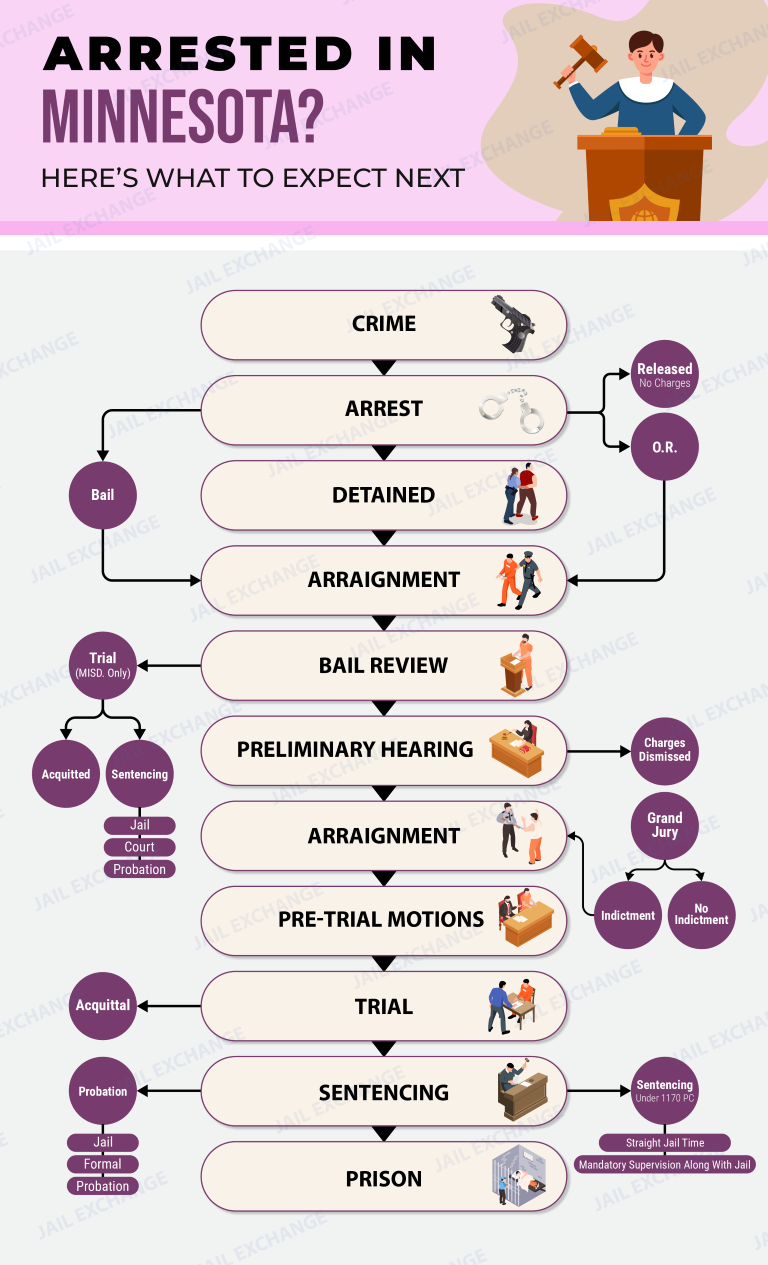
On many minor charges, a Dodge County deputy or city officer issues a citation and releases the person. An arrested person who is booked may be released on scheduled bail or held under contract in another county's jail until court. Anyone held must be brought before a Dodge County judge within 36 hours of arrest, without counting the day of arrest, Sundays or legal holidays, and a judge must find probable cause within 48 hours of an arrest made without a warrant.
How release works
The judge can release the defendant on recognizance or set bail. Minnesota practice is to set two amounts, one higher and free of conditions, the other lower and tied to conditions such as no alcohol, testing or no contact with a named person. Commercial bail bonds may be used to post either amount.
The court calendar in Mantorville
A misdemeanor case begins with arraignment. A gross misdemeanor case begins with a Rule 5 first appearance. A pretrial conference follows, and most Dodge County cases end there with a negotiated resolution. A trial is heard by six jurors, all of whom must agree on the verdict. When the defense files a speedy-trial demand, trial must begin within 60 days.
Lawyers for those who cannot pay
A defendant facing possible jail who cannot afford counsel should ask the judge at the first appearance for appointed counsel. The Third Judicial District Public Defender represents eligible people charged in Dodge County.
Penalty limits in Dodge County
- Petty misdemeanor in Dodge County: a fine of up to $300, and no jail.
- Misdemeanor in the Mantorville courthouse: a 90-day jail maximum and a fine of no more than $1,000, the range for theft of $500 or less, trespass and fifth-degree assault.
- Gross misdemeanor in the Third District: up to 364 days and $3,000; theft above $500 up to $1,000, and fifth-degree assault after a prior, are charged here.
- First DWI on a Dodge County highway: Dodge County typically files it as fourth-degree DWI, a misdemeanor. An alcohol concentration of 0.16 or more, a child younger than 16 in the vehicle or a refusal to test leads to a third-degree gross misdemeanor instead. The license revocation is a separate administrative action, and the court orders a chemical use assessment; ignition interlock and plate impoundment are possible.
Cases may end in dismissal, a continuance for dismissal, a stay of adjudication, probation or fines. A typical Dodge County misdemeanor takes one to four months.
↑ Back to the question list2. Felony (for example, burglary, felony theft, drug sale, second-degree assault)
Any crime punishable by more than a year in prison is a felony, and in Dodge County every felony is prosecuted by the County Attorney. Charges are filed by complaint; grand juries are used only for offenses carrying life imprisonment.
Hearings in a Dodge County felony
The Rule 5 first appearance comes within 36 hours for a defendant in custody. The judge explains the charge, rules on the request for a public defender and sets bail and release conditions. At the Rule 8 second appearance, discovery is shared and the defendant may plead. The omnibus hearing allows the defense to challenge a search, a confession or the existence of probable cause. The pretrial or settlement conference that follows is where most Dodge County felonies end in a plea agreement. A felony trial in Mantorville uses 12 jurors whose verdict must be unanimous, and a defendant who demands a speedy trial must be tried within 60 days.
Appointed defense
The Third Judicial District Public Defender represents eligible felony defendants in Dodge County, usually starting with the Rule 5 hearing.
Felony sentences in Dodge County
- Theft in Dodge County above $1,000: up to 5 years; theft above $5,000 carries 10, and above $35,000, 20.
- Burglary in the Third District: 20 years is the maximum for first degree, 10 for second degree and 5 for third degree.
- First-degree drug sale before a Mantorville judge: up to 30 years.
- Second-degree assault in Dodge County: up to 7 years when a dangerous weapon was used, plus a mandatory minimum for a firearm.
Probation conducts a presentence investigation before sentencing. The Minnesota Sentencing Guidelines compare the offense severity level with the defendant's criminal history score and produce a presumptive sentence, either a stayed sentence served on probation or a prison commitment. Dodge County judges can depart only for substantial and compelling reasons. A stay of imposition lets the conviction become a misdemeanor on the record when probation is successfully completed. Prison terms are typically served two-thirds inside and one-third on supervised release. Expect a felony case in Dodge County to take four to twelve months.
↑ Back to the question list3. Violent felony (for example, murder, criminal sexual conduct, aggravated robbery)
Violent felony charges in Dodge County follow the felony process above, but bail is generally set high and many defendants remain in a contracted jail outside the county until trial. A first-degree murder charge requires an indictment by a grand jury.
What these crimes carry
- First-degree murder in Dodge County: life in prison. For premeditated murder and certain other forms the sentence is life without parole; otherwise parole eligibility comes after 30 years.
- Second-degree murder in Mantorville's District Court: up to 40 years.
- Third-degree murder in Mantorville's District Court: up to 25 years.
- First-degree criminal sexual conduct in Dodge County: a maximum of 30 years, with a 144-month presumptive sentence for a first offense.
- First-degree aggravated robbery in Dodge County: up to 20 years.
Since Minnesota abolished capital punishment in 1911, no Dodge County case can end in a death sentence. Crime victims are entitled under chapter 611A of Minnesota Statutes to notice, to be present and to make a statement before sentencing.
Defense and duration
Eligible defendants are represented by the Third Judicial District Public Defender. Lab work, experts and motions make these prosecutions lengthy, and a Dodge County violent felony often takes one to two years or more.
↑ Back to the question list4. Juveniles (under 18) arrested in Dodge County
Youth under 18 accused of offenses in Dodge County appear in the juvenile division of District Court in Mantorville. The County Attorney decides whether to file a delinquency petition, and first-time offenders are frequently offered diversion so the case can be resolved without a court finding.
A youth who must be held is typically taken to whichever nearby licensed center has an open bed, such as the Dakota County Juvenile Services Center in Hastings or the Houston County juvenile detention center in Caledonia, never to an adult jail. Within 36 hours of a Dodge County youth's detention, not counting weekends and holidays, a judge must hold a detention hearing. Youth who qualify are appointed a public defender.
For serious offenses, a youth aged 14 to 17 may be prosecuted as an Extended Jurisdiction Juvenile, which adds a stayed adult sentence to the juvenile disposition. The County Attorney can also move to certify a youth 14 or older to adult court, and certification is presumed for 16- and 17-year-olds charged with an offense carrying presumptive prison or committed with a firearm. A Dodge County 16- or 17-year-old charged with first-degree murder is prosecuted in adult court. Juvenile records are generally confidential, though certain felony records involving youth 16 and older may be public.
↑ Back to the question list5. Federal cases (U.S. District Court) from Dodge County
When a crime committed in Kasson, Dodge Center, Hayfield or elsewhere in Dodge County is charged under federal law, the case is heard not in Mantorville but in the U.S. District Court for the District of Minnesota. Dodge County is part of that court's Third Division, which meets at the Warren E. Burger Federal Building and U.S. Courthouse, 316 N. Robert Street, St. Paul, MN 55101. Jurors from the division report to St. Paul or Minneapolis, and a defendant's initial appearance and detention hearing are often held in one of those two cities. Dodge County callers can reach the federal Clerk of Court at (612) 664-5000.
What makes it federal. Cases usually come from investigations by the FBI, DEA, ATF, Homeland Security Investigations, IRS or U.S. Postal Inspectors, often working with local officers. The usual charges are drug trafficking involving large quantities or interstate shipments, illegal gun possession by people with felony convictions, fraud, child exploitation, bank robbery and immigration offenses. Federal prosecutors can also adopt an arrest made by the Dodge County Sheriff's Office, and a person may face state and federal charges over the same events.
Who handles the case.
- Prosecutor: U.S. Attorney's Office for the District of Minnesota, St. Paul office at 316 N. Robert Street, Suite 404, St. Paul, MN 55101, (651) 848-1950, and main office at 300 S. 4th Street, Suite 600, Minneapolis, MN 55415, (612) 664-5600.
- Appointed defense: Office of the Federal Defender, 107 U.S. Courthouse, 300 S. 4th Street, Minneapolis, MN 55415, (612) 664-5858; a private CJA panel attorney steps in when the office has a conflict.
- Custody: U.S. Marshals Service, St. Paul, (651) 848-1435.
The federal process. First comes an initial appearance before a U.S. magistrate judge, who explains the charges and makes sure a lawyer is assigned. Prosecutors who want the person held must ask for a detention hearing, which usually takes place within three court days. The Bail Reform Act lets the judge release the defendant under conditions supervised by U.S. Probation and Pretrial Services, or detain the person if nothing short of custody will ensure appearance and safety. Bail bonds are not part of federal practice, and money bail is uncommon. If the case began by complaint, an indictment must follow within 30 days of the arrest, and arraignment comes next. Trial is supposed to start within 70 days under the Speedy Trial Act, although delays are frequently granted, and the great majority of cases end with a plea bargain. Jury verdicts require all 12 jurors to agree. Around three months after conviction, the judge reviews a presentence report and sentences under the advisory guidelines and any mandatory minimum. Parole has been abolished federally, so good-conduct time still leaves at least about 85% of the sentence to serve in a Bureau of Prisons facility, followed by supervised release. An appeal goes to the Eighth Circuit.
Finding a detainee. Dodge County already sends its own prisoners to other counties' jails, and federal detainees are placed separately by the Marshals in contract jails across Minnesota or out of state. The St. Paul Marshals office can tell family where a person is, and the Bureau of Prisons inmate locator covers people who have been sentenced. Federal prosecutors seldom charge Dodge County youth under 18.
↑ Back to the question listThis summary of the criminal process in Dodge County is for general information and is not legal advice. Anyone charged should consult a defense attorney or ask the court to appoint the Third Judicial District Public Defender; the Mantorville courthouse can be reached at (507) 624-7010, and the Sheriff's Office can say where a detainee is housed at (507) 635-6200.
Information for this service is currently unavailable.
People held by the Dodge County Sheriff's Office are kept at the Olmsted County Adult Detention Center in Rochester, so money for them goes onto an Olmsted County jail account.
- Online: Make a free account with Inmate Canteen, the company Olmsted County uses. You can add up to $500 per credit card, per person, every 30 days, and the money is ready right away.
- Kiosk: Machines that look like bank ATMs take cash, credit or debit cards at the Adult Detention Center, 101 4th Street SE, Rochester, and at the Work Release Facility, 140 4th Street SE, Rochester. After business hours, press the intercom and say you want to add money to someone's account.
- Money order by mail: The jail chooses not to publish a mailing address or payee for money orders. The only way to get it is to call the Olmsted County Adult Detention Center, where Dodge County holds people, at 507-328-6790, with the person's full name and date of birth ready.
If the person owes the jail money, part or all of a deposit pays that debt first. The rest buys video visit time, phone time, envelopes, stamps, paper and vending machine food. Staff will not tell family or friends what is in the account. Never mail cash or a personal check.
Dodge County, Minnesota, has no jail of its own. The Dodge County Sheriff's Office boards people under a contract with Olmsted County, so anyone arrested in Dodge County is usually held at the Olmsted County Adult Detention Center in Rochester. The sheriff's in-custody list shows who is being held. Mail follows Olmsted's rules, and personal letters do not go to Rochester at all.
Personal letters and photos (scanned):
Inmate's Full Name & Inmate Number
Olmsted County Jail
P.O. Box 16120
Jonesboro, AR 72401
Legal mail (to the Rochester jail):
Inmate's Full Name & Inmate Number
Olmsted County Adult Detention Center
101 4th Street SE
Rochester, MN 55904
- Digital delivery: Letters from family and friends go to a mail-scanning service, and the detainee reads a digital copy. Olmsted County, like many jails, went digital because some people soak letters in drugs such as heroin or meth, let them dry, and mail them in.
- Addressing: Write the person's name and their inmate number on the envelope. Every piece of mail is searched.
- What you can send: Handwritten letters in pen or pencil, typed letters, and photos that are appropriate and show no gang signs.
- What gets refused: Crayon or marker writing, blank paper, envelopes, stamps, stickers, anything with a smell or a liquid on it, and obscene or gang material.
- No reading material: Books, magazines, newspapers and pages or articles torn or copied from them are not allowed.
- No packages or checks: Packages, personal checks and checks from anyone else are refused.
- Money: Put money on the account online or at the kiosks at the Olmsted County jail buildings in Rochester.
Detainees can't take phone calls, but you can send electronic messages and photos once you set up an account.
Information for this service is currently unavailable.
Information for this service is currently unavailable.
Information for this service is currently unavailable.
Dodge County County Jails
Dodge County Juvenile Facilities
Nearby counties
- Olmsted County Adult Detention Center: 507-328-6790
- Dodge County Sheriff: 507-635-6200
The Dodge County Sheriff serves the following cities and towns of Dodge County: Blooming Prairie, Claremont, Dodge Center, Hayfield, Kasson, Mantorville and West Concord.