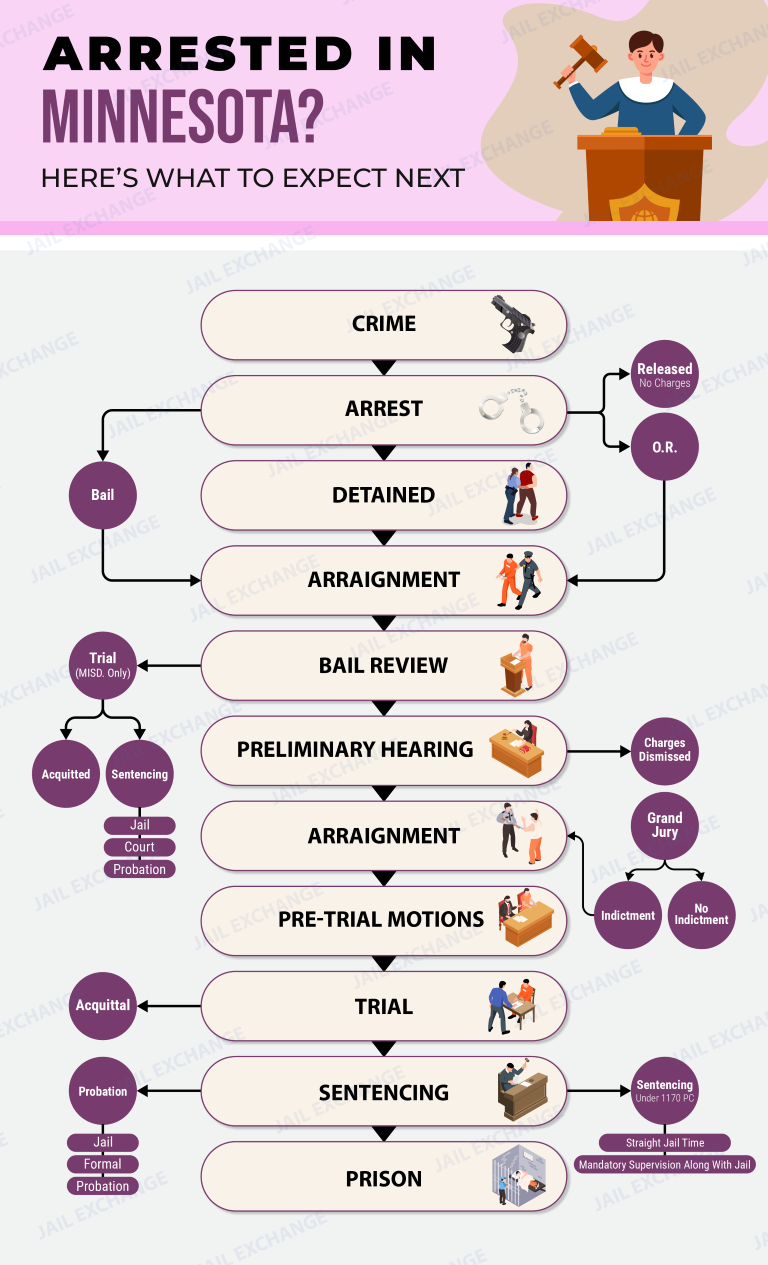
Hennepin County Adult Detention Center Criminal Court Process
Criminal Court Process for Hennepin County Minnesota
Hennepin County Criminal Cases: Courthouse, Charges and Court Dates in Minneapolis
The Hennepin County District Court makes up the whole Fourth Judicial District, and its main criminal home is the Government Center, 300 South Sixth Street, Minneapolis, MN 55487. Court administration answers at 612-348-6000. Some suburban cases below the felony level are heard in Brooklyn Center or Minnetonka. People held after arrest go to the county jail in the Public Safety Facility, 401 South Fourth Avenue, Suite 100, Minneapolis, MN 55415, which also uses space in City Hall.
Look up a name in the hourly jail roster to view charges and hearing dates. Our Inmates in Custody page goes over who is locked up, new bookings and free legal help.
Dial 612-348-6000 and ask which building and courtroom the first hearing is in, since cases can be heard downtown or in the suburbs. If a judge set bail, our Hennepin bail page explains how to post it.
1. Hennepin County courthouses and which cases go where
Hennepin County, home to Minneapolis and dozens of suburbs, makes up Minnesota's Fourth Judicial District on its own, and its District Court is the busiest trial court in the state. Felony cases are heard in downtown Minneapolis, at the Hennepin County Government Center and the adjoining Public Safety Facility, while lower-level suburban cases are also heard at courthouses in Brooklyn Center and Minnetonka. The Hennepin County Attorney prosecutes every felony and juvenile case; the Minneapolis City Attorney and suburban city prosecutors handle misdemeanors and gross misdemeanors from their cities. Adults who are arrested and held are booked into the Sheriff's jail at the Public Safety Facility.
- Hennepin County District Court, Criminal Division (Fourth Judicial District), Hennepin County Government Center, 300 South Sixth Street, Minneapolis, MN 55487, (612) 348-6000
- Hennepin County Public Safety Facility (courtrooms for in-custody and other criminal hearings, and the county jail), 401 South Fourth Avenue, Minneapolis, MN 55415
- Brookdale Courthouse (suburban non-felony cases), 6125 Shingle Creek Parkway, Brooklyn Center, MN 55430, (612) 348-6000
- Ridgedale Courthouse (suburban non-felony cases), 12601 Ridgedale Drive, Minnetonka, MN 55305, (612) 348-6000
- Hennepin County Attorney's Office, Hennepin County Government Center, 300 South Sixth Street, Minneapolis, MN 55487, (612) 348-5550
- Hennepin County Public Defender's Office (State Board of Public Defense), 701 Fourth Avenue South, Suite 1400, Minneapolis, MN 55415, (612) 348-7530
- Hennepin County Jail (Hennepin County Sheriff's Office), Public Safety Facility, 401 South Fourth Avenue, Suite 100, Minneapolis, MN 55415, (612) 348-5112
- Fourth District Warrant Helpline, (612) 540-6485
Which court hears your case. All criminal charges in the county, whether a petty misdemeanor ticket from Edina or a homicide in north Minneapolis, are filed in the one Hennepin County District Court; Minnesota has no separate city or municipal courts. The charge level decides who prosecutes and which steps follow, and in Hennepin it also affects where hearings take place. Misdemeanors and gross misdemeanors that occur in Minneapolis are prosecuted by the Minneapolis City Attorney's Office, and those in suburbs such as Bloomington, Brooklyn Park or Plymouth are prosecuted by each city's attorney, often a private firm under contract. The Hennepin County Attorney handles lower-level offenses only in the few areas without their own prosecutor, and it charges every felony in the county.
Where pretrial detainees are held. People arrested in Hennepin County who are not cited and released are booked by the Hennepin County Sheriff's Office into the county jail at the Public Safety Facility, 401 South Fourth Avenue in downtown Minneapolis, which has more jail space across the street in Minneapolis City Hall at 350 South Fifth Street. Pretrial detainees stay there until they post bail, are released by a judge, or their case ends. The jail information line is (612) 348-5112.
The Fourth Judicial District's Criminal Division works out of two downtown Minneapolis buildings and two suburban courthouses. Your citation, summons or release paperwork lists the exact courtroom, so check it before you go.
- Hennepin County Government Center, 300 South Sixth Street: the main criminal court offices are in the C tower, and many felony hearings and trials are held here. Criminal court administration answers at (612) 348-6000 on weekdays from 8:00 a.m. to 4:30 p.m.
- Public Safety Facility, 401 South Fourth Avenue: courtrooms here handle many in-custody first appearances, and people with certain warrants must turn themselves in at this building.
- Brookdale Courthouse, Brooklyn Center: hears non-felony criminal and traffic cases from northern and northwestern suburbs, including Brooklyn Center, Brooklyn Park, Crystal, New Hope, Robbinsdale, Champlin, Rogers and Osseo.
- Ridgedale Courthouse, Minnetonka: hears non-felony criminal and traffic cases from western and southwestern suburbs, including Minnetonka, Edina, St. Louis Park, Hopkins, Eden Prairie, Wayzata and the Lake Minnetonka communities.
Non-felony cases from Minneapolis, Bloomington, Richfield and the airport are heard downtown. The former Southdale courthouse in Edina has closed, and its cases were moved to Ridgedale and downtown. Suburban courthouses do not hear felonies; a suburban felony arrest is handled downtown. The court has moved some suburban case assignments in recent years, so confirm the location printed on your notice. Missed a court date? The Warrant Helpline at (612) 540-6485 can schedule many cases back on the calendar, although the warrant stays active until you actually appear.
↑ Back to the question list2. What happens after an arrest in Hennepin County
An arrest by Minneapolis Police, a suburban department, Metro Transit Police, the State Patrol or the Sheriff's Office usually leads to one of two outcomes. On many lower-level offenses the officer issues a citation with a court date and lets the person go. Otherwise, the person is brought to the Public Safety Facility for booking: fingerprints, photographs, a property inventory, a medical screening and a records check.
Bail schedule and pretrial screening
Some people booked on misdemeanors can be released by paying the amount on the court's bail schedule. Others wait for a judge. Before the first appearance, the county's pretrial services staff often interview the person and prepare a release evaluation that the judge reviews.
The 36-hour and 48-hour rules
Minnesota Rule of Criminal Procedure 4.01 requires that anyone kept in custody be brought before a judge within 36 hours after arrest, not counting the day of arrest, Sundays and legal holidays. When the arrest was made without a warrant, a judge must also review the facts and find probable cause within 48 hours; if no complaint is filed in time, the person must be released. In practice, a Friday-evening arrest in Hennepin County may not reach a courtroom until Monday or Tuesday.
Release decisions
At the first appearance, a Fourth District judge may release a defendant on recognizance or set conditional release. Hennepin judges commonly name two amounts: a higher bail with no conditions and a lower bail with conditions such as no contact with the alleged victim, no alcohol, check-ins with pretrial supervision, or electronic or alcohol monitoring. Bail can be posted in cash at the jail or through a licensed bail bond agent, since commercial bonding is legal in Minnesota.
↑ Back to the question list3. The Hennepin County Jail
The Hennepin County Jail is run by the elected Hennepin County Sheriff and serves as the intake and pretrial detention site for the entire county. Its main address is the Public Safety Facility, 401 South Fourth Avenue, Suite 100, Minneapolis, MN 55415, and it also uses housing inside Minneapolis City Hall at 350 South Fifth Street. The jail phone number is (612) 348-5112.
- Finding someone: the Sheriff's online jail roster is updated hourly and shows people now in custody and those released in the past week, along with charges, bail amounts and court dates.
- Posting bail: once a judge has set bail, it can be posted at the jail or through a bondsman; the roster and jail staff can confirm the current amount.
- After sentencing: people serving shorter local sentences may be moved to the county's Adult Corrections Facility in Plymouth, while those sentenced to more than a year go to the Minnesota Department of Corrections.
4. Getting a public defender in Hennepin County
Indigent defense in Hennepin County is provided by the Hennepin County Public Defender's Office, part of the State Board of Public Defense and one of the largest public defense offices in the state. Its main office is at 701 Fourth Avenue South, Suite 1400, Minneapolis, MN 55415, (612) 348-7530.
Eligibility depends on income and household size compared with the cost of hiring a private lawyer. You can ask for a public defender at your first appearance, and the judge decides whether to appoint one; public defenders are frequently present in the in-custody courtrooms so that a lawyer can speak for you on bail the same day. Appointment is available for misdemeanors that carry possible jail time as well as gross misdemeanors, felonies, juvenile delinquency cases and probation violations. If you were appointed a public defender but have not heard from the assigned attorney before your next date, call the office directly.
↑ Back to the question list5. Prosecutors and diversion in Hennepin County
Three kinds of prosecutors appear in Hennepin County criminal courtrooms:
- The Hennepin County Attorney's Office, led by the elected County Attorney, charges all adult felonies, all juvenile delinquency cases, and non-felony offenses in places that lack their own prosecutor. Main line: (612) 348-5550.
- The Minneapolis City Attorney's Office prosecutes misdemeanors and gross misdemeanors committed inside Minneapolis, including most first and second DWIs, domestic assaults charged below felony level, and theft under $1,000.
- Suburban city attorneys handle non-felony cases for their own cities, from Bloomington and Brooklyn Park to Wayzata, often through private attorneys the cities hire.
Diversion is a significant part of the Hennepin County system. The County Attorney's Office runs adult diversion programs for some lower-level felony and first-time offenders, which can lead to charges never being filed or being dismissed after the person completes requirements such as restitution, classes or community service. City prosecutors in Minneapolis and many suburbs also offer diversion or a continuance for dismissal on first-time misdemeanors. Eligibility depends on the offense, criminal history and the position of any victim, so ask your attorney whether a program might apply.
↑ Back to the question list6. Treatment and specialty courts in Hennepin County
The Fourth Judicial District runs treatment courts as alternatives to traditional sentencing for people whose offenses are tied to addiction, mental illness or military service. These courts involve frequent court reviews with the same judge, intensive probation supervision, drug and alcohol testing, and treatment, with incentives for progress and sanctions for violations.
- DWI court: for repeat impaired drivers, with long-term sobriety monitoring and treatment.
- Drug court: for people charged with drug-related felonies whose offenses are driven by substance use disorders.
- Veterans court: for veterans and service members whose cases connect to service-related conditions, with help from veterans' services agencies.
- Mental health court: for defendants with serious mental illness, linking court supervision to treatment and community support.
Entry is not automatic. A defense lawyer, the prosecutor or probation can refer a case, the team screens for eligibility, and the defendant usually has to plead guilty and agree to the program's terms. Completing a treatment court can mean a reduced charge, a dismissal or a stayed sentence that is never executed.
↑ Back to the question list7. Misdemeanor (for example, theft, a first DWI, fifth-degree assault, trespassing)
Hennepin County District Court hears an enormous volume of petty misdemeanors, misdemeanors and gross misdemeanors, downtown and in Brooklyn Center and Minnetonka. A petty misdemeanor is legally not a crime. Misdemeanors and gross misdemeanors are crimes and can lead to jail or a stay at the Adult Corrections Facility.
Arraignment and early hearings
A person who was cited appears at an arraignment on the date shown on the ticket; some payable arraignment calendars are held remotely. A person held in jail is arraigned within the 36-hour limit. At arraignment the Fourth District judge explains the charge, considers appointing the Hennepin County Public Defender, and decides on release. The case then moves to a pretrial hearing, where the Minneapolis City Attorney or the suburban prosecutor may offer diversion, a continuance for dismissal, a reduced charge or a plea. Defendants who go to trial get a jury of six, and the verdict must be unanimous.
Hennepin County penalty ranges at this level
- Petty misdemeanor: a Hennepin County fine of up to $300 and no jail.
- Misdemeanor: up to 90 days in custody and up to $1,000 in fines; this includes theft of $500 or less, trespass and fifth-degree assault.
- Gross misdemeanor: a Hennepin gross misdemeanor can mean 364 days and a $3,000 fine; examples in Hennepin courts include theft of $500 to $1,000 and fifth-degree assault after a prior domestic or assault conviction.
- First DWI in Hennepin County: fourth-degree DWI, a misdemeanor, unless one aggravating factor is present, such as an alcohol concentration of 0.16 or more, a child under 16 in the vehicle, or a refusal to test, which raises it to third-degree DWI, a gross misdemeanor. The administrative license revocation runs separately from the criminal case. A chemical use assessment is required, and ignition interlock, license plate impoundment and, in aggravated cases, vehicle forfeiture may follow.
A stay of adjudication can leave no conviction on the record after probation, and fines, probation, community work service and short jail terms are also common. Most Hennepin misdemeanor cases are completed within one to four months, though crowded calendars sometimes stretch that.
↑ Back to the question list8. Felony (for example, burglary, felony theft, drug sale, second-degree assault)
Felonies, offenses punishable by more than a year in prison, are charged by the Hennepin County Attorney through a written complaint and heard downtown in Minneapolis, even when the arrest happened in a suburb.
The Hennepin felony hearing sequence
- Rule 5 first appearance: within 36 hours for anyone in custody. The judge reviews the complaint, appoints the Hennepin County Public Defender for those who qualify, and sets bail and conditions.
- Rule 8 hearing: the second appearance, where discovery is exchanged and a plea may be entered or the case set for further hearings.
- Omnibus hearing: the defense can challenge searches, statements, identification procedures and probable cause.
- Pretrial or settlement conference: most Hennepin felony cases end here in a plea agreement.
- Trial: a twelve-person jury that must be unanimous. A defendant who formally demands a speedy trial must be tried within 60 days of the demand.
- Sentencing: after a conviction, county probation completes a presentence investigation.
Hennepin County felony sentences
- Theft: more than $1,000 carries up to 5 years in a Hennepin case; more than $5,000, up to 10 years; more than $35,000, up to 20 years.
- Burglary: a downtown judge can impose up to 5 years for third degree, 10 years for second degree and 20 years for first degree.
- First-degree sale of a controlled substance: up to 30 years.
- Second-degree assault (dangerous weapon): up to 7 years, and a firearm brings a mandatory minimum prison term.
Within these limits, sentences are guided by the Minnesota Sentencing Guidelines, which combine the offense severity level with the defendant's criminal history score. The result is a presumptive stayed sentence (probation, sometimes with local jail time) or a presumptive executed prison term, and a judge may depart only for substantial and compelling reasons. A stay of imposition allows the felony to be recorded as a misdemeanor after probation is successfully completed. A Hennepin defendant sent to prison typically spends two-thirds of the term behind bars and the final third on supervised release. Hennepin felony cases usually take four to twelve months.
↑ Back to the question list9. Violent felony (for example, murder, criminal sexual conduct, aggravated robbery)
Hennepin County handles more homicide and serious violent cases than any other Minnesota county. They follow the felony steps above, but bail is generally set very high, and many defendants remain in the Public Safety Facility throughout the case. First-degree murder is the only charge in Minnesota that requires a grand jury indictment, so the County Attorney presents those cases to a Hennepin County grand jury; second- and third-degree murder may be charged by complaint.
Maximum penalties
- First-degree murder: life imprisonment. Premeditated murder and certain other forms bring life without the possibility of parole; for the remaining first-degree convictions, a Hennepin defendant becomes parole-eligible after 30 years. Minnesota abolished capital punishment in 1911, so no Hennepin case can lead to a death sentence.
- Second-degree murder: up to 40 years. Third-degree murder: up to 25 years.
- First-degree criminal sexual conduct: up to 30 years, with a presumptive sentence of 144 months for an offender with no criminal history.
- First-degree aggravated robbery: up to 20 years.
Lawyers, victims and timelines
The Hennepin County Public Defender's Office assigns experienced trial attorneys to homicide and other serious violent cases. Victims and their families have rights under Minnesota Statutes chapter 611A, including notice of hearings and plea agreements, the right to attend, and the right to give an impact statement at sentencing; the County Attorney's victim-witness staff help them use those rights. Because of forensic testing, expert witnesses, and pretrial motions, these cases commonly take one to two years or more to reach trial or a plea.
↑ Back to the question list10. Juveniles (under 18) arrested in Hennepin County
Youth under 18 accused of offenses in Hennepin County go to the Juvenile Division of the Fourth Judicial District, which sits at the Juvenile Justice Center, 590 Park Avenue in Minneapolis. The Hennepin County Attorney's Office decides whether to file a delinquency petition; many first-time and lower-level cases are instead referred to diversion programs that, when completed, keep the case out of court.
Detention
Youth who are not released to a parent or guardian are held at the Hennepin County Juvenile Detention Center, 510 Park Avenue, Minneapolis, MN 55415, which is separate from the adult jail. A judge must hold a detention hearing within 36 hours of the youth being taken into custody, excluding weekends and holidays, and decide whether the youth can go home, perhaps with electronic monitoring or other conditions, or must stay detained. The Hennepin County Public Defender's Office has attorneys who represent youth in juvenile court.
Serious charges
For certain 14- to 17-year-olds, the County Attorney may ask for Extended Jurisdiction Juvenile (EJJ) prosecution, which keeps the case in juvenile court but adds a stayed adult sentence that can be executed if the youth violates the terms. Youth 14 and older may also be certified to stand trial as adults, and certification is presumed for 16- and 17-year-olds charged with an offense that carries a presumptive prison sentence or that was committed with a firearm. Sixteen- and seventeen-year-olds charged with first-degree murder are prosecuted in adult court from the start. Juvenile records are generally confidential, though some felony-level records of youth 16 and older can be open to the public.
↑ Back to the question list11. Federal cases (U.S. District Court) from Hennepin County
Downtown Minneapolis holds the main federal courthouse for Minnesota as well as Hennepin County's own criminal courts. The U.S. District Court for the District of Minnesota assigns Hennepin County to its Fourth Division, which sits at the Diana E. Murphy U.S. Courthouse, 300 S. 4th Street, Minneapolis, MN 55415, a short walk from the Government Center and the Public Safety Facility. Jurors for Fourth Division trials report to Minneapolis, and for Hennepin County defendants the initial appearance and detention hearing are usually held right there, though a hearing is sometimes set in St. Paul. The Clerk of Court for the Minneapolis courthouse answers at (612) 664-5000.
Which Hennepin County cases become federal
A case is federal when it charges a crime under federal law. Most are investigated by the FBI, DEA, ATF, Homeland Security Investigations, U.S. Postal Inspectors or IRS Criminal Investigation, often in task forces with Minneapolis police, suburban departments and the Hennepin County Sheriff. Frequent charges in Minneapolis and its suburbs include:
- drug trafficking, especially fentanyl, methamphetamine and other drugs in large amounts or brought across state lines;
- being a felon in possession of a firearm, possessing machine-gun conversion devices, and using a gun during a drug crime or violent crime;
- fraud, including large schemes against government benefit and nutrition programs, wire and bank fraud, and investment fraud;
- carjacking, robbery of banks and businesses, and other violent crimes with a federal element;
- child exploitation offenses and immigration crimes.
An arrest that starts in Hennepin County District Court can be adopted by federal prosecutors, sometimes with the state charges dismissed afterward, and the Constitution allows both governments to prosecute the same act.
The federal offices, all in downtown Minneapolis
- U.S. Attorney's Office for the District of Minnesota: U.S. Courthouse, 300 S. 4th Street, Suite 600, Minneapolis, MN 55415, (612) 664-5600. The office also has a St. Paul location at 316 N. Robert Street, Suite 404, St. Paul, MN 55101, (651) 848-1950.
- Office of the Federal Defender for the District of Minnesota, in the same building: 107 U.S. Courthouse, 300 S. 4th Street, Minneapolis, MN 55415, (612) 664-5858. It represents people who cannot afford a lawyer; when it has a conflict, the court appoints a private attorney from its CJA panel.
- U.S. Marshals Service, Minneapolis: (612) 664-5900, responsible for federal prisoners and their transport to court.
Stages of a federal case
1. Arrest and first hearing. The defendant is arrested by federal agents or on a federal warrant or indictment and brought before a U.S. magistrate judge. The judge explains the charges and penalties and appoints counsel for those who qualify.
2. Detention or release. If the prosecutor asks for detention, a hearing is usually held within three court days. Under the Bail Reform Act, the judge releases the defendant on conditions, supervised by U.S. Probation and Pretrial Services, or orders detention because no conditions would reasonably assure appearance and the safety of the community. Bail bondsmen have no part in federal court and money bail is rare, unlike in the Hennepin County courtrooms down the street.
3. Indictment. A defendant arrested on a complaint must be indicted by a grand jury within 30 days, unless a preliminary hearing is held instead. Arraignment on the indictment follows.
4. Plea or trial. The Speedy Trial Act requires trial within 70 days of indictment or first appearance, but continuances are common in cases with many defendants or heavy evidence. Most cases end in a plea agreement. A trial jury has 12 members and must be unanimous.
5. Sentencing. About three months after a plea or verdict, after U.S. Probation completes a presentence report, a district judge imposes sentence under the advisory U.S. Sentencing Guidelines and any mandatory minimum penalty.
6. Prison and supervised release. The federal system has no parole. With good-conduct time, a person serves at least about 85% of the prison term in a Bureau of Prisons facility, then a term of supervised release. Appeals are heard by the Eighth Circuit.
Locating a federal detainee
Being arrested in Minneapolis does not mean a federal defendant stays in the Public Safety Facility. The U.S. Marshals Service places pretrial detainees in county jails it contracts with around Minnesota, and sometimes in other states,. The Minneapolis Marshals office can tell relatives where a person is currently held. After sentencing, the Bureau of Prisons inmate locator shows the assigned institution. Hennepin County youth under 18 are only rarely charged federally.
↑ Back to the question listThis Hennepin County page gives an overview of how criminal cases move through the Fourth Judicial District and is not legal advice; individual cases can differ from what is described here. Anyone charged should speak with a defense attorney or request a public defender at the first hearing. The Hennepin County Public Defender's Office is at (612) 348-7530, and the District Court's criminal division is at (612) 348-6000.