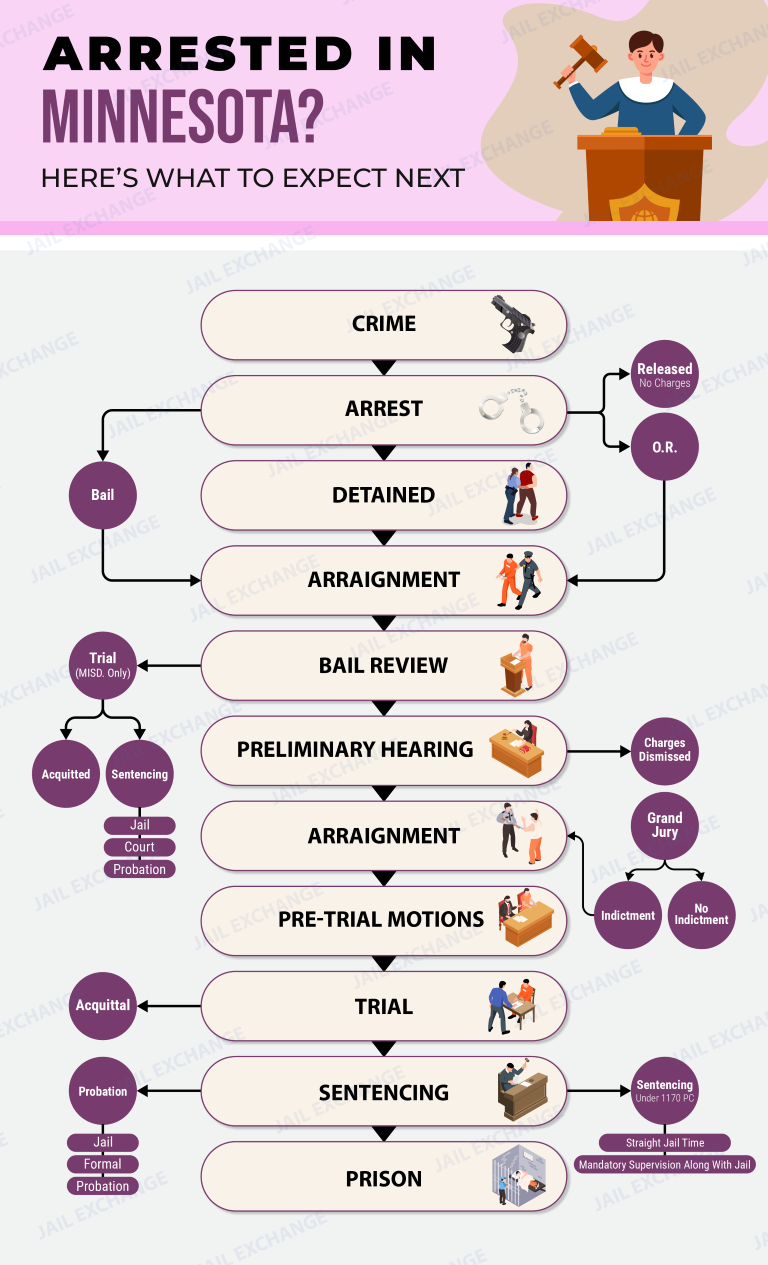
Houston County sits in Minnesota's far southeast corner, and its criminal cases are heard by the Houston County District Court on South Marshall Street in Caledonia, the county seat. The court belongs to the Third Judicial District. The Houston County Attorney charges all felonies and juvenile cases; misdemeanors and gross misdemeanors from La Crescent, Caledonia, Spring Grove, Houston and the other cities are generally prosecuted by city attorneys, and those from townships by the County Attorney. Adults who are held after an arrest stay in the Sheriff's jail in Caledonia.
- Houston County District Court (Third Judicial District), Houston County Courthouse, 306 South Marshall Street, Caledonia, MN 55921, (507) 724-7002
- Houston County Attorney's Office, Caledonia, (507) 725-5802
- Third Judicial District Public Defender (State Board of Public Defense), which covers appointed cases in Houston County; Houston County clients can reach its Winona office at 166 West Third Street, Suite 201, Winona, MN 55987, (507) 474-6440
- Houston County Jail (Houston County Sheriff), 306 South Marshall Street, Caledonia, MN 55921
Which court hears your case. In Houston County, as everywhere in Minnesota, there are no city courts; the District Court in Caledonia hears petty misdemeanors, misdemeanors, gross misdemeanors and felonies. The prosecutor and the procedure depend on how serious the charge is. A La Crescent misdemeanor, for instance, is ordinarily prosecuted by the attorney the city hires, while a similar offense in a rural township goes to the Houston County Attorney. Every felony, wherever it happens in the county, is the County Attorney's to charge.
Where pretrial detainees are held. When the Houston County Sheriff's Office, La Crescent or Caledonia police, or the State Patrol arrests someone who is not released, the person is booked into the Houston County Jail at 306 South Marshall Street in Caledonia, operated by the elected Sheriff. Detainees remain there until they post bail, a judge orders release, or the case is over. The Caledonia jail has also contracted to hold inmates for other Minnesota counties. Court Administration at (507) 724-7002 can confirm hearing dates.
- Misdemeanor (for example, theft, a first DWI, fifth-degree assault, trespassing)
- Felony (for example, burglary, felony theft, drug sale, second-degree assault)
- Violent felony (for example, murder, criminal sexual conduct, aggravated robbery)
- Juveniles (under 18) arrested in Houston County
- Federal cases (U.S. District Court) from Houston County
Misdemeanor (for example, theft, a first DWI, fifth-degree assault, trespassing)
Below the felony level, Houston County cases come in three grades: petty misdemeanors, which are not crimes and carry only a fine, plus misdemeanors and gross misdemeanors, both of which are crimes that can bring jail.
Ticket, booking and the clock
Many people charged with a minor offense in Houston County simply receive a citation with a date in Caledonia. Someone who is arrested and booked can often leave after posting the scheduled bail. If they stay in custody, they must appear before a judge within 36 hours, and that count leaves out the day of arrest, Sundays and legal holidays.
Arraignment and bail
The judge at a Houston County arraignment explains the charge and your rights, asks whether you want appointed counsel, and sets release terms. Minor cases often end in release on recognizance. In other cases the judge names a larger bail amount without conditions and a smaller amount that comes with conditions, such as abstaining from alcohol or having no contact with a named person. A bail bond company may post the bond, since commercial bail is lawful in Minnesota.
Lawyer, negotiation and trial
Defendants who qualify and face possible jail are assigned a lawyer from the Third Judicial District Public Defender. At the pretrial conference that follows, the city attorney or Houston County Attorney may propose a plea agreement, a lesser charge or a continuance for dismissal. If the case is tried, a jury of six people decides it, and the verdict has to be unanimous.
Sentencing limits in Houston County District Court
- Petty misdemeanor: the Caledonia court may fine up to $300 but may not jail.
- Misdemeanor: a Houston County misdemeanor can bring 90 days in jail and a fine of up to $1,000, for charges such as theft of $500 or less, trespass or fifth-degree assault.
- Gross misdemeanor: in Houston County, the cap is 364 days and $3,000, for charges such as theft of $500 to $1,000 or a second fifth-degree assault.
- First DWI in Houston County: normally fourth-degree DWI, a misdemeanor. If one aggravating factor exists, such as a 0.16 alcohol concentration or above, a child under 16 in the car, or a refusal to test, it becomes third-degree DWI, a gross misdemeanor. The license revocation runs administratively apart from the court case, the court orders a chemical use assessment, and ignition interlock or plate impoundment may be required.
Results include dismissals, stays of adjudication that avoid a conviction, fines, probation and jail. The usual Houston County misdemeanor takes one to four months.
Felony (for example, burglary, felony theft, drug sale, second-degree assault)
A Houston County felony is an offense with a potential prison sentence longer than one year. The County Attorney charges it by complaint, and a Third District judge in Caledonia presides.
Rule 5 and probable cause
People held in the Caledonia jail on felony charges come before a judge for the Rule 5 first appearance within 36 hours. If police arrested without a warrant, a judge must review probable cause within 48 hours. At Rule 5, the Houston County judge goes over the complaint, appoints a Third District public defender for qualifying defendants, and sets bail amounts and conditions.
After the first appearance
The Rule 8 hearing, the second appearance, is where the defense receives discovery and may enter a plea. Suppression and probable cause motions are argued at the omnibus hearing. Most Houston County felony cases resolve through negotiations at a pretrial or settlement conference. Trials are decided by a unanimous jury of twelve. A defendant who makes a speedy-trial demand has the right to a trial that starts within 60 days. A presentence investigation is prepared before sentencing.
Houston County felony penalties
- Theft: a theft above $1,000 in Houston County can bring up to 5 years, above $5,000 up to 10, and above $35,000 up to 20.
- Burglary: Caledonia judges can impose up to 5 years for third-degree, 10 for second-degree and 20 for first-degree burglary.
- First-degree drug sale: a maximum of 30 years.
- Second-degree assault: a maximum of 7 years, and a firearm makes a minimum prison term mandatory.
Actual sentences follow the Minnesota Sentencing Guidelines grid of offense severity and criminal history score, which sets a presumptive stayed or executed sentence. A Caledonia judge needs substantial and compelling reasons to depart from it. If a stay of imposition is granted and probation is completed, the conviction is recorded as a misdemeanor. A Houston County defendant sentenced to prison typically serves two-thirds of the term, then the remaining third on supervised release. These cases often take four to twelve months.
Violent felony (for example, murder, criminal sexual conduct, aggravated robbery)
Houston County violent felony cases move through the same Rule 5, Rule 8 and omnibus hearings as other felonies, but bail tends to be high and conditions strict, so many defendants wait out the case in the Caledonia jail. Only first-degree murder requires a grand jury indictment; the Houston County Attorney would convene a grand jury for such a charge.
- First-degree murder: life in prison, with no parole for premeditated murder and some other first-degree forms, and parole eligibility after 30 years for the rest. Capital punishment is off the table in Houston County, as Minnesota repealed it in 1911.
- Second-degree murder: a sentence of up to 40 years; third-degree murder: up to 25 years.
- First-degree criminal sexual conduct: a sentence of up to 30 years, with a presumptive 144 months for a first offense.
- First-degree aggravated robbery: a sentence of up to 20 years.
The Third Judicial District Public Defender continues to represent eligible Houston County defendants through trial and sentencing. Victims have rights under chapter 611A to notice, to be present at hearings and to make a statement at sentencing. Plan on one to two years, or more, for these cases to reach an end.
Juveniles (under 18) arrested in Houston County
Offenses by Houston County youth under 18 are heard by the juvenile division of the District Court in Caledonia. Delinquency petitions are filed by the Houston County Attorney, who frequently resolves first offenses through diversion, letting the youth complete conditions instead of going through a formal court case.
Houston County operates its own juvenile detention center, a short-term facility set up inside the county jail building at 306 South Marshall Street in Caledonia, with housing kept separate from adult inmates. It takes youth age 14 and older and also holds juveniles for other southeast Minnesota counties. Youth who cannot be placed there may be held at another licensed juvenile detention center. A judge must hold a detention hearing within 36 hours of custody, not counting weekends and holidays, and a public defender is appointed for the youth when needed.
Prosecutors have options for serious offenses. Some 14- to 17-year-olds can face Extended Jurisdiction Juvenile prosecution, in which the juvenile disposition comes with a stayed adult sentence. A youth 14 or older may be certified to adult court, and certification is presumed for 16- and 17-year-olds charged with an offense carrying a presumptive prison sentence or involving a firearm. When a Houston County 16- or 17-year-old is accused of first-degree murder, the case starts in adult court. Juvenile records are generally confidential, though some felony-level records for youth 16 and older may be public.
Federal cases (U.S. District Court) from Houston County
Houston County borders both Wisconsin and Iowa, and a crime that involves federal law, or more than one state, can bring charges in the U.S. District Court for the District of Minnesota rather than at the courthouse in Caledonia. The county is one of the Third Division counties, whose cases are handled at the Warren E. Burger Federal Building and U.S. Courthouse, 316 N. Robert Street, St. Paul, MN 55101. Federal jurors from the division report to St. Paul or Minneapolis. Initial appearances and detention hearings for a Houston County defendant are often held in St. Paul or Minneapolis too. Houston County residents can call the Clerk of Court at (612) 664-5000.
Typical federal charges. Agencies such as the FBI, DEA, ATF, Homeland Security Investigations, U.S. Postal Inspectors and the IRS investigate federal offenses. Those include drug trafficking in significant amounts or across state lines, which can arise along the La Crosse corridor near La Crescent, firearm possession by people with felony convictions, fraud, child exploitation, bank robbery and immigration violations. A case started by the Houston County Sheriff or a local police department may be adopted by federal prosecutors, and the state and federal governments can both prosecute the same conduct.
Contacts. Federal prosecutors are with the U.S. Attorney's Office for the District of Minnesota, St. Paul office: 316 N. Robert Street, Suite 404, St. Paul, MN 55101, (651) 848-1950; Minneapolis office: 300 S. 4th Street, Suite 600, Minneapolis, MN 55415, (612) 664-5600. Defendants who cannot hire a lawyer are represented by the Office of the Federal Defender, 107 U.S. Courthouse, 300 S. 4th Street, Minneapolis, MN 55415, (612) 664-5858, or, when that office has a conflict, by a private CJA panel attorney. The U.S. Marshals Service in St. Paul, (651) 848-1435, is in charge of federal custody.
Federal case timeline
Arrest and initial appearance: after agents arrest someone, or a federal warrant or indictment is served, a U.S. magistrate judge explains the charges and appoints a lawyer.
Detention: the government may request a detention hearing, which is usually held within three court days. Under the Bail Reform Act the defendant is released on conditions supervised by U.S. Probation and Pretrial Services unless no conditions will assure appearance and safety, in which case the judge orders detention. Money bail is rare and bondsmen are not part of the federal system.
Indictment: a case begun by complaint needs a grand jury indictment within 30 days of the arrest; arraignment follows.
Plea or trial: the Speedy Trial Act calls for trial within 70 days, though continuances are common. Most cases close with a plea agreement, and a trial jury of 12 must be unanimous.
Sentencing: about three months after conviction, using a presentence report, the advisory Sentencing Guidelines and any mandatory minimum. With parole abolished, at least about 85% of the sentence is served in the Bureau of Prisons, followed by supervised release. Appeals go to the Eighth Circuit.
The Marshals place federal pretrial detainees in contract jails around Minnesota and sometimes in other states, so a person arrested in Houston County may be moved away from Caledonia. Call the St. Paul Marshals office to locate someone, or check the Bureau of Prisons inmate locator after sentencing. Federal prosecutions of minors are rare.
This general guide to Houston County criminal procedure is offered for information only and is not legal advice. If you have been charged, a defense lawyer can explain your options, or you can ask the judge to appoint a public defender at your first appearance. Reach Houston County Court Administration in Caledonia at (507) 724-7002.