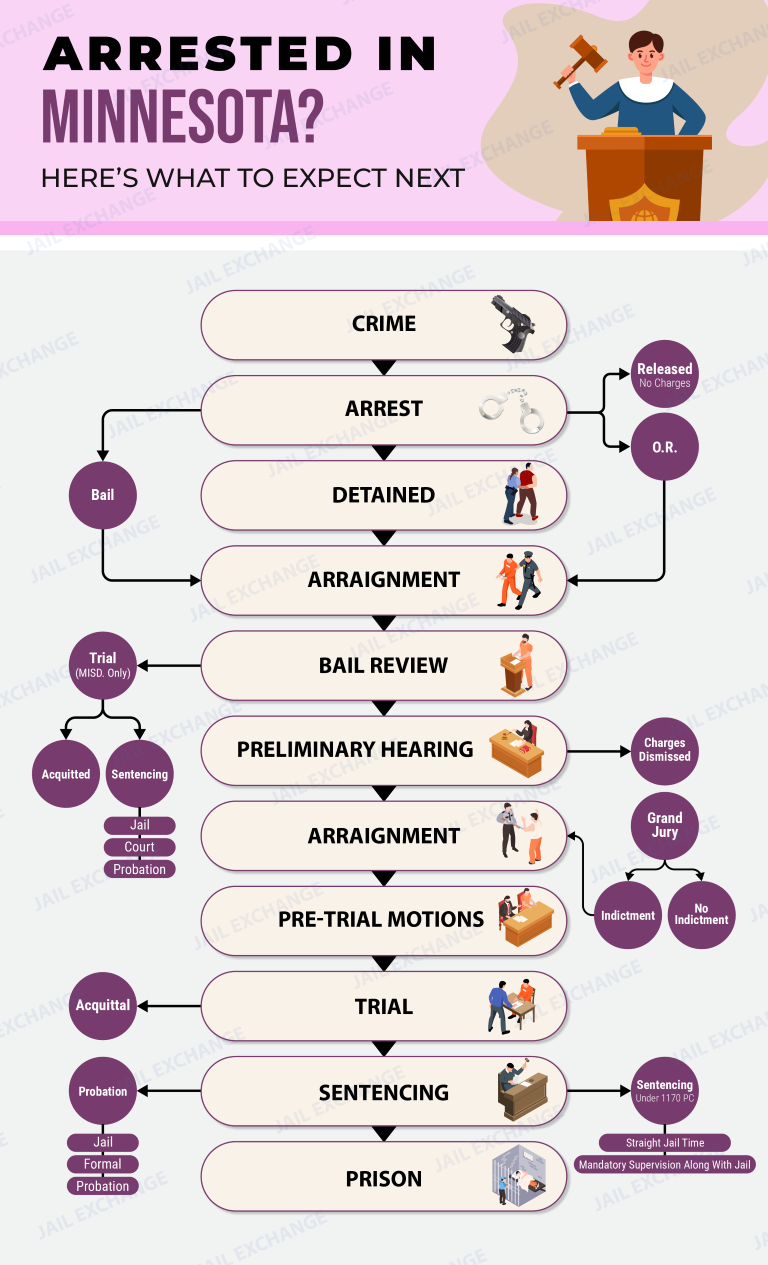
Isanti County Juvenile Detention Center Criminal Court Process
Criminal Court Process for Isanti County Minnesota
Isanti County Criminal Cases: Courthouse, Charges and Court Dates in Cambridge
Every criminal case from this county starts at the Isanti County Courthouse, part of the Tenth Judicial District, at 555 18th Avenue SW, Cambridge, MN 55008. Court administration takes calls at 763-290-7020. Anyone kept in custody waits at the Isanti County Jail in Cambridge until a judge sets release terms.
First, make sure the person is locked up here. The official in-custody list lets you search by name and shows the booking. For mugshots, charges and recent bookings, open our Isanti County Jail Roster.
Then ring court administration at 763-290-7020. Share who you are calling about, then request the case number plus the first hearing date. If cash is needed for release, our bail help for Isanti explains each step.
1. Misdemeanor (for example, theft, a first DWI, fifth-degree assault, trespassing)
Every criminal charge filed in Isanti County is heard by the Isanti County District Court at the courthouse in Cambridge, the county seat. Isanti is one of the counties in Minnesota's Tenth Judicial District, so its judges are part of the same district bench that serves Anoka, Chisago, Kanabec, Pine, Sherburne, Washington and Wright counties. The elected Isanti County Attorney prosecutes every felony and juvenile case, while lower-level offenses from inside Cambridge, Isanti and Braham are generally handled by the city's own prosecuting attorney. Adults who are arrested are booked into the Isanti County Jail, which the Sheriff runs at 509 18th Avenue SW in Cambridge.
- Isanti County District Court / Court Administration (Tenth Judicial District), Isanti County Courthouse, 555 18th Avenue SW, Cambridge, MN 55008, (763) 290-7020
- Isanti County Attorney's Office, 555 18th Avenue SW, 2nd Floor, Cambridge, MN 55008, (763) 689-8334
- Tenth District Public Defender's Office (Minnesota Board of Public Defense), which represents eligible adults and juveniles in Isanti County; ask for appointment at the first court appearance; Isanti County clients can reach its North Branch office at 38986 14th Avenue, North Branch, MN 55056, (763) 689-7070
- Isanti County Sheriff's Office, 2440 South Main Street, Cambridge, MN 55008, Sheriff (763) 689-2141; Isanti County Jail, 509 18th Avenue SW, Cambridge, MN 55008, jail master control (763) 689-2397
- Isanti County Probation, 555 18th Avenue SW, Lower Level, Room 0029, Cambridge, MN 55008, (763) 689-3052
Which court hears your case. Minnesota has no municipal or city courts, so a petty misdemeanor speeding ticket and a first-degree murder charge from Isanti County both land in the same District Court in Cambridge. What changes with the level of the charge is the prosecutor and the procedure. A misdemeanor or gross misdemeanor that happens inside a city is usually handled by a prosecutor the city retains, frequently a private attorney under contract, an offense in one of the county's townships is prosecuted by the Isanti County Attorney, and any felony, wherever it occurred, belongs to the County Attorney.
Where pretrial detainees are held. People arrested by the Isanti County Sheriff's Office, the Cambridge Police Department, the Minnesota State Patrol or other agencies in the county are taken to the Isanti County Jail at 509 18th Avenue SW in Cambridge. Anyone who is not released after booking remains there until a judge sets release conditions and those conditions are met, or until the case ends. Questions about whether someone is in custody can go to jail master control at (763) 689-2397.
Minnesota sorts its lesser offenses into three tiers, and all three are heard in Isanti County District Court. Most speeding tickets are petty misdemeanors, which Minnesota does not treat as crimes; the only penalty is a fine. A misdemeanor is a true criminal offense. A gross misdemeanor sits between a misdemeanor and a felony and is common for repeat DWIs and repeat domestic assaults.
From the arrest to the first hearing in Cambridge
Officers often release people charged with a misdemeanor by handing them a citation with a court date. Others are booked into the jail on 18th Avenue SW, where a bail schedule may allow quick release. A person who stays in custody must see a Tenth District judge within 36 hours, not counting the day of arrest, Sundays or legal holidays. For a misdemeanor this first hearing is the arraignment; for a gross misdemeanor it is called a Rule 5 appearance. In either case the judge explains the charge, decides whether to appoint a lawyer and sets release terms. Minnesota judges commonly name two figures, a larger bail with no strings attached and a smaller one tied to conditions like staying away from the complaining witness or abstaining from alcohol. Licensed bail bond companies may post bond in Minnesota.
Lawyers and prosecutors
If you cannot afford an attorney and could be jailed, ask the judge for the Tenth District Public Defender at that first appearance; eligibility depends on income. The prosecutor will be a city attorney for offenses inside Cambridge, Isanti or Braham, or the Isanti County Attorney for offenses anywhere else in the county. After arraignment comes a pretrial conference, where most cases are negotiated. A case that does not settle goes to a trial before six jurors, who must agree unanimously.
Penalties an Isanti County judge can impose
- Petty misdemeanor: no jail; a fine of no more than $300.
- Misdemeanor (theft of $500 or less, fifth-degree assault, trespass): up to 90 days in the Isanti County Jail and a $1,000 fine.
- Gross misdemeanor (theft of more than $500 up to $1,000, a fifth-degree assault with a qualifying prior): up to 364 days and a $3,000 fine.
- First DWI in Isanti County: charged as fourth-degree DWI, a misdemeanor, unless a 0.16-or-higher alcohol reading, a passenger younger than 16 or a refusal to test bumps it up to third-degree, a gross misdemeanor. The driver's license is revoked through a separate civil process, and a chemical use assessment is ordered before sentencing; aggravated cases can bring license plate impoundment, ignition interlock and vehicle forfeiture.
An Isanti County misdemeanor can end in a dismissal, a continuance for dismissal, a stay of adjudication (no conviction is entered if probation goes well), probation, a fine or time in the Cambridge jail. Most misdemeanor cases in Cambridge finish within one to four months.
↑ Back to the question list2. Felony (for example, burglary, felony theft, drug sale, second-degree assault)
A felony is any offense that can be punished by more than a year in state prison. Isanti County felonies begin with a sworn criminal complaint that the County Attorney files in District Court; no grand jury is used except in cases that carry a life sentence.
The early hearings
After booking at the Isanti County Jail, a felony suspect who is held appears for a Rule 5 hearing within the 36-hour window, often by video from the jail. When officers arrested without a warrant, an Isanti County judge has 48 hours to sign off on probable cause. At this hearing in Cambridge the judge goes over the complaint, appoints the Tenth District Public Defender for those who qualify, and sets bail and conditions. Before release, Isanti County Probation may complete a pretrial evaluation for the court. The case then returns for a Rule 8 hearing, where the defendant usually receives the police reports and the first plea offer. An omnibus hearing follows, at which the defense can challenge the evidence, the legality of a search or the existence of probable cause.
Settlement, trial and speedy trial rights
Many Isanti County felony cases resolve at a settlement conference. Those that do not go to a 12-person jury that must be unanimous. A defendant who formally demands a speedy trial is entitled to have trial begin within 60 days of that demand.
How felony sentences are set in the Tenth District
Sentencing follows the Minnesota Sentencing Guidelines, which plot the seriousness of the crime against a criminal history score; where the two meet on the grid shows the presumptive result, a stayed sentence served on probation or an executed prison term. A judge may depart from that result only for substantial and compelling reasons. Before sentencing, probation prepares a presentence investigation. Maximum penalties include:
- Theft charged in Isanti County: up to 5 years for property over $1,000, 10 years over $5,000 and 20 years over $35,000.
- Burglary in Cambridge or elsewhere in the county: first-degree burglary can bring 20 years, second-degree 10 years and third-degree 5 years.
- First-degree drug sale prosecuted by the Isanti County Attorney: as long as 30 years.
- Second-degree assault (assault with a dangerous weapon): a 7-year cap, and a firearm brings a mandatory minimum prison term.
If an Isanti County judge grants a stay of imposition and probation is finished without a violation, the record shows a misdemeanor instead of a felony. An Isanti County defendant sent to prison typically spends two-thirds of the sentence in custody, with the remaining third served on supervised release. Expect an Isanti County felony case to take roughly four months to a year.
↑ Back to the question list3. Violent felony (for example, murder, criminal sexual conduct, aggravated robbery)
Violent felonies travel the same District Court path in Cambridge as other felonies, but bail is usually far higher and many defendants remain in the Isanti County Jail for the life of the case. First-degree murder is the one charge that must go to a grand jury, which the Isanti County Attorney convenes to seek an indictment.
Maximum sentences under Minnesota law
- First-degree murder: life imprisonment. Premeditated murder and certain other forms bring life without parole; otherwise parole eligibility begins after 30 years. Minnesota abolished the death penalty in 1911.
- Second-degree murder: up to 40 years. Third-degree murder: up to 25 years.
- First-degree criminal sexual conduct: a 30-year maximum; the guidelines presume 144 months for someone with no prior record.
- First-degree aggravated robbery in Isanti County: as much as 20 years.
Defense, victims and timeline
The Tenth District Public Defender represents qualifying defendants in these cases as well, often assigning experienced trial attorneys. Crime victims in Isanti County cases have rights under Minnesota Statutes chapter 611A: to be told about hearings, to be present, and to speak to the judge before sentence is pronounced. Forensic testing, expert witnesses and motion practice mean these prosecutions commonly run one to two years or longer.
↑ Back to the question list4. Juveniles (under 18) arrested in Isanti County
Youth under 18 are not prosecuted in adult court in Isanti County except in limited situations. Their cases go to the juvenile division of Isanti County District Court, and the Isanti County Attorney decides whether to file a delinquency petition. For many first-time offenses, the County Attorney's office instead offers diversion, which keeps the matter out of court if the youth completes the agreed conditions.
A young person held in custody gets a detention hearing within 36 hours, excluding weekends and holidays. Isanti County's adult jail may hold a juvenile for only up to 6 hours; youth who must be detained are generally placed at the East Central Regional Juvenile Center in Lino Lakes, the secure facility Isanti County uses as one of its joint powers member counties. The Tenth District Public Defender can be appointed for the child.
Serious cases can leave the regular juvenile track. A youth aged 14 to 17 may be prosecuted as an Extended Jurisdiction Juvenile, which combines a juvenile disposition with a stayed adult sentence. A youth 14 or older can be certified to stand trial as an adult, and for 16- and 17-year-olds the law presumes certification when the alleged crime would carry presumptive prison time or involved a firearm. Sixteen- and seventeen-year-olds charged with first-degree murder are tried as adults. Juvenile records are generally confidential, though some felony-level records involving youth 16 and older can be public.
↑ Back to the question list5. Federal cases (U.S. District Court) from Isanti County
Some charges arising in Cambridge, Braham or the Isanti County countryside are filed in federal court instead of the courthouse on 18th Avenue SW. For federal purposes Isanti County sits in the District of Minnesota's Fourth Division, so its cases are assigned to the Diana E. Murphy U.S. Courthouse, 300 S. 4th Street, Minneapolis, MN 55415, and trial jurors report to Minneapolis. Early hearings are often held there or in St. Paul. Isanti County residents with questions for the federal Clerk of Court can call (612) 664-5000.
What makes it federal. The offense has to break a federal law, and the investigation usually comes from the FBI, DEA, ATF, Homeland Security Investigations, U.S. Postal Inspectors or IRS agents. Large drug-trafficking cases or those crossing state lines, felon-in-possession and other gun crimes, fraud, child exploitation, bank robbery and immigration offenses are the familiar categories. An arrest by the Isanti County Sheriff or Cambridge police can later be "adopted" federally, and both systems may charge the same conduct.
The offices involved.
- Prosecution: U.S. Attorney's Office for the District of Minnesota, Minneapolis (U.S. Courthouse, 300 S. 4th Street, Suite 600, Minneapolis, MN 55415, (612) 664-5600) and St. Paul (316 N. Robert Street, Suite 404, St. Paul, MN 55101, (651) 848-1950).
- Defense: Office of the Federal Defender, 107 U.S. Courthouse, 300 S. 4th Street, Minneapolis, MN 55415, (612) 664-5858; if it has a conflict, the judge appoints a CJA panel lawyer from private practice.
- Custody: U.S. Marshals Service, Minneapolis, (612) 664-5900.
The federal sequence for an Isanti County defendant.
- Arrest by federal agents or on a federal warrant or indictment, then an initial appearance before a U.S. magistrate judge, who reviews the charges and appoints counsel.
- A detention hearing, usually within 3 court days if the government wants the person held. The Bail Reform Act allows release on conditions overseen by U.S. Probation and Pretrial Services, or detention when no conditions would assure appearance and safety. Federal court does not work with bail bond agents, and cash bail is uncommon.
- Indictment by a grand jury within 30 days of arrest when the case started on a complaint (or a preliminary hearing), followed by arraignment.
- A Speedy Trial Act deadline of 70 days to trial, frequently extended. Most cases resolve by plea agreement; a trial jury has 12 members and must be unanimous.
- Sentencing around three months after plea or verdict, based on a presentence report, the advisory U.S. Sentencing Guidelines and any mandatory minimum. Without parole, at least about 85% of the sentence is served after good-conduct credit, in a Bureau of Prisons facility, followed by supervised release. The Eighth Circuit hears appeals.
Where the person is held. Federal pretrial detainees are placed by the Marshals in contract county jails around Minnesota and occasionally in other states, so someone arrested in Isanti County may be transferred to a different county. Ask the Minneapolis Marshals office for the current location; once a sentence is imposed, check the Bureau of Prisons inmate locator. Federal cases against juveniles are rare.
↑ Back to the question listThis summary describes the usual course of a criminal case in Isanti County and is not legal advice for any particular situation. If you or someone close to you has been charged, contact a criminal defense lawyer or request the Tenth District Public Defender at the first hearing; court administration in Cambridge can be reached at (763) 290-7020.