State criminal charges in Mahnomen County are heard at the Mahnomen County Courthouse in the city of Mahnomen, the county seat, by the Mahnomen County District Court. The court is part of the Ninth Judicial District, the largest district in Minnesota by area. The Mahnomen County Attorney prosecutes felonies and juvenile cases, and lower-level offenses from inside Mahnomen, Waubun or Bejou are generally handled by the city's prosecuting attorney. The Mahnomen County Sheriff runs the county jail in the courthouse building.
The entire county lies within the White Earth Reservation. Some matters involving enrolled members can instead go to the White Earth Band's own tribal court, so the charging papers should be checked to confirm which court a case is in.
- Mahnomen County District Court Administration (Ninth Judicial District), Mahnomen County Courthouse, 311 North Main Street, Mahnomen, MN 56557, (218) 935-2251
- Mahnomen County Attorney's Office, prosecutor for felonies, juvenile delinquency and township offenses, Mahnomen
- Ninth Judicial District Public Defender (State Board of Public Defense), defense counsel for eligible Mahnomen County defendants; Mahnomen County clients can reach its Thief River Falls office at 208 LaBree Avenue, Suite 102, Thief River Falls, MN 56701, (218) 681-0952
- Mahnomen County Sheriff's Office and Jail, 311 North Main Street, Mahnomen, MN 56557, (218) 935-2255
Which court hears your case. Every state criminal charge in the county, from a petty misdemeanor ticket up to a felony, is filed in Mahnomen County District Court; Minnesota has no municipal courts. The charge level decides who prosecutes and what hearings come next. Misdemeanors and gross misdemeanors committed inside a city are usually prosecuted by that city's attorney, who may be a contracted private lawyer. Those committed in the county's townships, and every felony, are prosecuted by the Mahnomen County Attorney.
Where pretrial detainees are held. A person arrested on a state charge in Mahnomen County who is not released is held in the Mahnomen County Jail, operated by the Sheriff at 311 North Main Street in Mahnomen, the same building as the courtroom. The jail can be reached through the Sheriff's Office at (218) 935-2255 for questions about custody, bail or visits.
- Misdemeanor (for example, theft, a first DWI, fifth-degree assault, trespassing)
- Felony (for example, burglary, felony theft, drug sale, second-degree assault)
- Violent felony (for example, murder, criminal sexual conduct, aggravated robbery)
- Juveniles (under 18) arrested in Mahnomen County
- Federal cases (U.S. District Court) from Mahnomen County
Misdemeanor (for example, theft, a first DWI, fifth-degree assault, trespassing)
This part of the guide explains petty misdemeanors, misdemeanors and gross misdemeanors, the three levels below a felony. The petty misdemeanor is the lightest: legally it is not a crime, and the only penalty is a fine that cannot exceed $300. In Mahnomen County, officers frequently issue a citation for a minor offense, and someone who is booked can often leave the jail after paying bail according to the court's schedule.
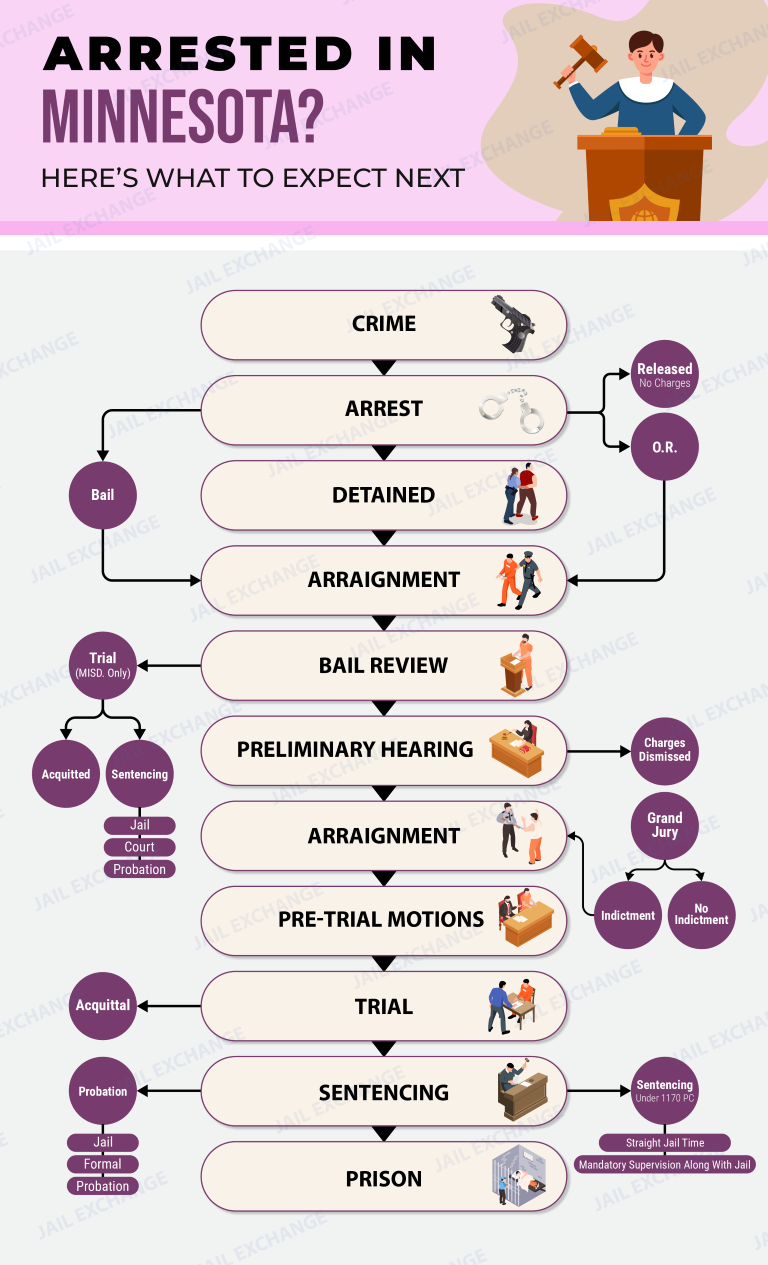
Arraignment within 36 hours
Minnesota's Rule 4.01 requires that an in-custody defendant appear before a judge within 36 hours of arrest, leaving out the arrest day, Sundays and legal holidays. A warrantless arrest additionally needs a judicial probable-cause determination within 48 hours. At the misdemeanor arraignment in Mahnomen, the judge informs you of the charge, asks about a lawyer and addresses release. The judge can release you on your promise to appear, or set paired bail amounts in which the lower figure is available only if you accept conditions like alcohol monitoring or avoiding contact with certain people. Commercial bail bonds are lawful and available.
Public defender appointment
Anyone facing possible jail who cannot afford private counsel may apply for a public defender at the arraignment. The court checks income, and the Ninth District Public Defender is assigned to qualifying Mahnomen County defendants.
Later court dates
A pretrial hearing gives the prosecutor and defense a chance to negotiate; many cases end there with a plea or dismissal. If not, the case is set for trial before six jurors, whose verdict must be unanimous. Once a defendant demands a speedy trial, it must be held within 60 days.
Penalties under Minnesota law for Mahnomen County cases
- Misdemeanor: a Mahnomen County sentence is capped at 90 days and $1,000.
- Gross misdemeanor: capped at 364 days in jail and $3,000.
- Theft: up to $500 is a misdemeanor, and theft valued from $500 to $1,000 is a gross misdemeanor.
- Fifth-degree assault: a misdemeanor for a first offense, a gross misdemeanor when prior qualifying convictions exist.
- A first DWI stop in Mahnomen County: without aggravating factors this is fourth-degree DWI, a misdemeanor. One aggravating factor, such as testing at 0.16 or above, having a child under 16 in the car or refusing a chemical test, makes it third-degree DWI, a gross misdemeanor. Expect a separate administrative license revocation, and possibly ignition interlock, plate impoundment and a chemical use assessment.
Resolutions range from dismissal and continuance for dismissal to a stay of adjudication, probation, a fine or local jail time. Plan for one to four months in most cases.
Felony (for example, burglary, felony theft, drug sale, second-degree assault)
Any crime with a possible penalty longer than a year in prison is a felony. These cases begin with a criminal complaint signed by the Mahnomen County Attorney's office. A defendant in custody has a Rule 5 first appearance within the 36-hour limit, at which the judge reviews the complaint, decides on public defender eligibility and sets bail and conditions of release.
The road to trial or plea in Mahnomen
Felonies return to court for a Rule 8 second appearance, where evidence is shared and the defendant can enter a plea. The omnibus hearing is next; defense motions to suppress evidence or dismiss for lack of probable cause are argued there. Settlement conferences may be scheduled before trial. A felony trial uses 12 jurors who must agree unanimously. After a guilty plea or verdict, probation prepares a presentence investigation report for the judge.
Mahnomen County felony sentences
Judges apply the Minnesota Sentencing Guidelines grid. Its two axes, offense severity and criminal history score, determine whether the presumptive sentence is stayed, meaning probation, or executed, meaning prison. Moving away from that presumptive result is allowed only when a Mahnomen judge finds substantial and compelling reasons.
- Felony theft in Mahnomen County: more than $1,000 can draw 5 years; more than $5,000, 10 years; more than $35,000, 20 years.
- Burglary: the first degree tops out at 20 years, the second at 10 and the third at 5.
- Sale of drugs in the first degree: a 30-year maximum.
- Second-degree assault, which involves a dangerous weapon: a 7-year maximum, with a mandatory minimum that can apply to firearms.
Through a stay of imposition, a felony can end up on the record as a misdemeanor if probation is completed. When prison is imposed, two-thirds of the term is typically spent in custody and one-third on supervised release. Expect a Mahnomen County felony to take four to twelve months, usually with the same public defender from start to finish.
Violent felony (for example, murder, criminal sexual conduct, aggravated robbery)
A violent felony in Mahnomen County uses the same hearings as any other felony, but bail is much higher and detention for the life of the case is common. An indictment from a grand jury is required only for first-degree murder and other crimes punishable by life.
Penalty ranges
- First-degree murder: a mandatory life term. Life without parole applies to premeditated murder and certain other categories; other first-degree convictions carry parole eligibility after 30 years. Minnesota does not have capital punishment, having repealed it in 1911.
- Second-degree murder: no more than 40 years. Third-degree murder: no more than 25 years.
- First-degree criminal sexual conduct: no more than 30 years, with a guidelines presumptive sentence of 144 months for a first-time offender in Mahnomen County.
- First-degree aggravated robbery: no more than 20 years.
Victims are guaranteed notice, attendance and the opportunity to speak at sentencing under chapter 611A of Minnesota Statutes. The Ninth District Public Defender represents eligible defendants. Investigations, laboratory work and pretrial motions mean these cases often take one to two years or longer.
Juveniles (under 18) arrested in Mahnomen County
State charges against children and teens under 18 are heard by the juvenile division of Mahnomen County District Court. The Mahnomen County Attorney decides whether to file a delinquency petition. For a first, minor offense, diversion is a common route that can resolve the case without a court finding.
Juveniles are not housed in the county jail. If detention is needed, the youth is typically taken to the nearest regional center with an open bed, such as the Northwestern Minnesota Juvenile Center in Bemidji or the West Central Regional Juvenile Center in Moorhead, and a detention hearing must take place within 36 hours of being taken into custody, excluding weekends and holidays. The judge then decides whether the young person can return home.
Prosecutors can seek Extended Jurisdiction Juvenile (EJJ) designation for certain 14- to 17-year-olds; the youth receives a juvenile disposition plus an adult sentence that stays suspended unless the terms are violated. Youth 14 and older may be certified for adult prosecution, and certification is presumed for 16- or 17-year-olds charged with an offense that carries a presumptive prison commitment or that was committed with a firearm. A Mahnomen County teen of 16 or 17 accused of first-degree murder faces trial as an adult. Juvenile files are generally confidential, though some felony records of youth 16 and older may be public. Eligible youth are entitled to a public defender.
Federal cases (U.S. District Court) from Mahnomen County
Besides the Mahnomen County District Court and the White Earth tribal court, there is a third court that can hear a case from this county: the U.S. District Court for the District of Minnesota. Mahnomen County is in the Sixth Division, based at the Edward J. Devitt U.S. Courthouse and Federal Building, 118 S. Mill Street, Fergus Falls, MN 56537, and trial jurors are drawn from that division. The first hearings in a federal case are often held in Minneapolis or St. Paul. For questions about a Mahnomen County federal case, the Clerk of Court's line is (612) 664-5000.
Minnesota is a Public Law 280 state, so crimes on the White Earth Reservation are generally prosecuted by the state rather than federally; the federal Major Crimes Act exception in Minnesota applies to the Red Lake and Bois Forte reservations, not White Earth.
When federal charges are filed
Federal court takes cases that violate federal law, investigated by agencies such as the FBI, DEA, ATF, Homeland Security Investigations, U.S. Postal Inspectors or the IRS. Usual examples are drug trafficking in large amounts or across state lines, felon-in-possession and other firearms offenses, fraud, child exploitation, bank robbery and immigration crimes. A Mahnomen County Sheriff's arrest can be adopted for federal prosecution, and the same conduct may be charged by both the state and the United States.
Federal offices
- U.S. Attorney's Office for the District of Minnesota: Minneapolis, U.S. Courthouse, 300 S. 4th Street, Suite 600, Minneapolis, MN 55415, (612) 664-5600; St. Paul, 316 N. Robert Street, Suite 404, St. Paul, MN 55101, (651) 848-1950.
- Office of the Federal Defender, which represents eligible Mahnomen County defendants: 107 U.S. Courthouse, 300 S. 4th Street, Minneapolis, MN 55415, (612) 664-5858; a private CJA panel attorney is appointed if it has a conflict.
- U.S. Marshals Service: the Fergus Falls office is staffed only during terms of court, so call Minneapolis, (612) 664-5900.
From arrest to judgment
Arrest by federal agents, or on a federal warrant or indictment, is followed by an initial appearance before a U.S. magistrate judge, who explains the charges and appoints counsel. Where the government seeks detention, a hearing is usually held within 3 court days. The Bail Reform Act provides for release on conditions supervised by U.S. Probation and Pretrial Services, and for detention when no conditions will assure appearance and safety. There are no bail bondsmen in federal court; money bail is rare. A complaint must be followed by a grand jury indictment within 30 days of arrest, unless a preliminary hearing is held, and then arraignment. Trial is due within 70 days under the Speedy Trial Act, though continuances are common, and plea agreements end most cases; a jury of 12 must reach a unanimous verdict. Sentencing comes about three months after plea or verdict, after a presentence report, under the advisory Sentencing Guidelines and any mandatory minimum. Without parole, people serve at least about 85% of the sentence after good-conduct time, in a Bureau of Prisons facility, followed by supervised release. Appeals go to the Eighth Circuit.
The Marshals keep federal pretrial detainees in contract county jails across Minnesota and at times out of state, so a person arrested in Mahnomen County may be moved to another county. Families can get the location from the Marshals; sentenced people appear in the Bureau of Prisons inmate locator. Federal prosecution of a Mahnomen County youth under 18 is rare.
This page summarizes the general process for state criminal cases in Mahnomen County and should not be taken as legal advice. If you have been charged, consult a defense attorney or request the Ninth District Public Defender at your first court appearance. Court administration in Mahnomen can be reached at (218) 935-2251.