
Ramsey County Correctional Facility
Ramsey County Correctional Facility
Jail Phone Number
651-266-1400Ramsey County Inmate Search: Locating Someone Held in St. Paul
When police anywhere in the county arrest an adult, the person is booked at the Adult Detention Center (ADC), 425 Grove Street, St. Paul, MN 55101. It is the pretrial jail. People serving a sentence of one year or less go to the Correctional Facility (RCCF), 297 South Century Avenue, Saint Paul, MN 55119. Read on for search tips, mugshots, bail, visits, money, mail and court dates.
The Sheriff's Adult Detention Center roster lists everyone now in the jail. Look up a name to see the booking date, the arrest charge, any formal charge, the court case number and the next court date. The list refreshes every 30 minutes, and a person stays on it for five days after leaving.
Staff at the jail answer 651-266-9350 day and night. Have the birth date and full name in front of you. Ask for the bail figure and a likely release time. To pay, follow the bail guide; for what happens at each hearing, read the court guide.
Read inmate search answers
 Read inmate search answers
1. How is the Ramsey County detention roster searched?
The roster is run by the county and covers the ADC on Grove Street. Follow these steps:
- Pull up the detention center roster in any web browser.
- Type or scan for the surname. With a common surname, match the booking date too.
- Read the arrest charge. A formal charge shows up once the prosecutor files one.
- Copy the court case number. Cases in this county start with 62.
- Note the date, time and place of the next hearing.
Bail amounts are a phone question. Call the jail at 651-266-9350 and ask. Someone serving a sentence at the RCCF shows up in its own resident lookup instead.
↑ Back to the question list2. No match on the Grove Street roster?
Fresh arrests often take a while to appear. Check these possibilities:
- Booking takes time. Prints and a photo must be done first. Look again in an hour, since the roster reloads every half hour.
- They were let go. Many people charged with a misdemeanor get a ticket and go home. Others are released by a judge at the first hearing.
- They are serving a sentence. Look in the RCCF resident lookup, or call the RCCF at 651-266-1400.
- The arrest happened across a county line. Minneapolis, Stillwater and Anoka each have their own county jail.
- They are under 18. Minors kept in custody are taken to the juvenile center on West 7th Street.
- The spelling differs. Try alternate spellings and nicknames.
Staff can check faster than you can. Ring the jail at 651-266-9350 with the date of birth handy.
↑ Back to the question list3. Which of the two adult sites has them?
The county runs two adult sites, and each has its own job:
- Adult Detention Center, 425 Grove Street, St. Paul, MN 55101, 651-266-9350. The Sheriff runs it on the Law Enforcement Center site, with room for 500. It holds people from arrest until their case is settled. It also holds people picked up for breaking probation or parole.
- Correctional Facility (RCCF), 297 South Century Avenue, Saint Paul, MN 55119, 651-266-1400. Community Corrections runs it. It houses men and women sentenced to up to one year. Some residents go out for work or school release.
An arrest in a nearby county leads to that county's jail:
- Hennepin County Jail (Minneapolis), 401 South 4th Avenue, Suite 100, Minneapolis, MN 55415, 612-348-5112
- Washington County Jail (Stillwater), 15015 62nd Street North, Stillwater, MN 55082, 651-430-7900
- Anoka County Jail (Anoka), 325 E Jackson Street, Anoka, MN 55303, 763-324-5100
4. Does the Ramsey County roster include mugshots?
No. The roster gives names, charges and court details, but it shows no mugshots or booking photos.
State law treats a booking picture as public. Police can keep it back for a while when sharing it could harm an active case (Minn. Stat. 13.82, subd. 26). Facts such as the charge and release are public too (Minn. Stat. 13.82, subd. 2). Requests go to whichever department booked the person. For a jail booking, call the Sheriff's Office at 651-266-9333 and ask for the Criminal History Unit. It handles photo requests on weekdays at 425 Grove Street, St. Paul, MN 55101.
- To ask ICE for its booking photo, file a records request.
- U.S. agencies otherwise tend to hold federal mugshots back. The U.S. Marshals Service may put one out, such as for someone who has fled.
5. Is there a release alert for the Grove Street jail?
Yes. The state Department of Public Safety runs Minnesota VINE. It watches county jail custody and reports when a person leaves or changes location.
- Register on VINELink or by calling 877-664-8463.
- For people moved to a state prison, switch to Minnesota Haven, the DOC's own notice tool.
The roster helps too. A person stays on it for five days after release, so you can confirm they left.
↑ Back to the question list6. Ramsey County bail: how does release happen?
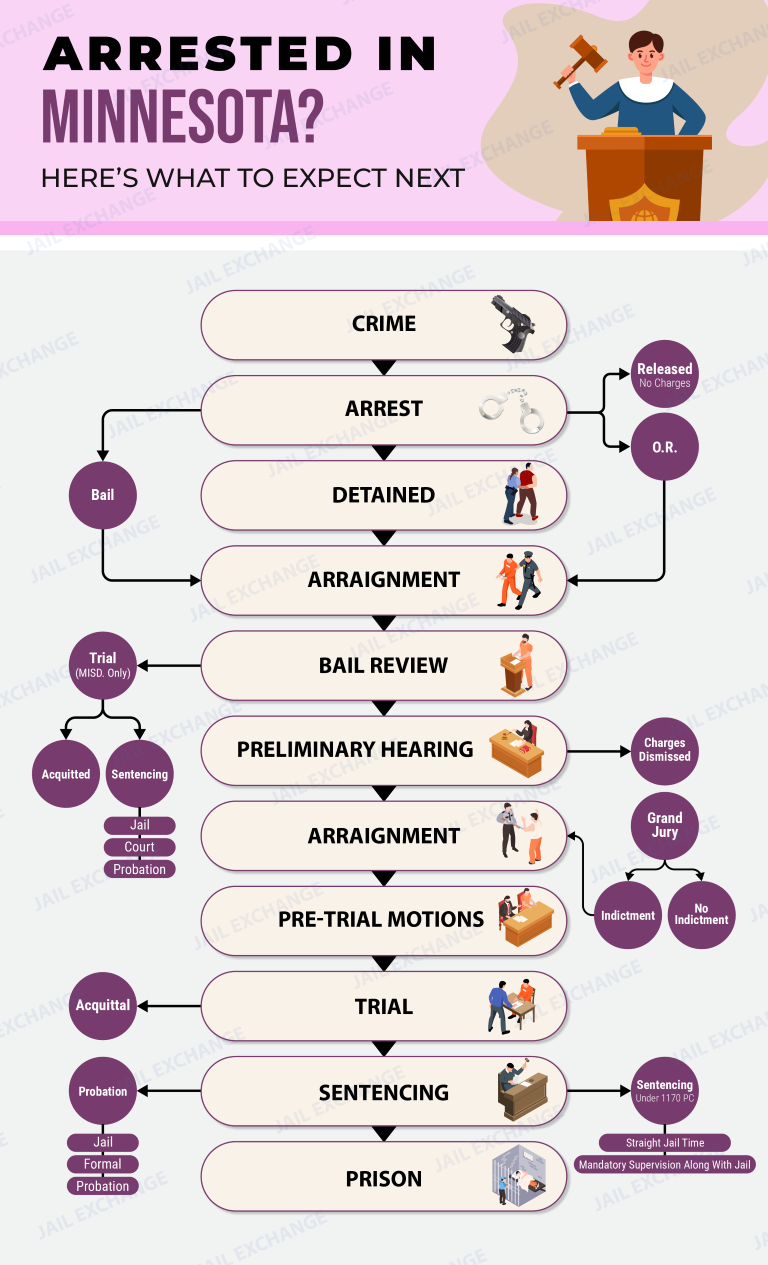
With no warrant, the limit is 36 hours to a judge. Day one is the day after arrest, and Sundays and legal holidays are not counted (Minn. R. Crim. P. 4.02, subd. 5). Many of these first hearings take place in courtrooms inside the Law Enforcement Center.
- Release without money. Judges start with a promise to come back to court. They add only the conditions needed for safety.
- Two amounts. Each order must also carry a plain money option with no rules attached. Expect two numbers: a smaller one paired with conditions and a bigger one free of them.
- Paying at the jail. The ADC lobby window at 425 Grove Street, St. Paul, MN 55101 is open 24 hours. It takes cash for the exact amount only. Cards, checks and money orders are refused.
- Bail agents. A state-licensed bondsman charges a premium of $100 or more, and that premium is never returned. The Sheriff's Office will not suggest a company.
- Who owns the cash. Money posted as bail is legally the defendant's, whoever brought it. Any refund goes to someone else only if the defendant signs court form CRM602.
For someone held at the RCCF, the Warrants Unit takes bail on weekdays. Call 651-266-9320 before you go. Walk through each payment step on our bail page. The statewide picture sits on our Minnesota bail laws page.
↑ Back to the question list7. Which charges were filed, and where?
Start with the roster. It shows the arrest charge right away and the formal charge once it is filed. It also lists the court case number.
Next, search Minnesota Court Records Online (MCRO) for free. Type the case number or the name to read the complaint and its charges. Some juvenile records stay hidden.
Criminal court staff can help by phone at 651-266-1999. The County Attorney's Office files felony charges. It is at 360 Wabasha Street North, Suite 100, Saint Paul, MN 55102, 651-266-3222.
↑ Back to the question list8. Is a free defense lawyer possible on a St. Paul case?
A free lawyer is available to people who can't pay for one. Eligible cases include felonies, gross misdemeanors and any misdemeanor with a jail risk. A judge reviews a financial form to decide. A person on means-tested benefits is assumed to meet the money test (Minn. Stat. 611.14, 611.17).
- Second Judicial District Public Defender, 445 Minnesota Street, Suite 2000, St. Paul, MN 55101, 651-352-2500
- Satellite office, 555 Park Street, Suite 200, St. Paul, MN 55101, 651-266-1991
Most people ask at their first hearing. Hiring a private attorney is also allowed. Attorneys see clients at the ADC seven days a week, holidays too, during set blocks, and must show a government photo ID.
↑ Back to the question list9. When can I video visit the Ramsey County jail?
Nearly every ADC visit uses a video screen. Pick a home device or a terminal in the jail lobby.
- Lobby visits are free. Times are Sunday 11:30 a.m. to 2:30 p.m., and Tuesday and Thursday noon to 2:30 p.m.
- Home visits run daily from 8:00 to 10:30 a.m., 11:30 a.m. to 4:30 p.m., and 5:30 to 9:30 p.m. Use a computer with a webcam, or the free phone app for iPhone, iPad or Android.
- Each person may have up to four 20-minute home visits a day.
- Open a visitor account on NCIC's website. Jail staff review each new account before it works.
- Reserve a slot one full day or more in advance. List any adult joining you as a guest.
- For a lobby visit, arrive 10 minutes early with your reservation code. Late starts are not made up.
Face-to-face visits are rare and decided case by case. Ask about home visit costs when you sign up. For RCCF visits, call 651-266-1400. Our visiting guide offers extra pointers.
↑ Back to the question list10. How do deposits to an ADC account work?
Account money buys canteen items such as snacks and stamps, and it pays for haircuts. There are three ways to add funds at the ADC:
- Online through TurnKey Corrections at inmatecanteen.com. A fee applies, and money posts within minutes. TurnKey support is 715-690-2965. Phone deposits are not taken.
- At the lobby kiosk at 425 Grove Street, St. Paul, MN 55101, any hour. Cash has no fee. A card costs a fee.
- By mail. Only two forms work: a cashier's check or a money order. Write the person's name as the payee. Address it to Ramsey County Adult Detention Center, Attention: (person's name), 425 Grove Street, Saint Paul, MN 55101.
Mailed cash or a personal check is returned to the sender. Balance details go only to the account holder. Leftover funds are paid out at release on a debit card or by check. Compare deposit options in our money guide. Canteen basics are in our commissary guide.
↑ Back to the question list11. How do NCIC jail calls and messages work?
People in the ADC can only make outgoing calls. NCIC runs the phones. To get calls, set up an account at ncic.com or call 800-943-2189.
- Officers at the jail don't relay messages left by phone.
- For a fee, you can leave a voice message through your NCIC account. Pick the Grove Street jail (listed as the ADC) when asked.
- Calls, visits and messages can be recorded. Talks with a lawyer are private.
Talking about the case on a recorded line can hurt it, so save that for the lawyer. For questions about tablets or texts, call the jail at 651-266-9350. Our phone guide covers call setup. For messaging, see our email and text guide.
↑ Back to the question list12. Where do letters to the Ramsey County jail go?
Write the lines just like this:
Inmate's full name
Ramsey County ADC
Inmate Mail
425 Grove Street
Saint Paul, MN 55101
- No booking number is needed on the envelope.
- Use the U.S. Postal Service. Items sent another way come back.
- Staff open and check mail for money and contraband, and they may read it.
- Packages are returned. Letters between people in jail are not allowed.
- Expect two or three extra business days for mail to be handed out.
- Mail that arrives after release is forwarded or sent back.
Before you send books or photos, ask the jail at 651-266-9350. For RCCF mail, call 651-266-1400. For general letter-writing tips, open our mail guide.
↑ Back to the question list13. How does a property pickup at the ADC work?
The person inside chooses who can collect their things. They fill out a property release form with your name.
- Bring a valid state or federal photo ID.
- Pick up at the public lobby window of the ADC, 425 Grove Street, St. Paul, MN 55101. It is open 24 hours.
- The jail takes no clothing for a jury trial and no other items for people inside.
- If the person goes to state prison, extra property is kept for 30 days and then destroyed.
Phone 651-266-9350 first to make sure the release form is signed.
↑ Back to the question list14. Who handles medical care at the ADC?
Call the ADC at 651-266-9350 and ask that medical staff get your message. Share their name, birth date, medicines with doses, and the doctor's number. Mention mental health needs plainly.
Your loved one should mention the need to staff inside, too.
The jail offers free sign language and oral interpreters, plus TTY phones, for deaf and hard-of-hearing detainees. Ask for the coordinator on the same line. For a life-threatening problem, dial 911.
↑ Back to the question list15. Is a warrant out in their name?
The Sheriff's Office has a Warrants Unit. Call it at 651-266-9320 with questions. The Sheriff also keeps a Most Wanted list, and the state DOC runs a Wanted Fugitives page covering people accused of violating supervised release. MCRO shows open cases, but warrants are a phone question. To clear one, get advice from a lawyer. After that, contact the court behind the warrant or turn yourself in on Grove Street. The District Court sits at 15 W. Kellogg Blvd., St. Paul, MN 55102, and its staff answer 651-266-8266.
↑ Back to the question list16. Where is their next Ramsey County court date listed?
The jail roster lists the next hearing with its date and place. A second option is the free MCRO hearing search, which works with a name.
- Courthouse, 15 W. Kellogg Blvd., St. Paul, MN 55102, main line 651-266-8266
- Courtrooms in the Law Enforcement Center, 425 Grove Street, St. Paul, MN 55101
- Criminal court help line, 651-266-1999
Court offices are open weekdays from 8:00 a.m. to 4:30 p.m. Check the notice for the right building, since one case can move between them. Our court guide breaks down the hearing types.
↑ Back to the question list17. Was the arrest on a federal charge?
The U.S. District Court for the District of Minnesota hears these cases. Its St. Paul site is the Warren E. Burger Federal Building, 316 North Robert Street, St. Paul, MN 55101. The clerk's line is 612-664-5000.
- A detention hearing is held early on. A federal judge rules there on jail or release until trial (18 U.S.C. 3142).
- The U.S. Marshals Service keeps federal prisoners in jails it works with. Call its office at 300 South 4th Street, Suite 402, Minneapolis, MN 55415, 612-664-5900, to learn where they are.
- Sentenced people move to Bureau of Prisons care. The BOP inmate locator shows where.
18. Could immigration agents claim them at the ADC?
What usually happens:
- ICE sends Form I-247A, its detainer form, to the ADC.
- The federal rule lets a jail keep someone up to 48 hours after they would otherwise be released so ICE can pick them up (8 CFR 287.7(d)).
- A February 6, 2025 Attorney General opinion addresses this in Minnesota. Its view: a jail may not keep holding a person solely on a detainer after their release time arrives.
- After ICE takes over, check the ICE Online Detainee Locator. Have their A-number ready, or their name and nation of birth.
- The ICE St. Paul Field Office handles cases from this area: 1 Federal Drive, Suite 1601, Fort Snelling, MN 55111, 612-843-8600.
19. Was the sentence to a state prison?
Felons given prison time serve it in a state facility. The Minnesota Department of Corrections runs those prisons. Until transport, Grove Street keeps holding them. Deputies later take them to the state intake center, where they are checked and given a placement.
- Search the DOC Offender Locator. A fresh transfer may need a few workdays before it shows.
- Typically the closing third of the sentence is spent outside on supervised release.
- For prison visiting and mail, open our Minnesota state prisons guide.
20. What if a teen was arrested?
Under state law, anyone not yet 18 is a child (Minn. Stat. 260B.007). In most cases, police release a young person into a parent's care. When a teen must stay in custody, it is at the Juvenile Detention Center, 25 West 7th Street, Saint Paul, MN 55102, 651-266-5255.
- Holding a youth in secure detention beyond 36 hours, not counting weekends or holidays, requires a petition and a judge's order (Minn. Stat. 260B.176).
- Cases go to juvenile court at the Juvenile and Family Justice Center, 25 West 7th Street, St. Paul, MN 55102. Juvenile court staff answer at 651-266-5115.
- Juvenile probation is in the same building, 651-266-5300.
- For ages 14 to 17, serious cases may move to adult court through certification, or become extended jurisdiction juvenile (EJJ) cases.
21. Which St. Paul or suburban agency arrested them?
Adults these agencies arrest inside the county are booked on Grove Street. For a non-emergency question, call county dispatch at 651-767-0640.
Sheriff's Office
- Main office, Law Enforcement Center, 425 Grove Street, St. Paul, MN 55101, 651-266-9333
- Patrol Station, 1411 Paul Kirkwold Drive, Arden Hills, MN 55112, 651-266-7300. Deputies patrol Arden Hills, Little Canada, North Oaks, Shoreview, Vadnais Heights and White Bear Township.
City police
- Saint Paul Police Department, 651-291-1111
- Maplewood Police Department, 651-777-8191
- Roseville Police Department, 651-792-7008
- New Brighton Department of Public Safety, through county dispatch
- Mounds View Police Department, 763-717-4070
- North Saint Paul Police Department, 651-767-2406
- White Bear Lake Police Department, also serving Gem Lake, 651-429-8511
- Saint Anthony Police Department, also serving Falcon Heights and Lauderdale, 612-782-3350
Campus and state
- University of Minnesota Police Department, 612-624-2677
- Minnesota State Fair Police, on the fairgrounds, through county dispatch
- Minnesota State Patrol Headquarters, 445 Minnesota Street, Suite 130, St. Paul, MN 55101, 651-201-7100. Ask which district office has a trooper's arrest.
Ramsey County bail and bond: the Grove Street window and what comes after
Most adults picked up by Saint Paul or suburban police are booked into the Ramsey County Adult Detention Center, 425 Grove Street, Saint Paul, MN 55101, the Sheriff's pretrial jail inside the Law Enforcement Center. People already serving a sentence may be at the county's Correctional Facility instead. Below are the cash-only bail rules, wait times, bondsman costs and release steps.
Look the person up in the jail roster search; once a judge acts, the bail amount shows there too. Our Ramsey County Inmate Search page explains warrants, charges and public defender requests.
Call the bail line at 651-266-9350 and spell out the full name and birthday for staff. Find out the amount and which building holds your person, since the Grove Street lobby window takes exact cash only, day and night. Our court page explains the first hearing.
1. Is my nephew inside the Grove Street detention center?
Search his name with Ramsey County Inmate Search and note the booking time. For a question the search leaves open, call the detention center at 651-266-9350. The state lists the building with 460 approved beds and no authority to hold juveniles, so a teenager arrested in Ramsey County is taken elsewhere.
↑ Back to the question list2. How do I post bail at the Adult Detention Center?
Go to the lobby window at 425 Grove Street. It is open 24 hours a day. The county accepts cash in the exact amount. It does not accept cards, checks or money orders. Count your cash and bring a photo ID. Release happens in the same lobby after jail staff finish processing.
↑ Back to the question list3. How long will release take after I pay?
Longer than most people expect. The county says processing time depends on the hour and on how many people are being released. Do not stand at the window all night. Ask staff for a rough time, and have a ride ready that you trust.
↑ Back to the question list4. What if my relative is at the Ramsey County Correctional Facility?
Bail for someone held there is taken by the Warrants Unit at the Law Enforcement Center, 425 Grove Street. The unit is open Monday to Friday, 8 a.m. to 4:30 p.m., except holidays. The Grove Street lobby window is for people held at the Adult Detention Center, so ask which building before you go.
↑ Back to the question list5. I have a warrant. Can I turn myself in and pay?
If the warrant shows a dollar bail, yes. You can surrender, post it, and receive a court date. A felony or qualifying gross misdemeanor warrant gives you a date the next business day. A misdemeanor warrant gets a date mailed from District Court. If no bail is listed, you are booked and see a judge, usually the next business day, and you will be fingerprinted and photographed.
↑ Back to the question list6. Will anyone be let out without paying?
Possibly. A Second District order lets screeners hired by the county's pretrial vendors release some people without bail, bond or conditions. It covers new citation charges such as driving after suspension and low-risk people on a state risk tool who are not charged with an excluded offense. Most felonies, domestic violence cases and first-degree DWI are excluded.
↑ Back to the question list7. Is there a posted price list for Ramsey County bail?
The county says bail is available for only certain offenses under court standards, and for other cases a judge decides later. A state policy discourages preset schedules. The amount appears in the search after the court acts. Call 651-266-9350 about a specific charge.
↑ Back to the question list8. When does a judge look at the case?
Within 36 hours of a warrantless arrest, not counting the day of arrest, Sundays or holidays. In two medical or verified-threat situations the court order permits holding a person up to the first hearing or 48 hours, including weekends. Court is at 15 West Kellogg Boulevard, and the main number is 651-266-8266.
↑ Back to the question list9. What do bondsmen charge in Ramsey County?
The county's FAQ says commercial companies typically charge about 10 percent, with a $50,000 bond costing $5,000 as its example. State law is firmer: the agent must charge the surety's filed rate, and at least $100. Ask for the full cost in writing. The Sheriff's Office does not recommend any company.
↑ Back to the question list10. Is bail the same as bond?
Not quite. Bail is cash paid to the court as a promise to appear. A bond is money or property pledged for the same purpose, often arranged through a bonding agency. The county says most people in jail can have either one posted on their behalf. Check that the jail will take a bond before you pay the agent.
↑ Back to the question list11. Can a house or land be pledged?
Court rules allow "other security," and bondsmen often ask for property on large bonds. To learn whether the land must sit in Ramsey, ask District Court at 651-266-8266. Never give a deed to someone who is not a licensed agent, and remember a quitclaim deed cannot be collateral.
↑ Back to the question list12. Who is the public defender in Ramsey County?
The Second Judicial District public defender lists a main office at 445 Minnesota Street, Suite 2000, phone 651-352-2500, and a St. Paul satellite office at 555 Park Street, Suite 200, phone 651-266-1991. Raise it with the judge when you first appear. Eligibility is the judge's call.
↑ Back to the question list13. Where are teenagers held in Ramsey County?
The Ramsey County Juvenile Detention Center, 25 West 7th Street, St. Paul, 651-266-5255. It has 44 beds in five pods for ages 13 to 18 and also takes youth from surrounding counties. The Juvenile and Family Justice Center, where court is held, is at the same street address.
↑ Back to the question list14. Which courthouse do I go to?
The main courthouse is 15 West Kellogg Boulevard. Other sites are the Juvenile and Family Justice Center at 25 West 7th, the Law Enforcement Center at 425 Grove Street, a commitment court at 402 University Avenue East and a suburban court in Maplewood at 2050 White Bear Avenue. One number reaches the court: 651-266-8266. Staff are there on weekdays from 8 a.m. to 4:30 p.m.
↑ Back to the question list15. What if the person is charged with domestic assault?
A judge reviews the case before release. Conditions can include no contact, staying away from the home, and giving up weapons. The release-without-bail order for county screeners excludes qualified domestic violence offenses. Plan on the person not going home, even if bail is paid.
↑ Back to the question list16. What happens if he misses court?
A warrant can be issued and the bond can be forfeited. For a bonded case the court must notify the agent within 30 days. Call his lawyer and the agent, and ask the court about a new date before the warrant is acted on.
↑ Back to the question listRamsey County contacts for bail and bond
- Jail: Adult Detention Center, 425 Grove Street, St. Paul, MN 55101; bail questions 651-266-9350
- Bond guide: Ramsey County jail bail and bond help
- Custody lookup: Ramsey County Inmate Search
- Bail window: Detention center lobby, 24 hours; exact cash only
- Warrants Unit: Law Enforcement Center, 425 Grove Street; Monday to Friday, 8 a.m. to 4:30 p.m.
- Sheriff's Office: 651-266-9333
- District Court: 15 West Kellogg Boulevard, St. Paul, MN 55102; 651-266-8266
- Public defender: 445 Minnesota Street, Suite 2000, St. Paul; 651-352-2500; satellite office, 555 Park Street, Suite 200; 651-266-1991
- Youth detention: Ramsey County Juvenile Detention Center, 25 West 7th Street, St. Paul, MN 55102; 651-266-5255
These hours, payment rules and phone numbers came from county and court pages that are not always dated, and the courts update their orders. A judge may set terms that differ from this guide. Call the window or the clerk to confirm before you bring money.
Video Visits at Ramsey County Correctional Facility
This is the county workhouse at 297 South Century Avenue, Saint Paul, MN 55119, not the Adult Detention Center on Grove Street. Call 651-266-1400 if you need to confirm where the person is housed.
Video from home: Use NCIC to register and book at least 24 hours ahead. The county says each resident may have one no-cost, 20-minute online visit per day. Check NCIC for available times.
Video at the facility: Call 651-266-1401 for help setting up an on-site video visit and to confirm when to arrive. In-person visits are for professional visitors only. Professionals can call 651-266-1400 to arrange an in-person or video session.
Visits may be monitored and recorded. You cannot visit someone if a restraining order or no-contact order is in effect between you.

NCIC Video Visitation provides a secure online platform that enables families and loved ones to conduct scheduled face-to-face video visits with incarcerated individuals from home. Using an internet-connected smartphone, tablet, or personal computer equipped with a webcam, visitors can connect directly without traveling to the facility.
Important: Advance Registration and Visitor Clearance Required
Detention centers do not permit unscheduled or unverified video sessions. Correctional facilities require prospective visitors to submit government-issued photo identification and receive administrative clearance before booking an appointment, an approval process that can take up to 48 hours depending on facility staffing. You should verify your visitor approval status with the facility prior to scheduling. If you do not register well in advance, you will miss your loved one's scheduled visiting window for the week.
Step-by-Step Instructions to Register and Schedule a Video Visit
- Visit NCIC Scheduling and sign into your account.
- Register your visitor profile and upload a clear photograph of your government-issued ID (driver's license or passport) for facility background review.
- Wait for email notification confirming facility visitor approval.
- Select Video Visitation, choose the detention facility, and select the inmate.
- Browse the available schedule calendar, select an open time slot, and pay the visitation fee using a credit or debit card.
- Log into the website or mobile app 10 minutes prior to the start time on a device with a functioning camera, microphone, and reliable high-speed internet connection.
What the Inmate Needs to Do
The inmate receives a visitation notification on their housing unit video kiosk or terminal. At the appointed time, they log in with their PIN and sit before the terminal. Inmates and visitors must strictly observe jail dress and conduct rules; sessions are monitored by staff and will terminate immediately upon any violation.
Official Provider: NCIC Official Website
Customer Service Telephone: 1-800-943-2189
Support Hours: 24 hours a day, 7 days a week, 365 days a year
Supported Languages: English and Spanish
Other Services Provided by NCIC Inmate Communications
In addition to Remote Video Visitation, NCIC provides calling and digital messaging services at participating facilities:
- Prepaid Phone Calling Accounts: Prepay for phone calling credits so your loved one can call your telephone directly.
• Learn more on our website: Prepaid Calling Accounts Guide | • Visit official vendor page: NCIC Prepaid Calling - Inmate Messaging Services: Send electronic messages and photos directly to an inmate's housing unit terminal.
• Learn more on our website: Inmate Messaging Guide | • Visit official vendor page: NCIC Messaging
Ramsey County Criminal Cases: Courthouse, Charges and Court Dates in St. Paul
Ramsey County District Court makes up the whole Second Judicial District, and its main courthouse stands at 15 West Kellogg Boulevard, Saint Paul, MN 55102. One number, 651-266-8266, reaches court administration on weekdays. People held before trial stay at the Sheriff's Adult Detention Center, 425 Grove Street, Saint Paul, MN 55101, while sentenced adults often serve time at the Ramsey County Correctional Facility.
Enter a name in the county's custody search and check whether a booking shows up. Our Inmates in Custody page for Saint Paul helps with recent arrests, open warrants and free legal help.
Then call 651-266-8266 and ask which building and courtroom will host the first hearing. The court uses several sites, so check before you drive. If bail is set, our bail page covers the exact-cash window.
1. Ramsey County court locations
Ramsey County is the state's most densely populated county, and its seat, St. Paul, is also Minnesota's capital. Criminal cases from St. Paul and the surrounding suburbs, including Roseville, Maplewood, White Bear Lake, Shoreview and New Brighton, are heard by Ramsey County District Court, which makes up the entire Second Judicial District. The Ramsey County Attorney prosecutes every felony and all juvenile delinquency cases, while the St. Paul City Attorney and the suburban cities' attorneys prosecute misdemeanors and gross misdemeanors that occur within their borders. Adults arrested in the county are booked and held at the Ramsey County Adult Detention Center inside the Law Enforcement Center on Grove Street in downtown St. Paul, run by the Ramsey County Sheriff.
Because of its caseload, Ramsey County's criminal process involves more locations, more prosecutors and more specialized programs than a typical Minnesota county. The sections below walk through the courthouses, the first hours after an arrest, the jail, public defense, prosecution and diversion, and the treatment courts, followed by what to expect at each level of charge.
- Ramsey County District Court (Second Judicial District), Ramsey County Courthouse, 15 West Kellogg Boulevard, St. Paul, MN 55102, (651) 266-8266
- Law Enforcement Center (court location and the Adult Detention Center), 425 Grove Street, St. Paul, MN 55101
- Juvenile and Family Justice Center (juvenile court), 25 West Seventh Street, St. Paul, MN 55102
- Ramsey County Attorney's Office, 360 Wabasha Street North, Suite 100, St. Paul, MN 55102, (651) 266-3222
- Ramsey County Sheriff's Office (operates the Adult Detention Center), St. Paul, (651) 266-9333
- Second Judicial District Public Defender (State Board of Public Defense), St. Paul, which represents eligible adults and juveniles in Ramsey County; its main office for Ramsey County is at 445 Minnesota Street, Suite 2000, St. Paul, MN 55101, (651) 352-2500, with a St. Paul satellite office at 555 Park Street, Suite 200, (651) 266-1991
Which court hears your case. Ramsey County has no separate municipal or city courts; Minnesota abolished them, and every criminal case here, from a petty misdemeanor ticket to a murder charge, belongs to Ramsey County District Court. The level of the charge decides the prosecutor and the steps, not the courthouse. A misdemeanor or gross misdemeanor in St. Paul is prosecuted by the St. Paul City Attorney's Office, and the same kind of charge in a suburb is usually prosecuted by that city's attorney, frequently a private attorney the city contracts with. Felonies, wherever they happen in the county, are always prosecuted by the Ramsey County Attorney. Your citation, complaint or court notice lists the courthouse and courtroom where you must appear.
Where pretrial detainees are held. Adults who are arrested by the St. Paul Police Department, the Sheriff's Office, suburban police departments, Metro Transit police or the State Patrol and are not released at the scene are taken to the Ramsey County Adult Detention Center in the Law Enforcement Center at 425 Grove Street, St. Paul. The Ramsey County Sheriff's Office runs the building, and a person awaiting trial remains on Grove Street until bail is posted, a Second District judge orders release, or the case is over. People who are later sentenced to local jail time are often sent instead to the Ramsey County Correctional Facility in Maplewood, which holds sentenced inmates rather than people awaiting trial.
The Second Judicial District operates from several buildings in and near downtown St. Paul. Business hours at all of them are 8:00 a.m. to 4:30 p.m., Monday through Friday, and the court's main number is (651) 266-8266.
- Ramsey County Courthouse, 15 West Kellogg Boulevard, St. Paul. The historic City Hall and Courthouse building houses court administration and many of the criminal courtrooms where felony hearings, trials and sentencings take place.
- Law Enforcement Center, 425 Grove Street, St. Paul. The same building as the county jail, it also contains court space, which makes it a practical location for hearings involving people who are in custody.
- Juvenile and Family Justice Center, 25 West Seventh Street, St. Paul. Delinquency cases involving youth under 18 are heard here, along with family court and domestic abuse matters.
- Suburban site in Maplewood, 2050 White Bear Avenue, Maplewood. This location mainly serves civil matters such as conciliation, housing and probate cases.
Within the court, criminal matters are handled by the Criminal and Traffic division, which includes criminal records, the Law Enforcement Center courtrooms, specialized courts and the Violations Bureau that processes payable citations. Always check your paperwork for the exact building and courtroom, because Ramsey County cases can be scheduled at more than one location over their lifetime.
↑ Back to the question list2. What happens after an arrest in Ramsey County
An arrest in Ramsey County can unfold in several ways. For many petty misdemeanors and misdemeanors, officers issue a citation, and the person goes home with a date to appear or an option to pay a fine through the Violations Bureau. More serious arrests, along with domestic assault and many DWI cases, usually mean transport to the Law Enforcement Center on Grove Street.
Booking
Booking on Grove Street means Ramsey County deputies collect personal details, fingerprint and photograph the arrestee, log personal property and run checks for outstanding warrants or holds from other jurisdictions. Some people charged with lower-level offenses can be released fairly quickly by posting bail under the court's bail schedule. Others must wait to see a judge.
The 36-hour and 48-hour limits
Under Rule 4.01 of the Minnesota Rules of Criminal Procedure, anyone still in the Ramsey County jail must get in front of a judge inside 36 hours; that clock ignores the arrest day itself, Sundays and legal holidays. A separate 48-hour deadline applies to warrantless arrests, by which time a Ramsey County judge must have reviewed the police account and found probable cause, or the detainee goes free. In Ramsey County, many of these first appearances for in-custody defendants take place at the Law Enforcement Center.
Release decisions
At the first appearance, a Second District judge decides whether to release the person on their own recognizance or set bail. Minnesota judges typically set two bail amounts: a higher one with no conditions and a lower one with conditions, such as no contact with a victim, alcohol monitoring, electronic monitoring, or reporting to pretrial supervision. Commercial bail bonds are legal in Minnesota, so a family can hire a bondsman and pay a nonrefundable fee rather than the full bail. Pretrial staff with Ramsey County Community Corrections may interview the defendant beforehand and provide information the judge considers in setting release terms.
↑ Back to the question list3. The Ramsey County Adult Detention Center
The Adult Detention Center is the county's pretrial jail. It is located in the Law Enforcement Center at 425 Grove Street in St. Paul and is operated by the Ramsey County Sheriff's Office. Every arresting agency in the county brings adult arrestees here for booking, so it holds people charged with everything from misdemeanors to homicide while their cases are pending.
Most stays are short: many detainees are released within a day or two after posting bail or being released at their first appearance. People charged with serious felonies who cannot post bail may remain for months. The Sheriff's Office handles questions about custody status, release and booking records; its Criminal History Unit at 425 Grove Street processes requests for booking photos during weekday business hours. For general calls, the Sheriff's main number is (651) 266-9333.
Once a case ends with a jail sentence, the person may serve that time at the Ramsey County Correctional Facility in Maplewood, which is run by the county for sentenced adults, rather than at the Adult Detention Center.
↑ Back to the question list4. Getting a public defender in Ramsey County
Public defense in Ramsey County is provided by the Second Judicial District Public Defender's Office, part of the statewide State Board of Public Defense. Its attorneys represent eligible adults charged with misdemeanors that can bring jail, gross misdemeanors and felonies, and they represent children in delinquency cases.
Eligibility is based on income and assets. A defendant fills out a financial statement, and the judge decides at the first appearance whether to appoint a public defender. Someone who is in custody at the Law Enforcement Center will usually meet a public defender at or shortly before that first hearing. People who are released with a court date should ask for appointment of counsel at their first appearance or contact the court beforehand. Felony defendants are often assigned a public defender who stays with the case through trial or plea, while misdemeanor clients may see different attorneys at different hearings.
↑ Back to the question list5. Prosecutors and diversion in Ramsey County
Two kinds of prosecutors work in Ramsey County District Court. The elected Ramsey County Attorney prosecutes all adult felonies and all juvenile delinquency cases in the county, plus misdemeanors and gross misdemeanors from areas that are not covered by a city prosecutor. The St. Paul City Attorney's Office prosecutes non-felony offenses committed in St. Paul, such as theft under $1,000, fifth-degree assault, domestic assault, trespass and DWI. Suburban cities handle their own non-felony cases, usually through private attorneys who serve as city prosecutors.
Diversion can keep a first case off a person's record. Prosecutors in Ramsey County may offer diversion for some first-time or lower-level offenses, under which the defendant completes conditions such as classes, restitution, community work or treatment and the charge is dismissed or never filed. Separate from formal diversion, negotiated outcomes like a continuance for dismissal or a stay of adjudication are common in misdemeanor and lower-level felony cases. Whether diversion is available depends on the charge, the person's record and the prosecutor's policies, so defendants should ask their attorney early.
↑ Back to the question list6. Treatment and specialty courts
The Second Judicial District's Criminal and Traffic division includes specialized courts for defendants whose offenses are connected to substance use, mental illness or military service. These programs, often called treatment courts, have historically included courts focused on repeat impaired driving, substance use disorders and veterans. They replace part of the traditional sentence with an intensive, closely supervised program.
Participants typically appear before the same judge on a regular schedule, undergo frequent testing, attend treatment and meet with a probation officer or coordinator. Progress earns fewer court appearances and other incentives, while missed tests or new offenses bring sanctions. Completing the program can lead to a reduced charge, a shorter sentence or, in some cases, dismissal. Entry is voluntary and requires screening; the defendant's attorney, the prosecutor and the treatment court team usually all play a part in the referral. Ask your lawyer whether your charge and history make you eligible for one of the current Ramsey County programs.
↑ Back to the question list7. Misdemeanor (for example, theft, a first DWI, fifth-degree assault, trespassing)
Ramsey County handles a very large volume of non-felony cases, which fall into three classes. A petty misdemeanor is not a crime, and the most a judge can impose is a $300 fine. A misdemeanor carries up to 90 days in jail and a $1,000 fine. A gross misdemeanor carries up to 364 days and $3,000.
How a St. Paul or suburban misdemeanor starts
Many cases begin with a citation; payable offenses can often be resolved through the Violations Bureau without a hearing, while others require a court appearance. A person booked into the Adult Detention Center may be released on the bail schedule or held until a judge sees them within the 36-hour limit.
The arraignment
At a misdemeanor arraignment, a Second District judge informs the defendant of the charge, the maximum penalties and the right to counsel, appoints a public defender if the person qualifies and jail is possible, and sets release terms using the two-amount bail approach and any conditions. Domestic-related cases commonly include a no-contact order.
Pretrial and trial
After a not-guilty plea, the case is set for a pretrial conference with the city prosecutor or the County Attorney. Typical resolutions include a lesser charge, diversion, a continuance for dismissal, a stay of adjudication that avoids a conviction once probation is complete, or a guilty plea with probation or limited jail time. Ramsey County misdemeanor juries seat six people, and all six must agree on the verdict.
Penalties in Ramsey County District Court
- Theft in St. Paul or the suburbs: $500 or less is a misdemeanor; from $500.01 to $1,000 the St. Paul or suburban prosecutor can charge a gross misdemeanor; over $1,000 is a felony charged by the County Attorney.
- Fifth-degree assault in Ramsey County: a misdemeanor for a first offense and a gross misdemeanor for a person with a qualifying prior.
- Trespass: usually a misdemeanor with up to 90 days.
- A first DWI arrest in Ramsey County: fourth-degree DWI is a misdemeanor with up to 90 days and $1,000. Add one aggravator, and the St. Paul City Attorney or suburban prosecutor will typically file third-degree DWI instead, a gross misdemeanor with a 364-day, $3,000 ceiling; the usual aggravators are a test at 0.16 or higher, a passenger under 16, or refusing to test. The administrative license revocation is separate from the criminal case, a chemical use assessment is required, and aggravated cases can bring ignition interlock, plate impoundment and vehicle forfeiture.
Most Ramsey County misdemeanor cases finish in one to four months, though busy calendars can stretch some longer.
↑ Back to the question list8. Felony (for example, burglary, felony theft, drug sale, second-degree assault)
The Ramsey County Attorney charges felonies by complaint; only offenses punishable by life imprisonment must go to a grand jury.
Rule 5 first appearance
A felony defendant held at the Law Enforcement Center must appear before a judge within the 36-hour limit, and a warrantless arrest requires a judicial probable-cause finding within 48 hours. That Rule 5 hearing is where a Ramsey County judge walks through the complaint, puts eligible defendants in touch with the Second District Public Defender, and settles bail and conditions, frequently after hearing from Community Corrections pretrial staff.
Rule 8, omnibus and trial
The second appearance, known as the Rule 8 hearing, typically comes a few weeks later, when discovery is shared and plea offers are discussed. At the omnibus hearing, the judge rules on motions challenging probable cause or the legality of searches, seizures and statements. Cases that do not resolve at a settlement conference go to trial before a 12-person jury, which must be unanimous. Defendants who formally demand a speedy trial in Ramsey County must have that trial start within 60 days. If the case ends in a conviction, Ramsey County Community Corrections writes a presentence investigation for the sentencing judge.
Sentencing under the Minnesota guidelines
Every felony sentence in the Second Judicial District starts from the Minnesota Sentencing Guidelines. On that grid, the row is the ranking of the crime and the column is the defendant's criminal history score; their intersection tells the St. Paul judge whether probation (a stayed sentence) or prison (an executed sentence) is presumed and for how long. Going outside that presumption requires substantial and compelling reasons, stated on the record.
- Felony theft in Ramsey County: the County Attorney can seek up to 5 years once the value passes $1,000, with the ceiling moving to 10 years above $5,000 and 20 years above $35,000.
- Burglary: the most a Ramsey County judge can impose is 20 years for first-degree burglary, 10 years for second-degree and 5 years for third-degree.
- First-degree drug sale: up to 30 years.
- Second-degree assault (dangerous weapon): up to 7 years, and Ramsey County judges must impose a statutory minimum prison term when the weapon was a gun.
With a stay of imposition, a Ramsey County felony conviction is later entered as a misdemeanor if probation goes well. Someone sent to prison from St. Paul generally spends two-thirds of the pronounced term inside and finishes the last third on supervised release. Plan on four to twelve months for a typical felony here.
↑ Back to the question list9. Violent felony (for example, murder, criminal sexual conduct, aggravated robbery)
Ramsey County sees more violent felony prosecutions than most Minnesota counties, and they follow the felony steps above. Bail is usually set very high, and many defendants spend the pretrial period at the Adult Detention Center. In St. Paul, a first-degree murder case reaches court only after a Ramsey County grand jury votes to indict.
Penalties
- First-degree murder: mandatory life, which for premeditated murder and a handful of other forms means life with no release; other first-degree convictions allow release to be considered after 30 years. The state's death penalty was repealed in 1911, so no Ramsey County case can end in execution.
- Second-degree murder: up to 40 years; third-degree murder: up to 25 years.
- First-degree criminal sexual conduct: up to 30 years; the guidelines presume 144 months for a Ramsey County defendant with no prior record.
- First-degree aggravated robbery: up to 20 years.
Defense, victims and timing
The Second District Public Defender assigns experienced trial attorneys to eligible defendants in these cases. Victims have rights under Minnesota Statutes chapter 611A to notice of hearings, to be present, and to address the court at sentencing, and the County Attorney's Office provides victim and witness services. Given forensic testing, expert witnesses and complex motions, violent felony cases in Ramsey County frequently take one to two years or more.
↑ Back to the question list10. Juveniles (under 18) arrested in Ramsey County
Youth under 18 accused of offenses in Ramsey County are handled by the juvenile division of the District Court at the Juvenile and Family Justice Center, 25 West Seventh Street in St. Paul. The Ramsey County Attorney files delinquency petitions, including for offenses that occurred in St. Paul or a suburb. A youth who cannot go home is held at the Ramsey County Juvenile Detention Center in St. Paul rather than on Grove Street, and a juvenile judge reviews that detention at a hearing within 36 hours, a deadline that does not run on weekends or holidays.
Diversion is common for first-time and lower-level offenses, and completing it can mean no petition is ever filed. For a serious felony by a 14- to 17-year-old, the Ramsey County Attorney can ask for an Extended Jurisdiction Juvenile designation: the youth gets juvenile programming, and an adult sentence hangs in the background, stayed, in case the terms are broken. Prosecutors may instead move to certify a youth 14 or older for trial in adult court. For 16- and 17-year-olds, Minnesota law presumes certification when the offense carries presumptive prison or a firearm was used, and at those ages a first-degree murder charge is filed directly in adult court. Second District public defenders represent qualifying youth at the Juvenile and Family Justice Center. Most Ramsey County juvenile files are not open to the public, but some felony matters involving 16- and 17-year-olds can be.
↑ Back to the question list11. Federal cases (U.S. District Court) from Ramsey County
For Ramsey County, the federal courthouse is a few blocks from the county's own. St. Paul is the seat of Division 3 of the U.S. District Court for the District of Minnesota, and Division 3 cases are heard at the Warren E. Burger Federal Building and U.S. Courthouse, 316 N. Robert Street, St. Paul, MN 55101 in downtown St. Paul. Jurors for Division 3 trials report to St. Paul or Minneapolis, so a Ramsey County resident called for federal jury service could serve in either building. Early proceedings in a Ramsey County case, such as the initial appearance and detention hearing, are often held in St. Paul, though some are set across the river at the Minneapolis courthouse. The Clerk of Court's main line is (612) 664-5000.
When an arrest in St. Paul or the suburbs becomes a federal case
Federal court handles violations of federal law, and those cases are usually built by federal agencies: the FBI, DEA, ATF, Homeland Security Investigations, the U.S. Postal Inspection Service and IRS Criminal Investigation, often working with St. Paul police or the Ramsey County Sheriff on joint task forces. Frequent categories in the east metro include:
- drug trafficking, especially large quantities of fentanyl, methamphetamine or cocaine, or supply lines that cross state lines;
- felon-in-possession, machine-gun conversion devices and other firearms offenses;
- fraud schemes involving banks, health care programs, pandemic relief or the mail;
- child exploitation, including online offenses;
- bank robbery and carjacking;
- immigration crimes such as reentry after removal.
A case can start with a state arrest and a Ramsey County charge and then be "adopted" by federal prosecutors, and the state case may then be dismissed. Because the state and the United States are separate sovereigns, the same conduct can lawfully be charged in both systems.
Prosecutor, defender and Marshals
The U.S. Attorney's Office for the District of Minnesota has a St. Paul office in the Burger building at 316 N. Robert Street, Suite 404, St. Paul, MN 55101, (651) 848-1950, and its main office at U.S. Courthouse, 300 S. 4th Street, Suite 600, Minneapolis, MN 55415, (612) 664-5600. Defendants who qualify for appointed counsel are represented by the Office of the Federal Defender for the District of Minnesota, 107 U.S. Courthouse, 300 S. 4th Street, Minneapolis, MN 55415, (612) 664-5858; if that office has a conflict, the court appoints a private lawyer from its CJA panel. Custody is the job of the U.S. Marshals Service, whose St. Paul office is at (651) 848-1435 and Minneapolis office at (612) 664-5900.
The federal process, step by step
Federal agents make the arrest, or the person is picked up on a federal warrant or indictment. At the initial appearance, a U.S. magistrate judge explains the charges, advises of rights and appoints counsel. When the government seeks detention, the detention hearing is usually held within three court days. The Bail Reform Act directs release on conditions, supervised by U.S. Probation and Pretrial Services, unless the judge finds no conditions will reasonably assure the defendant's appearance and the community's safety. Federal court does not use bail bondsmen, and a money bond is rare, which surprises families used to Ramsey County bail practice.
A defendant charged by complaint must be indicted by a grand jury within 30 days of arrest, or receive a preliminary hearing, before arraignment on the indictment. The Speedy Trial Act requires trial within 70 days of indictment or first appearance, though continuances are common in complex cases. Most federal cases end in plea agreements. If a case is tried, a 12-person jury must reach a unanimous verdict.
Sentencing typically comes about three months after a plea or verdict, once U.S. Probation prepares a presentence report. The judge applies the advisory U.S. Sentencing Guidelines along with any mandatory minimum. Federal sentences carry no parole; with good-conduct time, a person serves at least about 85% of the term in a Bureau of Prisons facility, then a term of supervised release. Appeals are decided by the Eighth Circuit. Federal prosecution of people under 18 is rare.
Finding a federal detainee
The Marshals Service does not operate its own jail in Minnesota. It houses pretrial detainees in county jails it contracts with throughout the state and sometimes out of state, so someone arrested in Ramsey County may be held in another county and moved between facilities as the case proceeds. The Marshals' St. Paul or Minneapolis office can tell family members where a person is being held. Once someone is sentenced, the Bureau of Prisons inmate locator lists the prison where that person is designated.
↑ Back to the question listWhat you have read is a general description of criminal practice in the Second Judicial District, not legal advice for your situation. Anyone facing charges should consult a defense attorney or ask for the Second District Public Defender at the first appearance. The court's main line is (651) 266-8266, and the Sheriff's Office, which runs the Adult Detention Center, can be reached at (651) 266-9333.

Inmate Canteen (operated by TurnKey Corrections) allows friends and family members to purchase pre-approved commissary packages, including brand-name snacks, confectionery goods, personal hygiene products, stationery, and apparel kits sent directly to an incarcerated loved one. Every package is packed to adhere strictly to facility security regulations, ensuring items pass institutional intake without being rejected at the loading dock.
Important: Package Deadlines and Delivery Windows Vary
Detention centers do not manage care package deliveries under identical schedules. While some facilities allow weekly orders, others restrict deliveries to bi-weekly or monthly distribution windows, and spending limits vary from jail to jail. You should verify the facility's active cutoff schedule and order allowances by calling them directly. If an order is submitted after the weekly processing deadline, delivery will be held until the following cycle, leaving your loved one waiting an extra cycle for fresh snacks, thermal wear, or personal care supplies.
Step-by-Step Instructions to Place a Commissary Package Order
- Confirm the inmate's legal first and last name, date of birth, and assigned booking or inmate ID number.
- Navigate to www.inmatecanteen.com and sign in or create a user profile.
- Select Commissary / Store and choose your state and detention center.
- Search for the inmate to unlock the facility's approved product catalog.
- Select allowable snack foods, candies, personal care goods, and clothing items up to the facility's allowed spending limit.
- Proceed to checkout, enter your debit or credit card billing details, and submit payment.
- Save your digital receipt and confirmation tracking number for your records.
What the Inmate Needs to Do
The inmate does not need an internet account to receive care packages. TurnKey Corrections prepares the order in secure, tamper-evident packaging and delivers it directly to the jail commissary department. Facility staff inspect the shipment and deliver the items during regular housing unit commissary rounds, where the inmate signs for receipt.
Official Provider: Inmate Canteen Official Website
Customer Service Telephone: 1-715-690-2965
Support Hours: Monday – Friday, 8:00 AM – 5:00 PM CST
Supported Languages: English and Spanish
Other Services Provided by Inmate Canteen (TurnKey Corrections)
In addition to Commissary Care Packages, Inmate Canteen provides several other communication, financial, and visitation services:
- Tablets & Chirp Units: Learn how secure handheld devices allow inmates to communicate, read, and message.
• Learn more on our website: Tablet Programs Guide | • Visit official vendor page: Inmate Canteen Devices - Remote Video Visitation: Schedule and join live face-to-face video visits from your computer or smartphone.
• Learn more on our website: Video Visitation Guide | • Visit official vendor page: Inmate Canteen Video Visits - Digital Messaging: Send electronic messages and photos directly to housing pod kiosks and handheld devices.
• Learn more on our website: Digital Messaging Guide | • Visit official vendor page: Inmate Canteen Messaging - Trust & Phone Deposits: Deposit money directly into an inmate's jail trust account or phone calling balance.
• Learn more on our website: Trust & Phone Deposits Guide | • Visit official vendor page: Inmate Canteen Deposits
Buy Commissary for an Inmate in the Ramsey County Correctional Facility
Ramsey County Correctional Facility Inmate Commissary - Sending Money or Purchasing Commissary for an Inmate
Ramsey County Correctional Facility allows inmates to purchase commissary. This can be snacks, hygiene products, stamps, stationary, clothing and even electronics.
You can buy commissary for an inmate using an online service called Inmate Canteen.
Inmate Canteen Customer Service can be reached at 715-690-2965, or by email at support@inmatecanteen.com.

There is a monthly limit of $200-300 on how much inmates can spend on commissary items.
This amount is subject to change so call the facility at 651-266-1400 in order to confirm the amount that cannot be exceeded.
Inmates have access to both an in-house commissary store, and commissary packages that can be purchased and shipped to the inmate by friends and family.
Scroll down for information on the Ramsey County Correctional Facility's service they use for you being able to purchase commissary items online and have them shipped directly to the inmate.
You can also go to our Inmate Money page for information on how to send money to an inmate.
Inmate Canteen Trust & Phone Deposits allow friends and family members to transfer money directly into an incarcerated person's jail trust account or telephone calling balance using a credit or debit card. Deposited funds give your loved one the financial balance needed to buy personal care goods, over-the-counter medication, snacks, and phone talk time from the facility canteen.
Important: Facility Banking Policies Vary Across Jails
Once a person is booked and moved to a cell, facilities do not always allow cash drop-offs or phone payments directly to the jail window. Some might and you should confirm this by calling the facility and asking. But if you do not register online and fund your loved one's trust account immediately, they may be forced to wait days or weeks for standard paper processing, leaving them without essential soap, clean undergarments, basic medical sundries or snacks.
Step-by-Step Instructions to Register and Deposit Funds
- Confirm the inmate's legal first and last name, date of birth, and assigned booking or inmate ID number.
- Navigate to www.inmatecanteen.com on your computer or mobile device.
- Click on Deposit Funds and select whether to fund the Trust Account (for commissary) or Phone Account (for talk time).
- Select the state and facility where the inmate is currently housed.
- Search for the inmate to confirm their active housing record matches the facility roster.
- Enter your deposit dollar amount, review convenience fees, and enter your debit or credit card billing details.
- Submit payment and save the digital confirmation receipt for your financial records.
What the Inmate Needs to Do
The inmate does not need an internet connection to receive trust funds. Once payment clears, the balance posts directly to their accounting profile in the jail's internal system. The inmate can review their updated balance at the pod kiosk terminal and place their regular weekly commissary order or make outbound phone calls.
Official Provider: Inmate Canteen Official Website
Customer Service Telephone: 1-715-690-2965
Support Hours: Monday – Friday, 8:00 AM – 5:00 PM CST
Supported Languages: English and Spanish
Other Services Provided by Inmate Canteen (TurnKey Corrections)
In addition to Trust & Phone Deposits, Inmate Canteen provides several other communication, financial, and commissary services at participating correctional facilities:
- Commissary & Snack Packs: Order pre-approved snack boxes, food packages, and clothing directly to the jail.
• Learn more on our website: Commissary Orders Guide | • Visit official vendor page: Inmate Canteen Commissary - Remote Video Visitation: Schedule and join live face-to-face video visits from your computer or smartphone.
• Learn more on our website: Video Visitation Guide | • Visit official vendor page: Inmate Canteen Video Visits - Digital Messaging & Chirp Texts: Send electronic messages and photos directly to housing pod kiosks and handheld devices.
• Learn more on our website: Digital Messaging Guide | • Visit official vendor page: Inmate Canteen Messaging
Deposit Money for an Inmate in the Ramsey County Correctional Facility
Residents of the Ramsey County Correctional Facility, 297 South Century Avenue in Saint Paul, can get money from home in two ways.
- Front lobby kiosk: Open Monday through Friday, 8 a.m. to 4 p.m., while the front lobby is open. Cash deposits have no fee, and it also takes credit and debit cards. The money is ready for the resident almost at once.
- Online: Use Inmate Canteen to put money in a resident's account. Refunds are handled only by the company, not the county.
The facility chooses not to publish whether it takes money orders by mail, who they would be made out to or where to send them. The only way to get it is to call the facility at 651-266-1400, with the resident's full name and date of birth ready. Ramsey County is not responsible for money put in through the kiosk or online, so double-check the name before you pay.
The Ramsey County Correctional Facility on South Century Avenue in Saint Paul, Minnesota, is run by Ramsey County Community Corrections, not the Sheriff. It houses men and women sentenced to up to one year and offers them programs. Residents get letters on paper through the post office, and staff inspect all mail for contraband and obscene material first. Use the name the resident was booked under on the first line.
Letters, legal mail and publications:
Ramsey County Correctional Facility
297 South Century Avenue
Saint Paul, MN 55119
- Sender's address: Up in the top left corner of the envelope, write your full name and mailing address. A letter missing them is unlikely to reach the resident.
- Pen color: Blue or black only. The facility refuses writing in felt marker, crayon, colored ink or lipstick.
- Plain envelopes: Don't draw on the envelope or enclose glitter, confetti or other loose things.
- Cards: A plain card can be sent; a musical one will be held back.
- Books: New books only, shipped from a publisher or a store. A book with obscene, pornographic or extremely violent material is thrown away.
- Newspapers and magazines: These also need to be new and come from the publisher. If a magazine has adult content, weapons or profanity in it, the resident won't get it.
- Packages: Only through the facility's commissary vendor.
- Stamps: Don't mail stamps; send money so the resident can buy them.
- Money: Deposits are made at the front lobby kiosk, which takes cash with no fee or a debit or credit card Monday to Friday, 8 a.m. to 4 p.m., or you can deposit online.
- Contact limits: Residents may not write co-defendants, people in other jails or prisons, or anyone under a no-contact order.
Residents can also get paid email and text messages, and the resident roster shows who is housed here.
NCIC Inmate Communications provides telecommunications services that allow incarcerated individuals to place outbound voice calls from dayroom telephones to family and friends. Because correctional facilities do not permit incoming phone calls, establishing an NCIC prepaid calling account connects calls directly to your cell phone or landline without being blocked by wireless carriers.
Important: Mobile Phones Automatically Block Inmate Calls
Cellular phone carriers automatically reject standard collect calls originating from jail phone systems. While some residential landlines might permit direct monthly billing, mobile devices and internet-based telephone lines require an active prepaid calling balance, which you can verify by checking with your provider. If you do not register online and fund an NCIC account right away, your loved one will receive an automated disconnect announcement when attempting to call your number.
Step-by-Step Instructions to Register and Fund an Account
- Visit account.ncic.com or call NCIC customer care at 1-800-943-2189.
- Click Create Account and register using the primary 10-digit telephone number where you want to receive calls.
- Select the state and correctional facility where your loved one is currently detained.
- Search for and add the inmate using their full legal name or booking ID number.
- Select your deposit dollar amount and enter your debit or credit card billing details.
- Submit payment and ensure your mobile phone settings allow calls from automated or unfamiliar correctional numbers.
What the Inmate Needs to Do
The inmate dials your 10-digit number from any dayroom telephone and keys in their assigned PIN. The automated system verifies that your phone number has an active prepaid balance and prompts you to press a digit to accept the call. All personal telephone conversations are recorded and monitored by facility staff.
Official Provider: NCIC Official Website
Customer Service Telephone: 1-800-943-2189
Support Hours: 24 hours a day, 7 days a week, 365 days a year
Supported Languages: English and Spanish
Other Services Provided by NCIC Inmate Communications
In addition to Prepaid Phone Calling, NCIC provides several other digital communication and visitation services at participating facilities:
- Remote Video Visitation: Schedule and join live face-to-face video visits from home using your computer or smartphone.
• Learn more on our website: Video Visitation Guide | • Visit official vendor page: NCIC Video Visits - Inmate Messaging Services: Send electronic messages and photos directly to an inmate's housing unit terminal.
• Learn more on our website: Inmate Messaging Guide | • Visit official vendor page: NCIC Messaging
Messages and photos at Ramsey County Correctional Facility
Ramsey County’s instructions direct families to NCIC for electronic messages and photos. Use your existing NCIC account or create one, then select the Ramsey County Correctional Facility at 297 S. Century Avenue and confirm the person in custody. This is a separate facility from the downtown Adult Detention Center.
Confirm the available options and any current charges before adding money. This guidance is for electronic messages and photos, not commissary or paper mail.
Inmate Canteen (TurnKey Corrections) provides specialized handheld tablets and Chirp communication units to incarcerated individuals in county detention centers. Running over a secure internal wireless network, these devices allow inmates to send and receive text messages, submit facility requests, review commissary balance accounts, and read digital materials directly from their living areas.
Important: Tablet Hardware Deployment and Rental Rules Vary
Detention centers do not manage tablet distribution identically. While some agencies issue individual personal tablets to every detainee at booking, others utilize shared pod docking stations or restrict tablet use to specific dayroom hours, which you should confirm with the facility directly. Although core educational and legal resources are generally provided free of charge, sending messages, initiating video calls, or making phone calls from the tablet requires an active balance funded by outside contacts.
Step-by-Step Instructions to Support and Fund Tablet Use
- Confirm that TurnKey Corrections / Inmate Canteen tablets or Chirp devices are active at the facility.
- Navigate to www.inmatecanteen.com and sign into your user profile.
- Link the inmate to your account by state, detention facility, and their legal name or booking ID.
- Select Messaging / Chirp Funds or Trust Deposits to add funds to their available balance.
- Specify your deposit amount, review convenience fees, and enter your credit or debit card billing details.
- Submit payment, save your confirmation receipt, and notify your loved one that their device balance is available.
What the Inmate Needs to Do
The inmate logs into their assigned tablet or Chirp device using their personal PIN. They can review their available messaging balance, read incoming family correspondence, and type replies directly on the device. Tablets are returned to docking stations during facility count times and for overnight charging.
Official Provider: Inmate Canteen Official Website
Customer Service Telephone: 1-715-690-2965
Support Hours: Monday – Friday, 8:00 AM – 5:00 PM CST
Supported Languages: English and Spanish
Other Services Provided by Inmate Canteen (TurnKey Corrections)
In addition to Tablet Services, Inmate Canteen provides several other communication, financial, and commissary services:
- Commissary & Care Packages: Order pre-approved snack boxes, food packages, and clothing directly to the jail.
• Learn more on our website: Commissary Orders Guide | • Visit official vendor page: Inmate Canteen Commissary - Remote Video Visitation: Schedule and join live face-to-face video visits from your computer or smartphone.
• Learn more on our website: Video Visitation Guide | • Visit official vendor page: Inmate Canteen Video Visits - Digital Messaging: Send electronic text messages and digital photos directly to housing pod kiosks and handheld devices.
• Learn more on our website: Digital Messaging Guide | • Visit official vendor page: Inmate Canteen Messaging - Trust & Phone Deposits: Deposit money directly into an inmate's jail trust account or phone calling balance.
• Learn more on our website: Trust & Phone Deposits Guide | • Visit official vendor page: Inmate Canteen Deposits
Ramsey County County Jails
Ramsey County Juvenile Facilities
Nearby counties
- Jail (Main): 651-266-1400
The Ramsey County Correctional Facility serves the following cities and towns of Ramsey County: Arden Hills, Falcon Heights, Gem Lake, Lauderdale, Little Canada, Maplewood, Mounds View, New Brighton, North Oaks, North Saint Paul, Roseville, Saint Anthony, Saint Paul, Shoreview, Spring Lake Park, Vadnais Heights, White Bear Lake and White Bear Township.