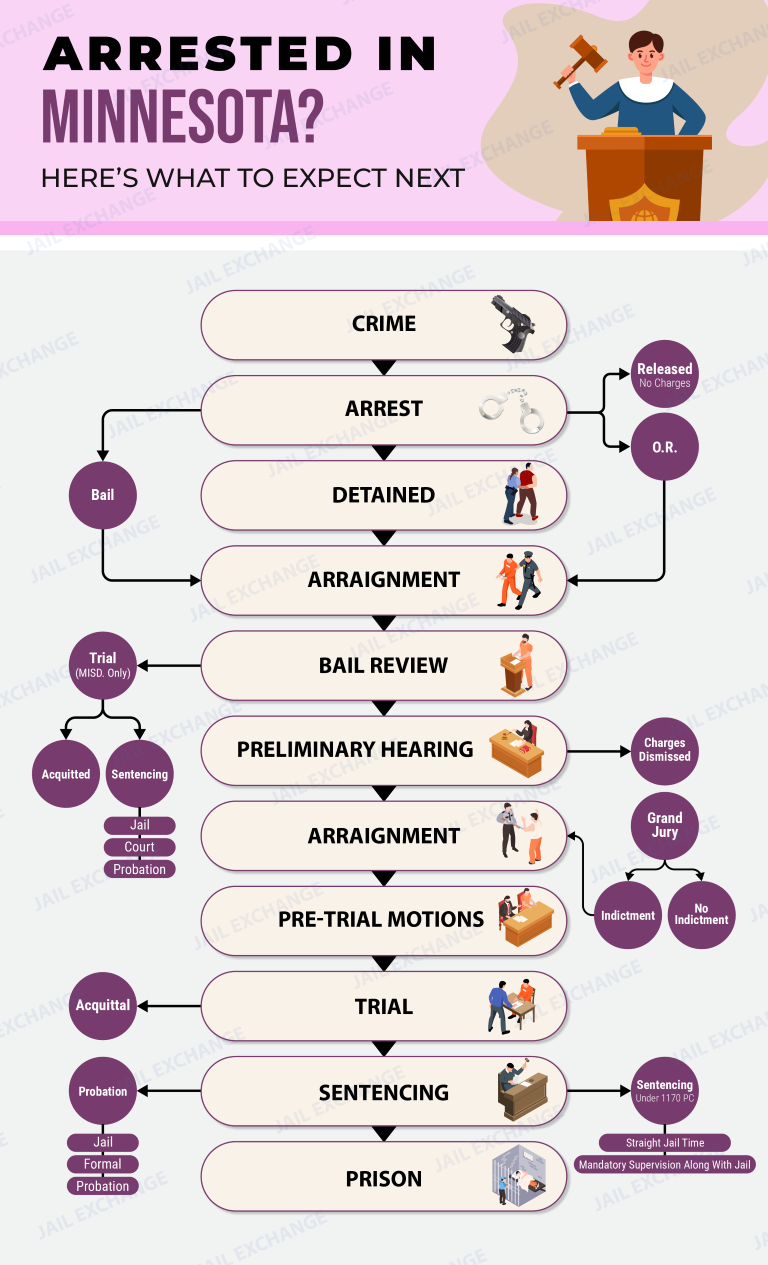
Rice County Jail Criminal Court Process
Criminal Court Process for Rice County Minnesota
Rice County Criminal Court Process: From Arrest to Sentencing in Faribault
Every criminal charge in this county is filed at the Rice County Courthouse, 218 NW Third Street, Suite 300, Faribault, MN 55021, where the District Court of the Third Judicial District sits. Its court administration office answers at 507-497-7134. If an offense happened on the Dakota County side of Northfield, the case goes there instead. Anyone kept after arrest is held at the Rice County Jail, 50 East View Drive, Faribault, MN 55021.
Search the person's name on the county's jail roster before you drive over. Our Inmate Lists page for Faribault walks through charges, mugshots and free legal help.
Phone court administration at 507-497-7134 and ask staff for the file number and the day your person goes before a judge. To raise bail money, see our Rice County bail page.
1. Misdemeanor (for example, theft, a first DWI, fifth-degree assault, trespassing)
Faribault is the county seat of Rice County, and the Rice County Courthouse on Northwest Third Street is where the county's criminal cases are filed and heard. The court is part of Minnesota's Third Judicial District, which takes in a long stretch of southeastern Minnesota. The Rice County Attorney prosecutes felonies, juvenile cases and lesser offenses from the townships; Faribault, Northfield and most other cities prosecute their own misdemeanors and gross misdemeanors through city attorneys, while the state court lists the County Attorney's line as the contact for Lonsdale. People arrested and held in custody are taken to the Rice County Jail at the Public Safety Center in Faribault, operated by the Sheriff.
- Rice County District Court (Third Judicial District), Rice County Courthouse, 218 NW Third Street, Suite 300, Faribault, MN 55021, (507) 497-7134
- Rice County Attorney's Office, Faribault, (507) 332-6103
- Third District Public Defender (State Board of Public Defense), the office a Faribault judge appoints for Rice County defendants who qualify; Rice County clients can reach its Owatonna office at 135 West Main Street, Suite E, Owatonna, MN 55060, (507) 455-5887
- Rice County Jail, Rice County Public Safety Center, 50 East View Drive, Faribault, MN 55021, (507) 332-6021
- Rice County Sheriff's Office, Rice County Public Safety Center, 50 East View Drive, Faribault, MN 55021, (507) 334-4391
Which court hears your case. Rice County District Court is the only criminal trial court for the county, so a petty misdemeanor from Dundas and a felony from Faribault both end up at the courthouse on Third Street. Minnesota has no separate city courts. The charge level decides the prosecutor and the procedure. For misdemeanors and gross misdemeanors that occur in a city, the city attorney, often a private attorney under contract, prosecutes; in the townships the Rice County Attorney handles them. All felonies go to the County Attorney. One local wrinkle: part of Northfield lies across the line in Dakota County, and an offense on that side of town is filed in Dakota County District Court instead.
Where pretrial detainees are held. When Faribault or Northfield police, the Rice County Sheriff's Office or the State Patrol make a custodial arrest, the person is booked into the Rice County Jail at the Public Safety Center, 50 East View Drive in Faribault. A Rice County detainee who cannot post bail and is not released by a judge stays at East View Drive while the case moves forward. The jail's main line is (507) 332-6021, and visiting is offered daily in set morning, afternoon and evening blocks.
Rice County groups three charge levels at this end of the scale. A petty misdemeanor is a violation rather than a crime and is punished by a fine of $300 or less. A misdemeanor carries a maximum of 90 days and $1,000; a gross misdemeanor, 364 days and $3,000.
Being cited or booked in Faribault
Many minor offenses in Rice County never involve a trip to jail: the officer issues a citation that sets a date at the Faribault courthouse. People who are arrested are booked at the Public Safety Center, and many leave after posting bail from the court's schedule. Someone who stays in custody has the right to see a judge within 36 hours of arrest; the arrest day, Sundays and legal holidays are not counted.
The arraignment
A misdemeanor begins with an arraignment before a Third District judge, who explains the charge, the maximum penalty and the defendant's rights, and then decides release. Following standard Minnesota practice, the Faribault judge will usually announce two figures, the bigger one payable with no strings and the smaller one available only if the defendant accepts rules like sobriety, staying away from the complaining witness, or reporting to a Rice County probation agent. Commercial bail bonds are legal in the state, and bond agents work in Faribault. If jail is a possible sentence and you cannot afford counsel, ask for a public defender at this hearing; the judge decides whether you qualify.
Pretrial conference, plea or trial
After arraignment, most Rice County cases are scheduled for a pretrial conference. The prosecutor often offers to reduce the charge, agree to a continuance for dismissal, or accept a stay of adjudication, under which completing probation leaves no conviction. A trial, if there is one, is decided by six jurors, and the verdict must be unanimous.
Penalties in Rice County District Court
- Theft in Faribault or Northfield: $500 or less is a misdemeanor, $500 to $1,000 a gross misdemeanor, and over $1,000 a felony.
- Fifth-degree assault: charged in Rice County as a misdemeanor on a first offense and as a gross misdemeanor when the defendant has a qualifying prior.
- Trespassing: usually a misdemeanor, up to 90 days in the Rice County Jail.
- First DWI in Rice County: with nothing extra, Faribault and Northfield prosecutors charge fourth-degree DWI, a misdemeanor topping out at 90 days and $1,000. Show one aggravator, such as a reading of 0.16-plus, a child under 16 aboard, or a refusal, and the charge moves up to third-degree DWI, a gross misdemeanor with as much as 364 days and $3,000 at stake. The license revocation runs through the state on a separate track, the Rice County court orders a chemical use assessment, and aggravated cases can add an ignition interlock requirement, special plates or vehicle forfeiture.
A misdemeanor in Rice County typically resolves in one to four months.
↑ Back to the question list2. Felony (for example, burglary, felony theft, drug sale, second-degree assault)
The Rice County Attorney's Office files felony charges through a criminal complaint. Grand juries are convened only for offenses punishable by life imprisonment.
The Rule 5 appearance
A person held on a felony in the Rice County Jail must appear before a judge within 36 hours, again leaving out the arrest day, Sundays and holidays. After a warrantless arrest, a judge must also confirm probable cause within 48 hours. The Rule 5 hearing in Faribault covers the complaint itself, appointment of a Third District public defender when the defendant qualifies, and the bail amounts and release conditions, sometimes informed by a pretrial evaluation.
The road to trial
A Rule 8 hearing, the second appearance, follows within a few weeks and is often when discovery and plea offers are exchanged. The omnibus hearing comes next, where the judge decides defense challenges to searches, statements and probable cause. If no agreement is reached at a pretrial or settlement conference, the case is tried before 12 jurors, who must be unanimous. Once a Rice County defendant demands a speedy trial, the court has 60 days to begin it. Felony sentencing in Faribault waits on a presentence investigation.
Third District sentencing
For felony sentencing, Rice County judges look up the case on the Minnesota Sentencing Guidelines grid, where the crime's severity ranking and the defendant's history score meet at a presumptive outcome: probation under a stayed term, or an executed prison commitment. Third District judges need substantial and compelling reasons to sentence any other way.
- Felony theft in Rice County: a Faribault judge can impose as much as 5 years when more than $1,000 was taken, and the cap reaches 10 years past $5,000 and 20 years past $35,000.
- Burglary: Rice County prosecutors can seek as much as 20 years when the burglary is first-degree, with lower caps of 10 years and 5 years for the second and third degrees.
- First-degree drug sale: up to 30 years.
- Second-degree assault (dangerous weapon): up to 7 years, with a mandatory minimum prison term when a firearm is used.
A stay of imposition allows a felony to be recorded as a misdemeanor once probation is completed. A Rice County prison sentence is usually two-thirds served inside, with the final third on supervised release. Rice County felony cases usually take four months to a year.
↑ Back to the question list3. Violent felony (for example, murder, criminal sexual conduct, aggravated robbery)
Violent felony cases in Rice County proceed through the same Rule 5, Rule 8 and omnibus stages, but bail is generally high and many defendants remain in the Faribault jail until trial. A charge of first-degree murder requires a grand jury indictment.
Penalties
- First-degree murder: a mandatory life term. When the murder was premeditated, or in certain other first-degree situations, life means no release at all; otherwise release can be considered after 30 years. A Rice County jury cannot impose death, because Minnesota dropped capital punishment in 1911.
- Second-degree murder: up to 40 years; third-degree murder: up to 25 years.
- First-degree criminal sexual conduct: up to 30 years, with a 144-month presumptive sentence for a first offense.
- First-degree aggravated robbery: up to 20 years.
Lawyers, victims and timing
Eligible defendants are represented by the Third District Public Defender. Chapter 611A of Minnesota Statutes guarantees victims in Rice County prosecutions notice of each hearing, the right to be in the courtroom, and a chance to speak before the sentence is handed down. These prosecutions often take one to two years or more because of forensic testing, expert witnesses and motion practice.
↑ Back to the question list4. Juveniles (under 18) arrested in Rice County
For a Faribault, Northfield or rural Rice County youth under 18, the matter goes before the Faribault courthouse's juvenile division, where the Rice County Attorney files any delinquency petition. If detention is needed, Rice County generally places the youth at the Dakota County Juvenile Services Center in Hastings, (651) 438-4970, which serves Rice County, never the East View Drive jail. The juvenile judge must review that placement at a detention hearing inside 36 hours, and weekend days and holidays do not count toward the limit.
Diversion is frequently offered for first offenses, and completing it keeps the youth out of formal court proceedings. For serious felonies, the County Attorney can seek Extended Jurisdiction Juvenile prosecution for youth 14 through 17, combining a juvenile disposition with a stayed adult sentence. From age 14, a Rice County youth can be certified for adult prosecution, and Minnesota presumes certification for 16- and 17-year-olds when the alleged offense carries presumptive prison or a firearm was used. A first-degree murder charge at 16 or 17 is filed in adult court from the outset. Third District public defenders take juvenile appointments in Faribault, and Rice County juvenile records are mostly closed, with some felony cases involving older teens as the exception.
↑ Back to the question list5. Federal cases (U.S. District Court) from Rice County
Rice County lies within the District of Minnesota, and for federal criminal matters it is assigned to Division 3, centered in St. Paul. Cases from Faribault, Northfield, Lonsdale and the rest of the county are handled at the Warren E. Burger Federal Building and U.S. Courthouse, 316 N. Robert Street, St. Paul, MN 55101, about 50 miles north of the Faribault courthouse. Federal jurors in Division 3 report to St. Paul or Minneapolis. The initial appearance and detention hearing are often in St. Paul or Minneapolis too. The Clerk of Court's office is at (612) 664-5000.
Federal agencies drive these cases. When the FBI, DEA, ATF, Homeland Security Investigations, U.S. Postal Inspectors or IRS Criminal Investigation build a case, the charges usually involve drug trafficking (particularly larger amounts or loads moving up and down I-35 across state lines), felons possessing guns and related firearms counts, fraud schemes, child exploitation, bank robbery or immigration violations. A Rice County Sheriff's arrest can be adopted for federal prosecution, and Minnesota and the United States may each charge the same conduct.
Offices to know
Charges are brought by the U.S. Attorney's Office for the District of Minnesota. Its St. Paul office, the closer one for Rice County, is at 316 N. Robert Street, Suite 404, St. Paul, MN 55101, (651) 848-1950; the main office is U.S. Courthouse, 300 S. 4th Street, Suite 600, Minneapolis, MN 55415, (612) 664-5600. The Office of the Federal Defender, 107 U.S. Courthouse, 300 S. 4th Street, Minneapolis, MN 55415, (612) 664-5858, represents defendants who cannot afford a lawyer, and the court appoints a CJA panel attorney if the Defender has a conflict. Federal custody belongs to the U.S. Marshals Service, reachable in St. Paul at (651) 848-1435 or Minneapolis at (612) 664-5900.
How a federal prosecution moves
It begins with an arrest by federal agents or on a federal warrant or indictment, then an initial appearance before a U.S. magistrate judge, who reviews the charges and appoints counsel. When prosecutors seek detention, the hearing is typically held within three court days. The Bail Reform Act lets the judge release the defendant on conditions, supervised by U.S. Probation and Pretrial Services, or detain the person if no conditions will assure appearance and safety. Bondsmen do not operate in federal court and money bail is unusual.
A complaint must be converted to a grand jury indictment, or supported at a preliminary hearing, within 30 days of arrest, and an arraignment follows. Trial is supposed to start within 70 days under the Speedy Trial Act, though judges often grant continuances. Most cases are settled by plea agreement; at trial, 12 jurors must vote unanimously. About three months after a guilty plea or verdict, sentencing takes place with a presentence report, the advisory Sentencing Guidelines and any mandatory minimum. No parole exists in the federal system, so with good-conduct time a person still serves at least about 85% of the sentence in a Bureau of Prisons facility, and supervised release follows. Appeals go to the Eighth Circuit. Federal juvenile prosecutions are rare.
The Marshals keep pretrial detainees in county jails under contract around Minnesota and sometimes out of state, so a person arrested in Rice County may be held in another county. The Marshals can tell families where; the Bureau of Prisons inmate locator lists people after sentencing.
↑ Back to the question listThis overview explains the usual course of a Rice County criminal case in general terms and is not legal advice. Contact a defense attorney about your circumstances, or ask the court for a Third District public defender at your first appearance. Rice County Court Administration can be reached at (507) 497-7134, and the jail at (507) 332-6021.