St. Louis County, the largest county in Minnesota by area, runs its District Court out of three courthouses: the main courthouse in Duluth, the county seat, plus full-service courthouses on the Iron Range in Virginia and Hibbing. The court is part of the Sixth Judicial District. Felonies and juvenile cases are prosecuted by the elected St. Louis County Attorney, while misdemeanors and gross misdemeanors from cities such as Duluth are prosecuted by city attorneys. Adults held after an arrest end up in the St. Louis County Jail in Duluth, with short-term lockups in Virginia and Hibbing.
- St. Louis County District Court, Duluth (Sixth Judicial District), 100 North Fifth Avenue West, Duluth, MN 55802, (218) 221-7560
- St. Louis County District Court, Virginia, 300 South Fifth Avenue, Virginia, MN 55792, (218) 305-7021
- St. Louis County District Court, Hibbing, 1810 East 12th Avenue, Hibbing, MN 55746, (218) 274-6007
- St. Louis County Attorney's Office, felony, juvenile and township prosecutor, Duluth
- Sixth District Public Defender's Office, Duluth (State Board of Public Defense); St. Louis County clients can reach its Duluth office at 306 West Superior Street, Duluth, MN 55802, (218) 733-1027
- St. Louis County Jail (St. Louis County Sheriff's Office), 4334 Haines Road, Duluth, MN 55811, (218) 726-2345
Which court hears your case. Whatever the charge, a St. Louis County criminal case belongs to the St. Louis County District Court; Minnesota abolished separate municipal courts long ago, so even a Duluth ordinance violation is filed there. The level of the offense determines who prosecutes and how many hearings follow, not which court has the case. A misdemeanor or gross misdemeanor committed within a city is typically handled by the city attorney's office or a private firm under contract with that city, and the Duluth City Attorney's Office prosecutes those cases from inside Duluth. When the same kind of offense happens in a township or unorganized territory, the St. Louis County Attorney prosecutes. All felonies are prosecuted by the County Attorney. Which of the three courthouses hears the case generally depends on where in the county the offense occurred.
Where pretrial detainees are held. The main adult detention facility is the St. Louis County Jail at 4334 Haines Road in Duluth, run by the Sheriff's Office ((218) 726-2345). The Sheriff also operates 72-hour lockups in Virginia, which holds up to 12 people, and Hibbing, which holds up to 8. People arrested on the Range can be held briefly in those lockups for court in Virginia or Hibbing, but anyone who stays in custody beyond a few days is generally housed at the Duluth jail.
- The three St. Louis County courthouses
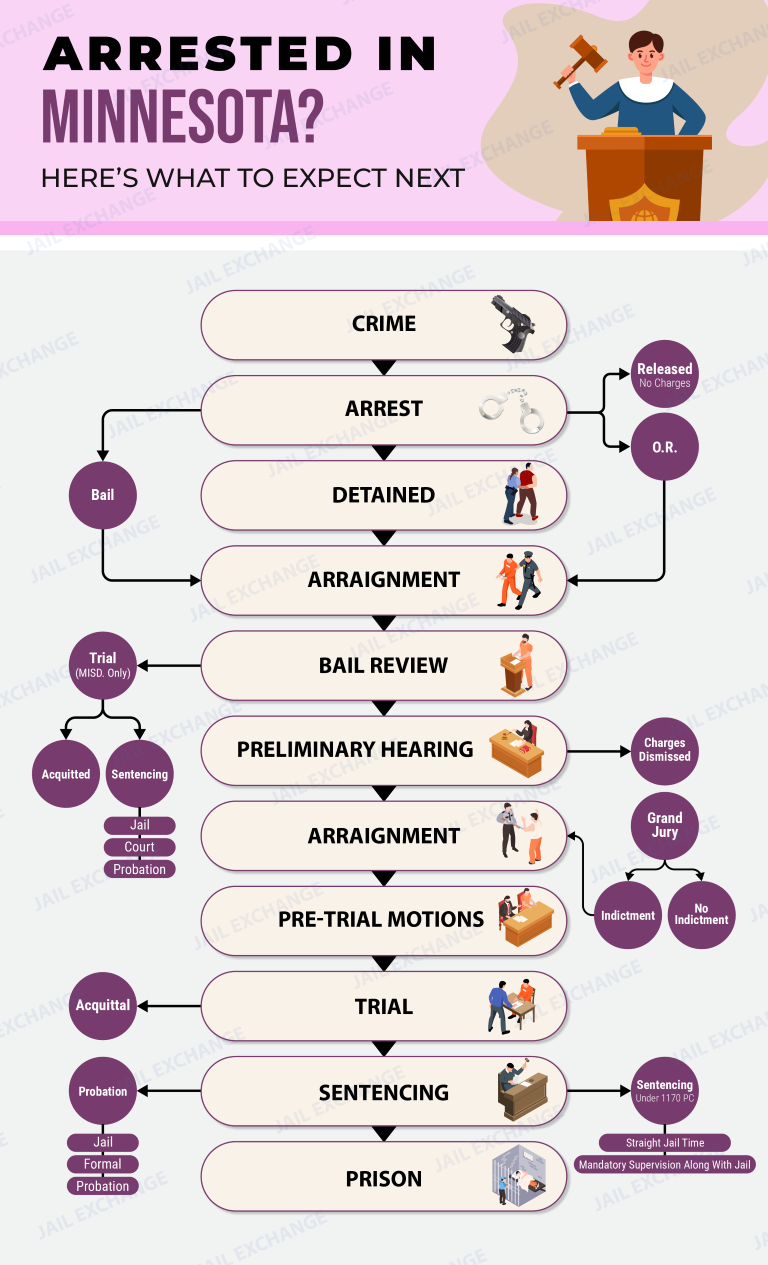
- What happens after an arrest in St. Louis County
- The St. Louis County Jail and Range lockups
- Public defenders in the Sixth District
- Prosecutors and diversion in St. Louis County
- Treatment courts in St. Louis County
- Misdemeanor (for example, theft, a first DWI, fifth-degree assault, trespassing)
- Felony (for example, burglary, felony theft, drug sale, second-degree assault)
- Violent felony (for example, murder, criminal sexual conduct, aggravated robbery)
- Juveniles (under 18) arrested in St. Louis County
- Federal cases (U.S. District Court) from St. Louis County
The three St. Louis County courthouses
Because St. Louis County stretches from Lake Superior to the Canadian border, the court keeps full administrative offices in three places. Each one can accept filings, take payments and schedule hearings in criminal, traffic, family, civil, probate and juvenile cases.
- Duluth Courthouse, 100 North Fifth Avenue West: the main courthouse, hearing most cases from Duluth and the southern part of the county. Call (218) 221-7560.
- Virginia Courthouse, 300 South Fifth Avenue: one of two Iron Range courthouses, handling many cases from Virginia and the surrounding northern part of the county. Call (218) 305-7021.
- Hibbing Courthouse, 1810 East 12th Avenue: the second Range courthouse, handling many cases from Hibbing and the western Range. Call (218) 274-6007.
Your citation, summons or release paperwork names the courthouse for your hearing. If you are unsure, call any of the three offices with your case number; staff can see cases countywide. Entering any of the courthouses involves security screening, so leave knives and other prohibited items at home.
What happens after an arrest in St. Louis County
Officers from the Sheriff's Office, Duluth Police, Range police departments, tribal police and the State Patrol all bring arrestees into the same system. Many minor offenses end with a citation and a court date. A custodial arrest leads to booking, where staff take fingerprints and photographs, inventory property and screen for medical needs.
Getting out before court
For some offenses a person can be released from booking by paying the amount listed on a bail schedule. Others, especially domestic assault, felony charges and serious DWI offenses, generally have to wait for a judge.
Seeing a judge within 36 hours
Under Minnesota Rule of Criminal Procedure 4.01, a person in custody must appear before a judge within 36 hours of arrest, not counting the day of the arrest, Sundays or legal holidays. A judge also has to find probable cause within 48 hours when the arrest was made without a warrant. In St. Louis County, first appearances for people in custody are frequently held by video between the jail and the courtroom.
How release is decided
The judge can release the person on recognizance or with conditions such as no contact, sobriety testing, alcohol monitoring or reporting to probation. If money bail is ordered, a Sixth District judge typically lists two amounts, the higher with no strings attached and the lower paired with release conditions. Bail may be posted with cash or through a licensed bail bond agent, and commercial bonds are legal in Minnesota. Pretrial evaluations prepared by probation staff help the judge weigh flight risk and public safety.
The St. Louis County Jail and Range lockups
The St. Louis County Jail on Haines Road, on the western edge of Duluth near Hermantown, is the county's full-service jail. It holds people waiting for a first appearance, defendants who have not posted bail and people serving local sentences. Questions about custody status, bail posting, visits or property go to the jail at (218) 726-2345.
On the Iron Range the Sheriff runs two smaller 72-hour holding facilities. The Virginia lockup has space for 12 people and the Hibbing lockup for 8. They make it possible to hold someone overnight and bring them to court on the Range without a long drive to Duluth. A person who is not released within that short window is typically transferred to the Duluth jail, which can mean a trip of an hour or more for families visiting from the north.
Public defenders in the Sixth District
The State Board of Public Defense provides public defenders for St. Louis County through the Sixth District Public Defender's Office, which has its main office in Duluth and attorneys who cover the Range courthouses. A person who cannot afford a lawyer can request one at the first appearance; the court reviews income and expenses and the judge makes the appointment.
Public defenders are appointed in misdemeanor, gross misdemeanor, felony and juvenile delinquency cases. They are not appointed for petty misdemeanors, which carry no jail. Because the public defender usually meets clients for the first time at or just before the first appearance, bring any paperwork you have, including the complaint and release conditions, to the next court date.
Prosecutors and diversion in St. Louis County
The elected St. Louis County Attorney handles felony cases across all three courthouses, every juvenile delinquency petition, and misdemeanor or gross misdemeanor cases from the townships and unorganized territory patrolled by the Sheriff. Inside Duluth, the Duluth City Attorney's Office prosecutes lower-level offenses such as shoplifting, disorderly conduct, many first DWIs and domestic assault misdemeanors. Range cities generally contract with private attorneys for the same work.
Diversion is a common outcome for first-time, nonviolent defendants. Successful completion of a diversion contract, which may include restitution, classes, treatment or community service, ends in dismissal. Prosecutors also negotiate continuances for dismissal, stays of adjudication and amended charges. In domestic violence and other cases with an identified victim, prosecutors are expected to consult the victim before agreeing to a resolution.
Treatment courts in St. Louis County
St. Louis County has operated treatment-court programs for years, aimed mainly at defendants whose offenses are tied to alcohol, drugs, mental illness or military service trauma. These programs, which can include DWI court, drug court, veterans court and mental health court tracks, replace a traditional sentence with close supervision, treatment, frequent testing and regular review hearings in front of the same judge.
Entry usually requires a guilty plea, a screening for eligibility and the agreement of the prosecutor. Participants who stay sober and follow the plan move through phases over a year or more and may earn a reduced sentence or dismissal; those who do not can be sentenced on the original charge. Which programs are open at the Duluth, Virginia or Hibbing courthouse at a given time varies, so ask your defense attorney.
Misdemeanor (for example, theft, a first DWI, fifth-degree assault, trespassing)
Minnesota divides its lowest-level offenses into petty misdemeanors, misdemeanors and gross misdemeanors, and all three are covered here. In St. Louis County most of these cases start with a ticket or a brief jail stay in Duluth, Virginia or Hibbing and are heard at the courthouse closest to where the offense happened.
Steps in a St. Louis County misdemeanor case
The first hearing is an arraignment, where the defendant hears the charge and enters a plea. After a not-guilty plea the case moves to a pretrial conference, where most cases settle. Cases that do not settle go to a court trial or a trial before six jurors, all of whom must agree. Gross misdemeanors are handled more like felonies, with a Rule 5 first appearance and an omnibus hearing, but the jury still has six members.
Lawyers for misdemeanor defendants
If jail is possible and the defendant cannot pay for a lawyer, the judge can appoint the Sixth District Public Defender's Office at arraignment.
Maximum sentences in the Sixth District
- A St. Louis County petty misdemeanor: not a criminal offense; the court can impose a fine of up to $300 and no jail.
- Misdemeanor charged in Duluth or on the Range: up to 90 days in jail and a $1,000 fine, covering theft of $500 or less, trespass and fifth-degree assault.
- Gross misdemeanor in St. Louis County: up to 364 days and $3,000, for example theft between $500 and $1,000 or a repeat fifth-degree assault.
- First DWI in St. Louis County: a fourth-degree DWI charged in Duluth or on the Range is a misdemeanor carrying up to 90 days and $1,000. One aggravating factor, such as an alcohol concentration of 0.16 or higher, a child under 16 in the vehicle or refusing a test, makes it a third-degree gross misdemeanor with up to 364 days and $3,000. An administrative license revocation runs separately from the criminal case, and ignition interlock, plate impoundment, vehicle forfeiture in aggravated cases and a chemical use assessment are all possible.
Probation, fines, community service, a stayed jail sentence or diversion are the usual outcomes for a first offense. A St. Louis County misdemeanor generally resolves in one to four months.
Felony (for example, burglary, felony theft, drug sale, second-degree assault)
The St. Louis County Attorney charges felonies by filing a complaint, and a judge must find probable cause before the case proceeds. Grand juries are convened in Minnesota only for crimes punishable by life in prison.
Felony hearings at the Duluth, Virginia or Hibbing courthouse
- First appearance under Rule 5: the charge is explained, counsel is appointed for eligible defendants and release terms are set.
- Second appearance under Rule 8: discovery begins and the parties may talk about a plea.
- Omnibus hearing: the defense may contest probable cause or ask the judge to suppress evidence from a search or interrogation.
- Settlement conference, then a trial before 12 jurors who must agree unanimously, or a plea.
- Sentencing, ordinarily after a presentence investigation report.
Defendants who make a speedy trial demand are entitled to trial within 60 days, absent good cause.
Appointed counsel in Sixth District felony cases
Eligible felony defendants are represented by the Sixth District Public Defender's Office through every stage, including sentencing.
Sentencing ranges for St. Louis County felonies
Felony sentences are set using the Minnesota Sentencing Guidelines, a grid that crosses offense severity with criminal history to produce a presumptive stayed sentence (probation) or executed sentence (prison). A judge needs substantial and compelling reasons to depart.
- Theft prosecuted in St. Louis County: up to 5 years when the value exceeds $1,000, 10 years above $5,000 and 20 years above $35,000.
- Burglary in the Sixth District: St. Louis County judges can impose as much as 20 years for first degree, 10 for second degree and 5 for third degree.
- First-degree drug sale in St. Louis County: up to 30 years in prison.
- Second-degree assault from St. Louis County (with a dangerous weapon): up to 7 years, with a mandatory minimum when a firearm is used.
Many lower-level felonies result in probation with local jail time, or a stay of imposition that reduces the conviction to a misdemeanor after probation is completed. A St. Louis County defendant sent to prison generally serves two-thirds of the term behind bars and the last third on supervised release. Expect a felony case here to take four to twelve months.
Violent felony (for example, murder, criminal sexual conduct, aggravated robbery)
Violent felony prosecutions in St. Louis County use the same Rule 5, Rule 8 and omnibus steps, but defendants often stay in the Haines Road jail throughout the case because bail is set high. First-degree murder charges require a grand jury indictment.
Penalties St. Louis County judges can impose for violent crimes
- First-degree murder: mandatory life imprisonment, without parole for premeditated murder and some other forms, and otherwise with parole eligibility after 30 years. There has been no death penalty in Minnesota since 1911.
- Second-degree murder: up to 40 years. Third-degree murder: up to 25 years.
- First-degree criminal sexual conduct: up to 30 years; the presumptive sentence for a first offense is 144 months.
- Aggravated robbery in the first degree: up to 20 years.
Victims, defense and timeline
Victims have rights under Minnesota Statutes chapter 611A to be notified, to be present and to speak at sentencing. The Sixth District Public Defender's Office represents qualifying defendants, frequently assigning senior trial lawyers to homicide and sexual assault cases. Forensic testing, expert witnesses and extensive motion practice mean these cases commonly take one to two years or longer.
Juveniles (under 18) arrested in St. Louis County
Youth under 18 are handled in the juvenile division of St. Louis County District Court, with hearings in Duluth, Virginia or Hibbing depending on where the offense took place. The St. Louis County Attorney decides whether to file a delinquency petition. For a first offense, diversion through a contract, restorative program or classes is a common alternative to formal charges.
A young person who is held in secure custody is taken to the Arrowhead Juvenile Center in Duluth rather than an adult jail or lockup. A detention hearing must take place within 36 hours of being taken into custody, excluding weekends and holidays, where a judge decides whether the youth can return home and under what conditions. The Sixth District Public Defender's Office represents children who qualify.
In serious cases, prosecutors can ask for Extended Jurisdiction Juvenile (EJJ) status for some 14- to 17-year-olds, meaning a juvenile disposition backed by a stayed adult sentence. They can also move to certify a youth 14 or older for adult prosecution; certification is presumed for 16- and 17-year-olds charged with an offense carrying a presumptive prison sentence or committed with a firearm. Sixteen- and 17-year-olds charged with first-degree murder are tried in adult court. Juvenile records are generally confidential, though certain felony-level records for youth 16 and older can be public.
Federal cases (U.S. District Court) from St. Louis County
Some arrests in St. Louis County lead not to the courthouse on North Fifth Avenue West but to the United States District Court for the District of Minnesota. The county belongs to the court's Division 5, which sits at the Gerald W. Heaney Federal Building and U.S. Courthouse, 515 W. First Street, Duluth, MN 55802, in the same downtown civic area as the county courthouse. Jurors for Duluth-division trials report to that building, so a defendant from Hibbing, Virginia or Ely who goes to trial is judged by a panel summoned to Duluth. Initial appearances and detention hearings for northeastern arrests are often held in Duluth as well, although some early hearings take place in Minneapolis or St. Paul. The Clerk of Court's main line is (612) 664-5000.
What turns a St. Louis County case federal
Federal charges rest on federal law, and the investigation usually involves an agency such as the FBI, DEA, ATF, Homeland Security Investigations, U.S. Postal Inspectors or IRS Criminal Investigation. Typical northeastern Minnesota examples include trafficking methamphetamine, fentanyl or other drugs brought in from outside the state, possession of a gun or ammunition by someone with a felony record, mail, wire or benefits fraud, child exploitation offenses, bank robbery, and immigration crimes, including matters tied to the Canadian border. An arrest by Duluth police or a sheriff's deputy can be "adopted" by federal prosecutors, and because the state and the United States are separate sovereigns, the same conduct can be charged in both courts.
Prosecutor, defender and Marshals
Charges are brought by the U.S. Attorney's Office for the District of Minnesota, headquartered at the U.S. Courthouse, 300 S. 4th Street, Suite 600, Minneapolis, MN 55415, (612) 664-5600; its St. Paul office is at 316 N. Robert Street, Suite 404, St. Paul, MN 55101, (651) 848-1950. Defendants who cannot afford counsel are represented by the Office of the Federal Defender for the District of Minnesota, 107 U.S. Courthouse, 300 S. 4th Street, Minneapolis, MN 55415, (612) 664-5858, or, when that office has a conflict, by a private lawyer appointed from the court's CJA panel. The U.S. Marshals Service controls federal custody; its Duluth office answers at (218) 529-3620, and the Minneapolis office at (612) 664-5900.
Steps in a Duluth-division case
- Arrest and initial appearance: after an arrest by federal agents or on a federal warrant or indictment, the person goes before a U.S. magistrate judge, who explains the charges and appoints a lawyer if needed.
- Detention hearing: if prosecutors ask to hold the person, a hearing usually follows within three court days. Under the Bail Reform Act the judge either releases the defendant on conditions monitored by U.S. Probation and Pretrial Services or orders detention when no conditions would assure appearance and community safety. Bail bond agents play no part, and money bail is rare.
- Indictment: a case started by complaint needs a grand jury indictment within 30 days of the arrest; a preliminary hearing may be held in the meantime.
- Arraignment and the trial clock: the Speedy Trial Act calls for trial within 70 days of indictment or first appearance, but continuances are routine. A federal trial jury has 12 members, and its verdict must be unanimous.
- Plea and sentencing: most cases are resolved by plea agreement. Sentencing comes roughly three months later, after a presentence report, under the advisory U.S. Sentencing Guidelines and any mandatory minimum.
- Prison and after: there is no federal parole; with good-conduct credit a person serves at least about 85% of the term in a Bureau of Prisons facility, then a period of supervised release. Appeals go to the Eighth Circuit.
Where federal detainees from the county are held
A person charged federally is in the custody of the Marshals rather than the Sheriff, even if the first night was spent at the Haines Road jail. The Marshals Service rents beds in county jails it contracts with across Minnesota, and occasionally outside the state, so someone arrested in Virginia or Duluth may be moved to another county's jail while the case is pending. Relatives can phone the Duluth Marshals office to find out where a person is housed. Once a sentence is imposed, the Bureau of Prisons inmate locator lists the prison where the person was sent.
Bois Forte and other reservation lands
Minnesota is a Public Law 280 state, which means the state usually prosecutes crimes committed on reservations. The Bois Forte Reservation is an exception: on Bois Forte lands in St. Louis County, including part of the Nett Lake area and the Vermilion section near Tower, serious offenses covered by the Major Crimes Act, such as murder, manslaughter, sexual abuse and assault resulting in serious bodily injury, are prosecuted in federal court. The Fond du Lac Reservation, which also reaches into the county, follows the general state-jurisdiction rule. Separately, federal courts very seldom take cases against people younger than 18.
This guide summarizes how criminal cases generally move through the St. Louis County District Court and is not legal advice. If you or someone close to you has been charged, consult a criminal defense attorney or ask the Sixth District Public Defender's Office to be appointed at the first appearance; the Duluth courthouse is at (218) 221-7560 and the county jail at (218) 726-2345.