Washington County Juvenile Detention Center Criminal Court Process
Criminal Court Process for Washington County Minnesota
How a Criminal Case Moves Through the Washington County Courts in Stillwater
Every criminal case in Washington County, from a Woodbury ticket to a Forest Lake felony, goes to the District Court of the Tenth Judicial District at the courthouse, 14949 62nd Street North, Stillwater, MN 55082. Court administration's main line is 651-413-8030. Anyone the judge has not released waits next door, inside the county jail, 15015 62nd Street North, Stillwater, MN 55082.
A quick name check in the Sheriff's custody lookup tells you if a relative remains locked up in Stillwater. Our Inmates in Custody page for Washington explains bookings, charges and how to request a public defender.
Call court administration at 651-413-8030 on a weekday to learn the date and courtroom of the first appearance. Criminal and traffic questions also have their own line, 651-413-8133. If release needs money, our Stillwater bail payment guide lays out the counter, window and kiosk.
1. The Washington County courthouse in Stillwater
Washington County, on the eastern edge of the Twin Cities metro, sends all of its criminal cases to the Washington County District Court, which sits at the Government Center courthouse on 62nd Street North in Stillwater, the county seat. The court is one of eight in Minnesota's Tenth Judicial District. The elected Washington County Attorney prosecutes felonies, juvenile delinquency cases and lower-level offenses from unincorporated areas, while cities such as Woodbury, Cottage Grove, Oakdale, Forest Lake and Stillwater use their own city prosecutors for misdemeanors and gross misdemeanors. Adults who are arrested and held are booked into the Washington County Jail in the Sheriff's Law Enforcement Center next door to the courthouse.
Because the county is large and busy, this page includes more detail than most: the courthouse, the first hours after an arrest, the jail, appointed counsel, prosecutors and diversion, and treatment courts, followed by what to expect for each level of charge.
- Washington County District Court (Court Administration, Tenth Judicial District), Washington County Courthouse, 14949 62nd Street North, P.O. Box 3802, Stillwater, MN 55082, main line (651) 413-8030; criminal and traffic (651) 413-8133; juvenile (651) 413-8132
- Washington County Attorney's Office, Washington County Government Center, Stillwater, (651) 430-6115
- Tenth District Public Defender (State Board of Public Defense), which represents eligible defendants in Washington County District Court; Washington County clients can reach its Stillwater office at 1825 Curve Crest Boulevard West, Suite 202, Stillwater, MN 55082, (651) 351-3700
- Washington County Jail (Washington County Sheriff's Office, Law Enforcement Center), 15015 62nd Street North, Stillwater, MN 55082, jail division (651) 430-7900; Sheriff's Office main line (651) 430-7600
Which court hears your case. Whether the charge is a petty misdemeanor speeding ticket from Woodbury or a felony assault in Forest Lake, it is filed in the same Washington County District Court in Stillwater; Minnesota has no separate city, municipal or county courts. The level of the charge decides who prosecutes and which hearings you will have. Misdemeanors and gross misdemeanors committed inside a city are normally prosecuted by that city's attorney, which in Washington County is usually a private attorney the city has hired. The same offenses in a township or unorganized area are prosecuted by the Washington County Attorney. Every felony, from anywhere in the county, is the County Attorney's case.
Where pretrial detainees are held. People arrested by the Sheriff's Office, a city police department or the State Patrol in Washington County who are not released are taken to the Washington County Jail at the Law Enforcement Center, 15015 62nd Street North in Stillwater. The jail is run by the elected Sheriff and operates around the clock. A person stays there until bail is posted, a judge orders release, or the case is resolved. For booking and custody questions, call the jail division at (651) 430-7900.
All criminal hearings in the county, from first appearances to jury trials, take place at the Washington County Courthouse, part of the Government Center campus at 14949 62nd Street North in Stillwater. The courtrooms, Court Administration counters and the County Attorney's Office share the campus, and the Sheriff's Law Enforcement Center and jail sit next door, so in-custody defendants can be brought to court without leaving the complex.
The ornate 19th-century courthouse on the hill in downtown Stillwater is now a historic site, not a working courtroom, so do not go there for a hearing. Court Administration is open Monday through Friday, 8:00 a.m. to 4:30 p.m. The criminal and traffic counter answers at (651) 413-8133, and the juvenile division at (651) 413-8132. Many first appearances and short hearings in Washington County may be held remotely or by video from the jail; your notice or your lawyer will tell you whether to appear in person.
↑ Back to the question list2. What happens after an arrest in Washington County
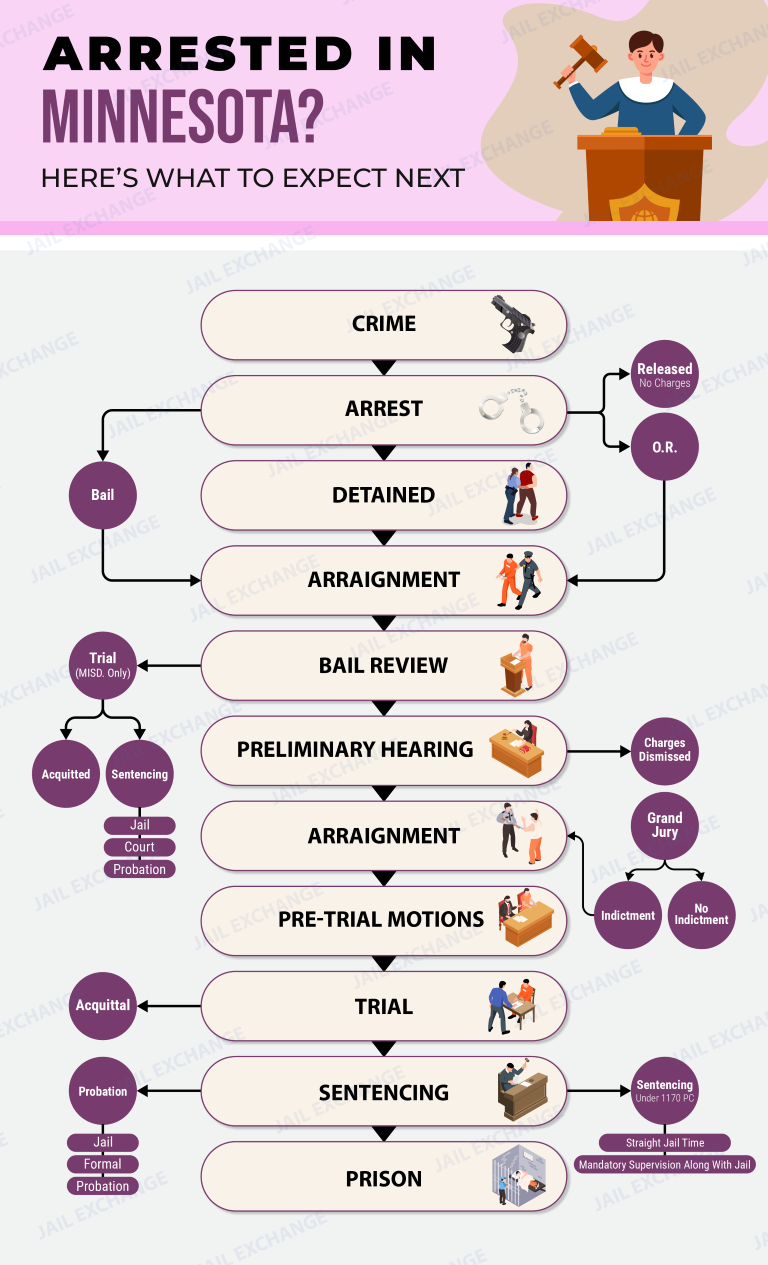
An arrest in Washington County usually unfolds in this order:
- Citation or booking. For many minor offenses the officer writes a citation with a court date and lets the person go. Otherwise the person is taken to the Law Enforcement Center in Stillwater, photographed, fingerprinted and searched, and their property is inventoried.
- Bail schedule or hold. Many people booked on misdemeanors can post bail under the Tenth District's schedule and leave within hours. People arrested on felonies, domestic assault or certain DWI charges are more often held to see a judge.
- Probable cause review. When there was no warrant, a judge must find probable cause for the arrest within 48 hours.
- First appearance within 36 hours. A person still in custody must be brought before a Washington County judge within 36 hours, not counting the day of arrest, Sundays and legal holidays. Someone arrested on a Friday afternoon is typically seen on Monday, or Tuesday after a holiday.
- Release decision. At the first appearance (a Rule 5 hearing for felonies and gross misdemeanors, an arraignment for misdemeanors), the judge reads the charge, decides whether to appoint a public defender, and sets release. Options include release on recognizance, conditional release with requirements such as no contact, no alcohol, alcohol monitoring or pretrial supervision, and money bail. Minnesota judges generally set two bail figures, a higher one without conditions and a lower one with them. A pretrial evaluation prepared by county corrections staff may help the judge decide. Commercial bail bonds are legal in Minnesota, so a family can use a bondsman.
3. The Washington County Jail
The Washington County Jail is operated by the Washington County Sheriff's Office inside the Law Enforcement Center at 15015 62nd Street North, Stillwater, MN 55082. It holds adults awaiting a first appearance, people who could not post bail or meet release conditions, and people serving shorter local sentences. Business offices are open on weekdays, while the jail itself and the county's 911 center run 24 hours a day.
- Jail division and booking information: (651) 430-7900
- Sheriff's Office main line: (651) 430-7600
- Non-emergency dispatch: (651) 439-9381
Staff can tell callers whether a person is in custody, the charges, and the bail amount once a judge has set it. Questions about the court case itself go to Court Administration or the defense lawyer, not the jail.
↑ Back to the question list4. Getting a public defender in Washington County
The State Board of Public Defense provides appointed lawyers in Washington County through the Tenth District Public Defender. Anyone charged with a misdemeanor, gross misdemeanor or felony who could be jailed and cannot afford a private attorney can apply. The usual practice is to complete a financial statement before or at the first appearance; the judge reviews income and household size and, if the person qualifies, appoints the public defender on the spot. Petty misdemeanors do not qualify because they carry no jail.
Once appointed, the public defender normally keeps the case through resolution. Juveniles in delinquency cases also receive appointed counsel. If the office has a conflict, for example because it already represents a co-defendant, the court arranges for another lawyer. Court Administration at (651) 413-8030 can tell a defendant whether counsel has been appointed in their file.
↑ Back to the question list5. Prosecutors and diversion in Washington County
Two kinds of prosecutors appear in Washington County District Court. The Washington County Attorney's Office, (651) 430-6115, handles all felonies, all juvenile delinquency petitions, and misdemeanors and gross misdemeanors from areas without their own city prosecutor. City attorneys, usually private firms on contract, prosecute misdemeanors and gross misdemeanors from their cities, such as a shoplifting arrest at a Woodbury store or a fifth-degree assault in Cottage Grove. The citation or complaint names the prosecuting authority.
Both kinds of prosecutors can offer alternatives to a conviction for appropriate cases, especially first-time, low-level offenses. Common tools include pretrial diversion (completing classes, restitution or community work in exchange for dismissal), a continuance for dismissal, and a stay of adjudication, under which no conviction is entered if the defendant completes probation. In felony cases, a stay of imposition can leave a person with a misdemeanor on the record after successful probation. Victims are consulted, and restitution is usually part of any agreement.
↑ Back to the question list6. Treatment and specialty courts
Minnesota's treatment courts, including drug courts, DWI courts, veterans treatment courts and mental health courts, are supervised probation programs for people whose offenses are driven by addiction, mental illness or service-related trauma. Participants appear in front of the same judge regularly, undergo frequent testing, attend treatment and earn rewards or sanctions based on progress. Successful graduates may receive a reduced charge, a dismissal or a shorter sentence, depending on the program's terms.
The Tenth Judicial District runs treatment court programs for its counties. Entry is voluntary but selective: a defendant typically must be referred by the defense attorney, the prosecutor or probation, must meet eligibility rules (many programs exclude people with certain violent convictions), and usually must plead guilty. If you believe you might qualify for a treatment court in Washington County, ask your public defender or private attorney early in the case, because a referral can affect plea negotiations.
↑ Back to the question list7. Misdemeanor (for example, theft, a first DWI, fifth-degree assault, trespassing)
Washington County's highest-volume cases are petty misdemeanors, misdemeanors and gross misdemeanors. A petty misdemeanor is not a crime and cannot bring jail. Misdemeanors and gross misdemeanors are crimes, and in the county's cities they are usually prosecuted by a city attorney.
The first hearing
A misdemeanor case opens with an arraignment and a gross misdemeanor with a Rule 5 appearance, either on the date written on the citation or, for someone in custody, within the 36-hour limit. The judge explains the charge and maximum penalty, rules on a public defender request and sets release conditions. Defendants who were released on a citation often handle the arraignment by entering a not-guilty plea and getting a pretrial date.
Pretrial conference and trial
At the pretrial conference the defense and the city attorney or County Attorney discuss evidence and offers. Most Washington County misdemeanor cases end there with a plea to a reduced charge, a continuance for dismissal or a stay of adjudication. A defendant who wants a trial can choose a judge or a jury of six, whose verdict must be unanimous. Filing a speedy-trial demand requires the trial to start within 60 days.
Penalties in Washington County District Court
- Petty misdemeanor in Stillwater court: up to a $300 fine, with no jail and no right to an appointed lawyer.
- Misdemeanor: up to 90 days in the Washington County Jail and a $1,000 fine. Theft of $500 or less, trespass and most fifth-degree assaults are misdemeanors.
- Gross misdemeanor: up to 364 days and $3,000 in a Washington County case. Theft of more than $500 up to $1,000 is a gross misdemeanor, and fifth-degree assault can be one when there is a recent prior.
- First DWI in Washington County: ordinarily a fourth-degree misdemeanor. One aggravating factor (an alcohol concentration of 0.16 or more, a passenger under 16, or refusing a chemical test) makes it third-degree DWI, a gross misdemeanor. Expect a separate administrative license revocation and a chemical use assessment; in aggravated cases the court and the state can also require ignition interlock, impound license plates and seek forfeiture of the vehicle.
Outcomes for these cases range from dismissal to fines, probation, community work, and jail time served locally. A Washington County misdemeanor usually takes one to four months, longer if it is set for trial.
↑ Back to the question list8. Felony (for example, burglary, felony theft, drug sale, second-degree assault)
Only the Washington County Attorney's Office prosecutes felonies in the county. It charges them through a criminal complaint reviewed by a judge; Minnesota requires a grand jury only for offenses punishable by life imprisonment.
The felony hearings in Stillwater
- Rule 5 first appearance: within 36 hours for a jailed defendant. The judge reviews the complaint, appoints the Tenth District Public Defender if the defendant qualifies, and sets the two-tier bail and conditions.
- Rule 8 hearing: the second appearance, typically a few weeks later. Discovery is exchanged, and the County Attorney often makes an initial plea offer.
- Omnibus hearing: the defense can contest probable cause and ask the court to suppress evidence from an unlawful search, stop or interrogation. Contested issues may be decided after an evidentiary hearing.
- Pretrial or settlement conference: the last major chance to negotiate before trial.
- Trial: before 12 jurors, who must all agree to convict, or before a judge if the defendant waives a jury.
- Sentencing: after a guilty plea or verdict, probation prepares a presentence investigation covering the defendant's history and circumstances.
Sentencing guidelines and penalties
Washington County judges sentence felonies using the Minnesota Sentencing Guidelines grid, which combines the offense's severity level with the defendant's criminal history score. The resulting presumptive sentence is either stayed (probation, often with local jail time) or executed (prison), and the judge may depart only for substantial and compelling reasons.
- Felony theft in Washington County: for property valued over $1,000, up to 5 years; over $5,000, up to 10; over $35,000, up to 20.
- Burglary filed by the Washington County Attorney: the maximum is 20 years for first degree, 10 for second degree and 5 for third degree.
- First-degree drug sale: up to 30 years in a Stillwater courtroom.
- Second-degree assault with a dangerous weapon: up to 7 years, and a mandatory minimum prison term when a firearm is used.
A stay of imposition lets a Washington County felony become a misdemeanor on the record once probation is completed. People who go to prison typically serve two-thirds of the sentence in custody and the rest on supervised release. Felony cases here usually take four to twelve months.
↑ Back to the question list9. Violent felony (for example, murder, criminal sexual conduct, aggravated robbery)
Homicide, serious sexual assault and armed robbery cases in Washington County move through the same Rule 5, Rule 8 and omnibus hearings as other felonies, but nearly every stage carries more weight. Judges set high bail and strict conditions, and many defendants remain in the Washington County Jail for the life of the case. A first-degree murder charge must be presented to a Washington County grand jury, which decides whether to return an indictment.
Maximum sentences
- First-degree murder (Washington County District Court): life in prison. Premeditated murder and several other first-degree offenses require life without parole; for the rest, parole eligibility comes after 30 years. Minnesota abolished the death penalty in 1911.
- Second-degree murder: up to 40 years. Third-degree murder: up to 25 years in a Washington County prosecution.
- First-degree criminal sexual conduct: up to 30 years, with a guidelines presumption of 144 months for a first offense.
- First-degree aggravated robbery: up to 20 years.
Victims, defense and timeline
Under Minnesota Statutes chapter 611A, victims in Washington County have the right to be notified of hearings and plea agreements, to attend, and to give an impact statement at sentencing. The County Attorney's victim-witness staff usually serve as the contact point. Defendants who qualify are represented by the Tenth District Public Defender, whose most experienced trial attorneys typically handle homicide and sexual assault cases. Because these cases often involve forensic testing, expert witnesses and lengthy motion practice, one to two years from charge to verdict is common, and some take longer.
↑ Back to the question list10. Juveniles (under 18) arrested in Washington County
Youth under 18 accused of offenses in Washington County go to the juvenile division of the District Court at the Stillwater courthouse, reachable at (651) 413-8132. The Washington County Attorney reviews police reports and decides whether to file a delinquency petition. For many first offenses, especially shoplifting, minor drug or alcohol charges and similar conduct, the youth is referred to a diversion program instead, and successful completion means no petition is filed.
Juveniles are not housed in the adult jail. A youth who cannot be released to a parent is generally placed at the East Central Regional Juvenile Center in Lino Lakes, which Washington County uses as a joint powers member, after any short stay in the county's temporary juvenile holding facility in Stillwater. The court must hold a detention hearing within 36 hours of the youth being taken into custody, not counting weekends and holidays, and the judge decides whether the youth can go home, with or without conditions such as electronic monitoring. Eligible juveniles are represented by the Tenth District Public Defender.
For the most serious cases, two paths lead toward adult consequences. Extended Jurisdiction Juvenile prosecution, available for some 14- to 17-year-olds, keeps the case in juvenile court but adds a stayed adult sentence that can be executed if the youth violates the terms. The County Attorney may also move to certify a youth 14 or older to adult court, and certification is presumed for 16- and 17-year-olds charged with an offense that carries a presumptive prison sentence or that was committed with a firearm. A 16- or 17-year-old charged with first-degree murder in Washington County is prosecuted as an adult. Most Washington County juvenile court files are closed to the public; the main exception involves some felony-level cases against youth who were 16 or 17 at the time.
↑ Back to the question list11. Federal cases (U.S. District Court) from Washington County
Washington County is one of the counties assigned to Division 3 of the United States District Court for the District of Minnesota, the St. Paul division. A federal case from Stillwater, Woodbury, Cottage Grove, Oakdale or Forest Lake is therefore heard at the Warren E. Burger Federal Building and U.S. Courthouse, 316 N. Robert Street, St. Paul, MN 55101, roughly a half-hour drive from the Government Center courthouse. Division 3 jurors report to St. Paul, so a trial jury for a Washington County case comes from the eastern metro and the southeastern counties. Initial appearances and detention hearings are often held in St. Paul or Minneapolis. The Clerk of Court's main line is (612) 664-5000.
How an east-metro case becomes federal
A case lands in federal court because the conduct violates a federal statute, and it usually arrives through an investigation by the FBI, DEA, ATF, Homeland Security Investigations, U.S. Postal Inspectors or IRS Criminal Investigation. In a suburban county along the Wisconsin border and Interstate 94, frequent examples include:
- drug trafficking, particularly large quantities or supply lines that cross state lines;
- felon-in-possession and other firearms offenses;
- investment, mortgage, health-care, bank, wire and mail fraud schemes;
- child exploitation investigations, often begun online;
- bank robbery; and
- immigration offenses.
Arrests made by the Sheriff's Office or a city department in Washington County can be adopted by federal prosecutors, and dual prosecution is lawful, so state and federal charges may proceed for the same conduct. Something that happens across the St. Croix River in Wisconsin would instead belong to a Wisconsin federal court.
Prosecutors, defenders and the Marshals
The U.S. Attorney's Office for the District of Minnesota keeps an office in the St. Paul federal building at 316 N. Robert Street, Suite 404, St. Paul, MN 55101, (651) 848-1950; its headquarters is in the U.S. Courthouse, 300 S. 4th Street, Suite 600, Minneapolis, MN 55415, (612) 664-5600. Anyone who cannot afford a lawyer is represented by the Office of the Federal Defender for the District of Minnesota, 107 U.S. Courthouse, 300 S. 4th Street, Minneapolis, MN 55415, (612) 664-5858; if a conflict prevents that, the court appoints a private attorney from its CJA panel. The U.S. Marshals Service holds federal defendants; call its St. Paul office at (651) 848-1435 or Minneapolis at (612) 664-5900.
Stages of a federal prosecution
Arrest and first hearing. The case begins with an arrest by federal agents or on a federal warrant or indictment. At the initial appearance, a U.S. magistrate judge tells the defendant what the charges are and appoints counsel when needed.
Detention or release. If the government moves to detain, a detention hearing ordinarily follows within three court days. Under the Bail Reform Act, the judge releases the defendant on conditions supervised by U.S. Probation and Pretrial Services, or orders detention when no conditions will assure appearance and the community's safety. Unlike the county system in Stillwater, federal court does not involve bail bondsmen, and money bail is rare.
Indictment and arraignment. If the case started with a complaint, a grand jury must return an indictment within 30 days of arrest, though a preliminary hearing may come first. The defendant is then arraigned and enters a plea.
Trial or plea. The Speedy Trial Act requires trial within 70 days of indictment or first appearance, but continuances are granted often. Most federal cases end in plea agreements. If the case is tried, all 12 jurors must agree on the verdict.
Sentencing and prison. About three months after a guilty plea or verdict, after U.S. Probation prepares a presentence report, the judge sentences under the advisory U.S. Sentencing Guidelines and any mandatory minimum. The federal system has no parole: with good-conduct time, a person serves at least about 85% of the sentence in a Bureau of Prisons facility and then completes supervised release. Appeals go to the Eighth Circuit.
Federal detainees and locating someone
Once charged federally, a person is held for the U.S. Marshals Service, which contracts with county jails across Minnesota and sometimes in other states. Someone first booked at the Law Enforcement Center on 62nd Street North may be moved to a different county's jail while the case is pending. Family members can call the Marshals in St. Paul or Minneapolis to learn where the person is held, and the Bureau of Prisons inmate locator shows where sentenced people are serving their time. People under 18 are only rarely prosecuted in federal court.
↑ Back to the question listThis guide outlines the usual course of a criminal case in Washington County, Minnesota, and does not constitute legal advice. People who have been charged should talk with a criminal defense lawyer or ask the judge to appoint the Tenth District Public Defender; Court Administration in Stillwater is at (651) 413-8030, and the jail division at (651) 430-7900.