Calhoun County Jail Criminal Court Process
Criminal Court Process for Calhoun County Mississippi
Calhoun County, Mississippi — Criminal Courts, Bail, and Sentencing
The courthouse for Calhoun County sits at 103 W. Main St., Pittsboro, MS 38951, phone 662-412-3117. Justice Court takes the early steps and smaller charges, and Circuit Court takes the felonies. Anyone booked after an arrest waits in the county jail.
Is your family member still in the cell? Try the official jail search, then see our Inmate Lists page for recent arrests and charges.
If you got a ticket or a first-hearing notice, phone the justice court clerk at 662-412-3134 and ask for the date. To understand bail before that hearing, open our bail page.
1. Which U.S. District Court handles federal charges from Calhoun County?
U.S. District Court for the Northern District of Mississippi — Oxford Division: 911 Jackson Avenue East, Oxford, MS 38655. Telephone: 662-234-1971.
Federal prosecutors can bring a criminal case involving Calhoun County in the Northern District when a federal statute applies. Common examples include certain interstate fraud schemes, crimes involving federal property, federal drug trafficking, and some firearms offenses.
A federal case typically includes an initial appearance before a magistrate judge, a detention or release decision, an indictment when required, plea or trial proceedings, and sentencing under federal law. Pretrial federal detainees may be housed under U.S. Marshals contracts; a federal prison sentence is handled by the Bureau of Prisons.
This guide explains general criminal-court procedures, not advice for an individual charge. The formal charging documents and court orders control the person’s case.
↑ Back to the question list2. Where are the criminal courts serving Calhoun County?
Calhoun County Courthouse: 103 W. Main St., Pittsboro, MS 38951. Courthouse telephone: 662-412-3117. This is the courthouse directory number, not necessarily the direct line for every individual clerk.
- Municipal Court: where a city has one, this handles municipal offenses and some state-law misdemeanors within its jurisdiction. A city court cannot conduct a full felony trial.
- County Court and Youth Court: Calhoun County may have a county court handling assigned matters; in counties without one, youth matters can be handled in chancery court. Juvenile court arrangements are not identical everywhere in Mississippi.
- Circuit Court: the principal felony trial court for Calhoun County. The circuit clerk handles circuit filings and maintains case records. A courthouse may also house other courts, but they have separate clerks and calendars.
- Justice Court: hears many state-law misdemeanors occurring in the county and performs early proceedings in felony accusations. Ask for the justice-court docket, not the circuit felony docket, when a citation names justice court.
The courthouse address above is a verified county courthouse listing. It is not a claim that every juvenile, municipal, or justice-court hearing takes place in that same courtroom. Read the name and location on the summons or hearing notice.
↑ Back to the question list3. What should a family expect immediately after an arrest in Calhoun County?
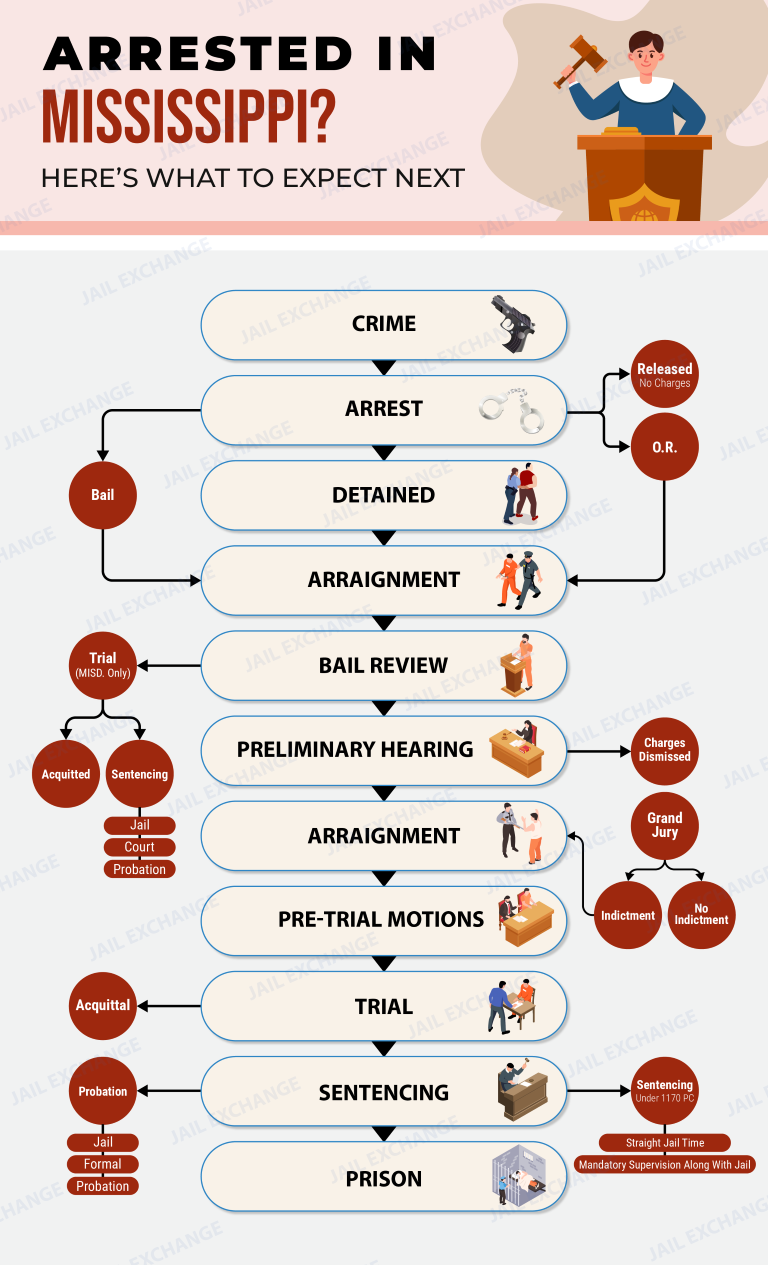
Families often discover that booking and arraignment are two different events. Booking records the arrest; a court appearance addresses the accusations and a possible release order. That distinction matters in Calhoun County.
A bail amount does not tell you whether someone is guilty. Its purpose is tied to appearance and lawful safety concerns. A defendant may ask the court to review the terms of release.
For the Calhoun County case, write down the person’s legal name, booking number if available, charge, next hearing date, and bond terms. A release decision does not end the prosecution.
↑ Back to the question list4. How does a minor criminal charge proceed in Calhoun County?
Court dates for misdemeanors are easy to overlook when someone has been released from jail. Missing a required appearance may lead to another warrant and more trouble.
Police departments may issue citations for municipal court instead of taking someone to the county jail. Always use the court named on the citation, because not every misdemeanor is filed in the same place.
A Calhoun County misdemeanor can conclude with dismissal, a lawful diversion or negotiated resolution, or trial. The result will depend on the accusation and evidence, not on the fact of an arrest.
↑ Back to the question list5. What happens when a person faces felony charges in Calhoun County?
A preliminary hearing, if held, asks whether there is probable cause to proceed. That is different from proof beyond a reasonable doubt, which prosecutors need for a criminal conviction at trial.
If the accusation in Calhoun County is a felony, watch for the circuit-court case and indictment information. A grand jury decides whether a formal accusation should issue; it does not decide that the accused is guilty.
An arrest warrant, an indictment, and a conviction are three very different things. Only a guilty plea accepted by the court or a lawful finding of guilt establishes criminal guilt.
↑ Back to the question list6. How do major felony prosecutions work in Calhoun County?
Serious violence charges often require more hearings and evidence review. Witnesses, forensic testing, and defense motions can affect when the case is ready for trial.
For a violent felony arising in Calhoun County, the state circuit court is generally the trial court unless a federal law supplies jurisdiction. Victims’ rights, protective orders, witness issues, and release restrictions may all matter.
↑ Back to the question list7. How are juvenile criminal cases handled in Calhoun County?
A child accused of breaking the law does not automatically go to the adult jail. The youth court process has separate detention and hearing rules; some very serious charges may follow different procedures.
For a youth from Calhoun County, the family should pay particular attention to the written notice of detention, youth-court date, and who is allowed to attend. Ordinary adult court-contact rules do not automatically apply.
↑ Back to the question list8. What punishment may follow a conviction in Calhoun County?
Court costs, assessments, restitution, treatment requirements, and license consequences may add to a sentence where authorized, even when the main fine is small.
- Petit larceny, ordinary property worth under $1,000 (§ 97-17-43(1)): potentially up to six months in county jail and a fine up to $1,000; the law generally requires suspended jail time with probation or a fine unless the court makes specified findings.
- Aggravated assault (§ 97-3-7(2)(a)): up to one year in county jail or up to 20 years in state custody for the usual offense; enhanced situations carry different rules.
- Aggravated domestic violence (§ 97-3-7(4)(a)): 2 to 20 years in state custody for the basic offense; repeated convictions may increase the sentencing range.
- Simple domestic violence (§ 97-3-7(3)(a)): up to six months in jail, a fine up to $500, or both; qualifying repeat cases can become felonies.
- Simple assault (Miss. Code § 97-3-7(1)(a)): up to six months in county jail, a fine of up to $500, or both.
The court’s sentencing authority comes from the offense-specific statute and applicable enhancements. A jail-time maximum is different from what a particular judge actually imposes.
↑ Back to the question list