Bollinger County Jail Criminal Court Process
Criminal Court Process for Bollinger County Missouri
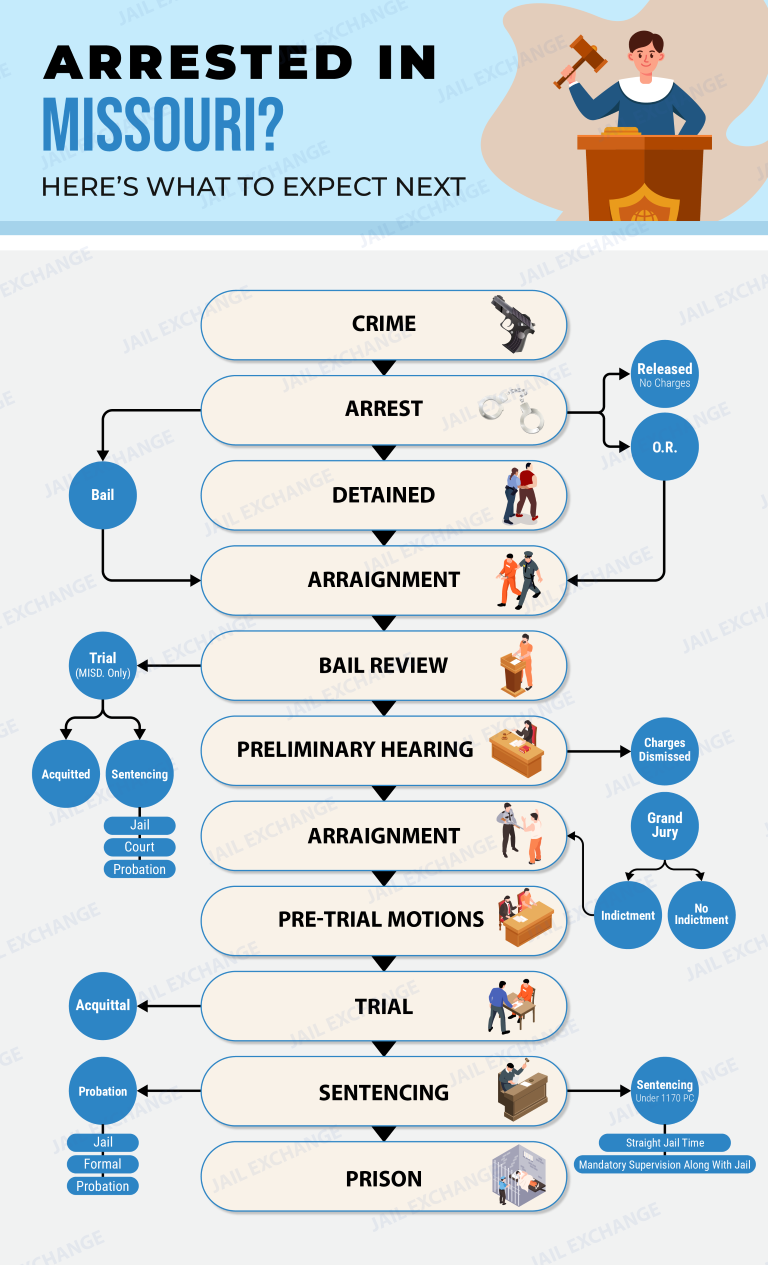
Bollinger County, Missouri — Criminal Courts and Sentencing
When police take someone into custody in Bollinger County, the court path depends on the charge—not simply on the arresting department. A local associate circuit division may hear a misdemeanor while a felony is prepared for a circuit-judge trial. Both are parts of Missouri’s circuit court.
Choose a question to jump directly to its answer:
- Where does a criminal case go in Bollinger County?
- What should a family expect after an arrest in Bollinger County?
- How are misdemeanors handled in Bollinger County?
- What happens when the charge is a felony in Bollinger County?
- How does the court handle a serious violent felony in Bollinger County?
- What happens if someone under 18 is accused in Bollinger County?
- What are the jail terms, prison sentences and fines in Bollinger County?
- Which federal court hears federal criminal charges from Bollinger County?
1. Where does a criminal case go in Bollinger County?
Missouri organizes trial courts into judicial circuits. Associate circuit judges commonly handle lesser offenses and the early steps of more serious cases.
- Bollinger County Circuit Court / Circuit Clerk, 204 High St., Marble Hill, MO 63764, 573-238-2773.
Which court controls the charge? State felony prosecutions generally belong in circuit court; associate circuit judges handle many misdemeanors and early felony matters. Municipal ordinance prosecutions may be assigned to a city municipal division. The local prosecutor represents Missouri in state cases; a city attorney may prosecute an ordinance ticket.
A circuit clerk handles case filings, many notices, and records. A prosecutor is not the defendant’s attorney. A person who cannot afford a private defense lawyer can ask about qualifying for the Missouri State Public Defender.
2. What should a family expect after an arrest in Bollinger County?
The arresting agency may take a person to the local jail for processing, including identification, inventory of property, and a health review.
Release may be on a promise to appear, with supervision, or under a secured bond ordered by a judge.
The first court hearing deals with the accusation, the person’s rights, and whether release is allowed while the case is pending. A judge can set restrictions on contact, travel, weapons, or reporting. Failing to return to court may result in a warrant and new consequences.
For a worried family, the useful facts are the person’s complete name, date of birth, booking agency, whether a bond was ordered, and the next hearing date. A jail phone operator cannot give legal advice and a bond amount should not be mistaken for a criminal fine.
3. How are misdemeanors handled in Bollinger County?
For a minor state charge, an arrest is possible, but the case may start with paperwork and a court appearance instead.
At an arraignment or initial court date, the accused learns the charge and can enter an authorized plea. The prosecutor and defense may exchange information or discuss an agreement. If there is no agreement, the court schedules a contested hearing or trial.
Missouri law, § 558.011, permits at most one year for a Class A misdemeanor, six months for Class B, and 15 days for Class C. Under § 558.002, ordinary maximum fines are $2,000, $1,000, and $750 respectively, unless a more specific rule controls.
A judge can consider probation or a suspended sentence when allowed. A traffic ticket or city ordinance charge may follow its own fine schedule; it should not automatically be treated as a Class A misdemeanor.
4. What happens when the charge is a felony in Bollinger County?
The prosecutor may seek an indictment from a grand jury. A case may also proceed through an information after the legally required steps.
A felony allegation can first appear before an associate circuit judge to address counsel, bond, and probable cause.
A judge deciding probable cause is not deciding whether the defendant is guilty. If charges go forward, both sides have opportunities for motions, disclosure of evidence, and plea discussions. A criminal conviction at trial requires proof beyond a reasonable doubt.
Counsel matters early: statements, searches, identification issues, and detention orders can shape the defense. A plea may avoid trial but can also create a lasting record or prison sentence, so the person should understand the terms before agreeing.
5. How does the court handle a serious violent felony in Bollinger County?
A major violent prosecution may need forensic testing, expert witnesses, and several pretrial hearings.
Serious violent accusations usually bring closer attention to release conditions and victim safety.
Missouri defines “dangerous felonies” by statute. Certain convictions carry an 85% minimum service requirement before parole eligibility. That is not a rule for every charge involving violence; it depends on the precise conviction and statute.
In homicide and other extremely serious cases, the lawyer may address expert evidence, mental-state disputes, and sentencing issues long before trial. Families should not assume that a high bond means guilt or that a dismissed charge guarantees immediate release when other warrants exist.
6. What happens if someone under 18 is accused in Bollinger County?
A child may be released to family with rules to follow, supervised at home, or held in an authorized youth facility when legally justified.
A youth accused of wrongdoing generally goes through the circuit court’s juvenile division, not the adult criminal calendar.
The juvenile division considers the child’s age, the allegation, family situation, and safety needs. A formal petition, if filed, is different from an adult criminal information or indictment. Some youth matters may be diverted from full court processing.
Parents or guardians should ask who is assigned to the child, where the youth is being held if detained, and when the next hearing will occur. Transfer to adult criminal court is possible only under specific legal procedures; it is not automatic for every serious accusation.
7. What are the jail terms, prison sentences and fines in Bollinger County?
A defendant may face a fine, probation, a suspended sentence, jail or prison depending on what is proven and the law that applies.
- Class A felony: 10–30 years or life.
- Class B felony: 5–15 years.
- Class C felony: 3–10 years.
- Class D felony: up to 7 years.
- Class E felony: up to 4 years.
- Class A misdemeanor: up to one year; normally up to $2,000 fine.
- Class B misdemeanor: up to six months; normally up to $1,000 fine.
- Class C misdemeanor: up to 15 days; normally up to $750 fine.
- Class D misdemeanor: no ordinary jail term; normally up to $500 fine.
Missouri Revised Statutes §§ 558.011 and 558.002 set these general ranges and fines. Standard felony fines can reach $10,000 for Classes C, D, or E. Some individual crimes have different rules, special minimums, or sentencing enhancements. A prior felony can also affect the authorized punishment.
For Class D or E felonies, Missouri law can permit a special county-jail term of up to one year instead of a longer state prison term. Probation, treatment court, and suspended sentences are possible in eligible cases; none is promised simply because a person has no record.
Parole eligibility is not the same as an automatic release date. The date can change with the charge, sentencing law, and Department of Corrections decisions. These figures state the general law in force in October 2026, not legislation scheduled to take effect in 2028.
What changes under Missouri sentencing law on January 1, 2028?
For families in Bollinger County, the difference between current law and the scheduled 2028 law matters. Missouri Revised Statutes § 558.011 has a new version scheduled to take effect January 1, 2028. The percentages below describe when someone may first qualify for parole consideration, not a promised release date. They do not replace special rules that demand a longer time in prison.
- Class A felony: 10 to 30 years or life; generally 70% of the sentence before parole eligibility.
- Class B felony: 5 to 15 years; generally 50% before parole eligibility.
- Class C felony: 3 to 10 years; generally 30% for a first conviction, 35% for a second and 50% for a third or later conviction. Certain offenses requiring sex-offender registration carry 40%.
- Class D felony: up to 7 years; generally 20% for a first conviction, 25% for a second and 50% for a third or later conviction. Certain registrable offenses carry 25%.
- Class E felony: up to 4 years; generally 15% for a first conviction, 20% for a second and 50% for a third or later conviction. Certain registrable offenses carry 25%.
- Dangerous felonies: the law requires 85% of the sentence before parole eligibility.
For Class A and B felonies and certain crimes requiring sex-offender registration committed on or after January 1, 2028, the law also removes eligibility for conditional release. Parole and conditional release are not the same. Whether the new law applies to a particular person depends on the offense date, the final charges, earlier convictions and other sentencing laws. Until the effective date, the existing statute remains controlling. Source: Missouri Revised Statutes § 558.011.
8. Which federal court hears federal criminal charges from Bollinger County?
Federal and Missouri state prosecutions follow different procedures, use different judges, and may put detainees in different facilities.
Federal court jurisdiction: Bollinger County falls within the U.S. District Court for the Eastern District of Missouri, Southeastern Division. Federal proceedings for this division are associated with Cape Girardeau.
Federal courthouse: Rush Hudson Limbaugh Sr. U.S. Courthouse, 555 Independence St., Cape Girardeau, MO 63703, telephone 573-331-8980.
Federal crimes may include interstate drug trafficking, bank robbery covered by federal law, crimes involving federal officials, unlawful firearms conduct under a federal statute, wire fraud, and certain immigration offenses. A state drug, theft, or assault charge does not automatically turn federal merely because someone crosses a county line.
Federal agents may arrest a suspect, followed by an initial appearance before a U.S. magistrate judge, detention decision, and indictment or other proper charge. The U.S. Attorney prosecutes; a federal public defender or appointed attorney may represent someone who qualifies. A person awaiting federal trial can be placed in a contract jail, and any federal prison sentence is generally served through the Bureau of Prisons.
This is general court-process information, not personal legal advice. A defendant should speak with their defense lawyer about their actual charges, bond order, and next court date.