
Jefferson County Detention Center
Jefferson County Detention Center
Jail Phone Number
636-797-5513Jefferson County Inmate Search: Finding and Contacting a Family Member
To find someone arrested in Jefferson County, use the Sheriff’s official Inmate Search. Its Filter by Name box narrows the list, and a separate link covers people released within the last 72 hours. Compare the identifying details carefully, and call the jail at 636-797-5081 if a recent booking is missing or the current location is unclear.
The Jefferson County Detention Center is at 510 First Street, Hillsboro, MO 63050. When calling, have the person’s full legal name, birth date and approximate arrest time ready. Ask for the booking number and actual holding location before arranging a visit, mail or a deposit. A missing online result does not confirm release; the arresting department can help identify the receiving facility.
The questions below cover mugshots, warrants, calls, visits, deposits, mail and urgent family concerns. Our Bail guide explains bond and release questions, while the Court guide helps with Jefferson County case records, clerk contacts and hearing locations.
Read inmate search answers
 Read inmate search answers
1. How do I find someone arrested in Jefferson County?
Go to the official custody lookup. Its Filter by Name box narrows the list to matching text. Compare identifying details carefully before using a result for a family inquiry. The page separately links people released within the last 72 hours. For a current location or an unclear match, use 636-797-5081, 510 First Street, Hillsboro, MO 63050. Keep the custody identifier separate from the court case reference.
2. What if I cannot find a recent booking?
Find out who made the arrest and which institution received the person. Ask receiving staff whether intake has finished or another agency has taken charge. Give the legal name and timing, supplying other identifiers privately if staff require them to distinguish similar names. A missing current result does not confirm release or the absence of an arrest. Follow a transfer through the receiving institution, and check the recent-release route when the question concerns a departure rather than current housing.
3. Which contact should I use for jail business?
Detention inquiries go to 636-797-5081, with the jail at 510 First Street, Hillsboro, MO 63050. Sheriff's headquarters is at 400 First Street, Hillsboro, MO 63050, 636-797-5000. Confirm the appropriate counter and appointment before making a trip. The Jefferson County Detention Center overview connects family guides. Court filings belong with the clerk on Main Street, and another institution may have its own visiting, account and pickup procedures after a transfer.
4. How can I request a booking photograph?
Identify the agency and event date when asking for a particular report or image. Sheriff's headquarters at 400 First Street, Hillsboro, MO 63050, 636-797-5000, can route a county records inquiry. A city police investigation may remain with that department after county detention. State which booking event or incident you mean rather than asking for an unspecified complete history. An arrest image is not a conviction record and cannot tell you where its subject is housed now.
5. How can I receive custody alerts?
Use MOVANS to identify the matching available record and follow its current agency-specific registration directions. The state launched its replacement county-jail alert platform in May 2026; earlier subscribers should use the replacement process. Help is 573-526-1929. Keep your chosen contact information current. A movement notice concerns detention status, while the court supplies hearing requirements separately. Confirm the receiving institution if a notice reports a move and keep following the filed case independently.
6. What should I confirm before paying bond?
Obtain the actual release order, case reference, amount and permitted bond type. Ask which office accepts payment and which identification is required. The Bail guide explains the options. Before paying, check for additional orders from any other jurisdiction. Save the payment receipt and release terms. Ask detention staff when and where an approved pickup can take place. A purchase-account deposit or telephone payment serves a different purpose from fulfilling the judge’s release order.
7. Where can I read the charges filed in court?
Use Case.net and match the person to the correct court file. The Circuit Clerk is at 300 Main Street, Hillsboro, MO 63050, 636-797-5443. Keep multiple case references separately when several matters appear. Follow the file beyond its first entry. Prosecutors may change counts, and the judgment records the outcome rather than the original accusation. A lawyer can explain the effect of the particular order.
8. Which public defender office serves Jefferson County?
Missouri Public Defender District 23 is at 305 Third Street, Hillsboro, MO 63050, 636-789-5254. Its mailing address is P.O. Box 156, Hillsboro, MO 63050. Follow the application requirements and provide the requested financial information and case documents. Include the upcoming appearance details. Eligibility concerns qualifying state criminal matters; ordinary state defender coverage excludes city ordinance, civil and family cases. Confirm the actual proceeding before assuming an appointment is available.
9. How should I arrange a family visit?
The Sheriff offers on-site and remote video contact through IC Solutions, requiring adult visitors to register. Minors need a parent or legal guardian present. Consult the visitation guide and the provider's available appointments, then confirm the person's current placement before traveling or purchasing contact. The facility restricts visiting during its specified operational periods, including 5 p.m. to 6 p.m. Ask the attorney to use the separate advance-scheduling procedure for legal access.
10. What should I check before sending account money?
Access Corrections provides the deposit service. The Sheriff lists in-person funding from 8:30 a.m. to 4:30 p.m. Monday through Friday, including the lobby kiosk and a money order made out to the detainee. Read the money guide and verify the recipient before paying. Save the confirmation with the amount and account reference. Do not treat the accepted methods for commissary as proof of the methods allowed for a court bond.
11. How do I arrange calls or ask about messaging?
IC Solutions provides telephone services, with support at 888-506-8407. The Sheriff's phone page distinguishes a prepaid account tied to one receiving number from a detainee debit account used for permitted numbers. Use the calling instructions and choose the account purpose carefully. Keep the service identifier for support. Arrange private legal communications through counsel's approved channel; a routine family call is not the route for giving staff an urgent health or safety report.
12. What should I check before sending personal mail?
The current Sheriff's policy requires nonprivileged incoming correspondence to use standard white postcards no larger than 5 by 7 inches. Address them with the detainee's legal name, number and housing unit, Jefferson County Detention Center, 510 First Street, Hillsboro, MO 63050, plus a complete return address. Mailed commissary deposits are not accepted. Consult the correspondence instructions and confirm how privileged legal mail must be sent. Confirm current housing before posting correspondence or sending any original court documents.
13. How can I collect belongings after booking?
Describe the item and find out how the detainee authorizes collection. Check the receiving counter, appointment and identification before setting out. Use the jail at 636-797-5081, 510 First Street, Hillsboro, MO 63050. If an item is evidence, ask the investigating agency for its release procedure rather than assuming it is ordinary stored property. Approval to collect belongings does not authorize bringing clothes, packages or supplies into the facility.
14. How do I report an urgent concern or medication need?
Call detention at 636-797-5081 and make the urgency clear. For a non-emergency deputy request, the Sheriff separately lists 636-797-9999 as a 24-hour contact. Identify the person and ask for the route to staff who can respond. Explain the relevant prescription, care provider or event using that channel. Record when contact was made and any requested follow-up. Call 911 for an emergency outside the facility.
15. How can I check a Jefferson County warrant?
Identify the issuing court and its case number first. Ask the Circuit Clerk at 300 Main Street, Hillsboro, MO 63050, 636-797-5443, for the court record. Get legal advice on how to address the order and its appearance requirements. Arrange any necessary surrender through the Sheriff at 636-797-5000. A missing name in a jail lookup is not assurance that the court recalled a warrant. Retain the actual written decision instead of taking an outdated listing or a private payment request as evidence of recall.
16. Where can I confirm the next court appearance?
Save the court's notice beside the matching Case.net file. Provide the case reference when asking clerk staff at 636-797-5443 when a scheduling issue is urgent. Verify the division hearing the matter, its setting and how attendance works. The Court guide supplies procedural context. A change in custody does not itself move the hearing or cancel attendance. Ask counsel before treating discharge or an transfer to another facility as removal of a scheduled appearance.
17. Where do I look after a federal arrest?
Jefferson County is in the Eastern Division of Missouri's Eastern District. The Thomas F. Eagleton U.S. Courthouse is at 111 South 10th Street, St. Louis, MO 63102, 314-244-7900. The U.S. Marshals at that address, Suite 2.319, route federal custody questions at 314-539-2212. Federal proceedings have their own release orders, distinct from state matters. Use the BOP locator to find federal prison information and the responsible federal agency for pretrial placement.
18. How can I find someone transferred to ICE?
Find which authority now holds custody and enter the identifying details requested in the ICE locator. An immigration detainer requests detention up to 48 hours after they would otherwise be released. The lawyer should review its relationship to the criminal court’s release decision. ICE's St. Louis office is at 1222 Spruce Street, Room 1.100, St. Louis, MO 63103, 314-244-9787. Follow ICE's document-request directions.
19. How do I find someone in a Missouri state prison?
Use the Missouri DOC offender lookup by entering a name or the assigned DOC number. Check both placement and status: this database includes probation and parole records, which do not confirm that a person is in prison. Save the DOC reference beside the sentencing file for future inquiries. The Missouri institution directory connects facility guides after placement is known. Check how the new institution handles deposits and correspondence before paying for services, posting items or arranging travel.
20. How can a parent locate a detained child?
The Juvenile Office is at the Justice Center, 400 First Street, Hillsboro, MO 63050, 636-797-5350. Identify the officer assigned to the child and confirm the next hearing and any actual detention placement. Check housing independently from the court office address. Obtain the officer’s directions for parent contact, representation and any proposed visit or deposit. Adult jail tools do not replace the authorized procedure for protected youth-case information.
21. Which local police department should I contact?
- Jefferson County Sheriff: 400 First Street, Hillsboro, MO 63050; 636-797-5000. Jail: 636-797-5081.
- Arnold Police: 2101 Jeffco Boulevard, Arnold, MO 63010; 636-296-3204.
- Byrnes Mill Police: 141 Osage Executive Circle, Byrnes Mill, MO 63051; 636-677-7727.
- Crystal City Police: 130 Mississippi Avenue, Crystal City, MO 63019; 636-937-4601.
- De Soto Police: 17 Boyd Street, De Soto, MO 63020; 636-586-8891.
- Festus Police: 100 Park Avenue, Festus, MO 63028; 636-937-3646.
- Herculaneum Police: 1 Parkwood Court, Herculaneum, MO 63048; 636-479-4791.
- Hillsboro Police: 101 Main Street, Hillsboro, MO 63050; 636-797-5229.
- Pevely Police: 401 Main Street, Pevely, MO 63070; 636-475-5301.
Specify which department investigated the incident when requesting its report. Booking and court records can have separate numbers. Call 911 for emergency assistance.
Jefferson County Bail and Bond: Helping a Relative Get Released
To help someone get released on a Jefferson County case, confirm the bond order, permitted payment type and other holds before paying. Call the Sheriff at 636-797-5081 to ask where the person is held and which office receives the particular bond. The questions below explain payment, surety contracts and requests for conditions the defendant can meet.
The Circuit Clerk is at 300 Main Street, Hillsboro, MO 63050, 636-797-5443. A judge decides release conditions; jail staff carry out the order. Keep the current court order, case number and booking identifier together before arranging payment.
The detention center’s contact address is 510 First Street, Hillsboro, MO 63050. Confirm the actual detention and payment location before traveling, especially if another county is involved. Our Inmate Search guide helps locate someone, the Court guide explains hearings, and the Missouri Bail guide covers statewide release rules.
1. Where do I start if I need to post bond?
Call the Sheriff at 636-797-5081 and ask for current custody, actual housing, the release order, permitted bond type and any other holds. The detention center’s published contact address is 510 First Street, Hillsboro, MO 63050. Ask which office receives payment for the particular case before traveling or sending money.
2. Which office can explain the court's order?
The Circuit Clerk is at 300 Main Street, Hillsboro, MO 63050, 636-797-5443. Ask which order is current, what it allows and which office receives the payment. Staff explain procedure, while counsel advises the defendant about legal choices.
3. How do I confirm the person is still in custody?
Call 636-797-5081 and provide the full legal name, date of birth and arrest details if known. Ask for the booking identifier and actual detention facility. A court file or old photograph does not establish present custody. The Inmate Search guide explains further checks and family contact.
4. What should I ask before spending money?
Ask which case the payment covers, the exact amount and permitted type, the current payment location and method, and whether another hold would prevent release. Keep the booking and case numbers separate. Money for commissary or video contact is not a bond payment.
5. Why might a person have no bond amount yet?
The person may be in booking, awaiting a charging decision or waiting for the judge's order. Missouri § 544.170 generally requires discharge within 24 hours after warrantless arrest unless a charge and warrant provide continued custody as stated there. Another lawful basis for detention may apply. Ask counsel about the facts rather than assuming automatic release.
6. Which court decides release on a state charge?
Jefferson County is in Missouri’s 23rd Judicial Circuit. The judge handling the case decides release terms; jail staff carry out the order. A cashier cannot reduce the amount. Check the county and case number before choosing a receiving court or jail office.
7. Does every case require cash bail?
No. Missouri Rule 33.01 calls for an individual assessment of appearance and safety, considering nonmonetary conditions before financial ones when appropriate and taking ability to pay into account. Detention is possible when legal requirements are met. The Missouri Bail guide explains the statewide rules.
8. What does release on recognizance mean?
The defendant promises in writing to appear and obey the order, potentially without an upfront deposit. There may still be restrictions on contact, travel, alcohol, weapons or reporting. Read the actual conditions before making family or work plans. Recognizance does not dismiss the charge.
9. What kinds of bond might be permitted?
The order may allow full cash, an authorized percentage deposit, a licensed surety or approved property security, or release on a promise with conditions. Ask which alternatives are written into the order. A court-authorized 10% deposit is different from a commercial premium, and neither is available automatically.
10. When can an unaffordable condition be reviewed?
Counsel can ask about release review and modification under Rules 33.05 and 33.06. Explain what cannot be met and provide financial, housing and appearance information. Ask about the scheduled hearing rather than assuming a weekend arrest has a fixed outcome. The present order remains in force unless changed.
11. What should I check before hiring a bail agent?
Check the Missouri license and get a written contract showing the premium, collateral, payment terms and co-signer obligations. Ask what happens if the person misses court or the surety surrenders them. A service fee generally is not refundable court cash. Do not sign based only on a quoted percentage.
12. Can a home or land be used for bond?
The court must authorize and approve property security. Ask which ownership, lien and valuation documents are needed. Understand the risk of forfeiture before pledging a home or farm. A relative's willingness to help does not require the judge to accept the proposed property.
13. What should I bring to post an approved bond?
Bring identification, the defendant's full name and the booking or case number. First confirm the receiving office, street address, available hours and accepted payment. Get a receipt naming the payer and case. Ask how payment confirmation and the release order reach the jail.
14. Can I use a card or pay bond online?
Ask jail or court staff about that specific order and provider. A website accepting commissary money, phone credit or fines is not automatically a bond service. Confirm the payee and fee before entering card details. Do not buy a money order until the receiving office confirms the method.
15. Who can post money for a family member?
An adult payer should be at least 18 and bring government-issued identification. Ask about additional requirements for this bond. Check the depositor name on the receipt and ask how an eventual refund is issued. Private arrangements among relatives do not automatically alter the court record.
16. How long will release take after payment?
The receiving office must process payment and release authority, and jail staff must address other lawful holds. Ask what remains before arranging pickup. There is no release-time guarantee for every case. A receipt does not prove that discharge is finished; confirm the pickup location with staff.
17. How can relatives living elsewhere help?
Start with the actual detention facility, case number and current release order. Ask the receiving office what a payer living elsewhere must do before sending funds. Family can help contact counsel and organize records without promising a release time or signing an agent's contract before reading it.
18. What if a traveler is arrested in Jefferson County?
Ask which agency made the arrest, which facility received the person and which county filed the charge. Tell counsel about out-of-town housing, work and transportation needs. A lawyer can request workable conditions. Returning home does not excuse a required hearing or travel restriction.
19. What should I ask after an arrest away from home?
Get the exact location, arresting agency, receiving facility and case number. The name of a nearby town or recreation area is not enough to identify the court. Confirm which order and payment office apply before sending money, and explain travel needs to counsel.
20. Can another county prevent release?
A separate valid warrant or hold may remain after the local bond is satisfied. Ask which county and case need action and whether a transfer is expected. One receipt covers the stated order, not every other matter. Have the lawyer review the remaining basis for custody.
21. What if an out-of-state warrant is found?
It can create a separate hold and extradition proceeding. Ask which state and agency requested custody and notify counsel. The defendant should understand the consequences before signing a waiver. Paying a local bond does not resolve the other state's court order.
22. How do probation, parole or immigration matters affect release?
Ask staff to identify every separate basis for custody. Another supervising agency or court may need to act. An ICE detainer requests a hold of up to 48 hours after they would otherwise be released. Counsel should review the actual request and orders; the criminal bond does not decide an immigration case.
23. Where do Hillsboro ordinance cases go?
Read the court named on an Arnold, Festus, De Soto or other city citation before paying. The Jefferson County Circuit Clerk is at 300 Main Street, Hillsboro, MO 63050, 636-797-5443. Ask which court has the file, where the hearing will take place and whether a requested payment is bond or a fine involving a plea. A city ordinance case may have a different clerk or calendar. Ask the court to identify the order and whether a proposed payment is bond or a fine involving a plea.
24. What paperwork should the family keep?
Save the full release order, receipt and next court notice. Check dates, restrictions, case number and payer details. Make copies available to the defendant and lawyer. Update contact information as required. A reminder from a relative helps, but the defendant remains responsible for compliance.
25. What if the release order is unclear or difficult to follow?
Ask counsel before acting on a guess. Work, childcare, housing or treatment needs may support a request for change, but the judge must approve it. A protected person's invitation does not cancel a no-contact order. Violations can lead to a warrant, stricter conditions or detention.
26. Can an agent return the defendant to custody?
A surety may have surrender rights and duties under Missouri law and the contract. Ask counsel and the agent which procedure applies and whether a new order is needed. Review additional charges in writing. Surrender does not end the criminal prosecution or cancel its hearings.
27. What information helps a request for different conditions?
Give counsel a realistic account of income, necessary expenses, housing, work, treatment and transportation to court. Explain the particular condition that cannot be met and propose an alternative. The court decides the request; submitting it alone does not lower the amount or excuse the existing terms.
28. How do I check the most recent bond entry?
Find the correct Jefferson County file on Missouri Case.net. Other counties share the 23rd Circuit, so match the county and case number. Read later entries that may replace an older amount. Ask the clerk or lawyer to explain any uncertainty before paying based on a docket screenshot.
29. How can I check whether cash bond is refundable?
Call the Circuit Clerk at 636-797-5443 with the receipt and case number. Ask whether the court released the deposit, who is recorded to receive it and whether lawful deductions apply. Keep the mailing address current. Do not assume full repayment or a fixed date before processing is complete.
31. Does dismissal mean the person leaves immediately?
Ask the lawyer what the dismissal changes and whether any other cases remain. The jail needs appropriate release authority and may still have a separate lawful hold. Check bond discharge and refund paperwork separately. One closed case does not establish that every warrant or order has ended.
32. What should someone do after missing a hearing?
Contact the lawyer promptly and explain the reason. The court may issue a warrant and begin forfeiture. Ask which filing or appearance is needed; a relative's call does not automatically excuse the absence. A commercial contract may also expose a co-signer to costs.
33. Do children use adult bond procedures?
Juvenile matters generally have different detention and release rules. Ask the Circuit Clerk at 636-797-5443 for the juvenile office. A parent needs the child's actual placement, assigned officer, lawyer and next hearing. Do not assume a child is in the adult jail or send adult bond funds without directions.
34. Who helps someone who cannot afford a lawyer?
The Hillsboro public defender office serving Jefferson County is at 305 Third Street, Hillsboro, MO 63050, 636-789-5254. Use the application for services and ask how the defendant can apply from jail. The program reviews finances and qualifying state charges; ordinary municipal, traffic, civil and family matters are excluded.
35. Who decides release on a federal charge?
Jefferson County is in the Eastern Division of the U.S. District Court for the Eastern District of Missouri. The Thomas F. Eagleton U.S. Courthouse is at 111 South 10th Street, St. Louis, MO 63102, 314-244-7900. Follow the actual federal notice for the courtroom and attendance instructions. A county calendar and state bond do not control a separate federal proceeding. Follow federal counsel's directions; paying a state bond does not satisfy a separate federal order.
36. Can the defendant travel to work after release?
Read the actual travel and reporting terms before crossing a restricted boundary or leaving Missouri. Counsel can request approval or a modification if work requires travel. Explain the schedule and route and obtain required permission. Employment alone does not change a release condition.
37. What if the case involves an order of protection?
Read both the protective order and criminal release conditions with counsel. They may restrict direct contact, messages, third-party contact or access to a shared home. Arrange housing and any permitted property pickup without violating the order. A private agreement between the people involved does not change the court's terms.
38. What should a family do after a holiday arrest?
Call 636-797-5081 to ask whether an existing warrant or order already sets release conditions and where an authorized payment is accepted. If terms have not been entered, ask counsel about the initial appearance and review. Do not rely on an assumed holiday delay or a promise that staff can set a bond themselves.
39. What is the final check before traveling to Hillsboro?
Confirm custody, the current amount and permitted bond type, other holds, the payment counter and accepted method at 636-797-5081. Bring identification and the booking number. For court records call 636-797-5443. Our Court guide explains the next hearing after release.
Family Video Visits at Jefferson County Detention Center
Family and friends visit by video through ICSolutions, either on a kiosk at the jail or from a compatible device at home. The jail is at 510 First Street, Hillsboro, MO 63050. Call the jail at 636-797-5081 to confirm custody or ask about a visit.
Daily visiting hours, Central: 7 a.m.–5 p.m. and 6–9 p.m. The sheriff’s schedule runs from 7 a.m. to 9 p.m. but blocks visits from 5 to 6 p.m.
- At the jail: Adult visitors register for free and schedule through ICSolutions. Select an on-site slot and use the terminal in the visitation center.
- From home: Download and test ICS Mobile or the Windows visitation application before you schedule. Off-site visits are paid; review the price shown when booking.
Visitors younger than 18 must have a parent or legal guardian present. Dress appropriately. The jail may end a visit or restrict privileges for misconduct or security reasons. Attorneys arrange confidential visits separately and must schedule in advance.

ICSolutions Video Visitation provides a secure online platform that enables families to conduct scheduled face-to-face video visits with incarcerated loved ones from home using an internet-connected smartphone, tablet, or personal computer equipped with a webcam.
Important: Advance Registration and Visitor Clearance Required
Detention centers do not permit unscheduled or unverified video sessions. Correctional facilities require prospective visitors to submit government-issued photo identification and receive administrative clearance before booking an appointment, an approval process that can take up to 48 hours depending on facility staffing. You should verify your visitor approval status with the facility prior to scheduling. If you do not register well in advance, you will miss your loved one's scheduled visiting window for the week.
Step-by-Step Instructions to Register and Schedule a Video Visit
- Visit www.icsolutions.com and sign into your account.
- Register your visitor profile and upload a clear photo of your government-issued ID (driver's license or passport) for facility background review.
- Wait for email notification confirming facility visitor approval.
- Select Schedule Visit, choose the detention facility, and select the inmate.
- Browse the available schedule calendar, select a time slot, and pay the visitation fee using a credit or debit card.
- Log into the website or app 10 minutes prior to the start time on a device with a functioning camera, microphone, and reliable high-speed internet connection.
What the Inmate Needs to Do
The inmate receives a visitation notification on their housing unit video kiosk or terminal. At the appointed time, they log in with their PIN and sit before the terminal. Inmates and visitors must strictly observe jail dress and conduct rules; sessions are monitored by staff and will terminate immediately upon any violation.
Official Provider: ICSolutions Official Website
Customer Service Telephone: 1-888-506-8407
Support Hours: 24 hours a day, 7 days a week, 365 days a year
Supported Languages: English and Spanish
Other Services Provided by ICSolutions
In addition to Remote Video Visitation, ICSolutions provides calling and voicemail services at participating correctional facilities:
- AdvancePay Prepaid Calling Accounts: Prepay for phone calling minutes so your loved one can call your telephone directly.
• Learn more on our website: AdvancePay Calling Guide | • Visit official vendor page: ICSolutions Prepaid Calling - Inmate Voicemail Services: Leave recorded voice messages that your loved one can listen to on dayroom phones.
• Learn more on our website: Inmate Voicemail Guide | • Visit official vendor page: ICSolutions Voicemail - Access Secure Deposits (Partner Trust Transfers): Deposit trust money into an inmate's account via Keefe Group partner networks.
• Learn more on our website: Inmate Trust Deposits Guide | • Visit official vendor page: Access Corrections Trust Deposits
Jefferson County Court Guide: Case Searches, Locations and Family Help
For Jefferson County criminal court information, call the Circuit Clerk at 636-797-5443. The courthouse office is at 300 Main Street, Hillsboro, MO 63050. Search Missouri Case.net for public case records and hearing entries. Match the county, case number and division before deciding where to appear.
The Circuit Clerk handles court records at 300 Main Street in Hillsboro; court mail goes to P.O. Box 100, Hillsboro, MO 63050. Search Case.net for public case entries, and check the named court and division before paying or traveling. Ask the clerk about the actual courtroom and attendance instructions. Jefferson County is in Missouri’s 23rd Judicial Circuit. The court named on the notice determines where the defendant must attend.
For custody and the actual detention facility, call the Sheriff at 636-797-5081. The detention center’s contact address is 510 First Street, Hillsboro, MO 63050; a jail address is not a substitute for a hearing location. Our Inmate Search guide helps locate someone, and our Bail guide explains release.
1. Which court handles a Jefferson County criminal case?
Jefferson County is in Missouri’s 23rd Judicial Circuit. The Circuit Clerk is at 300 Main Street, Hillsboro, MO 63050, 636-797-5443. Circuit and associate circuit proceedings are parts of Missouri's trial-court system. Read the notice for the assigned division, judge and courtroom.
Associate circuit judges handle many misdemeanors and early felony matters. An ordinance case can belong to a municipal division. The prosecutor represents the government; a defendant needs separate defense counsel. Clerk staff help explain records and procedures but cannot advise a defendant how to plead.
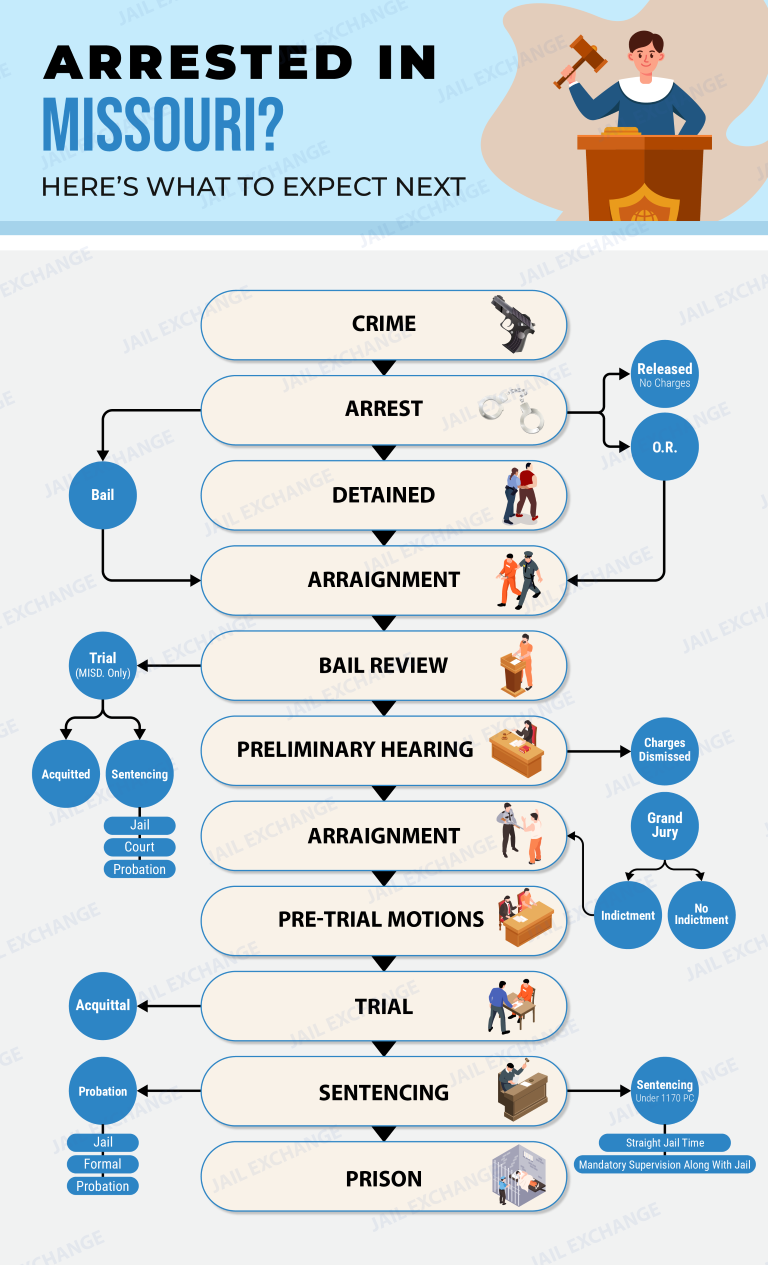
2. What should a family expect after an arrest in Jefferson County?
Some arrests result in a summons rather than detention. Others lead to jail intake, where staff record personal property and document the charges.
Judges consider appearance in court and public safety when deciding whether conditions or monetary security are needed.
The first court hearing deals with the accusation, the person’s rights, and whether release is allowed while the case is pending. A judge can set restrictions on contact, travel, weapons, or reporting. Failing to return to court may result in a warrant and new consequences.
For a worried family, the useful facts are the person’s complete name, date of birth, booking agency, whether a bond was ordered, and the next hearing date. A jail phone operator cannot give legal advice and a bond amount should not be mistaken for a criminal fine.
3. How are misdemeanors handled in Jefferson County?
A misdemeanor hearing may involve a plea, a pretrial setting, a negotiated resolution, or a trial if the accusation is disputed.
At an arraignment or initial court date, the accused learns the charge and can enter an authorized plea. The prosecutor and defense may exchange information or discuss an agreement. If there is no agreement, the court schedules a contested hearing or trial.
Missouri law, § 558.011, permits at most one year for a Class A misdemeanor, six months for Class B, and 15 days for Class C. Under § 558.002, ordinary maximum fines are $2,000, $1,000, and $750 respectively, unless a more specific rule controls.
A judge can consider probation or a suspended sentence when allowed. A traffic ticket or city ordinance charge may follow its own fine schedule; it should not automatically be treated as a Class A misdemeanor.
4. What happens when the charge is a felony in Jefferson County?
After the charging stage, the court schedules arraignment, evidence exchange, motions, plea discussions, and, where necessary, trial.
In more serious prosecutions, a preliminary hearing tests whether enough evidence exists to continue; it does not decide guilt.
A judge deciding probable cause is not deciding whether the defendant is guilty. If charges go forward, both sides have opportunities for motions, disclosure of evidence, and plea discussions. A criminal conviction at trial requires proof beyond a reasonable doubt.
Counsel matters early: statements, searches, identification issues, and detention orders can shape the defense. A plea may avoid trial but can also create a lasting record or prison sentence, so the person should understand the terms before agreeing.
5. How does the court handle a serious violent felony in Jefferson County?
The person accused is presumed innocent; judges still consider safety and flight risk at pretrial proceedings.
Charges involving homicide, forcible violence, or weapons can lead to longer detention disputes and more complicated hearings.
Missouri defines “dangerous felonies” by statute. Certain convictions carry an 85% minimum service requirement before parole eligibility. That is not a rule for every charge involving violence; it depends on the precise conviction and statute.
In homicide and other extremely serious cases, the lawyer may address expert evidence, mental-state disputes, and sentencing issues long before trial. Families should not assume that a high bond means guilt or that a dismissed charge guarantees immediate release when other warrants exist.
6. What happens if someone under 18 is accused in Jefferson County?
Juvenile cases often involve a deputy juvenile officer, the child’s guardian, and attorneys, with records handled differently from adult case files.
In juvenile proceedings, the court considers whether the allegation is true and what intervention protects the child and community.
The juvenile division considers the child’s age, the allegation, family situation, and safety needs. A formal petition, if filed, is different from an adult criminal information or indictment. Some youth matters may be diverted from full court processing.
Parents or guardians should ask who is assigned to the child, where the youth is being held if detained, and when the next hearing will occur. Transfer to adult criminal court is possible only under specific legal procedures; it is not automatic for every serious accusation.
7. What are the jail terms, prison sentences and fines in Jefferson County?
Missouri has standard punishment classes, but specific offenses and repeat-offender provisions can change the result.
- Class A felony: 10–30 years or life.
- Class B felony: 5–15 years.
- Class C felony: 3–10 years.
- Class D felony: up to 7 years.
- Class E felony: up to 4 years.
- Class A misdemeanor: up to one year; normally up to $2,000 fine.
- Class B misdemeanor: up to six months; normally up to $1,000 fine.
- Class C misdemeanor: up to 15 days; normally up to $750 fine.
- Class D misdemeanor: no ordinary jail term; normally up to $500 fine.
Missouri Revised Statutes §§ 558.011 and 558.002 set these general ranges and fines. Standard felony fines can reach $10,000 for Classes C, D, or E. Some individual crimes have different rules, special minimums, or sentencing enhancements. A prior felony can also affect the authorized punishment.
For Class D or E felonies, Missouri law can permit a special county-jail term of up to one year instead of a longer state prison term. Probation, treatment court, and suspended sentences are possible in eligible cases; none is promised simply because a person has no record.
Parole eligibility is not the same as an automatic release date. The date can change with the charge, sentencing law, and Department of Corrections decisions. These figures state the general law in force in October 2026, not legislation scheduled to take effect in 2028.
What changes under Missouri sentencing law on January 1, 2028?
For families in Jefferson County, the difference between current law and the scheduled 2028 law matters. Missouri Revised Statutes § 558.011 has a new version scheduled to take effect January 1, 2028. The percentages below describe when someone may first qualify for parole consideration, not a promised release date. They do not replace special rules that demand a longer time in prison.
- Class A felony: 10 to 30 years or life; generally 70% of the sentence before parole eligibility.
- Class B felony: 5 to 15 years; generally 50% before parole eligibility.
- Class C felony: 3 to 10 years; generally 30% for a first conviction, 35% for a second and 50% for a third or later conviction. Certain offenses requiring sex-offender registration carry 40%.
- Class D felony: up to 7 years; generally 20% for a first conviction, 25% for a second and 50% for a third or later conviction. Certain registrable offenses carry 25%.
- Class E felony: up to 4 years; generally 15% for a first conviction, 20% for a second and 50% for a third or later conviction. Certain registrable offenses carry 25%.
- Dangerous felonies: the law requires 85% of the sentence before parole eligibility.
For Class A and B felonies and certain crimes requiring sex-offender registration committed on or after January 1, 2028, the law also removes eligibility for conditional release. Parole and conditional release are not the same. Whether the new law applies to a particular person depends on the offense date, the final charges, earlier convictions and other sentencing laws. Until the effective date, the existing statute remains controlling. Source: Missouri Revised Statutes § 558.011.
8. Which federal court handles charges from Jefferson County?
Jefferson County is in the Eastern Division of the U.S. District Court for the Eastern District of Missouri. The Thomas F. Eagleton U.S. Courthouse is at 111 South 10th Street, St. Louis, MO 63102, 314-244-7900. Follow the actual federal notice for the courtroom and attendance instructions. A county calendar and state bond do not control a separate federal proceeding.
Federal charges require a basis in federal law, such as qualifying firearms, bank robbery, fraud or interstate drug offenses. A state accusation does not become federal simply because someone crosses a county line. Federal authorities decide federal release. Pretrial detainees can be held in contract jails and may not immediately appear in the BOP locator.
9. How do I find the case number and next hearing?
Search Missouri Case.net by name or case number and match Jefferson County and the person. Read recent docket entries and hearing information. Match the person and case number rather than relying on a similar name.
Call 636-797-5443 if the notice and online entry are unclear. A new or restricted matter may not be publicly visible. Counsel explains the legal effect of a court entry.
10. Where do I ask about a Hillsboro municipal ticket?
Read the court named on an Arnold, Festus, De Soto or other city citation before paying. The Jefferson County Circuit Clerk is at 300 Main Street, Hillsboro, MO 63050, 636-797-5443. Ask which court has the file, where the hearing will take place and whether a requested payment is bond or a fine involving a plea. A city ordinance case may have a different clerk or calendar.
A city officer can issue a state charge or an ordinance allegation. The department alone does not establish the case type. Keep the ticket and read the named court, response instructions and next date before paying or traveling. A fine involving a plea is different from posting bond.
11. How can someone apply for a public defender?
The Hillsboro public defender office serving Jefferson County is at 305 Third Street, Hillsboro, MO 63050, 636-789-5254. Use the application for services and ask how the defendant can apply from jail. The program reviews finances and qualifying state charges; ordinary municipal, traffic, civil and family matters are excluded.
Family can help gather financial and case information, but an application does not automatically appoint a lawyer or postpone a hearing. Give staff the next court date. Ask the appropriate court about representation for a proceeding outside the state program.
12. Does detention in another county move the Jefferson County case?
A detention location and a filing court are different things. Ask the Sheriff for the actual jail and counsel or the clerk for the active court file. Housing elsewhere does not by itself establish that the case moved; a change of venue is a separate court matter.
Use 636-797-5081 for custody questions and 636-797-5443 for a Jefferson County criminal file. Keep the receiving jail's booking identifier and court case number separately. Do not choose a hearing location from a jail address alone.
13. How can I check a warrant or missed hearing?
Search the correct Jefferson County file on Missouri Case.net and call the criminal clerk at 636-797-5443. The courthouse office is at 300 Main Street, Hillsboro, MO 63050. Ask staff to clarify an entry you do not understand. A missing public result does not prove that no warrant exists. Ask the Sheriff at 636-797-5081 about its current inquiry and surrender procedure, and discuss the proper court response with counsel. Keep any order resolving the warrant. Do not assume a private payment to an unknown caller cancels it or that paying one bond resolves every separate order.
14. How can relatives help prepare for a hearing?
Keep the current notice, case number, lawyer's contact and release conditions together. Confirm the courthouse entrance, courtroom and security rules and arrange a reliable ride. Tell counsel promptly about a medical, work or transportation problem affecting attendance.
Our Bail guide explains release conditions and requests for change. A relative's call does not excuse a hearing. Respect contact restrictions while helping; a protected person's invitation does not cancel a court order.
Jefferson County Jail commissary: in person or online
For someone held at the Jefferson County Detention Center in Hillsboro, the Sheriff lists Access Corrections for online deposits. The office lobby also has a cash or card kiosk during weekday office hours, 8:30 a.m. to 4:30 p.m.
If you use a money order, take it in person during those hours and make it payable to the person in custody. Do not mail it. These payments fund the person’s commissary account rather than ordering a package. See the inmate money guide.

Access Secure Deposits (Smart Deposit) allows families and friends to securely transfer money directly into an incarcerated person's jail trust account using a debit or credit card. Deposited funds become immediately available for your loved one to purchase essential hygiene goods, over-the-counter medication, food items, and writing materials from the facility commissary.
Important: Inmate Banking Policies Vary by Facility
Once a person is booked and moved to a cell, facilities do not always allow cash drop-offs or phone payments directly to the jail. Some might and you should confirm this by calling the facility and asking. But if you do not register online and fund your loved one's trust account immediately, they may be forced to wait days or weeks for standard paper processing, leaving them without essential soap, clean undergarments, basic medical sundries or snacks.
Step-by-Step Instructions to Register and Access Service
- Obtain the inmate's legal first and last name, date of birth, and official six- to ten-digit Booking or Inmate ID number.
- Visit the official Access Corrections portal at www.accesscorrections.com or download the Access Corrections mobile app.
- Select the state and the exact detention facility or county jail where the inmate is currently housed.
- Add the inmate as a contact and confirm their identity from the facility roster.
- Enter your debit or credit card billing information, choose your deposit amount, review the facility processing fee, and submit your payment.
- Save and print your transaction confirmation number for verification.
What the Inmate Needs to Do
The inmate does not need internet access to receive your deposit. Once approved, the funds post directly to their facility account balance. The inmate can verify their balance at the dayroom kiosk or on their trust statement and start ordering items on the next designated commissary day.
Official Provider: Access Corrections / Keefe Group Official Website
Customer Service Telephone: 1-866-345-1884
Support Hours: 24/7/365
Supported Languages: English and Spanish
Other Services Provided by Access Corrections / Keefe Group
In addition to Access Secure Deposits (Trust Money), Access Corrections / Keefe Group provides several other communication, financial, and visitation services at participating correctional facilities:
- Digital Messaging & Photos: Send digital letters and pictures straight to the inmate's kiosk or tablet.
• Learn more on our website: Digital Messaging & Photos Guide | • Visit official vendor page: Access Corrections / Keefe Group Digital Messaging & Photos - Commissary Care Packages: Order pre-approved food boxes, thermal clothes, and snack bundles directly to the jail.
• Learn more on our website: Commissary Care Packages Guide | • Visit official vendor page: Access Corrections / Keefe Group Commissary Care Packages
Deposit Money for an Inmate in the Jefferson County Detention Center
Do not mail commissary money to the Jefferson County Detention Center. Bring it to the jail, 400 1st Street in Hillsboro, or send it online.
- In person: Staff take deposits Monday to Friday, 8:30 a.m. to 4:30 p.m.
- Lobby kiosk: The kiosk in the office lobby takes cash or a credit card.
- Money order: Bring a money order made out to the person's name.
- Online: Make a web deposit through Access Corrections.
Questions about a person's commissary account go to (636) 797-5081, Monday to Friday, 8:30 a.m. to 4:30 p.m. Have their full name and date of birth ready.
The Jefferson County Detention Center on First Street in Hillsboro accepts personal mail on postcards only. A personal letter sealed in an envelope will not be delivered. Envelopes are allowed only for legal mail from a lawyer or someone working on the case, and everything goes to the same Hillsboro address.
Postcards, legal mail and publications:
Inmate's Full Name & Cell assignment, and Alien # if applicable
Jefferson County Detention Center
510 First Street
Hillsboro, MO 63050
- Addressing the postcard: Write the inmate's full name and their cell assignment, plus their alien number if they have one. The inmate lookup can help confirm they are in custody.
- Your name and address: They belong in the upper left of the postcard. If they're missing, the card will likely be destroyed.
- Ink: Blue or black only, with no felt pens, crayons, colored ink, lipstick or perfume.
- Books: Paperbacks must be new and mailed by a publisher or a store. Hardcover books are not accepted, and books with extreme violence or sexual content are destroyed.
- Magazines and newspapers: Each one must be shipped by its publisher, and staff keep any magazine with weapons, profanity or adult content.
- Legal mail: Attorneys and other case professionals can send letters in envelopes to the same address.
- Stamps and items: You can't send stamps. Packages come only from the jail's commissary provider.
- Who may not write: An inmate here can't trade mail with a co-defendant, a person held at another jail or prison, or someone named in a no-contact order.
- Penalties: Mail is a privilege. The jail has zero tolerance for violations and can suspend it.
To add funds, send money online rather than by mail.
ICSolutions provides secure inmate telecommunications systems that allow incarcerated individuals to place outbound telephone calls from housing pods to friends and family. Because correctional facilities do not accept incoming calls, establishing an AdvancePay prepaid account links funds directly to your 10-digit phone number so calls connect without carrier restrictions.
Important: Wireless Carriers Restrict Inmate Calls by Default
Major mobile cellular carriers do not permit traditional collect calls originating from correctional facilities. While some landlines might support direct monthly billing, mobile devices and internet-based telephone numbers require an active prepaid balance or funded debit account, which you can verify by checking with your provider. If you do not register online and fund an account right away, incoming calls from your loved one will automatically fail to ring through to your phone.
Step-by-Step Instructions to Register and Fund an Account
- Visit www.icsolutions.com or call customer support at 1-888-506-8407.
- Click Create an Account and register using your primary 10-digit telephone number and email address.
- Select the state and facility where the inmate is currently detained.
- Link the inmate to your profile using their full legal name and booking ID number.
- Select Prepaid Collect to link funds to your phone number, or choose Debit Telephone to provide the inmate funds to call any approved number.
- Select your deposit amount and complete payment using a credit or debit card.
- Check your mobile phone settings to ensure unknown or automated numbers are not routed directly to spam.
What the Inmate Needs to Do
The inmate dials your 10-digit number from any dayroom phone and enters their assigned PIN. The automated system verifies that your phone number has an active prepaid balance and prompts you to accept the call. All non-privileged conversations are recorded and monitored by the facility.
Official Provider: ICSolutions Official Website
Customer Service Telephone: 1-888-506-8407
Support Hours: 24 hours a day, 7 days a week, 365 days a year
Supported Languages: English and Spanish
Other Services Provided by ICSolutions
In addition to AdvancePay Prepaid Calling Accounts, ICSolutions provides voicemail and video visitation services at participating facilities:
- Inmate Voicemail Services: Leave one-way voice messages that your loved one can listen to on dayroom phones.
• Learn more on our website: Inmate Voicemail Guide | • Visit official vendor page: ICSolutions Voicemail - Remote Video Visitation: Schedule and join live video visits from home using your computer or smartphone.
• Learn more on our website: Video Visitation Guide | • Visit official vendor page: ICSolutions Video Visits - Access Secure Deposits (Partner Trust Transfers): Deposit trust money into an inmate's account via Keefe Group partner networks.
• Learn more on our website: Inmate Trust Deposits Guide | • Visit official vendor page: Access Corrections Trust Deposits
ICSolutions Inmate Voicemail allows family members and approved contacts to leave a private, recorded voice message for an incarcerated individual. Because outside callers cannot phone an inmate directly, this one-way voice messaging feature ensures critical family updates and legal news reach your loved one even when you cannot be near your telephone to answer live calls.
Important: Voicemail Feature Availability Varies by Facility
Inmate voicemail is not enabled at every correctional facility contracted with ICSolutions. Jails determine whether to offer voicemail services based on local security protocols and monitoring capabilities, which you should confirm with the facility directly. If your loved one's detention center does not support voicemail, you must set up an AdvancePay calling account so they can reach you directly during dayroom phone hours.
Step-by-Step Instructions to Leave an Inmate Voicemail
- Log into your existing profile at www.icsolutions.com or dial 1-888-506-8407.
- Confirm that your loved one's detention facility supports the voicemail feature.
- Dial the facility's dedicated ICSolutions voicemail access telephone number provided on your dashboard.
- Follow the automated voice prompts and enter the inmate's booking identification number.
- Record your personal voice message (typically up to 3 minutes in length).
- Accept the call charges using funds from your prepaid account balance or a credit card.
What the Inmate Needs to Do
When the inmate logs onto any housing unit telephone using their assigned PIN, the automated system notifies them that a new voicemail is waiting in their queue. The inmate follows the audio prompts to play the recording. All messages are subject to monitoring and recording by correctional staff.
Official Provider: ICSolutions Official Website
Customer Service Telephone: 1-888-506-8407
Support Hours: 24 hours a day, 7 days a week, 365 days a year
Supported Languages: English and Spanish
Other Services Provided by ICSolutions
In addition to Inmate Voicemail Services, ICSolutions operates live calling and video visitation options:
- AdvancePay Prepaid Calling Accounts: Prepay for phone calling minutes so your loved one can call your telephone directly.
• Learn more on our website: AdvancePay Calling Guide | • Visit official vendor page: ICSolutions Prepaid Calling - Remote Video Visitation: Schedule and join live video visits from home using your computer or smartphone.
• Learn more on our website: Video Visitation Guide | • Visit official vendor page: ICSolutions Video Visits - Access Secure Deposits (Partner Trust Transfers): Deposit trust money into an inmate's account via Keefe Group partner networks.
• Learn more on our website: Inmate Trust Deposits Guide | • Visit official vendor page: Access Corrections Trust Deposits

ICSolutions Inmate Messaging provides a two-way digital communication platform that allows families to send electronic letters and photo attachments directly to an incarcerated loved one. Transmitted electronically, messages clear security review in hours, eliminating the lengthy transit delays associated with traditional postal mail.
Important: Electronic Mail Screening and Stamp Rules Differ
Inmates cannot receive incoming phone calls, and traditional postal mail rules differ across correctional agencies. While some facilities still allow regular handwritten letters, many jails and prisons contracting with ICSolutions have transitioned to digital-only mail scanning or restrict postal delivery, which you can verify by checking facility rules. If you do not register online and purchase messaging credits immediately, your loved one may face lengthy periods without direct written contact from family.
Step-by-Step Instructions to Register and Send Messages
- Go to www.icsolutions.com and create a user profile or sign in.
- Verify your primary 10-digit telephone number and email address.
- Select the detention facility and link the inmate using their full legal name or booking ID.
- Select Messaging and purchase electronic message credits with a credit or debit card.
- Type your message in the composition window and attach approved JPEG photographs if permitted.
- Submit your message to the facility's screening queue.
What the Inmate Needs to Do
All incoming messages pass through automated and manual mailroom screening. Once cleared, the message appears in the inmate's inbox on their housing unit kiosk or assigned tablet. The inmate logs in with their PIN, reads your letter, views approved images, and writes an electronic reply using their available messaging credits.
Official Provider: ICSolutions Official Website
Customer Service Telephone: 1-888-506-8407
Support Hours: 24 hours a day, 7 days a week, 365 days a year
Supported Languages: English and Spanish
Other Services Provided by ICSolutions
In addition to Inmate Messaging, ICSolutions provides several other communication and visitation options:
- Inmate Tablets & Media: Discover educational programs, phone access, and entertainment offered on facility tablets.
• Learn more on our website: Tablet Programs Guide | • Visit official vendor page: ICSolutions Tablets - Prepaid Phone Calling Accounts: Prepay for phone calling credits so your loved one can call your mobile device directly.
• Learn more on our website: Phone Calling Guide | • Visit official vendor page: ICSolutions Phone Calling - Remote Video Visitation: Schedule and join live video visits from home using your computer or smartphone.
• Learn more on our website: Video Visitation Guide | • Visit official vendor page: ICSolutions Video Visits
ICSolutions provides secure, corrections-grade handheld tablets designed for prison and jail living units. Through these handheld devices, incarcerated individuals can communicate with family via digital messaging and video calls, stream approved music, play games, read eBooks, and access institutional legal research databases without leaving their bunks.
Important: Tablet Hardware Deployment and Rental Rules Vary
Detention centers do not manage tablet distribution identically. While some agencies issue individual personal tablets to every detainee at booking, others utilize shared pod docking stations or restrict tablet use to specific dayroom hours, which you should confirm with the facility directly. Although core educational and legal resources are generally provided free of charge, sending messages, listening to music, or making phone calls from the tablet requires an active balance funded by outside contacts.
Step-by-Step Instructions to Fund ICSolutions Tablet Services
- Verify that ICSolutions tablets are deployed at the inmate's current detention center.
- Navigate to www.icsolutions.com and sign into your user profile.
- Select Debit Telephone or Inmate Media Account depending on your facility's funding categories.
- Link the inmate to your account by entering their full legal name or facility inmate ID.
- Select your deposit amount, review convenience fees, and enter your credit or debit card details.
- Submit payment, save your receipt, and notify your loved one that funds have been added.
What the Inmate Needs to Do
The inmate unlocks their assigned tablet using their unique facility PIN. Once logged on, they can open the media store to purchase songs, read digital books, write messages, or initiate phone calls using available credits. Tablets are plugged into secure housing docking carts nightly for charging and administrative monitoring.
Official Provider: ICSolutions Official Website
Customer Service Telephone: 1-888-506-8407
Support Hours: 24 hours a day, 7 days a week, 365 days a year
Supported Languages: English and Spanish
Other Services Provided by ICSolutions
In addition to Tablet Programs, ICSolutions manages several communication, financial, and visitation services:
- Inmate Messaging & Digital Mail: Send electronic messages and photos directly to an inmate's tablet or pod terminal.
• Learn more on our website: Digital Messaging Guide | • Visit official vendor page: ICSolutions Messaging - Prepaid Phone Calling Accounts: Fund calling minutes so your loved one can call your telephone directly.
• Learn more on our website: Phone Calling Guide | • Visit official vendor page: ICSolutions Phone Calling - Remote Video Visitation: Schedule and join live video visits from home using your computer or smartphone.
• Learn more on our website: Video Visitation Guide | • Visit official vendor page: ICSolutions Video Visits
Jefferson County Juvenile Facilities
Nearby counties
- Jail (Main): 636-797-5513
- Adult Probation: 636-789-3392
- Court: 636-797-5555
- Juvenile: 636-797-6413
- MO Highway Patrol: 636-300-2800
- Prosecutor: 636-797-5321
- Public Defender: 636-789-5254
The Jefferson County Detention Center serves the following cities and towns of Jefferson County: Arnold, Byrnes Mill, Crystal City, De Soto, Festus, Herculaneum, Hillsboro, Kimmswick, Pevely and Festus.